Sales role-playing scripts are structured practice conversations that let reps rehearse one specific selling moment before a real call. Think discovery, demo pressure, objection handling, negotiation, competitor questions, and follow-up. One person plays the prospect, complete with objections and goals. The other plays the rep and works toward a clear outcome.
This guide gives you 12 sales role-play scenarios examples, each with an example script and practice prompts. Use them as a training ground for the situations that decide deals: hardball discount requests, missing features, stalled buyers, and last-minute curveballs. Every scenario is copy-ready, so you can paste one into your next session or load it into an AI buyer that runs it on demand.
Scenarios are one half of the job; the drills and the debrief are the other. Our sales role-play training guide covers the whole loop.
What is a sales role-play scenario?
A sales role-play scenario is a structured practice conversation that recreates a real selling situation so a rep can rehearse a specific skill before facing a live prospect. One person plays the buyer, complete with a persona, goals, and objections. The other plays the rep and works toward a clear win condition.
The format goes back decades. Larry J.B. Robinson described it in his 1987 Harvard Business Review article "Role Playing as a Sales Training Tool". The core idea has not changed: a practice arena where reps test strategies, ask questions, and find the gaps in their game before a live buyer does.
Done well, role-play builds confidence and prepares reps for the full range of customer reactions they will meet in the field. The best scenarios recreate the exact moment a deal usually slips, then let the rep run at it again and again.

Why sales role-play works
Reps rarely lose deals because they do not know the product. They lose them in the seconds after a hard question, when the answer needs to be calm, specific, and already rehearsed. Role-play is where that rehearsal happens, off the clock of a live opportunity.
Those seconds are trainable: objection handling training drills that exact moment until the reply comes out steady.
The payoff shows up in ramp and performance. Teams that build repeatable practice into training have reported a 37% average performance increase and 30% faster ramp time after running structured role-play at scale (Mentor Group case study). New reps hit their stride sooner, and tenured reps stop leaking margin on the same three objections.
There is a confidence effect too. A rep who has already handled the discount demand ten times in practice does not freeze when a real buyer opens with it. They have a move ready, and the buyer can tell.
Scenarios drill the moment. A course builds the skill underneath it, and our roundup of sales communication skills training programs compares the ten worth shortlisting.
How to run a sales role-play
A good role-play takes five minutes to set up. Pick one scenario and one skill, then brief the buyer on their persona and objections. Set a win condition, run the conversation for 5 to 10 minutes, and debrief on what to change. Whether you run it with a colleague or an AI buyer, the five-step structure below applies.
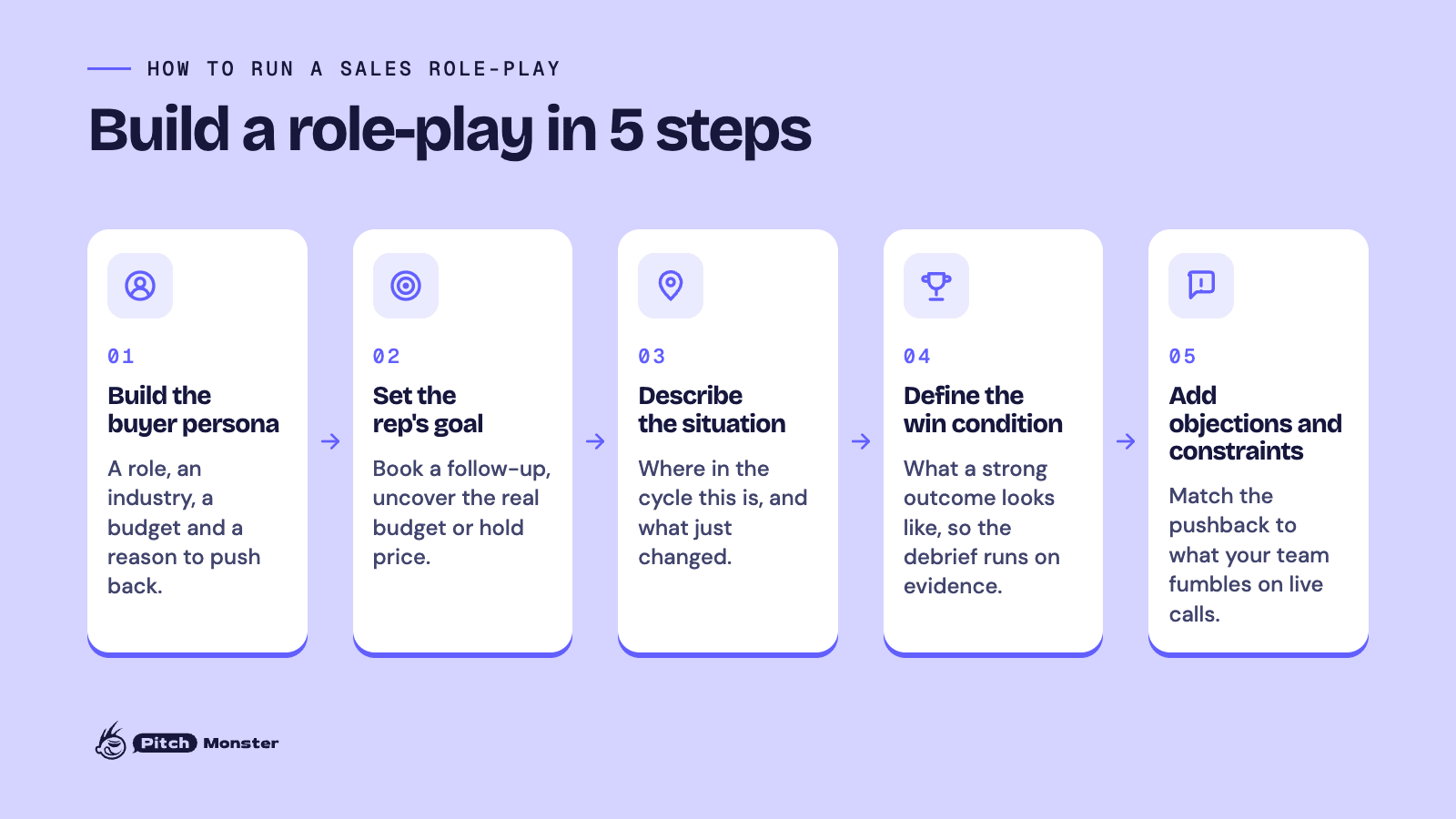
Step 1: Build the buyer persona
Match the buyer to your real ICP. Give them a role, an industry, a budget, and a reason to push back. The closer the persona is to a buyer your reps actually face, the more the practice transfers to live calls.
Step 2: Set the rep's goal
Decide what the rep should achieve: book a follow-up, uncover the real budget, hold price, or get to a next step. A clear goal turns a loose conversation into a measurable drill.
Step 3: Describe the situation
Set the scene. Where in the cycle is this conversation, what does the buyer already know, and what just changed? Reps should know enough to start, but not so much that the scenario plays itself.
Step 4: Define the win condition
Write down what a strong outcome looks like so the debrief is about evidence, not opinion. This is also what an AI buyer uses to score whether the rep handled the moment well.
Step 5: Add objections and constraints
Hand the buyer a list of objections and hard limits. This is where the rep does the real work, so make the pushback match the questions your team fumbles on live calls.
Keep sessions short and always debrief before the next rep goes. For a full walkthrough with prompts and examples, see how to create AI role-plays for sales training.
Sales role-playing scripts by stage
Use the script to frame the moment, not to make the rep memorize lines. Each stage below gives the rep a starting move and the buyer a realistic pushback. If you need the broader session format, use the sales role-play training guide before you run these scripts.
Stage | Rep opening script | Buyer pushback to practice |
|---|---|---|
Discovery | "Before I talk product, can I ask what made this problem worth solving now?" | "Things are mostly fine. We are just looking around." |
Demo | "I will keep this tied to the workflow you described, then pause for gaps." | "Can it do this one specific thing?" |
Objections | "That concern makes sense. Can I ask what you are comparing this against?" | "It costs more than we expected." |
Negotiation | "Let's separate price from scope so we do not cut the part you need most." | "Another vendor offered a discount if we sign this week." |
Competitor questions | "The honest difference depends on the job you need done. What matters most in the decision?" | "How are you different from the other tool we are reviewing?" |
Follow-up | "I am checking back because you said this would come up after the internal review." | "We paused this for now. Send me something later." |
The goal is not a perfect line. The goal is a rep who can stay calm, ask the next useful question, and move the buyer toward a clear next step.
How to use a script without sounding scripted
A script should give the rep a path through pressure, not a speech to recite. Have reps read the buyer context, say the opening in their own words, and keep the next question tied to what the buyer just said.
The easiest rule is simple: script the intent, then let the wording breathe. For example, the intent might be "ask what changed," but the rep can say, "What made this a priority now?" or "Why look at this this quarter?" Both work if the buyer opens up.
Run the same script a few times with different buyer moods. Friendly, rushed, skeptical, and price-sensitive buyers all need a different tone. That variation keeps the rep from sounding rehearsed.
Match each scenario to your sales cycle
Strong reps rehearse the whole journey, not just the close. Map your practice to the stages where deals tend to slip, and to the seniority of the rep. New SDRs should drill cold outreach and discovery first. Account executives should live in negotiation, multi-stakeholder, and competitor scenarios.
The table below maps the 12 scenarios to the cycle, including the cold-call and stalled-deal moments that decide early-stage and mid-funnel deals:
Sales stage | Scenarios to practice |
|---|---|
Cold outreach and gatekeepers | The Skeptical Prospect and The Reluctant Revealer, run as a cold call where the buyer screens for relevance before the rep has earned the conversation |
Discovery and qualification | The Reluctant Revealer, The Indecisive Prospect |
Building credibility | The Skeptical Prospect, The Feature Fanatic |
Handling a stalled or gone-dark deal | The Indecisive Prospect, The Last-Minute Objection |
Negotiation and pricing | The Price Haggler, The Power Balance Shift, The Deadline Pusher |
Complex deals | The Multi-Stakeholder Deal, The Sudden Change in Decision-Maker, The Cultural Barrier |
Staying in control | The Last-Minute Objection, The Unexpected Curveball |
Pick the stage where your team loses the most deals and start there. Rotate a new scenario in only once reps handle the current one cleanly.
If the gap is not the script itself but the cadence around it, use the role-play program guide to turn these drills into a repeatable weekly motion.
12 sales role-play scenarios and scripts
Each scenario includes the setup, what a strong rep is practicing, an example opening script, and prompts you can use to raise the difficulty.
The most useful scenario types span the full sales cycle. Cold-call and discovery scenarios train reps to earn the right to the conversation before they pitch. Objection-handling scenarios cover price pressure, missing features, and last-minute hesitation. Negotiation scenarios simulate hardball discount requests and competitor pressure. Multi-stakeholder and complex-deal scenarios prepare reps for the politics that stall late-stage deals. The 12 examples below cover all of these categories.
1. The Price Haggler

The situation: A prospect fixated on the lowest possible price keeps pushing for discounts and extras beyond your approved limits. They claim a competitor offered a similar solution for less.
What good looks like: The rep holds the value of the product, uncovers what the cheaper option leaves out, and steers toward a deal that works for both sides. They do not concede on price just to keep things moving.
Example script:
Buyer: "Your competitor is offering me a 25% discount. Can you match that?"
Rep: "I understand you are looking for the best value. I may not be able to match that exact discount, but let's look at how we can shape a package that fits your budget without giving up the support and quality you came to us for."
Practice prompts:
- "Can you offer a discount if I commit to a longer contract?"
- "Why is your pricing higher than your competitors?"
- "What extra value am I getting at this price?"
- "Is there any room to move on the price?"
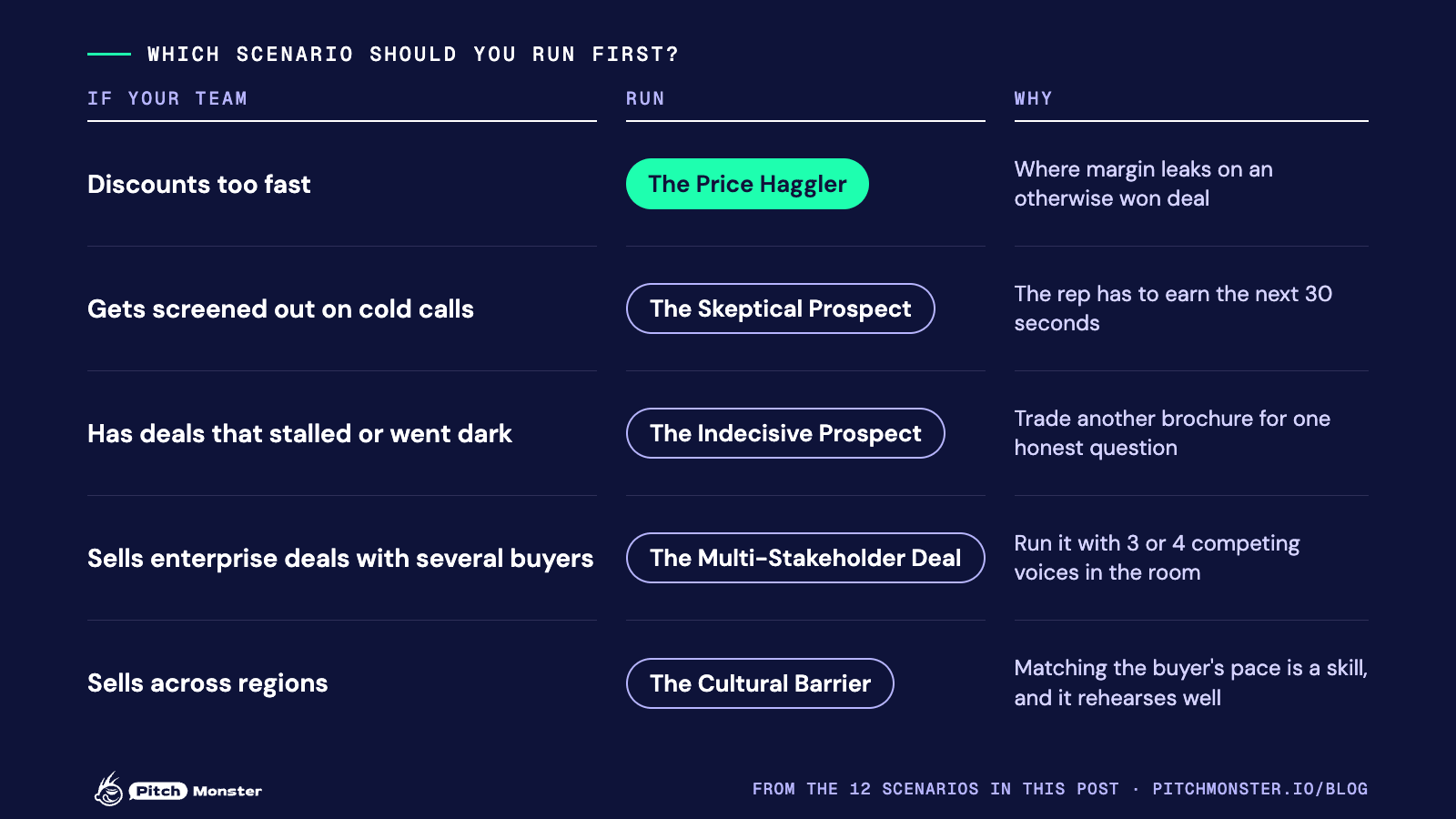
Run this one first if your reps discount too fast. It is the single most common moment where margin leaks on an otherwise won deal.
2. The Deadline Pusher
The situation: A prospect insists on a tight implementation or delivery date that is hard to hit.
What good looks like: The rep negotiates a realistic timeline while showing real commitment to the buyer's outcome, rather than over-promising to win the deal.
Example script:
Buyer: "I need this implemented within two weeks, or I will have to go with another vendor."
Rep: "Meeting your timeline matters to me. A two-week rollout is a stretch, so let me check with our delivery team on where we can safely move faster. In the meantime, let's confirm the setup that gets you live with the least risk."
Practice prompts:
- "Can you guarantee delivery by this date?"
- "What happens if you miss the deadline?"
- "Is there a way to fast-track the process?"
- "Can you move our project to the front of the queue?"
The skill here is protecting the timeline without protecting your ego. A calm reset beats a promise you cannot keep.
3. The Feature Fanatic

The situation: A prospect is set on a specific feature your product does not currently offer.
What good looks like: The rep reframes around the outcomes the buyer actually needs, shows the closest existing capability, and is honest about the roadmap.
Example script:
Buyer: "I like your product, but I really need [specific feature], and it looks like you don't have it."
Rep: "[Specific feature] is clearly important to you. We don't have that exact capability today, but [alternative feature] gets you most of the way there, and I will pass your use case to our product team so it is on their radar."
Practice prompts:
- "Can you add this feature for us?"
- "How do your features compare to your competitor's?"
- "How often do you ship updates?"
- "Can the product be customized to our needs?"
Reps who ace this one sell the outcome, not the checklist. That is a habit worth drilling until it is automatic.
4. The Reluctant Revealer

The situation: A prospect hesitates to share their needs, budget, or decision process.
What good looks like: The rep builds enough trust that the buyer opens up, without interrogating them or stalling the conversation.
Example script:
Rep: "To point you to the right solution, I need to understand your situation and budget. Can you share more about what you are trying to fix?"
Buyer: "I am not sure I can share that at this stage."
Rep: "That is fair. My goal is to find the right fit, not to push you. Even a rough range helps me tailor this, and if confidentiality is the concern, I am happy to walk through how we handle that first."
Practice prompts:
- "Why do you need to know this?"
- "How will you use the information I share?"
- "How do you keep our data secure?"
- "What protects our information once we share it?"
This is discovery under friction. The rep wins by earning trust one question at a time, not by pushing harder.
5. The Last-Minute Objection
The situation: Just as the deal is about to close, the prospect raises a new objection that could derail it.
What good looks like: The rep stays calm, addresses the concern, and reaffirms value without panicking or caving.
Example script:
Buyer: "Before we wrap this up, I heard your competitor has a new feature we might need. Can you match it?"
Rep: "Thanks for flagging it. Let me look into that feature and come back with a straight answer. In the meantime, let's revisit the capabilities you told me matter most, and we can set a quick follow-up so you decide with full information."
Practice prompts:
- "I just learned your product needs extra training we didn't budget for. How do we limit that cost?"
- "A stakeholder raised data-security concerns. How does your product address them?"
- "We heard your support response times might be slow. How do you guarantee timely help?"
- "A competitor has an update that could outperform you. How do you stay competitive?"
The move is to slow the moment down, not speed to a concession. A confident pause reassures the buyer more than a rushed yes.
6. The Power Balance Shift
The situation: Late in the negotiation, the prospect uses a competitor's offer to gain the upper hand.
What good looks like: The rep handles the pressure, brings the conversation back to value, and avoids a reflexive discount.
Example script:
Buyer: "Your competitor just offered me 35% off if I sign today."
Rep: "I understand that is tempting. Let's step back to why our solution stood out in the first place and the value it adds over the next year. A discount is easy to compare, but it is worth weighing against what the cheaper option will cost you later."
Practice prompts:
- "Why should we choose you over the discounted offer?"
- "How does your ROI compare to the competitor's?"
- "How can you guarantee better results?"
- "Can you match or beat their offer?"
This is where reps learn to hold their footing when the buyer applies pressure. The anchor is value, not the discount they just heard.
7. The Sudden Change in Decision-Maker

The situation: After a long conversation, the prospect reveals they are not the final decision-maker.
What good looks like: The rep keeps momentum, equips their champion, and gets access to the new decision-maker.
Example script:
Buyer: "I love the solution, but I need my manager's sign-off before we move."
Rep: "Good to know, and it makes sense to get everyone on the same page. I am happy to join a short call with your manager to cover the value and answer questions. Let's also recap the points that matter most to you, so you can carry them forward with confidence."
Practice prompts:
- "How flexible are your terms for a new decision-maker's requests?"
- "Can you give me materials to present internally?"
- "What is the best way to convey your value to someone new?"
The rep's job is to turn their contact into a confident champion. Arm them well and the deal survives the handoff.
8. The Cultural Barrier

The situation: The rep meets a prospect with different communication norms, expectations, or negotiation customs.
What good looks like: The rep adapts pace and style to the buyer's culture while keeping the integrity of the offer.
Example script:
Buyer: "We don't make decisions on the spot. I need to consult our team and weigh all options before committing."
Rep: "Thanks for sharing how your team works. Take the time you need to get everyone comfortable. If it helps, I can provide extra materials or set up follow-up sessions to support your team's process."
Practice prompts:
- "Do you have customer stories from [country] you can share?"
- "Does your team speak our language or understand our market?"
- "How do you handle local regulations in our industry?"
- "Which of your benefits matter most in our market?"
Reps who sell across regions need this in their muscle memory. Matching the buyer's pace is a skill, and it rehearses well.
9. The Skeptical Prospect

The situation: The prospect doubts the effectiveness or credibility of your product, often on a cold call before you have earned their attention.
What good looks like: The rep meets skepticism with evidence and proof, and builds trust instead of getting defensive.
Example script:
Buyer: "I have heard your product doesn't always deliver. How do I know it will work for us?"
Rep: "A healthy dose of skepticism is fair. Let me share case studies and results from teams in your industry, and I can set up a call with a current customer so you hear it firsthand rather than from me."
Practice prompts:
- "How can you guarantee the results you promise?"
- "Explain the methodology behind the outcomes you claim."
- "Can you provide independent, third-party validation?"
- "What ROI is realistic, and how long until we see it?"
Run this as your cold-call and gatekeeper drill too. When the buyer starts cold, the rep has to earn the next 30 seconds before anything else.
10. The Multi-Stakeholder Deal

The situation: The rep negotiates with several buyers at once, each with different priorities.
What good looks like: The rep addresses competing concerns and keeps the group moving toward a shared outcome.
Example script:
Buyer 1: "My main concern is staying within budget."
Buyer 2: "For me it is support and ongoing updates."
Rep: "You each have a real priority here. Let me show how this covers budget while still giving you the support and update cadence you need, and where there are trade-offs, we will make them in the open."
Practice prompts:
- "Show how you add value for each stakeholder, even when our goals differ."
- "What trade-offs will each of us have to make?"
- "If stakeholders deadlock, how do you help us reach consensus?"
- "Handle one stakeholder's objection that contradicts another's requirement."
This scenario gets harder as deal size and stakeholder count grow. Enterprise reps should run it with three or four competing voices in the room.
11. The Indecisive Prospect

The situation: The prospect is interested but keeps stalling, asking for more information instead of deciding. Sometimes the deal has gone quiet and needs reviving.
What good looks like: The rep surfaces the real reason for the hesitation and guides the buyer to a confident next step.
Example script:
Buyer: "I am still not sure this is right for us. Can you send more on that feature so I can review it?"
Rep: "Happy to send it. Before I do, can we take a few minutes to name what is making you hesitate? If I understand the real concern, I can get you exactly what you need to decide instead of more to read."
Practice prompts:
- "Can we pilot or test the solution before committing?"
- "What is your roadmap for future improvements?"
- "What would you need to see to feel confident deciding?"
Use this one to rehearse reviving a stalled, gone-dark deal. The rep wins by trading another brochure for one honest question.
12. The Unexpected Curveball
The situation: Mid-negotiation, the prospect drops a change that shifts the context of the deal.
What good looks like: The rep thinks on their feet, adapts the approach, and keeps control of the conversation.
Example script:
Buyer: "Our budget was just cut by 30%, so we can't afford this at the current price."
Rep: "Thanks for telling me early. Let me look at how we can adjust scope to fit the new budget while still covering your priorities. I would rather find a version that works than lose the outcome you need."
Practice prompts:
- "Our office is relocating to another country. How does your solution adapt?"
- "Our leadership just changed strategy. How do you keep adding value?"
- "Can you assure us our data stays confidential through the change?"
- "What protects our information if our requirements shift?"
This is the improvisation drill. There is no perfect script, so reps practice staying composed and buying themselves a beat to think.
Run these scenarios with AI
Manual role-play works, but it depends on a manager being free, and feedback changes from one coach to the next. That is why most teams cap practice at a few sessions a quarter. Reps also hold back in front of peers, so the hardest moments never get rehearsed enough.
AI sales role-play removes that ceiling. Reps practice any of these scenarios on demand, the AI buyer pushes back like a real prospect, and every session is scored against the same playbook. No one has to schedule a partner or wait for the next team session.
Turn any of these 12 scenarios into a live drill
With PitchMonster, a manager can build a scenario from a call recording, a website URL, or product docs in about two minutes. Paste in the Price Haggler or the Multi-Stakeholder Deal, set the win condition, and reps can run it that afternoon. Reps then practice in 27 languages, so global teams rehearse in the language they actually sell in.
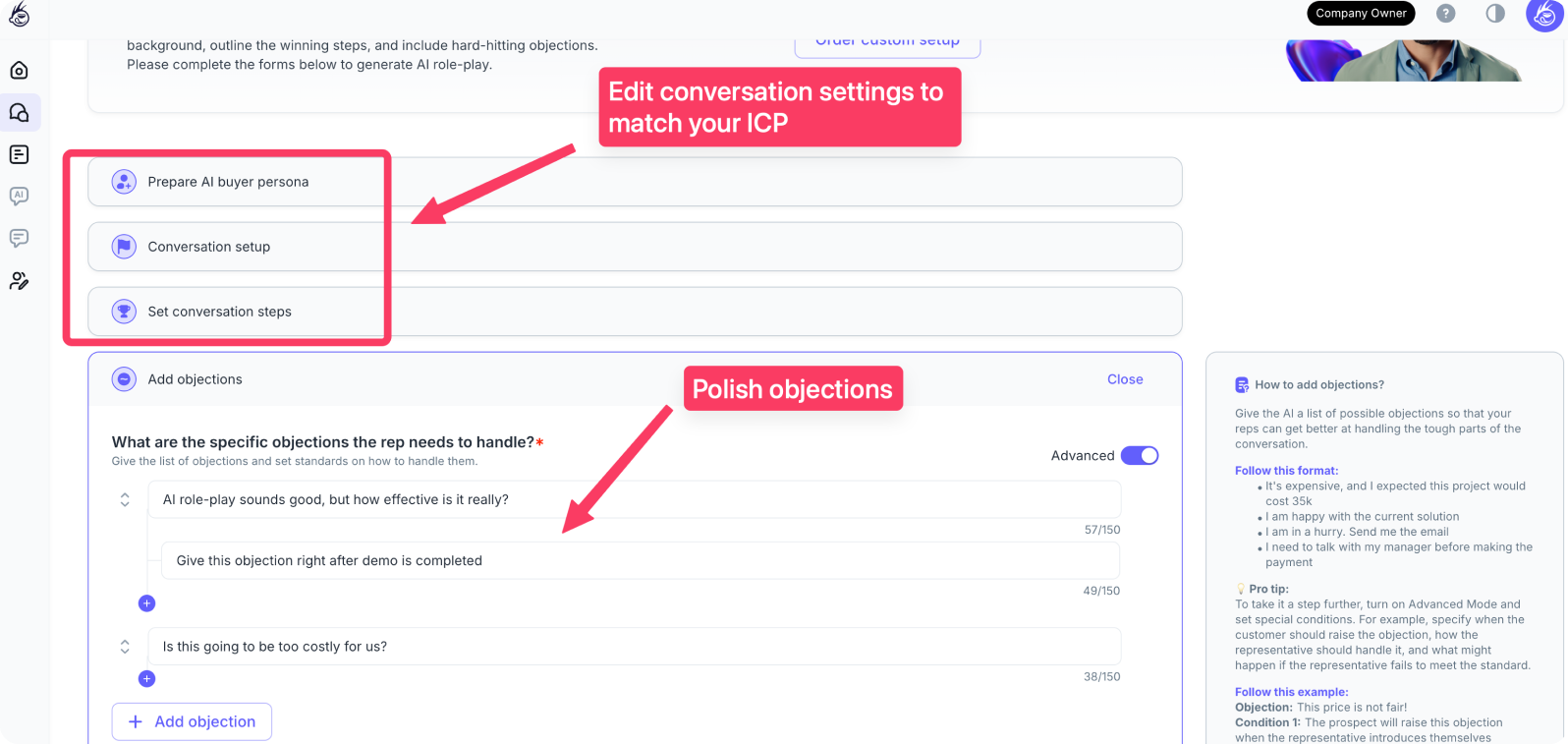
An AI buyer that pushes back like a real prospect
The AI buyer holds a persona and objections, so the pushback feels earned rather than scripted. Reps can repeat the same hard moment ten times in an afternoon, changing one thing each run, until the response holds up under pressure. That is the volume of reps manual practice can never reach.
Socratic AI Coach feedback after every session
After each session, reps talk with the AI Coach. It asks what they noticed and what they would change before they ever see a score. As one customer put it, "there's no better substitute for live fire with real clients" (Craig Gordon, Prevail IWS). AI role-play gets reps as close to that as practice allows.
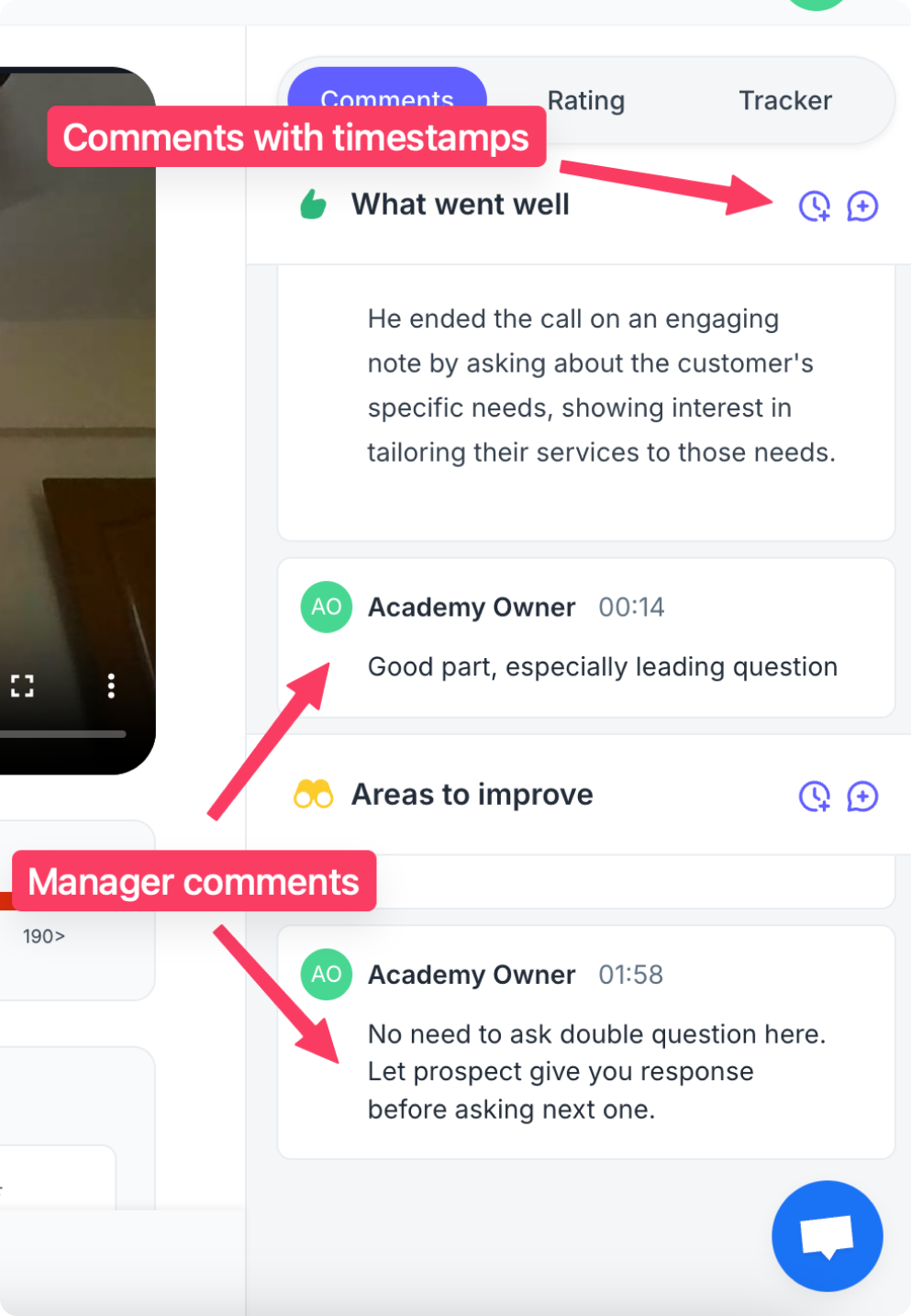
Scorecards and analytics managers can act on
Every run is scored against your scorecard, so managers see who is ready and who needs another rep on a specific skill. Teams using this loop have seen 37% higher performance and 30% faster ramp (Mentor Group case study), because coaching lands where it is needed instead of everywhere at once.
Manager scoring block
Use the same five fields every time so feedback stays concrete:
Score field | What to look for |
|---|---|
Goal | Did the rep know the one outcome they were trying to reach? |
Buyer response | Did the rep react to what the buyer said, or just keep pitching? |
Objection handling | Did the rep acknowledge the concern, ask a useful question, and answer without rushing? |
Next step | Did the rep close with a clear, buyer-owned next action? |
Debrief | Did the rep name what worked, what failed, and what to try next? |
AI vs manual role-play at a glance
The two approaches are not either-or, but they scale very differently. Here is how they compare on the things that decide whether practice actually happens:
Factor | Manual role-play | AI role-play (PitchMonster) |
|---|---|---|
Availability | Only when a manager or peer is free | On demand, any time |
Reps per week | A few per quarter for most teams | As many as the rep wants |
Feedback | Varies by coach | Same playbook and scorecard every time |
Repeating a hard moment | Awkward to redo with a colleague | Rerun the same objection ten times |
Languages | Whatever the partner speaks | 27 languages |
Setup | Brief a partner each time | Build from a call, URL, or docs in ~2 minutes |
For a side-by-side look at the tools in this category, see our comparison of the best sales role-play tools and our roundup of the top sales training tools reviewed. To operationalize practice across the team, see how PitchMonster fits into sales enablement.
Want these 12 scenarios tailored to your product and buyers? Book a demo and we will build your first role-play library with you.
FAQ
What is a sales role-play scenario?
A sales role-play scenario is a simulated buyer conversation that lets a rep practice one specific skill - discovery, objection handling, or negotiation - in a low-risk setting before a real call. A coach or an AI buyer plays the prospect, pushes back, and the rep rehearses the response until it holds up under pressure.
How do you run a sales role-play?
Pick one scenario and one skill, brief the buyer on their persona and objections, set a clear win condition, run the conversation for 5 to 10 minutes, then debrief on what worked and what to change. Rotate roles so every rep plays buyer, seller, and observer.
What should sales reps practice in role-plays?
Cover the full cycle: opening a cold call, leading discovery, handling price and feature objections, managing multiple stakeholders, and closing. Prioritize the moments where your team actually loses deals, not the parts reps are already comfortable with.
Are there sales role-play scripts I can use?
Yes. Each of the 12 scenarios above includes an example opening script and a set of practice prompts you can copy. Treat them as a starting point and rewrite the buyer lines to match your market, product, and real objections before you run them with your team.
Where can I get free sales role-play scenarios or a PDF?
This page is a free, copy-ready set of 12 scenarios with scripts, so you can paste any one straight into a doc or slide for your next session. For a version that runs itself and scores each rep, load the same scenarios into an AI role-play tool instead of a static PDF.
What are good sales role-play scenarios for an interview?
For a sales interview, use a short discovery-plus-objection scenario: give the candidate a persona, one clear goal, and one hard pushback like a price objection or a stall. Watch how they ask questions, handle the objection, and drive to a next step in five minutes.
How many role-play scenarios should a sales team practice?
Start with three to five scenarios that map to where you actually lose deals, and rotate them until reps handle each one cleanly. Add scenarios like multi-stakeholder deals or curveballs as reps advance. Depth on a few beats shallow reps on twenty.
How is AI sales role-play different from manual role-play?
AI sales role-play runs on demand, scores every rep against the same playbook, and gives instant coaching, so practice no longer depends on a manager's calendar. Reps can repeat the same hard moment ten times in an afternoon instead of waiting for the next team session.