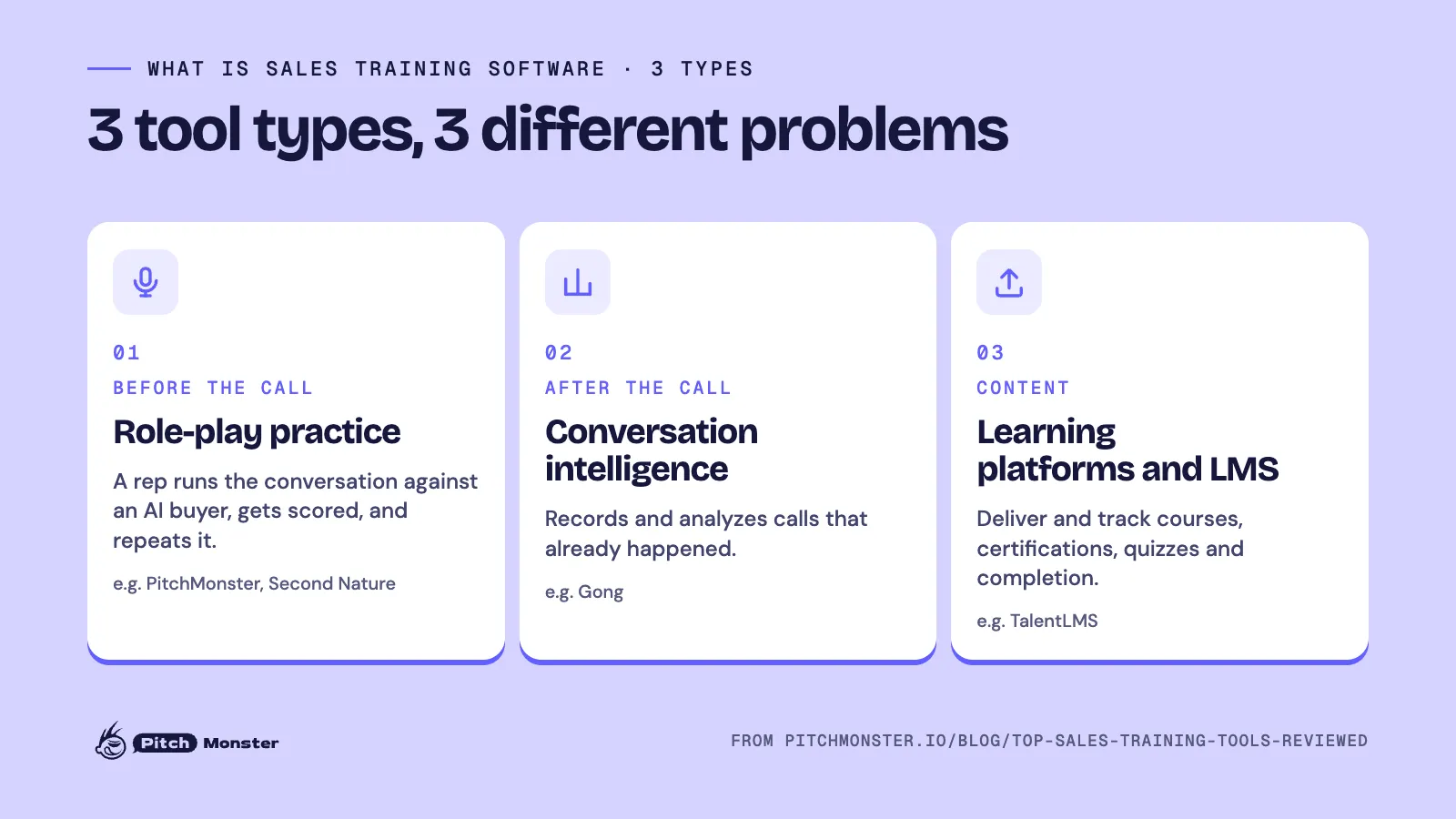
Three kinds of product get sold as sales training software, and they fix different problems. Role-play practice tools put a rep into a simulated buyer conversation before the real one. Conversation intelligence analyzes calls that already happened. Learning platforms deliver courses and certifications. Buy the wrong type and you get a report on a problem nobody fixed.
This comparison covers 13 platforms: what each is best for, the honest limitation or the question to put to the vendor, and how to match a tool type to your bottleneck. Updated September 2026.
Sales training software compared at a glance
Tool | Tool type | Best for | Company size fit | Our take |
|---|---|---|---|---|
PitchMonster | Role-play practice | AI role-play practice with post-session coaching | SMB to enterprise | Realistic AI buyers plus a Socratic AI Coach after every session, and an EU base. Not a call-recording tool. |
Second Nature | Role-play practice | Avatar-based role-play across sales and other customer-facing teams | Mid-market to enterprise | The closest direct alternative in the practice category, built around avatar-based scenarios across sales and other customer-facing teams. |
Gong | Conversation intelligence | Analysis of real calls and deal coaching | Mid-market to enterprise | Records and analyzes live calls, then turns them into playlists and scorecards. It coaches the past, so pair it with practice. |
Mindtickle | Learning and enablement | Data-driven readiness at scale | Enterprise | The reporting layer is the purchase at large headcounts. Ask who owns the platform internally after go-live. |
Allego | Learning and enablement | Video-based coaching and peer learning | Mid-market to enterprise | Rep-submitted video plus a library of approved examples. Ask who reviews the submissions and how fast. |
SmartWinnr | Learning and enablement | Quizzes, gamification, and KPI contests | SMB to mid-market | Reinforcement cadence rather than conversation practice. Ask what it tells you about how a rep speaks to a buyer. |
Trainual | Learning and enablement | Process documentation and onboarding steps | SMBs and small teams | Documentation and assignment, thin on skill analytics. Good when nothing is written down. |
Spekit | Learning and enablement | In-app, just-in-time knowledge | SMB to mid-market | A reference layer inside the CRM, not a practice layer. It shortens the search, not the learning curve. |
Bigtincan (Brainshark) | Learning and enablement | Video coaching and content management in one suite | Mid-market to enterprise | An established readiness suite with content and coaching together. Heavier to set up than a single-purpose tool. |
Showpad | Learning and enablement | Content plus coaching for field sales | Mid-market to enterprise | Strongest when content is the priority and coaching rides along with it. Ask how deep the practice side actually goes. |
SalesHood | Learning and enablement | Scaling onboarding across teams | Mid-market to enterprise | Cohort consistency rather than conversation practice. Ask who maintains the curriculum after launch. |
Seismic Enablement Cloud | Learning and enablement | Role-based practice and coaching inside a wider suite | Enterprise and upper mid-market | The consolidation play. Compare the practice module against a dedicated tool before you sign. |
Ambition | Performance motivation | Gamification, leaderboards, and live metrics | Mid-market to enterprise | Changes how much reps do, not how well they do it. Pair it with a training tool, not instead of one. |
Tool type and company size fit are both our classification, based on how each vendor positions itself. Neither is a vendor-published segment, and neither is a pricing tier. Pricing was not verified for this review; request a current quote from each shortlisted vendor in writing. On mobile, read each row as a stacked label and value rather than a squeezed grid.
How we evaluated these tools
We work in this market every day, so this list reflects how these platforms are actually bought and used by sales teams, not a scrape of vendor feature pages. We weighted each tool on five things that decide whether training changes behavior.
First, practice realism: how close the simulated conversations get to a real buyer, including objections and pushback. Second, coaching depth: whether the tool only reports scores or actually helps a rep improve. Third, analytics and reporting that a manager or enablement lead can take to leadership. Fourth, setup and adoption, since the best platform is the one reps keep using. Fifth, fit by team size and region, including data residency for teams that need it.
Most vendors quote per seat on request, so instead of chasing list prices we note the company size each tool fits best and how each vendor positions itself in the category. Figures attributed to PitchMonster customers come from named case studies, linked inline. Confirm current pricing with each vendor before you buy.
What is sales training software?
Sales training software is a platform that helps a sales team onboard new reps and improve seller skill through some mix of role-play simulation, live call analysis, and structured learning. The label covers three product types, and they behave differently once they are in your stack.
Role-play practice tools simulate the conversation. A rep runs a cold call, a discovery call, or a renewal negotiation against an AI buyer, gets scored, and repeats it. The point of this category is repetition without a human on the other side, which is what makes it survive contact with a busy sales floor. PitchMonster and Second Nature both sit here, and they are covered at numbers 1 and 2 below.
Conversation intelligence records and analyzes calls that already happened. Gong's own category page defines sales training software around call recording and analysis, coaching playlists and scorecards, on-demand libraries, dashboards, and CRM integration, and argues that the best training asset is the voice of the customer rather than a static course (gong.io/sales-training-software). That is a fair description of what conversation intelligence does well. It is also a description of a rear-view mirror. If you want the manager-review workflow specifically, our roundup of call coaching software goes deeper on that slice.
Learning platforms and LMS products deliver and track content. Courses, certifications, quizzes, completion reporting. TalentLMS, for example, markets itself directly as the LMS for sales teams (talentlms.com). This is the right purchase when your foundational content does not exist or nobody can find it. It is the wrong purchase when your content is fine and your reps still freeze on the pricing objection.
One boundary worth drawing: instructor-led methodology programs are a different line item entirely. Sandler and the roundups of training programs published by vendors like Highspot cover curricula, certifications, and trainers, not software you deploy (sandler.com, highspot.com). Programs teach a framework. Software gives reps somewhere to practice it and gives you the data to see whether they did. If your gap is the underlying skill rather than the platform, fix the training program first and buy tooling after.
Match the tool to your bottleneck
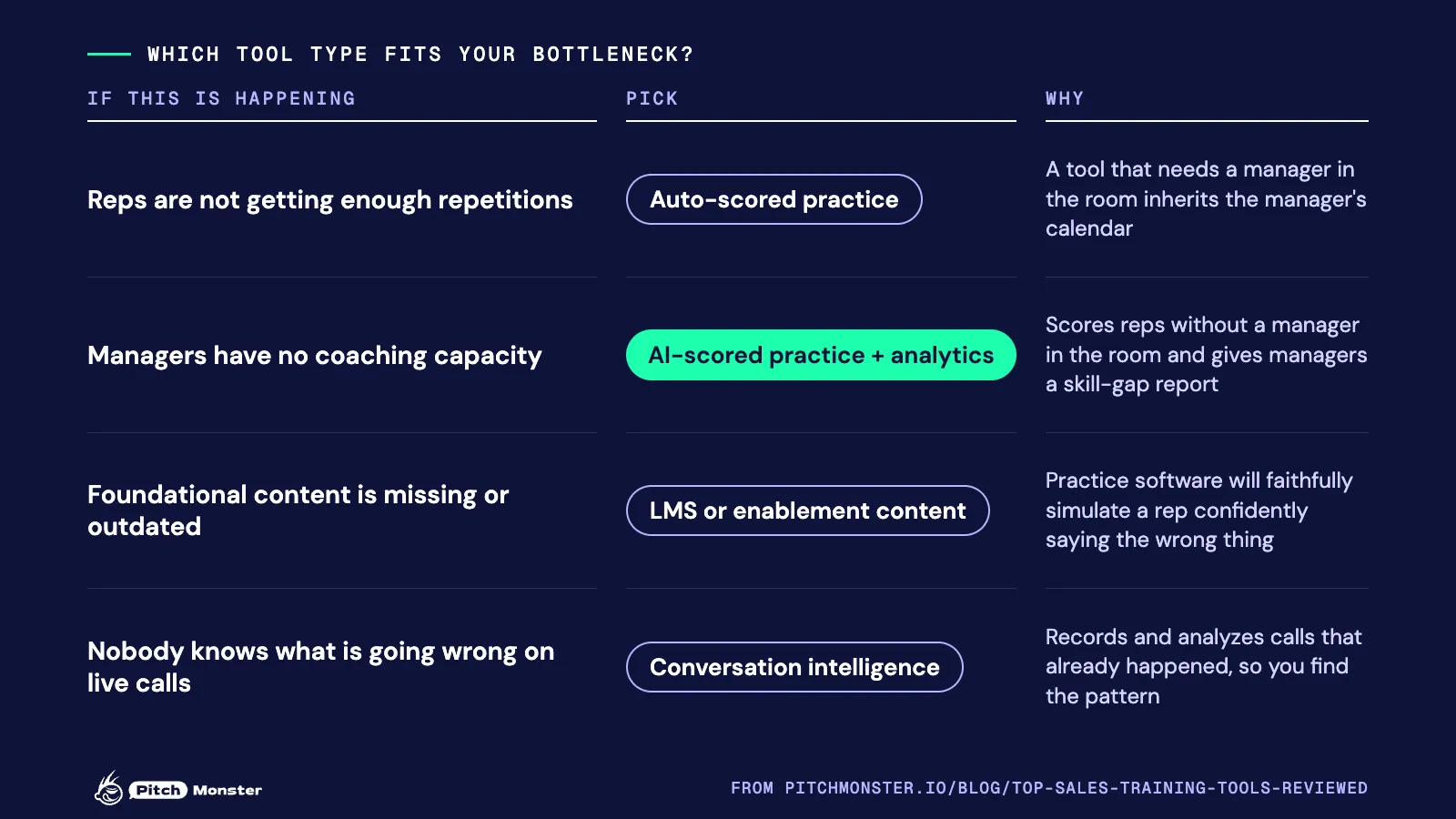
Before you compare vendors, answer one question: what specifically is not happening today?
Reps are not getting enough repetitions. They hear the same three objections every week and improvise every time. Nobody rehearses before a first call with a strategic account. That points at a practice tool with automatic scoring, because a practice tool that needs a manager in the room inherits the manager's calendar along with it.
Managers have no coaching capacity. They want to coach and they have 8 direct reports, a forecast call, and their own number. Here is the sentence a Head of Enablement can say out loud in a leadership meeting: "if managers have no time to run practice sessions, we need a tool that scores reps without a manager in the room, and gives managers a skill-gap report instead of 40 hours of listening." That points at AI-scored practice plus analytics, not at more content.
Foundational content does not exist or is out of date. Reps cannot answer basic product questions, the deck is 6 months stale, and onboarding is a folder of links. This is an LMS or enablement-content problem. Practice software will faithfully simulate a rep confidently saying the wrong thing.
Nobody knows what is going wrong on live calls. You have symptoms - stalled deals, discovery that skips budget - and no evidence. That is conversation intelligence.
Two qualifiers narrow things further. If your team is fully remote and you need delivery that works without scheduled sessions, our list of online sales training tools filters for self-serve delivery. If the pressure is specifically ramp time for new hires, the shortlist of tools that shorten ramp is the better starting point than a general comparison.
The 13 best sales training software platforms for 2026
The 13 sales training platforms below run in the order of the three tool types: practice first, then conversation intelligence, then learning and enablement, with the one performance-motivation tool on the list placed last.
1. PitchMonster - best for AI role-play practice with post-session coaching
PitchMonster puts reps into realistic AI buyer conversations: natural pacing, filler words, and objections that respond to what the rep just said rather than firing off a script. Drills cover discovery, objection handling, demo delivery, negotiation, multithreading, and prospecting calls, in 29 languages, so a rep in Madrid can practice in the language they use with customers.
The workflow matters as much as the simulation. You supply the scenario: the persona your reps struggle with and the objection that stalls your deals. The rep runs it alone and gets scored, with no session to book. Managers get skill-gap analytics across the team rather than a pile of recordings to review. The five sections below cover the pieces of that workflow one at a time.
AI role-play realism across real objections
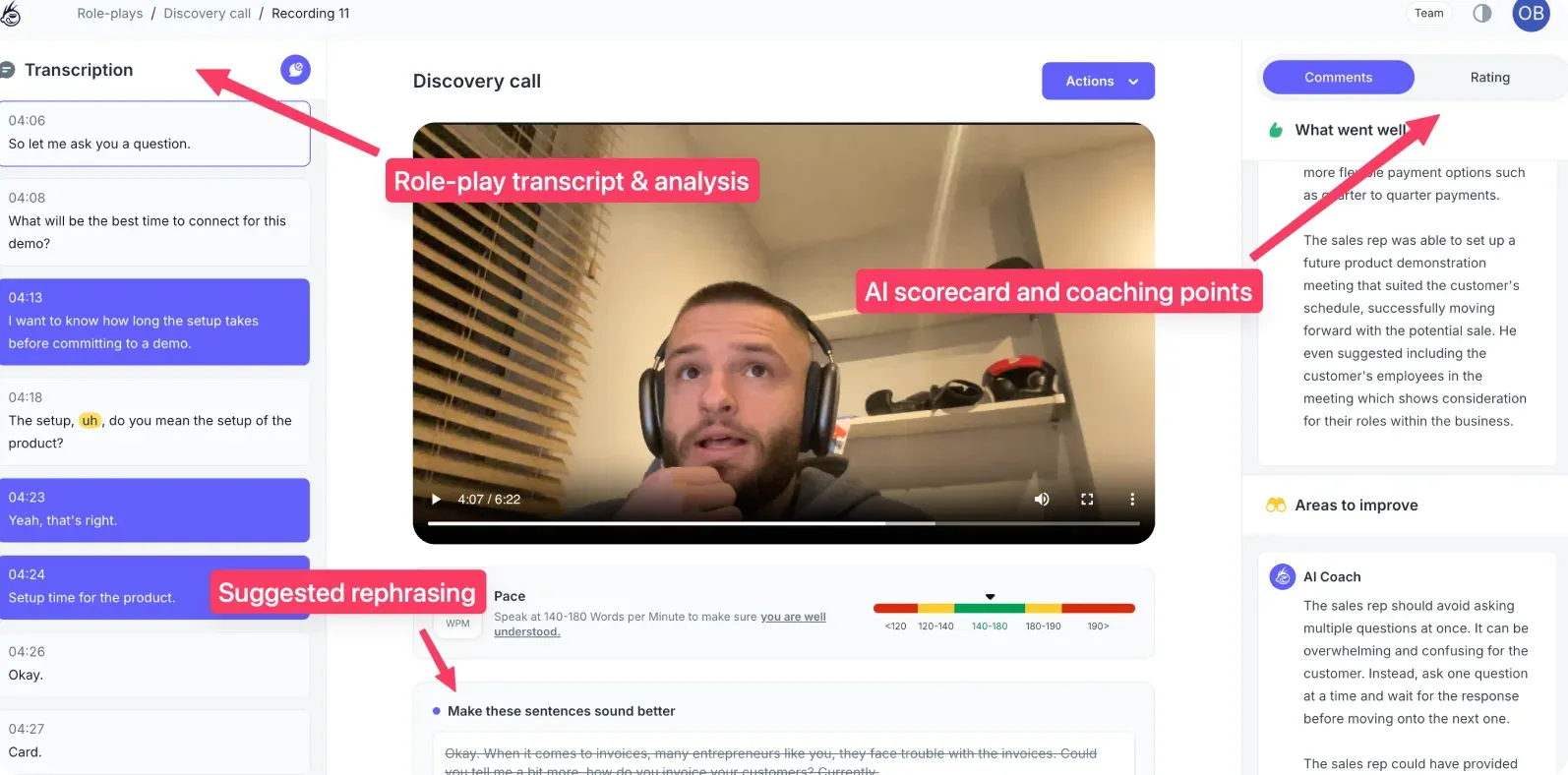
A manager can build a scenario from a call recording, product docs, or a website URL in about two minutes, either from a template library or from scratch. There are four difficulty levels, up to and including Insane, plus 40+ customization parameters. Reps practice cold calls, discovery meetings, and demos in settings that closely mirror the real conversation, and each session generates a full transcript so leaders can see exactly what was said, not a summary of it.
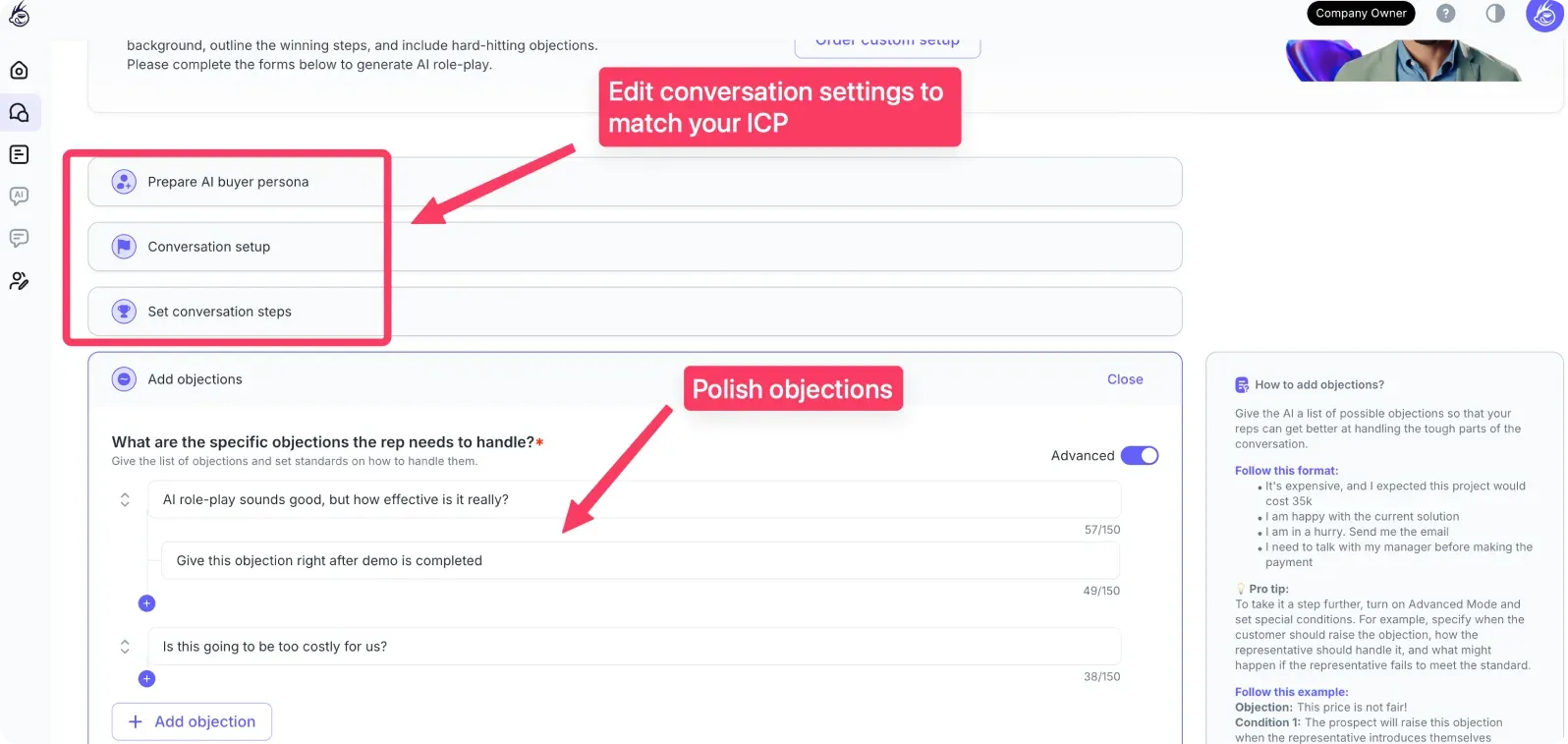
Ready-made role-plays cover the essentials like objection handling and talk tracks, so new hires ramp faster while top performers keep refining against harder scenarios. Because the buyer objects to what the rep actually says rather than following a fixed script, a rep cannot memorize their way through a session the way they can with a canned demo scenario.
The post-session Socratic AI Coach
The post-session AI Coach is Socratic. It asks the rep why they conceded on price when they did, what they could have asked before the discount came up, and what they would try next time, rather than handing over a numeric score and moving on. It runs 24/7, so practice is never queued behind a manager's calendar, and a rep can debrief the moment a session ends instead of waiting for a 1:1 slot next week.
This matters because self-diagnosed lessons stick. When a rep reasons their way to what went wrong, the fix tends to hold on the next live call in a way a handed-down score rarely does. Wendy Mateo De Perkins of One Park Financial summed up the reaction: "I think I really like the AI coach. That's definitely going to save us a lot of time."
Manager skill-gap analytics
Leaders set evaluation criteria that match how the team actually sells, either by uploading their own metrics or starting from a scorecard library, and every session is analyzed automatically against it. That gives managers skill-gap data across the whole team instead of a stack of recordings nobody has time to sit through.
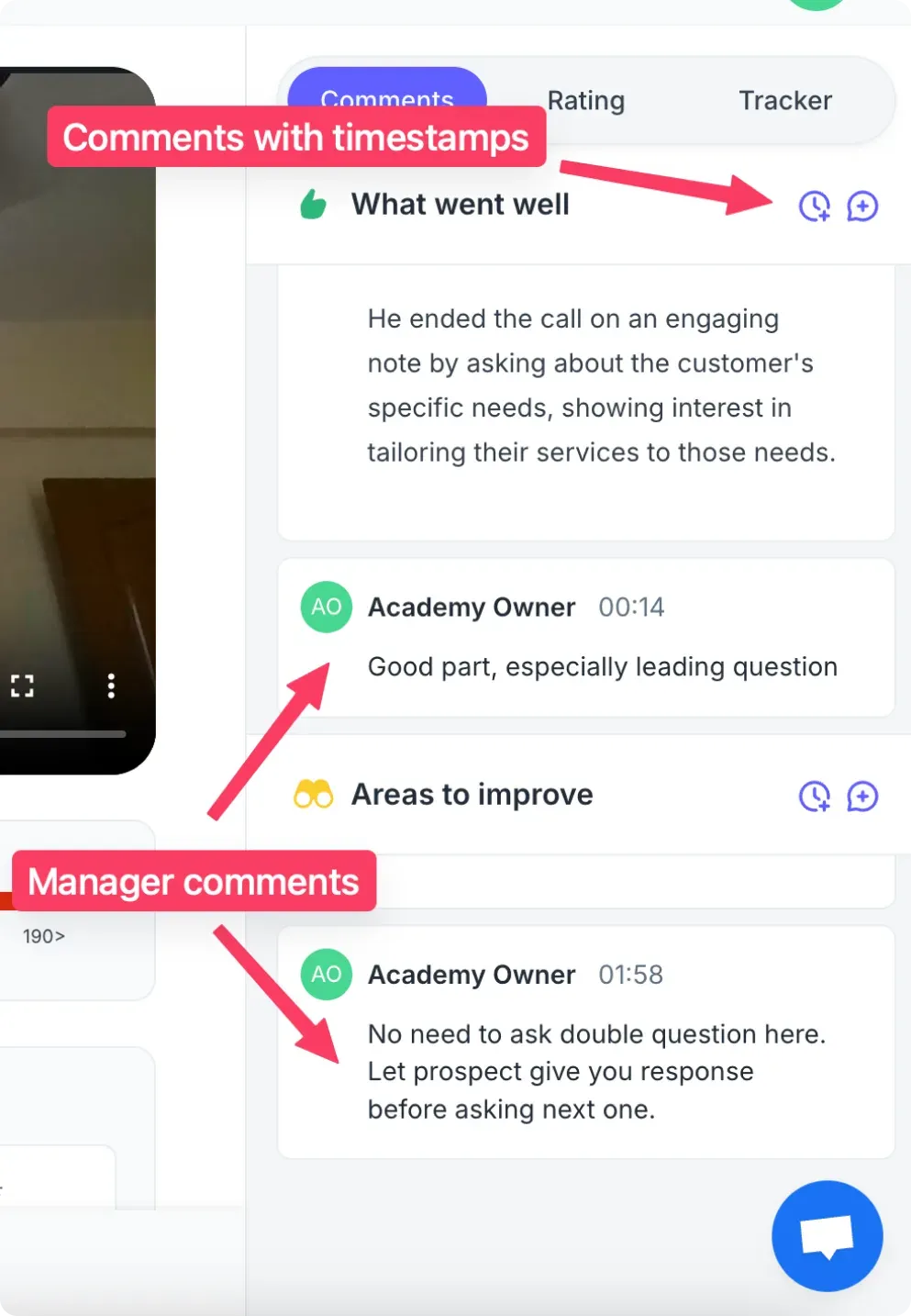
Each interaction is also analyzed for pacing, sentiment, and filler words, so the platform can point out both what a rep said and how it landed, then flag the specific moments, like pricing discussions or next-step commitments, where a call started to go sideways.
Scenario and persona setup
The setup work sits with whoever owns training, not with the rep. An enablement lead or manager builds the persona your reps struggle with and the objection that stalls your deals, and the AI buyer holds that persona consistently across every rep who runs the scenario. That consistency is what makes side-by-side comparison across a team possible: every rep is tested against the same buyer, not a slightly different one each time.
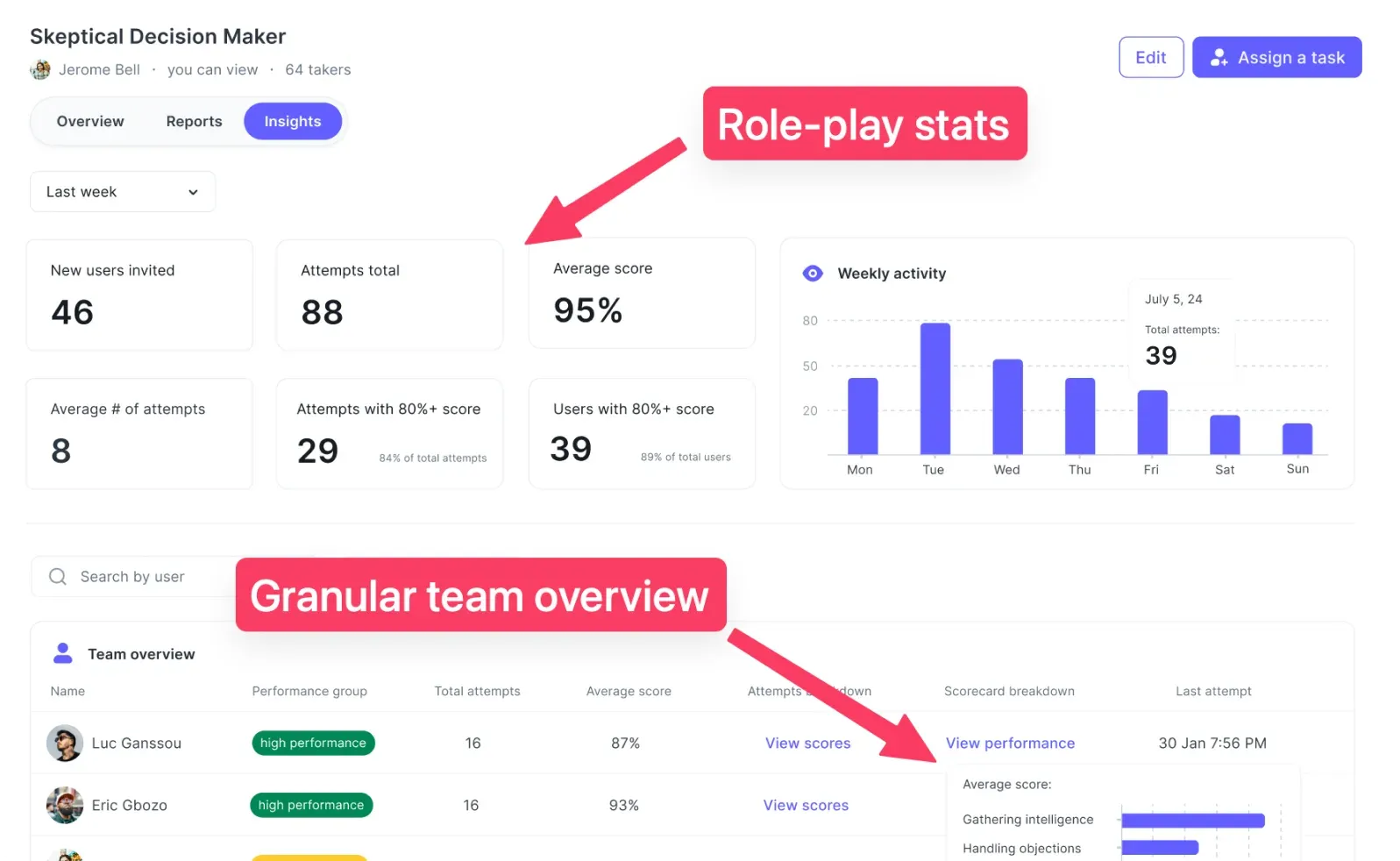
Feed the scenario builder a vague brief and the buyer comes out vague too, which is the honest limitation named below. The tool is only as sharp as the scenario behind it.
Languages and EU data residency
PitchMonster is the only European-based option among the leading tools in this category, which shortens the GDPR and data residency conversation with your security reviewers. With drills available in 29 languages, a distributed team can run the same scenario in the language each rep actually uses on the call, rather than translating a script and hoping the objections still land the same way.
Fits SMB through enterprise, and it is strongest where manager coaching capacity is the binding constraint.
The honest limitation: this is not conversation intelligence. It does not record, transcribe, or analyze your real customer calls, so if call review of live deals is your priority, pair it with a tool that does that. Second limitation worth naming: role-play quality tracks scenario quality. Feed it a vague scenario and you get a vague buyer, which puts the setup work on you or your enablement team.
Proof: Mentor Group recorded 50% faster ramp on average and a 2X reduction in coaching time per rep after rolling out PitchMonster.
Pricing is quote-only, priced per seat. See pricing for your team size, and book a demo to run a session against your own scenario.
2. Second Nature - best for avatar-based role-play across customer-facing teams
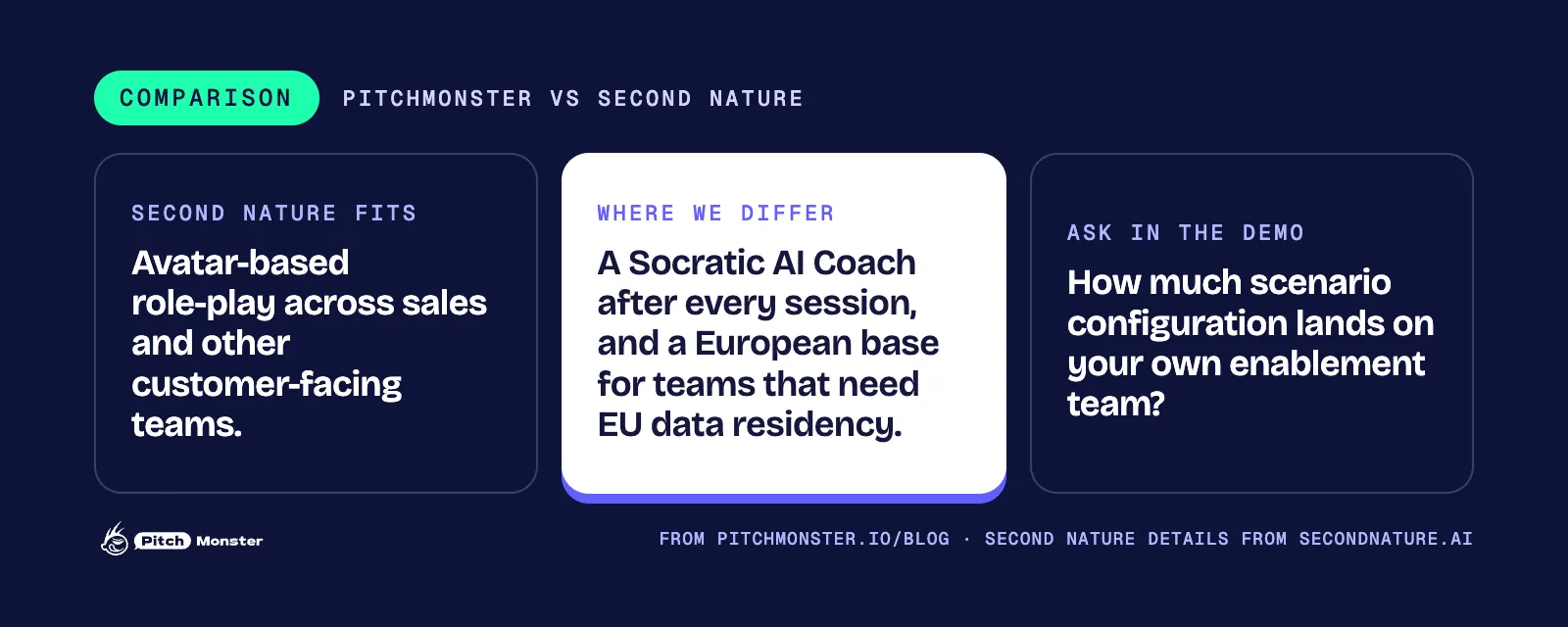
Second Nature is the closest direct alternative to PitchMonster in this comparison. Its site positions AI role-plays and coaching as the bridge between training and go-to-market execution, with practice scenarios covering discovery calls, objection handling, and cold calls, and with avatar formats that include moving avatars, video avatars, and multi-persona meetings for both B2B and B2C conversations (secondnature.ai). The same site markets use cases beyond sales, including customer support, call center, HR, and learning and development, and industry pages for insurance, technology, telco, financial services, and education.
Fits mid-market to enterprise, going by how the product is positioned. Smaller teams should confirm fit directly rather than assume it.
Where PitchMonster differs: the post-session Socratic AI Coach that questions the rep instead of handing over a score, and a European base for teams that need EU data residency answered in writing. If Second Nature makes your shortlist, ask specifically how much scenario configuration lands on your own enablement team.
3. Gong - best for analyzing real customer calls
Gong is the reference point for understanding what happens in your pipeline. Its own category page describes the component parts: call recording and analysis, coaching playlists and scorecards, on-demand training libraries, performance dashboards, and CRM integration (gong.io/sales-training-software). The workflow follows from that. Calls get captured automatically, a manager or enablement lead pulls the moments worth learning from into a playlist, and reps study real customer conversations rather than a course. Gong's argument on the same page is explicit: the best training asset is the voice of the customer, not a static module.
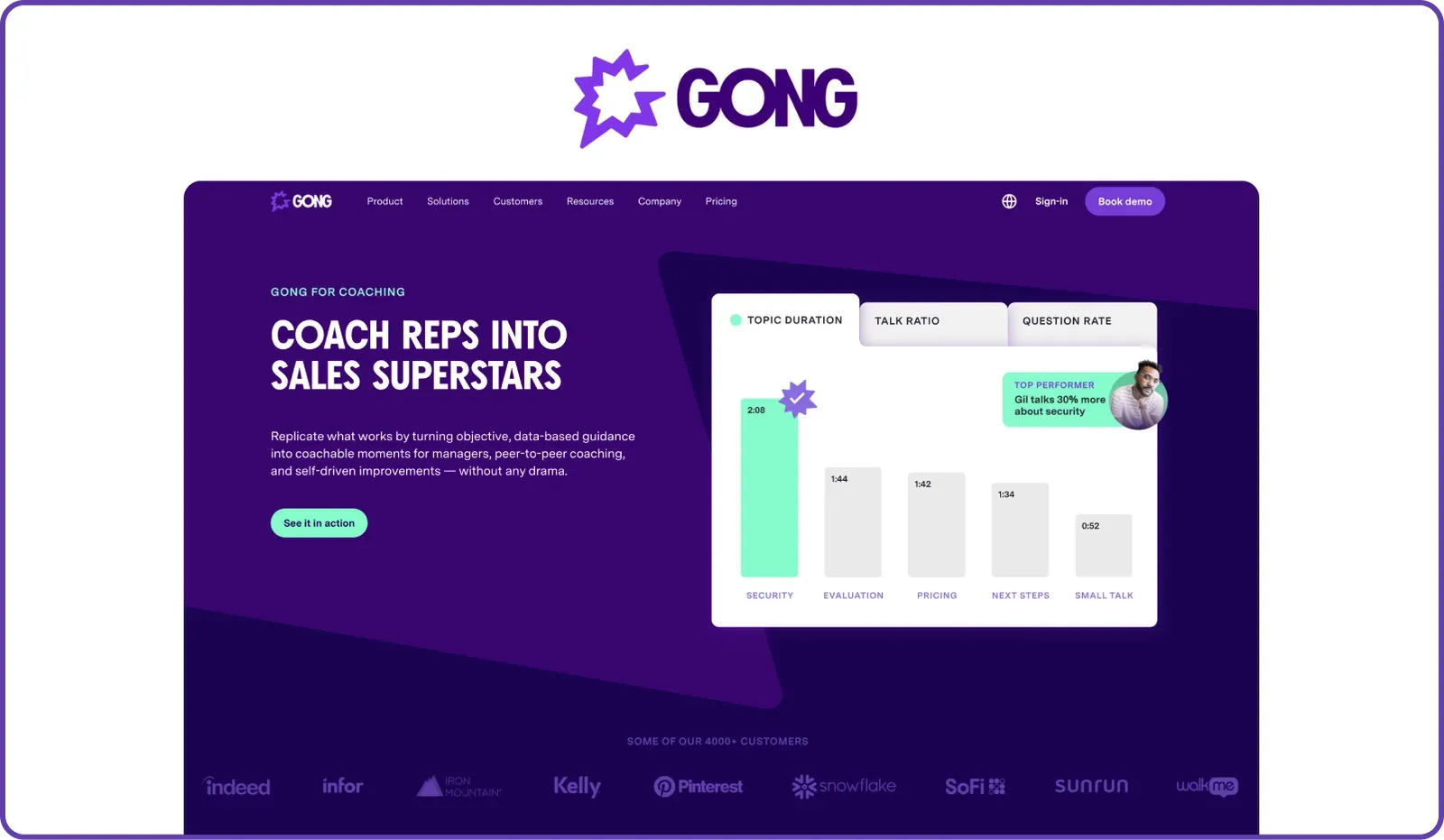
Fits mid-market to enterprise teams with real call volume, where managers already have a coaching habit and need better inputs for it.
Where it stops: everything Gong coaches on has already happened, and the coaching loop still needs a person to build the playlist and deliver the feedback. A rep learns from the call they lost rather than rehearsing before the call they are about to take. Treat it as the analysis half of the pair, with a practice tool as the other half. For a practice-first approach to the same coaching problem, see how PitchMonster compares for rep readiness.
4. Mindtickle - best for data-driven readiness at enterprise scale
Data-driven readiness at scale is the claim Mindtickle competes on. Readiness suites in this bracket usually cover onboarding paths, certifications, and reinforcement scoring; confirm the current surface on Mindtickle's own site before you shortlist.
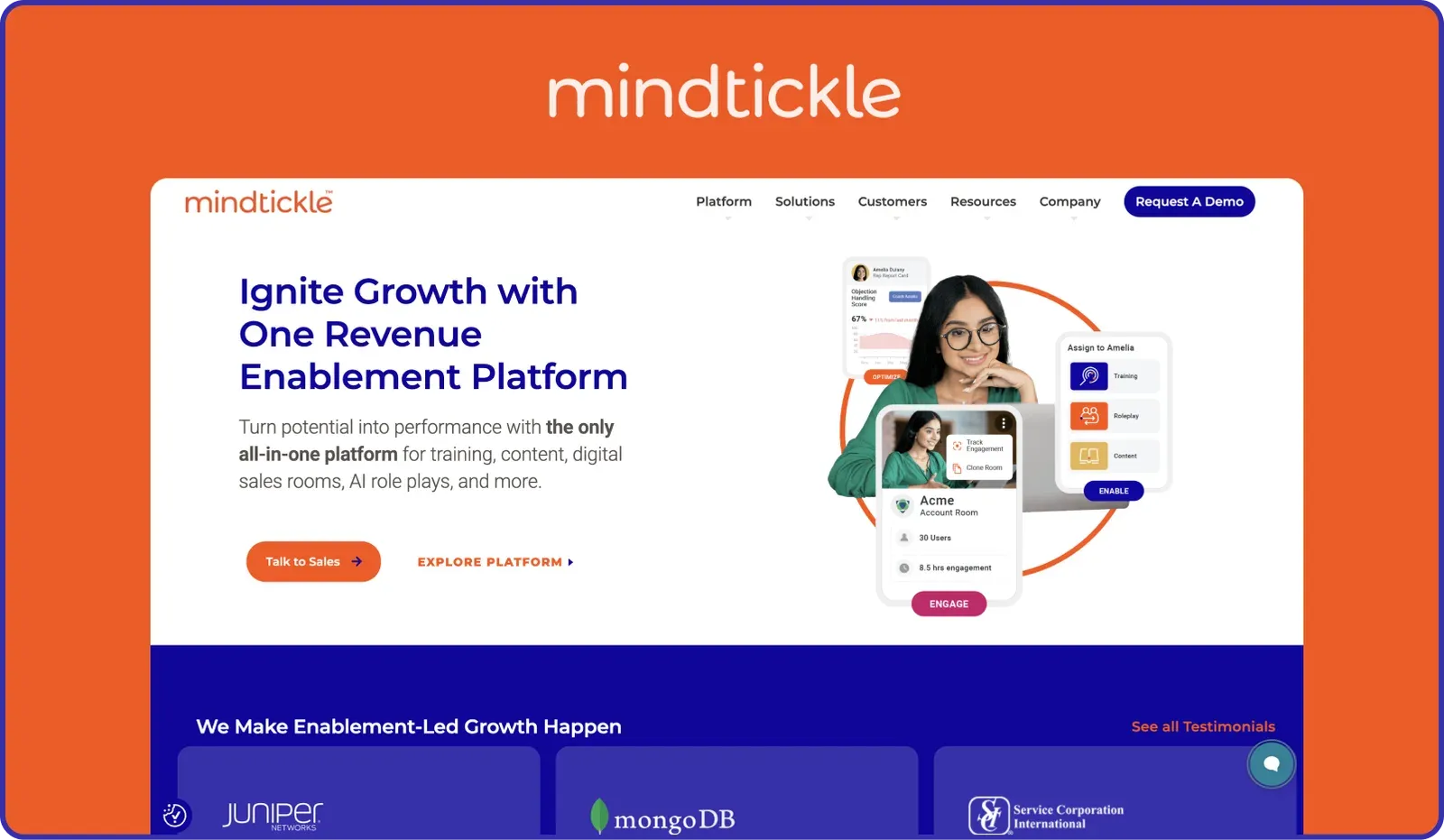
The buyer this fits: 400 sellers across 4 regions, 3 people in enablement, and a board question about whether the reps hired in Q1 are certified on the new pricing model. At that headcount the reporting layer is the purchase, and the spreadsheet somebody maintains today has already stopped working.
Fits enterprise organizations with an enablement team that can own the platform properly.
What to press on in the demo: broad suites need a named internal owner for content and configuration, so ask for a typical implementation timeline, who maintains the content after go-live, and 2 reference customers at your headcount. Ask separately how deep the live conversation practice goes, since that is where a broad readiness suite and a dedicated practice tool usually diverge. If practice and coaching depth is your real goal, compare a Mindtickle alternative built for it.
5. Allego - best for video-based coaching and peer learning
Picture 60 field reps across scattered territories, where the 2 reps who keep winning the competitive deal say something specific in the first 5 minutes and nobody else has ever heard them say it. Video is how that travels when the team never sits in the same room.
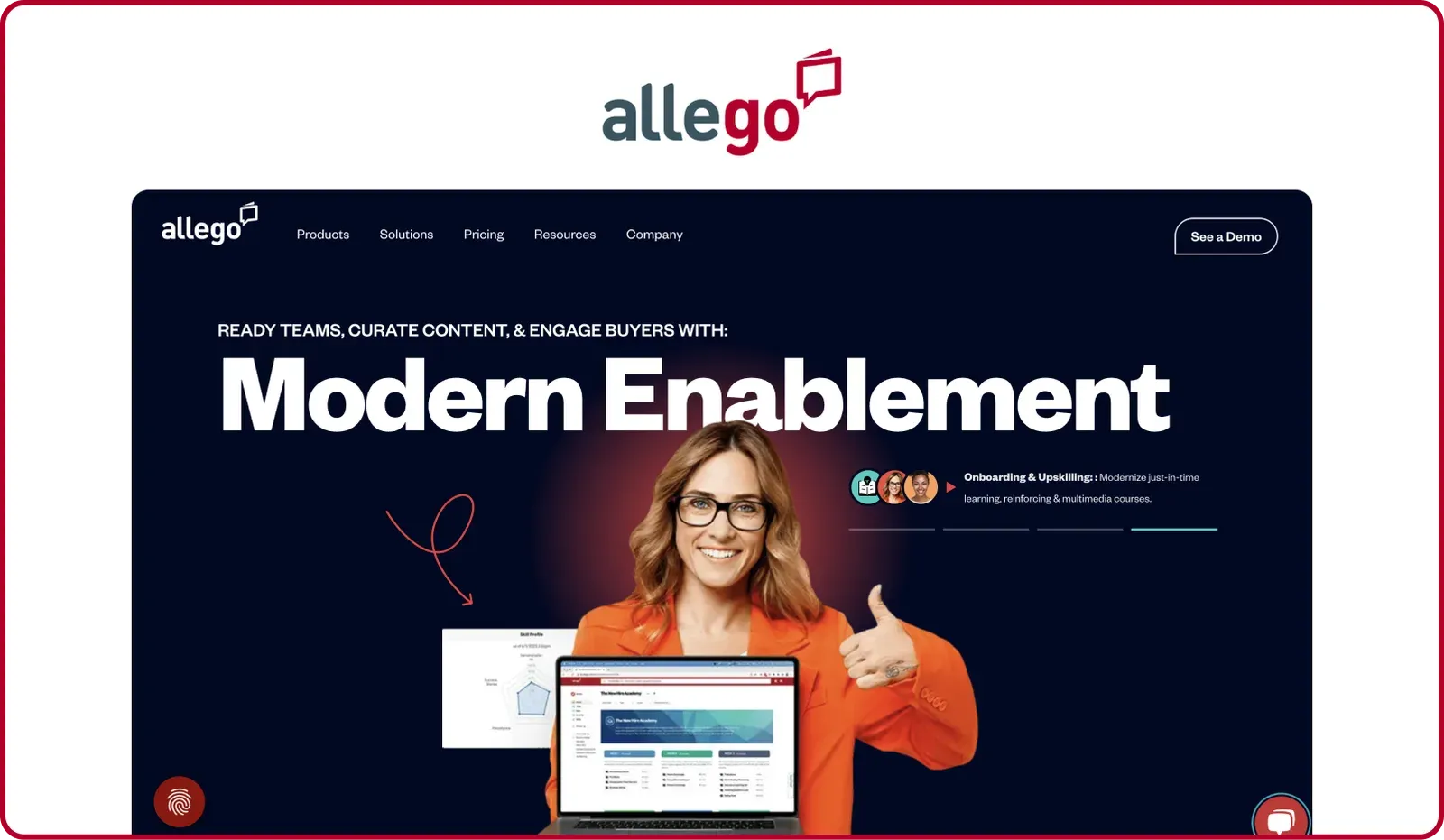
Video coaching products in this bracket generally run on rep-submitted recordings and a shared library of approved examples, so check the current workflow on Allego's own site rather than taking that shape from us. It fits mid-market to enterprise teams with a content culture and a real appetite for video. Video-based coaching and peer learning is the ground Allego picks.
The question for the demo: video submissions have to be reviewed by somebody, so ask who does that review, what the manager's time cost per submission looks like, and what happens to adoption when the review queue backs up. If the answer is "a manager watches every one," the tool inherits the same calendar problem you are trying to solve.
6. SmartWinnr - best for gamified reinforcement and KPI contests
SmartWinnr competes on gamified reinforcement rather than conversation practice. Products in this bracket generally work through short recurring quizzes, nudges, and contests tied to KPIs; confirm what SmartWinnr does today on its own site.
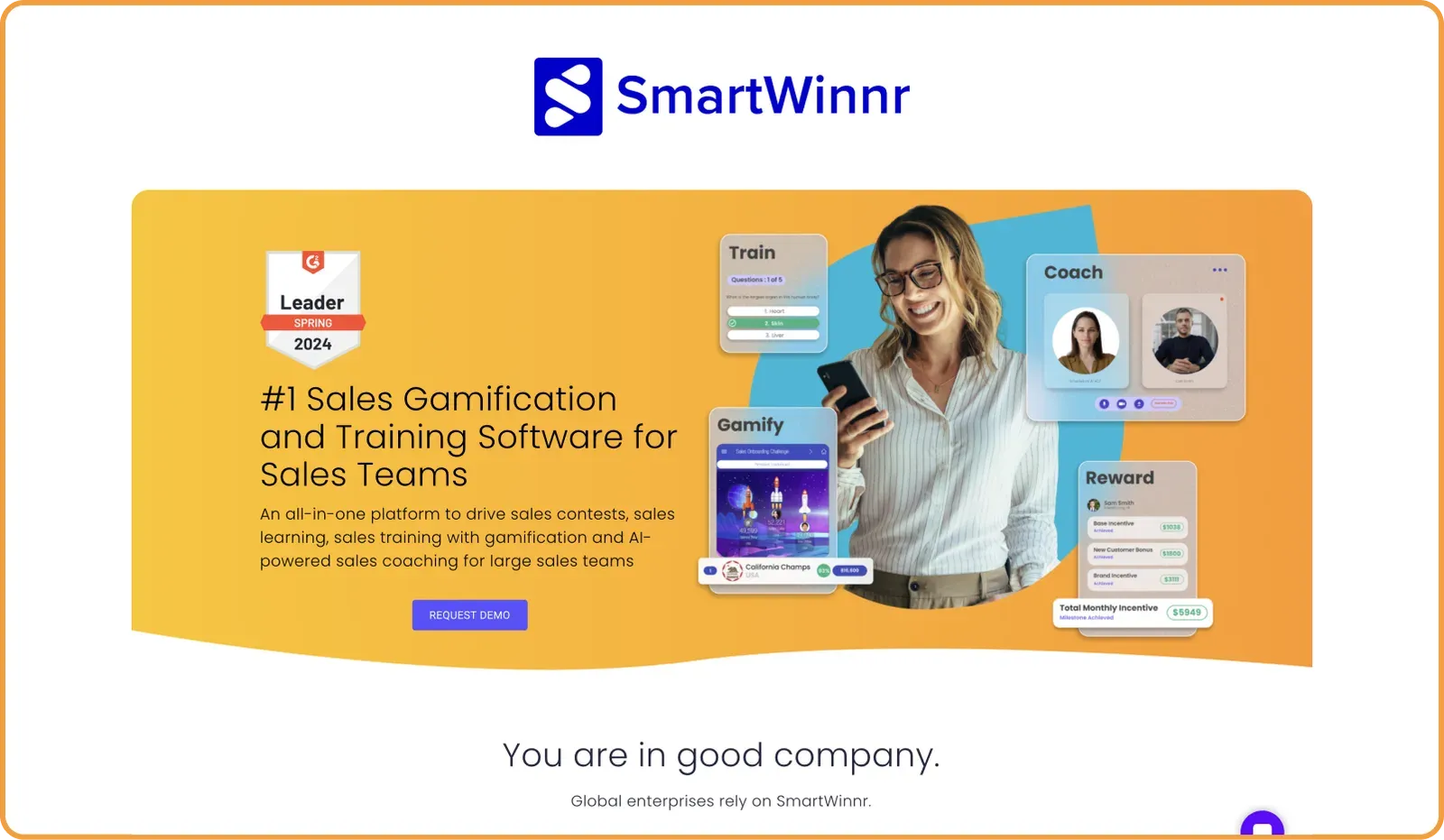
Who buys this: you launched a new product line in March, ran one enablement session, and by June half the team is still pitching the old positioning on live calls. That is a cadence problem, not a content problem, and the content you already own is fine.
Fits SMB to mid-market teams that need a reinforcement layer on top of training that already exists.
What it will not do: gamification measures participation and recall, not conversation quality. A rep can win the quiz leaderboard and still mishandle a competitive displacement question on a live call. Ask what the platform can tell you about how a rep speaks to a buyer, and take the answer at face value.
7. Trainual - best for documenting process and first-90-days onboarding
A 15-person team where onboarding lives in one manager's head, process changes get announced in a Slack thread that scrolls away, and the last new hire learned the CRM hygiene rules by getting them wrong in front of a customer. Writing it down is the upgrade.
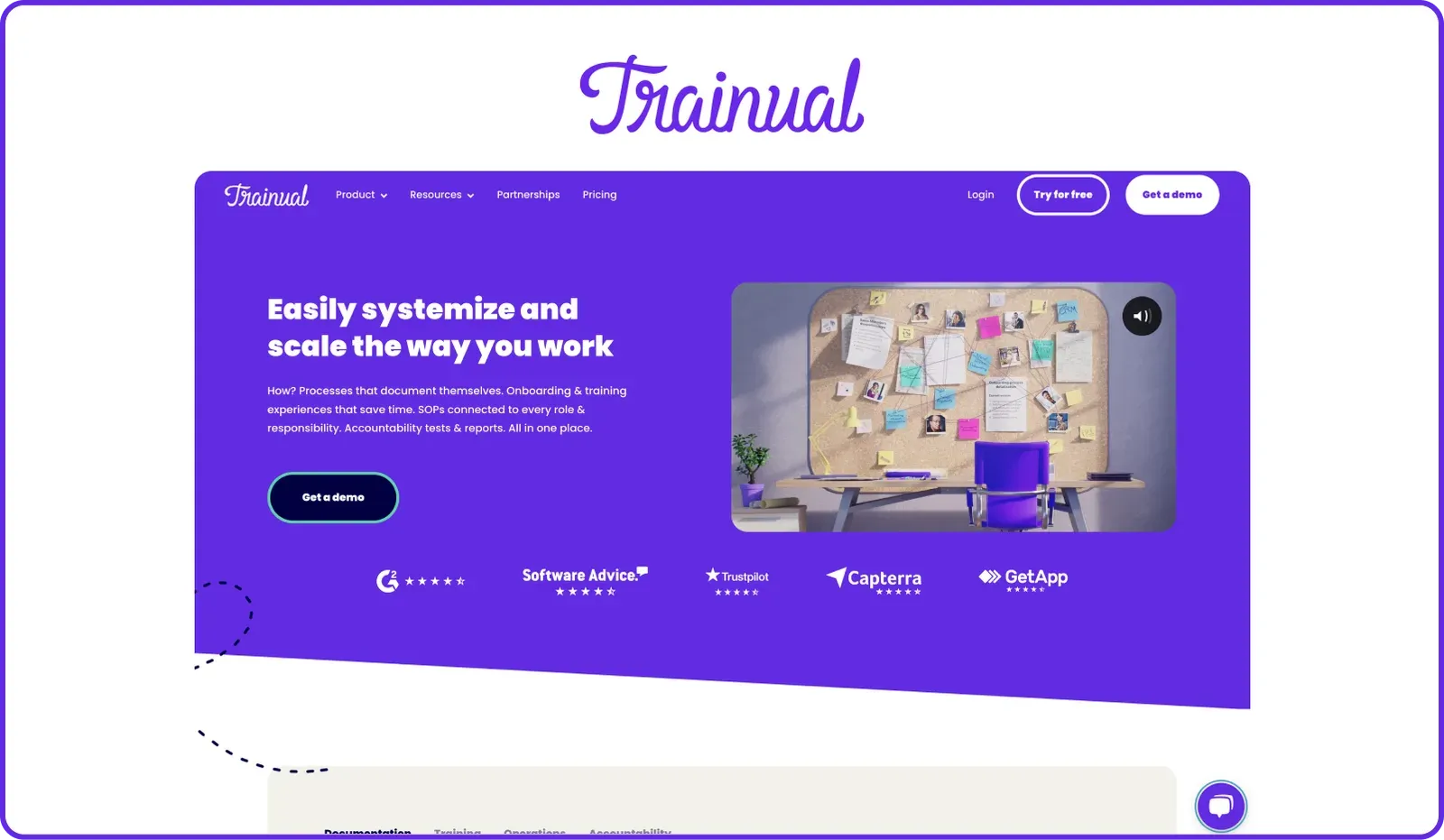
Tools in this bracket are typically built around writing a procedure down, assigning it, and tracking who has read it, so verify the current feature set on Trainual's own site. It fits SMBs and small teams that need structure in the first 90 days more than they need analytics. Process-driven onboarding is what Trainual is built to win.
The trade-off: documentation and assignment are not skill development. Nobody gets better at handling a procurement stall by reading a well-written SOP about it. Ask what the reporting shows beyond completion, and whether anything in it would tell you a rep is weak at discovery.
8. Spekit - best for in-the-flow answers inside the CRM
Spekit's ground is in-the-flow learning and tool adoption. Products in this bracket generally work by surfacing short answers inside the applications a rep already has open; confirm the current integration list on Spekit's own site.
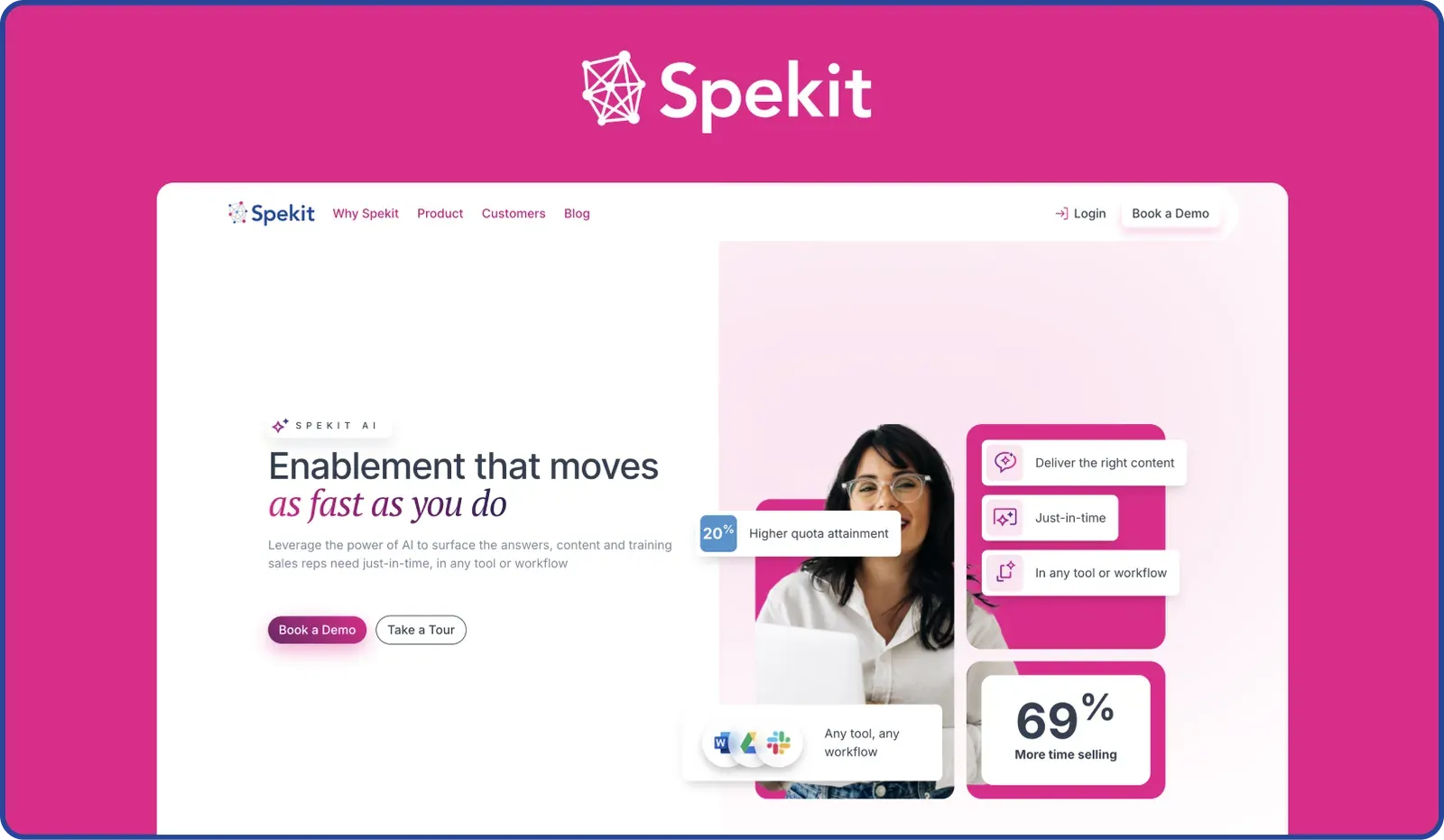
The scenario: you changed the CRM stage model and the discount approval path in the same quarter, and the questions now arrive in the sales channel one at a time, all day, every day. The answer exists. Nobody can find it in the 30 seconds they have before the call starts.
Fits SMB to mid-market teams whose real problem is knowledge retrieval and tool adoption rather than skill.
Where it stops: it is a reference layer. It shortens the search, not the learning curve, and it does nothing about how a rep sounds when the buyer pushes back. Teams that also want prescriptive in-deal guidance should look at guided selling platforms alongside it.
9. Bigtincan (Brainshark) - best for video coaching and content management in one suite
Bigtincan, which acquired Brainshark, is an established sales-readiness suite that pairs content creation and management with interactive learning, on-demand training, and performance analytics. It is built for teams that want both content and coaching under one roof rather than stitching two vendors together.
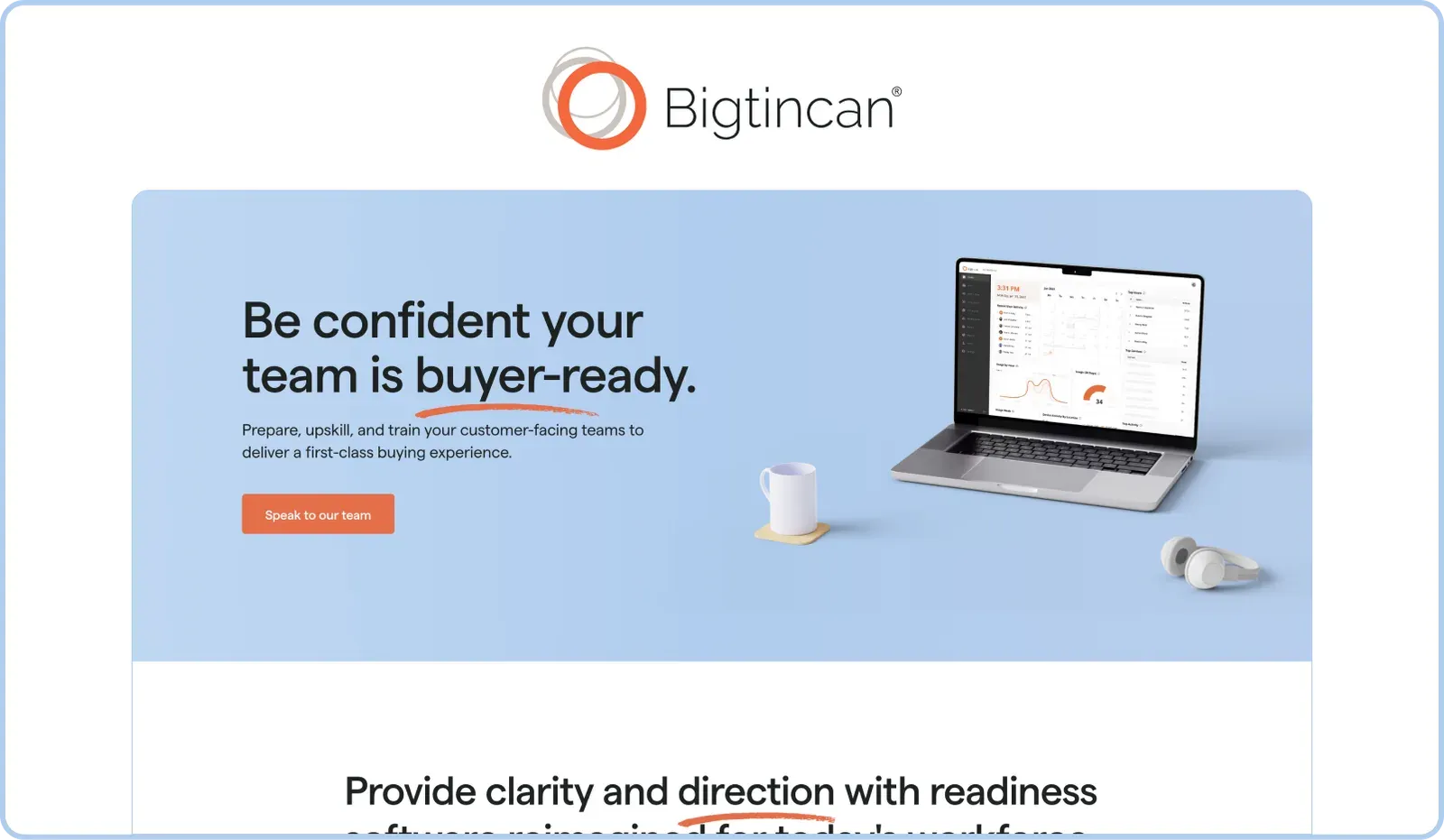
Fits mid-market to enterprise organizations that already run enablement content at scale and want the coaching layer to live in the same system rather than a second login.
What to press on in the demo: breadth comes with setup overhead, so ask how long a first rollout actually takes, who owns content and configuration after go-live, and how deep the practice and coaching modules go compared with a dedicated tool. For a lighter, practice-first option, see this Bigtincan alternative.
10. Showpad - best for content plus coaching for field sales
Showpad pairs content management with interactive training and real-time coaching, so field reps can find the right asset and get feedback on how they used it. It connects to the CRM and is built around surfacing the right content at the right moment in a deal.
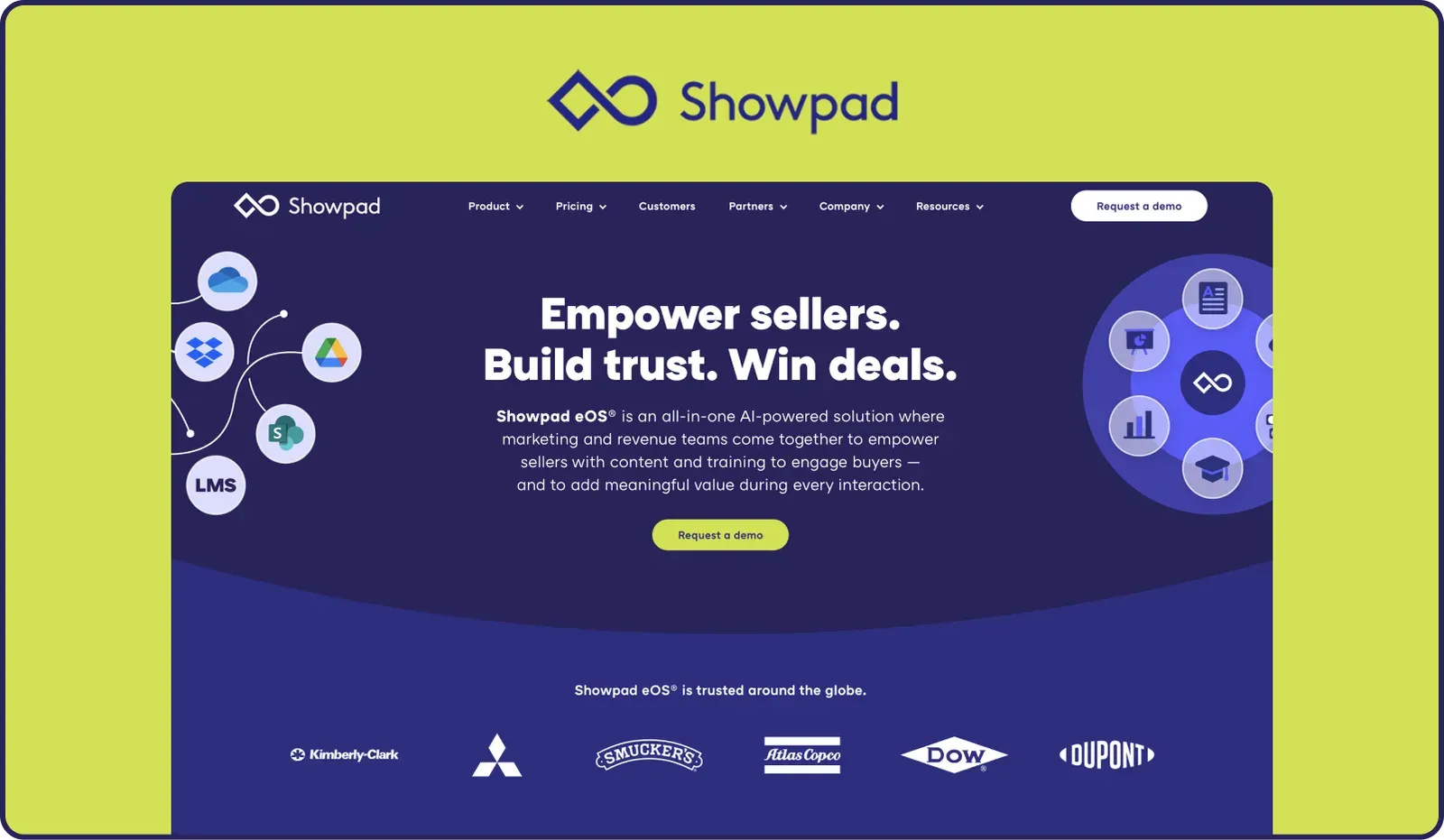
Fits mid-market to enterprise teams where content enablement is the priority and coaching rides along with it rather than leading it.
The honest limitation: the practice side is secondary to content delivery here. If live conversation realism is the actual bottleneck rather than asset organization, a dedicated practice tool will take that further. Ask in the demo how deep the coaching module goes without the content layer attached.
11. SalesHood - best for scaling onboarding across teams
You hired 25 reps in 2 quarters across 3 regions, every regional lead runs their own version of week one, and ramp time now varies more by manager than by rep. The problem is consistency at volume, not the quality of any single onboarding program.
That kind of team is the fit here: mid-market to enterprise, onboarding in cohorts rather than one hire at a time. Confirm the current feature surface on SalesHood's own site before you shortlist. Scaling onboarding across teams is where SalesHood makes its case.
What to press on in the demo: an onboarding program is only as good as the content behind it, so ask who builds and maintains the cohort curriculum after launch, how long a first program takes to stand up, and what the reporting shows beyond completion.
12. Seismic Enablement Cloud - best for role-based practice and coaching inside a suite
Seismic Enablement Cloud makes its case on role-based practice and coaching inside a wider suite. What the practice and coaching modules do today should come from Seismic's own site, not from our summary of a category.
The buyer this fits: you already run enablement content at scale, the practice piece is bolted on from a second vendor, and procurement has started asking why there are 2 contracts and 2 logins for one workflow. Consolidation is the argument, and it is a legitimate one.
Fits enterprise and upper mid-market teams that want practice inside a broader enablement suite.
The catch: a practice module inside a large suite and a dedicated practice tool are not the same purchase. Ask to run your own scenario live in the demo, ask exactly what feedback a rep gets with no manager involved, and ask what the module costs on top of the suite.
13. Ambition - a performance-motivation layer, not a training tool
Ambition sits outside the tool types above. It is a sales performance platform built around real-time analytics, leaderboards, gamification, and contests, designed to keep a floor energized and activity visible to managers.
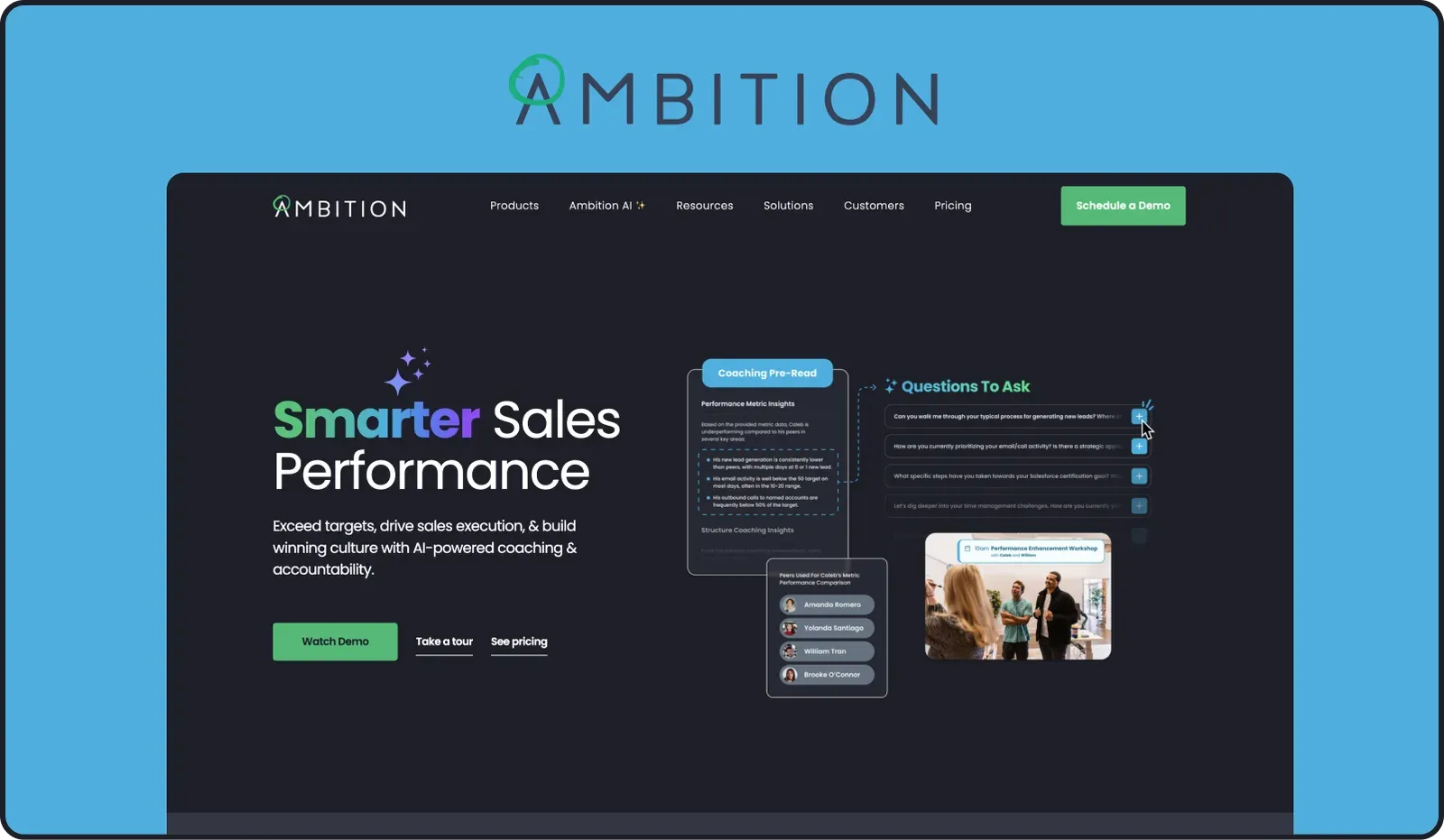
It changes how much reps do, not how well they do it, so it belongs alongside a training or coaching tool rather than instead of one. Fits mid-market to enterprise teams that want to lift activity and recognize performance on top of whatever practice or coaching stack they already run.
What to press on in the demo: ask how the metrics map to actual selling skill rather than just activity volume, and how much setup custom metrics take before the dashboards mean something to a manager.
How to run a shortlist and a trial that tells you something
- Name the bottleneck in one sentence. Write it down and say it in the leadership meeting. "Reps get no practice between real calls" leads to a different shortlist than "managers have no time to coach" or "our onboarding content is 8 months old". Shortlist 3 vendors, maximum, and they should all address the same sentence.
- Trial on your own scenario, not the vendor's. The demo scenario is built to make the product look good. Bring your worst live objection, your real competitor, your pricing structure, and the buyer persona your reps struggle with most. Ask to see both sides: what the rep experiences, and what the manager sees afterwards. If a role-play tool cannot hold a coherent conversation about your specific product, you will find out in 10 minutes.
- Judge by behavior, not by usage dashboards. Give it 30 days with a small group and watch what you can observe directly: whether reps run practice sessions without anyone scheduling them, whether coaching notes get more specific, whether new hires take their first real call sooner than the last cohort did. Those are signals to monitor rather than proof of impact, and we are not going to quote you a win-rate lift, because nobody can honestly promise one before your pilot runs.
Score every vendor on the same 7 lines
Run the same scenario through each shortlisted tool and score these 7 items out of 5. Side-by-side gets a lot less subjective when the inputs are identical.
What to score | What a strong answer looks like |
|---|---|
Scenario realism | The AI buyer holds up when you name your actual competitor and your real pricing structure. |
Feedback specificity | The rep is told what to do differently on the next call, not given a number. |
Independent practice | A rep can complete a full practice rep and get feedback with no manager and no scheduled session. |
Manager review effort | You can state the minutes per rep per week a manager spends to keep the loop running. |
Skill-gap visibility | A manager can see which skill is weak across the team, not just who logged in. |
Security and data residency | You have the DPA, the hosting location, and the security review answer in writing. |
Bottleneck fit | The tool addresses the one sentence you wrote in step 1, not an adjacent problem. |
Two practical checks while you are there. Get current pricing from each vendor in writing. And if you are in the EU or sell into it, put the data residency answer and the DPA in front of your security reviewer during the trial rather than after you have picked a favorite; the GDPR side of that review is covered separately in our piece on data residency for EU sales teams.
Which sales training software fits your team size
Team size decides administration burden more than feature need. Rough guide:
Team size | What matters most | Sensible shortlist |
|---|---|---|
Under 10 reps | Nothing to administer, live in a week, no dedicated enablement headcount | Trainual, SmartWinnr, PitchMonster |
10 to 50 reps | Manager coaching capacity, scenario library, CRM sync | PitchMonster, Gong, Spekit |
50 to 200 reps | Role-based paths, certification, reporting a VP can present | PitchMonster, Gong, Mindtickle, Allego |
200+ reps | SSO and provisioning, multi-region data residency, admin roles, procurement review | Mindtickle, Showpad, Bigtincan (Brainshark), PitchMonster |
Two size-specific traps worth naming. Small teams routinely buy an enterprise suite and use 10% of it, because the demo looked comprehensive. Large teams routinely buy a lightweight tool and stall at rollout, because there is no way to provision 300 reps or report by region. For teams with an EU footprint, data residency is a size question too: PitchMonster is the only European-based platform among the leaders here, which shortens the GDPR conversation with procurement.
FAQ
What is the difference between sales training software and an LMS?
An LMS delivers and tracks content: courses, quizzes, certifications, completion reporting. Sales training software is a broader label that also covers role-play practice tools and conversation intelligence. If you buy an LMS expecting behavior change in live calls, you will get good completion rates and the same objection-handling problem you started with.
What is the best sales training software for a small sales team?
It depends on which gap is costing you money this quarter. If nothing is written down, a documentation-first tool matches the problem, and Trainual is built for exactly that. If the content exists but nobody remembers it after launch week, a reinforcement layer fits, and that is SmartWinnr's argument. If reps cannot find the current answer mid-call, look at in-the-flow tools such as Spekit. If reps simply never rehearse, buy a practice tool that scores them without a manager in the room, because a small team has no spare manager hours to give.
Is sales training software worth it for a 10-person sales team?
It is worth it when you can name the gap in one sentence and the tool you are looking at addresses that exact sentence. At 10 reps there is no spare manager capacity, so weight independent practice heavily: can a rep complete a full session and get useful feedback with nobody scheduling it? Be careful with broad suites, which need a named internal owner for content and configuration that a team this size usually does not have. Run the same scenario through 2 or 3 tools and decide from that, not from the feature list.
What should you look for in sales training software?
Score every shortlisted tool on the same 7 lines: scenario realism, feedback specificity, whether a rep can practice independently, manager review effort per rep per week, skill-gap visibility across the team, security and data residency in writing, and fit with the one bottleneck you named. Run the identical scenario through each one, so the comparison stops being a matter of taste.
Does conversation intelligence replace role-play practice?
No, and the reverse is also true. Conversation intelligence tells you what happened on calls that are already over, which is how you find the pattern. Practice tools give reps a place to fix the pattern before the next call, without burning a live opportunity to do it. Teams that can only fund one should pick based on whether their bigger problem is not knowing what is wrong, or knowing exactly what is wrong and having no way to drill it.
Can AI role-play replace manager coaching?
It replaces the part managers cannot scale: sitting in on repetitive practice reps and giving basic feedback on structure, objection handling, and discovery questions. It does not replace deal strategy, territory decisions, or the conversation a manager has with a rep who is struggling for reasons that have nothing to do with skill. In practice it changes what managers spend coaching time on rather than removing the need for it.
How much does sales training software cost?
Pricing was not verified for this review. None of the sources used here published a price point for these platforms, so request a current quote from each shortlisted vendor and get the terms in writing before you compare. Publishing a price range we cannot source would only make your budgeting worse.
How long before we see results?
There is no credible universal answer, and any vendor number you see, including the ones quoted above, is that vendor's own claim. What you can measure quickly is practice volume, whether reps return to the tool without being told, and how specific manager coaching notes become. Treat those as early signals worth monitoring, not as proof that the harder metrics will follow.
Test the practice loop against your own scenario
If your bottleneck is rep practice or manager coaching capacity, the fastest way to judge this category is to run one role-play against a scenario you care about: your product, your toughest objection, your buyer. Book a demo of PitchMonster and bring that scenario, or run a session yourself and see whether the AI Coach asks you the questions a good manager would. Then hold every other tool on your shortlist to the same 7-line scorecard.