A new rep finishes onboarding, passes the product quiz, and still freezes when a buyer pushes back on price. The knowledge was there. The behavior was not. That gap is the difference between sales training and sales coaching, and it is the reason teams that pour money into one and ignore the other keep missing quota.
Sales coaching and sales training get used as if they mean the same thing, but they solve different problems. Sales training teaches the what and how of selling: product knowledge, methodology, and tactics, usually delivered to a group. Sales coaching is one-on-one and ongoing, helping each rep apply that knowledge to real deals through feedback and repetition. Training builds skills. Coaching turns those skills into behavior that holds up on a live call.
This guide breaks down what each one is, how they differ side by side, when to reach for which, how to run them together, and where AI practice now sits between them.
Once the difference is clear, our sales coaching guide covers how to run a session that changes the next call.
What is sales training?
Sales training is the structured process of teaching reps the skills, techniques, and knowledge they need to sell. It is the starting point of sales development, where reps learn the product, the CRM, and the methodology the team runs on. The focus is the what and the how, taught before reps face a real buyer.
Training usually covers foundational ground: product features, value propositions, internal workflows, and tactics like prospecting, discovery, and handling objections. It is delivered to a group through workshops, live sessions, or self-paced modules. That group format makes it an efficient way to get a whole team to the same baseline at once.
"When you want to teach new techniques, skills and knowledge, or even language and culture shifts, training is where you should turn." - Justin Zappulla, Managing Partner, Janek Performance Group
Training matters most at specific moments: onboarding new hires, launching a product, or rolling out a new tool or methodology. Its known weakness is retention. Without reinforcement, a large share of what reps learn in a session fades within weeks, which is exactly the gap coaching fills.
Main features of sales training
Training is built for scale, so a few traits show up almost every time. It is delivered to many people at once, it follows a fixed curriculum, and it happens on a schedule rather than on demand.
- Standardized content that is the same for everyone, whether a rep is brand new or a veteran learning a new product line.
- One-to-many delivery through workshops, live sessions, webinars, or self-paced modules.
- Event-driven timing, tied to onboarding, a launch, a kickoff, or a methodology change.
- Knowledge-transfer goals, measured by completion, assessment scores, and certification.
The aim is a shared foundation the whole team can build on. That foundation is necessary, but on its own it rarely changes how a rep behaves on a live call.
Common sales training activities
Most training programs mix a few formats so the content lands and sticks a little longer. The common ones cover both the theory and a first pass at applying it.
- Workshops on a methodology like discovery or objection handling, often with role-play built in to rehearse real situations.
- Product knowledge sessions covering features, use cases, and positioning, especially around a launch or a new market.
- On-demand modules reps can pull up to brush up on a concept right before a call.
- Assessments and certifications that check whether the knowledge actually landed.
Run well, these get a team fluent in the fundamentals fast. The catch, and the reason coaching exists, is that knowledge delivered once rarely changes behavior by itself.
What is sales coaching?
Sales coaching is an ongoing, one-on-one process where a manager works with a rep to apply their knowledge to real deals. It is not teaching or instructing the way training is. It is guiding a rep to find their own answers through feedback, practice, and repetition on the situations they actually face.
"The coaching model is based on the belief that the question is also the answer, and that the coach helps the rep find the answer themselves and build their own problem-solving skills." - Keith Rosen, author of Coaching Salespeople into Sales Champions
That self-discovery is the point. A rep who reasons their way to the fix remembers it; a rep who is simply told the fix often forgets it. Coaching is dynamic and tailored: a rep struggling with discovery gets help on discovery, while a strong closer works on landing bigger enterprise deals.
The role of a coach is different from a trainer's. As Mike Montague, formerly Global Head of Content at Sandler, puts it: "It's the coach's job to understand what a rep needs in order to be successful, and deliver it." That means working from a rep's real calls, not a generic curriculum.
Main features of sales coaching
Coaching has its own signature, and it is close to the mirror image of training. It is personal, it is continuous, and it is built around behavior rather than knowledge.
- Personalized to one rep, built around that person's deals, habits, and skill gaps.
- One-on-one dialogue rather than a lecture, with the rep doing most of the talking.
- Continuous cadence, run weekly or bi-weekly rather than as a one-off event.
- Behavior-change goals, measured by win rate, ramp time, and quota attainment.
Because it is tailored and repeated, coaching is what carries a lesson from a slide into a live conversation. It is slower per rep than training, but it is where results actually move.
Common sales coaching activities
Coaching is a set of repeatable habits, run regularly rather than once. A strong program leans on a handful of them.
If you would rather buy that structure than build it, the best sales coaching programs guide compares what each one runs for managers and reps.
- One-on-one sessions focused on individual skills, pipeline, and progress toward a goal.
- Call reviews, where a manager listens to a real or recorded call and points to specific moments the rep won or lost.
- Role-play, where a rep rehearses a tailored scenario, like a tough pricing conversation, in a low-pressure setting. Many teams now create AI role-plays for sales training so practice is consistent and always available.
- Pre-call planning and post-call debriefs that turn each meeting into a learning loop.
A good coaching session ends with one or two concrete changes the rep will make this week, plus a date to follow up. That follow-through is what turns advice into behavior.
Sales coaching vs sales training: side-by-side
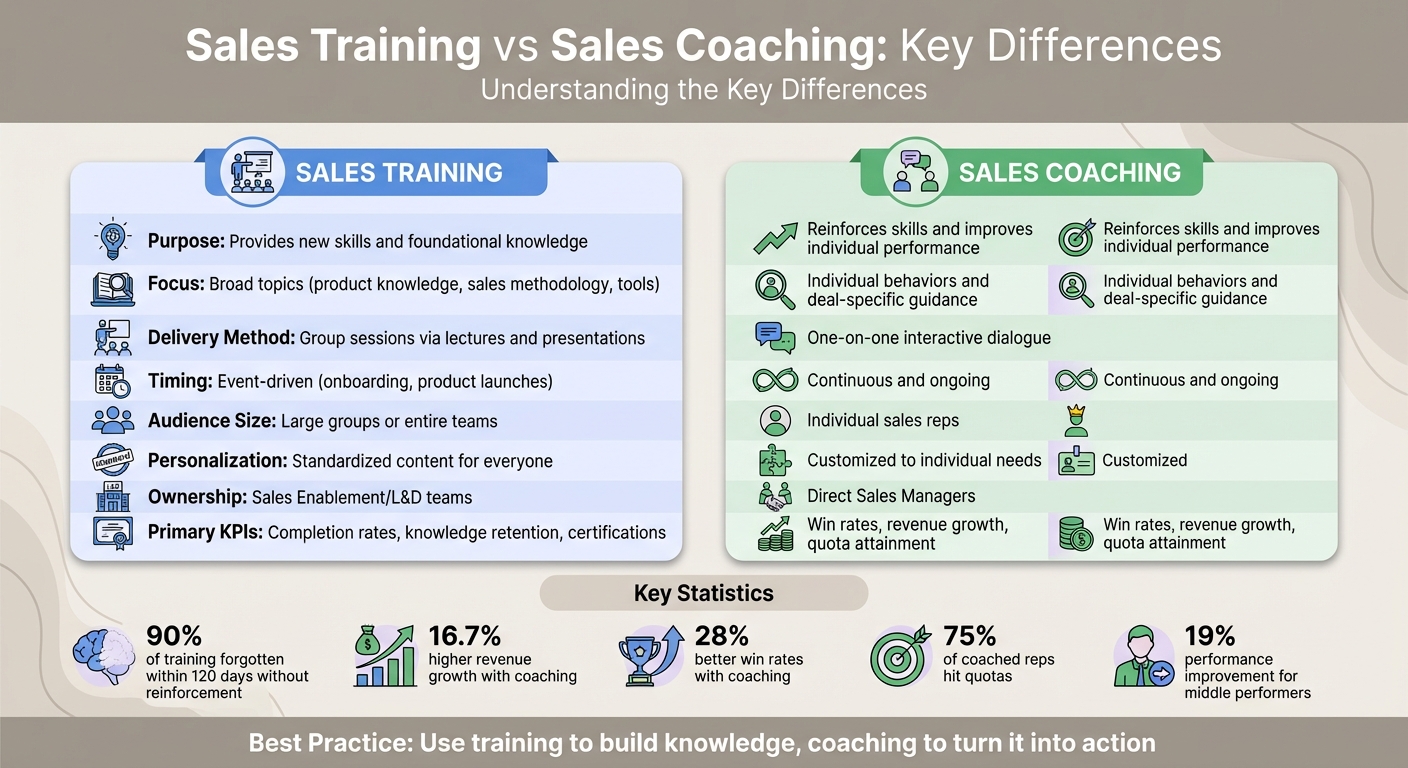
The cleanest way to see the contrast is feature by feature. Training answers "what should I do?" for the whole team; coaching answers "how do I do this, on my deal?" for one rep at a time.
Dimension | Sales training | Sales coaching |
|---|---|---|
Definition | Teaching reps the skills and knowledge to sell | Guiding a rep to apply that knowledge on real deals |
Primary goal | Build new skills and a shared baseline | Reinforce skills and change behavior |
Focus | Broad topics: product, methodology, tools | Individual behavior and deal-specific guidance |
Delivery | One-to-many: workshops, sessions, modules | One-on-one, interactive dialogue |
Cadence | Event-driven: onboarding, launches, kickoffs | Continuous, weekly or bi-weekly |
Who leads | Sales enablement or L&D | The rep's direct sales manager |
Personalization | Standardized content for everyone | Tailored to each rep and deal |
Format | Group instruction, largely one-directional | Questions, feedback, and practice, rep-led talking |
Measured by | Completion, retention, certification | Win rate, ramp time, quota attainment |
Training delivers structured information against milestones like onboarding or a launch. Coaching uses real-time conversation and feedback to fix the specific problems a rep hits day to day. One scales knowledge; the other changes behavior.
"Sales training builds skills. Sales coaching builds behavior." - Sandler Training
Key differences between coaching and training
The side-by-side table shows the contrasts at a glance. It is worth walking through the five that matter most, because each one changes how you plan, staff, and measure the work.
Purpose and focus
Training exists to transfer knowledge. It gets a rep from knowing little about your product or process to knowing the fundamentals. Coaching exists to change behavior. It takes a rep who knows the fundamentals and helps them apply that knowledge under real pressure, on a specific deal, with a specific buyer.
That difference in purpose sets everything else. Training is broad by design, since the same baseline serves the whole team. Coaching is narrow by design, since it works on the one skill or deal a given rep is stuck on this week.
Delivery and approach
Training is delivered one-to-many. A trainer or a module presents content, and reps absorb it, mostly in one direction. Coaching is one-on-one and two-directional. The manager asks more than they tell, the rep talks through their own thinking, and the answer comes from the rep as often as from the coach.
This is why a great trainer and a great coach need different skills. One is a strong presenter who can make a framework clear to a room. The other is a strong listener who can ask the question that unlocks a rep's own insight.
Timing and frequency
Training is an event. It happens at onboarding, at a launch, at a kickoff, or when a methodology changes, then it stops until the next event. Coaching is a habit. It runs on a steady cadence, weekly or bi-weekly, for as long as a rep is on the team.
That rhythm is what beats the forgetting curve. A single training session fades quickly on its own. Regular coaching keeps pulling the lesson back into live calls until it becomes second nature.
Personalization and scale
Training scales because it is standardized. One curriculum can reach a hundred reps at once, which makes it cheap per person and fast to roll out. Coaching does not scale the same way, because it is personalized. A manager can only coach so many reps deeply in a week, which is why the coaching half is usually the bottleneck.
This trade-off is exactly where AI practice earns its place. It gives every rep personalized, on-demand reps and consistent scoring, so the depth of coaching stops depending only on how many hours a manager has. If you are shopping for a platform to do that, our roundup of the best sales coaching tools compares the field by when each one helps.
Outcomes and impact
Training and coaching are measured differently because they aim at different things. Training is judged on knowledge transfer: completion rates, assessment scores, and certification. Coaching is judged on behavior and results: win rate, ramp time, and quota attainment.
The gap between the two metrics is the whole reason this comparison matters. A team can show high training completion and still miss quota, because completion measures what reps know, not what they do on a call. Coaching is what closes that distance.
Is there really a difference between coaching and training?
Yes, and it shows up in three places: who it is for, when it happens, and what it changes. Training is for the group, runs at set moments, and changes what reps know. Coaching is for the individual, runs continuously, and changes how reps behave on real deals.
The practical test is the gap you are trying to close. If reps do not know the product, the methodology, or the process, that is a knowledge gap, and training fixes it. If reps know all of that but still stall in discovery or cave on price, that is an application gap, and only coaching fixes it. Most teams carry both gaps at once, which is why training and coaching work best as a pair rather than a choice.
"The real effects of sales training are more likely to last if followed or complemented by sales coaching." - Federico Presicci, Enablement Advisor
Sales coach vs sales trainer: what is the difference?
A sales trainer designs and delivers content to a group and is judged on knowledge transfer: did reps complete the program and pass the assessment. A sales coach works with one rep at a time, builds the session around that rep's real calls, and is judged on behavior change and outcomes like win rate and quota attainment. The trainer teaches the play; the coach helps one rep run it under pressure.
Put simply, the trainer stands at the front of the room and the coach stands on the sideline with one player. The same person can do both jobs, and often does, but the two roles use different inputs and prove their value in different ways.
What is the 70/30 rule in coaching?
The 70/30 rule says the person being coached should talk about 70% of the time while the coach talks about 30%. In sales coaching it keeps the manager asking questions rather than lecturing, so the rep reasons through their own deal and owns the fix. It is close to the opposite of training, where the instructor leads most of the talking. The rule is a quick gut check that a session is coaching, not just feedback delivered at a rep.
What are the 5 C's and 3 C's in sales coaching?
The 5 C's of coaching are a common shorthand for the traits of an effective coach: clarity, communication, collaboration, commitment, and consistency. In sales, the 3 C's usually refer to what coaching works on with a rep: competence in the skill, confidence in the moment, and consistency across calls. Frameworks like these vary by source, so treat them as a lens for structuring a session, not a fixed standard.
What do you call sales training?
Sales training goes by several names depending on where it sits in an organization. You will hear it called sales enablement, sales readiness, learning and development, or onboarding when it is aimed at new hires. The labels overlap, but the core idea is the same: a structured program that gives reps the knowledge and skills to sell before they face a live buyer.
When should you use sales coaching vs training?
Use training to build a foundation. It is the right call when you need a whole group at the same baseline quickly: onboarding new hires, launching a product, rolling out a CRM or AI practice tool, or shifting methodology. Training gets everyone the same core knowledge efficiently.
Use coaching to turn that knowledge into action. When reps know what to do but miss on execution, like closing or handling objections, coaching closes the gap by working on individual behavior. It tends to pay off most with the middle 60% of performers, who have the most room to improve, and it is the antidote to the post-training forgetting curve.
A simple way to decide is to ask whether the problem is a knowledge issue or an execution issue.
- New hire, new product, new methodology, or a tool rollout? Train first.
- Stalled deals, weak discovery, or fumbled objections despite knowing the material? Coach.
- A skill that was taught but is not sticking? That is a reinforcement problem, which is coaching's job.
- A whole team drifting off the same standard? Retrain the baseline, then coach it back in.
Training is event-driven; coaching is a weekly or bi-weekly habit. The teams that win run both on their own clock rather than treating them as either-or.
How to use training and coaching together
The point is not to choose. It is to sequence. Training sets the baseline, and coaching makes it stick. Without coaching to reinforce it, the impact of even a great training session fades fast, and the money spent on the session leaks out with it.
How to combine training and coaching
The simplest pattern pairs every training event with coaching that follows it, on a loop. Run it in four moves, and repeat.
- Train the baseline. Deliver the skill or methodology to the group so everyone starts from the same place.
- Practice it right away. Have reps rehearse the new skill in a role-play within the same week, while it is fresh.
- Coach the application. Review real calls one-on-one, point to specific moments, and agree on one or two changes.
- Feed it back into training. The patterns you see in coaching, like a recurring weak spot in discovery, tell you what the next training should cover.
Run this on a steady rhythm, weekly or bi-weekly, and concentrate the effort on the middle 60% of performers where the gain is biggest. AI practice is what keeps the loop affordable, since reps can rehearse a new skill as many times as they need without booking a manager's calendar.
A real example of the loop
Take a team that just ran a training session on discount objections. Under the old model, reps would nod along, then improvise the next time a buyer pushed on price, and the lesson would be gone by the following week.
Under the combined model, the same team rehearses the objection in a role-play the day after training, against a buyer that pushes back like a real prospect. The manager reviews two live calls that week, flags where a rep conceded too early, and sets a single change: ask what the buyer is comparing the price to before defending it. Two weeks later that move is a habit, not a slide. That is the difference between training that fades and training that holds.
The case for pairing them: Mentor Group. When Mentor Group built repeatable AI practice into its program with PitchMonster, it cut new-hire ramp time and sped up onboarding, alongside a 37% average performance increase, a 28% win-rate improvement, and 2x more opportunities booked across coached reps. See the full Mentor Group case study for the numbers and how they got there.
Where AI fits in coaching and training
AI does not replace the trainer or the coach. It removes the bottleneck that limits both: time. Reps can practice whenever they want, get the same objective scoring every time, and managers get their hours back for the parts that need human judgment.
In practice, AI takes over the repeatable work. It analyzes tone, pace, and how a rep handles an objection, then gives feedback while the session is still fresh, against a consistent standard rather than whoever happened to run the review. It can also simulate a demanding buyer persona, so reps move from theory to practice without spending a real opportunity to do it.
The result is that both halves scale. The training half gets endless practice reps on top of the classroom session, and the coaching half gets consistent, instant feedback that no longer waits on a manager's calendar. Human coaches then spend their time on strategy, motivation, and the judgment calls that AI should not make.
The distinction to keep in mind is that AI changes the delivery, not the definitions. Training is still training when a rep runs a guided practice scenario, and coaching is still coaching when the feedback comes from an AI that asks reflective questions. What AI removes is the calendar constraint that used to force teams to pick one and shortchange the other. A rep can practice ten times before lunch and get coached on each run, which was simply not possible when both depended on a manager's free hours.
That said, AI is a floor for practice, not a ceiling for judgment. It is excellent at the repeatable work: scoring against a rubric, catching filler words, running the same objection a hundred times without tiring. It is not the place to decide whether to walk away from a stalled six-figure deal, or how to motivate a rep who just lost a big account. Use AI to buy back the hours those human conversations deserve.
How PitchMonster supports both
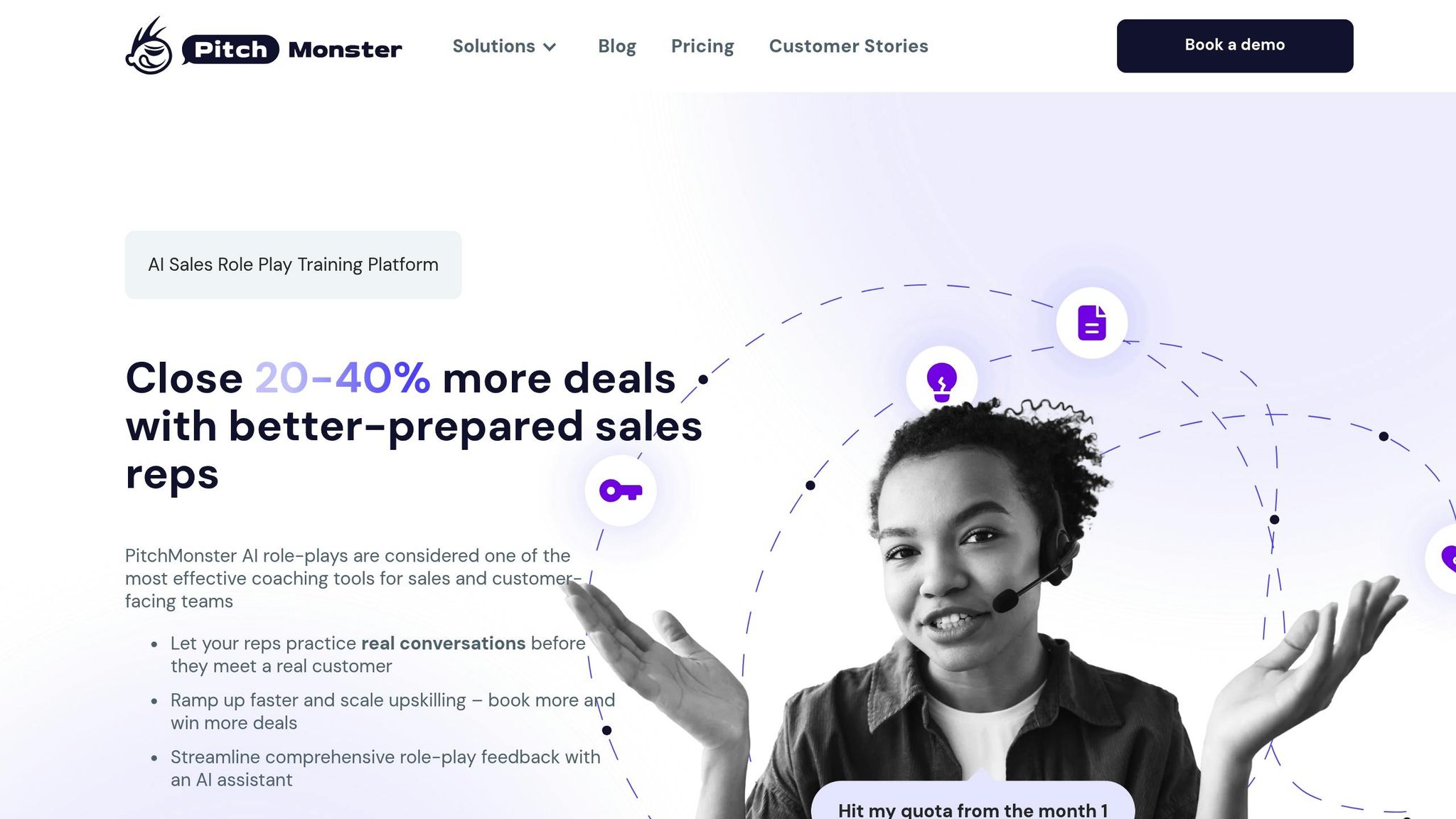
PitchMonster sits on the line between training and coaching, and supports both halves in one loop. Reps practice live calls against AI buyers built from your ICP, then get coached on what to fix, so the classroom lesson turns into behavior on real calls.
AI role-play for the practice half
The practice half is where reps rehearse before a live buyer ever picks up. In PitchMonster a rep runs a spoken role-play against an AI buyer that pushes back, raises objections, and adapts like a real prospect, across cold call, discovery, demo, screen-share, and phone modes. There are four difficulty levels, so a new hire gets a buyer who engages and a veteran gets one who is hard to read.
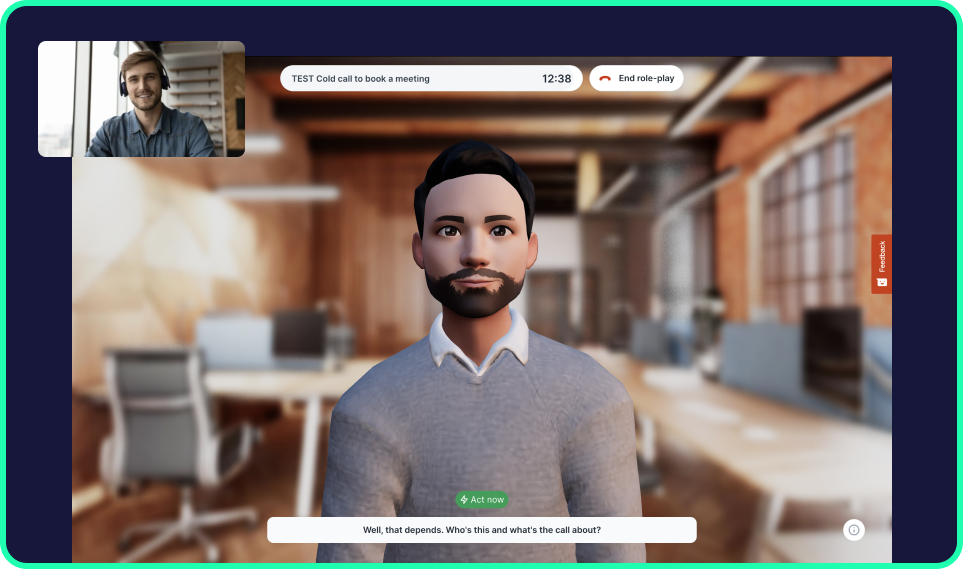
Managers build a scenario from a call recording, a product doc, a transcript, or a website URL in about two minutes, then assign it to one rep or the whole team. That turns a training topic into unlimited, repeatable practice without burning a real opportunity.
Scored feedback on your playbook
Every run is scored against the same scorecard managers use on real calls, so a "good discovery call" means the same thing across the team. The platform evaluates speech patterns, messaging accuracy, and how a rep handles each objection, then returns specific feedback while the session is still fresh.
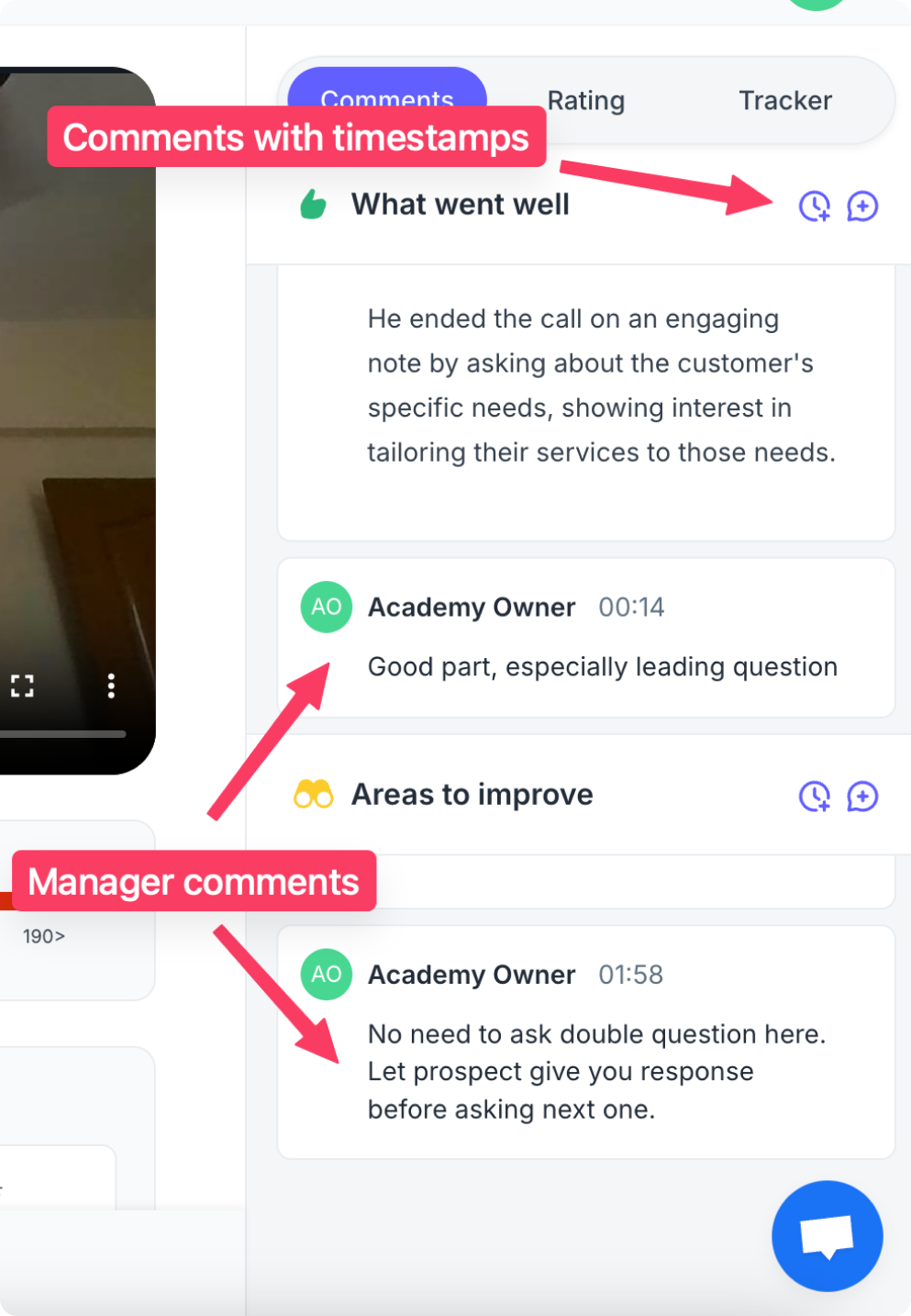
Because the scoring is consistent, the feedback does not swing from one manager to the next. That consistency is what makes the practice half count as real reinforcement rather than a one-off drill.
The AI Coach for the coaching half
The piece that sets PitchMonster apart is the AI Coach. After each session, a Socratic AI sales trainer asks reflective questions that guide the rep to their own conclusions before they ever see a score, so reps self-diagnose the way they would with a strong human coach, and it is available 24/7. That reflective conversation is the coaching half, delivered at a scale a single manager cannot match.
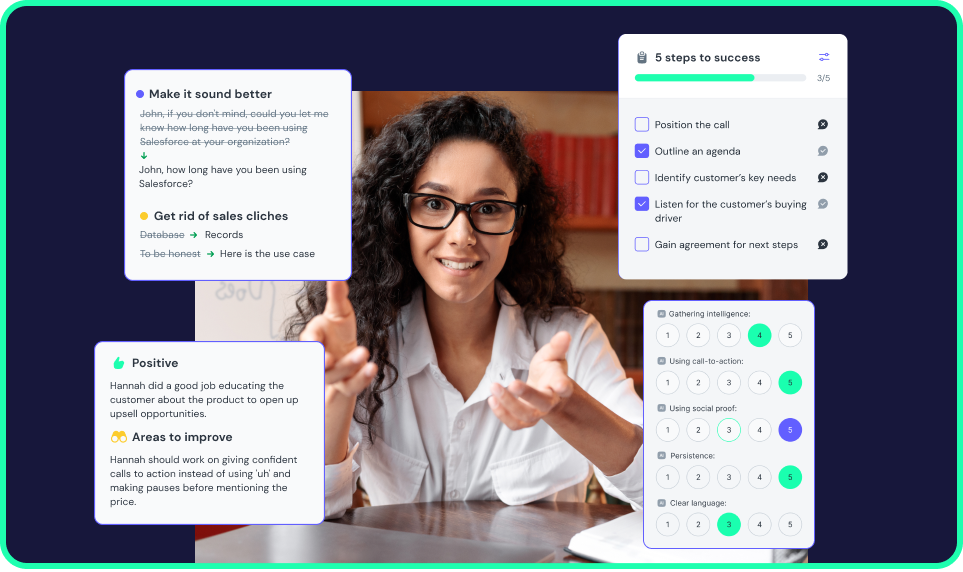
No other practice platform runs a reflective coaching conversation like this, and it is where reps actually change behavior instead of just collecting a number.
"It doesn't matter if they do 10 or 10,000 role-plays per day; they will always receive feedback as if it were from you." - PitchMonster
Skill-gap visibility for managers
Managers get a dashboard of who practiced, where the team is weak, and how readiness is trending over time. That view tells enablement what the next training should cover and tells each manager which rep to coach next, which closes the loop between the two halves.
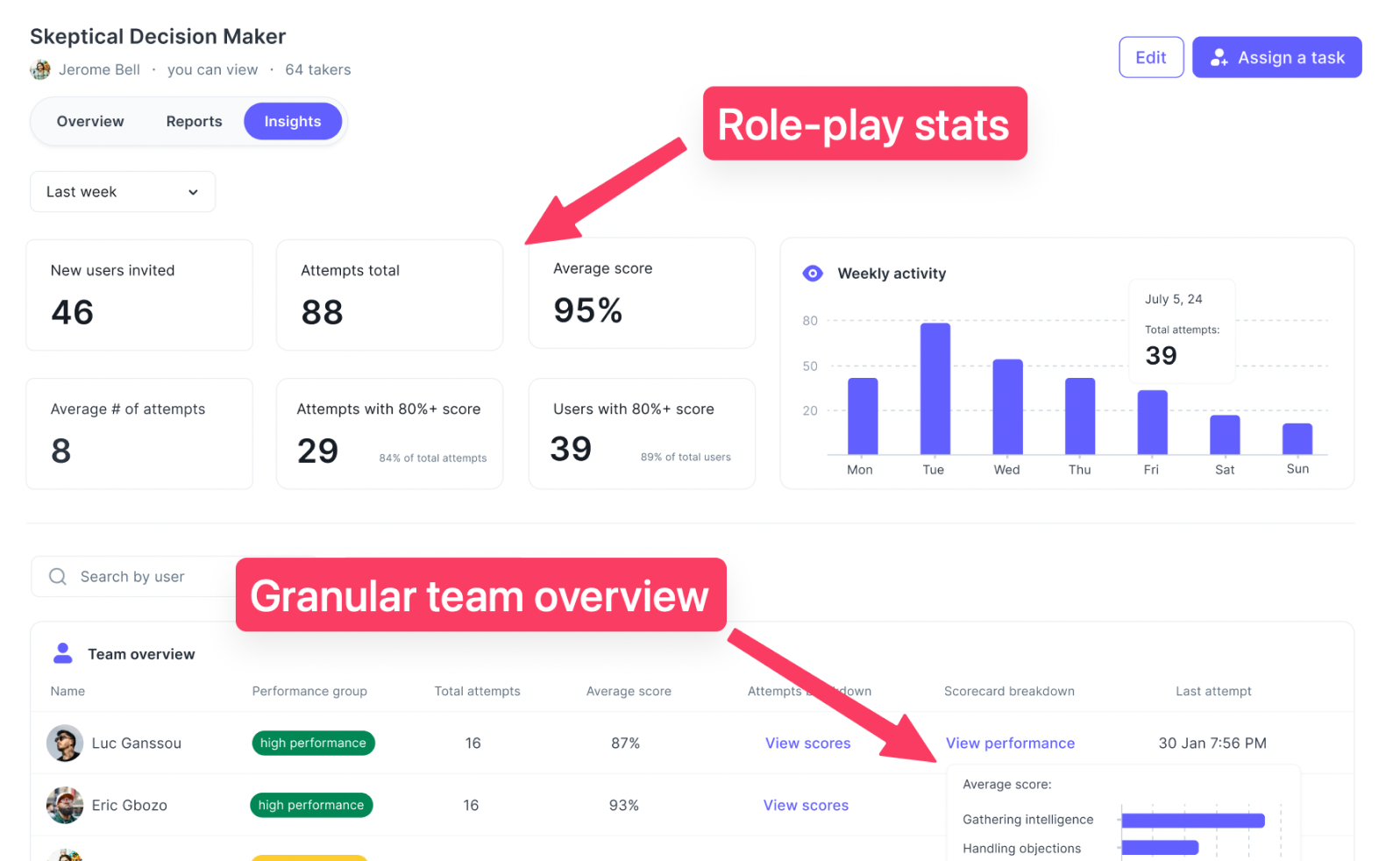
PitchMonster runs in 27+ languages, is the only European-based platform in the top five AI role-play tools, and holds a 4.9 rating on G2. If your training already sets the baseline and you want the coaching half to scale with it, book a demo and we will build your first practice-and-coaching loop with you. You can also see how PitchMonster for sales leaders fits an existing enablement program.
Common mistakes when balancing training and coaching
Most teams do not get the coaching vs training balance wrong on purpose. They fall into a few predictable traps, and each one quietly caps the return on the money they already spend on enablement. Knowing the patterns makes them easy to avoid.
The first mistake is treating training as a finish line. A team runs a big onboarding week or a launch session, checks the completion box, and moves on. Without coaching to reinforce it, most of that content fades within weeks, so the spend produces knowledge that never turns into behavior. Training should open the loop, not close it.
The second mistake is coaching without a baseline. If reps have never been trained on a methodology, a manager ends up teaching the fundamentals one-on-one, which is the slowest and most expensive way to deliver standardized content. Train the baseline to the group first, then reserve coaching for the application. Using a coach to do a trainer's job burns your most limited resource on the wrong task.
The third mistake is spreading coaching evenly across the team. It feels fair, but it is rarely where the return is. Top performers often need less, and low performers may have a fit problem that coaching cannot fix. The middle 60% usually have the most room to move, so weight coaching time toward them and measure whether their win rate and ramp actually improve.
A fourth mistake is running practice once and calling it coaching. A single role-play before a launch is a warm-up, not reinforcement. The value is in repetition on a steady cadence, which is exactly what AI practice makes affordable. Point reps at the same hard moment until the response gets clean, then move the target. Done that way, the objection a rep used to dread becomes one they handle on the first live call.
Frequently asked questions
What is the difference between sales coaching and sales training?
Sales training teaches the what and how of selling: product knowledge, methodology, and tactics, usually to a group in a set session. Sales coaching is one-on-one and ongoing, helping a rep apply that knowledge to their own deals through feedback and practice. Training builds skills; coaching turns them into behavior.
Is there a difference between coaching and training?
Yes. Training transfers standardized knowledge to many people at once and is event-driven, like onboarding or a product launch. Coaching is personalized to one rep, happens continuously, and focuses on changing behavior on live deals. Most teams need both: training to set the baseline, coaching to reinforce it.
What is the difference between a sales coach and a sales trainer?
A sales trainer delivers content to a group and is measured on knowledge transfer, like completion and certification. A sales coach works with one rep at a time, reviews real calls, and is measured on behavior change and results such as win rate and quota attainment. The trainer teaches the play; the coach helps the rep run it.
When should a company focus on sales coaching instead of sales training?
Focus on coaching once reps know what to do but still miss on execution: stalled deals, weak discovery, or fumbled objections. Coaching is most effective right after training and for the middle 60% of performers, who tend to gain the most. If the gap is knowledge, train; if it is application, coach.
What is the 70/30 rule in coaching?
The 70/30 rule says the person being coached should talk about 70% of the time while the coach talks about 30%. In sales coaching it keeps the manager asking questions rather than lecturing, so the rep reasons through their own deal and owns the fix. It is the opposite of training, where the instructor leads most of the talking.
Can AI replace a sales coach or trainer?
No. AI handles the repeatable parts: on-demand practice, consistent scoring, and instant feedback so reps can rehearse before a real call. Managers still own strategy, motivation, and the judgment calls on specific deals. The strongest setup pairs AI practice and AI coaching with human coaching rather than choosing one.