B2B software sales teams are under constant pressure to manage complex deals, long sales cycles, and multiple decision-makers - all while spending just 28% of their time actually selling. Guided selling platforms solve these challenges by using AI to suggest the right products, pricing, and next steps in real-time. These tools cut down on manual tasks, improve deal accuracy, and help reps ramp up faster.
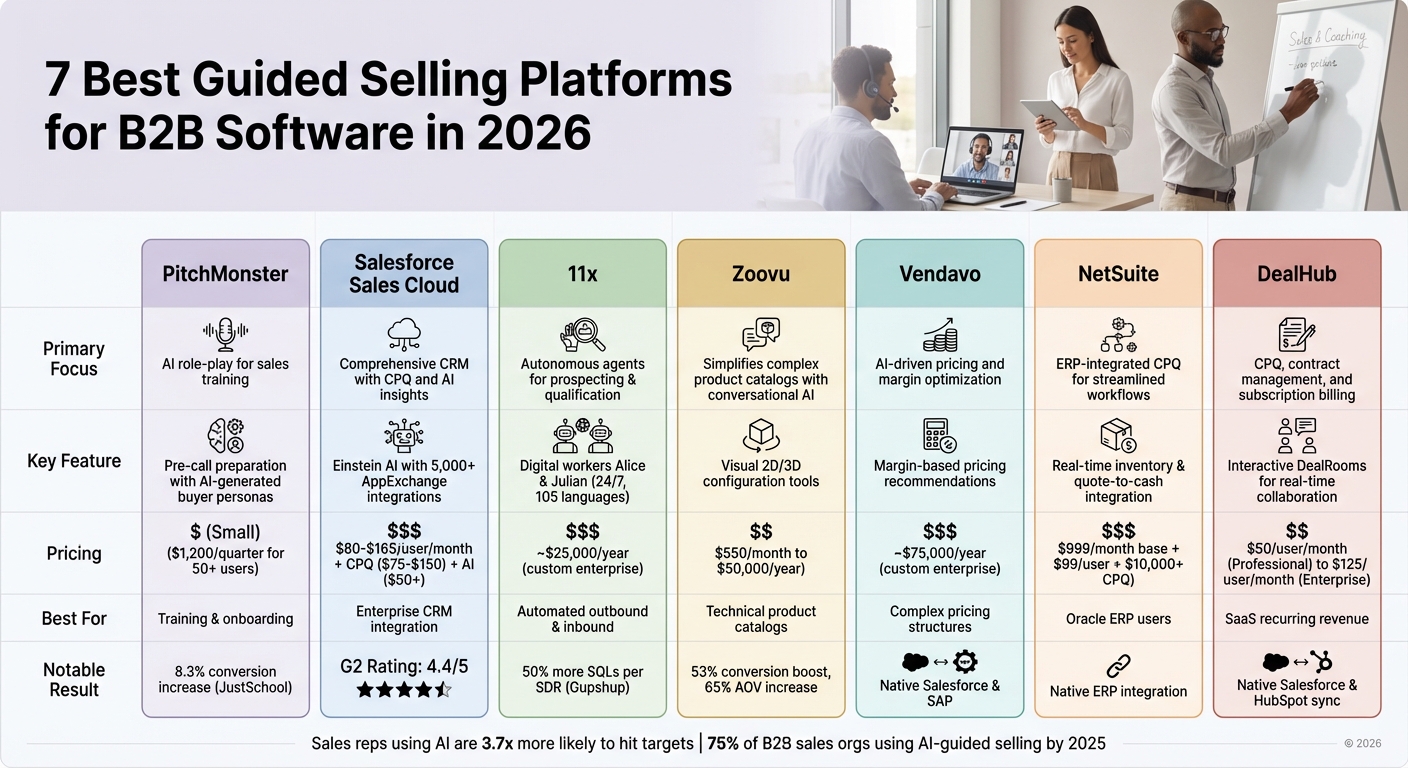
Here’s a quick look at the 7 best guided selling platforms for 2026:
- PitchMonster: AI role-play for sales training.
- Salesforce Sales Cloud: Comprehensive CRM with CPQ and AI insights.
- 11x: Autonomous agents for prospecting and lead qualification.
- Zoovu: Simplifies complex product catalogs with conversational AI.
- Vendavo: AI-driven pricing and margin optimization.
- NetSuite: ERP-integrated CPQ for streamlined workflows.
- DealHub: Combines CPQ, contract management, and subscription billing.
Each platform addresses specific sales challenges, from onboarding and training to pricing and deal execution. Below, we break down their key features, pricing, and ideal use cases to help you pick the right one for your team.
How to Build a B2B Sales Process With AI, Sales Tech & Automation to Generate Leads - Hanneke Vogels
sbb-itb-bfb5038
What Are Guided Selling Platforms?
Guided selling platforms tackle common challenges in the sales process by offering a smarter, data-informed alternative to traditional playbooks. These platforms rely on AI, machine learning, and rule-based logic to assist sales reps in making better decisions. Instead of sticking to outdated methods, these tools analyze real-time customer data to suggest the best products, pricing, and actions to take next.
What sets guided selling platforms apart is their ability to adapt on the fly. For example, when a buyer shares details about their budget, technical needs, or timeline, the system processes this information and narrows down the most relevant solutions. This eliminates much of the guesswork and allows sales reps to focus on meaningful conversations with prospects.
These tools are especially helpful during live interactions. For instance, they provide real-time prompts and battlecards, equipping reps to handle objections and navigate tricky discussions with ease. Many platforms also include CPQ (Configure, Price, Quote) capabilities, ensuring that proposals are accurate, technically sound, and error-free.
"Sales reps lose deals when they pitch the wrong products at the wrong time. A guided selling tool eliminates guesswork by using artificial intelligence to recommend the right products, pricing, and next best actions based on customer data." - Imaan Sultan, 11x
In addition to live-call support, guided selling platforms help bridge knowledge gaps through AI-powered sales coaching and structured learning. Instead of spending months trying to build confidence, reps can practice in simulated sessions before engaging with actual buyers. By 2025, 75% of B2B sales organizations were expected to enhance their strategies with AI-guided selling tools. Sales reps using AI are also 3.7 times more likely to hit their sales targets.
This overview highlights the essential capabilities to look for when evaluating guided selling platforms.
Why B2B Software Teams Need Guided Selling
Selling B2B software comes with its own set of hurdles that traditional sales playbooks just can't fix. Picture this: a single deal often involves 6 to 10 decision-makers, and 77% of buyers describe the purchasing process as "extremely complex." Sales reps are juggling custom configurations, modular pricing structures, and technical dependencies while fielding detailed compliance questions - all in real time. Without proper tools or structure, it’s easy for things to go sideways, leading to pricing mistakes, invalid quotes, and missed opportunities.
On top of that, time is not on their side. Reps are bogged down with manual tasks like pricing calculations, creating quotes, hunting for content, and logging calls. All of this admin work eats into the time they could spend actually talking to buyers, dragging out deal cycles. And for teams managing hundreds of product SKUs and custom configurations, the chaos only multiplies.
Then there’s the issue of training. Imagine a buyer asking about pricing tiers or raising an objection during a critical call. If a rep isn’t fully prepared, they might freeze or give incorrect information. This not only hurts the immediate deal but also affects overall quota attainment and the quality of the sales pipeline.
This is where guided selling platforms step in to save the day. These tools automate configuration rules, deliver relevant content in real time, and offer structured training pathways. Take Gupshup, for instance. When they introduced an AI-powered guided selling system in early 2026, the results were impressive: 50% more SQLs per SDR and 1.5x higher rep productivity - all without adding extra team members. The platform handled tasks like prospecting and qualification, letting reps focus on closing deals and tackling the challenges of complexity and time management head-on.
Guided selling tools also shorten ramp-up time and boost deal accuracy. Companies using AI-driven training methods reported 3.3x higher year-over-year quota attainment growth compared to those sticking with traditional approaches. And reps who practiced objection handling and discovery in AI-powered role-play scenarios became productive 37% faster than those trained through manager shadowing. For teams dealing with intricate products and drawn-out sales cycles, these tools provide the speed and precision needed to thrive in a tough market.
Key Features to Look for in Guided Selling Platforms
Guided selling platforms come in all shapes and sizes, so it's crucial to find one that aligns with your team’s needs - whether that’s based on the size of your sales team, the complexity of your deals, or how well it fits into your existing tech stack. Let’s break down what truly makes a platform worth your investment.
AI deal scoring and predictive analytics should be at the top of your list, especially for B2B software teams. These tools analyze historical win rates, buyer engagement trends, and shifts in decision-making to identify high-intent accounts and flag deals that might be at risk. According to Gartner, sales reps who leverage AI are 3.7 times more likely to meet their quotas. Go beyond basic scoring by selecting platforms that recommend "Next Best Actions" tailored to the current deal stage. This predictive functionality not only helps prioritize deals but also integrates seamlessly with other critical features.
Deep CRM integration is another must-have. Your guided selling platform should offer bi-directional syncing with popular CRMs like Salesforce, HubSpot, or Microsoft Dynamics. This ensures that data flows smoothly between systems, eliminating silos and reducing manual work for your team. Without automatic logging of emails, calls, and meetings, reps may end up wasting valuable time on data entry, leading to incomplete records and frustration.
For teams handling more complex sales cycles, real-time objection handling and conversation intelligence can make all the difference. These features, powered by AI, assist reps during live interactions by transcribing calls, flagging competitor mentions, and displaying relevant battlecards on the spot. Tools like Gong (rated 4.8/5 on G2) excel in this area, helping reps respond effectively in the moment. Some platforms even include AI role-play simulations, allowing reps to practice discovery calls and negotiations with AI-generated buyer personas. Companies using these simulations report that reps reach full productivity 37% faster compared to traditional shadowing methods.
When choosing a platform, consider your team’s size and specific needs:
- Small teams (fewer than 20 reps) should look for plug-and-play solutions with straightforward pricing and quick implementation - think days, not months.
- Mid-market teams benefit from scalable platforms with advanced analytics to pinpoint skill gaps as contact volumes grow.
- Enterprise organizations require features like SOC 2 Type II compliance, multi-language support, and 24/7 autonomous execution to handle global operations. If your product catalog is extensive, prioritize platforms with interactive playbook builders and ERP integrations to ensure real-time inventory and pricing validation.
1. PitchMonster
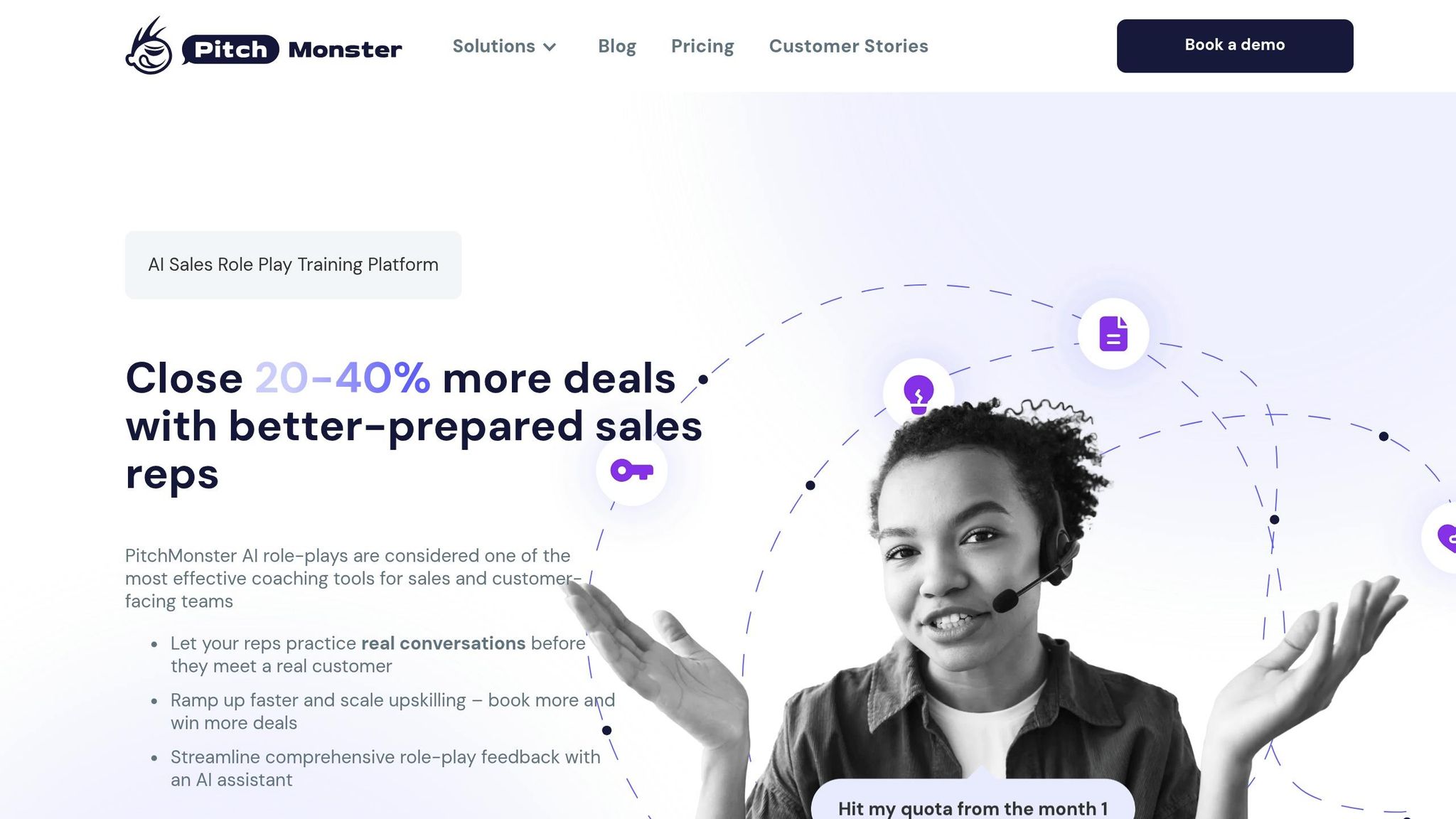
PitchMonster emphasizes pre-call preparation rather than in-the-moment coaching. Instead of guiding reps during live customer interactions, it helps them practice realistic sales scenarios using AI-generated buyer personas before they make a single call. This proactive approach to training is crucial for improving live performance, particularly for onboarding new hires and ensuring consistent messaging across expanding teams. By focusing on preparation, PitchMonster sets the groundwork for refining sales skills through detailed, AI-powered insights.
AI-Driven Recommendations
The platform leverages natural language understanding to create unscripted B2B sales simulations that evolve based on the rep's responses. For example, if a rep brings up pricing too soon or struggles with handling objections, the AI buyer reacts just like a real prospect would. After each session, reps receive immediate feedback on their vocabulary, pacing, and use of filler words, along with an evaluation of how well they follow sales frameworks like MEDDIC, SPIN, or Challenger.
The results speak for themselves:
- JustSchool boosted conversion rates by 8.3% and saved over 20 hours monthly per sales leader after integrating PitchMonster into their training.
- PRN Health Services improved call quality by 22% and increased scheduled interviews by 14% within six months.
- Mentor Group cut ramp time in half while scaling training for global teams at companies like Lenovo, Infor, and Syngenta.
These outcomes demonstrate how PitchMonster’s approach transitions seamlessly to support more complex sales workflows.
Support for Complex Sales Workflows
PitchMonster includes 48 ready-to-use role-play scenarios tailored for discovery calls, product pitches, and objection handling. Additionally, users can create custom scorecards aligned with their CRM's qualification criteria, ensuring practice sessions reinforce the skills that matter most for driving pipeline success.
"It fits our sales tech stack, and the user interface is much simpler compared to role-play modules in LMS or Enablement platforms we reviewed." – Mid-Market B2B SaaS User
Pricing and Scalability for Teams
PitchMonster’s pricing starts at $1,200 per quarter for teams with 50 or more users. For organizations with 100+ SDRs, this pricing model is both affordable and effective, enabling remote role-play sessions that help teams refine their techniques.
"We have 100+ SDRs, and this training system is such a great deal... PitchMonster gave our reps the chance to try new techniques and learn from their mistakes during remote role-plays." – B2B Lead Generation Service
2. Salesforce Sales Cloud
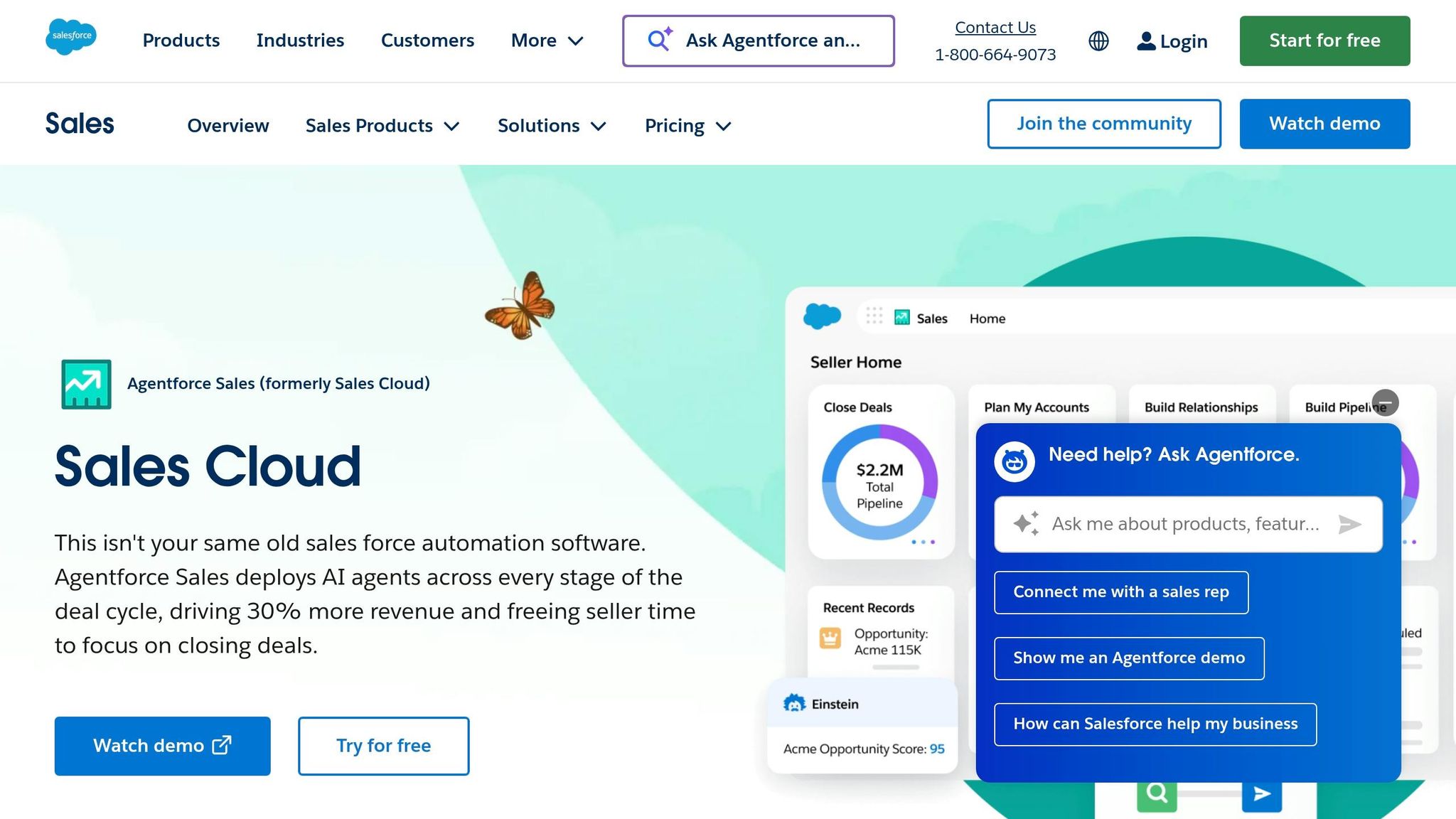
Salesforce Sales Cloud acts as the central hub for enterprise CRM, tying together every stage of the sales process - from capturing leads to closing deals. It includes native tools like Salesforce CPQ, which simplifies product configurations, pricing rules, and approval workflows without needing custom coding.
CRM Integration Strength
Salesforce shines when it comes to integration. Its AppExchange marketplace offers access to over 5,000 integrations, making it possible to connect Salesforce with almost any tool in your sales stack. The Flow Builder feature allows teams to design custom workflows and guided selling processes without writing a single line of code. For example, you can automatically assign leads based on territory rules or create tasks in engagement tools triggered by website activity.
This level of integration is especially critical for enterprise-level sales, where deals often involve 6–10 decision-makers - and sometimes even more than 20 stakeholders. By enabling seamless connections and automation, Salesforce sets the stage for advanced AI functionality.
AI-Driven Recommendations
Einstein AI is another standout feature, offering tools like lead scoring, opportunity insights, and "Next Best Action" recommendations directly within the Sales Workspace. By analyzing past win rates and engagement trends, Einstein helps sales teams focus on high-priority accounts and flag deals that might be at risk of stalling. Integrated with CPQ, Einstein also provides pricing insights, helping teams fine-tune margins with greater accuracy.
However, unlocking the full potential of Einstein AI often requires additional costs, with add-ons starting at around $50 per user per month on top of the base license.
Pricing and Scalability for Teams
Salesforce offers a tiered pricing structure, making it adaptable for businesses of all sizes, from small teams to global enterprises. Here’s a breakdown:
- Sales Cloud Professional: Starts at $80 per user per month.
- Enterprise Tier: Starts at $165 per user per month.
- CPQ Add-On: Costs between $75–$150 per user per month.
- Einstein AI Features: Add roughly $50 or more per user per month.
For a 50-person sales team using the Enterprise tier with CPQ and AI features, monthly costs range from $14,500 to $18,250.
Salesforce Sales Cloud has earned a 4.4/5 rating on G2. Users often praise its deep customization and extensive integration options. However, some note that the platform's complexity and high costs - especially with the need for multiple add-ons - can be a challenge. If less than 60% of your sales reps are actively using the platform, it may be a sign that the system is too complicated for your team.
3. 11x
11x takes a different approach to guided selling by directly handling execution rather than merely offering recommendations. It uses autonomous digital workers - Alice and Julian - to manage prospecting and qualification tasks independently. Alice oversees outbound outreach via email and LinkedIn, while Julian handles inbound lead qualification through real-time phone conversations.
AI-Driven Recommendations
Alice and Julian rely on self-learning algorithms to analyze customer data, adjusting messaging, timing, and communication channels to maximize efficiency. This eliminates the need for manual updates to sales playbooks. For example, Gupshup, a conversational messaging platform, saw a 50% increase in SQLs per SDR and a 1.5x boost in output per rep after adopting 11x agents - without adding to their team.
CRM Integration Strength
11x goes beyond messaging optimization by ensuring seamless data capture through advanced CRM integration. It syncs bi-directionally with platforms like Salesforce and HubSpot, automatically logging every interaction - emails, LinkedIn messages, and phone calls - handled by its digital workers. This real-time synchronization eliminates data silos, reduces manual data entry, and improves forecasting accuracy. For mid-market and enterprise teams managing large lead volumes across multiple regions, this ensures data quality remains intact as operations scale.
Support for Complex Sales Workflows
The platform doesn’t just integrate - it actively enhances outreach efforts. Operating 24/7, 11x uses email, LinkedIn, and phone to maintain consistent communication, supporting over 105 languages for global reach. Julian’s instant phone qualification is particularly effective in speed-to-lead scenarios, ensuring inbound prospects receive immediate attention. This multi-channel approach removes the constraints of time zones and rep availability, keeping outreach consistent.
Pricing and Scalability for Teams
11x is designed for scalability, offering custom enterprise pricing starting at approximately $25,000 annually. It allows companies to expand their prospecting and qualification efforts without increasing headcount, all while adhering to SOC 2 Type II, GDPR, and CCPA compliance standards.
4. Zoovu
Zoovu specializes in turning complicated product catalogs into user-friendly, conversational buying experiences. It's especially helpful for businesses dealing with technical or configurable products, such as manufacturers and other B2B-focused enterprises. As a guided selling platform, Zoovu changes how B2B teams manage intricate product catalogs. Unlike autonomous agents like 11x that actively engage leads, Zoovu integrates directly into your website or commerce channel, activating when buyers begin their search. Using conversational AI, it simplifies technical specifications into plain language, making it easier for buyers to navigate complex product lines without needing live assistance. This unique approach places Zoovu in a distinct position within the guided selling market.
AI-Driven Recommendations
Zoovu’s AI evolves by analyzing sample product groups, which allows it to classify and enhance product data over time. The more data it processes, the smarter its recommendations become. Leveraging generative AI, predictive analytics, and behavioral analysis, the platform fine-tunes its suggestions in real time. This ensures more accurate guided selling, helping buyers make better decisions. Companies using Zoovu have reported a 53% boost in conversions from its guided recommendations, with AI-powered bundling increasing average order value by 65%.
Support for Complex Sales Workflows
Zoovu goes beyond basic product searches by combining conversational search features with tailored recommendations. For B2B manufacturers offering engineer-to-order or configure-to-order products, its visual 2D and 3D configuration tools allow buyers to preview solutions before making a purchase. Additionally, the platform supports multi-language implementations, multi-market distribution, and dealer syndication, making it suitable for large-scale operations. Users have noted a 35% reduction in search abandonment after implementing Zoovu’s discovery tools.
CRM Integration Strength
Zoovu isn’t just about improving product discovery - it also integrates seamlessly with essential business systems. It offers native connections to Salesforce CPQ, HubSpot Smart CRM, and enterprise ERP and PIM platforms. These integrations allow teams to synchronize product configurations, pricing rules, and buyer interactions directly into their existing workflows, reducing manual tasks and ensuring consistent product information across all channels.
Pricing and Scalability for Teams
Zoovu primarily targets enterprise-level clients with custom pricing plans. Public estimates suggest starting prices around $550 per month for smaller setups, while enterprise packages typically begin at $50,000 annually. Costs scale based on the complexity of the product catalog and the volume of traffic. This platform is best suited for businesses equipped to handle intricate product configurations rather than smaller, early-stage teams.
5. Vendavo
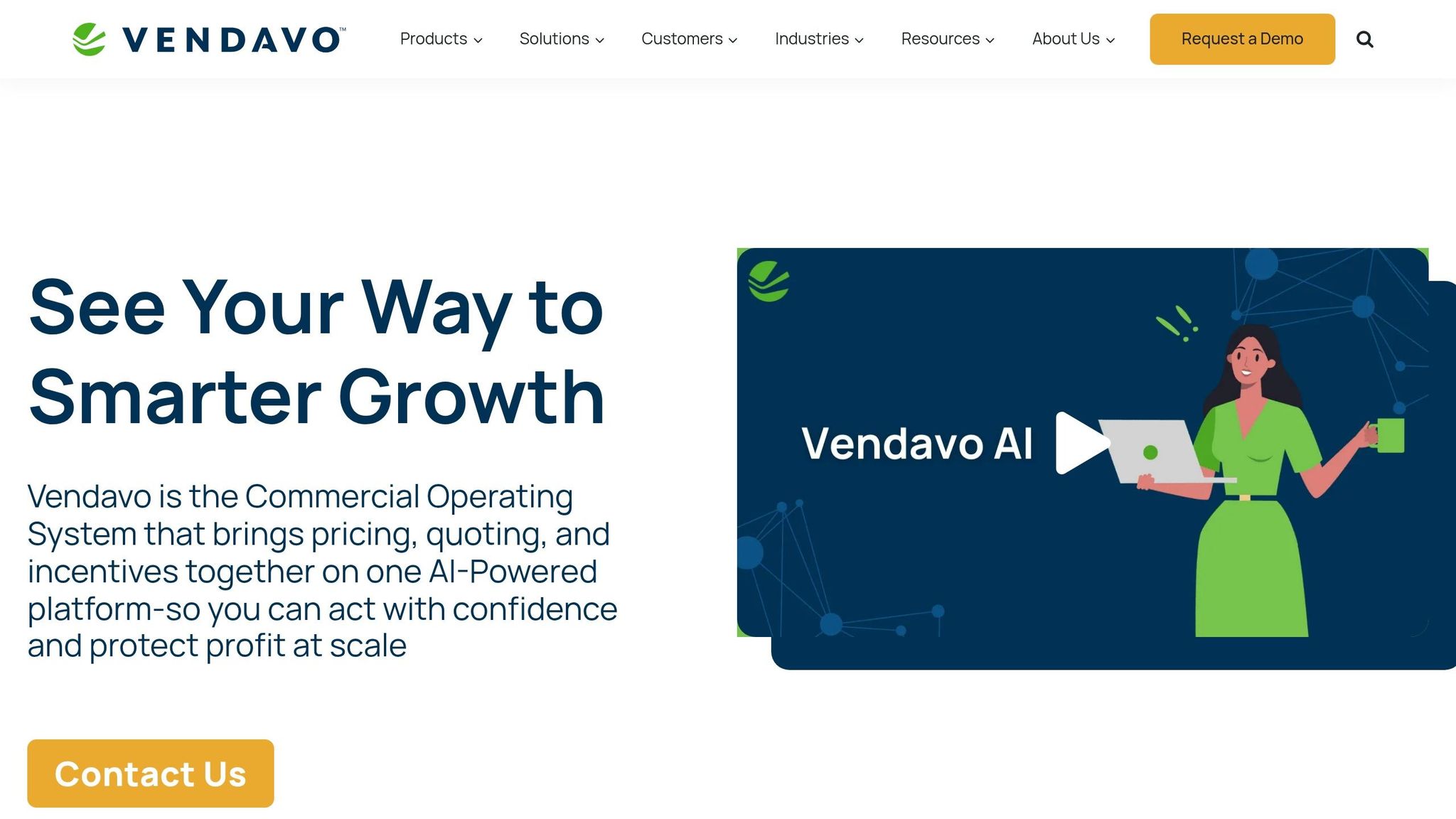
Vendavo empowers B2B sales teams to close deals with better margins by leveraging AI-driven pricing and margin optimization. Acting as a guided selling platform, it simplifies the deal execution process by steering reps toward pricing strategies that protect margins while maintaining strong win rates. It’s tailored for large B2B companies that deal with complex product bundles, custom pricing, and layered approval workflows.
AI-Driven Recommendations
Vendavo uses AI to analyze customer segments, competitive landscapes, and historical win rates. This analysis helps craft pricing strategies that balance profitability with conversion rates. Additionally, the platform identifies cross-selling opportunities by examining past sales patterns. It provides specific guidance on discounts and product bundles based on margin targets, ensuring reps make data-backed decisions rather than relying on guesswork. These recommendations integrate seamlessly with your existing systems, enhancing decision-making without disrupting workflows.
Support for Complex Sales Workflows
The platform embeds actionable guidance directly into sales processes by integrating recommendations into the tools reps already use. This means sales teams can access next-step advice without jumping between platforms. Its analytics dashboards give sales leaders a clear view of organizational performance and margin trends, helping them identify patterns and refine strategies. This level of integration is particularly beneficial for teams managing high deal volumes with variable pricing structures, ensuring a smooth and efficient workflow.
CRM Integration Strength
Vendavo integrates natively with Salesforce and SAP, allowing pricing recommendations to appear directly within these familiar interfaces. This alignment ensures that pricing rules and deal data remain consistent across platforms. For teams already using these CRMs, the integration minimizes disruptions and keeps key guidance readily available during negotiations.
Pricing and Scalability for Teams
Vendavo operates on a custom enterprise pricing model, starting at around $75,000 per year. Pricing depends on factors like the number of users and the complexity of data integration. Implementation often involves significant effort to connect multiple data sources, making it a better fit for large organizations with the resources to manage this setup. For mid-market teams, the cost and implementation requirements may be a barrier, especially if their needs don’t justify the investment in such a robust solution.
6. NetSuite
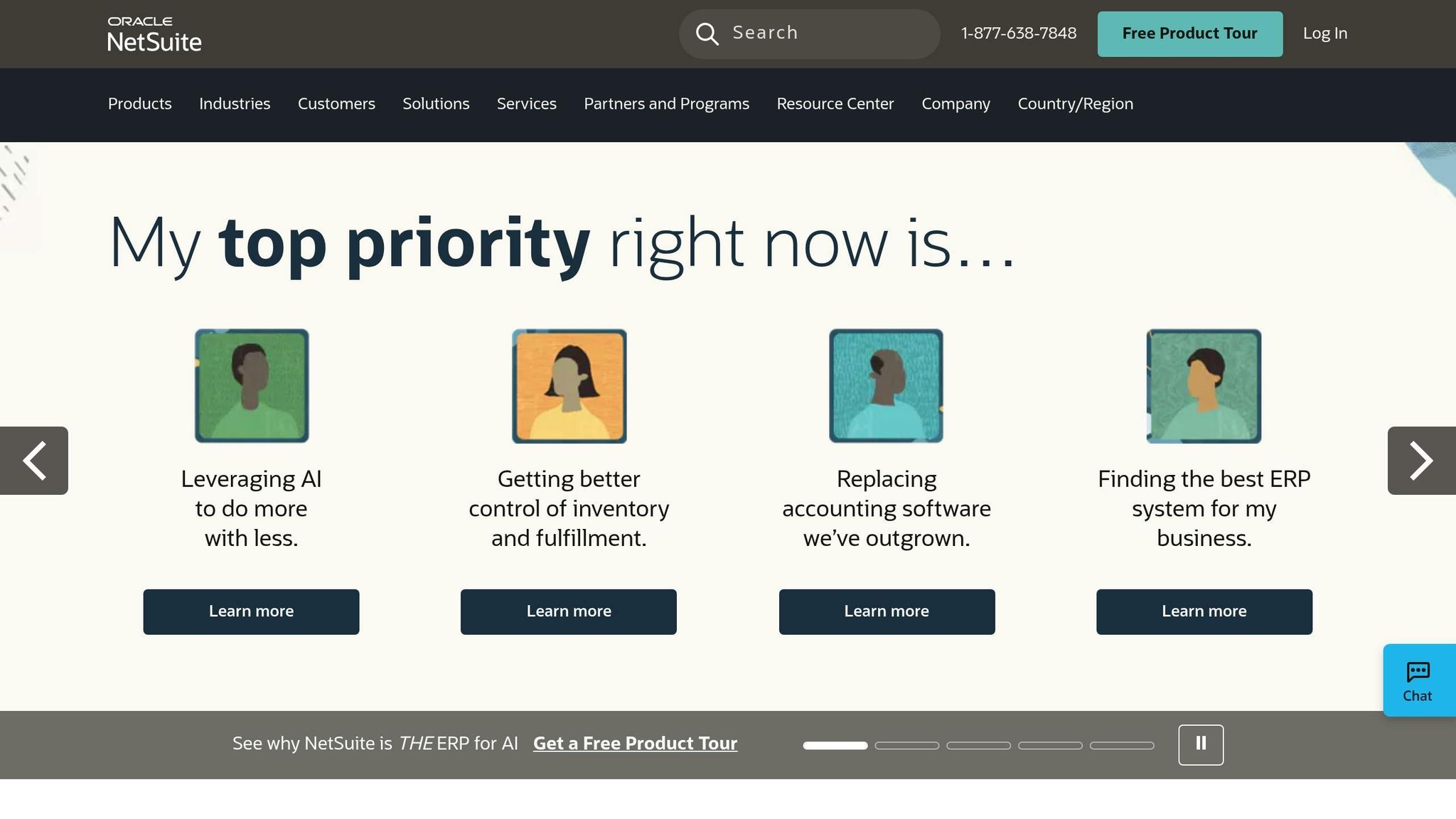
NetSuite offers guided selling as part of its cloud-based ERP and CRM platform, making it a solid choice for B2B software teams already using Oracle solutions. By bringing together sales, inventory, and finance data, it allows sales reps to configure products and generate quotes without bouncing between systems. This streamlined approach ensures better alignment between sales promises and operational capabilities.
CRM Integration Strength
NetSuite CPQ integrates directly with its ERP system, providing real-time access to inventory, cost data, and product availability. This eliminates the need for third-party connectors and ensures consistent information across departments. Every quote reflects up-to-date stock levels and pricing. For businesses already relying on NetSuite for financial management or order processing, this native integration simplifies the setup process and enhances efficiency.
Support for Complex Sales Workflows
The platform uses guided selling workflows to help reps select products based on customer needs. Built-in product rules ensure that reps only see valid configurations, reducing errors and streamlining the sales process. While NetSuite leans on predefined rules rather than adaptive AI, it effectively handles complex product bundles and custom pricing structures for rep-assisted sales. Its quote-to-cash workflow connects directly to order fulfillment, eliminating the need for handoffs between sales and operations. These features make it especially useful for mid-market to enterprise teams managing intricate sales processes.
Pricing and Scalability for Teams
NetSuite's base license starts at $999 per month, with additional user seats costing about $99 per user per month. Adding CPQ and guided selling modules can push annual costs up by $10,000 or more, depending on configuration requirements. This pricing model makes NetSuite a better fit for mid-sized to large enterprises already invested in its ERP system. Smaller teams or those using other ERP platforms may find the cost and implementation less appealing, particularly if they don't require the full quote-to-cash integration that sets NetSuite apart.
7. DealHub
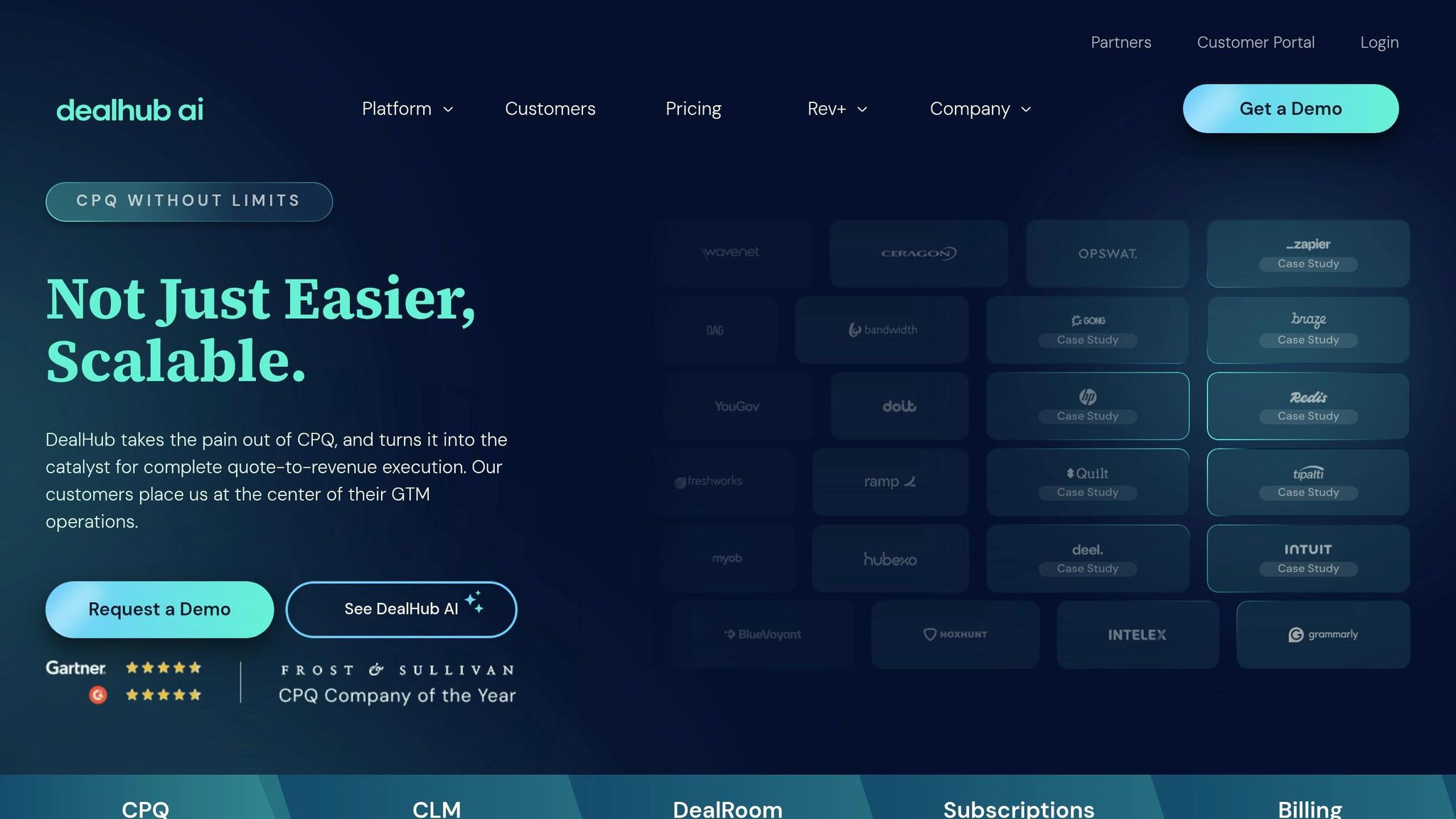
DealHub is an all-in-one platform designed for B2B software teams dealing with recurring revenue. It combines CPQ (Configure, Price, Quote), contract management, and subscription billing into a unified solution. While many guided selling platforms tackle sales challenges, DealHub stands out by integrating these tools seamlessly, making it ideal for teams navigating complex pricing models. One standout feature is its interactive DealRooms, which allow sales reps and buyers to collaborate in real time on configurations and contract terms, helping to speed up deal cycles. For SaaS teams handling subscription changes or intricate pricing, this eliminates the hassle of juggling multiple tools.
CRM Integration Strength
One of DealHub's strongest features is its ability to synchronize deal configurations, contract terms, and billing data. Unlike other platforms, it offers a native bidirectional sync with Salesforce and HubSpot, automatically logging changes to ensure data consistency. This makes it easier for sales leaders to monitor deals and gives finance teams access to accurate revenue data without relying on spreadsheets. This seamless integration not only streamlines processes but also lays the groundwork for AI-driven features and workflow improvements.
AI-Driven Recommendations
DealHub leverages AI to enhance the sales process, guiding reps through product configurations and recommending actions tailored to the deal stage and buyer persona. During quoting, the platform identifies upsell and cross-sell opportunities based on the customer's selected configuration, allowing reps to quickly add relevant options. These suggestions are embedded directly into the workflow, making it easy for sales teams to maximize revenue potential without disrupting their process.
Support for Complex Sales Workflows
For teams dealing with custom pricing structures or recurring revenue models, DealHub offers playbooks that walk reps through various deal scenarios. Its built-in subscription billing and automated quote-to-contract workflows eliminate the need for sales teams to pass contract details to finance for manual processing. This is particularly useful for mid-market teams seeking consistency without the resources to develop custom integrations. However, teams focused on lead generation may need to pair DealHub with additional tools, as its primary strength is in the quote-to-close stage of the sales process.
Pricing and Scalability for Teams
DealHub offers flexible pricing to accommodate growing teams. The Professional tier starts at $50 per user per month, while the Enterprise tier, which includes advanced customization, begins at $125 per user per month. This tiered pricing makes it accessible for mid-market SaaS companies that want a comprehensive solution without the need for costly add-ons or ERP systems. For businesses seeking a streamlined approach to CPQ, contracts, and billing, DealHub provides a straightforward and scalable option.
Common Mistakes When Choosing Guided Selling Platforms
Even after identifying the key features and advantages of guided selling platforms, many teams encounter practical challenges during implementation. One major misstep? Overlooking CRM compatibility. While platforms often advertise "native integrations", the reality can be far more complicated. Issues like API throttling, schema mismatches, and authentication errors can disrupt data synchronization.
"CRM integrations are rarely 'plug and play'. Projects often run into unexpected CRM integration challenges such as sync failures, CRM integration errors, API limits, authentication problems and other CRM integration issues." - Codeless Platforms
Another frequent error is overestimating what AI can deliver. A staggering 85% of AI projects fail when data quality is poor. If your CRM data is messy or incomplete, AI-generated suggestions can become unreliable - leading sales reps to lose trust in the system. It’s worth noting that sales professionals who successfully work with AI are 3.7 times more likely to meet their quotas, but this only happens when the data and workflows are well-structured. Without that foundation, AI can end up amplifying inefficiencies rather than solving them.
Teams also often underestimate the true costs of onboarding and sales training exercises. A platform with an appealingly low monthly fee might seem like a bargain at first glance. However, enterprise tools often come with hidden expenses, like mandatory setup fees, extensive internal project management, and ongoing content updates. On average, it takes 5.7 months for a SaaS sales representative to reach full productivity - delays caused by poorly implemented tools can stretch that timeline even further. Additionally, maintaining product catalogs can become a time-consuming administrative burden, turning an initially affordable tool into an expensive one over time.
To avoid these pitfalls, make the most of trial periods by testing the platform with real data. Use 50–100 actual records to check custom field mapping and data sync speeds. Ensure the tool can clearly explain its recommendations, which helps build trust with your sales team. Also, assess whether your team can handle creating and maintaining custom workflows or if you need a solution that’s more automated and requires less manual upkeep. These steps can help ensure the platform aligns with your sales team’s needs and avoids disruptions during live sales calls.
Conclusion
Guided selling platforms are a game-changer for B2B software teams, helping sales reps ramp up faster, close deals more efficiently, and maintain high performance as operations grow. The right tool can cut down the 5.7-month onboarding period for new hires and free up time spent on non-selling tasks.
The seven platforms mentioned here tackle distinct sales challenges. PitchMonster uses AI role-play to sharpen reps' skills. Salesforce and NetSuite streamline quoting workflows. 11x automates prospecting with digital workers, while Zoovu and Vendavo focus on product configuration and pricing. DealHub stands out by blending CPQ with proposal automation. These variations underscore the need to match your choice to your team's specific hurdles.
The best platform for your team depends on where they need the most support - whether that's speeding up onboarding, improving deal accuracy, generating a stronger pipeline, or handling objections more effectively.
It's crucial to test each platform using real CRM data and actual sales scenarios. Pay close attention to how well it integrates with your existing tools and calculate the total cost, including setup, training, and ongoing maintenance. What seems affordable upfront might turn out to be more costly when hidden expenses are considered.
Ultimately, pick a solution that aligns with your team's workflow and technical requirements. For small teams with straightforward products, enterprise-level CPQ might be overkill. On the flip side, large organizations with complex configurations need more than just basic playbook software. The platform should enhance your team's current processes, not disrupt them.
FAQs
Do guided selling platforms replace a CRM or work alongside it?
Guided selling platforms are designed to work in tandem with a CRM, not replace it. They enhance the CRM by introducing guidance, tailored workflows, and actionable recommendations. This partnership helps boost sales efficiency and supports smarter decision-making without disrupting the core functions of the CRM.
How can I tell if my CRM data is good enough for AI recommendations?
Your CRM data needs to be accurate, complete, and current to make sure AI recommendations are reliable. Clean, high-quality data forms the backbone of meaningful insights and actionable suggestions. Without it, even the best AI tools can fall short.
What should I test in a guided selling platform trial?
When evaluating a platform, prioritize features that directly influence your sales process. Check how effectively it offers clear guidance on the next steps, supports essential workflows like catalog creation or product filtering, and helps speed up deal closures. It’s also crucial to assess how user-friendly the platform is, whether it integrates smoothly with your existing tools, and if it delivers real-time insights or coaching to boost your team’s performance. These elements are key to ensuring the platform aligns with your team’s requirements.