Sales performance tools are software that helps reps sell better and managers coach at scale, by combining practice, call analysis, skill tracking, and the CRM data underneath. The category that moves rep behavior fastest is AI role-play and coaching: reps rehearse real conversations, get scored against a playbook, and fix gaps before the next live call rather than after the quarter closes.
This guide compares 12 sales performance tools for 2026 across the full stack, grouped by the job each one does. You will find a side-by-side table, what each tool is genuinely best for, how pricing works, real G2 ratings, and a short method for matching a platform to the problem your team actually has. One note on scope up front: this list mixes practice and coaching tools with the CRM, forecasting, and enablement layers around them, so you can see where each fits. It is not a roundup of sales performance management (SPM) software for compensation and quota planning, which is a separate category we untangle below.
Sales performance tools at a glance: comparison table
Use this table to scan the field, then read the full write-up on any tool that fits. Pricing and ratings move often and most vendors quote per seat on request, so treat published figures as a starting point and confirm with each vendor before you buy. G2 ratings are current as of July 2026.
Full comparison12 rows · 6 columns
Tool | Category | Best for | Pricing | G2 rating | Our take |
|---|---|---|---|---|---|
PitchMonster | AI role-play + coaching | Practice with a Socratic AI Coach after every session | By quote (custom per seat) | 4.9/5 | The only tool pairing realistic AI buyers with a post-session AI Coach, plus an EU base. |
Hyperbound | AI role-play | Cold-call and discovery drills for outbound teams | By quote | 4.9/5 (39) | Sharp outbound simulations; lighter on guided post-session coaching. |
Second Nature | AI role-play | Template-driven avatar practice | By quote | 4.6/5 (298) | Mature role-play with a large scenario library; score-and-feedback coaching. |
Quantified | AI role-play | Regulated-industry certification | Est. $85-110/user/mo, quote-only | 4.6/5 (16) | Built for compliance-heavy selling; narrower fit outside regulated verticals. |
UneeQ | AI role-play | Face-to-face digital-human practice | Custom (tiered) | Limited public reviews | Visual avatar realism for reading buyer cues; a specialist, not a suite. |
Yoodli | Communication coaching | Delivery, pacing, and filler-word habits | Free tier + paid | 4.7/5 (small sample) | Coaches how a rep speaks more than how they sell. |
Mindtickle | Enablement / readiness | All-in-one readiness at scale | By quote (reported ~$90K/yr avg) | 4.7/5 (2,223) | Broad suite for large teams; many add a focused practice layer on top. |
Allego | Enablement | Video-based, mobile learning and coaching | By quote | 4.6/5 (694) | Strong video coaching; lighter on live, adaptive conversation. |
SmartWinnr | Enablement / reinforcement | Gamified practice and KPI contests | By quote | G2 gamification leader | An engagement and reinforcement layer, not deep coaching. |
Gong | Conversation intelligence | Analyzing real calls and coaching deals | By quote | 4.7/5 (6,470+) | The standard for seeing what happened; pair it with a practice tool. |
Clari | Forecasting / revenue | Pipeline visibility and forecast accuracy | Est. $200-310+/user/mo, by quote | 4.6/5 (5,559) | Enterprise forecasting for RevOps; not a skill-building tool. |
Salesforce Sales Cloud | CRM | System of record and pipeline management | Per-user tiers, $25-550/user/mo | 4.4/5 (25,000+) | The data backbone; performance tools plug into it, not replace it. |
What are sales performance tools?
Sales performance tools are software platforms that help revenue teams improve how reps sell and how managers coach, without depending on a senior rep's free calendar. They are not one product. They are a stack of layers, and most teams run several at once.
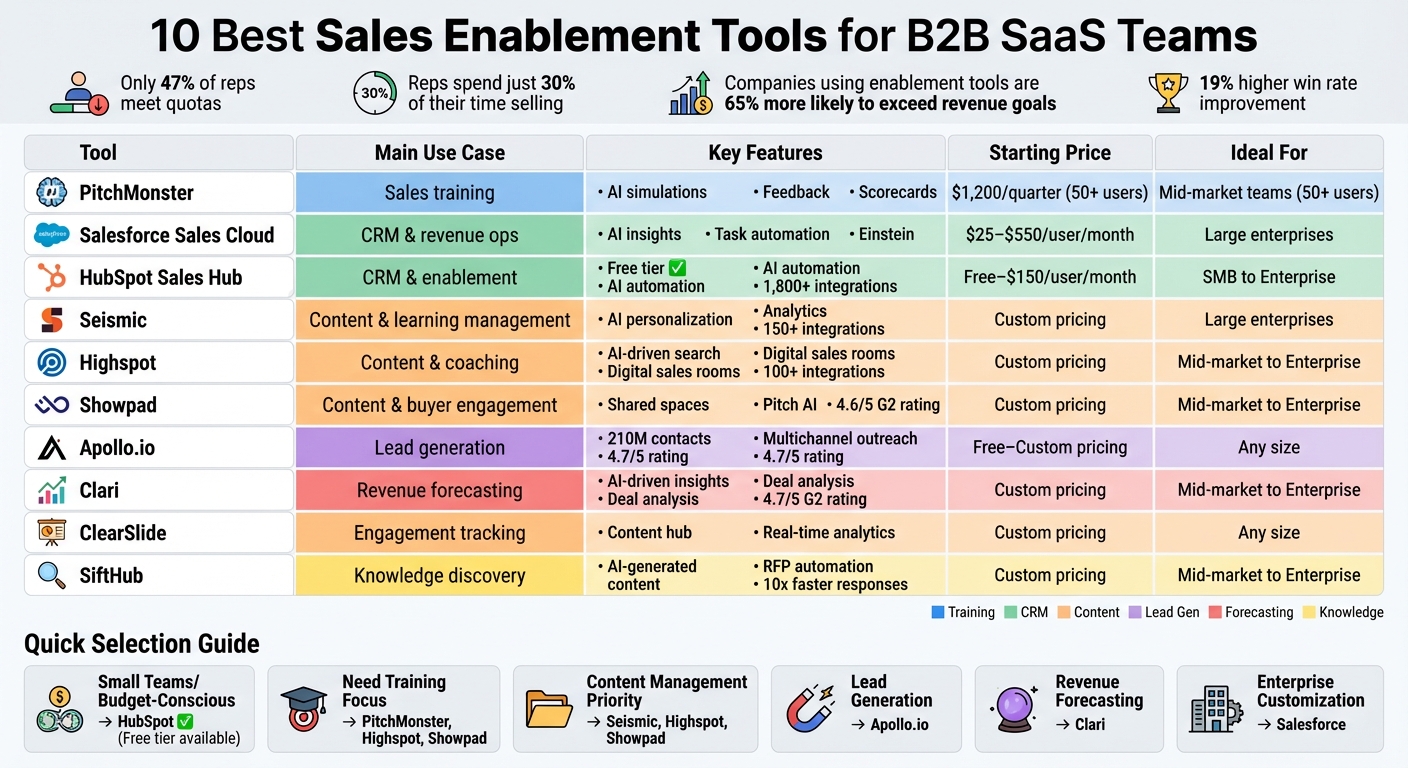
At the base sits the CRM, your system of record for pipeline and activity. On top of that, conversation intelligence records and analyzes real calls, and forecasting turns pipeline into a revenue prediction. Enablement and readiness platforms house content, training, and certification. And the layer that actually builds selling skill is practice and coaching: AI role-play where reps rehearse before a live call, plus feedback that helps them improve.
Knowing which layer holds your bottleneck is the fastest route to the right shortlist. A team drowning in messy pipeline data needs CRM and forecasting help. A team whose reps freeze on objections needs practice and coaching. The tools below are grouped by that logic, so you can jump to the layer that matches your gap.
Sales performance tools vs sales performance management software
This is the distinction that trips up most buyers, and search results make it worse. Type "sales performance tools" into Google and the first page fills with sales performance management (SPM) software: Salesforce, CaptivateIQ, Xactly, Varicent, Forma.ai. Those are worth knowing, but they solve a different problem.
Sales performance management software handles incentive compensation, quota planning, and territory design. It answers the finance question: who hit the number, and what do we pay them. Names in this space include Xactly, CaptivateIQ, Varicent, Anaplan, and Salesforce Spiff. If your pain is commission errors, quota modeling, or territory carve-ups, that is the category to shortlist, and this article is not it.
Sales performance tools in the practice-and-coaching sense do the opposite job. They change whether a rep can hit the number, by building the selling skill behind the result through role-play, coaching, and call analysis. SPM measures the outcome; practice tools move it. The rest of this guide covers the second category, plus the CRM, forecasting, and conversation-intelligence layers that feed it.
How we picked these sales performance tools
We work in this market every day, so this list reflects how these platforms are bought and used, not a scrape of vendor feature pages. Every tool here is a real, verifiable product, and every rating comes from its live G2 profile.
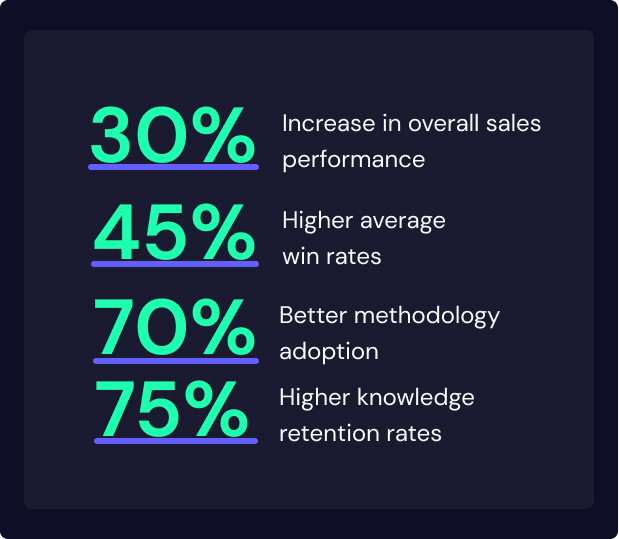
We weighed each tool on five things that decide whether it changes behavior. First, practice realism: how close a simulated conversation gets to a real buyer, including objections and pushback. Second, coaching depth: whether the tool only reports a score or helps a rep improve. Third, analytics a manager or enablement lead can take to leadership. Fourth, setup and adoption, since the best platform is the one reps keep using after week one. Fifth, fit by team size and region, including data residency for teams that need it.
Pricing and ratings change often, and many vendors quote per seat on request. Where a figure is a public tier we cite it; where it is an outside estimate we mark it as such and note that quotes are custom. No number here is invented. Figures attributed to PitchMonster customers come from named case studies, linked inline.
AI role-play and practice tools
This is the layer that turns a finding into a fix. Reps run realistic conversations against an AI buyer, get scored against your playbook, and drill the moments they fumble, before those moments cost a real deal. If your reps sound unready on live calls, start here. Newer entrants like Kendo AI, a self-serve AI role-play tool, have also entered this category; see our PitchMonster vs Kendo AI comparison for how it compares.
1. PitchMonster
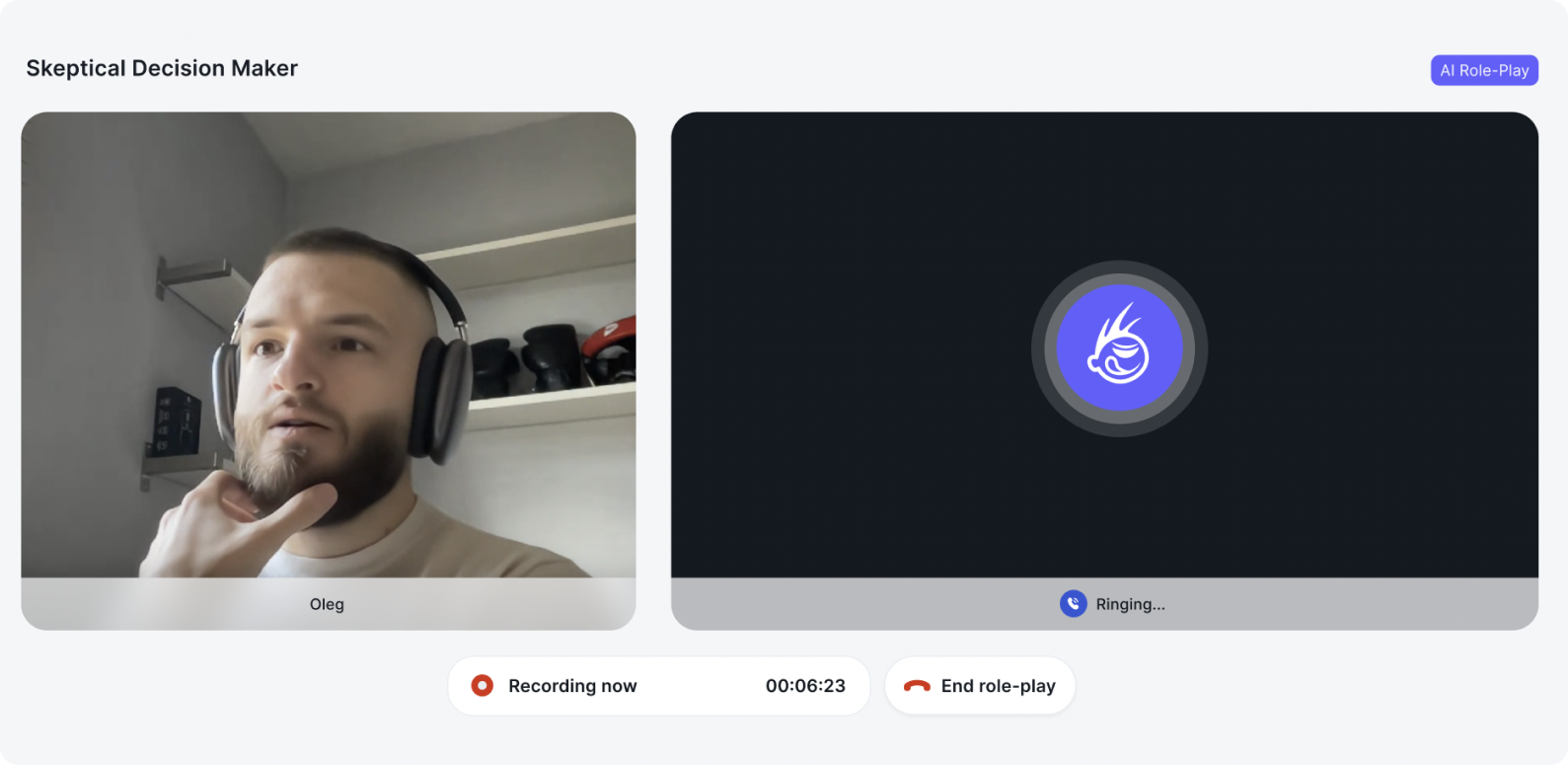
PitchMonster is best for teams that want reps to practice realistic conversations and get coached after every one, not just complete a course. It is the practice-and-coaching layer of the stack, built to sit alongside your CRM rather than replace it.
The difference is the AI Coach. After each session, a Socratic AI sales trainer asks reflective questions that guide the rep to their own insight before they ever see a score, available 24/7. No other tool on this list does that, and it is where behavior changes: reps self-diagnose, then practice the fix. As Wendy Mateo De Perkins of One Park Financial put it, "I think I really like the AI coach. That's definitely going to save us a lot of time."
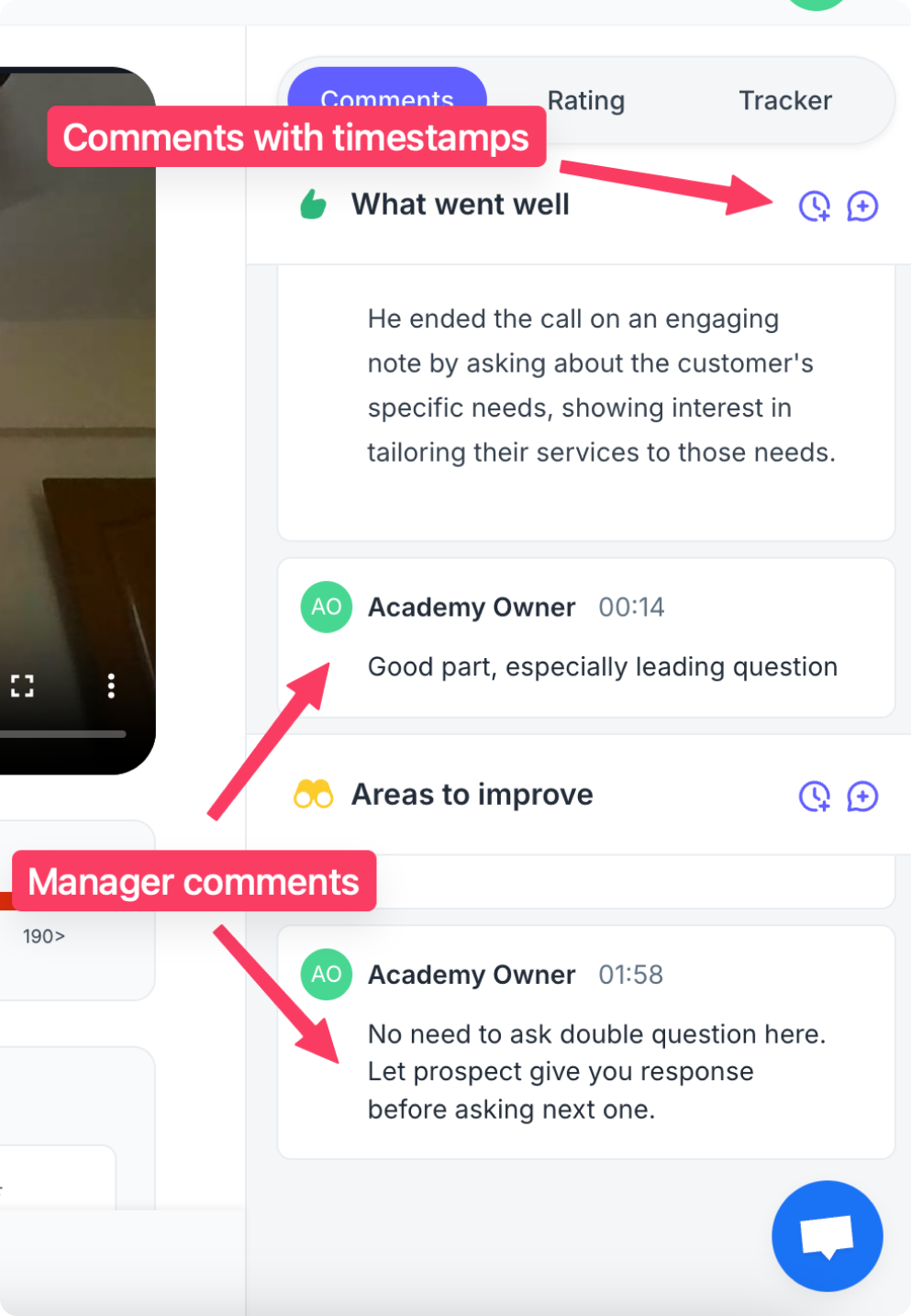
Around that sits the practice engine. Reps run cold calls, discovery, and demos against AI buyers that adapt and object like your real ICP, then get scored against your own playbook. A manager can build a scenario from a call recording, product docs, or a website URL in about two minutes, with four difficulty levels and support for 27 languages. Live Call Analysis scores real recordings against the same scorecard, so practice and live performance share one standard. Scores connect to Salesforce and HubSpot, and PitchMonster is the only European-based platform among the leaders, which matters for teams that need GDPR compliance and EU data residency.
PitchMonster fits sales teams of roughly 10 to 300 reps running consultative B2B motions, with someone who owns training. It holds a 4.9/5 on G2, keeps a 100% enterprise renewal rate since spring 2024, and has trained more than 300,000 reps. Pricing is quote-only (custom per seat), with onboarding, a dedicated CSM, and support included and no setup fees; see pricing for your team size or book a demo to run your first role-play on your own material. Proof: Mentor Group recorded 30% faster ramp, 37% higher performance, a 28% win rate improvement, and 2x more opportunities after rolling out PitchMonster.
2. Hyperbound
Hyperbound is best for cold-call and discovery practice on outbound teams. It builds AI role-play around buyer simulations that react in the moment, so reps face pushback, tough questions, and sudden shifts rather than a fixed script.
Teams design custom buyer personas by industry, role, or personality, then run reps through them and score against frameworks like MEDDIC or SPIN. It connects to Salesforce and HubSpot so scenarios sit in the workflow. Reviewers call the realistic outbound simulations and quick persona building a strong fit for SDR and BDR teams drilling the top of the funnel. Where it is lighter: it leans self-serve, with less of the guided post-session coaching that turns a score into a lasting behavior change, and one G2 theme notes practice drops off after the first month unless managers keep it live.
Hyperbound suits outbound-heavy teams that want volume practice on cold calls and discovery. It holds a 4.9/5 on G2 across 39 reviews, and pricing is by quote. For a side-by-side on coaching depth and team fit, see our Hyperbound alternative breakdown.
3. Second Nature
Second Nature is best for template-driven avatar practice. It uses AI avatars to simulate sales conversations, and reps practice discovery, objection handling, and closing with a persona that adapts as the conversation moves.
Teams can upload their own decks and recordings to tailor scenarios, feedback maps to frameworks like MEDDIC or SPIN, and a template library covers common B2B situations so standard programs roll out quickly. It runs 24/7, so reps do not wait on a manager. Where it is lighter: the coaching is score-and-feedback rather than a guided, reflective loop, G2 reviewers flag scoring that can feel harsh or inconsistent, and the AI handles structured scenarios better than off-script discovery.
Second Nature fits teams that want proven AI role-play with templates to start fast. It holds a 4.6/5 on G2 across 298 reviews, and pricing is by quote. For a direct comparison on coaching depth, see PitchMonster vs Second Nature.
4. Quantified

Quantified is best for practice in regulated industries like life sciences, finance, and insurance. It runs AI role-play built for compliance-heavy selling, where messaging accuracy and certification matter.
Customizable AI personas mimic real buyer behavior so reps can rehearse product presentations and compliance-driven messaging on demand, tied to their territory or upcoming calls. It scores reps across sessions, flags who is ready for certification, and connects to Salesforce, Veeva CRM, Microsoft Dynamics, and learning systems like Docebo and Cornerstone. Where it is lighter: the regulated-industry focus makes it a narrower fit for general B2B teams, and one G2 note asks for deeper objection-handling practice.
Quantified fits enterprise teams in regulated verticals. It holds a 4.6/5 on G2 from a small pool of 16 reviews, and outside estimates put pricing near $85 to $110 per user per month, though quotes are custom and confirmed by demo.
5. UneeQ
UneeQ is best for face-to-face digital-human practice. Reps hold simulated conversations with lifelike AI avatars that show human-like expressions and respond in real time, which makes the interaction feel closer to a video meeting than a voice-only drill.
The platform pulls performance data from Salesforce and HubSpot and returns a scorecard on metrics like talk time after each session. Because modern selling happens on video and in person, the visual realism helps reps practice reading non-verbal cues that voice-only tools cannot develop. Where it is lighter: UneeQ is a practice specialist rather than a full readiness suite, so teams often pair it with a coaching or analytics layer, and cost can be a barrier for smaller projects.
UneeQ fits teams that want high-pressure, face-to-face-style practice where buyer cues matter. Public review counts are limited, and pricing is a custom subscription tiered by deployment scale and usage.
6. Yoodli

Yoodli is best for communication coaching: delivery, pacing, and filler-word habits. It helps reps sharpen how they come across through AI role-play across buyer personas, objection types, and deal stages.
Its Custom Rubrics let managers define evaluation criteria around a methodology like MEDDIC or Challenger, and reps can adjust the AI's personality and difficulty to practice everything from friendly prospects to skeptical decision-makers. It connects to Salesforce and HubSpot. The standout is clear feedback on communication habits, plus a free tier to start. Where it is lighter: as one G2 reviewer put it, Yoodli does not always judge the strategy of what you say, so a rep can deliver a weak pitch with clean pacing and still pass. It coaches how a rep communicates more than how they sell against your ICP.
Yoodli fits teams focused on presentation and delivery skills alongside selling. It holds a 4.7/5 on G2 from a small sample, and a free tier is available with paid plans by quote. For a selling-first comparison, see our Yoodli alternative breakdown.
Sales enablement and readiness platforms
Enablement platforms are the library and the report card. They house content, run structured onboarding and certification, and roll skill data up for leadership. They are strongest for standardizing readiness across a large team, and most pair them with a sharper practice tool for conversation reps.
7. Mindtickle

Mindtickle is best for all-in-one sales readiness at scale. It is a broad suite that combines learning modules, onboarding automation, readiness assessments, role-play, and analytics in one place.
Its adaptive AI buyer adjusts to context, and an AI Copilot automates first-pass feedback so managers review less by hand. A Readiness Index pulls quiz results, role-play performance, and call analytics into a single score, and the suite ties training engagement to Salesforce and HubSpot data. Where it is lighter: the breadth can feel overwhelming at first, setup takes time, and reviewers note the enterprise price tag with average contracts reported near $90K a year. Practice and coaching depth is why many teams add a focused role-play layer on top rather than relying on the suite alone.
Mindtickle fits enterprise teams standardizing readiness across many reps. It holds a 4.7/5 on G2 across 2,223 reviews, and pricing is by quote. If practice and coaching depth is your real goal, compare a Mindtickle alternative built for it.
8. Allego

Allego is best for video-based, mobile learning and asynchronous coaching. Reps record pitches, get feedback, and reach on-demand learning from their phones, which suits distributed and field teams.
Managers can set up scenarios from simple prompts, and analytics can score performance against frameworks like MEDDIC or Challenger. It syncs results and recordings with Salesforce and HubSpot, and Gartner named it a Leader in the 2025 Magic Quadrant for Revenue Enablement Platforms. Where it is lighter: it leans toward recorded practice and content rather than live, adaptive conversation, and G2 reviewers note a learning curve and content that can clutter as libraries grow.
Allego fits teams that value video coaching and need training accessible anywhere. It holds a 4.6/5 on G2 across 694 reviews, ranks well on ease of use, and pricing is by quote.
9. SmartWinnr
SmartWinnr is best for gamified practice, reinforcement, and KPI contests. It blends AI role-play with gamification and workflow automation, so busy reps stay engaged with short, repeatable drills.
Reps practice scenarios with AI buyers that challenge pricing and raise stage-specific objections, and managers build scenarios from templates with a rapid builder. Custom scoring tracks how well reps hit key messaging, instant AI feedback cuts grading time, and it connects to Salesforce and SAP through REST APIs while feeding pipeline data into leaderboards and contests. Where it is lighter: it is a reinforcement and contest layer on top of practice rather than a deep coaching platform.
SmartWinnr fits teams that want to lift participation and reinforce a known playbook, and it is popular in pharma and insurance. It is a repeat G2 leader in sales gamification with strong satisfaction scores, multi-language support for global teams, and pricing by quote.
Conversation intelligence and forecasting tools
These tools tell you what already happened and what is likely to happen next. Conversation intelligence turns real calls into coachable evidence; forecasting turns pipeline into a revenue number leadership can trust. Neither builds skill on its own, so both pair well with a practice layer.
10. Gong

Gong is best for analyzing real sales calls and coaching reps on actual deals. It is the standard for conversation intelligence: it records, transcribes, and analyzes live calls and meetings, then surfaces where reps win, lose, or miss.
It connects to your CRM and turns call data into deal and pipeline signals, so managers coach against real evidence instead of memory. The strengths are deep call analysis, deal-level visibility, and a large integration footprint. Where it is lighter: Gong shows what already happened, and it is not built for reps to rehearse before the call, which is why many teams pair it with a practice tool. The depth of the interface also takes time to learn.
Gong fits revenue teams that want data-driven coaching tied to live deals. It holds a 4.7/5 on G2 across more than 6,470 reviews, the largest review base on this list, and pricing is by quote. For the practice side of the same coaching problem, see how PitchMonster supports rep readiness.
11. Clari

Clari is best for pipeline visibility and forecast accuracy. It pulls activity from emails, calls, and CRM data to give RevOps and leadership a clear read on where deals stand and how the quarter will land.
AI-driven insights capture sales activity automatically, deal tracking sits in one dashboard, and the platform strengthens forecast discipline across a large team. Where it is lighter: reviewers cite a learning curve and heavy admin, and it is a forecasting and revenue tool, not a skill-building one. It tells you the number is at risk; it does not coach the rep who can save the deal.
Clari fits enterprise B2B teams with a dedicated RevOps function, typically 100 reps or more. It holds a 4.6/5 on G2 across 5,559 reviews, and outside estimates put the full stack near $200 to $310 or more per user per month, with custom quotes.
CRM: the system of record
Every tool above reads from or writes to the CRM. It is the backbone, not a performance tool on its own, but no shortlist is complete without naming where the data lives.
12. Salesforce Sales Cloud

Salesforce Sales Cloud is best as the system of record and pipeline manager. It holds accounts, contacts, opportunities, and activity, and it is where most performance tools send their scores and signals.
The strength is reach and extensibility: a huge integration marketplace, deep customization, and reporting that scales from a startup to a global enterprise. Practice, coaching, conversation intelligence, and forecasting tools plug into it rather than replace it. Where it is lighter: on its own it records data and manages process; it does not build selling skill, and heavy customization needs an admin. HubSpot is the common alternative for teams that want a simpler setup.
Salesforce Sales Cloud fits teams that need a durable data backbone under the rest of the stack. It holds a 4.4/5 on G2 across more than 25,000 reviews, the most-reviewed B2B product on G2, and publishes per-user tiers from about $25 to $550 a month.
What most teams get wrong about sales performance tools
The common mistake is treating a sales performance tool as a scoreboard. A dashboard that reports low conversion or missed quota tells you something is wrong, but it does not fix anything. By the time an end-of-quarter report lands, the deals it describes are already lost. Knowing the gap and closing the gap are different jobs, and tracking alone only does the first.
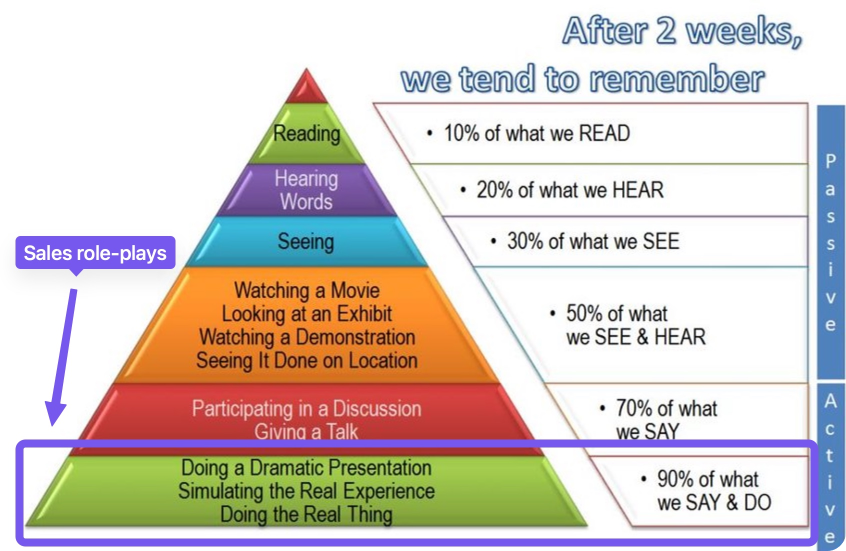
Reps also spend a thin slice of their week actually selling. Adding more tracking without cutting admin makes that worse. And passive learning fades fast: reps forget most of a lecture-style course within days, while active practice, where they say the words out loud and get corrected, is what sticks. That is the case for putting a practice layer next to your reporting layer.
The tools that move the number turn a finding into a rep's next action. Spot that a rep fumbles a pricing objection, then hand them a scenario to drill it until the response holds up. Pairing call analysis, which shows what happened, with AI role-play, which lets reps practice what to do next, is what turns data into behavior change. A scoreboard without a practice field just keeps score.
That finding-to-drill handoff is the job AI sales coaching software is built for: spot the gap, practice it, rescore it.
How to choose a sales performance tool
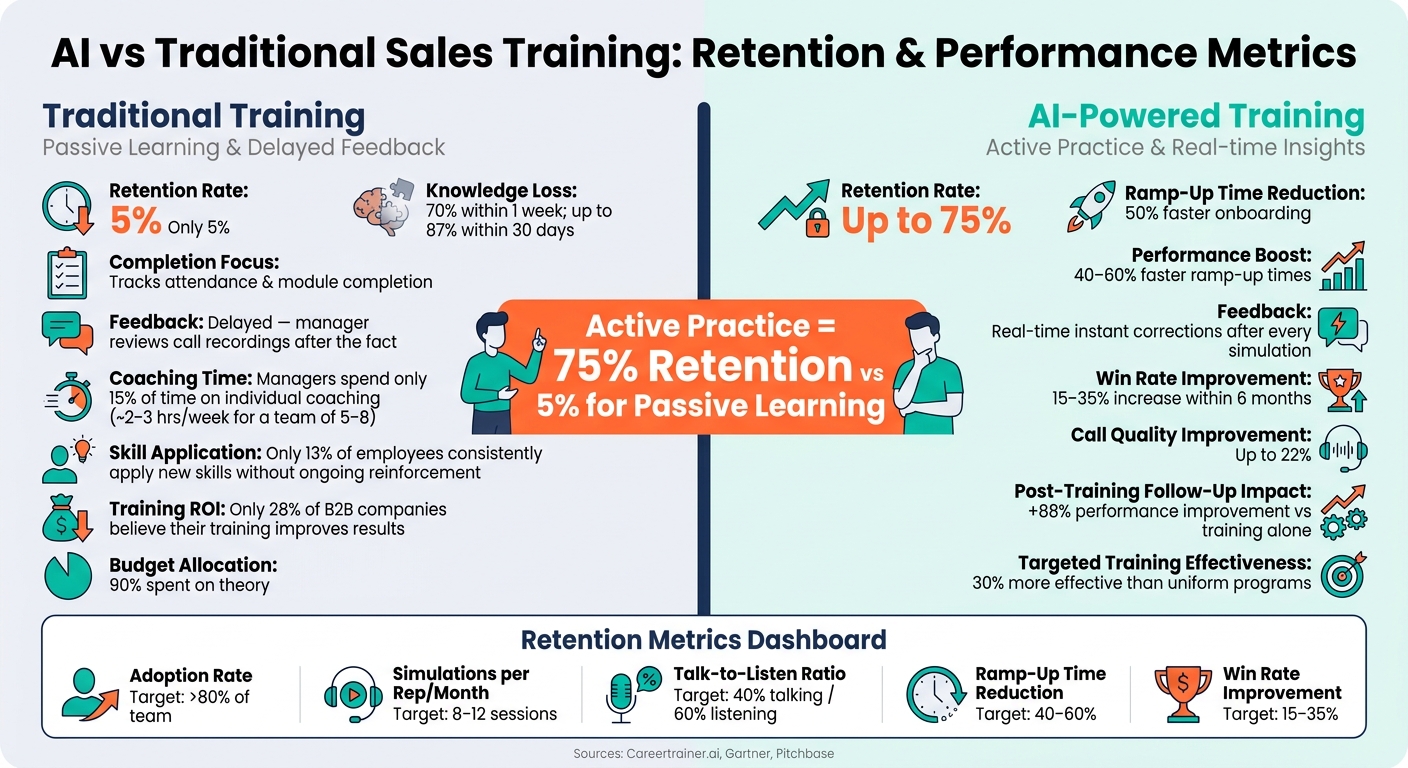
Start with the bottleneck, not the feature list. If reps need more repetitions before live calls, you want an AI role-play and coaching platform. If managers cannot coach at scale, you want conversation intelligence. If you are standardizing readiness across hundreds of reps, you want a broad enablement suite. If your forecast is unreliable, you want a forecasting tool. Most teams have one of these as the real constraint.
Then pressure-test the shortlist on what decides adoption. Does it connect to your CRM, Salesforce or HubSpot, so training and scores live where reps already work? That single question came up again and again in how buyers search for these tools, and it is worth confirming the integration covers opportunities and activities, not just contacts. Will the tool scale from new hires to top performers without a rebuild? Is the interface simple enough that reps keep using it after week one? And does the vendor support onboarding, since a platform nobody adopts returns nothing?
Run a real trial before you commit. Build a scenario on your own use case, put a few reps through it, and judge the output, not the demo. Set a baseline for ramp time and win rate first so you can prove the return after a quarter. For the practice-and-coaching angle specifically, you can book a demo and run your first role-play on your own material. For the wider software market, see our comparison of the best sales training platforms, and for structured drills your reps can start this week, our sales role-play scenarios.
Sales performance tools for a 50-person team
Mid-sized teams get squeezed. They are past the point where a manager can coach every rep by hand, but not big enough to absorb a heavy enterprise suite with a six-month rollout. For a team around 50 reps, the right move is usually a focused practice-and-coaching platform plus the CRM and call-analysis tools you already run.
PitchMonster is built for this range. It fits teams of roughly 10 to 300 reps, a manager can stand up a scenario from a call recording or website URL in about two minutes, and onboarding runs in hours rather than months. Scores flow into Salesforce or HubSpot, so a team lead sees skill gaps in the same place they track pipeline. If you already use Gong, keep it for live-deal coaching and add practice on top; the two answer different halves of the same problem.
Skip the tools whose sweet spot is 100-plus reps with a dedicated RevOps function, like Clari, unless forecasting is your specific pain. For a 50-person team, the win is fast deployment, real adoption, and one shared scorecard, not the widest feature list. Prove it on ramp time and win rate for your next cohort of hires, then expand.
Frequently asked questions about sales performance tools
What are sales performance tools?
Sales performance tools are software that helps reps sell better and managers coach at scale. They span several layers: AI role-play and practice, communication coaching, enablement and readiness, conversation intelligence, forecasting, and the CRM underneath. The layer that changes rep behavior fastest is practice and coaching, where reps rehearse real conversations and fix gaps before the next live call.
What is the difference between sales performance tools and sales performance management software?
Sales performance management (SPM) software handles compensation, quota planning, and territory design, tools like Xactly, CaptivateIQ, Varicent, and Salesforce Spiff. Sales performance tools in the practice-and-coaching sense build selling skill through role-play, coaching, and call analysis. SPM tells you who hit quota; practice tools change whether a rep can.
How do I improve sales performance with these tools?
Start with your bottleneck, then match a tool to it. If reps need more reps before live calls, use an AI role-play and coaching platform. If managers cannot coach every deal, add conversation intelligence. If you are onboarding at scale, add an enablement suite. Set a baseline for ramp time and win rate first, so you can prove the change after a quarter.
What tools do salespeople use?
Most sellers work across a CRM (Salesforce or HubSpot) as the system of record, a sales engagement or dialer tool, and conversation intelligence for call visibility. On top of that, high-performing teams add practice and coaching tools so reps rehearse before real calls, plus enablement platforms for content and readiness. The practice layer is where selling skill actually gets built.
How do you measure sales performance?
Measure it on outcomes and the behaviors behind them. Outcome metrics include win rate, ramp time, average deal size, and quota attainment. Behavioral metrics include objection-handling quality, talk-to-listen ratio, and discovery depth, which conversation intelligence and role-play scoring surface. Tie a tool to one baseline metric before rollout, then compare after a quarter or two.
Which sales performance tools work best for a 50-person team?
A 50-person team usually wants a focused practice-and-coaching platform it can deploy without a long rollout, not a heavy enterprise suite. PitchMonster fits teams of roughly 10 to 300 reps and builds a scenario from a call recording or website URL in about two minutes. Pair it with your CRM and, if you already run Gong, keep call analysis for live-deal coaching.
How much do sales performance tools cost?
Most vendors price per seat and quote on request, so published numbers are rare. PitchMonster is quote-only (custom per seat), with onboarding, a dedicated CSM, and support included and no setup fees. Salesforce Sales Cloud publishes per-user tiers from about $25 to $550 a month. Enterprise suites like Mindtickle and Gong typically run into five or six figures a year. Always confirm current pricing with each vendor.
Do sales performance tools integrate with our CRM?
The good ones do. PitchMonster, Hyperbound, Second Nature, Yoodli, Mindtickle, Allego, and Gong all connect to Salesforce and HubSpot, so practice scores and call data live where reps already work. Before you buy, confirm the integration covers the objects you care about, such as opportunities and activities, not just contact sync.
How do I measure ROI from a sales performance tool?
Tie the tool to metrics you already track: ramp time for new hires, win rate, average deal size, and quota attainment. Set a baseline before rollout, then compare after one or two quarters. One PitchMonster customer, Mentor Group, recorded 30% faster ramp and a 28% win rate improvement, which is the kind of before-and-after a budget owner can defend.