Call coaching software records, transcribes, and analyzes sales calls so managers and reps can see what worked, what missed, and where deals slip. It uses AI to read signals like talk-to-listen ratio, question frequency, and objection handling, then turns hours of recordings into a handful of reviewable scorecards. The best tools write call data back to the CRM, so coaching happens where reps already work.
This guide compares the 10 best call coaching software tools for sales teams in 2026, sorted by what each one does best: deep post-call analysis, live in-the-moment guidance, or a mix of both. We flag where each tool fits, what it roughly costs, and how it rates on G2. We also name one gap every call-analysis tool shares, then cover the practice layer that closes it.
For where call coaching fits in a broader coaching practice, see our sales coaching guide.
Quick comparison
Here is the shortlist at a glance. "Coaching style" is the timing axis that should drive your pick. "Pricing fit" is the segment each tool serves best, since most vendors quote by seat count and contract. G2 ratings are pulled from public g2.com listings and move over time.
Tool | Coaching style | Pricing fit | G2 rating | Best for |
|---|---|---|---|---|
PitchMonster | Practice + AI coaching (pre-call) | SMB to enterprise; by quote | 4.9/5 | Rehearsing the moment before the live call |
Gong | Post-call + real-time deal alerts | Enterprise | 4.7/5 | Teams with a dedicated RevOps function |
Mindtickle | Post-call inside a training platform | Enterprise | 4.7/5 | Large enablement, training, and certification |
Jiminny | Post-call, asynchronous-first | SMB and mid-market | 4.6/5 | Mid-market B2B teams that want depth cheaply |
Balto | Real-time guidance | Mid-market to enterprise; by quote | 4.5/5 | High-volume inside sales and telesales |
Allego | Post-call + video practice | Mid-market to enterprise; by quote | 4.6/5 | Regulated-industry enablement and content |
Salesloft Conversations | Both (real-time whisper + post-call) | Mid-market to enterprise | 4.7/5 | Teams already running Salesloft |
Clari Copilot | Real-time + forecasting | Mid-market to enterprise | 4.6/5 | Teams using Clari for pipeline |
Chorus by ZoomInfo | Post-call + risk flags | Mid-market to enterprise | 4.5/5 | Teams standardized on ZoomInfo |
Salesforce Sales Cloud | Post-call inside the CRM | Enterprise | 4.4/5 | Salesforce shops wanting native coaching |
Ratings and prices reflect publicly available figures at the time of writing and shift over time. Treat the table as a starting shortlist, then confirm current numbers with each vendor before you buy.
How to coach sales calls with AI
Before the tool list, it helps to see how AI coaching actually works on a real call. Most conversation intelligence platforms follow the same three steps, so the skill transfers no matter which one you pick.
First, the software captures and transcribes the call. It joins the dialer or meeting, records both sides where regulations allow, and produces a searchable transcript within minutes. That alone saves a manager from scrubbing through an hour of audio to find two coachable moments.
Second, it tags the moments that matter. Tools like Gong use trackers to flag keywords and themes, so a competitor mention, a pricing objection, or a long rep monologue surfaces automatically. A manager can jump straight to the 90 seconds where a deal turned instead of listening end to end.
Third, it scores the conversation against a playbook. The AI reads talk-to-listen ratio, question count, and sentiment, then rolls those into a scorecard tied to the behaviors you care about. Over dozens of calls, patterns appear that a single review would miss.
The catch is timing. Every step above happens after the call ends, so the rep already lived the mistake. That is fine for reviewing patterns, but it means the fix always arrives one deal late. Keep that limit in mind as you compare tools, because it is the thread that runs through this whole category.
What is call coaching software?
Call coaching software captures sales calls and meetings, transcribes them, and uses AI to analyze what happened. It tracks signals like talk-to-listen ratio, question frequency, sentiment shifts, and keyword triggers, then turns those into scorecards and coaching notes a manager can act on.
The point is scale. A manager cannot sit in on every call, so the software reviews all of them and surfaces the few that need attention. That frees a manager to coach the middle of the team, the reps who are not in crisis but have the most room to grow, instead of only the loudest fires.
It also cuts admin. The software handles transcription, call summaries, and CRM updates automatically, so reps spend less time logging and more time selling. When call data flows into the deal record on its own, pipeline reviews start from facts instead of memory.
People often use "call coaching software" and "conversation intelligence" to mean the same thing, and the overlap is real. Conversation intelligence is the engine that reads the call; call coaching is what a manager does with that read. Two design choices separate these tools: when the coaching happens, and how deep the analysis goes. That first choice, real-time versus post-call, should drive your shortlist, so we cover it next.
Real-time vs post-call coaching
The biggest split in this category is timing. Some tools coach reps while the call is live. Others analyze the recording afterward. Neither is better in the abstract, because they solve different problems.
Real-time coaching runs during the call. As the conversation unfolds, the tool surfaces talking points, objection responses, and battlecards in a sidebar, and some alert the manager the moment a rep starts to struggle. This suits high-volume environments like inside sales and telesales, where reps are on the phone all day and a nudge in the moment changes the outcome.
Post-call coaching analyzes the recording after the call ends. It scores the conversation, highlights key moments, and surfaces patterns across dozens of calls so managers spot trends a single review would miss. This suits longer, consultative deals where the value is in reviewing the arc of a conversation, not reacting inside it.
Here is how the two compare:
Dimension | Real-time coaching | Post-call coaching |
|---|---|---|
When it helps | During the live call | After the call ends |
Best for | High-volume phone teams, telesales, SDRs | Complex, consultative, multi-stakeholder deals |
What it delivers | Live prompts, battlecards, monologue alerts | Scorecards, transcripts, trend analysis |
Risk | Prompts can disrupt natural conversation flow | A rep still learns on a live deal |
Typical tools | Balto, Clari Copilot | Gong, Chorus, Jiminny |
A second way vendors describe this split is AI-led versus AI-assisted coaching. AI-led means the software pushes prompts straight to the rep in the moment, like a battlecard or a monologue alert. AI-assisted means the AI does the analysis and hands it to a manager, who still owns the coaching conversation. AI-led maps to real-time and high-volume work; AI-assisted maps to post-call review on consultative deals.
Many teams that can afford it run both: real-time to steer the call, post-call to coach the pattern. What neither mode does is let a rep practice before the call, which is the limit we return to at the end. Keep the split in mind as you read the list, because most tools lean one way.
What to look for
Once you know whether you need real-time, post-call, or both, a few features separate tools that get used from tools that gather dust. Use the checklist below as a buyer's shortlist.
Start with CRM and dialer integration. If the tool does not sync with Salesforce, HubSpot, Pipedrive, or your phone system, reps will not use it and managers will not trust the data. As one common piece of enablement wisdom goes, if reps have to leave their dialer or CRM to use the software, they will not. Automatic CRM updates also keep pipeline data accurate without manual entry.
Then look at analysis depth. Good tools go past transcription to read tone, pacing, sentiment, talk-to-listen ratio, and keyword triggers, so a manager can tell a passing competitor mention from a real concern. Searchable call libraries and the ability to clip strong moments from top reps turn raw recordings into onboarding material.
Watch the scorecard design. A scorecard that grades twenty behaviors at once buries the signal. The tools reps actually improve with focus coaching on one or two behaviors at a time, like objection handling or discovery quality, until those become habit.
Run any shortlist through five quick questions:
- Does it sync with our CRM and dialer without extra work?
- Does the analysis go past a transcript into tone, pacing, and objections?
- Can a manager coach in the flow, with clips and timestamped notes?
- Do the scorecards focus on a few behaviors, not a wall of metrics?
- Does it help a rep fix the gap, or only report it?
That last question is the one most buyers skip. Analysis is necessary, but on its own it leaves the practice gap open, which is exactly what the final section is about.
PitchMonster's sales call analysis closes that loop: real calls scored on the same scorecard reps practice against.
10 best call coaching software tools
The list below is grouped by what each tool does best. PitchMonster leads because it closes the one gap the rest share. Gong, Jiminny, and Chorus lead on post-call conversation intelligence. Balto and Clari Copilot lead on real-time guidance. Mindtickle, Allego, Salesloft, and Salesforce fold coaching into a broader platform.
1. PitchMonster: practice the call before it happens
Every other tool on this list analyzes calls that already happened. PitchMonster is the practice layer that comes first. It is an AI sales role-play platform where reps rehearse realistic conversations with AI buyers before the real call, so the skill gap closes in practice instead of on a live deal. That is why it sits at the top: it fixes what call recorders can only report.
The buyer adapts, objects, and pushes back like your actual ICP, and a manager can stand up a scenario in about two minutes. The result is a coaching loop that runs on its own schedule, not the manager's calendar, and it pairs cleanly with any call recorder you already own.
Realistic AI buyers tuned to your ICP
Reps practice against an AI buyer that behaves like the person they actually sell to. It stalls, raises pricing pushback, brings in a skeptical stakeholder, and changes its mind mid-conversation. Because the buyer reacts to what the rep says, no two runs are identical, so a rep can drill the same hard moment ten times and get ten realistic reps of it.
Scenarios built from a real call in about two minutes
A manager can build a role-play from a real call recording, a product doc, or a website URL, without writing a script from scratch. That means the practice mirrors the exact deals your team is losing, and a gap surfaced by your call coaching tool becomes a rehearsal the same afternoon. PitchMonster ships with pre-made scenarios and supports popular sales methodologies, so a new team is not starting from a blank page.
The AI Coach: Socratic feedback no recorder has
This is the piece no call recorder offers. After each session, a Socratic AI Coach asks the rep what they noticed and what they would do differently, guiding them to their own insight before they ever see a score. Reps self-diagnose, which is where a habit actually changes, instead of nodding along to a manager's notes. It is the clearest line between a tool that reports and a tool that improves.
Objective scorecards on tone, pacing, and messaging
Every session is scored against customizable scorecards that grade tone, pacing, discovery, and messaging. Managers get concise performance summaries and can spot skill gaps without sitting through each session, so coaching stays consistent even as the team grows. The scoring is the same for every rep, which removes the guesswork from who is ready.
27+ languages with EU data residency
PitchMonster runs role-plays in 27-plus languages, so global teams practice in the language they sell in. It is the only European-based platform among the top options, with GDPR-ready data handling and EU data residency, which matters for regulated and cross-border sales orgs that cannot send call data just anywhere.
Practice that runs 24/7
Because the AI buyer and AI Coach are always available, practice no longer waits on a manager's calendar. A new hire can run reps at 9pm the night before a big call, and a full team can certify on new messaging over a weekend. That turns coaching from a scheduling problem into an always-on habit.
Fits your existing stack
PitchMonster is designed to sit alongside your CRM, your enablement content, and whatever call recorder you already run. It does not replace Gong or Salesloft; it uses the gaps they surface as fuel for the next practice session, so the two layers reinforce each other instead of competing.
Teams running this practice-first loop have seen 37% higher performance and 30% faster ramp (Mentor Group case study). On the AI Coach specifically, Wendy Mateo De Perkins at One Park Financial put it plainly: "I think I really like the AI coach. That's definitely going to save us a lot of time."
Coaching style: practice and AI coaching, before the call. Pricing: by quote, see pricing. Rating: 4.9/5 on G2. Best for: any team that wants reps to fix the gap before it costs a deal.
PitchMonster is strongest when it runs next to a call recorder, not instead of one. If you want to see it work on your own scenarios, book a demo and we will build your first practice scenarios from your real calls.
2. Gong: post-call conversation intelligence for enterprise RevOps
Gong is the reference point for conversation intelligence. It captures calls, video meetings, and emails, transcribes them, and uses AI to surface patterns in how reps sell. Managers benchmark talk-to-listen ratios, question frequency, and objection handling against the team, and Gong flags critical deal moments like competitor or pricing mentions for follow-up.
Gong goes beyond single conversations to score deal health across the pipeline, drawing forecasting signals straight from call data. That depth suits enterprise teams running complex, multi-stakeholder deals with a dedicated RevOps function to act on the insights. Gong reports that customers like Diligent embedded it to lift close rates by 7.4%, the kind of outcome that justifies the enterprise price for a team at scale.

Verdict: the gold standard for post-call analysis if you have the scale and the RevOps muscle to use it. Pricing runs roughly 100 to 150 dollars per user per month on annual contracts, with an annual platform fee and one-time onboarding on top of that, itemised in our Gong pricing breakdown. Rating: 4.7/5 on G2. Coaching style: post-call, with real-time deal alerts.
3. Mindtickle: coaching plus certification for large enablement teams
Mindtickle is a revenue productivity platform that folds call coaching into a broader readiness and training system. Rather than only analyzing past calls, it builds structured learning paths, AI role-plays, and certification workflows, then uses call analysis to spot skill gaps and assign targeted modules to fix them.
Certification is central. Reps complete training, pass exercises, and hit benchmarks before they sell live, which fits large organizations onboarding cohorts or rolling out new messaging across a whole team. Managers track progress with coaching scorecards and a readiness index, so leadership can see who is ready before a rep ever touches a live deal.

Cons: custom pricing can reach six figures, and our Mindtickle pricing review walks through what drives a quote; the platform can feel heavy for smaller teams to administer.
Verdict: the right pick when you want coaching, training, and certification unified for a big enablement motion, not a lightweight call reviewer. Pricing is custom. Rating: 4.7/5 on G2. Coaching style: post-call inside a training platform.
4. Jiminny: collaborative coaching for mid-market teams
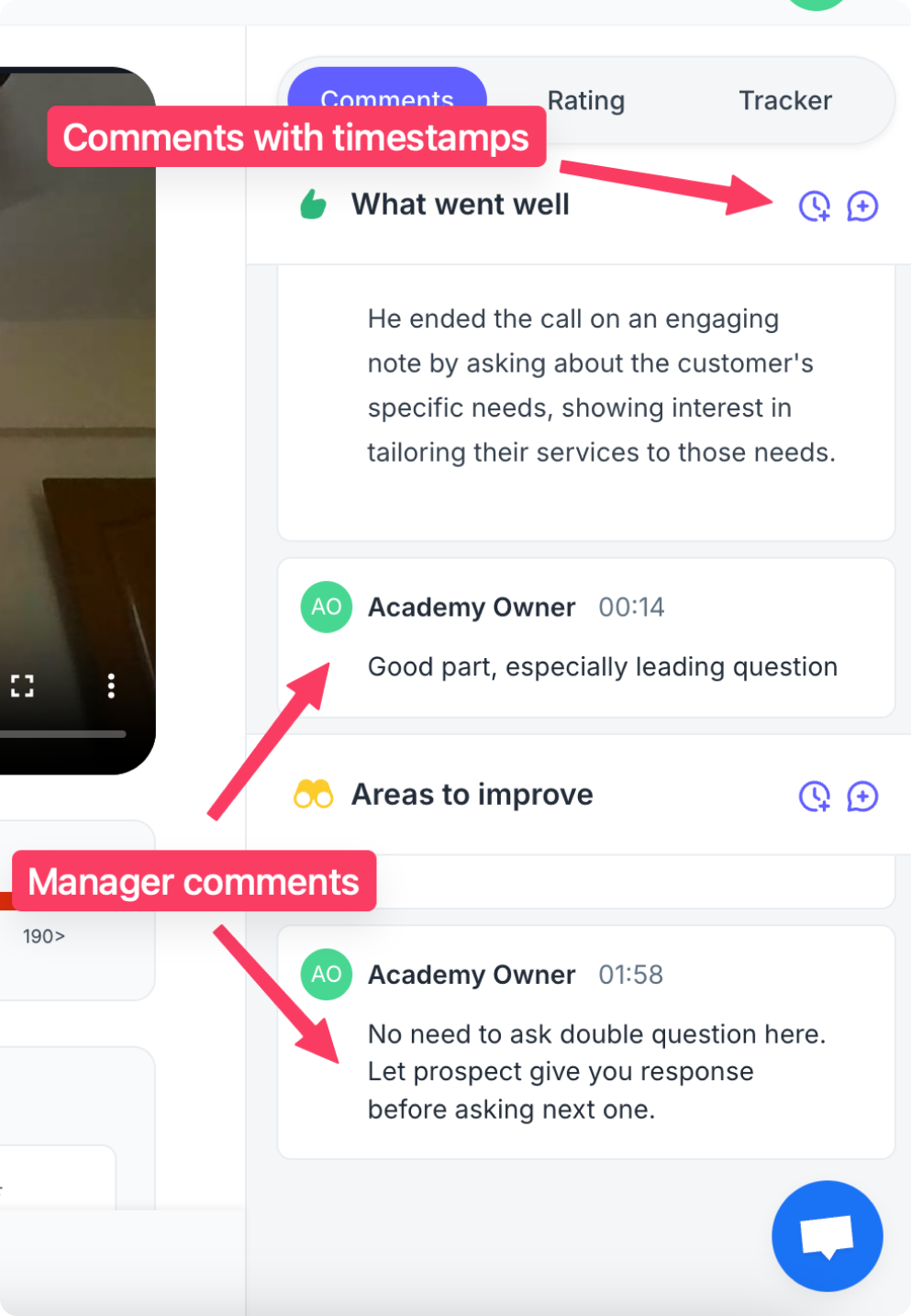
Jiminny brings conversation intelligence to mid-market teams without the enterprise complexity or price tag. It records calls, video meetings, and emails, then leans into asynchronous coaching: managers leave timestamped comments directly on recordings, and reps tag peers or managers for feedback on specific moments, so coaching becomes a shared habit rather than a top-down review.
Its Ask AI feature lets managers search recordings for moments like pricing or objections instead of listening end to end. That keeps review time short even as call volume grows.
5. Balto: real-time guidance for high-volume phone teams
Balto is built for real-time guidance during live calls. Through an active sidebar, it tracks the conversation and surfaces instant prompts, talking points, objection scripts, and playbook reminders, so reps adjust without waiting for a post-call review. Its coaching-moment alerts notify a manager the instant a rep starts to struggle, missing a key question or mishandling an objection, so they can listen in and step in.
Balto also automates call scoring against manager-set criteria, so problem calls surface without manual review. It ties feedback to active deals through CRM integration, which makes it a natural fit for phone-heavy teams that live on the dialer.
6. Allego: video coaching and content for regulated industries

Allego combines video-based coaching, conversation analysis, and content management in one platform. Alongside call analysis, it leans on asynchronous video practice: reps record pitches or demos, and managers and peers leave timestamped comments on the video timeline, which is useful for onboarding and refining messaging before live calls. Allego reports that Hillman Group cut new-rep ramp from six months to 90 days by letting reps practice and get feedback without waiting for live role-play sessions.
Its Refract technology analyzes conversations to find effective behaviors and turn them into coaching clips, and it offers a large integration library so feedback and content reach reps inside the tools they use. ZoomInfo has said it saved 400 hours by using Allego's AI pre-scoring and insights, a sign of how much review time the analysis can remove.
7. Salesloft Conversations: coaching for teams already on Salesloft
Salesloft Conversations is the call coaching module inside the Salesloft platform, so calls, cadences, and deals live in one place. It records inbound and outbound calls through the Salesloft dialer, then generates AI summaries and searchable transcripts so managers skip long reviews. Salesloft points to customers like 3M, which reported closing deals 2.5 times faster after standardizing on the platform.
For live coaching, managers can listen to active calls and whisper advice to reps in the moment, and the Rhythm engine flags deal risks and next steps inside the rep's workflow. That makes it a natural fit for teams already running their whole sales motion in Salesloft.

8. Clari Copilot: real-time coaching tied to the forecast
Clari Copilot sits between conversation intelligence and revenue forecasting, which makes it a strong fit for teams that want to connect call quality to pipeline health. It captures call and meeting data and flags risks like competitor mentions or pricing concerns so managers catch at-risk deals early.
Its standout is real-time coaching: live battlecards, suggested objection responses, and a monologue alert that warns reps when they are dominating the conversation. It syncs with Salesforce, HubSpot, and video tools, writing conversation data back into the CRM automatically.

9. Chorus by ZoomInfo: coaching next to prospecting data
Chorus pairs conversation intelligence with ZoomInfo's contact and company database, so call insights sit next to buyer and account data. Backed by a database of roughly 500 million contacts and 100 million companies, it analyzes calls, meetings, and emails to flag what separates top performers, and its playlists group calls by theme, like objection handling or pricing, so managers can coach asynchronously without scrubbing through recordings.
Chorus also tracks deal momentum, flagging stalled stakeholders or repeated competitor mentions for action. Chorus notes that 57% of sales reps struggle with accurate pipeline forecasting, which is why its momentum tracking resonates with sales leaders. Teams already using ZoomInfo for prospecting get the most from the tight integration.

10. Salesforce Sales Cloud: native coaching inside the CRM
Salesforce Sales Cloud brings call coaching directly into the CRM through its Einstein Conversation Insights and Agentforce capabilities. Because coaching sits next to deal records and account history, managers can tie a call moment straight to the opportunity it affects, without exporting data to a third-party tool.
Salesforce analyzes calls to uncover missed insights and coaching moments, then keeps everything in the same system reps already log into. Agentforce Sales Coach adds AI-guided practice scenarios built from real CRM data, and early adopters like the healthcare company Precina have used it to onboard staff with instant feedback on accuracy and compliance. For teams already on Salesforce, that native integration can remove the need for a separate coaching platform.

Best call coaching software by team type
The right pick depends less on a feature checklist than on how your team sells. Here is a quick read by team type, since the same tool rarely fits a two-rep startup and a 300-seat enterprise.
Inside sales and SDR teams live on the phone at volume, so real-time guidance pays off fastest. Balto and Clari Copilot prompt reps mid-call, while a practice layer like PitchMonster drills the cold-call opener and the first objection before the dial. For SDR collaboration, Jiminny's timestamped comments let a pod coach each other without a manager in every session.
Enterprise and RevOps-led teams running complex, multi-stakeholder deals want depth and forecasting. Gong and Chorus lead here, and Mindtickle fits when certification and structured training matter as much as call review. These teams usually have the RevOps function to act on the analysis.
Mid-market teams want depth without the enterprise price or rollout. Jiminny is the common value pick, and Salesloft Conversations makes sense if the team already runs Salesloft end to end.
Remote and global teams need coaching that does not depend on being in the same room. Asynchronous review (Jiminny, Allego) and always-on practice in 27-plus languages (PitchMonster) keep coaching consistent across time zones.
Small teams usually want one tool that earns its seat. A meeting recorder with summaries covers the basics, and PitchMonster lets a small team practice real scenarios without hiring a dedicated enablement manager. Whatever the size, the pattern holds: analysis finds the gap, practice closes it.
How to roll out a call coaching program
Buying a tool is the easy part. The teams that see results treat call coaching as a program, not a piece of software, and roll it out in a way reps trust. Here is how to stand one up without the pushback that sinks most launches.
Start with one or two behaviors, not twenty. Pick the metrics that move deals for your team, like objection handling or discovery quality, and coach those until they become habit. A scorecard that grades everything at once buries the signal and overwhelms reps, so narrow beats broad in the first quarter.
Include reps in the rollout, not just managers. When leadership uses the software only as a reporting tool, reps read it as surveillance. Bring a few reps into the trial, let them see the analysis on their own calls, and frame it as a resource for growth. Adoption follows trust, and trust follows involvement.
Build a certification checkpoint. A program needs a bar, not just feedback. Have reps hit a readiness benchmark, in a role-play or a scored live call, before they own a territory or a new product line. Certification turns coaching from an open-ended activity into a milestone the whole team can see.
Pair analysis with practice. Analysis tells a rep what went wrong; practice lets them fix it before the next call. The strongest programs close the loop: a manager surfaces a gap in the call data, then assigns a role-play so the rep drills that exact moment against an AI buyer instead of a live prospect.
Combine AI scores with human judgment. AI can miss the nuance of a rep who adapts to a buyer's signals, so review the scores with a manager's eye rather than treating them as final. A short weekly review of a handful of flagged calls beats an automated grade nobody discusses. Done this way, a call coaching program compounds instead of stalling after month one.
Common mistakes when choosing call coaching software
A few predictable missteps separate a tool that improves outcomes from one that gathers dust. Avoiding them is mostly about fit and follow-through, not features.
Chasing flashy features over workflow fit. A tool can look impressive with a wall of metrics, but if reps have to leave their CRM or dialer to use it, adoption drops fast. Choose the tool that fits how your team already works, even if a competitor's demo has more dashboards.
Treating it as a manager-only reporting tool. When reps see the software as surveillance rather than support, they disengage. Involving them early, as covered above, changes how the whole team reads it.
Starting with too many metrics. Bombarding reps with data creates confusion and kills focus. Begin with one or two behavioral metrics and add more only once those stick. Poor CRM integration is a related trap, since it pushes manual data entry back onto reps and erodes the time savings you bought the tool for.
Over-relying on AI scores without oversight. AI can penalize a rep who reads the room and adapts, so pair automated scores with human review. And remember that software alone changes nothing: the tool is only as good as the coaching habit around it, which is why the rollout matters as much as the purchase.
Where practice fits
Every tool above shares one limit. They analyze calls that already happened. That means a rep learns a lesson on a live deal, after the discovery question was fumbled or the objection landed wrong. The recording tells you what went wrong, but it cannot give the deal back.
That is the gap a practice layer fills, and it is where PitchMonster sits. Reps rehearse realistic conversations with AI buyers before the real call. The buyer adapts, objects, and pushes back like your actual ICP, and a manager can build a scenario from a real call recording, product docs, or a website URL in about two minutes, in 27-plus languages.
The piece no call recorder has is the AI Coach. After each session, a Socratic AI trainer asks the rep what they noticed and what they would do differently, guiding them to their own insight before they ever see a score. Reps self-diagnose, which is where the habit actually changes, and it runs 24/7, so practice no longer waits on a manager's calendar.
The two layers work together. Record real calls with Gong or Chorus, find the skill gap in the data, then close it in PitchMonster: the rep drills the exact moment, ten times if they need it, against an AI buyer instead of a live prospect. Teams running this loop have seen 37% higher performance and 30% faster ramp (Mentor Group case study).
Want to turn the gaps your call coaching software surfaces into reps who close them? Book a demo and we will build your first practice scenarios from your real calls.
FAQ
What is call coaching software?
Call coaching software records, transcribes, and analyzes sales calls so managers and reps can see what worked and what missed. It uses AI to read signals like talk-to-listen ratio, question frequency, and objection handling, then turns hours of recordings into a few reviewable scorecards. Most tools also write call summaries back to the CRM so coaching happens where reps already work.
What is the difference between real-time and post-call coaching?
Real-time coaching surfaces prompts, battlecards, and objection responses while the call is live, so reps adjust in the moment. Post-call coaching analyzes the recording afterward, scoring the conversation and surfacing patterns across many calls. Real-time suits high-volume phone teams; post-call suits complex deals where managers want depth over speed. Many teams run both.
What is the difference between AI-led and AI-assisted coaching?
AI-led coaching pushes prompts straight to the rep during the call, like a live battlecard or a monologue alert. AI-assisted coaching hands the analysis to a manager after the call, who then coaches with the AI's read as a starting point. AI-led fits high-volume phone work; AI-assisted fits consultative deals where a human still owns the coaching conversation.
How much does call coaching software cost?
Pricing spans a wide range. Mid-market conversation intelligence like Jiminny starts around 85 dollars per user per month. Enterprise platforms like Gong and Chorus run roughly 100 to 222 dollars per user per month on annual contracts, often with seat minimums and deals above 40,000 dollars a year. Real-time guidance tools and all-in-one suites usually price by quote. Confirm current numbers with each vendor.
Is AI call coaching software worth it?
For most teams past a handful of reps, yes. A manager cannot review every call, so AI reviews all of them and surfaces the few that need attention, which is where coaching time pays off. The value depends on adoption: pick a tool that syncs with your CRM and dialer, focus on one or two behaviors at a time, and pair analysis with practice so reps fix the gap before the next live call.
Does call coaching software replace sales role-play?
No. Call coaching software analyzes calls that already happened, so a rep learns the lesson on a live deal. Role-play platforms let reps rehearse the same hard moment before it costs a deal. The two are complementary: record real calls with a tool like Gong, find the skill gap, then close it by having reps practice against an AI buyer in PitchMonster.
What should call coaching software integrate with?
At minimum your CRM (Salesforce, HubSpot, or Pipedrive) and your dialer or meeting tools (Zoom, Teams, or a native phone system). If reps have to leave their CRM or dialer to use it, adoption drops. CRM sync also keeps pipeline data current by writing call summaries and next steps back to the deal record automatically.
Is there free call coaching software?
A few meeting tools offer free transcription and basic call summaries, and some vendors run limited free tiers. They are fine for a solo rep or a first look, but they rarely include the scorecards, coaching workflows, and CRM writeback a growing team needs. Most sales teams outgrow a free plan within a quarter and move to a paid tool priced by seat.
What is the best call coaching software for small teams?
Smaller teams usually want depth without enterprise overhead or seat minimums. Jiminny is a common pick at roughly 85 dollars per user per month with asynchronous coaching and direct CRM sync. For the practice side, PitchMonster lets a small team drill real scenarios without hiring a dedicated enablement manager, so reps ramp without burning live pipeline.
PitchMonster vs Gong: which do I need?
They solve different problems, and many teams run both. Gong is conversation intelligence: it records real calls and shows what happened. PitchMonster is the practice layer: reps rehearse with an AI buyer before the call, then a Socratic AI Coach helps them self-diagnose. Record with Gong to find the skill gap, then close it in PitchMonster before it costs a live deal.