AI sales role-play feedback is the coaching a rep gets after practicing a conversation with an AI buyer. Instead of a single grade, the best systems return specific, behavior-level guidance - did the rep set a next step, handle the pricing objection, talk too much - in seconds, against the same scorecard every time. That consistency is what turns practice into real improvement on live calls.
Most teams already run role-play exercises for sales training. The hard part is the feedback. A rep finishes a session, gets a vague "good job" or a number with no context, and carries the same habit into the next real call. This guide covers what good AI feedback looks like, what it should measure, when it should land, and eight best practices that make reps act on it.
What is AI sales role-play feedback?
AI sales role-play feedback lets a rep practice with a responsive AI buyer and then receive instant, behavior-specific coaching on how the conversation went. The system reads measurable moments - whether pricing came up and how it was handled, whether a next step was set, how often filler words crept in - and returns guidance the rep can act on, not just a grade.
That makes it different from an old-style role-play with a peer, where feedback depended on who was watching and how much time they had. An AI buyer pushes back like your real prospect, then scores the call against the same rubric for every rep. A new hire practicing at 7am and a veteran running reps at 9pm get judged the same way.
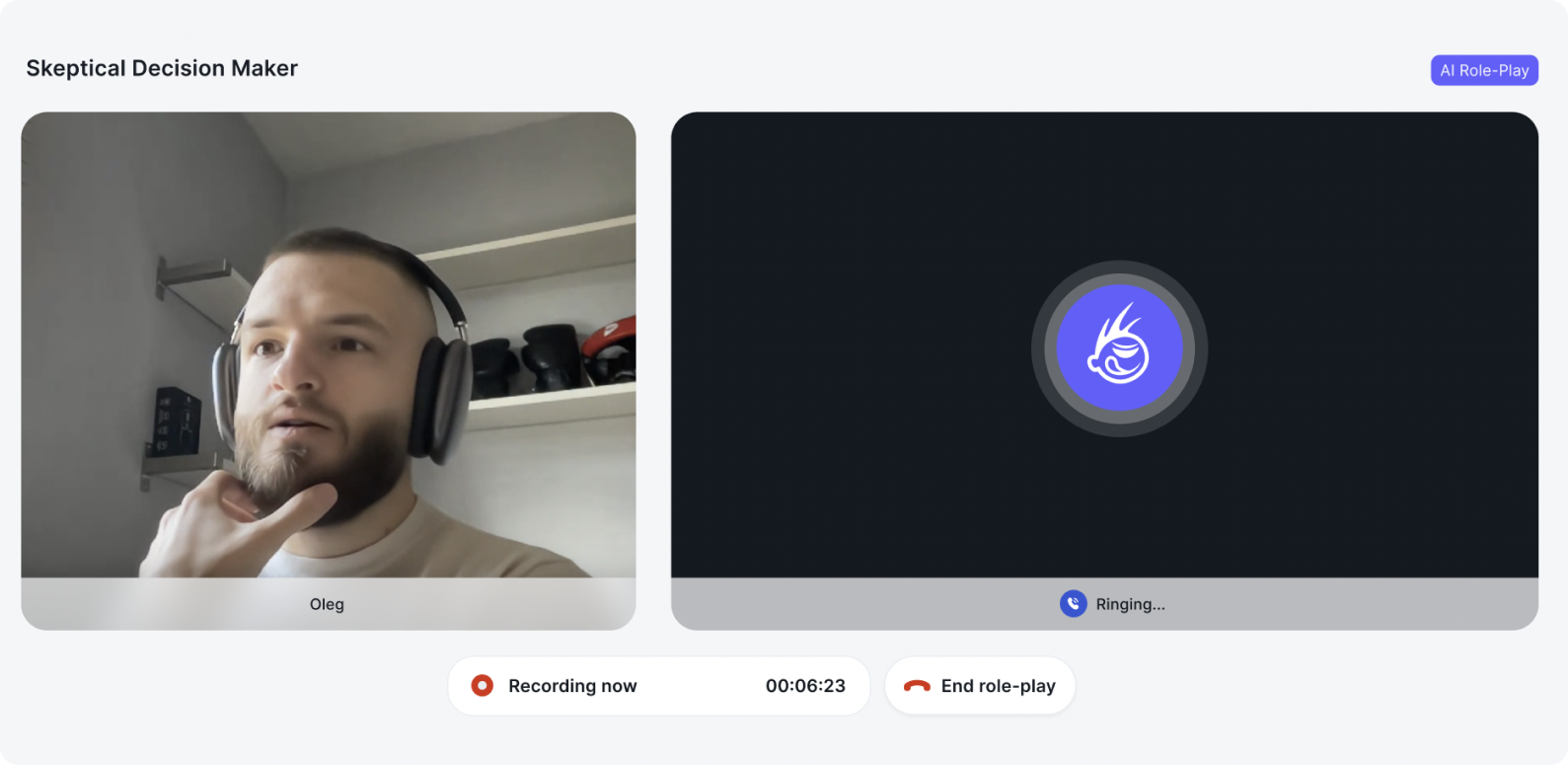
What separates a useful system from a glorified quiz is when and how it delivers that feedback. A score on its own tends to get skimmed and forgotten. Feedback that makes the rep reflect first, then confirms what they noticed, sticks. The rest of this guide is about building that loop.
Start with the AI Coach, not the score
The fastest way to waste a practice session is to flash a number the moment it ends. The rep reads "78," feels judged or relieved, and moves on. Nothing changes. Every other AI role-play tool works this way: the call ends, a scorecard appears, and the rep is left to read it on their own.
PitchMonster's AI Coach runs the loop backwards. After a role-play, it opens a short Socratic conversation before any score shows up: what felt off in that call, where did you lose the buyer, what would you do differently next time. The rep diagnoses their own performance first. By the time the scorecard appears, they have already reached the insight, so it lands as confirmation instead of correction. This is the moment where reps actually change behavior, and no other AI role-play tool ships it.
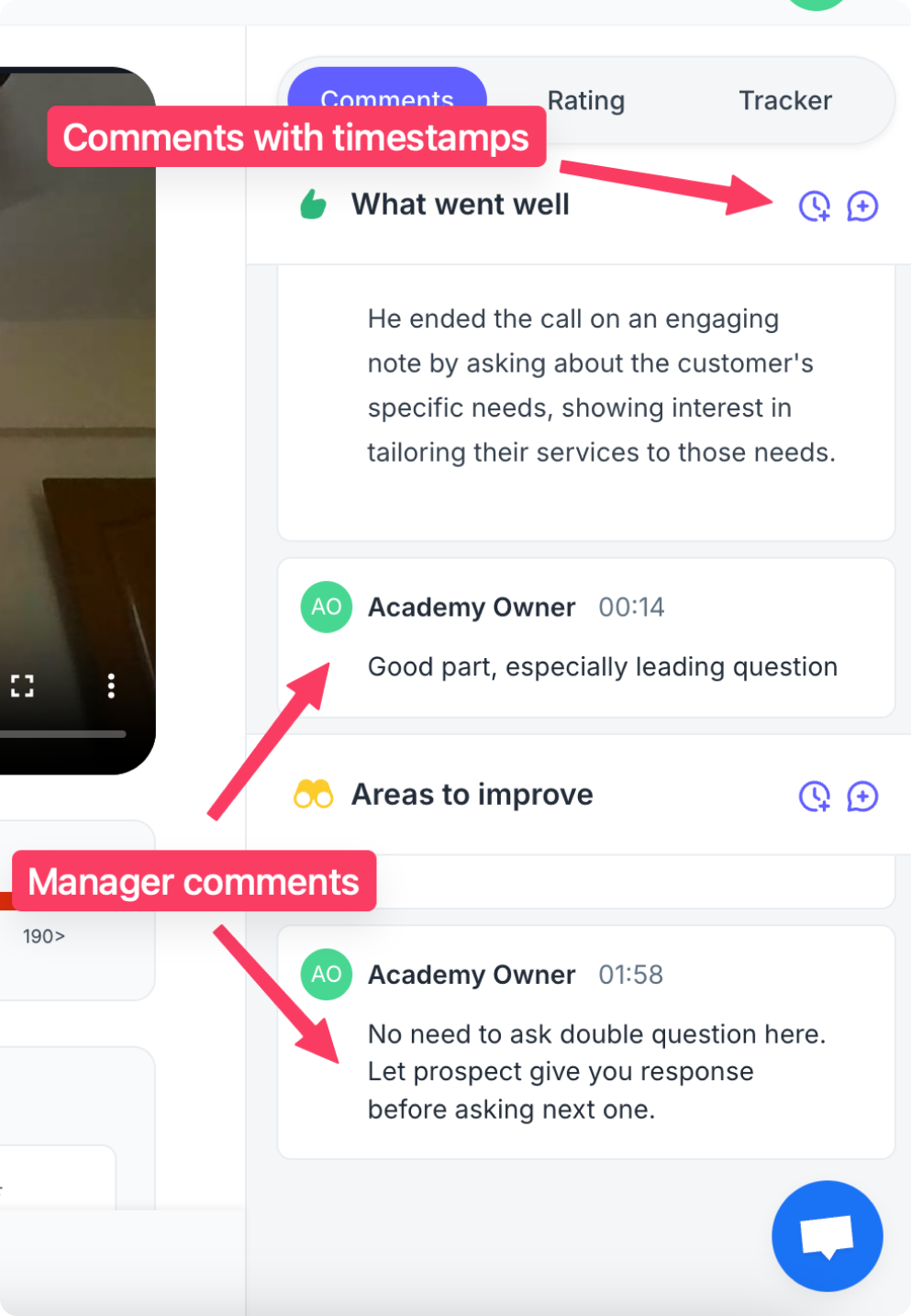
Self-diagnosis works because people defend feedback they are handed and act on conclusions they reach themselves. Ask a rep "what would you change?" and they own the answer. Tell them "you talked too much" and they argue the transcript. The AI Coach is available around the clock, so this reflective step happens after every rep, not just the ones a manager had time to review.
"I think I really like the AI coach. That part was, to me, the most impressive. That's definitely going to save us a lot of time." - Wendy Mateo De Perkins, Senior PM and Instructional Designer, One Park Financial
It also changes the manager's job. Reps arrive at coaching sessions already aware of the gap, so the one-on-one starts at "how do I fix it" instead of "here is what you did wrong." That single shift is why the AI Coach is the first best practice, not an afterthought.
What should AI feedback measure?
AI feedback should measure observable actions a rep can repeat or change, not personality traits. Score whether the rep set a clear next step, isolated and reframed the objection, confirmed the buyer's timeline, and asked open discovery questions. Add quantitative signals like talk-to-listen ratio and filler-word count. Skip vague labels like "confidence," which reps cannot act on and two reviewers will never grade the same.
A useful scorecard usually spans three layers. Delivery covers pacing, talk-to-listen ratio, and filler words. Content covers whether the rep hit the value message and used the discovery questions that matter. Strategy covers objection handling, next-step discipline, and reading the buyer's intent. Score all three and you see not just that a call went sideways, but where.
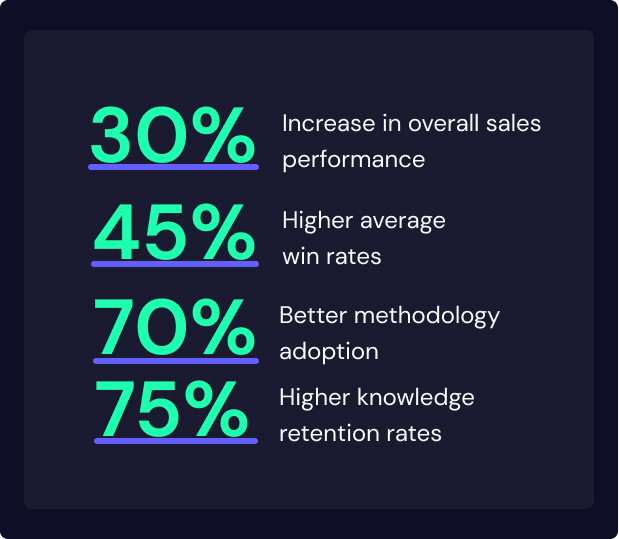
The reason behavior beats traits is repeatability. "Confidence" is a feeling; "set a next step before ending the call" is a behavior a rep can drill until it is automatic. A scorecard built from behaviors gives every rep the same target and gives a manager a clean read on who needs work on what. The table below shows the difference between criteria reps can act on and the vague ones to drop.
Vague criteria (avoid) | Behavior-based criteria (use) |
|---|---|
"Showed confidence" | Held price without an unprompted discount |
"Good communication" | Talk-to-listen ratio stayed under 50/50 |
"Handled objections well" | Isolated the objection, then reframed it with value |
"Built rapport" | Asked at least three open discovery questions |
"Strong close" | Confirmed a specific next step and date |
Tailor the criteria to the conversation type. A cold call, a discovery call, a demo, and a QBR each reward different behaviors, so a single generic scorecard waters down the feedback. Build one rubric per call type and the coaching gets sharper for everyone.
When should reps get feedback?
Timing decides whether feedback sticks. The strongest programs run it in two beats: an instant loop right after the role-play, and a spaced review days later. Skip the first and the lesson fades before the rep applies it. Skip the second and the habit never sets.
The instant loop is where AI has the clear edge. The moment a session ends, the rep reflects with the AI Coach, sees the scorecard, and runs the scenario again with one thing to fix. A manager watching recordings cannot match that speed, and by the time written notes arrive two days later the rep has lost the thread of the call.
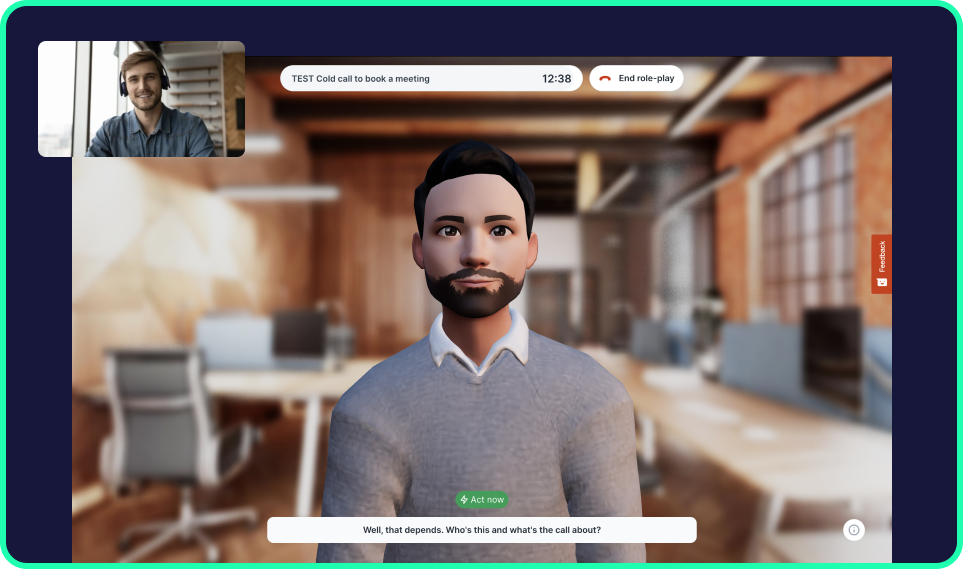
Give feedback in the right setting, too. A blunt score dropped in a team channel embarrasses people and teaches them to game the number. Reflective feedback in a private practice loop does the opposite - the rep experiments, fails safely, and tries again with no audience. Virti and other trainers call weak timing "delayed feedback," and it is the quiet killer of most role-play programs. Fix the timing and half the feedback problem solves itself.
AI feedback vs human coaching
AI and a human coach are good at different things, and the best programs lean on both rather than picking one.
AI wins on speed and consistency. A manager might take days to watch a recording, write notes, and book time to deliver feedback. AI returns coaching the moment a session ends, and it grades against the same scorecard every time. It also has no calendar limit: a rep can run ten sessions in an afternoon, covering cold calls, discovery, demos, and QBRs, and get scored on each one.
A human coach reads what a scorecard cannot. A manager notices a pattern of weak discovery questions and ties it to the specific account a rep keeps stalling on. Good managers already use the situation-behavior-impact model to make feedback concrete, and AI does the same job at scale: it names the situation, the behavior, and the result, then hands the manager the pattern to coach against. AI finds the patterns; the manager decides what to do about them.
AI feedback | Human coaching | |
|---|---|---|
Speed | Seconds after the session | Scheduled, often days later |
Consistency | Same scorecard every rep, every time | Varies by manager and mood |
Availability | Around the clock, unlimited reps | Limited by one calendar |
Best at | High-volume reps, pattern tracking | Deal strategy, context, careers |
The teams that get the most out of AI feedback do not fire their coaches. They point manager time at the conversations that need judgment and let AI handle the volume of scored, consistent practice underneath.
8 best practices for AI sales role-play feedback
How you set up sales role-play training and its feedback decides whether reps trust it or quietly ignore it. These eight practices separate the programs that change behavior from the ones that just generate scores.
1. Score observable behavior, not personality
Start from actions, not adjectives. "Did the rep establish a clear next step?" beats "Was the rep confident?" every time. Why it matters: a behavior can be practiced until it is automatic, while a trait just labels the rep and leaves them nowhere to go. How to do it: write every scorecard line as something a reviewer could point to in the transcript, and build a separate rubric for each call type, because the winning moves on a cold call are not the ones that win a QBR.
2. Let reps self-diagnose before the score
Make reflection the first step of every session, not the last. Why it matters: reps act on conclusions they reach themselves and argue with verdicts they are handed. How to do it: use a Socratic AI Coach that asks "what would you change?" before it reveals the number, so the rep names the gap first. SThree, a specialist staffing firm on the FTSE, built its consultative selling framework straight into AI scorecards for 2,700 consultants across 11 countries, and trainers now spot a skipped step in minutes instead of shadowing calls for hours.
"If a learner skips a step, we spot it straight away and send them back in until every box is green." - Stefano Bianchini, Senior Curriculum Lead, SThree
3. Get the timing right
Deliver feedback in two beats: instant after the role-play, and a spaced review later. Why it matters: instant feedback catches the lesson while the call is fresh, and the spaced review is what turns a one-time fix into a habit. How to do it: let the AI score and reflect with the rep the moment a session ends, then schedule a manager review a few days out to check whether the change held on the next batch of practice reps.
4. Cap each session at one or two behaviors
Dumping a dozen corrections on a rep after one session guarantees they retain none of them. Why it matters: attention is finite, and noise crowds out the one change that would move the call. How to do it: pick one or two behaviors per session - confirming the timeline, holding price - and pair each with a single concrete next step. This matters most during onboarding, when reps are still forming basic habits.
5. Ground every scenario in real buyers
Feedback is only as good as the scenario behind it. Why it matters: if reps practice against a generic, agreeable persona, the coaching will not survive contact with a real prospect. How to do it: preload the objections your team actually hears - the price push, the "just send me an email," the prospect who goes dark after the demo. PitchMonster spends three to four hours during onboarding defining goals, building custom scenarios, and setting benchmarks, so the feedback reads as practical rather than theoretical. For a full walkthrough, see how to create AI role-plays for sales training.
6. Space the practice out
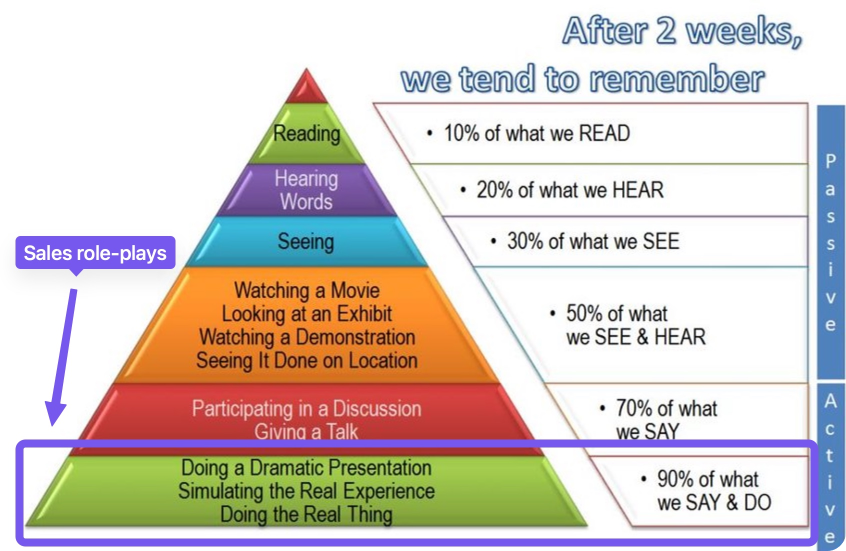
One heavy training day fades fast; short reps spread over weeks stick. Why it matters: skills decay without repetition, and spaced practice is how a corrected behavior becomes muscle memory. How to do it: schedule short, frequent role-plays instead of a single marathon session, and reuse the same scenario until the rep's score on the target behavior holds steady. The learning-retention curve below is why active, repeated practice beats a passive lecture reps forget by Friday.
7. Keep managers in the loop
AI feedback works best alongside manager coaching, not instead of it. Why it matters: when managers step back entirely, they lose sight of who is struggling and why, and reps stop treating the practice as real. How to do it: let the AI handle scoring and pattern-spotting across every session, then point the manager's one-on-ones at the gaps the data surfaces. The manager brings the deal context and career conversation the scorecard cannot.
8. Tie feedback to pipeline numbers
Feedback has to connect to numbers a leader cares about. Why it matters: a practice score that never touches the pipeline is a vanity metric. How to do it: track how role-play scores line up with meeting-set rate, deal cycle length, and win rate, and export the scores to Salesforce, HubSpot, or Gong so a manager can see which skill gap is denting revenue. Mentor Group ran this full loop and reported a 37% average performance increase, a 28% win-rate improvement, roughly 30% faster ramp, and 2x more opportunities booked.
Run all eight together and the feedback stops being a report card and starts being a training system.
Common mistakes to avoid
Even the best AI role-play tools fall flat when the feedback is handled badly. Four mistakes show up again and again.
Over-relying on the number
A score like "78 out of 100" invites reps to chase the number instead of the behavior behind it. Hold the score back. Ask "what felt off in that conversation?" first, let the rep analyze, then reveal it. The reflection is where the learning happens; the number just confirms it.
Overloading the session
Too much feedback reads like noise, gets skimmed, and changes nothing. Zero in on one or two behaviors and pair each with a concrete next step. Focused beats comprehensive when the goal is a habit that lasts past Friday.
Skipping rep onboarding
Drop an AI role-play tool on a team with no guidance and reps will misread the scores or ignore the suggestions. Show them how to read a scorecard and how to use the AI Coach before you expect results. A short walkthrough up front saves weeks of confusion.
Running one generic scorecard
A single rubric for cold calls, discovery, demos, and renewals grades everyone on the wrong things. The behaviors that win a first call are not the ones that close a QBR. Build a scorecard per conversation type, and the feedback gets specific enough to act on.
Skip these traps and AI feedback does what it should: sharpen reps faster while freeing managers to coach the moments that need a human. PitchMonster reports a 100% enterprise renewal rate since spring 2024, more than 300,000 reps trained, and a 4.9 out of 5 rating on G2 - the loop holds up once teams run it end to end.
FAQ
What is AI sales role-play feedback?
AI sales role-play feedback is the coaching a rep receives after practicing a conversation with an AI buyer. The system scores observable behaviors - whether the rep set a next step, handled the pricing objection, or talked too much - and returns specific guidance in seconds, against the same scorecard every time, so practice no longer waits on a manager's calendar.
What should an AI role-play scorecard measure?
Measure observable actions, not traits. Good criteria include whether the rep set a clear next step, isolated and reframed the objection, confirmed the buyer's timeline, and asked open discovery questions. Add signals like talk-to-listen ratio and filler-word count. Avoid vague labels like confidence or communication, which reps cannot act on.
How is AI feedback different from a human coach?
AI returns consistent, behavior-level feedback in seconds and runs around the clock, so a rep can practice ten sessions in an afternoon and get scored the same way each time. A human coach reads context, ties a weak habit to a specific live deal, and handles career and strategy. The strongest programs use both.
How do I stop AI feedback from overwhelming reps?
Limit each session to one or two behaviors and one clear next step. Have the AI Coach ask the rep what they would change before the score appears, so they self-diagnose instead of skimming a number. Save broader pattern reviews for a manager's one-on-one, where context makes the data useful.
What does good AI sales role-play feedback look like?
It names a specific behavior and the moment it happened: "You gave a discount at 4:12 before the buyer pushed on price - next time isolate the objection first." It ties to one scorecard criterion, offers a concrete next rep, and arrives while the call is fresh. Vague praise like "good energy" is not feedback a rep can repeat.
Is there free AI sales role-play feedback?
Some tools offer a free trial or a limited free tier so reps can test scored practice. Free options tend to use generic personas and a fixed scorecard, which is fine for a first look. Team programs that tie feedback to your methodology, your buyers, and your CRM are usually custom-quoted. PitchMonster pricing is quote-based - book a demo for a number sized to your team.
How do I connect AI role-play feedback to pipeline results?
Build scenarios around revenue moments like price objections and competitor pressure, then score the behaviors that move those deals. Export the scores to your CRM and watch how they track against meeting-set rate, deal cycle length, and win rate. Use the gaps to target manager coaching where it changes the number.
Want AI feedback built around your scorecard and your buyers? Book a demo, see pricing, or explore PitchMonster for sales leaders.