Sales communication skills training is structured instruction and practice that sharpens the skills a rep uses in a live buyer conversation - active listening, discovery questioning, objection handling, and tone control. The goal is behavior change, not information transfer. The strongest programs pair a clear method with repeated practice, because a salesperson learns to handle a hard moment by rehearsing it, not by reading about it.
This guide compares the 10 best sales communication skills training programs for 2026. Below you get a side-by-side table, a full write-up on what each program is genuinely best for, how it runs, its pros and cons, and a short method for matching one to the gap your team actually has.
If you are lifting a whole team rather than sending one rep to a course, sales team upskilling covers how that works with practice at the center.
Comparison table
Scan the field here, then read the full write-up on any program that fits. Pricing and formats change often, so most providers quote per team on request. Use the "best for" and pricing-fit columns to shortlist, then confirm current details with each provider before you buy.
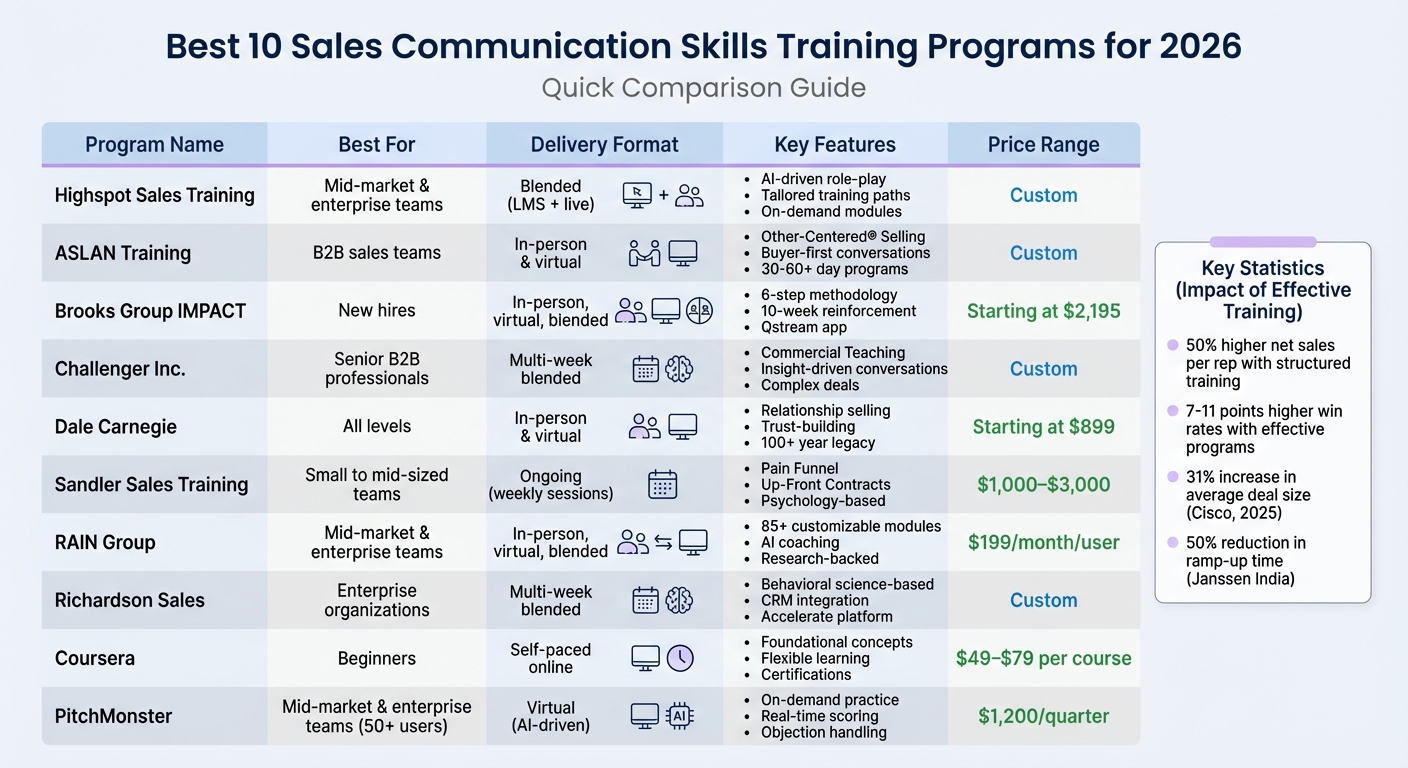
Program | Best for | Format | Pricing fit |
|---|---|---|---|
PitchMonster | On-demand rep practice with a Socratic AI Coach | AI role-play, virtual | SMB to enterprise (by quote) |
Sandler | Psychology-based selling system with weekly reinforcement | Onsite, virtual, blended | SMB to enterprise |
Dale Carnegie | Relationship and confidence skills | In-person, virtual, blended | SMB to enterprise |
RAIN Group | Consultative, value-led B2B conversations | In-person, virtual, blended | Mid-market to enterprise |
Challenger | Insight-led complex B2B deals | Multi-week blended plus LMS | Mid-market to enterprise |
The Brooks Group (IMPACT Selling) | New-hire foundations and a shared language | In-person, virtual, blended | SMB to enterprise |
ASLAN Training | Buyer-first, other-centered conversations | Workshops, virtual, blended | Mid-market to enterprise |
Richardson Sales Performance | Enterprise teams wanting CRM-tied training | Blended with digital reinforcement | Enterprise |
Highspot | Enablement teams adding training to content | Blended (LMS plus coaching) | Mid-market to enterprise |
Coursera | Beginners learning the basics | Self-paced online | Individuals / new SDRs |
Pricing fit shows the company size each program serves best. Most providers quote per team on request, so confirm current pricing and format with each vendor before you buy.
These programs address the same recurring problems: inconsistent messaging across a team, low rep confidence on hard calls, and skills that fade after a one-off workshop. They take very different routes to fix them, so the write-ups below focus on what each one is built to do well.
What is sales communication skills training?
Sales communication skills training sharpens the skills a rep uses in a live buyer conversation: listening to understand, asking questions that surface real needs, handling objections without getting defensive, and controlling tone and pace. The aim is a rep who can do the skill under pressure, not just describe it. That is why the best programs weight practice and coaching over lecture.
Most programs work across three layers. The first is communication fundamentals: active listening, questioning, and reading the room. The second is selling tactics: discovery frameworks like SPIN or MEDDIC, negotiation, and turning an objection into a next step. The third is method and consistency, so every rep runs a similar play and a buyer hears one coherent message no matter who they talk to.
The format has shifted. Classroom workshops still anchor many programs, but teams now add AI-driven role-play so reps can rehearse a discovery call or a pricing objection in a low-stakes setting before they spend a real lead on it. You can even create custom AI role-plays that mirror your own buyers and objections, which turns a static method into daily practice.
Core sales communication skills these programs build
Before you compare providers, it helps to know what a strong program is trying to change. The skills below show up in almost every good curriculum, because they are the ones that decide how a live conversation goes. A program that only teaches product knowledge and a pitch is not communication training; it is a briefing.
- Active listening. Hearing what a buyer actually means, not just waiting to talk, so you catch the real objection under the stated one.
- Discovery questioning. Asking open, layered questions that surface a buyer's true problem instead of leading them to a feature.
- Objection handling. Staying calm and curious when a buyer pushes on price, timing, or a competitor, and turning the pushback into a next step.
- Tone and pacing. Controlling talk-to-listen ratio, filler words, and pace so the message lands the way it was meant.
- Framing and storytelling. Positioning value in the buyer's terms and using a short, relevant story to make a point stick.
- Reading the room. Picking up on hesitation, silence, or a shift in a group call and adjusting before the deal cools.
The best programs do not just name these skills; they make reps perform them repeatedly until the response is automatic. That is the difference between a rep who knows the theory of objection handling and one who handles the objection without a flicker on a live call.
Why sales communication skills training matters
Communication training targets the gap that shows up after onboarding. A rep can pass a knowledge check, then freeze when a buyer pushes on price or goes quiet mid-call. That knowing-doing gap is why two reps selling to the same buyer can post very different results. It is exactly where structured practice earns its keep.
Managers feel the squeeze too. One-on-one role-play does not scale, so coaching is the first thing that slips when a team gets busy. AI-powered practice tools help by scoring every session against the same playbook and handing managers the highlights. A leader can then keep an eye on many more reps than a manual cadence allows and spend their own time on deal strategy instead of repeating the same drill.
The programs that hold up share one trait: reinforcement. A single workshop fades; spaced, repeated practice builds the instinct a rep needs to handle a hard moment without thinking it through first. Whether that reinforcement comes from weekly coaching or daily AI reps, the principle is the same. You practice the moments where deals are won and lost, often enough that the response becomes automatic.
There is a leadership angle too, which shows up in searches for communication training aimed at whole sales teams. When a program only trains individual reps, the message across the team stays inconsistent and a manager has no shared standard to coach against. The programs that move a team, not just a person, give leaders a common framework and the data to reinforce it, so a buyer hears the same coherent story whether they talk to a first-week SDR or a senior AE. That is the difference between training as an event and training as a system.
How we picked these programs
This list favors programs built to change how reps communicate in real conversations, not generic course catalogs. Each entry is judged on five things: the method it teaches, how it delivers, whether it reinforces skills after the first session, who it fits, and how it prices. The ranking leads with practice depth and coaching, because that is where communication skills actually move.
The mix is deliberate. It spans AI role-play platforms, classic methodology programs, consultative B2B training, an enablement suite, and a self-paced option for beginners. That way you can match a route to your team's stage rather than buying the most famous name on the list. Where a provider does not publish a figure, we describe the company size it fits best rather than guess a price.
The 10 best sales communication skills training programs
1. PitchMonster - AI Sales Role-Play and Coaching Platform
Best for: teams that want reps to practice real conversations and get coached, not just complete a workshop.
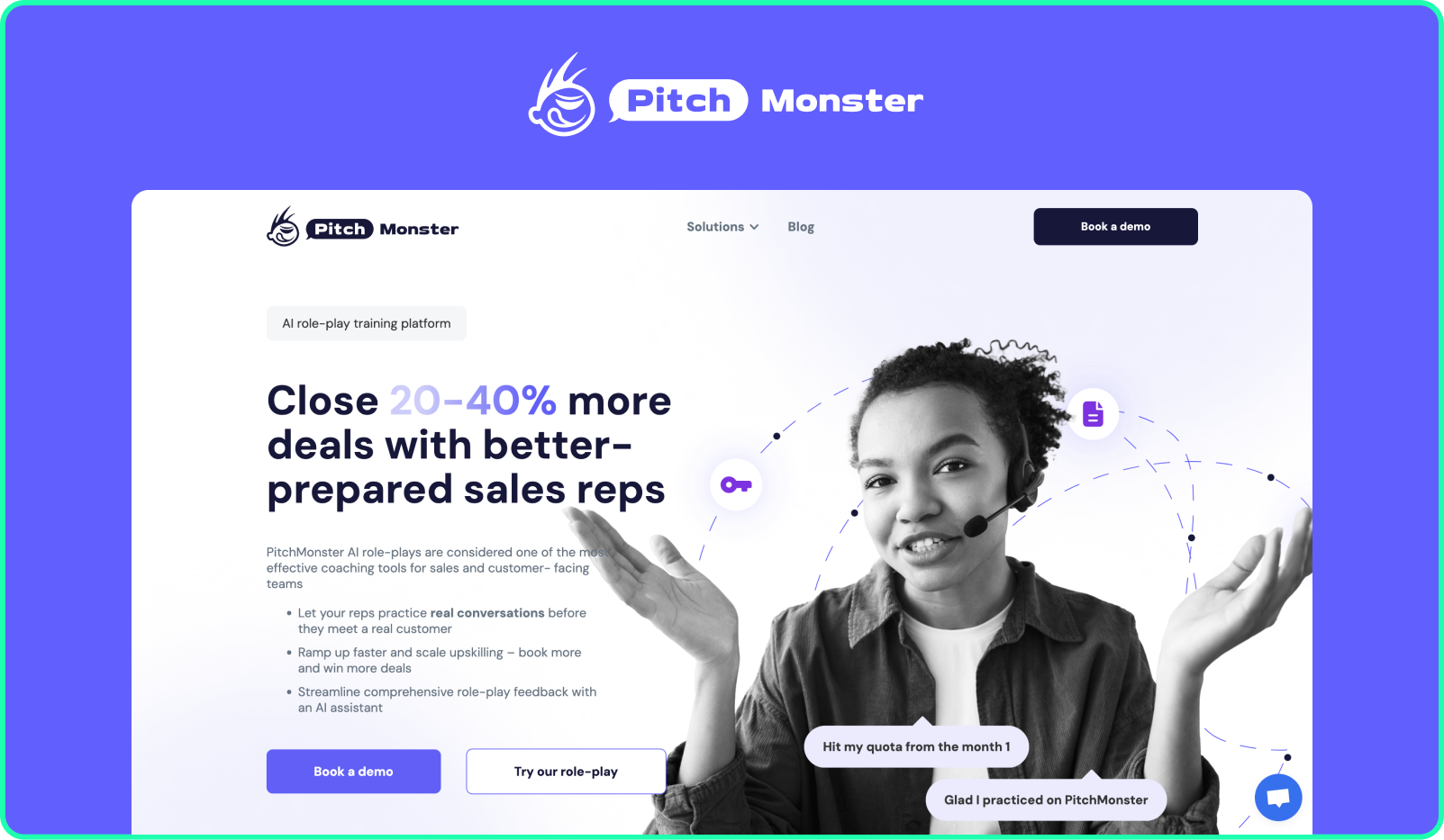
PitchMonster is an AI sales role-play platform built for teams that want reps to rehearse real conversations before the real call. Reps work through cold calls, discovery, objection handling, and closing against an AI buyer that adapts, pushes back, and objects like your actual ICP. Then they get scored against your own playbook. It is the practice-and-coaching layer that turns a methodology into a habit, and it fits SMBs through enterprises running consultative, B2B motions.
What sets it apart is the coaching. Most programs on this list serve content or report a score. PitchMonster runs the full loop: realistic practice, a Socratic AI Coach that helps the rep self-diagnose, and analytics a leader can act on. It is the only program here that pairs a realistic AI buyer with a post-session Socratic AI Coach that makes the rep diagnose their own gap before they see a score. The seven subsections below cover how that plays out feature by feature.
Custom AI role-plays built from your own material
Effective practice depends on scenarios that mirror real customer conversations. PitchMonster lets your team run tailored simulations, either from a template library or from scratch. Reps rehearse cold calls, discovery meetings, and demos in settings that closely replicate the real thing.
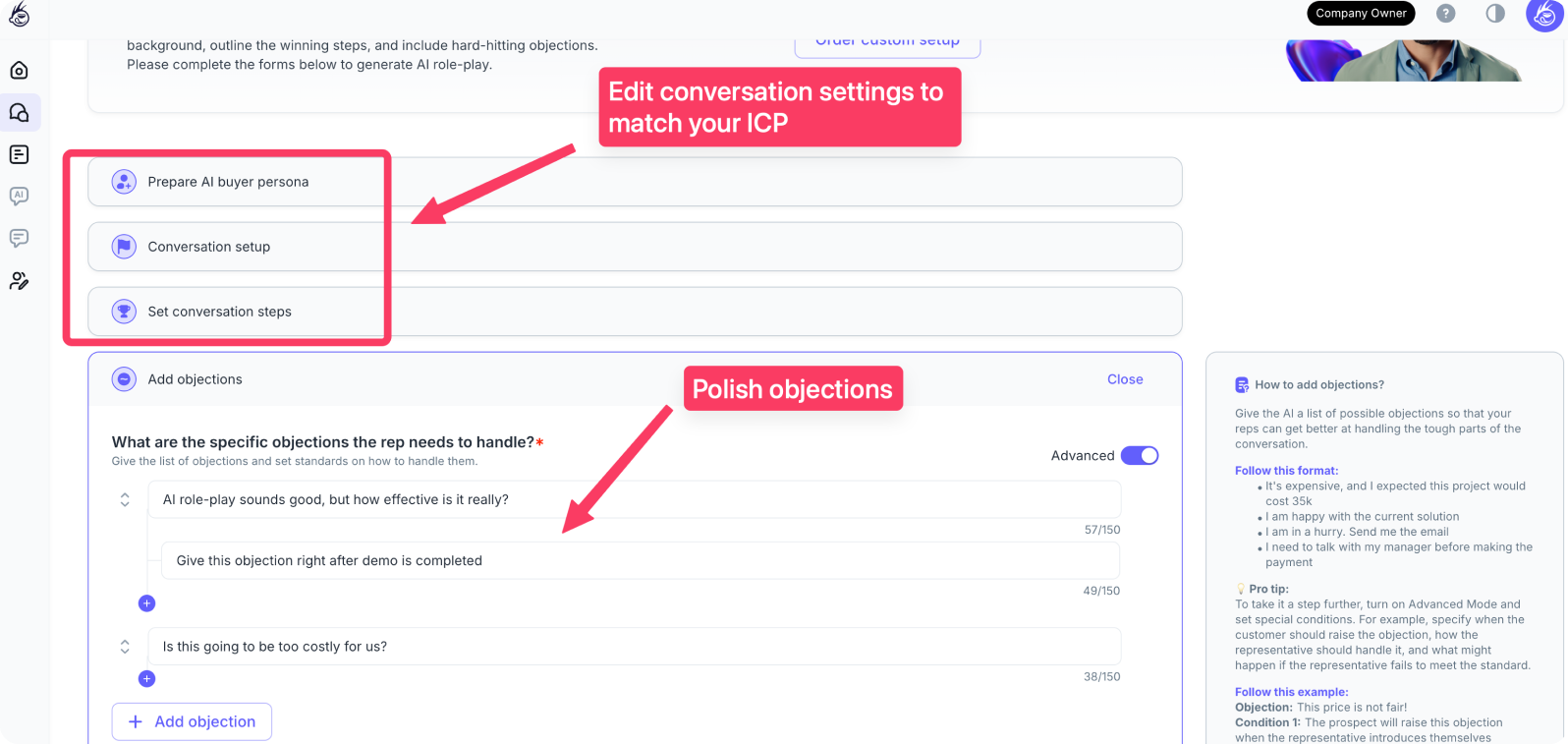
A manager can build a scenario from a call recording, product docs, or a website URL in about two minutes. There are four difficulty levels, up to and including Insane, plus dozens of customization parameters and support for 27 languages. Ready-made role-plays cover the essentials like objection handling and talk tracks, so new hires ramp faster while top performers keep refining. Each session generates a full transcript and AI feedback, which gives leaders a record to reinforce winning behavior across the team.
Personalized role-play feedback after every session
Practice only pays off with feedback that drives improvement. After each simulation, PitchMonster delivers detailed, AI-generated insights on what the rep did well and where to adjust. Whether the goal is sharper objection handling, cleaner pitch delivery, or a better talk-to-listen balance, every session feeds the rep's growth.
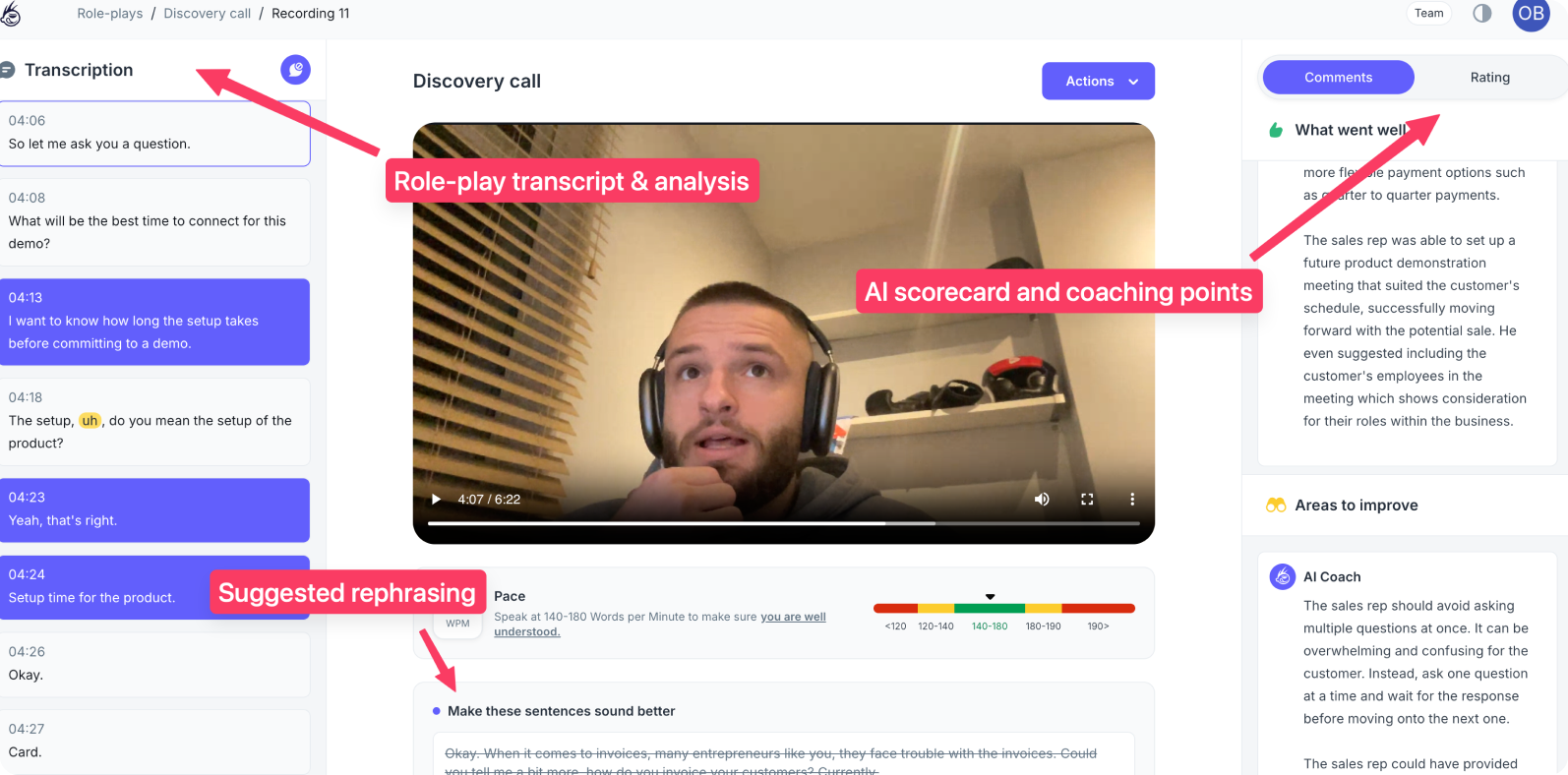
Each interaction is analyzed for the moments that matter, like pricing discussions, next-step commitments, and sentiment shifts. The platform highlights strengths and flags gaps, so leaders can tailor coaching and reinforce the behaviors that win. Sentiment and vocabulary analysis let it act as a virtual coach that builds rep confidence between real calls.
Built-in AI speech coaching
Communication skills decide a lot of deals, and PitchMonster's speech coaching gives reps the feedback to sharpen them. Think of it as a sales Grammarly. It analyzes each conversation for pacing, sentiment, and filler words, then suggests changes to phrasing and talk time.
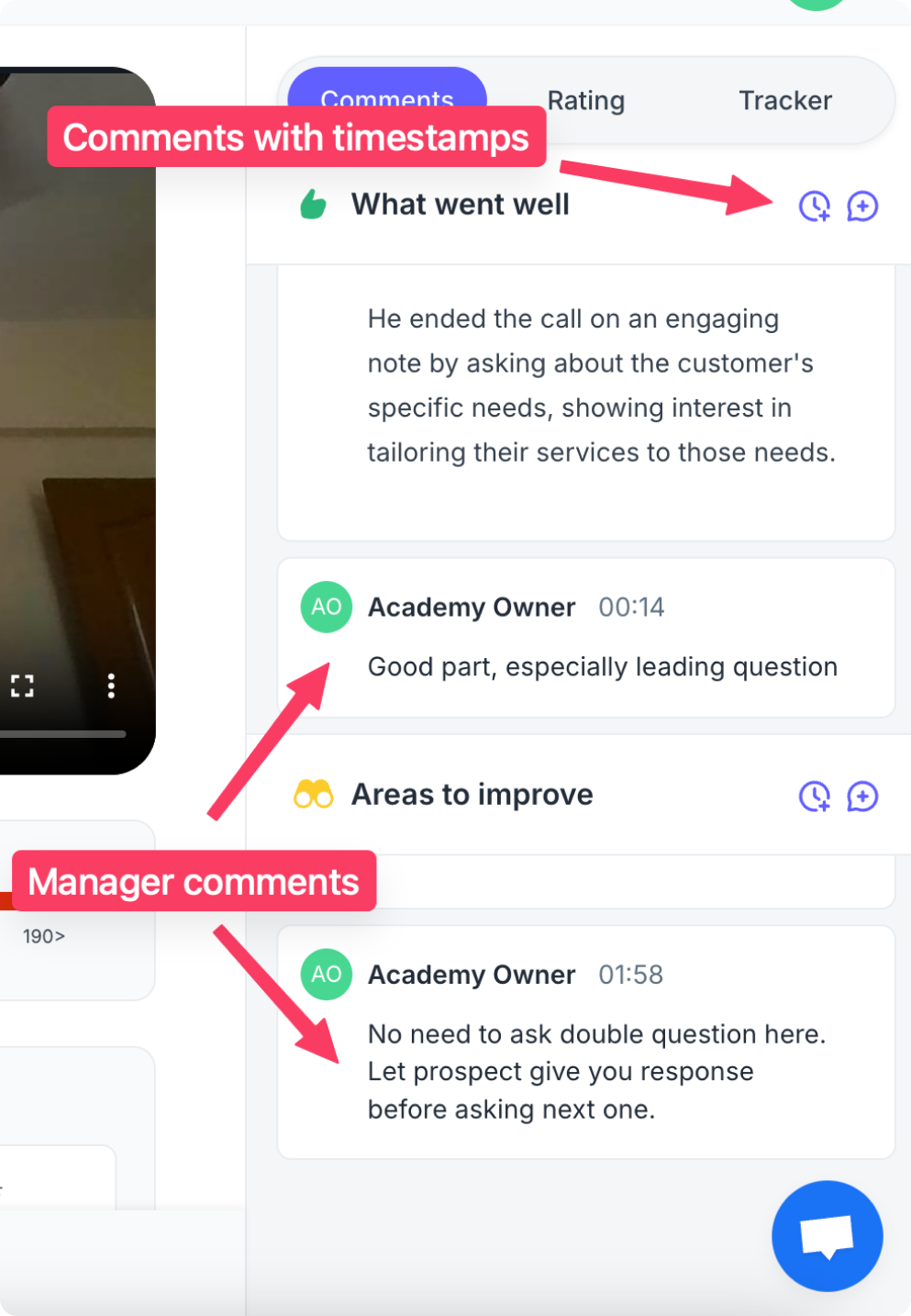
Across cold calls, discovery, and demos, the AI keeps every interaction tuned for clarity and impact. Reps get consistent, specific feedback they can apply on the next call, which builds confidence and steadily lifts performance. As one of our customers put it, the way we say things in our head is not often how it lands, and this is where reps hear the difference.
Create your own AI scorecard
Scoring should match how your team actually sells. PitchMonster's AI Scorecard lets leaders set evaluation criteria that fit their process, either by uploading their own metrics or starting from the scorecard library. You can assess reps on the factors that matter, like objection handling, talk time, and closing.
Because scoring is consistent, feedback stays objective and every rep is measured the same way. The scorecard analyzes each session automatically and produces clear scores that simplify performance reviews and surface winning behavior. With that data in one place, leaders can refine training and prove what is working to the people who own the budget.
The Socratic AI Coach, the differentiator
The AI Coach is the reason teams pick PitchMonster over a straight practice tool. After each session, a Socratic AI sales trainer asks reflective questions that guide the rep to their own insight before they ever see a score. It is available 24/7, so reps can debrief on their own time. No other program on this list does this.
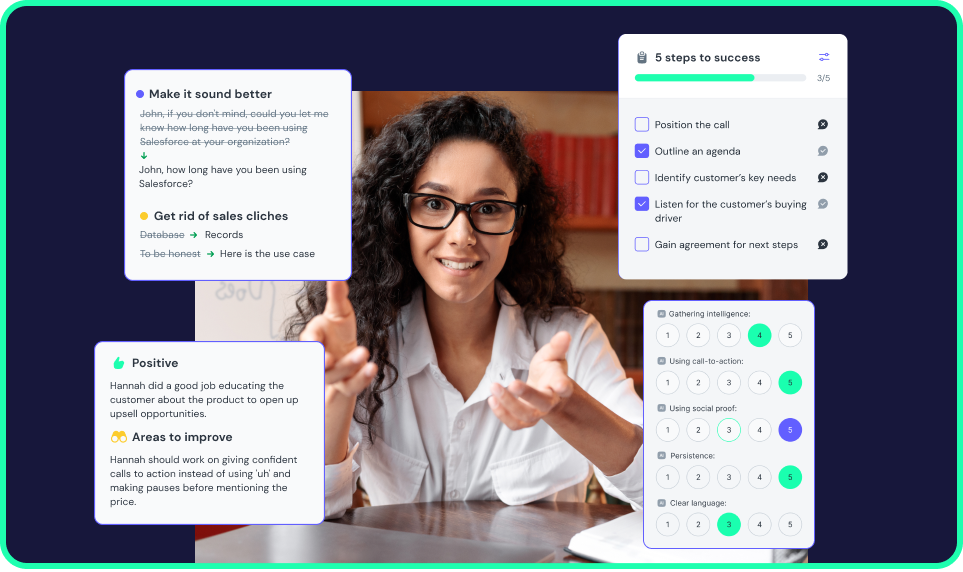
This matters because self-diagnosed lessons stick. When a rep reasons their way to what went wrong, the fix holds on the next live call in a way a handed-down score rarely does. It is the closest thing to a patient manager sitting beside every rep after every practice call, without the calendar cost.
Analytics that let managers coach at scale
Leaders need more than a pile of transcripts. PitchMonster rolls every session into rep-level and team-level analytics, so a manager can see who is ready, who is stuck on discovery, and which objection keeps tripping the team up. The data turns coaching from a guess into a targeted conversation.
Because the same scorecard runs on every session, progress is comparable over time. A leader can watch a new hire climb week by week and confirm readiness before that rep ever touches live pipeline. That visibility is what lets one manager support a whole team rather than a handful of reps.
The analytics also change the conversation with leadership. Instead of reporting that the team completed a workshop, an enablement lead can show which skills improved, which objections still trip reps up, and how readiness maps to ramp time. That turns training from a cost line into a measurable input a budget owner can defend.
Formats, languages, and how it runs
PitchMonster is entirely virtual and on demand, with face-to-face, screen-share, and phone modes. Reps practice whenever it suits them, with no wait for a scheduled session or manager availability. Four difficulty levels and 27 languages mean the same platform serves a first-week SDR and a senior enterprise AE.
It suits sales enablement and L&D teams onboarding new hires, finding skill gaps, and lightening the coaching load on managers, plus revenue leaders who want to confirm reps are ready before they touch pipeline. For a wider view of how it fits a leadership workflow, see the sales leaders solution.
Where it fits: SMBs to enterprises running consultative, B2B motions with a manager, team lead, or L&D owner for training. Pricing is quote-only (custom per seat), with onboarding, a dedicated CSM, and support included and no setup fees. See pricing for your team size.
Proof: Mentor Group recorded 30% faster ramp, 37% higher performance, and a 28% win rate improvement after rolling out PitchMonster. Wendy Mateo De Perkins of One Park Financial summed up the reaction to the coaching: "I think I really like the AI coach. That's definitely going to save us a lot of time."
See it on your own use case. Book a demo and run your first AI role-play, built from your product and your ICP, in about two minutes.
2. Sandler
Best for: a psychology-based selling system with weekly reinforcement that fights the fade.
Sandler is built around the Sandler Selling System, a psychology-based method that trains reps to behave like consultative problem-solvers rather than pitch-and-close salespeople. Its signature framework, the Sandler Submarine, walks a rep through qualifying a prospect, surfacing pain, and stepping away from a deal that is not a fit, which protects time as much as pipeline.
What makes Sandler distinct is its reinforcement model. Instead of a one-off workshop, reps move through an evaluation, core training, execution, and ongoing accountability with a coach, which fights the fade that kills most training. Signature techniques include the Pain Funnel, a questioning sequence for uncovering deeper needs, and Up-Front Contracts, which set mutual expectations at the start of a meeting so calls stall less often.
The delivery is deliberately hands-on. Class sizes stay small so a coach can watch each rep practice, and the program runs through a franchised network of training centers across many countries, which makes it a fit for teams that want local, in-person reinforcement rather than a single remote course. Reps try a technique in the field, then come back to debrief, so the skill is tested against real buyers rather than left as theory.
Where it fits: SMB to enterprise teams that want a durable methodology and coaching rather than a single session. Sandler quotes per engagement on request, so confirm current pricing for your team size and certification level.
3. Dale Carnegie
Best for: the human side of selling, when the gap is confidence and rapport rather than process.
Dale Carnegie is the long-standing name in the human side of selling, with a flagship program, Winning with Relationship Selling, focused on building the trust that turns a contact into a customer. For teams whose gap is confidence and rapport, it is still the reference point, with entry-level and advanced tracks for reps at different stages.
The communication training centers on relationship-based techniques. One signature move is the Disagree Agreeably approach, which helps a rep handle an objection or a difference of opinion without damaging the relationship, alongside verification techniques that confirm a message landed the way it was meant. The curriculum also covers prospecting, questioning, storytelling, and building personal credibility on a call.
Dale Carnegie structures its tracks by experience, so a new rep can start with foundational sales essentials while a senior seller sharpens advanced skills, and managers get a dedicated leadership track. The virtual format runs across weekly sessions rather than a single marathon day, which spaces the practice out, and in-person training runs over consecutive days at a client site or a Dale Carnegie center. Availability in many countries and languages makes it a practical pick for a distributed team that wants one consistent program worldwide.
Where it fits: SMB to enterprise teams that need to lift confidence and relationship skills across reps in multiple regions. Dale Carnegie prices by course, location, and format and quotes corporate onsite training separately.
4. RAIN Group
Best for: consultative, value-led conversations in complex B2B sales.
RAIN Group trains consultative, value-led conversations and is built for complex B2B sales in software, financial services, and manufacturing, where deals involve several decision-makers and a long cycle. If your reps need to lead an insight-driven conversation rather than run a feature pitch, this is squarely the lane.
The program pairs facilitator-led sessions with a large library of modular training blocks, so a curriculum can be tailored from topics like insight selling, storytelling, negotiation, and strategic account management. Its Catalyst platform adds AI-supported coaching between sessions, which helps bridge the gap from theory to a live call. Cohorts are kept small to keep the practice interactive.
The modular design is the real draw for a complex team. Rather than a fixed course, an enablement lead can assemble a curriculum from more than eighty portable blocks and match it to the exact motion reps run, whether that is a long financial-services cycle or a multi-stakeholder software deal. Specialized bootcamps go deeper on deal structuring and high-stakes negotiation, so a team can start with foundations and add advanced content as reps mature.
Where it fits: mid-market to enterprise B2B teams, account managers, and the managers coaching them. RAIN Group quotes team and enterprise pricing on request based on scope and format.
5. Challenger
Best for: insight-led selling and buyer decisiveness in complex, high-stakes deals.
Challenger is based on the research behind The Challenger Sale and teaches reps to lead with insight: to teach the buyer something, tailor the message to each stakeholder, and take control of the conversation. It fits mid- to senior-level B2B sellers working complex deals where a buyer wants education, not a demo. Its newer JOLT framework extends the method to help reps move indecisive buyers to a decision.
The communication focus is specific: challenging a buyer's assumptions, reframing their perspective, and delivering a bold point of view with confidence. Behavioral reinforcement tools help the new behavior become routine rather than a one-day idea, and coaching modules help managers strengthen Challenger behaviors across the team. Content can sit inside an enterprise LMS.
The blend of formats is built for busy enterprise reps. Virtual instructor-led sessions carry the core method, self-paced modules fill in around a selling schedule, and shorter workshops reinforce specific skills, all of which can run through a company's own learning platform. The JOLT additions are worth noting on their own, because indecision, not a competitor, kills many complex deals, and the framework gives reps a concrete way to move a hesitant buyer toward a confident yes.
Where it fits: mid-market to enterprise teams selling complex, high-consideration deals. For teams that want immersive practice on top of the method, AI-driven role-play can layer in realistic reps. Challenger quotes on request and workshops usually need a minimum cohort.
6. The Brooks Group (IMPACT Selling)
Best for: new-hire foundations and giving a team one shared selling language.
The Brooks Group has run sales training since 1977, and its IMPACT Selling program is a six-step consultative methodology that gives a team a structured, repeatable framework for sales conversations. It is a strong choice for new-hire foundations, where the value is a shared language everyone runs from day one.
The communication skills are practical: advanced questioning, active listening, presenting, pre-call planning, and handling objections, with content that can be customized for challenges like qualifying digital leads and managing multi-stakeholder approvals. Reinforcement comes through a multi-week playbook and an IMPACT Selling for CRM add-on that pushes daily prompts into tools like Salesforce, so a new skill shows up on a real deal instead of staying in a workbook.
The delivery flexes to how a team learns. In-person training runs over consecutive days, while the virtual track spreads across several sessions so reps can absorb and apply between them, and a modular design blends classroom, virtual, and micro-learning. The Brooks Group also layers in talent assessments and a manager track, so a leader can pinpoint where each rep needs work and coach against it rather than run the same drill for everyone.
Where it fits: SMB to enterprise teams onboarding new reps or standardizing an inconsistent sales motion. The Brooks Group quotes per participant and per team on request and offers a money-back guarantee on core programs.
7. ASLAN Training and Development
Best for: buyer-first, other-centered conversations that rebuild trust.
ASLAN centers on Other-Centered Selling, which shifts a rep from pitching features to genuinely addressing the buyer's needs. The thesis is that trust and a real conversation come from leading with the customer's problem, and the training is built to make that the default rather than a nice idea.
The communication focus lands on objection handling, active listening, and buyer-first conversations, with specialized tracks for strategic account management and virtual selling for remote and hybrid teams. Longer engagements run over weeks, and real-time coaching plus AI-supported reinforcement push reps to practice the skill rather than only absorb the concept.
ASLAN tends to run as a change program rather than a single event. Engagements can span a month or more, blending workshops with follow-up coaching so the buyer-first habit has time to replace old pitch reflexes. The virtual-selling track is a genuine differentiator for distributed teams, since it targets the specific challenge of building trust and reading a buyer over a screen rather than across a table.
Where it fits: mid-market to enterprise sellers, strategic account teams, and the managers coaching them. ASLAN prices by length and format and quotes on request.
8. Richardson Sales Performance
Best for: enterprise teams that want training tied to the way reps already work.
Richardson has run sales communication training for decades and builds its programs on behavioral science, with a blended model of live workshops, virtual sessions, and digital reinforcement through its Accelerate platform. Its hook is tight integration with the way reps already work, so training does not sit in a separate tab.
What stands out is that CRM workflow integration. Training concepts are pushed into tools like Salesforce so a rep applies a new skill on a real deal right away. The curriculum spans the full cycle - creating pipeline, winning opportunities, growing accounts, and sales management - and uses micro-learning and practice questions to keep the skill alive between sessions.
Richardson organizes its content into role-specific tracks, so reps, managers, and leaders each get material aimed at their part of the motion rather than one generic course. On objection handling, for example, it coaches reps to hold a positive mindset and stay buyer-focused instead of turning defensive, which protects trust in a tense moment. For a large, distributed org, the Accelerate platform keeps everyone aligned without pulling the whole team into the same room at the same time.
Where it fits: enterprise teams that want research-backed training embedded in the CRM and reported to leadership. Richardson quotes custom enterprise pricing on request.
9. Highspot
Best for: enablement teams that want training where their go-to-market content already lives.
Highspot is best known as a sales enablement platform, and its training sits inside that wider system: on-demand modules through Highspot University, instructor-led workshops, and AI-driven role-play tied to a team's go-to-market content. For an enablement team that already lives in Highspot, adding training where the content already lives is the obvious draw. It is a platform first and a communication-skills program second, which is why it sits here rather than at the top. Teams that find the practice depth too light usually end up weighing Highspot alternatives instead.
The communication training emphasizes buyer-focused scenarios: discovery, qualification, and tailored positioning, with company-specific data used to build realistic buyer situations. Reps get AI-driven feedback after practice, and managers get coaching dashboards that surface skill gaps and track how often reps apply new frameworks on real calls.
Highspot can tailor training paths by role, experience, and region, so a first-week BDR and a seasoned enterprise AE do not sit through the same generic module. Because the platform also houses the content reps send buyers, a manager can connect a training gap to what is actually happening in deals and adjust the material accordingly. The trade-off is focus: the practice depth is lighter than a tool built only for role-play, which is the case for pairing it with a dedicated practice platform.
Where it fits: mid-market to enterprise enablement teams that want training inside their existing content platform. Highspot does not publish pricing and quotes a custom package on request.
10. Coursera
Best for: brand-new sellers learning the vocabulary and the basics.
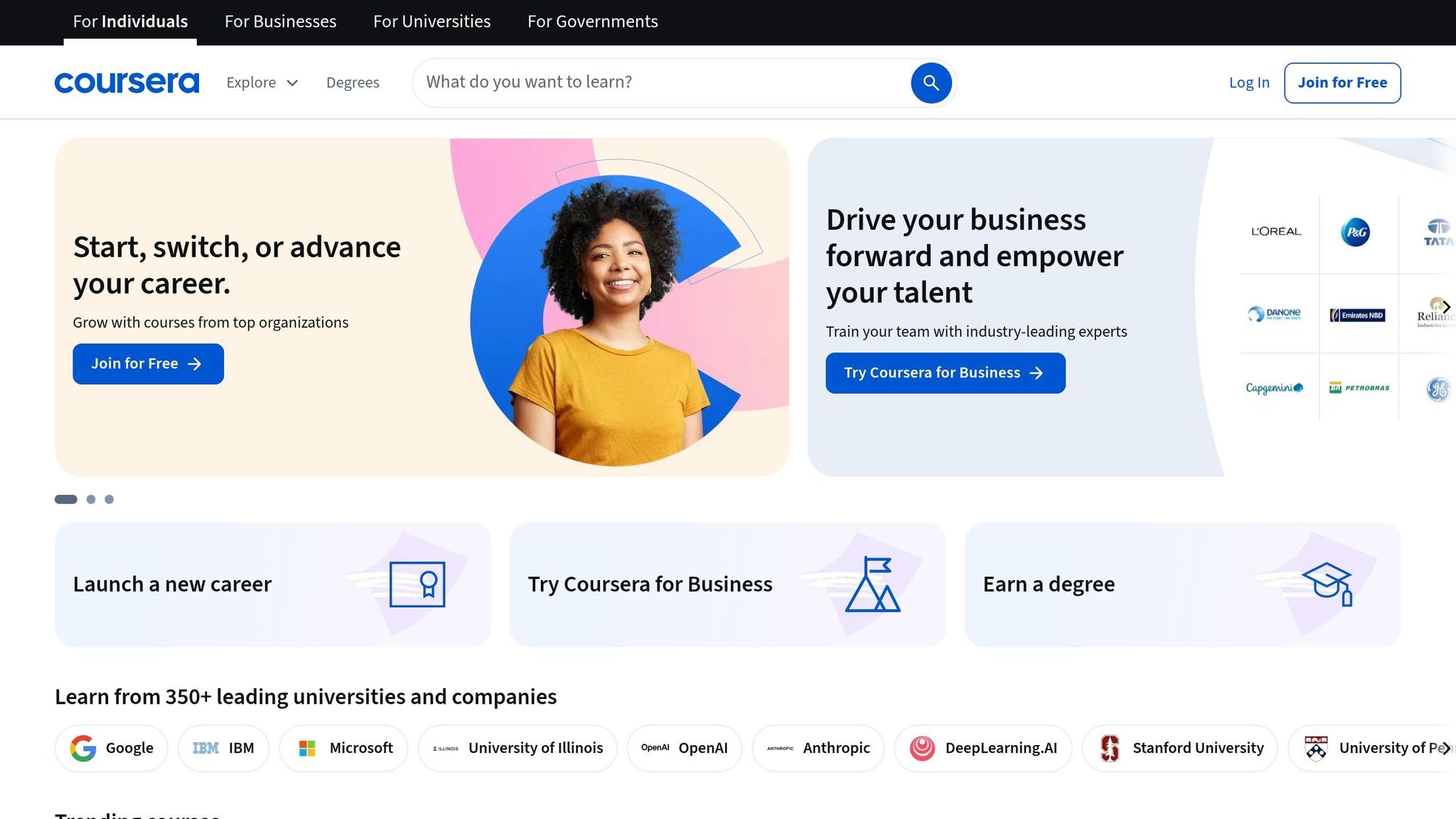
Coursera is the entry point, not the destination. It offers foundational courses such as The Art of Sales: Mastering the Selling Process that introduce broad concepts - prospecting, negotiation, objection handling - through frameworks rather than hands-on drills. For a brand-new seller learning the vocabulary, that is exactly enough.
The communication content stays at the conceptual level: inbound versus outbound, how a CRM works, what a sales process looks like at a high level, plus some coverage of AI tools in sales. It is useful for grounding, but it does not put a rep into a pressured conversation, so seasoned sellers usually find it thin and move on to hands-on training.
The value is in the on-ramp. A new SDR in their first months gets the vocabulary and the mental model of a sales process for very little cost, and a manager can use a course to set a shared baseline before company-specific training begins. The self-paced format fits around a schedule and works on any device, which suits a distributed team, but there is no live element, so it cannot replace coaching once a rep is actually selling.
Where it fits: individuals starting out and new SDRs in their first months, plus managers who want to set a baseline before deeper training. Many foundational courses are free, with low-cost paid certificates.
Sandler vs Challenger vs The Brooks Group
Buyers often shortlist these three together, so it helps to line them up. Sandler is a psychology-based system with weekly-style reinforcement, best when you want reps to qualify hard and behave like consultants. Challenger is an insight-led method for complex, high-consideration deals, best when your buyers want to be taught something rather than pitched. The Brooks Group's IMPACT Selling is a six-step foundational framework, best when you need to ramp new hires fast on one shared language.
The practical split is stage and deal type. Choose Brooks for foundations and onboarding, Challenger for senior reps in complex enterprise deals, and Sandler when qualification discipline and relationship depth matter most. None of the three is a practice tool on its own, so many teams pair the method they pick with an AI role-play platform so reps rehearse it and get scored the same way every time.
Workshops vs AI role-play practice
A recurring question when buying communication training is whether a workshop or an AI role-play tool is the better spend. They are not really competitors; they solve different halves of the problem. A workshop teaches the method and the mindset. AI role-play turns that method into a rehearsed habit by giving a rep unlimited reps and instant, consistent feedback. The strongest setups use both.
The table below lines up the trade-offs so you can see where each one earns its keep.
Dimension | Instructor-led workshop | AI role-play practice |
|---|---|---|
Main job | Teach the method, mindset, and framework | Rehearse the method until it is automatic |
Reps per person | A handful during the session | Unlimited, on demand, any time |
Feedback | Live but subjective and hard to standardize | Instant, scored against the same playbook every time |
Scales to a big team | Limited by trainer and calendar time | Yes, one manager can oversee a whole team |
Best at | Shared language, buy-in, complex judgment | Muscle memory, readiness checks, reinforcement |
The takeaway is simple: a workshop without reinforcement fades, and practice without a method drills the wrong habits. Buy the method from a program on this list, then reinforce it with repeated practice so the skill survives first contact with a real buyer.
Common mistakes to avoid
The biggest misstep is treating communication training as a one-and-done event. A team sends reps to a workshop, then drops them straight into live calls without realistic practice. The concepts make sense in the room, but they do not survive first contact with a buyer who pushes back, so the investment leaks away within weeks.
A second mistake is leaning on passive learning. Recorded videos and slide decks are fine for introducing an idea, but they do not build the instinctive response a rep needs when a buyer goes quiet or changes the subject. A rep can ace a quiz on active listening and still freeze in the moment, because reading about a skill is not the same as performing it under pressure.
The third is skipping reinforcement because coaching does not scale. Peer role-play helps, but manager time is finite, so structured practice is the first thing to slip on a busy team. The fix is frequent, hands-on reps: AI simulations, weekly manager-led drills, or applying a new technique directly to a live deal, so the skill is rehearsed often enough to stick.
How to choose a sales communication skills training program
Start with the moment your team loses deals. If reps fumble discovery or objections on live calls, prioritize a program with heavy practice and reinforcement over a one-day workshop. If the problem is an inconsistent message across the team, a methodology program like Sandler, Challenger, or The Brooks Group gives everyone a shared play to run. If the gap is confidence and rapport, Dale Carnegie is the classic pick.
Then weigh three practical filters. Reinforcement: does the skill get practiced after the first session, or does it fade? Fit: is the program built for your motion, whether transactional, consultative, or complex enterprise? Proof: can you tie it to a metric you already track, like ramp time or win rate, so a budget owner can defend it? For leaders specifically, look for manager coaching content and dashboards, since that is what turns a one-time program into an ongoing lift.
A common and effective setup is to pair a methodology with a practice layer. The method gives reps the framework; an AI role-play tool lets them rehearse it on demand and get scored the same way every time, so the training shows up in real conversations instead of staying in a binder. Want to see what daily practice does to call quality? Book a demo and we will build your first role-play library on your own buyers and objections.
FAQ
What is sales communication skills training?
Sales communication skills training is structured instruction and practice that sharpens the skills a rep uses in a live buyer conversation - active listening, discovery questioning, objection handling, and tone control. The goal is behavior change, not information transfer, so the strongest programs pair a clear method with repeated practice rather than a single workshop.
What is the best sales communication skills training program?
It depends on the moment your team loses deals. For repeatable rep practice with instant coaching, PitchMonster leads. For a psychology-based system, Sandler fits. For relationship and confidence skills, Dale Carnegie is the classic. For consultative B2B conversations, RAIN Group and Challenger are strong. Match the program to the gap your team actually has.
What are the 5 C's of communication?
The 5 C's of communication are clarity, conciseness, coherence, courtesy, and correctness. In a sales conversation they translate into saying the point plainly, keeping it short, staying on a logical thread, respecting the buyer's time, and getting the facts right. Most communication training builds these habits first, then layers selling tactics on top of them.
What are the 7 C's of communication in sales?
The 7 C's of communication are clarity, conciseness, concreteness, correctness, coherence, courtesy, and completeness. They act as a checklist for any buyer message: is it clear, tight, specific, accurate, logically ordered, respectful, and complete? Sales communication training uses them as a baseline for discovery questions, objection responses, and follow-up emails alike.
How do you learn sales and communication skills?
You learn sales and communication skills by practicing them, not by reading about them. Start with a method for discovery, questioning, and objection handling, then rehearse each moment repeatedly - through weekly coaching, peer role-play, or an AI role-play tool that scores you the same way every time. Reinforcement after the first session is what makes the skill stick.
How long does sales communication skills training take to work?
Foundational workshops run from a single day to several weeks, but the skill only holds with reinforcement after the session ends. Teams that add weekly practice or AI role-play tend to see change in conversations within a quarter. One PitchMonster customer, Mentor Group, recorded 30% faster ramp and a 28% win rate improvement after building practice into onboarding.
Can you train sales communication skills remotely?
Yes. Most established programs now run virtual or blended formats, and AI role-play tools are remote by design. A rep practices a discovery call or a pricing objection on their own schedule and gets scored against the same playbook every time. Remote practice removes the calendar bottleneck that caps how often a manager can run live drills.
Final recommendation
The right program is the one that closes your biggest gap. If reps keep walking into live calls unready, lead with practice and coaching, and PitchMonster is built for exactly that: realistic AI buyers, a Socratic AI Coach that makes lessons stick, and analytics that let one manager coach a whole team. If your constraint is a shared method, a framework like Sandler, Challenger, or The Brooks Group gives everyone the same play to run.
Whatever you shortlist, prove it before you buy. Set a baseline for ramp and win rate, then run a real role-play on your own use case so you judge the output, not the demo. Book a demo to see how your reps perform against a buyer built from your own ICP.