Sales performance training is structured practice and coaching that changes how reps sell, measured against revenue outcomes like win rate and ramp time rather than course completion. The strongest sales performance training programs pair a selling methodology with active practice on real scenarios and feedback after every rep, so the skills hold up on a live call instead of fading after the session.
This guide compares the 10 best sales performance training programs for 2026. Below you will find a side-by-side table, what each one is genuinely best for, how the formats, lengths, and pricing work, and a short method for matching a program to the gap your team actually has.
Quick results only count if they hold, and sales rep certification is how teams prove the skill stuck before quota is on the line.
Comparison table
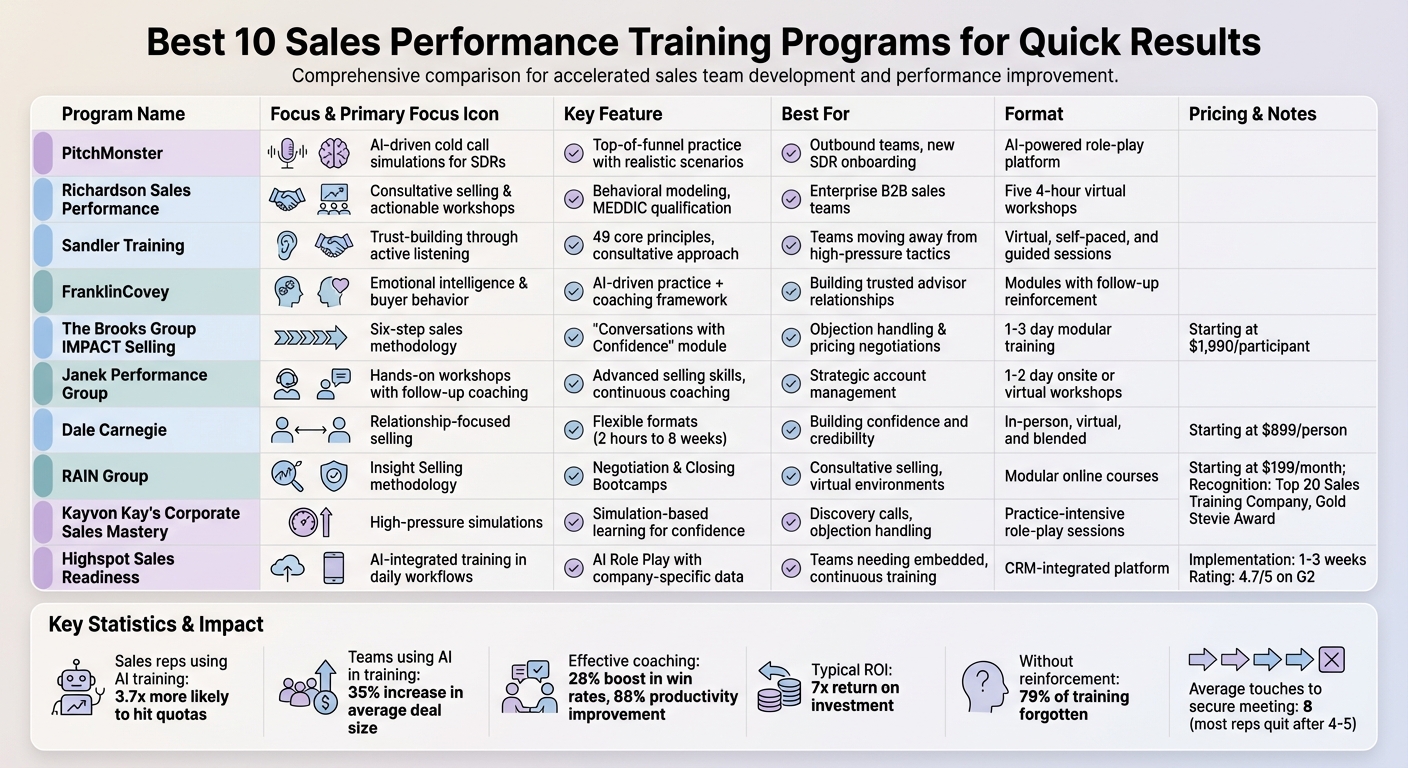
Use this table to scan the field, then read the full write-up on any program that fits. Formats and pricing change often and most providers quote per seat or per team on request, so treat these as a starting point and confirm before you buy. Where a provider publishes a figure, it is shown; where it does not, the column shows the company size the program fits best.
Program | Best for | Format and length | Pricing |
|---|---|---|---|
PitchMonster | AI role-play practice with post-session coaching | Self-serve platform, on demand | Quote-only (SMB to enterprise) |
Richardson Sales Performance | Consultative selling for complex B2B deals | 1 to 2 day workshops, virtual, blended | On request (mid-market to enterprise) |
Sandler Training | Trust-based selling and reinforcement over time | 3-day core plus 12 to 18 month reinforcement | On request (SMB to enterprise) |
FranklinCovey | Relationship selling and buyer psychology | 1-day or flipped classroom, plus microlearning | On request (mid-market to enterprise) |
The Brooks Group | A repeatable six-step methodology (IMPACT) | 2 days in person or 6 virtual sessions | $2,495 in person, $2,195 virtual per participant |
Janek Performance Group | Fast, workshop-driven skill lifts | One day, onsite, virtual, or self-paced | $1,245 onsite, $1,895 virtual, $995 self-paced |
Dale Carnegie | Confidence and interpersonal skills | 8-week virtual or 3-day onsite | Varies by location and format |
RAIN Group | Insight Selling and negotiation | 2 days in person or 6 virtual modules | On request (mid-market to enterprise) |
Korn Ferry | Assessment-led training at enterprise scale | Consulting plus training, scoped per engagement | On request (enterprise) |
Challenger | Teaching insight-led selling that reframes the deal | Live, online, and manager workshops | On request (mid-market to enterprise) |
Prices for The Brooks Group and Janek Performance Group are the per-participant figures those providers list publicly (source: Negotiation Experts, 2026); confirm current rates before you buy. All other programs quote on request, so the pricing column shows the company size each fits best.
What is sales performance training?
Sales performance training is training built to change rep behavior and revenue results, not just deliver content. It connects a company's go-to-market strategy to what reps actually do on calls: discovery, qualification, handling objections, positioning, and closing. The test of a program is whether a rep does something differently on a live call, and whether that shift shows up in win rate, deal size, or ramp time.
That is what separates it from a one-off workshop or a library of videos. A popular framework here is learn, practice, apply, then coach, which keeps skills moving from the classroom into real deals. The programs below approach that loop in different ways, from instructor-led methodology to AI-driven practice, but they share one goal: get reps ready before the next real conversation.
The category splits into two camps. Instructor-led methodology providers teach a repeatable selling system and reinforce it over weeks. Practice platforms compress the practice loop so reps rehearse hard conversations on demand and get scored. High-performance teams often run both, which is why this list blends the two.
What makes a program deliver fast results
Not every program changes behavior. A few features separate the ones that lift quota attainment from the ones that fade after a week.
Active practice is the first. Watching a video or sitting through a lecture leads to fast forgetting. Programs that work put reps into the conversation, responding to a CFO who pushes back on price or a technical buyer scrutinizing the product, until the response becomes muscle memory.
Fast, specific feedback is the second. When a rep hears what to fix right after a practice rep, they can adjust before the next live call instead of waiting for a manager to find time. The shorter that loop, the faster the result.
Realistic scenarios are the third. Generic scripts do not prepare a rep for the objections, personas, and sales cycles they meet in your market. The closer the practice is to your real pipeline, the more of it transfers to a live deal.
Measurable outcomes are the fourth. Strong programs track a leading metric like ramp time and a lagging one like win rate, so the investment is defensible. One PitchMonster customer, Mentor Group, recorded 30% faster ramp, 37% higher performance, and a 28% win rate improvement after rolling out structured practice, the kind of before-and-after a budget owner can point to.
These four traits also explain the fastest turnarounds for underperforming teams. When a team is missing quota, the gap is rarely more content. It is reps who never get enough live repetitions and never hear specific feedback in time to use it. A program that fixes those two things moves the number first.
10 best sales performance training programs
1. PitchMonster: AI Sales Role-Play and Coaching Platform
Best for: teams that want reps to practice realistic conversations and get coached after every one, not just attend a workshop.
PitchMonster is an AI sales role-play platform. Reps rehearse cold calls, discovery, and demos against AI buyers that adapt and object like your real ICP, then get scored against your own playbook. Managers get the skill-gap data to coach at scale, without hiring more trainers or burning real pipeline on unready reps. It fits SMBs through enterprises running consultative B2B motions, typically from a handful of reps up to a few hundred.
What makes it different is the coaching. Most programs on this list teach a methodology or report a score. PitchMonster runs the full loop: realistic practice, a Socratic AI Coach that helps the rep self-diagnose, and analytics a leader can act on. It is also the only European-based platform among the leaders, which matters for GDPR compliance and EU data residency. The six subsections below cover how that plays out feature by feature.
Custom AI role-plays built from your own material
Effective practice depends on scenarios that mirror real customer conversations. PitchMonster lets your team run tailored simulations, either from a template library or from scratch. Reps practice cold calls, discovery meetings, and demos in settings that closely replicate the real thing.
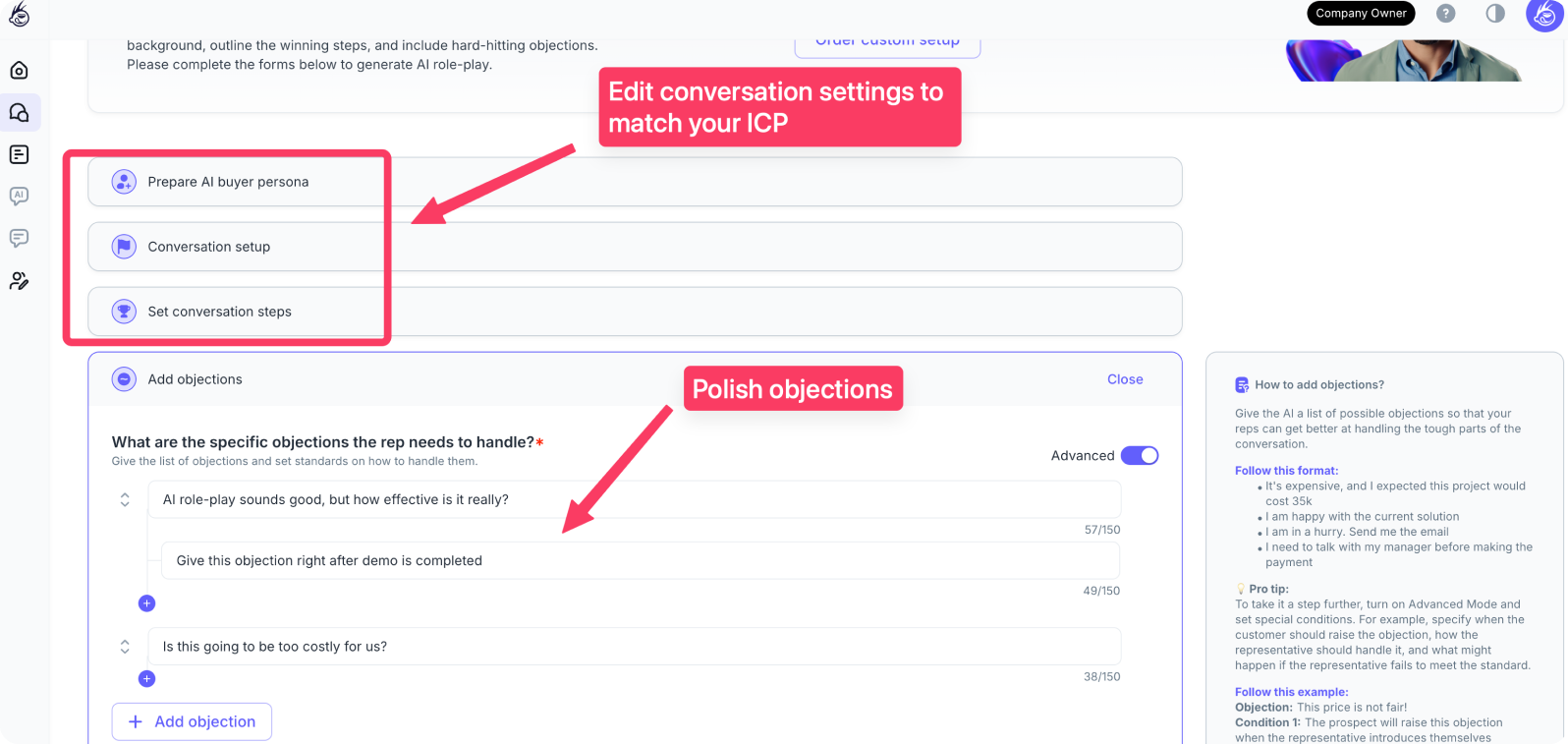
A manager can build a scenario from a call recording, product docs, or a website URL in about two minutes. There are four difficulty levels, up to and including Insane, plus 40+ customization parameters and support for 27+ languages. Ready-made role-plays cover the essentials like objection handling and talk tracks, so new hires ramp faster while top performers keep refining. Each session generates a full transcript and AI feedback, so leaders can reinforce winning behavior across the team.
Personalized role-play feedback after every session
Practice only pays off with feedback that drives improvement. After each simulation, PitchMonster delivers detailed, AI-generated insights on what the rep did well and where to adjust. Whether the goal is sharper objection handling, cleaner pitch delivery, or better talk-time balance, every session feeds the rep's growth.
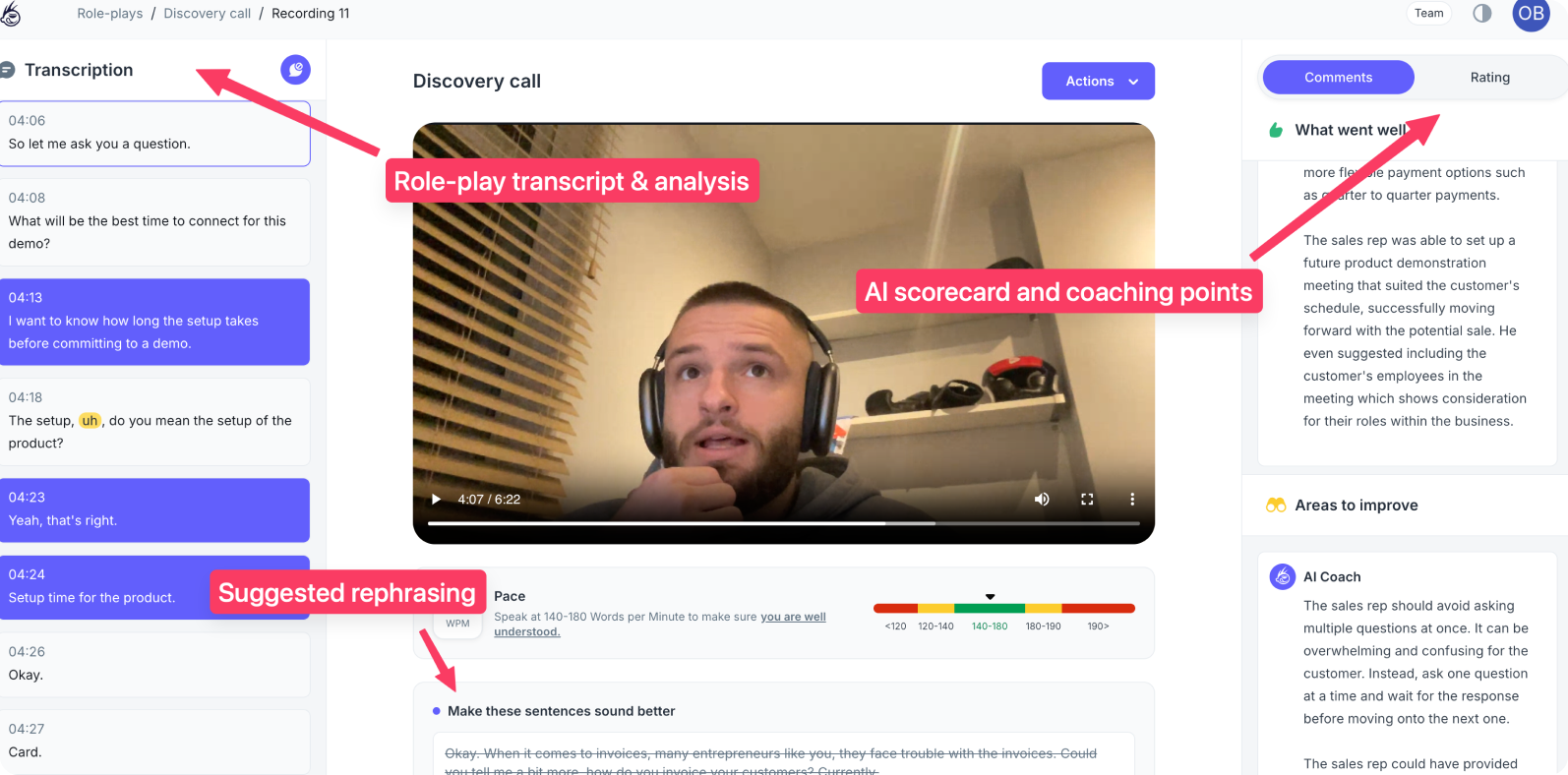
Each interaction is analyzed for the moments that matter, like pricing discussions, next-step commitments, and sentiment shifts. The platform highlights strengths and flags gaps, so leaders can tailor coaching and reinforce the behaviors that win. Sentiment and vocabulary analysis let it act as a virtual coach, building rep confidence between real calls.
Built-in AI speech coaching
Communication skills decide a lot of deals, and PitchMonster's speech coaching gives reps the feedback to sharpen them. Think of it as a sales Grammarly. It analyzes each conversation for pacing, sentiment, and filler words, then suggests changes to phrasing and talk time.
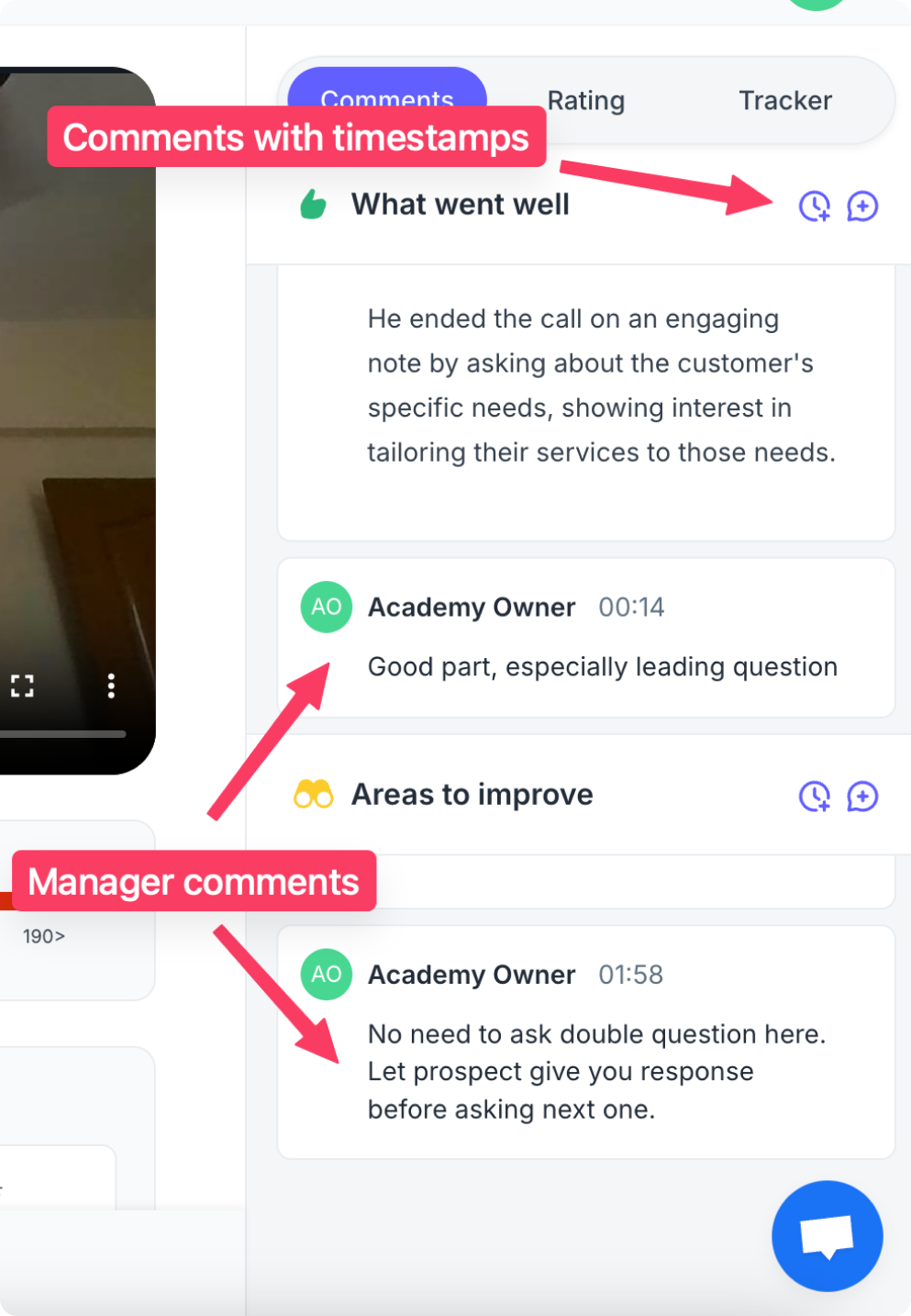
Across cold calls, discovery, and demos, the AI keeps every interaction tuned for clarity and impact. Reps get consistent, specific feedback they can apply on the next call, which builds confidence and steadily lifts performance. As one of our customers put it, the way we say things in our head is not often how it lands, and this is where reps hear the difference.
Create your own AI scorecard
Scoring should match how your team actually sells. PitchMonster's AI Scorecard lets leaders set evaluation criteria that fit their process, either by uploading their own metrics or starting from the scorecard library. You can assess reps on the factors that matter, like objection handling, talk time, and closing.
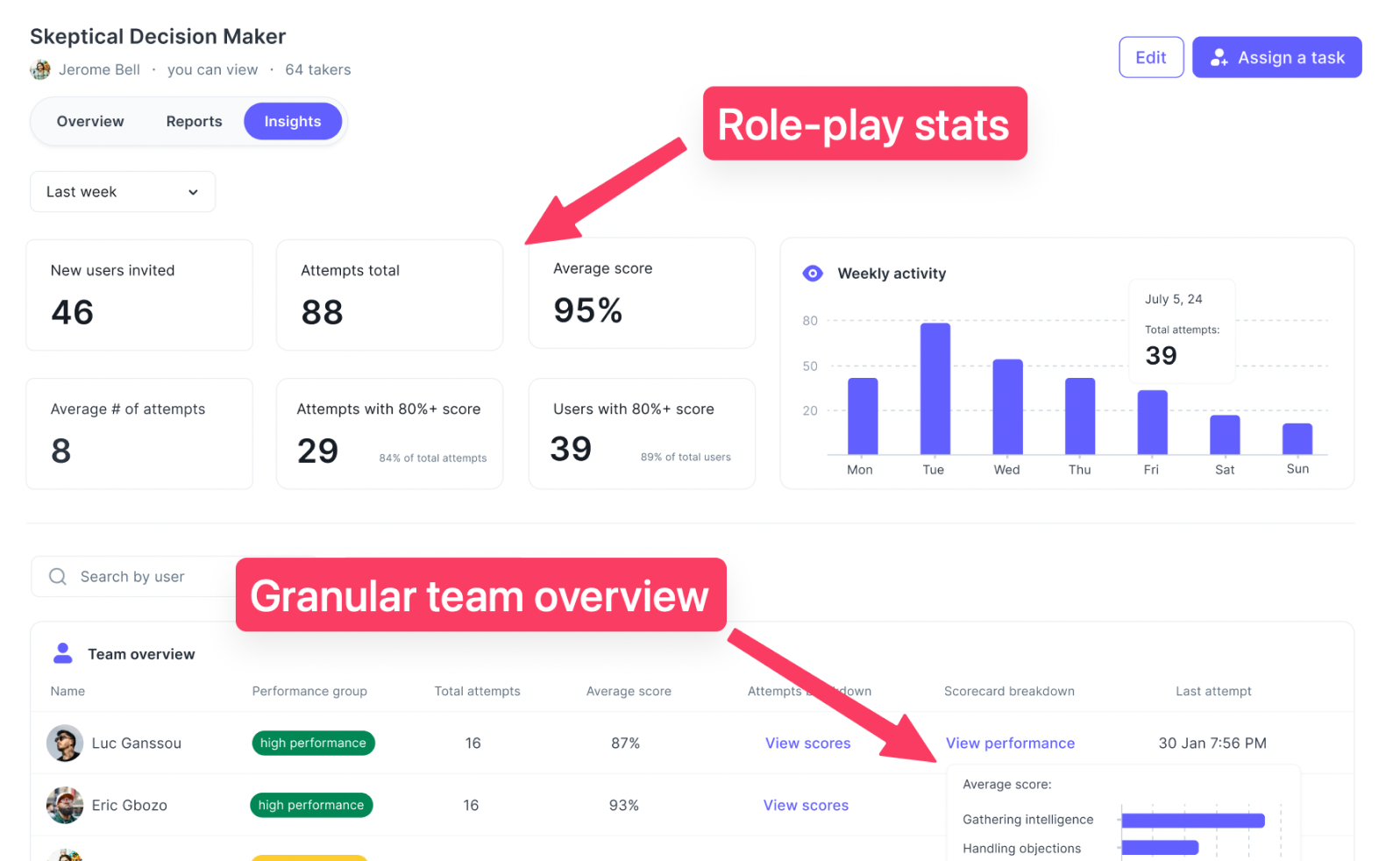
Because scoring is consistent, feedback stays objective and every rep is measured the same way. The scorecard analyzes each session automatically and produces clear scores that simplify performance reviews and surface winning behavior. With that data in one place, leaders can refine training and prove what is working.
The Socratic AI Coach, the differentiator
The AI Coach is the reason teams pick PitchMonster over a straight practice tool. After each session, a Socratic AI sales trainer asks reflective questions that guide the rep to their own insight before they ever see a score. It is available 24/7, so reps can debrief on their own time. No other program on this list does this.
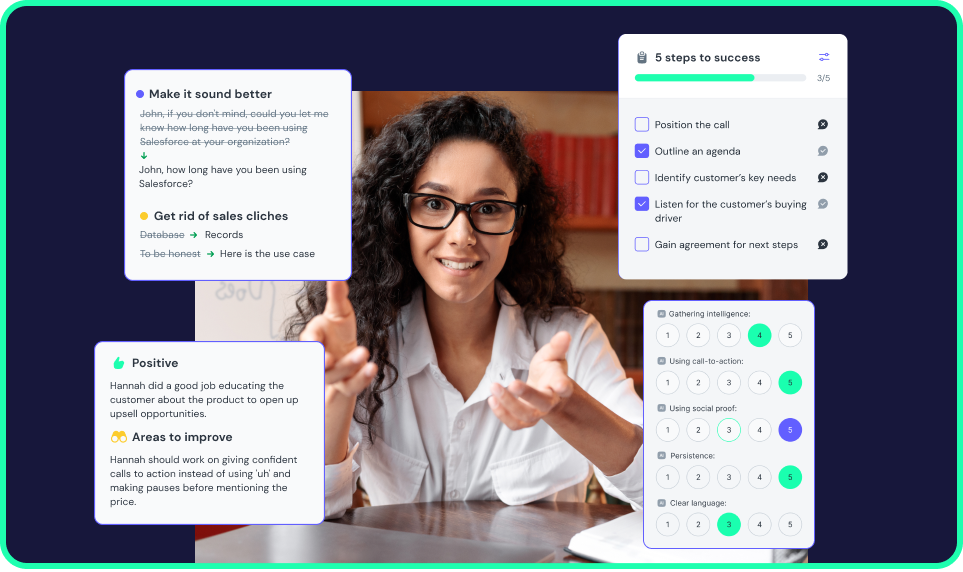
This matters because self-diagnosed lessons stick. When a rep reasons their way to what went wrong, the fix holds on the next live call in a way a handed-down score rarely does. That is what closes the gap between learning a tactic in a workshop and using it on a buyer under pressure.
Analytics and skill trends for managers
Leaders need to see the whole team, not just one session. PitchMonster rolls every scored role-play into rep-level and team-level views, so a manager can see who is ready, who needs another rep, and which skill is lagging across the floor.
That visibility is what makes the program defensible to leadership. You can tie practice volume and scores to the outcomes you already report, then coach the specific reps and skills that move the number. It also answers the underperforming-team question directly: the data shows exactly where the gap is before you spend another training dollar.
Where it fits: sales teams of roughly 10 to 300 reps running consultative B2B motions, with a manager, team lead, or L&D owner for training. It works best as the practice layer that turns a methodology into a repeatable skill, alongside or after an instructor-led program. Pricing is quote-only (custom per seat), with onboarding, a dedicated CSM, and support included and no setup fees. See pricing for your team size.
Verdict: the fastest way to turn a methodology into on-call behavior, and the strongest pick when the gap is practice rather than knowledge.
Proof: Mentor Group recorded 30% faster ramp, 37% higher performance, and a 28% win rate improvement after rolling out PitchMonster. As Wendy Mateo De Perkins of One Park Financial put it, "I think I really like the AI coach. That's definitely going to save us a lot of time."
See it on your own use case. Book a demo and run your first AI role-play, built from your product and your ICP, in about two minutes.
2. Richardson Sales Performance
Best for: consultative, value-based selling in complex B2B deals.
Richardson is a long-standing methodology provider with 40+ years in the market, focused on moving reps away from feature pitching toward conversations that match buyer needs. Its Connected Selling Curriculum organizes training into creating pipeline, winning opportunities, growing accounts, and sales management, with behavioral modeling that shows the difference between weak and strong selling.
Format and length: 1 to 2 day instructor-led workshops, 2 to 4 hour virtual sessions, and blended digital journeys, with classroom cohorts of roughly 15 to 25. Pricing is available on request and depends on team size and customization, so confirm directly. Verdict: a top pick when reps need a durable framework for complex deals and leadership will invest across quarters. Reps who freeze on live calls after the workshop often add a practice tool to close the last gap.
3. Sandler Training
Best for: trust-based selling and reinforcement that compounds over time.
Sandler has refined its consultative system since 1967, built around active listening, disciplined questioning, and a set of selling principles rather than high-pressure tactics. It trains more than 50,000 sales professionals a year. The emphasis is on lasting behavioral change, not a one-time event, which is why the program is structured for ongoing reinforcement.
Format and length: onsite, live virtual, and self-paced, with a roughly 3-day core followed by long reinforcement cycles. Sandler does not disclose prices publicly, so pricing is quote-only by team size and format. Verdict: one of the strongest picks for durable, trust-based selling when you can commit to reinforcement. Its role-play exercises pair naturally with an AI practice tool for teams that want more reps between sessions.
4. FranklinCovey
Best for: relationship selling and the buyer psychology behind it.
FranklinCovey's sales training centers on consultative selling and emotional intelligence, helping reps become trusted advisors rather than order-takers. Its Helping Clients Succeed suite covers engaging customers, advancing decisions, and negotiating win-win outcomes, with practice on reading buyer cues, building rapport, and handling objections.
Format and length: one-day sessions or flipped-classroom delivery over time, plus microlearning, delivered onsite, virtually, or blended. Pricing is quoted on request. Verdict: a strong choice when the gap is trust and buyer relationships rather than deal mechanics, and it layers well with a practice platform for the reps who need repetitions.
5. The Brooks Group (IMPACT Selling)
Best for: teams that want one repeatable, six-step methodology across the floor.
The Brooks Group's IMPACT Selling is a structured, six-step method delivered through a mix of classroom, virtual, and micro-learning, with modules on questioning, listening, and presenting. The modular format keeps reps in the field while they train, and the program includes a 10-week post-live playbook and flash drills to reinforce the method.
Format and length: 2 days in person (7.5 hours a day) or 6 virtual sessions, with a maximum class size around 20. Pricing is public: $2,495 per participant in person and $2,195 virtual (source: Negotiation Experts, 2026). Verdict: a strong pick when you want the whole floor speaking one method, with reinforcement already included. Add an on-demand practice tool if reps need more reps than the drills provide.
6. Janek Performance Group
Best for: a fast, workshop-driven lift when you need quick wins.
Janek combines onsite or virtual workshops with follow-up reinforcement, with a Critical Selling Skills program covering questioning, presenting, and closing. The selling point is speed: a one-day option that produces visible improvement in communication and confidence during the session itself. Janek is one of the most-searched programs among revenue leaders comparing research-backed training.
Format and length: one day, delivered onsite, virtually, self-paced, or blended, with a maximum class size around 20. Pricing is public: $1,245 per participant onsite, $1,895 virtual, and $995 self-paced (source: Negotiation Experts, 2026). Verdict: a strong pick when a team needs a fast lift this quarter, especially SDR or underperforming teams that need momentum. Pair it with ongoing practice so the gains do not fade after the workshop.
7. Dale Carnegie
Best for: confidence, credibility, and the interpersonal side of selling.
Rooted in relationship-building, Dale Carnegie's sales training is learning by doing: interactive activities and practice scenarios with immediate trainer feedback, designed to feel close to real customer interactions. It targets the confidence reps need to hold consultative conversations with informed, selective buyers.
Format and length: an 8-week virtual course (2-hour weekly sessions) or a 3-day onsite program, with class sizes up to 40. Pricing varies by location and format, so confirm current rates with the provider. Verdict: a strong choice when the gap is confidence and communication, particularly for new reps, and it complements a methodology or practice tool for complex deals.
8. RAIN Group
Best for: Insight Selling and negotiation.
RAIN Group builds training around Insight Selling, a consultative method that leads with understanding and value before the pitch. Its Negotiation and Closing programs walk reps through structuring deals and managing risk in realistic scenarios, mixing self-paced learning with hands-on assignments.
Format and length: 2 days in person or 6 virtual modules (2.5 hours each), with a maximum class size around 18 to 20. Pricing is available on request. Verdict: a strong pick when discovery, insight, and negotiation are the weak spots, and it pairs well with a practice tool so reps rehearse the method against a realistic buyer.
9. Korn Ferry
Best for: assessment-led training at enterprise scale.
Korn Ferry approaches sales performance as a consulting engagement: define what success looks like, assess the talent against it, then apply targeted training and coaching. That makes it a fit for large organizations that want diagnostics and a tailored program rather than an off-the-shelf workshop.
Format and length: scoped per engagement, combining consulting, assessment, and training across formats. Pricing is quoted per engagement. Verdict: a strong pick for enterprises that want a diagnostic-led, tailored program, and many pair the trained methodology with a practice platform so reps get the repetitions between sessions.
10. Challenger
Best for: teaching insight-led selling that reframes how the buyer sees the deal.
Challenger builds training around its Teach, Tailor, Take Control approach: reps lead with a commercial insight that reframes the customer's thinking, tailor it to the stakeholder, and stay in control of the process. It is aimed at complex sales where the buyer needs a new perspective, not just a relationship.
Format and length: live workshops, online courses, and manager coaching, delivered across formats. Pricing is quoted on request. Verdict: a strong pick when deals stall because buyers see no reason to change, and it depends on reinforcement, so a practice tool helps reps rehearse the insight-led opening until it holds.
How to choose and prove results
Start with the bottleneck, not the brand. If reps lack a framework for complex deals, a methodology program like Richardson, Sandler, RAIN Group, or Challenger fits. If they know the framework but freeze on live calls, the gap is practice, and a tool like PitchMonster closes it by letting them rehearse and get coached on demand. If the issue is confidence and rapport, Dale Carnegie or FranklinCovey lean that way. Most teams have one of these as the real constraint.
For a high-performance team already hitting quota, the goal is a sharper edge, so lead with a methodology that raises the ceiling and add scored practice to keep it there. For an underperforming or new SDR team, the faster path is usually more repetitions and specific feedback, so a fast workshop plus on-demand practice moves the number first. Match the program to which of those two situations you are in.
Then pressure-test the shortlist on what decides adoption. Does the program fit how your reps work, or pull them out of the field for days at a time? Is there reinforcement after the session, or does it end when the workshop does? Can you build practice on your own scenarios rather than generic scripts? And does it produce evidence a leader will accept?
- Define the outcome first. Decide whether you are shortening ramp, lifting win rate, or turning around a team, then pick a program built for that gap rather than the biggest brand.
- Check the format against your calendar. A multi-day offsite and an on-demand platform fit very different teams, so weigh how much time reps can leave the field.
- Confirm there is reinforcement. The programs that change behavior reinforce it for weeks; a one-off workshop rarely holds on its own.
- Insist on realistic practice. Reps should rehearse your objections and personas, not a generic script, so the skill transfers to real pipeline.
- Judge the evidence it produces. Look for scoring or analytics a leader will accept, not just a completion certificate.
- Set a baseline, then decide. Record ramp time and win rate before rollout so you can prove the return after a quarter and defend the spend.
That last point is where most training fails to justify itself. Set a baseline for ramp time and win rate before rollout, then measure again after a quarter, and review results on a regular cadence so you can drop what is not moving the number. For the practice-and-coaching angle specifically, you can book a demo and run your first role-play on your own material. For a wider view of the software side of this market, see our comparison of the best sales training platforms, and for ready-to-run practice, our library of sales role-play scenarios.
FAQ
What is sales performance training?
Sales performance training is structured practice and coaching that changes how reps sell, measured against revenue outcomes rather than course completion. The strongest programs pair a selling methodology with active practice on real scenarios and feedback after each rep, so skills hold up on live calls instead of fading after the workshop.
Which sales performance training program gives the fastest results?
Speed comes from how often reps practice, not how long the workshop runs. Methodology programs like Richardson and Sandler move behavior over weeks of reinforcement. A practice platform such as PitchMonster compresses that loop: reps run the same hard conversation on demand and get coached after every attempt, so the gap between learning a tactic and using it on a buyer closes faster.
What is high-performance sales training?
High-performance sales training focuses on the behaviors that separate top reps from the rest, then drills them until they hold under pressure. It goes past product knowledge into discovery, objection handling, and negotiation, and it measures change with metrics like win rate and ramp time. The fastest versions pair a proven methodology with frequent, scored practice. For a wider field including longer-form and methodology-led options, see our roundup of sales training programs for reps.
What is the best sales training for underperforming teams?
For an underperforming team, diagnose the gap before you buy. If reps lack a framework for complex deals, a methodology program like Richardson or Sandler fits. If they know the framework but freeze on live calls, the gap is practice, and a tool like PitchMonster lets them rehearse and get coached on demand. Set a baseline metric first so you can prove the turnaround.
How much do sales performance training programs cost?
Most providers quote per participant or per team and rarely publish rates. Where figures are public, The Brooks Group lists $2,495 per participant in person and Janek lists $1,245 onsite. PitchMonster is quote-only (custom per seat), with onboarding, a dedicated CSM, and support included and no setup fees. Confirm current pricing with each vendor.
Is methodology training or AI role-play better for sales performance?
They solve different parts of the problem. Methodology training gives reps a framework for discovery, objections, and negotiation. AI role-play turns that framework into a repeatable skill by letting reps rehearse it against a realistic buyer and get scored. Many teams run both: a methodology for the what, and a practice tool for the reps to make it stick.
How do I prove a sales training program is working?
Tie it to metrics you already track: ramp time for new hires, win rate, average deal size, and quota attainment. Set a baseline before rollout, then compare after one or two quarters. One PitchMonster customer, Mentor Group, recorded 30% faster ramp and a 28% win rate improvement, which is the kind of before-and-after a budget owner can defend.
Final recommendation
The right program is the one that closes your biggest gap. If reps keep walking into live calls unready, lead with practice and coaching, and PitchMonster is built for exactly that: realistic AI buyers, a Socratic AI Coach that makes lessons stick, and an EU base for teams that need it. If reps need a durable framework for complex deals, a methodology like Richardson, Sandler, RAIN Group, or Challenger fits, and if the gap is confidence, Dale Carnegie or FranklinCovey lean that way. For a fast, workshop-driven lift, Janek and The Brooks Group deliver momentum, and Korn Ferry suits enterprises that want an assessment-led rollout.
Whatever you shortlist, prove it before you buy. Set a baseline for ramp and win rate, then run a real role-play on your own use case. Book a demo to see how your reps perform against a buyer built from your own ICP.