Sales teams in 2026 face mounting pressure: 69% of B2B reps missed quotas in 2025. This checklist provides a clear, actionable framework to prepare your team for success. Key steps include:
- Assess readiness gaps: Use performance data (win rates, ramp times) and feedback to identify weaknesses.
- Define scenarios: Map out sales situations and set clear criteria for success.
- Leverage AI role-play: Enable reps to practice critical conversations with sales role-play tools that improve skills by 38%.
- Measure and improve: Continuously track metrics like win rates and quota attainment to refine strategies.
With buyers conducting 96% of their research independently and deals becoming more complex, your sales team needs a structured readiness plan to perform under pressure. Follow this guide to boost productivity, shorten ramp times, and improve deal outcomes.
Introduction: Why Sales Readiness Matters in 2026
The changing sales landscape
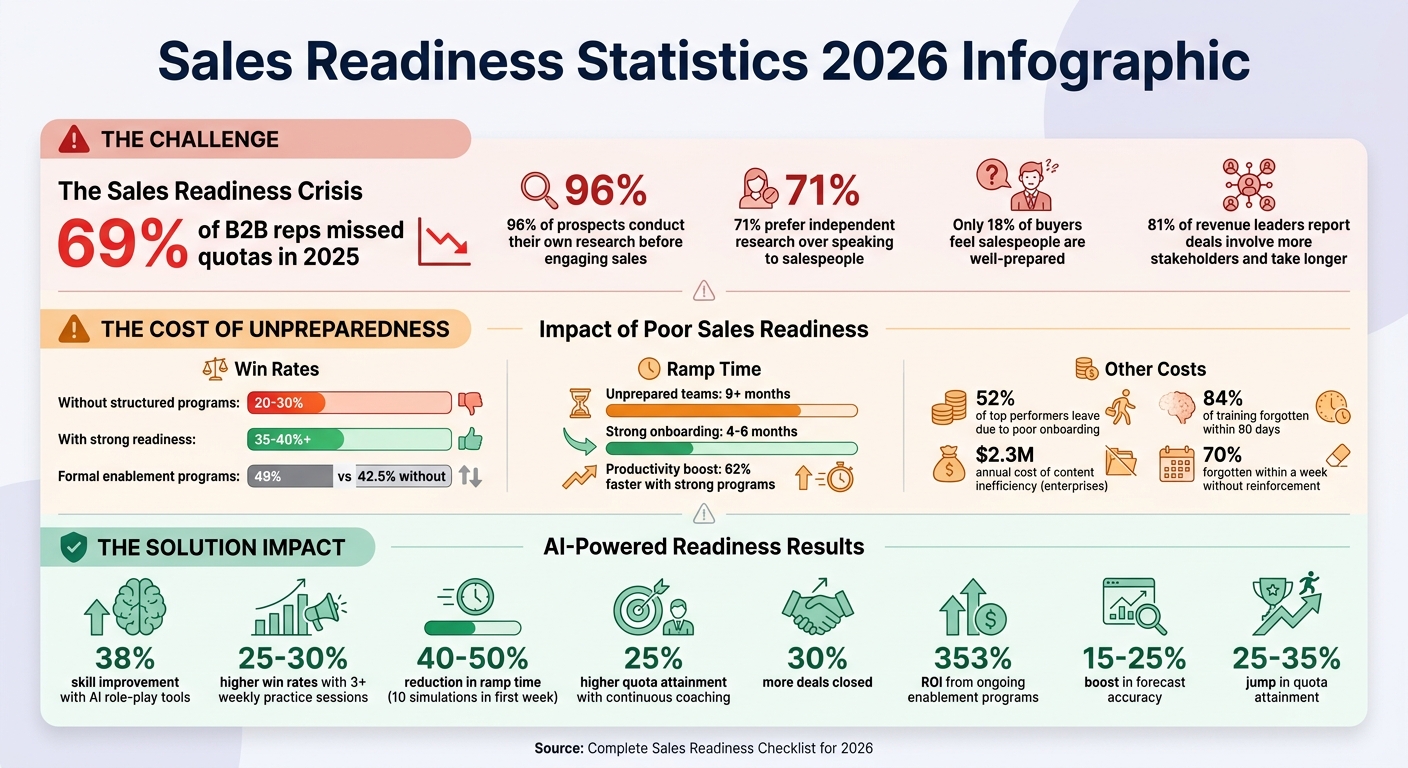
The way buyers approach purchases has shifted dramatically. Today, 96% of prospects conduct their own research before ever engaging with a sales rep, and 71% actually prefer this independent research over speaking to a salesperson. This means sales reps need to bring something extra to the table - offering consultative insights that go far beyond the information buyers can easily find online. And they need to deliver this value from the very first interaction.
At the same time, the complexity of deals has skyrocketed. 81% of revenue leaders report that deals in 2026 involve more stakeholders and take longer to close than in the past. Sales reps are now expected to manage multiple decision-makers, translate technical requirements for engineers, and build compelling business cases for CFOs. The old tactics of simply showcasing product features or running demos no longer suffice. Buyers demand tailored, expert-level guidance from day one.
These shifts highlight one thing: a strong readiness strategy is no longer optional - it's essential.
The cost of unprepared sales teams
When sales reps aren't adequately prepared, the consequences are both immediate and far-reaching. For starters, only 18% of buyers feel that the salespeople they meet are well-prepared, which can lead to missed deal opportunities. Unprepared reps often end up practicing on real prospects, which not only lowers lead quality but also harms your brand's reputation. They struggle to clearly communicate ROI or articulate value propositions effectively.
The financial toll is undeniable. Companies without structured readiness programs see win rates stagnate between 20-30%, while top-performing teams achieve 35-40% or more. New hires in these underprepared organizations take 9+ months to ramp up, compared to just 4-6 months for teams with strong onboarding processes. And the problem doesn’t stop with deals - there’s also a talent retention issue. 52% of top-performing sales professionals have left jobs due to poor onboarding experiences, meaning you're not just losing sales but also your most capable team members.
"A sales hire's first 90 days can make or break an entire fiscal year. Ramp them quickly and they'll book meetings, close revenue, and breathe life into your pipeline. Let them drift and you'll lose two quarters of productivity." - Eden, Managing Director, Quota Crushers Agency
How this checklist will help
This checklist is designed to tackle these challenges head-on with a clear, data-driven strategy. It offers a structured framework to turn basic training into consistent, high-performance results. You'll learn how to pinpoint skill gaps using real-world performance metrics, identify critical scenarios your reps need to master, utilizing sales role-play training best practices, and implement AI-driven practice programs using top sales training tools that scale effectively - without overburdening your managers.
The upcoming steps focus on actionable strategies. You'll discover how to pilot readiness programs with small teams, roll them out across your organization, and measure their impact on revenue using metrics that matter. By following this approach, you'll build a repeatable system that accelerates new hire ramp times, sharpens your team's skills, and keeps everyone ready to adapt as the market evolves. This framework will help you turn readiness challenges into measurable success.
sbb-itb-bfb5038
The Ultimate Sales Training 2026 (Full Course for Tech Sales)
1. Assess Your Current Sales Readiness
Start by gathering solid data on your team’s performance, processes, and the challenges your sales reps face daily. A detailed assessment highlights the specific areas where your team needs help and helps you decide where to focus your time and resources.
Analyze skill gaps and metrics
Take a close look at important metrics like ramp time for new hires and win rates. Ramp time can reveal where readiness falls short. Track metrics like playbook usage, certification results, and whether reps can confidently explain ROI to a CFO or handle competitive objections in real-world scenarios. As Prospeo explains:
"The quiz tested recall. The call tested readiness. They're not the same thing."
Pay attention to data quality, too. For example, if your contact database has a bounce rate over 5%, even the best-trained reps will struggle to connect with prospects. Also, check your lead response times - responding within 5 minutes can boost conversions by 8x to 21x, compared to waiting 10–30 minutes.
Audit sales processes and tools
Next, examine whether your tools and processes help or hinder your team. Reps spend only 28–30% of their time actively selling - the rest goes to admin tasks, searching for resources, and dealing with disorganized systems. Review how much of your sales content is actually used; 65% of sales content goes untouched because reps either can’t find it or don’t trust it. If reps are recreating materials 40% of the time, it’s a sign that your system isn’t meeting their needs. This inefficiency costs enterprises around $2.3 million annually in missed opportunities.
Make sure your tools meet modern standards, such as AI-powered coaching, real-time feedback, and automated updates. Many top-performing teams are already using AI-driven tools. If your organization still relies on annual training days and static PDFs, you risk falling behind. Teams with formal sales enablement programs report 49% win rates, compared to 42.5% for those without.
This type of audit lays the groundwork for pinpointing areas that need improvement.
Gather feedback from reps and managers
Numbers only tell part of the story - insights from your team fill in the gaps. Conduct quarterly surveys to ask reps if they have the tools and knowledge to close deals. Interview both reps and managers to identify "content graveyards" - resources that exist but go unused - and uncover specific challenges in your sales process.
Ask about pain points: Are reps bogged down by manual CRM updates? Can they find the right content in under 60 seconds when a buyer asks a tough question? Do they feel prepared to handle complex, multi-stakeholder deals? These answers will help you determine whether the gaps are in skills, processes, or both. Keep in mind that 70% of salespeople feel overwhelmed by their tech stack, so simplifying it might be just as important as adding new tools.
This feedback is essential because training without reinforcement doesn’t stick. Studies show that 84% of sales training content is forgotten within 90 days, and 70% is lost within a week if there’s no follow-up. Your assessment should go beyond tracking what training occurred - it should measure whether reps can apply what they’ve learned when it matters most. This insight will shape your next steps, such as refining sales scenarios and introducing targeted AI role-play exercises.
2. Define Sales Scenarios and Key Competencies
Now that you’ve assessed your current situation, it’s time to define what sales readiness looks like for your team. This means identifying the sales role play scenarios and behaviors that directly contribute to success. These scenarios will form the foundation for focused training and AI-driven role-play exercises in the next step.
Identify Critical Sales Scenarios
Pinpoint the pivotal sales moments that significantly influence your win rate. These often include:
- Discovery calls: Reps need to accurately frame the problem and establish relevance.
- Competitive displacement: When prospects are already using a rival solution, reps must differentiate effectively.
- Executive conversations: In high-stakes meetings, like with a skeptical CFO, reps may have less than 90 seconds to clearly communicate ROI.
- Multi-stakeholder scenarios: Situations where reps must navigate conflicting priorities, such as balancing the concerns of CISOs and VPs of Engineering.
Don’t forget outreach scenarios triggered by specific events - like a company hiring a new leader, experiencing rapid growth, or undergoing reorganization. By focusing on scenarios that reflect your actual deal flow, you can prioritize training where it matters most.
Define Success Metrics for Each Scenario
Set measurable, revenue-focused goals to track progress effectively. For example:
- Discovery calls: Target a meeting-to-opportunity conversion rate of 35–40%, compared to the usual 25–30%.
- Competitive scenarios: Monitor win rates and stage velocity, ensuring that strong demo performance leads to quicker movement from demo to proposal.
Leverage the AIR taxonomy to structure your metrics:
- Activities: Daily efforts, like practice sessions.
- Indicators: Weekly signals, such as improved stage conversion rates.
- Results: Quarterly outcomes, like higher win rates.
This framework helps diagnose issues early. For instance, if reps are completing training (Activity) but aren’t improving stage conversions (Indicator), it may highlight a disconnect between training and real-world application.
Document Buyer Personas and Messaging
Create detailed persona profiles and tailored messaging for each role your reps interact with. For example:
- CFOs: Focus on ROI and risk reduction.
- VPs of Engineering: Address technical compatibility and implementation timelines.
Develop persona-specific discovery questions and objection-handling scripts, and compile them into easy-to-use battle cards.
Align your content with the buyer’s journey:
- Early-stage: Provide insight-driven materials for discovery calls.
- Mid-funnel: Equip reps with competitive positioning tools.
- Late-stage: Use ROI calculators to support final negotiations.
Audit your existing content to identify what works. Retire outdated or unused materials to ensure reps have quick access to the most effective resources during buyer interactions. With these scenarios and metrics clearly outlined, your team will be ready to dive into AI-powered role-play training to build consistency and improve results. You can also create AI role-plays to scale this practice across the entire organization.
3. Implement AI Role-Play and Practice Programs
Now that you've outlined your scenarios and competencies, it's time to bring them to life with AI-driven practice tools. This step takes theoretical knowledge and turns it into real-world conversational skills, allowing sales reps to rehearse critical moments in a risk-free setting - well before they engage with actual prospects.
Select and Configure an AI Role-Play Platform
When choosing a platform, prioritize adaptive voice AI over basic text-based chatbots or rigid decision trees. By 2026, "Generation 3" voice simulators powered by large language models are the gold standard. These tools deliver natural, free-flowing responses, ensuring a more realistic interaction. For smooth conversations, aim for end-to-end latency between 500–700 milliseconds, with 800 milliseconds as the upper limit.
PitchMonster's AI sales role-play training page shows what adaptive voice practice looks like in a live product.
Look for platforms that integrate seamlessly with tools like Gong, enabling you to turn real-world objections or lost-deal recordings into practice scenarios. The platform should support deep persona customization, incorporating industry-specific language, varying resistance levels, and even hidden buyer concerns. Feedback should go beyond basic metrics, offering insights into skills like discovery questioning, talk-to-listen ratios, and objection handling. Align these capabilities with your predefined sales scenarios to ensure focused skill development.
For example, in early 2026, Snowflake launched an AI role-play program that saved over 1,200 hours of manager coaching time each quarter while maintaining rigorous certification standards. Similarly, Clari saw a 36% boost in overall conversation quality after integrating AI simulations informed by real call data.
Create Realistic Sales Scenarios
Leverage real call recordings, objections, and CRM data to design authentic simulations. Develop detailed personas with specific names, roles, company sizes, industries, and personality traits - such as analytical, skeptical, or rushed. Set resistance levels to match the experience of your reps, with supportive scenarios for newcomers and tougher challenges for seasoned professionals.
Incorporate "hidden" concerns like budget constraints that reps must uncover through effective questioning. Program the AI to adjust its responses dynamically, even simulating emotional reactions to poor handling or disengaging when necessary. Tie these scenarios to key business events, such as new product launches or competitive displacement opportunities, to make the practice sessions both relevant and impactful.
Establish Regular Practice Routines
Aim for 8 to 12 simulations per rep each month, translating to about 2 to 3 sessions per week. Reps who practice at least three times weekly against realistic competitive scenarios often achieve win rates 25% to 30% higher. For new hires, completing around 10 simulations in their first week can reduce ramp-up time by 40% to 50%.
Position the platform as a safe, private space for reps to learn and make mistakes - not as a tool for managerial oversight. Require brief 10-minute "pre-call" simulations before critical competitive deals to help reps internalize objection-handling strategies. Use spaced reinforcement - short, weekly practice sessions instead of one-time training events - to counteract the forgetting curve, which shows that 87% of training content is lost within 30 days without consistent practice. Tools like PitchMonster make it easy to set participation goals and integrate practice into daily workflows, helping reps stick to the ideal 2–3 sessions per week.
With a structured practice routine in place, your team is ready to build on these efforts, ensuring they stay sharp and prepared for any sales challenge.
4. Roll Out and Scale Sales Readiness Programs
After fine-tuning your AI role-play simulations, it’s time to take your sales readiness program to the next level. A systematic, phased rollout ensures consistency and measurable results across the organization.
Phase 1: Pilot with a small team
Begin with a small group of 5–15 reps over a 90-day pilot period. Here’s a suggested timeline:
- Weeks 1–2: Use quizzes, call reviews, and AI role-plays to assess skill gaps and establish a baseline.
- Weeks 3–4: Focus on training, delivering role-based playbooks and in-depth product knowledge.
- Weeks 5–7: Shift to practice with AI-driven simulations and provide targeted coaching.
- Weeks 11–12: Wrap up with a final AI role-play certification to confirm field readiness.
Take inspiration from GreyScout, a B2B company that, in 2026, cut new hire ramp time from 8–10 weeks to just 4 weeks. Their success came from gating live deals - new reps couldn’t interact with prospects until passing simulations on objection-handling and discovery. During your pilot, track metrics like Time to First Deal and Time to First Meeting. These early indicators shift more quickly than win rates and provide immediate feedback on program impact.
Once the pilot demonstrates success, expand the program to the rest of your sales team.
Phase 2: Expand across teams
With the pilot team certified, roll the program out to the broader sales organization using rolling cohorts. For larger teams, schedule new hire cohorts every 2–4 weeks to maintain quality and avoid bottlenecks. Tailor simulations for specific roles: SDRs can focus on cold-call openers and qualification scripts, while AEs work on competitive displacement and negotiation skills.
Manager involvement is crucial for adoption. Integrate AI practice scores into 1:1 coaching sessions to provide precise, actionable feedback. Equip managers with simulation data so they can offer specific guidance rather than generic advice. During this phase, track metrics like content usage rates and Demo-to-Proposal conversion rates to measure how behaviors are changing across the team.
Phase 3: Institutionalize and track progress
Use the lessons from the pilot and expansion phases to make continuous training a permanent part of your operations. Embed practice requirements directly into your CRM - like requiring reps to complete an AI negotiation simulation before advancing a deal to the "Proposal" stage. Establish certification gates to ensure ongoing skill development, not just during onboarding. Centralized playbooks with version control can help maintain consistent messaging across teams.
Monitor long-term metrics such as win rates, quota attainment, and ramp time reduction to gauge the program’s overall impact. Companies with formal sales enablement programs see win rates of 49%, compared to 42.5% for those without. Set participation goals to ensure engagement - tools like PitchMonster can track whether reps are completing the recommended 2–3 practice sessions per week. By this stage, your program becomes a continuous improvement system, seamlessly integrated into daily workflows and driving measurable revenue growth.
5. Measure Success and Continuously Improve
Once your readiness program is up and running across teams, the next step is proving its impact on revenue. Forget surface-level metrics like training completion rates or content downloads. Instead, zero in on meaningful indicators. Look at leading indicators like meetings booked and discovery questions asked, which highlight immediate coaching opportunities. Then, track lagging indicators such as win rates and quota attainment to measure long-term performance. These metrics will serve as your guide for making improvements that actually matter.
Track Key Performance Indicators (KPIs)
Pay attention to KPIs that reflect real-world deal execution. For example, Sales Rep Ramp-up Time should ideally fall between 3–6 months, with new hires achieving at least 70% of their quota by Month 6. Keep an eye on Time to First Deal separately - it changes faster than win rates and shows whether your onboarding is teaching reps how to execute, not just memorize.
Content usage rates are equally important. If less than 80% of your reps are actively using playbooks, it might mean the materials aren’t connecting with what’s happening in buyer conversations. Beyond that, use assessment-based KPIs like certification scores for objection handling to pinpoint skill gaps before they hurt performance.
When it comes to conversation quality, track metrics like the talk-to-listen ratio (aim for 43%–57%) and the number of discovery questions asked during calls (top reps average 11–14). Tools like PitchMonster can help track whether reps complete the recommended 2–3 weekly practice sessions, ensuring they’re sharpening their skills between live calls. Companies that implement thorough KPI tracking often see a 15%–25% boost in forecast accuracy and a 25%–35% jump in quota attainment.
Connect Readiness Efforts to Revenue Impact
Use these KPIs to directly link readiness efforts to revenue outcomes.
"If your enablement strategy doesn't touch live pipeline, it's already obsolete." - Fluint.io
Pinpoint where deals are getting stuck - whether it’s after the first demo, during negotiations, or at the proposal stage - and tailor your readiness programs to address these bottlenecks. For instance, track Demo-to-Proposal conversion rates to see if your discovery and value proposition training is hitting the mark. Use your CRM to monitor multi-threading depth (the number of contacts per opportunity); increasing this number can reduce the risks of single-threaded deals. Also, keep an eye on deal slippage rates - aim for less than 20% - to ensure reps are qualifying opportunities effectively rather than inflating the pipeline.
Pipeline velocity is another critical metric. Calculate it using this formula:
(Number of Opportunities × Average Deal Size × Win Rate) ÷ Sales Cycle Length.
If velocity improves after introducing AI role-play training, you’ve got proof of impact. Research shows that companies with formal sales enablement programs achieve win rates of 49%, compared to 42.5% for those without. Plus, strong onboarding programs can accelerate new hires’ productivity by 62%, directly enhancing revenue capacity.
Iterate Based on Feedback and Results
An iterative approach helps reinforce earlier steps in identifying and addressing readiness gaps. Create a structured feedback loop with weekly reviews of content usage and win/loss analysis, monthly updates to training materials, and quarterly strategy reviews that include field satisfaction surveys. Ask your reps directly if they have the tools and knowledge they need to succeed. If the answer is no, your content might be gathering dust in a “graveyard.”
"The best battle cards are written with input from top performers who've handled the objections in real deals." - Knowlify
Regular win/loss analyses can also uncover readiness gaps, like weak ROI explanations or ineffective competitive positioning, that may have contributed to lost deals. Since learners forget 80%–90% of training without reinforcement, use feedback loops to identify which scenarios need more practice. Companies that provide ongoing, continuous training are twice as likely to outperform their peers. In today’s fast-changing environment, static readiness simply isn’t enough. Build a system that evolves alongside your market, your buyers, and your team’s performance data.
Conclusion: Building a Future-Ready Sales Team
Recap of key steps
Creating a sales team ready for the future involves focusing on a few critical actions: identifying skill gaps, outlining key scenarios, using AI-powered role-play, expanding readiness programs, and keeping a close eye on metrics tied to revenue impact. These efforts need to be ongoing to ensure lasting results. As buyers become more informed and sales cycles lengthen, consistent enablement keeps your team sharp and improves win rates.
Long-term benefits of continuous readiness
The benefits of continuous readiness go far beyond simply speeding up onboarding. Teams that prioritize ongoing coaching are seeing impressive results - 25% higher quota attainment and 30% more deals closed, leading to a 353% ROI. But the real game-changer? Preventing the dreaded knowledge loss. Without reinforcement, reps forget 80% to 90% of training within a week. Companies with robust readiness programs have halved the ramp-up time for new hires and significantly boosted the quality of their data.
"Sales readiness is the bridge between knowing the material and executing under pressure, and almost nobody builds that bridge deliberately." - Prospeo Team
Call to action for sales leaders
Take action today. Use the checklist as your guide to evaluate your team's readiness. Start incorporating AI simulations to help your reps refine their skills. Are they prepared to handle objections or explain ROI to a CFO without hesitation? Platforms like PitchMonster let your team practice these critical conversations in a risk-free environment, improving their performance before they engage with real leads. This approach also eases the coaching load on managers while enhancing call quality across the board. The most successful sales teams have access to timely coaching and the right resources. Build that system now - because by 2026, static readiness won’t cut it.
FAQs
What’s the fastest way to spot our biggest sales readiness gaps?
The fastest way to spot gaps in sales readiness is by assessing whether your team can confidently navigate real-world selling situations. This includes handling objections smoothly and clearly explaining ROI, even under pressure. AI-driven assessments paired with real-time feedback can quickly uncover skill deficiencies. Add to this a steady stream of coaching to ensure reps are applying what they’ve learned effectively. By blending these tools with regular evaluations, you can identify areas that need attention and improve your team’s overall readiness.
Which sales scenarios should we train first for the biggest revenue impact?
To drive the most revenue impact, concentrate training efforts on scenarios where sales reps need quick, context-specific guidance. Key stages to focus on include discovery, objection handling, proposal presentation, and negotiation. Prioritize skills such as effectively managing objections, customizing messaging for specific prospects, and navigating complex, multi-stakeholder deals. Mastery in these areas equips reps to handle critical moments with confidence, leading to stronger engagement with prospects and better revenue results.
How can we prove AI role-play improves win rates and ramp time?
Organizations have shown that AI role-play delivers measurable results, like a 17% boost in win rates and a 40% decrease in ramp time. Key metrics, including quicker onboarding, better handling of objections, and role-play scores tied directly to sales performance, highlight its effectiveness. Incorporating these findings into ongoing training programs underscores its value in driving sales success.