Sales call coaching is how you help reps get better at the conversations that decide deals, before, during, or after the call happens. Modern programs work in three timings: pre-call practice against an AI buyer, in-call prompts that surface answers live, and post-call analysis that scores the recording. The strongest teams pair practice with analysis, and each program below is sorted into the lane it actually serves.
Most teams already train their reps. What they lack is a way to practice the hard moments often enough that reps do not freeze when a buyer pushes back on price or stalls at the close. That gap is why we put the lanes before the program list. Pick the lane that matches where your calls break, then choose the tool inside it.
For the fundamentals a program rests on, see our sales coaching guide.
What is sales call coaching?
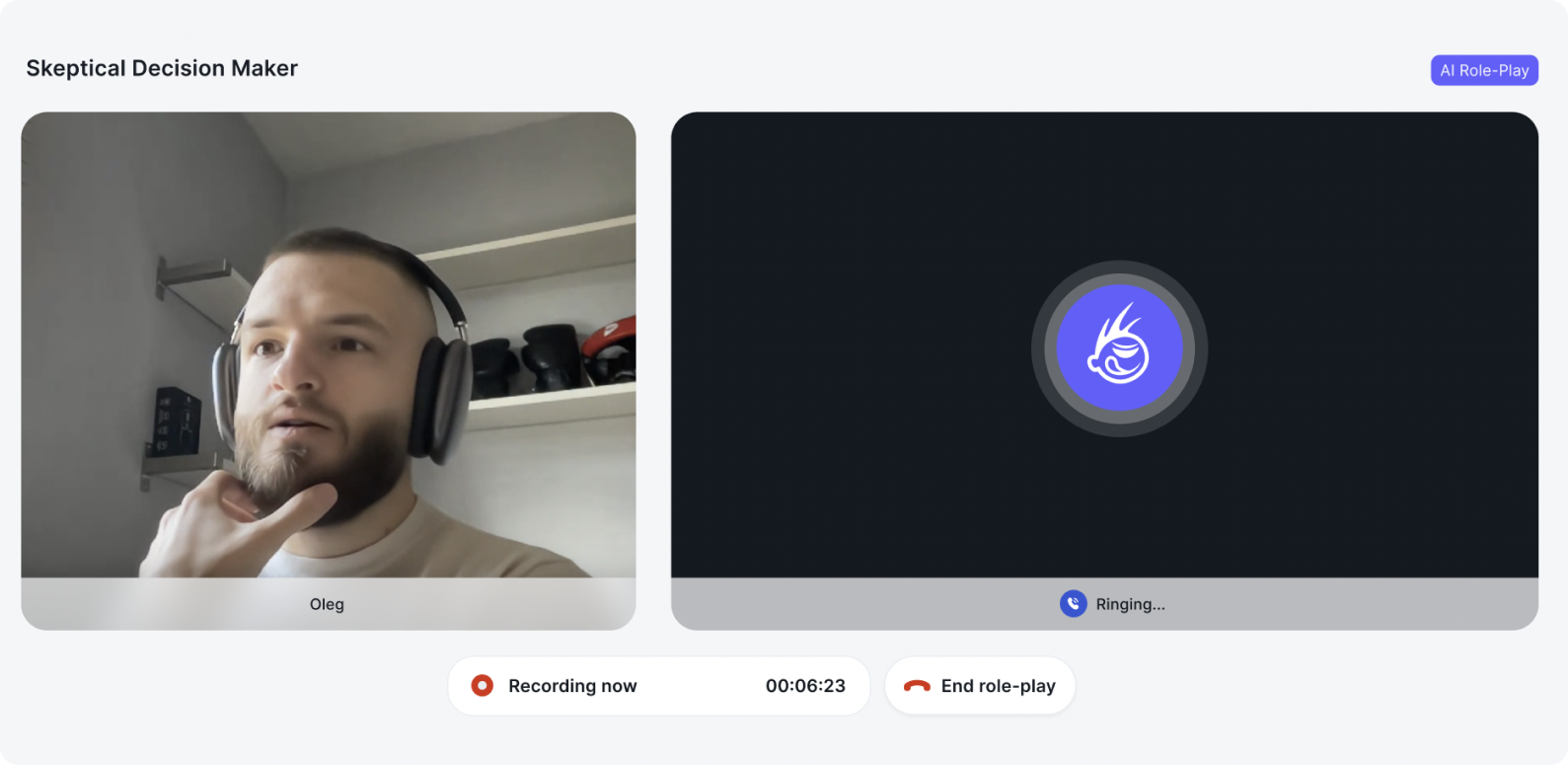
Sales call coaching is the work of helping reps improve at the conversations that decide deals: discovery, objection handling, and the close. It used to mean a manager sitting in on a call, taking notes, and giving feedback afterward. That still happens. But a manager can only sit on a handful of calls, so most reps got coached rarely and inconsistently.
Software changed the math in two directions. One set of tools lets reps rehearse a call before it happens, against an AI buyer that objects and pushes back like a real prospect. The other set records real calls, transcribes them, and scores the conversation so a manager can review many calls without listening to each one end to end.
Both aim at the same outcome: a rep who handles the moment well when revenue is on the line. They reach it from opposite sides of the call, and that timing is the choice that should drive your shortlist.
The three timings of call coaching
Ask five vendors what sales call coaching means and you get three answers, because they work at three different points in the call. Sorting them by timing makes the category easy to read.
Practice tools work before the call. A rep rehearses a discovery question or a price objection against an AI buyer, and the session is scored. In-call tools work during the call, surfacing battle cards or suggested answers while the rep is still talking to the prospect. Analysis tools work after the call, transcribing and scoring the recording so a manager can spot patterns across dozens of conversations.
Timing | What happens | Example tools | Best when |
|---|---|---|---|
Before the call (practice) | Rep rehearses with an AI buyer; the session is scored | PitchMonster, Hyperbound, Second Nature | Reps freeze on objections or ramp too slowly |
During the call (in-call assist) | Live prompts surface answers, battle cards, and next steps | Aircall, Balto | Reps need real-time support on complex calls |
After the call (analysis) | The recording is transcribed and scored for review | Gong, Chorus, Avoma | Managers cannot see what happens on calls at scale |
In-call assist has a place, but it props reps up mid-call rather than building the skill. The lasting gains come from the other two timings, so the rest of this guide focuses on practice before the call and analysis after it.
Practice vs analysis: pick your lane
The biggest split in this category is practice versus analysis. Practice tools work before the call; analysis tools work after it. Neither is better in the abstract. They fix different problems.
Practice tools put a rep in a simulated call with an AI buyer. The rep rehearses a question or a price objection, the AI reacts, and the session is scored against a playbook. Mistakes happen in a safe setting, so a rep can repeat the same hard moment until the response holds. This suits onboarding, low-performer upskilling, and any team whose reps know what to say in theory but stumble under live pressure.
Analysis tools record and score real calls. They flag moments like competitor mentions or pricing pushback, track talk-to-listen ratio, and surface patterns across calls a manager would never have time to review. This suits teams that need visibility into what is actually happening on calls, and managers who coach off real evidence rather than memory.
Dimension | Practice (before the call) | Analysis (after the call) |
|---|---|---|
When it helps | Before a live conversation | After the call ends |
Best for | Onboarding, objection drills, building confidence | Visibility at scale, deal review, manager coaching |
What it delivers | AI buyer rehearsal, instant scoring, repetition | Recordings, transcripts, scorecards, trend analysis |
Main limit | Practice is not the real deal | The rep still learns on a live deal |
Typical tools | PitchMonster, Hyperbound, Second Nature | Gong, Chorus, Avoma |
Many teams that can afford it run both: practice to build the skill, analysis to confirm it shows up live. For a deeper look at the analysis lane on its own, see our comparison of the best call coaching software for sales teams.
The 4 programs at a glance
Four tools, two lanes. PitchMonster, Hyperbound, and Second Nature center on AI practice, where reps rehearse live conversations and get instant feedback. Gong leads the analysis lane, scoring real calls so managers coach from evidence. The table compares lane, coaching focus, sourced pricing, and G2 rating, and each section below adds a best-for verdict.
Program | Lane | Coaching focus | Pricing | G2 rating |
|---|---|---|---|---|
PitchMonster | Practice (before) | AI role-play plus a Socratic AI Coach, built from your ICP | Custom by quote; onboarding and CSM included (pricing) | 4.9 / 5 |
Hyperbound | Practice (before) | Outbound and cold-call drills, self-serve | By quote; free cold-call practice bot | 4.9 / 5 (39 reviews) |
Second Nature | Practice (before) | Scripted AI persona for full-conversation simulation | ~$30-$40 per user/mo (per listings), annual | 4.6 / 5 (298 reviews) |
Gong | Analysis (after) | Records and scores real calls, deal-health signals | ~$1,300-$1,600 per user/yr (~$100-$150/user/mo) plus platform fee | 4.7 / 5 (6,500+ reviews) |
Read on for the full breakdown of each program and who it fits. If you want the broader field rather than call coaching specifically, our roundup of sales coaching programs for teams covers the wider set.
1. PitchMonster
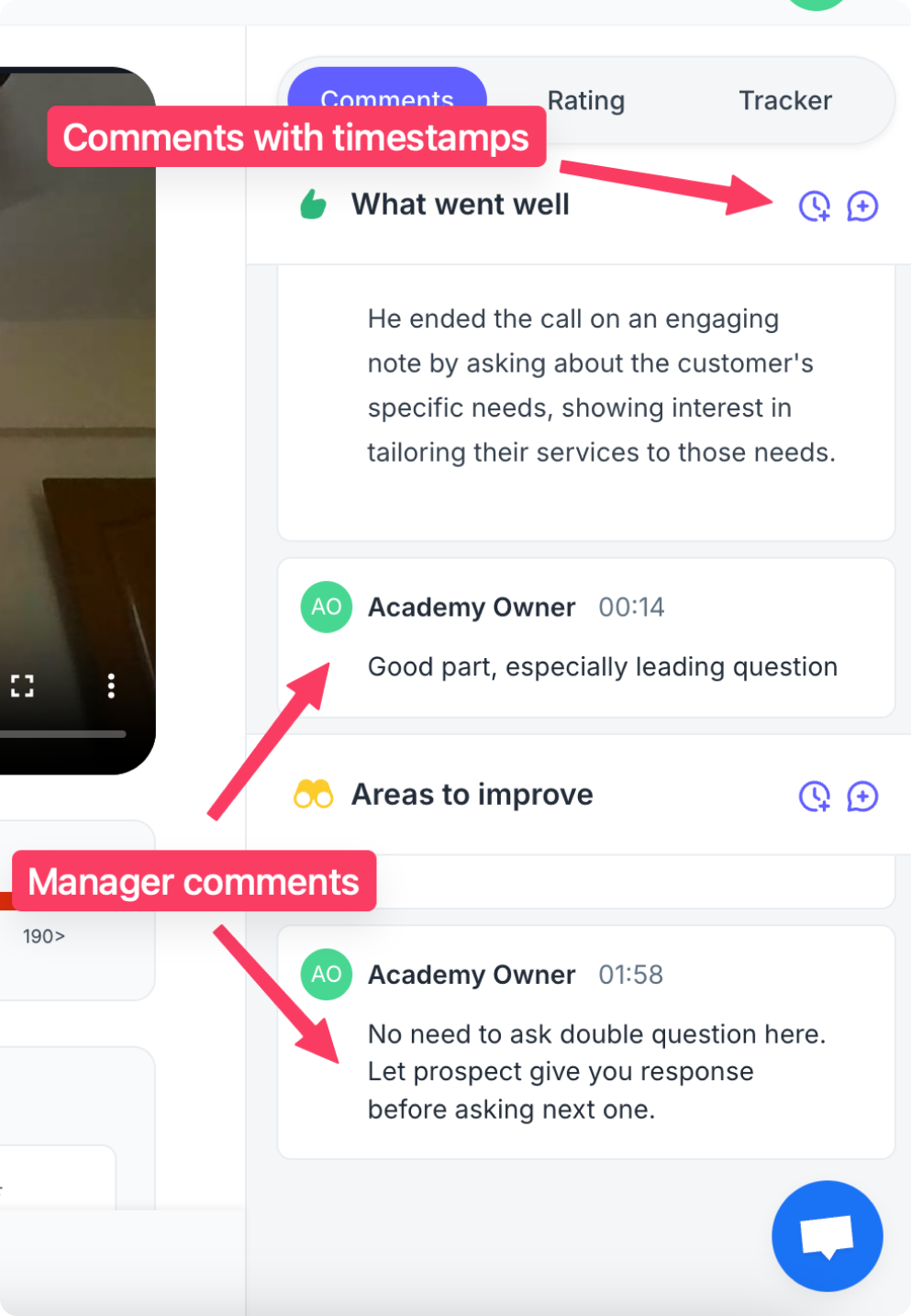
PitchMonster is an AI sales role-play platform, and its differentiator for call coaching is the AI Coach. After every practice session, a Socratic AI sales trainer asks reflective questions that guide the rep to their own insight before they ever see a score. No other tool here has that layer, and it is where call habits change, because reps self-diagnose the moment they hesitated instead of waiting for a manager's read.
The practice itself is built from your data. Reps face realistic buyer concerns, pricing pushback, stalls, and competitor comparisons drawn from your ICP rather than generic scripts. The AI buyer adapts to each response in real time across four difficulty levels, so a new hire can start gentle and a senior rep can take on a hostile, late-stage negotiation. A manager can build a scenario from a real call recording, product docs, or a website URL in about two minutes, and reps can run it in 27 languages.
For teams, PitchMonster adds customizable scorecards, pre-built scenarios, leaderboards, and self-coaching tools, so practice runs without constant manager oversight. It is the only European-based option in the top tier, which matters for GDPR and EU data residency. Pricing is quote-only (custom per seat) with onboarding and a dedicated CSM included; see PitchMonster pricing for team figures, or book a demo to get your first call scenario built with you.
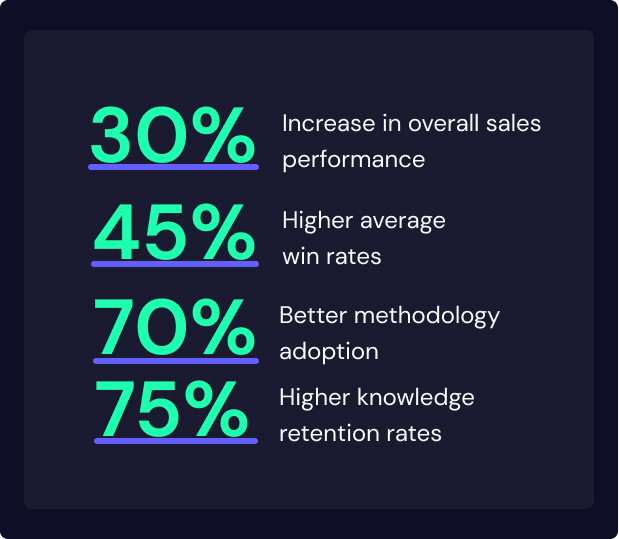
The proof is on record. Teams running this loop have seen 30% faster ramp, a 28% win-rate improvement, 37% higher performance, and roughly twice as many opportunities booked (Mentor Group case study). PitchMonster holds a 4.9 out of 5 rating on G2, has trained more than 300,000 reps, and has kept a 100% enterprise renewal rate since spring 2024.
Best for: teams that want realistic AI call practice plus a genuine coaching layer, and that value EU data residency and a high-touch service model.
2. Hyperbound
Hyperbound helps SDR teams sharpen their skills for live outbound calls through AI role-plays for sales training. The AI plays a prospect and responds to the rep in real time, which makes it a good fit for onboarding or ramping reps who need volume practice before they dial a real list.
After each session, the platform gives instant feedback on how the rep handled objections and where the conversation slipped. Hyperbound builds confidence through repetition rather than dissecting past calls, and teams can tune scenarios and buyer personas to match their own outbound motion, whether the focus is cold calls, discovery, or demos. Cold-call practice is a particular strength, and a free cold-call practice bot lets a team try the format before buying. Team pricing is by quote.
On G2, Hyperbound holds a 4.9 out of 5 rating across 39 reviews, with users citing realistic simulations and fast onboarding. For a deeper side-by-side, see our Hyperbound alternative comparison.
Best for: SDR teams that want fast, self-directed cold-call and outbound practice without heavy manager setup.
3. Second Nature
Second Nature offers avatar-based simulations where reps practice full conversations with a scripted AI persona acting as the customer. The persona reacts as the rep speaks, raising objections and responding to answers, which gives reps a low-pressure setting to refine a pitch, handle objections, and rehearse the close without the cost of a real call. The lifelike responses are the platform's headline feature.
Each session is scored on how the rep manages objections, holds clarity, and closes, and managers can pull those scores and coaching notes to target where reps need work. The platform is built for enterprise-scale training, letting large teams practice at once, which helps during onboarding or a messaging change. Public listings put pricing at roughly $30 to $40 per user per month on annual contracts, and it holds a 4.6 out of 5 rating on G2 across 298 reviews. Reviewers praise the realistic practice but note the scoring can feel harsh and can drift when reps go off-script. For a direct comparison, see PitchMonster vs Second Nature.
Best for: large teams that want consistent, scored simulation practice and can work within a more scripted persona model.
4. Gong

Gong sits in the other lane. Instead of rehearsing the call, it records and analyzes the calls that already happened. It captures calls, video meetings, and emails, transcribes them, and surfaces patterns in how reps sell, benchmarking talk-to-listen ratios, question frequency, and objection handling against the team, and flagging deal moments like competitor or pricing mentions for follow-up.
Gong goes beyond single conversations to score deal health across the pipeline, drawing forecasting signals from call data, which suits enterprise teams running complex, multi-stakeholder deals. It holds a 4.7 out of 5 rating on G2 across more than 6,500 reviews. The trade-off is cost and setup: reported pricing runs roughly $1,300 to $1,600 per user per year, about $100 to $150 per user per month, plus a platform fee, and smaller teams often find the rollout heavy. Gong tells you what went wrong on a live deal; it does not let a rep rehearse before that deal is at stake, which is why many teams pair it with a practice tool.
Best for: enterprise teams with a dedicated RevOps function that want deep visibility into real calls and deal health.
How to build a sales call coaching program
Buying a tool is not a program. A sales call coaching program is a cadence, a rubric, and clear roles, and you can stand one up in a few weeks. Start with the moment where you lose the most deals, then build the loop around it.
Set the cadence first. Give every rep a weekly target of completed practice sessions, two to three is a realistic floor, and protect the time on the calendar so it does not get cut for pipeline. Pair that with a monthly call review, where a manager scores one or two real calls per rep against the same rubric the practice uses. Weekly practice builds the muscle; monthly review checks that it shows up live.
Write the rubric before you score anything. A workable scorecard rates a handful of dimensions on every call:
- Discovery: did the rep uncover the real problem and the cost of inaction?
- Objection handling: did they acknowledge the concern before answering it?
- Talk-to-listen ratio: is the buyer doing enough of the talking?
- Next step: did the rep secure a specific, dated commitment?
- Filler and pacing: is the delivery clear and controlled under pressure?
Keep the same rubric for practice and for live-call review, so a rep sees one consistent standard instead of a different opinion from each coach.
Then assign the roles. Reps own their weekly practice and their own reflection on what they would change. Managers own the monthly review and the coaching conversation, using the 70/30 rule so the rep does most of the talking. Enablement or RevOps owns the rubric, the scenario library, and the dashboard that tracks completion and scores. If your team is structured this way, our sales enablement solution shows how the pieces connect.
Track a short list of metrics so you can prove the program works. Read.ai groups call signals into sentiment, engagement, talk time, filler words, and power dynamics, and those map cleanly to a practice rubric. Add the outcome numbers that leadership cares about, win rate and ramp time, and review them every month. If practice completion climbs but win rate does not move, the scenarios are wrong, and you fix the content rather than pushing harder on volume.
Match the tool to the failure
The fastest way to pick a lane is to name the failure. Where do deals actually slip on your team? The answer points to practice, analysis, or both.
Where you lose deals | The failure | Start with |
|---|---|---|
Reps freeze when a buyer pushes back on price | No reps for the hard moment | Practice: objection drills against an AI buyer, plus a coach that makes them reflect |
New hires take months to sound credible | Slow ramp | Practice: repeat real scenarios until the response holds, from week one |
Managers coach on gut feel, not evidence | No visibility | Analysis: score real calls and review the patterns |
Reps sound fine solo but fall apart live | Confidence gap | Practice first, then analysis to confirm it shows up on real calls |
A strong framework changes nothing on calls | No habit | Practice on a weekly cadence with a scored rubric |
Read the table top to bottom and most teams find two rows that describe them. That is the honest signal to run both lanes: practice to build the skill, analysis to verify it. If only one row fits, start there and add the other when the first is a habit.
The practice and reflection habit
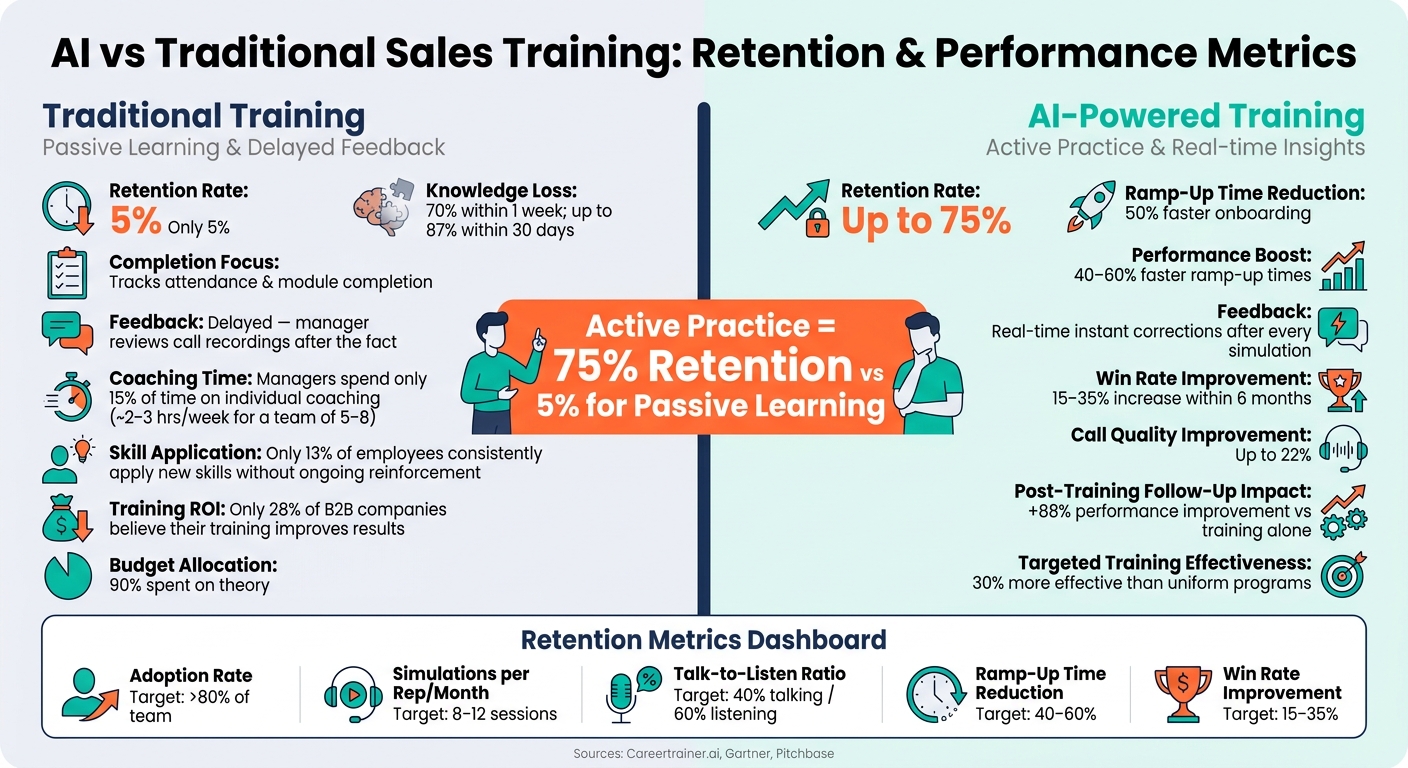
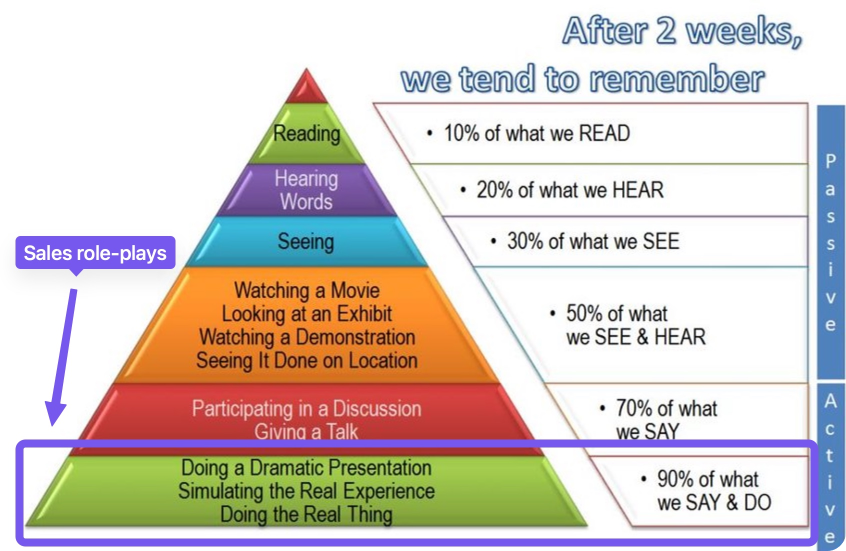
Skills do not stick from watching. People forget most of what they hear in a lecture within days, and remember far more of what they practice and then teach back to themselves. That is the whole case for putting practice, not content, at the center of a sales call coaching program.
Reflection is the half most programs skip. A score tells a rep what they got wrong. It does not make them work out why, and the why is what changes the next call. This is where a Socratic coaching layer earns its place: instead of handing over a grade, it asks the rep what they would do differently, so the insight is theirs. Reps who reason to their own answer hold onto it, which is the same logic behind the 70/30 rule in coaching.
Build the loop so it repeats without a manager in the room. A rep runs a scenario, reflects with the AI Coach, sees the score, then runs it again with the fix. Ten reps of one hard moment in an afternoon beats one team role-play a quarter. Do that every week and the response is automatic by the time a real buyer raises it.
What most teams get wrong about sales call coaching
The most common mistake is treating coaching as an event instead of a habit. A rep sits through a workshop, nods along, and is back to old patterns within weeks. Without repeated practice on realistic calls, even a strong objection-handling framework stays theoretical and collapses the moment a buyer pushes back.
The second mistake is buying a tool and never tracking whether reps use it. Adoption is where most programs quietly die. Managers default to gut feel about who is ready for live calls, practice sessions go uncompleted, and the impact fades. The fix is unglamorous: set a weekly target of completed sessions, show progress on a dashboard, and tie completion rates to outcomes reps care about, like win rate and ramp time.
The third is coaching off generic content instead of your own deals. Peer role-play that uses made-up scenarios misses the specific objections a team actually loses to. The programs that move close rates are built from the real moments where deals slip, scored the same way for every rep, and run often enough to build muscle memory. For a wider field of practice platforms, see our comparison of top sales training tools, or book a demo to see your own call scenarios built in PitchMonster.
FAQ
What is sales call coaching?
Sales call coaching is the practice of improving how reps handle live customer calls, either by rehearsing the conversation before it happens or by scoring the recording after. Practice tools let a rep drill objections against an AI buyer; analysis tools score a real call against a playbook. Most teams that close more deals use both: rehearse the hard moment, then check how it went live.
What is the difference between call practice and call analysis?
Call practice tools, like PitchMonster or Hyperbound, let a rep rehearse a conversation with an AI buyer before the real call, so mistakes happen in a safe setting. Call analysis tools, like Gong, record and score calls that already happened. Practice builds the skill before the deal is at stake; analysis tells you where it broke after. They solve different halves of the same problem.
How much do sales call coaching programs cost?
Pricing varies by lane. Scripted AI simulation like Second Nature runs roughly $30 to $40 per user per month per public listings. PitchMonster is quote-only (custom per seat) with onboarding and a dedicated CSM included. Call analysis platforms cost more: Gong is reported at roughly $1,300 to $1,600 per user per year, about $100 to $150 per user per month, plus a platform fee. Confirm every vendor number directly.
What are the 5 C's of sales coaching?
The 5 C's are a memory aid, and versions vary by trainer. A widely taught version is clarity, communication, collaboration, commitment, and consistency: set a clear standard, talk about it plainly, work on it together, get the rep to commit to a change, and keep the cadence steady. The point is that coaching is a repeated habit, not a one-time review.
What are the 7 steps of a sales call?
A common version runs: preparation and research, opening and rapport, needs discovery, presenting the solution, handling objections, closing, and follow-up. The exact labels shift between methodologies, but the shape holds. Call coaching maps to these steps, so reps can drill the two or three where deals actually slip, usually discovery, objection handling, and the close.
What is the 70/30 rule in sales coaching?
The 70/30 rule says the rep should do about 70 percent of the talking in a coaching session and the coach about 30 percent. Instead of lecturing, the coach asks questions that guide the rep to their own conclusion. It mirrors the talk-to-listen balance reps need on live calls, and it is why a Socratic coaching layer that makes reps reflect tends to change behavior faster than a scorecard alone.
Does call coaching replace manual role-play?
It scales it. Manual role-play depends on a manager being free, so most teams cap it at a few sessions a quarter and feedback shifts from one coach to the next. AI call coaching runs on demand, scores every rep against the same playbook, and gives instant feedback, so a rep can drill the same hard moment ten times in an afternoon instead of waiting for the next team session.
How do I get reps to actually use a call coaching program?
Tie practice to a number and make it routine. Set a weekly target of completed sessions, show progress on a dashboard, and connect completion rates to outcomes reps care about, like win rate and ramp time. Coaching sticks when it is built from the objections your team actually loses deals to, scored consistently, and visible, not when it is an occasional workshop nobody tracks.