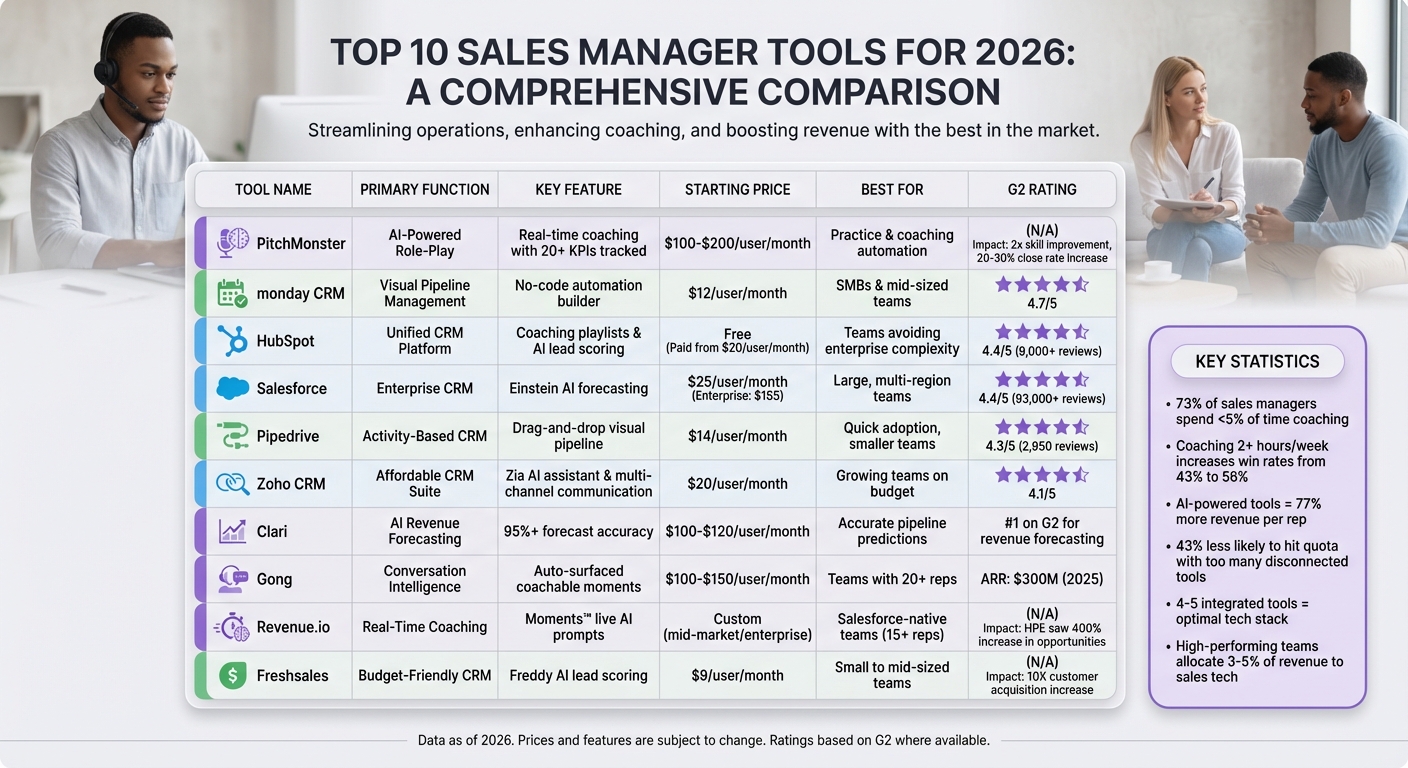
Sales managers juggle countless tasks - coaching, pipeline tracking, and hitting quotas - while often losing valuable time to administrative work. The right tools can change that by simplifying workflows, improving coaching, and increasing quota attainment. Here’s a quick look at 10 tools designed to help sales managers succeed in 2026:
- PitchMonster: AI-powered role-play for reps to practice pitches and objection handling.
- monday CRM: Visual pipeline management with automation to reduce admin work.
- HubSpot: Unified CRM with coaching playlists and AI for lead scoring.
- Salesforce: Advanced forecasting and customization for large teams.
- Pipedrive: User-friendly CRM with a drag-and-drop pipeline and AI sales assistant.
- Zoho CRM: Affordable CRM with AI forecasting and multi-channel communication.
- Clari: AI-driven forecasting for accurate deal predictions.
- Gong: Conversation intelligence for coaching and deal insights.
- Revenue.io: Real-time coaching and Salesforce-native integration.
- Freshsales: Budget-friendly CRM with AI lead scoring and built-in communication tools.
Key takeaway: Choose tools that save time, integrate with your CRM, and align with your sales process. Focus on platforms that reduce admin work and enhance coaching, as increasing coaching time to over two hours weekly can boost win rates from 43% to 56%. A well-integrated tech stack of 4–5 tools is often more effective than juggling too many disconnected systems.
BEST CRM Software | Tested 15 CRMs for 2026 (HONEST Opinion)
sbb-itb-bfb5038
What Sales Manager Tools Do and Why They Matter
Sales manager tools tackle three major challenges: pipeline visibility, rep coaching, and hitting quotas. Without these tools, managers often waste days updating CRMs and creating manual forecasts instead of focusing on coaching. In fact, a staggering 73% of sales managers spend less than 5% of their time coaching because they’re too busy sorting through data and cleaning spreadsheets. To address these issues, a range of specialized tools has emerged.
CRM platforms like Salesforce and HubSpot act as a central hub, tracking every customer interaction and deal in one place. Conversation intelligence tools such as Gong analyze call recordings to uncover patterns in successful conversations, enabling scaled coaching without requiring managers to listen to every call. Pipeline analytics software leverages AI to assess deals based on buyer engagement metrics - like email opens, meeting attendance, and response times - rather than relying on subjective updates from reps. Meanwhile, account intelligence platforms track external factors like leadership changes or earnings reports, allowing managers to focus on strategic coaching rather than just deal mechanics.
The impact of coaching is undeniable - boosting weekly coaching time from under 30 minutes to over two hours increases win rates from 43% to 56%. Additionally, teams using AI-powered management tools see 77% more revenue per rep compared to those without. However, there’s a downside: when salespeople are overwhelmed by too many disconnected tools, they’re 43% less likely to meet their quotas. The key is choosing tools that automate repetitive tasks, freeing managers to focus on activities that genuinely drive sales forward.
One standout solution is role-play coaching tools like PitchMonster. These tools address a critical need: giving new reps the chance to practice before interacting with real buyers. AI-powered simulations let reps refine their objection handling and pitch delivery in a risk-free environment. This not only builds their confidence but also ensures consistent messaging across teams, all without requiring managers to oversee every practice session. As a result, ramp times shorten, and teams stay aligned even when spread out geographically.
1. PitchMonster
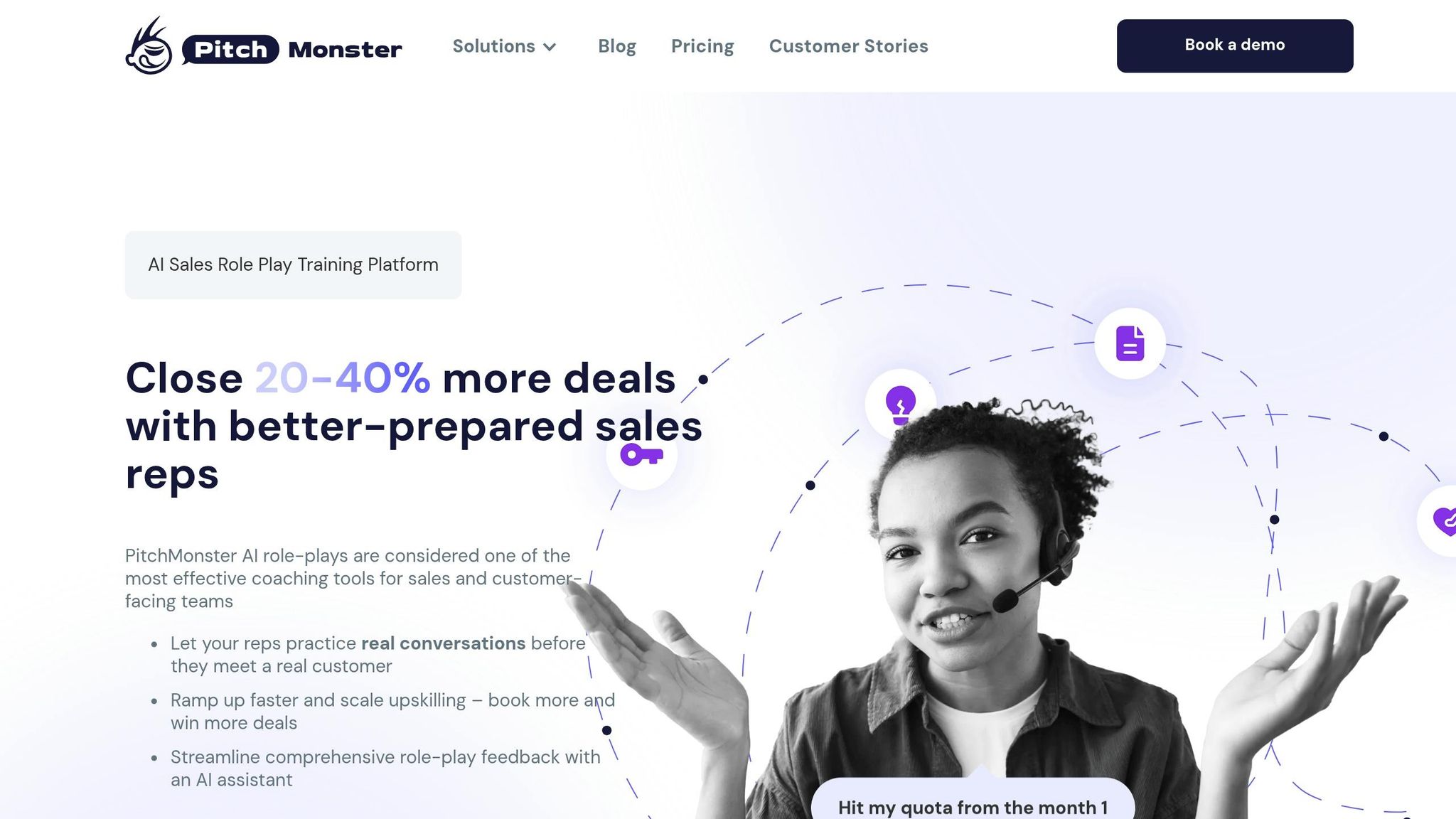
PitchMonster is an AI-powered role-play platform designed to bridge the gaps in pre-call training for sales reps. It allows reps to practice their pitches with AI-generated personas, such as a budget-conscious manager or a skeptical VP, giving them the chance to refine their skills in objection handling, discovery questions, and pitch delivery. This eliminates the constant need for manager involvement and ensures new reps are better prepared before speaking with real prospects.
The platform automatically tracks over 20 key performance indicators (KPIs), including talk-to-listen ratios, sentiment changes, and buying signal detection. This helps managers quickly identify areas where reps might struggle, such as handling price objections. By assigning focused drills, managers can help reps improve their skills more effectively. In fact, reps who practice twice weekly with PitchMonster show twice the improvement compared to those relying solely on live call feedback.
PitchMonster also provides real-time coaching during live calls with minimal delay. For example, if a prospect raises a pricing concern or signals buying intent, the tool offers suggested responses within 2–3 seconds. This real-time guidance helps reps stay on track, handle objections confidently, and has been linked to a 20–30% increase in close rates within just 90 days.
The platform integrates seamlessly with tools like Salesforce, HubSpot, Zoom, Google Meet, and Microsoft Teams. It automatically logs calls, generates summaries, and saves reps 10–15 minutes of admin work per call. Additionally, insights from these calls can be used with follow-up tools like Lavender for email outreach or PandaDoc for proposal creation, streamlining the entire sales process.
Pricing for PitchMonster starts at approximately $100–$200 per user per month. For sales managers overseeing large teams, the platform provides a scalable way to deliver consistent coaching, improve training outcomes, and drive better quota attainment through data-driven insights.
2. monday CRM
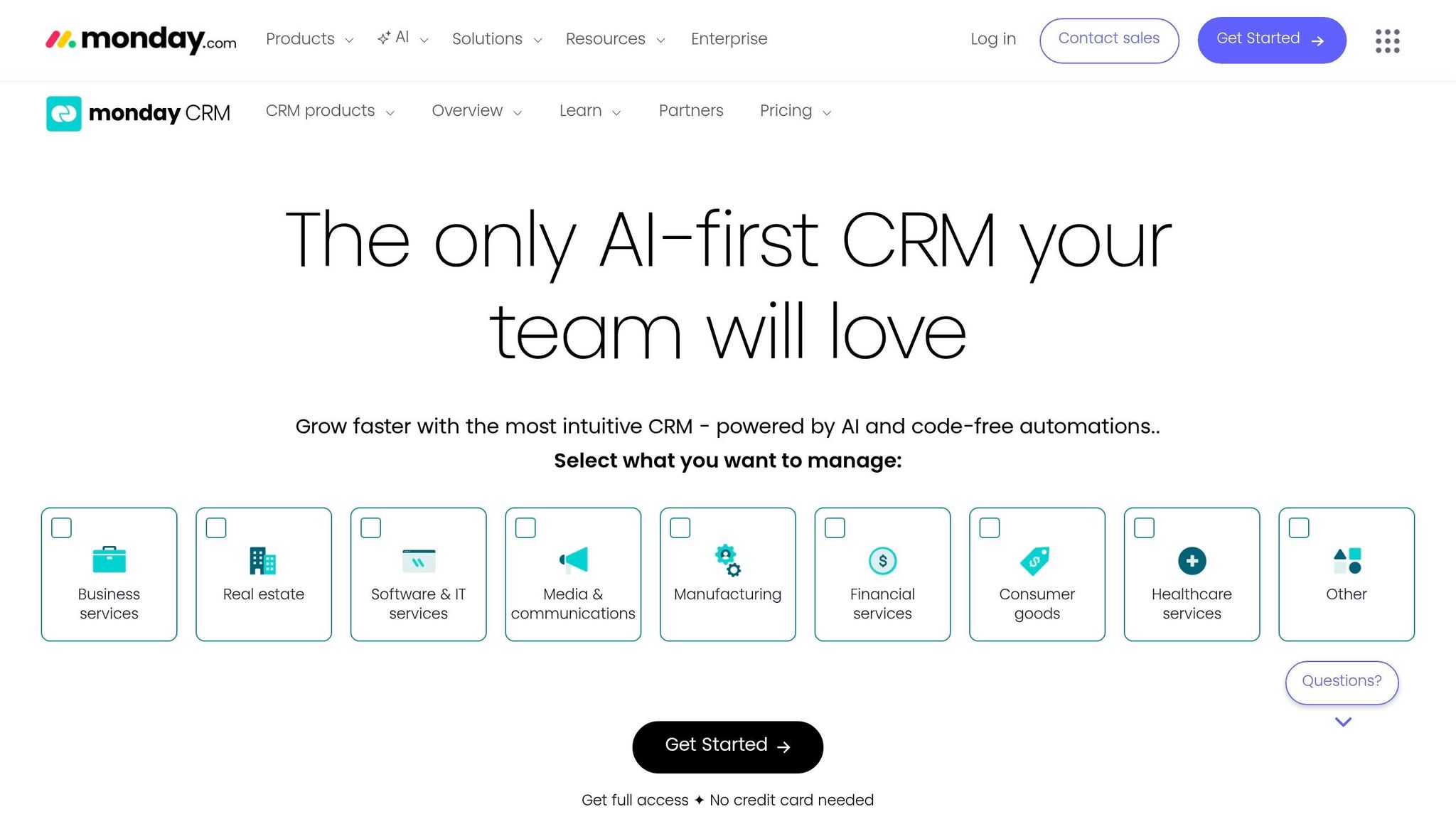
monday CRM offers a visually-driven approach to pipeline management, giving sales teams a clear, streamlined way to track deals. Its drag-and-drop interface and color-coded boards make it easy for managers to see where each deal stands at a glance. Instead of sifting through endless reports, leaders can zero in on the deals that need their attention and spend more time coaching their teams.
The platform features a no-code automation builder that takes care of repetitive tasks like updating statuses or assigning tasks. Managers can set workflows to send notifications when deals stall or automatically move leads between stages - no manual input required. This means fewer hours wasted on admin work and more time spent driving results through proven strategies to increase sales team performance. By automating these tasks, monday CRM helps managers focus on what really matters: guiding their teams and closing deals. It also ensures smoother communication across different sales tools.
With over 200 integrations, including Salesforce, HubSpot, Slack, Gmail, and Zoom, monday CRM centralizes communication and keeps everything in one place. Its two-way data sync with other CRMs ensures consistent information across platforms, eliminating the hassle of duplicate entries - a big win for teams juggling multiple tools.
"I have visibility into all the information I need to manage customer relationships and understand our sales performance." - Christopher Stone, Vice President of Business Development
Pricing starts at $12 per user per month for the Basic plan, with Standard, Pro, and Enterprise tiers available for teams needing more advanced options. monday CRM has a 4.7/5 rating on G2, with users praising its easy-to-use interface and quick learning curve. However, some note that it lacks advanced enterprise-level tools like territory management, making it a better fit for SMBs and mid-sized teams that prioritize flexibility over complexity.
3. HubSpot
HubSpot offers a well-rounded CRM solution designed to unify sales, marketing, and service teams on one platform. With HubSpot, sales managers can instantly access a clear pipeline view. The platform simplifies tasks like activity tracking, deal forecasting, and quota management - no need for a dedicated administrator. This makes it an appealing option for teams that want to avoid the complexity of larger enterprise systems.
A standout feature for managers is the coaching playlists tool. Instead of wasting time digging through call recordings, managers can create libraries of effective call examples. New reps can listen to these examples to understand what works before making their own calls. At the same time, managers can set a consistent standard for success across the team. This approach reduces the need for manual role-playing while providing real-world examples.
HubSpot also incorporates AI tools to enhance productivity. Features like predictive lead scoring, automated data enrichment, and AI-generated email content help prioritize valuable opportunities and minimize manual tasks. On top of that, integrations with tools like Gong allow call summaries and sentiment trends to automatically update deal records, adding even more efficiency.
For pricing, HubSpot starts with a free tier that includes essential CRM and sales tools, making it a great starting point for smaller teams. Paid plans range from $20 per user per month for the Starter tier to $150 per user per month for Enterprise. With a 4.4/5 rating on G2 from over 9,000 reviews, users often highlight its ease of use and quick setup. However, some note that costs can increase with advanced features. Overall, HubSpot is a solid choice for managers looking to save time on admin tasks while boosting their team's sales readiness.
4. Salesforce
Salesforce is designed for large sales teams that need extensive customization and advanced forecasting tools. It handles complex, multi-region sales processes with features like configurable workflows, custom dashboards, and hierarchical forecast rollups that provide a clear view of pipeline health. These tools integrate smoothly with its intelligent forecasting capabilities.
Einstein AI, Salesforce's built-in intelligence, uses historical data to analyze deals, flag at-risk opportunities, and provide actionable forecasting insights. This allows managers to adjust strategies before deals fall through. According to Salesforce's 2026 State of Sales report, sellers rely on an average of 8 tools to close deals, and Salesforce connects these tools through its AppExchange marketplace.
One of Salesforce's biggest strengths is its adaptability. Sales managers can create custom objects, automate multi-stage approval processes, and assign detailed permissions to global teams. However, this level of flexibility comes with challenges. As Semir Jahic, CEO of Salesmotion, explains: "Salesforce offers the deepest customization, reporting, and app ecosystem in B2B sales." But with this depth comes the need for dedicated Revenue Operations (RevOps) support to prevent the platform from becoming what some users describe as an "expensive spreadsheet." The high level of customization also means higher costs and a steeper learning curve.
Pricing begins at $25 per user per month for the Starter tier. The Enterprise plan, which includes Einstein AI and advanced forecasting, is priced at $165 per user per month, while the Unlimited tier costs $330. Salesforce holds a 4.4/5 rating on G2 from over 93,000 reviews, with users praising its robust features and integrations but noting the complexity of implementation and training.
For teams managing intricate sales processes and equipped with dedicated resources, Salesforce provides unparalleled control. However, smaller teams or those without admin support may find simpler alternatives more suitable.
5. Pipedrive
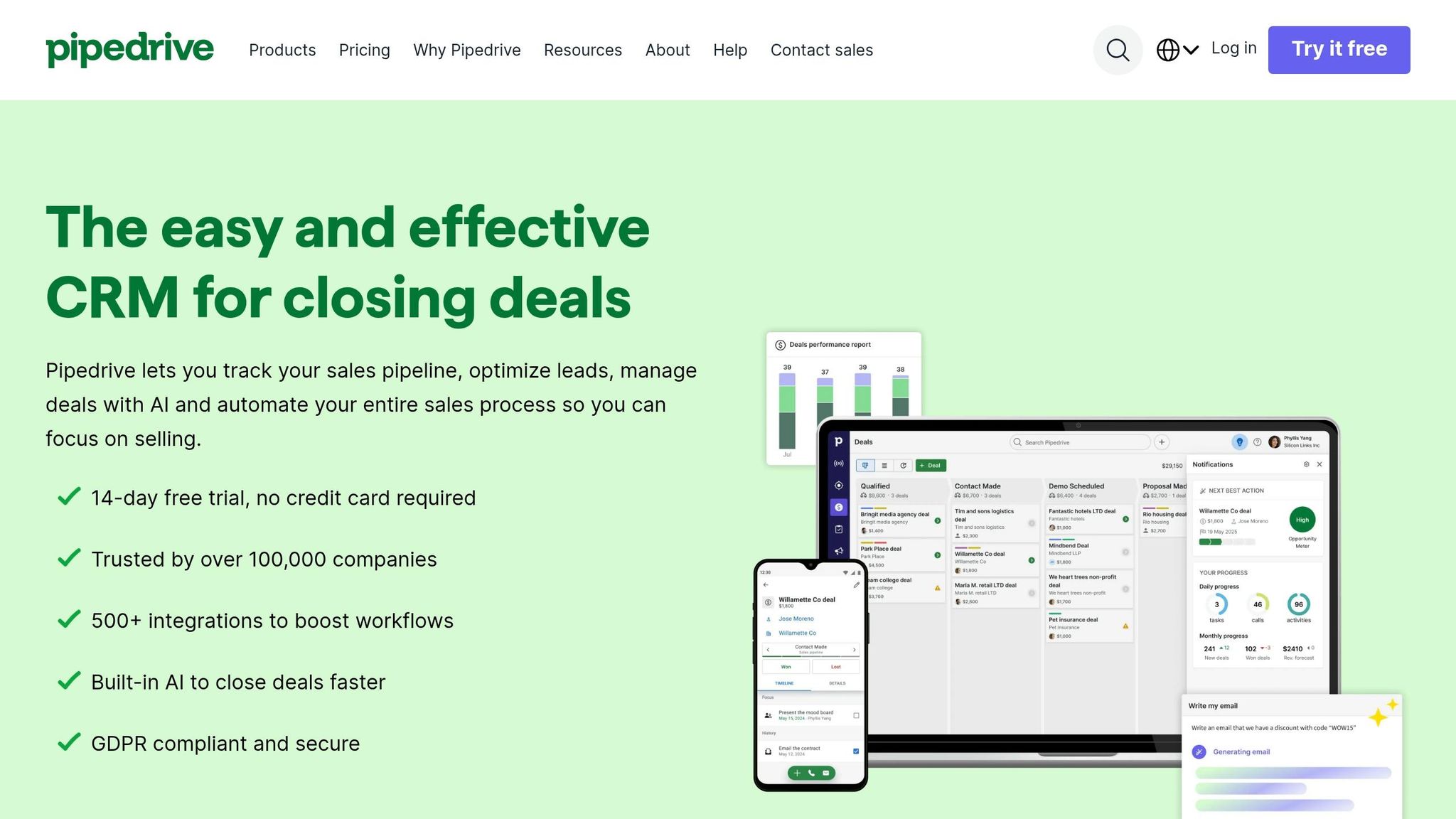
Pipedrive is a straightforward CRM tool designed for sales teams looking for a system that’s ready to perform right out of the box. Its standout feature is a visual drag-and-drop pipeline that clearly displays the status of every deal and the next steps required. This activity-focused setup ensures sales reps spend more time advancing deals rather than digging through tabs or manually updating records.
The platform’s AI Sales Assistant adds another layer of efficiency by flagging stagnant deals and suggesting actionable steps to keep them moving. Companies like Swapped and Raincatcher showcase how automation through Pipedrive can significantly reduce administrative workload and speed up deal closures. For example, in May 2025, Swapped, a blockchain security firm, streamlined compliance form automation based on client locations, saving each salesperson 4–6 hours weekly and cutting their deal-to-close cycle by 21%. Similarly, M&A advisory firm Raincatcher automated document tracking and task assignments, saving over 30 hours per week and doubling their pipeline valuation to nearly $250 million - all without increasing headcount.
Pipedrive’s integrations are another major advantage. It connects seamlessly with over 500 apps, including Slack, Trello, Google Apps, and conversation intelligence tools like Jiminny. These platforms often complement top sales training tools to provide a complete coaching ecosystem. Features like two-way email sync and Zapier integration create a centralized workspace, allowing sales reps to complete tasks more efficiently without juggling multiple platforms. Automated workflows further boost productivity, helping sales teams hit targets 16% more often - all without requiring a dedicated admin to manage the system. This streamlined connectivity ensures sales managers can focus on driving revenue instead of dealing with manual processes.
Pricing starts at $14 per user per month, with mid-tier plans offering more advanced automation options. On review sites, Pipedrive holds a 4.5/5 rating on Capterra from 3,041 reviews and 4.3/5 on G2 from 2,950 reviews. Users often highlight the clean interface and how the visual pipeline simplifies task management, especially for smaller teams. However, some note that it may lack the depth needed for complex, multi-region enterprise operations compared to platforms like Salesforce.
For teams seeking an easy-to-adopt CRM that enhances deal visibility and momentum without the complications of larger systems, Pipedrive is a solid choice. It’s built to deliver results quickly and efficiently.
6. Zoho CRM
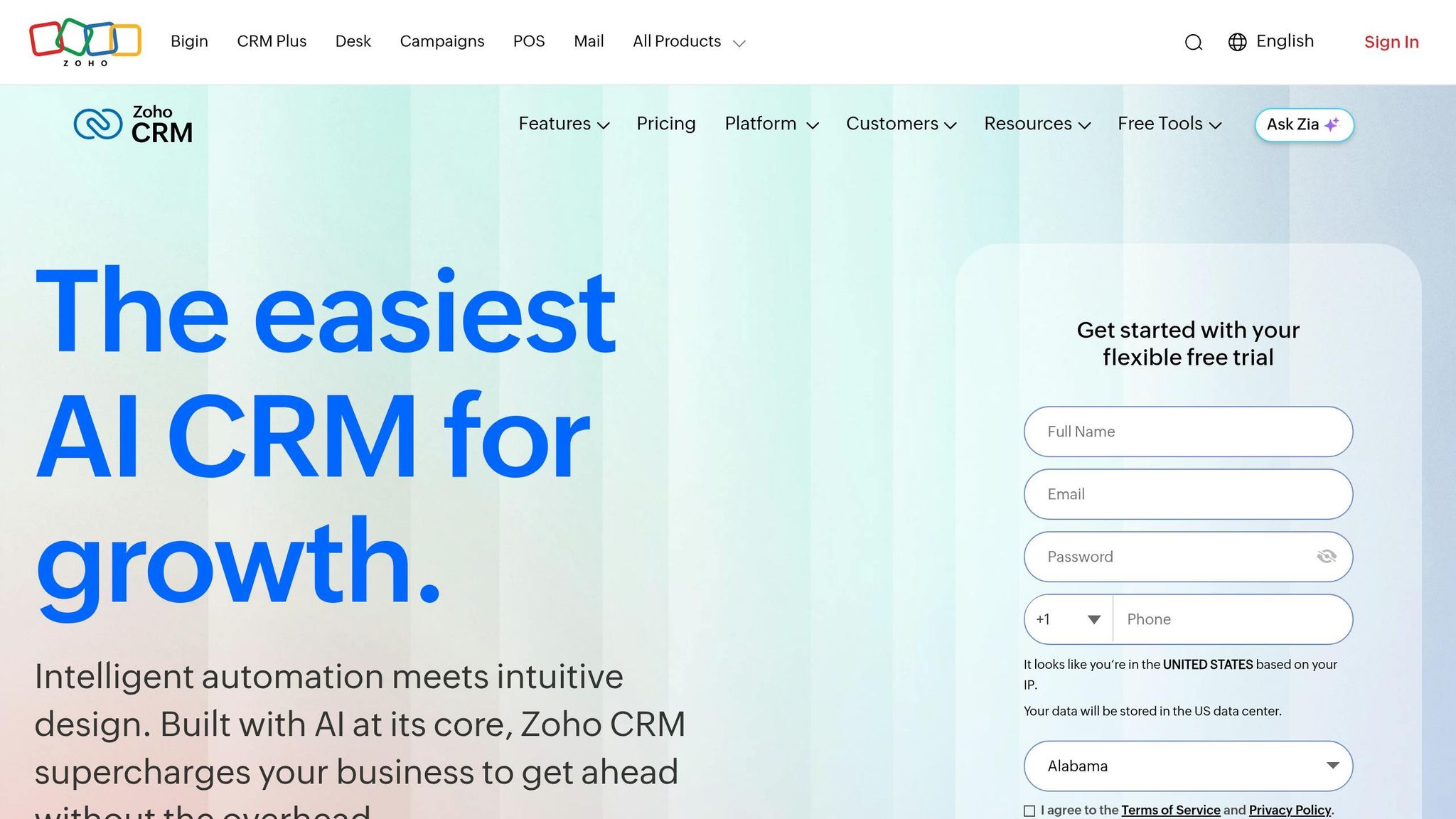
Zoho CRM stands out as a solid tool for sales teams that are expanding, offering advanced features at a starting price of about $20 per user per month. It includes AI-driven forecasting, workflow automation, and tools for managing communication across multiple channels.
One of its strengths is the ability to customize workflows without needing IT support. With the Blueprint builder, sales managers can design workflows that guide deals from the initial contact to closing. Zoho’s AI assistant, Zia, goes a step further by analyzing emails, calls, and chats to identify cooling deals or predict the best times to follow up. It can even flag potential churn when activity levels drop. This tailored approach works seamlessly with Zoho's integrated communication tools.
Another major plus is Zoho's unified ecosystem, which consolidates all interactions - emails, calls, and even social media - into a single record. This reduces data silos and simplifies tracking. Features like built-in telephony and live chat are already included, unlike many competitors that require add-ons or higher-tier plans for similar capabilities.
Zoho CRM has a 4.1/5 rating on G2, with users often highlighting its affordability and ability to scale with growing teams. However, some reviewers note that the interface feels outdated compared to newer platforms and that the initial setup can be challenging. Investing time in configuration early on can save teams from headaches down the road.
For teams that prioritize workflow automation and multi-channel communication while keeping costs manageable, Zoho CRM offers a balanced solution. It’s particularly suited for managers aiming to coach their teams effectively and scale operations smoothly.
7. Clari
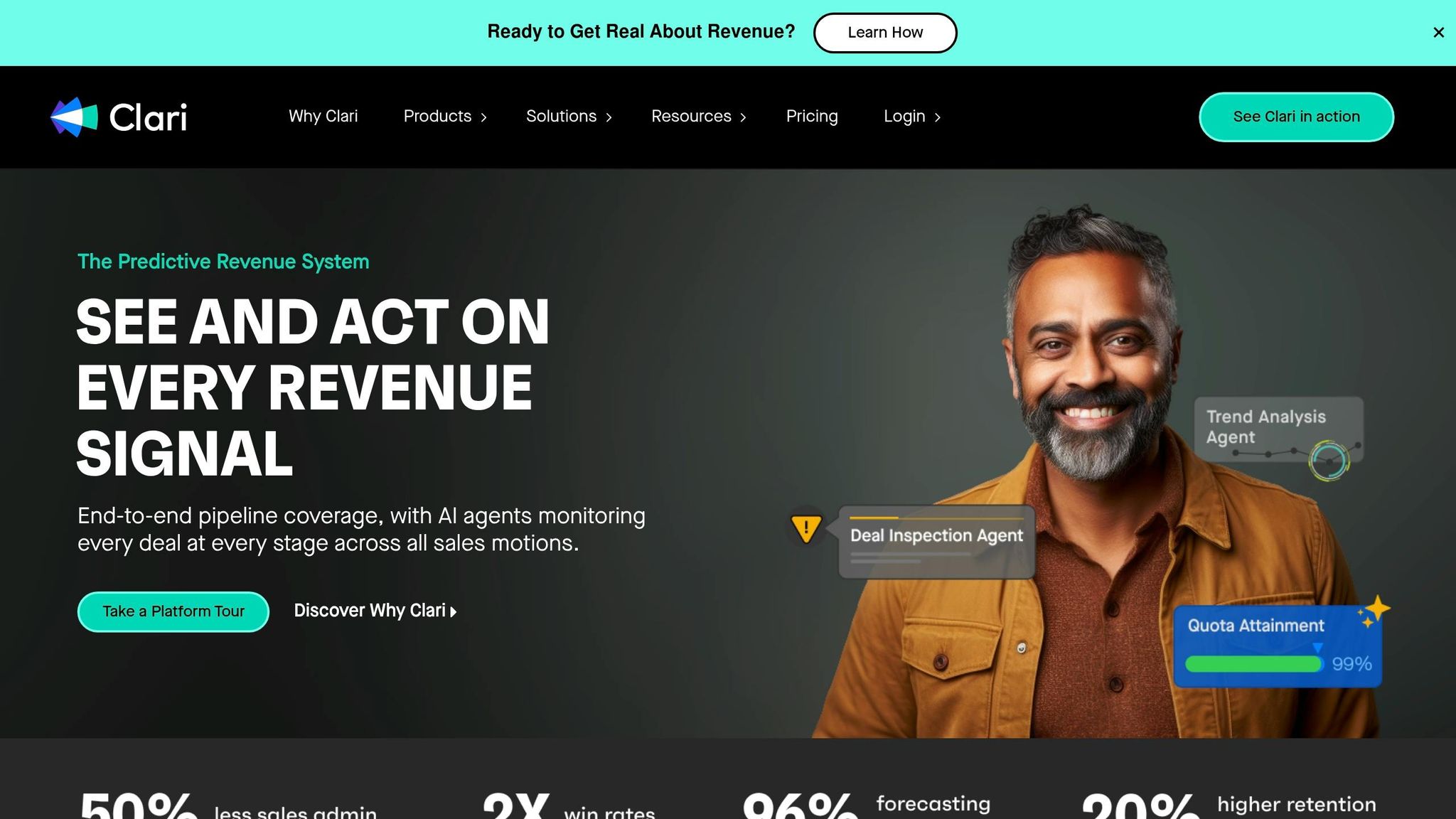
Clari zeroes in on a key challenge for sales managers: determining whether a forecast is reliable. Using AI, it predicts deal outcomes by analyzing historical patterns, live deal signals, and pipeline changes. This helps teams achieve forecast accuracy of over 95% across all segments.
The platform eliminates the need for manual spreadsheet forecasting by automating data roll-ups from sources like your CRM, ERP, emails, calendars, and even data warehouses such as Snowflake. This creates a unified view that extends beyond what sales reps log into Salesforce. Tools like "Deal Inspection" and "Trend Analysis Agents" alert managers to slipped deals, stalled opportunities, and inactive reps before the quarter ends, allowing for timely interventions.
A standout feature is Clari's ability to handle intricate revenue models. Whether your team uses subscription-based, consumption-based, or hybrid pricing, Clari consolidates it all seamlessly. Unlike traditional CRMs that struggle with usage-based models, Clari integrates product-usage data directly from data lakes, offering a comprehensive view. This becomes increasingly relevant as more companies adopt consumption-based pricing models.
"We use Clari to have more intelligent forecast conversations, especially when we look farther out. By looking at historical trends, we can extrapolate where we'll be going forward." - Jules Gsell, RVP of Growth and Start-Up Sales Orgs, Databricks
Clari holds the #1 ranking on G2 for revenue forecasting and was recognized as a Leader in the 2025 Gartner Magic Quadrant for Revenue Action Orchestration. Pricing for the base platform generally starts at $100–$120 per user per month, with costs exceeding $200 per user when including features like conversation intelligence via Clari Copilot. For managers seeking precise, boardroom-ready forecasts and early warnings about pipeline risks, Clari delivers insights that go far beyond what spreadsheets and CRM reports can provide.
8. Gong
Gong is a platform designed to record and transcribe customer interactions across calls, video meetings, and email. Using AI, it dives into these conversations to uncover what's really happening, offering managers an objective view of deal health based on buyer engagement - not just what reps log into the CRM. For managers struggling with coaching challenges, Gong provides a window into actual sales calls, helping them see what’s working and what’s not.
One of Gong's standout features is its ability to surface coachable moments automatically. By analyzing patterns like talk-to-listen ratios, the frequency of questions, and how reps handle objections, the platform delivers a curated feed of specific call segments that need attention. Instead of sifting through hours of recordings, managers can focus on actionable highlights. Additionally, Smart Trackers monitor keywords or topics - like mentions of competitors or pricing discussions - so managers can identify trends across the team with ease. This emphasis on actionable insights makes Gong a game-changer for evaluating live sales interactions.
The platform also introduces AI-driven deal health scores, which assess both rep activity and buyer engagement to flag potential obstacles that could derail deals. This goes far beyond standard CRM reporting, which often relies on self-reported data like deal stages and amounts. Gong’s impact is evident in its growth, reaching $300 million in Annual Recurring Revenue (ARR) by 2025, as it became a must-have tool for enterprise sales teams.
Gong integrates seamlessly with major CRMs like Salesforce, HubSpot, and Microsoft Dynamics. By syncing call notes automatically, it reduces the need for manual data entry while keeping deal context up to date. Pricing typically starts at $100–$150 per user per month with an annual commitment, and the platform is most effective for teams with at least 20 reps, where its AI analytics can truly shine.
For managers looking to understand what’s happening in sales conversations and where reps need support, Gong delivers insights that spreadsheets and CRM dashboards just can’t provide. Its detailed conversation analysis complements role-play tools by identifying real-world coaching opportunities.
9. Revenue.io
Revenue.io brings together conversation intelligence, guided selling, and real-time coaching, all seamlessly integrated into Salesforce. Unlike tools that sync data externally, Revenue.io operates natively within Salesforce. This means every call, text, and email is logged automatically, saving sales teams from the headache of manual data entry. For managers juggling CRM data and coaching, this eliminates a major time drain.
One of its standout features is Moments™, an AI-powered engine that provides live prompts during active calls. For example, if a sales rep dominates the conversation, a monologue alert pops up. If a prospect raises an objection, the system instantly offers battlecards and actionable next steps. This real-time coaching approach adds immediate value by addressing issues as they happen. Managers can also leverage RingDNA & CAI Live to monitor calls in real time and step in with guidance when deals start to falter.
Another key feature is its AI-driven scorecards, which evaluate calls to pinpoint areas needing improvement, such as objection handling or talk-to-listen ratios. Instead of combing through hours of call recordings, managers get concise performance insights. The Call Libraries feature enables teams to store and share top-performing calls, transforming successful conversations into training tools for onboarding and skill-building.
The platform has delivered impressive results for its users. For instance, HPE automated activity logging across 150 countries and saw a 400% increase in sales opportunities. NFI Industries achieved 8X more conversations from calls and 10X more meetings with qualified decision-makers. Nutanix used Revenue.io to manage a surge in leads, ensuring every interaction was captured in Salesforce while improving visibility for managers.
Revenue.io is particularly well-suited for Salesforce-centric teams with 15 or more reps. It consolidates multiple tools into one, reducing the complexity of managing various vendors. While pricing details aren't publicly available, the platform is geared toward mid-market and enterprise teams aiming to streamline their sales tech stack. For managers seeking real-time coaching and seamless CRM integration without the hassle of managing multiple tools, Revenue.io offers a comprehensive solution. Its ability to unify key functions sets the stage as we move on to the next tool in the lineup.
10. Freshsales
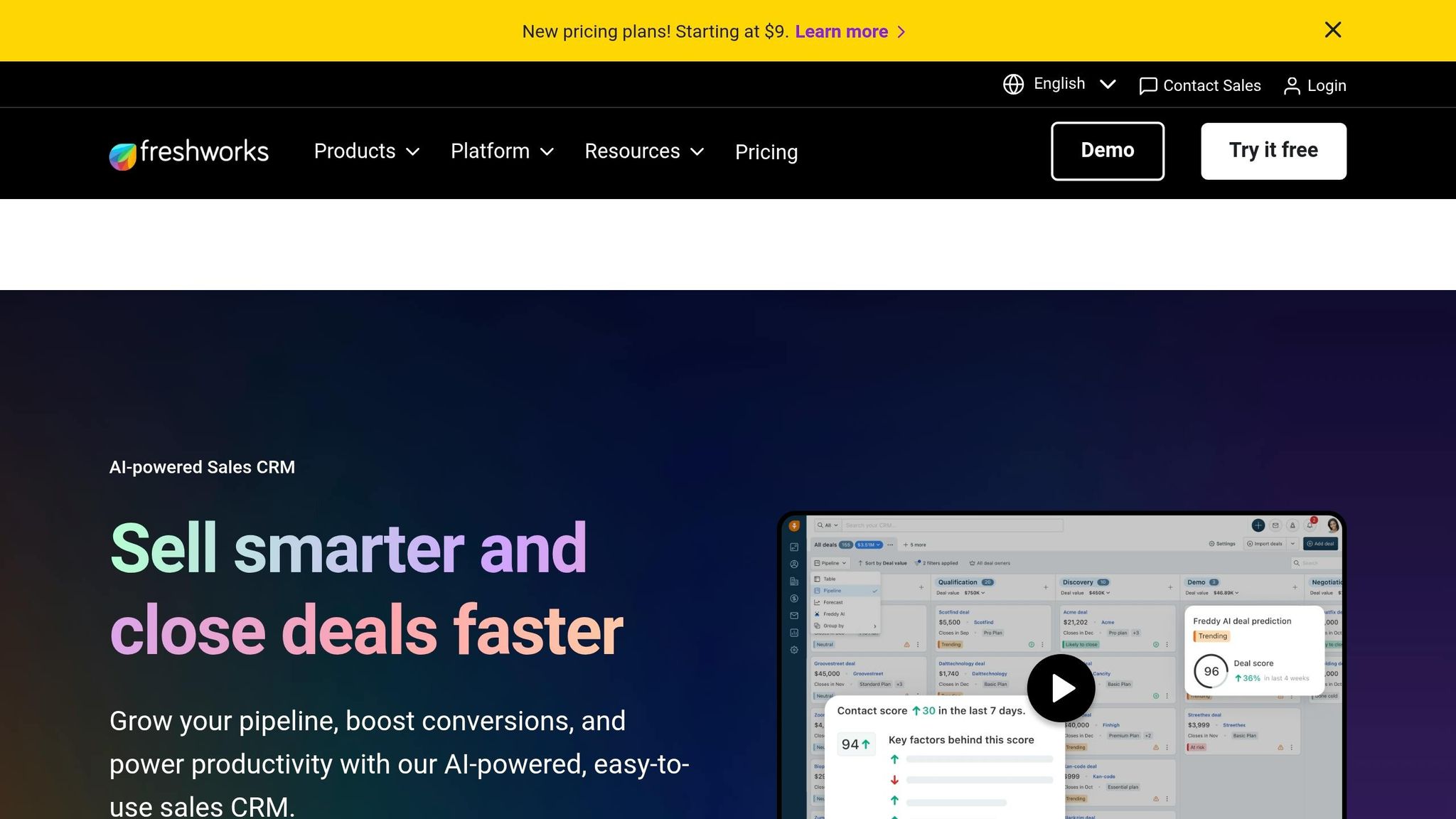
Freshsales stands out as a budget-friendly tool designed to help managers hit their sales targets. It combines AI-powered lead scoring, built-in phone and email capabilities, and chat tools in one platform. Starting at just $9 per user per month for the Growth plan, it’s an accessible option for small to mid-sized teams looking for more than just basic contact management without breaking the bank.
A standout feature is its Freddy AI, which evaluates leads based on their engagement - like email clicks and page visits - assigning scores that classify them as Hot (71-99), Warm (30-70), or Cold (0-30). This system helps sales managers focus their team’s efforts on high-potential prospects instead of wasting time on leads that aren’t ready to convert. Alexandra, a CRM Operations Manager at Humn, shared that after adopting Freshsales, her team increased customer acquisition by 10X in one year while reducing time spent on admin tasks by 20%. The platform’s data-driven tools also include features to prevent deals from stalling.
For instance, the deal alert system flags opportunities that have been inactive for weeks, allowing managers to intervene and guide their reps before prospects lose interest. The Pro plan, priced at $39 per user per month, supports multiple sales pipelines, which is perfect for teams juggling different product lines or customer segments without needing separate systems.
Freshsales is particularly well-suited for small to mid-sized teams that value built-in communication tools and don’t require extensive customization. Mike Hopkins, Senior VP of Sales and Service at Blue Nile, used the platform to cut appointment no-show rates to around 20%, significantly improving his team’s efficiency. For larger teams, the Enterprise plan at $59 per user per month includes advanced features like audit logs and enhanced governance to manage data and permissions more effectively.
While Freshsales offers great value, some key features - like multiple pipelines and duplicate management - are only available on higher-tier plans. Additionally, teams that rely heavily on third-party integrations might find the platform less versatile compared to other specialized tools. However, for managers prioritizing simplicity and affordability, Freshsales delivers a balanced solution that consolidates essential sales functions without a hefty price tag.
What Sales Managers Get Wrong About Tool Selection
Many sales managers make the mistake of choosing tools based on feature lists rather than how well the software aligns with their team's actual selling process. This often leads to what experts call "tool sprawl" - a chaotic mix of eight or more disconnected platforms that sales reps have to juggle just to close one deal.
The real issue lies in prioritizing features over functionality. Managers frequently opt for "enterprise-grade" platforms when their team needs something simpler. Or they add niche tools without ensuring proper integration with their CRM, which ultimately forces reps into tedious manual data entry.
"The reason managers do not coach more is not laziness. It is infrastructure." - Semir Jahic, CEO & Co-Founder, Salesmotion
This lack of coaching time highlights a deeper problem. The solution? Start by defining your sales process, then select tools that enhance it. For example, in 2025, Frontify saw a 42% boost in sales velocity after equipping managers with proactive account-level insights through Salesmotion. With less time spent chasing CRM updates, managers could focus on coaching account strategies. The takeaway: A straightforward, well-integrated tool beats a complicated system every time.
To make smarter tool investments, consider the bigger picture. Before introducing new software, calculate the total cost of ownership - this includes not just licensing fees but also implementation and training expenses. Ensure the tool integrates seamlessly with your CRM and works on mobile devices. If it doesn’t deliver measurable improvements in close rates or sales cycle times within two quarters, it’s time to move on. Studies show that increasing coaching time from under 30 minutes to over two hours per week can push win rates from 43% to 56%.
For teams looking to reduce admin headaches and prepare reps more effectively, focused platforms are key. Instead of piling on another data-gathering tool, consider PitchMonster and Nytro.ai. These platforms let reps practice real conversations with AI before live calls, helping them build confidence and consistency without requiring managers to role-play every scenario. This shift allows managers to step back from micromanaging and focus on strategic coaching for high-priority deals.
When selecting sales manager tools, focus on platforms that save time and improve results. The best tools automate data management and offer clear pipeline insights, allowing managers to spend more time coaching. Here's why that matters: increasing weekly coaching time from under 30 minutes to over two hours can boost win rates from 43% to 56%. Additionally, teams using AI-driven management tools see 77% more revenue per rep compared to those relying on manual processes.
Keep it simple. A tool that fits seamlessly into workflows is far more effective than one overloaded with features. Salespeople stretched too thin are 43% less likely to meet quotas, so a user-friendly tool that integrates with your CRM will outperform a complex system that gathers dust.
Your choice should depend on team size and sales needs:
High-performing sales teams typically allocate 3-5% of revenue to sales technology, ensuring they have the right tools for the job.
Platforms designed for coaching can make a big difference, too. AI-driven tools allow reps to practice calls and scenarios before going live, helping them build confidence and consistency without requiring managers to role-play every situation. This approach not only saves managers hours but also gets reps up to speed faster. Users of these tools often see a 20-30% improvement in close rates within 90 days.
Finally, weigh the total cost - including licensing, training, and administrative overhead - before committing to a tool. If it doesn’t lead to measurable gains in close rates or shorter sales cycles, it might be time to rethink your tech stack.
FAQ
The following questions address common concerns about selecting and measuring the effectiveness of sales manager tools in today's market.
What features should I prioritize when choosing sales manager tools in 2026?
Focus on tools with AI forecasting that use scenario modeling and historical data - these provide better accuracy than manual inputs. Real-time coaching features are also crucial, as they help sales reps during conversations, not just afterward.
Look for account intelligence tools that highlight buying signals like leadership changes or earnings reports, allowing managers to guide strategy rather than just deal mechanics. Ensure the tool integrates seamlessly with your CRM to avoid manual data entry, and check for SOC 2 certification if it handles customer interaction recordings.
Can an all-in-one platform replace specialized tools for sales coaching and performance tracking?
While all-in-one platforms like Salesforce or HubSpot offer pipeline visibility and serve as solid systems of record, they often lack the depth needed for real-time coaching or detailed account intelligence. In 2026, most sales teams rely on four to five integrated tools rather than juggling 15+ disconnected platforms.
Specialized tools are designed for specific tasks, such as AI role-play practice, post-call conversation analysis, or speeding up CRM updates. Tools that are overly complicated or poorly adopted won’t deliver results, no matter how feature-rich they are.
How do I determine the ROI of investing in sales manager tools for my team?
Start by tracking how much non-selling time your tools eliminate. On average, reps spend 28 hours per week on administrative tasks, so reducing this time can significantly impact productivity. Also, measure changes in deal speed and win rates after implementation.
Consider how quickly new hires reach full productivity with improved onboarding tools. Most teams notice measurable improvements in win rates and quota attainment within two quarters. According to Highspot's State of Sales Enablement Report 2025, companies with integrated tools are 42% more likely to boost rep productivity compared to those with disconnected systems.
How much should I budget for sales manager tools?
High-performing sales teams generally allocate 3-5% of revenue to sales technology. Entry-level CRMs like Pipedrive start at $14 per user per month, while mid-tier options like HubSpot Professional cost around $100 per user per month. Enterprise tools with AI features, like Salesforce Unlimited, can cost $330 per user per month, and conversation intelligence platforms like Gong range from $100 to $150 per user per month.
When budgeting, include not just license fees but also costs for add-ons, integrations, and setup. Enterprise tools like Clari often require annual commitments starting at $15,000 to $30,000 or more.
Should I choose tools based on features or team adoption?
Team adoption should always come first. Overly complex tools can reduce quota attainment by 43%.
Before selecting a tool, define your sales methodology and process stages. Choose software that fits your workflow instead of forcing your team to adapt to the tool. If you have field reps, test mobile apps thoroughly, and prioritize tools that integrate seamlessly with your existing CRM.
Conclusion
The right tools for sales managers do more than streamline tasks - they create the time and space needed for effective coaching, which directly impacts revenue. When managers dedicate over two hours a week to coaching instead of less than 30 minutes, win rates soar from 43% to 56%. That kind of improvement only happens when tools handle the busy work, allowing managers to focus on what truly drives results.
Start by evaluating your team’s workflow rather than chasing a long list of features. A straightforward tool your team actually uses will always outperform a complex platform that collects dust. Ideally, aim for four to five tools that integrate seamlessly - your CRM as the backbone, conversation intelligence for coaching insights, and account intelligence for strategic decision-making.
This setup works perfectly with tools like PitchMonster for targeted coaching. PitchMonster offers unlimited AI role-play practice, freeing managers from constant role-playing sessions. Teams that practice twice a week develop skills at double the pace of those relying solely on live-call feedback. Plus, its real-time coaching cards help reps adjust strategies mid-conversation - when it still counts - not after the deal is lost.
To ensure success, test new tools over a 90-day period with clear metrics. Track how much non-selling time they save, how they affect deal velocity, and how quickly new hires ramp up. Teams using AI-powered tools report generating 77% more revenue per rep - but only when the tools align with the team’s selling style.
Focus on tools that shift managers’ time from data management to coaching. That shift will lead to noticeable and measurable sales growth.