Kendo AI alternative

The Kendo AI Alternative for Teams That Coach After Every Role-Play

Kendo AI is an AI sales management suite that reviews recorded calls, scores them against your methodology and assigns AI role-play against the gaps it finds. PitchMonster is a practice and readiness platform where reps rehearse in three modes, real calls get scored on the same rubric, and an AI coach debriefs the rep in conversation afterwards.

  • Kendo publishes pricing and sells self-serve; we are demo-led, which is slower to start
  • Our AI coach asks the rep what they would change before it shows the score
  • Completed SOC 2, EU data residency and 29 languages against Kendo's published roadmap
Book a Demo

Trusted by 300K+ reps from World’s leading teams

Barton AssociatesMentorSyngentaXactlyFoxtonsLenovoABBSalesforceAdobeBarton AssociatesMentorSyngentaXactlyFoxtonsLenovoABBSalesforceAdobe
TD SYNNEXSThreeXfinityBritaCrexiGlobal IndustrialSupermetricsTata PlayBrollTD SYNNEXSThreeXfinityBritaCrexiGlobal IndustrialSupermetricsTata PlayBroll

Direct answer

Is PitchMonster a Kendo AI alternative?

Yes. Both products do AI role-play with configurable buyers, score real call recordings against custom scorecards, run manager reporting and route training to the reps who need it. If you shortlisted Kendo for practice plus call review in one place, PitchMonster covers the same ground. Reps rehearse against AI buyers in phone, face-to-face and screen-share modes, real calls are scored on the rubric reps already practiced against, and managers work from one view instead of two.

  • Kendo publishes pricing and sells self-serve. A manager can start this week without procurement. We are demo-led, and that is slower.
  • Kendo lists more meeting recorders, including Fathom, Fireflies and Zoom, plus a Push API for any dialer that can hand over a recording.
  • Kendo Agent answers plain-language questions about the team and assigns training from the answer. We have no equivalent.

None of those usually decide a pilot. What does is what happens the moment a role-play ends, and where the recordings live.

PitchMonster vs Kendo AI

How PitchMonster and Kendo AI compare

Decision areaRecommendedKendo AI
Platform centre
Practice and readiness. Role-play, scorecards, coaching, certification and reporting, with real-call scoring attached to the same rubric
Sales management. Call review is the entry point, with role-play assigned against the gaps it surfaces, plus candidate screening and a manager agent
Practice modes
Three modes: phone, face-to-face and screen-share. Post-sale, recruiting, leadership and hiring role-plays included
Voice role-play with transcripts and automated scoring. Screen-share or presentation practice is not publicly documented
Scenario build sources
Build from a transcript, an uploaded document, or a real call recording. A new scenario takes about two minutes. Role-play editor carries 40+ customizations
One prompt produces a realistic AI prospect to train against. Configurable by training objective, call type, product and offer, and common objections
Buyer persona and difficulty
Buyer persona configuration plus difficulty levels, so the same scenario runs easy for week one and hard for certification. Response latency around 1.5s
Custom prospects defined by role, industry, company size, personality and objections. Difficulty levels are not publicly documented
After the session ends
AI Coach opens a two-way conversation the rep starts on demand after any role-play. It asks the rep what they would change, then shows the scorecard. Speech coaching runs alongside it
Automated call summary with strengths and weaknesses, sentiment and an end-of-call result, plus a score. The post-session coaching mechanic is not publicly documented as a dialogue
Real-call analysis and scoring
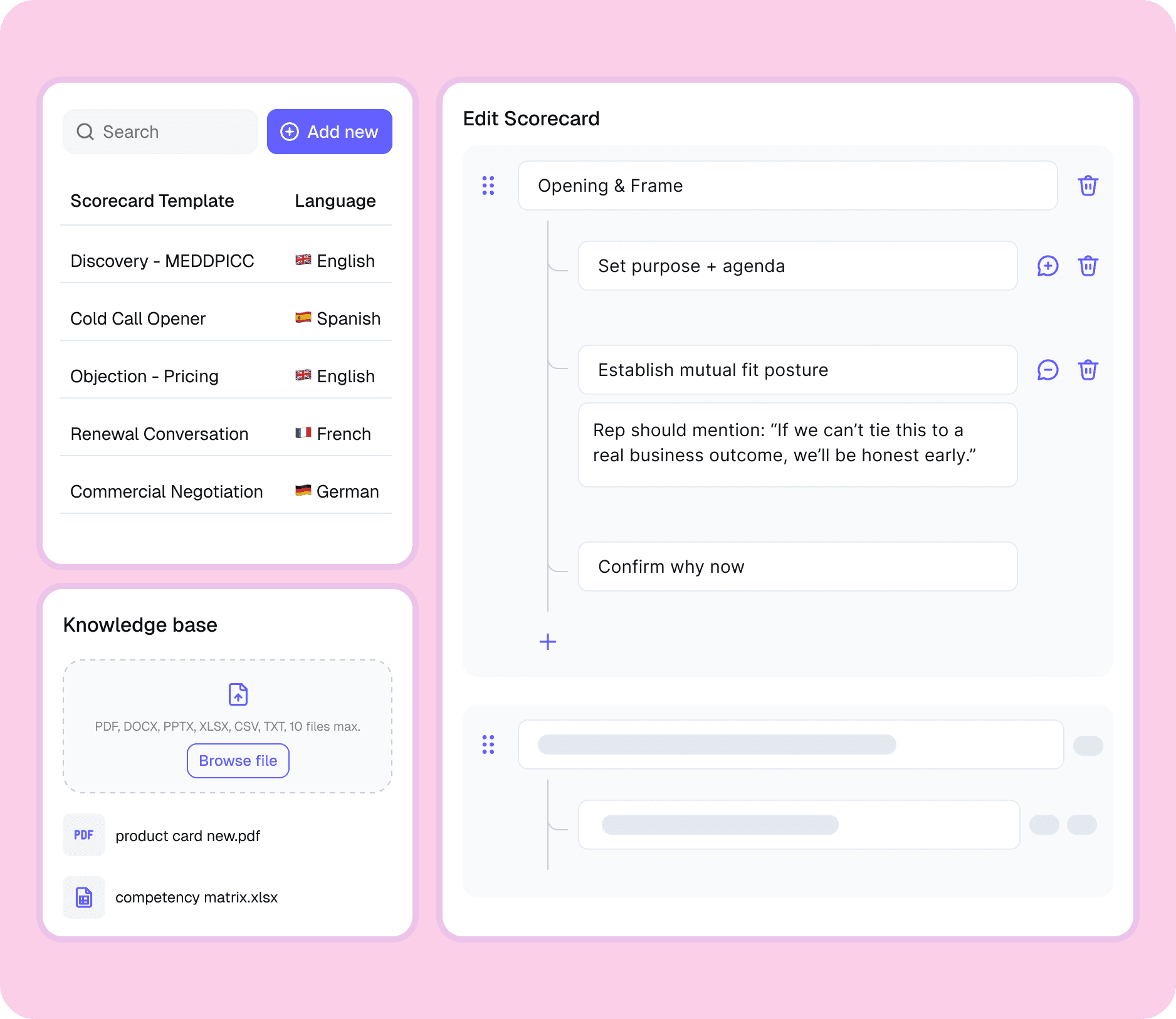
Call Analysis scores real calls on the same scorecard reps practice against. AI scorecards plus a scorecard template library. Human-led feedback and certification on top
Automated review of every imported call with custom scorecards, or presets including BANT, MEDDPIC and NEPQ. Genuinely strong here, and the reason most teams shortlist them
Languages
29 languages and dialects, with identical scoring criteria in every one, at no extra cost
8+ languages by their own published comparison, which names English, Spanish, German, French and Italian
Voice and accent
Voice and accent customization, so a scenario can be run in the accent your reps will hear on the phone
25+ synthetic voices by their own published comparison
Manager reporting and automation
Reports and activity analytics, leaderboards, company structure and groups, admin roles and permissions. Practice and real calls report in one place
Individual and team reports, score histories and trend dashboards. Kendo Agent answers plain-language questions about the team and assigns training from the answer, a real capability we do not match
Integrations
Salesforce and Gong, LMS integration, webhooks, 2FA and SSO
Fathom, Zoom, Fireflies, Slack, Zapier, Salesloft, Salesforce, Aloware, Outreach, a Push API and webhooks. Broader meeting-recorder coverage than ours. No Gong or LMS connector is listed on their integrations page
Data residency and certifications
European company. EU data residency, GDPR, SOC 2
Application on Vercel's global edge, customer data on Google Cloud and Firebase replicated across multiple Google Cloud regions. No EU-resident option publicly documented. Their documentation lists SOC 2 Type II as currently in progress with expected completion Q3 2026, ISO 27001 planned for 2027, HIPAA on the roadmap
Pricing model and onboarding
Sales-led. No public pricing; quoted per package. Onboarding runs about 3-4 hours with a dedicated CSM, and the first scenario is rebuilt live on the demo call
Publishes per-seat plan pricing openly and sells self-serve, with metered role-play minutes and call-scoring hours on top and a quoted Enterprise tier. If you want to buy without a call, that is a real advantage. Done-for-you setup and a dedicated account manager sit on the Enterprise tier
Independent reviews
4.9 on G2
4.8 on G2, by the figure Kendo publishes itself
Decision rule
Choose PitchMonster if practice is the daily habit you are building, if you need one rubric across rehearsals and real calls, if reps sell in more than a handful of languages, or if EU data residency and a completed SOC 2 have to be true at signature
Teams whose problem is call review first and practice second, that want to buy self-serve at a published price, weigh that against a compliance roadmap rather than a completed certification

Last reviewed: August 2026. Competitor details come from their own published documentation and change often. Check the current version before you decide.

Compare the operating model

Three decisions to settle before changing platforms

Where the platform's centre of gravity sits

The two platforms run the same loop in opposite directions, and that changes who logs in daily.

  • Kendo starts at call review. Score a real call, diagnose the weakness, assign role-play against it.
  • PitchMonster starts at practice. Reps rehearse first, in three modes, and Call Analysis scores real calls on the same scorecard.
  • Decide which direction your team already works in.

Who owns the recordings, and under whose law

Every role-play is a voice recording of a person, so the hosting answer matters.

  • PitchMonster is a European company with EU data residency, GDPR and SOC 2.
  • Kendo documents hosting on Vercel and Google Cloud, with data replicated across multiple Google Cloud regions.
  • Their SOC 2 Type II is in progress against a Q3 2026 target, with ISO 27001 planned for 2027.
  • If your security team needs a signed answer this quarter, ask both vendors in writing this week.

Run the same scenario in both tools

Take one real recorded call and have each vendor rebuild it as a role-play.

  • Run the same rep through both, and compare how the buyer behaves off script and how fast it responds.
  • Watch what happens the moment the session ends.
  • Check whether a manager can see the result next to that rep's real calls without exporting anything.

A connected loop for
practice and review

Reps rehearse in role-play, call analysis scores the real calls, and the AI coach turns every gap into the next assignment.

AIRole-play

Reps practice realistic conversations with AI buyers before speaking to real prospects. The AI adapts to objections, pushes back, and behaves like your actual ICP, across 29 languages. A judgment-free space to fail, repeat, and get it right before it matters.

Learn more

The thing a demo will not show you

What happens when the role-play ends

Both products score a rep against your rubric. The difference is what the rep gets handed afterwards, and it is the difference between a report and a conversation.

Kendo hands the rep an automated call summary: strengths, weaknesses, sentiment, an end-of-call result and a score. A coaching dialogue after the session is not publicly documented.

PitchMonster's AI Coach inverts the order. The rep opens it on demand, and it asks them what they would change before it shows them the score. Reps argue with a number. They rarely argue with a question they answered themselves, and the score lands differently after they have already named the gap.

Watch for this in both demos

  • Ask to see the screen a rep sees the second a role-play ends - not the manager dashboard.
  • Ask whether the rep can start the debrief themselves, or only receive one.
  • Ask whether the same rubric scores rehearsals and real calls, or whether they are two rubrics wearing the same name.
  • Ask a rep in their first 90 days which debrief they would actually open twice.

Read this before you talk to us

Where Kendo is the better answer

Kendo was founded in 2024 and is bootstrapped, and it beats us on the things a small fast team gets right. Three of these are not close.

If your first problem is call review rather than rehearsal, Kendo starts from the recordings and works backwards to the training. We start from the practice and connect the real calls to it. Neither order is wrong; they suit different teams. Recording-first is also Gong's home ground, and we compare it in the same depth.

Rows Kendo wins outright

  • Published pricing and self-serve signup. A manager can start this week without procurement. We are demo-led, and that is slower.
  • Meeting recorders: Fathom, Fireflies and Zoom natively, plus a Push API for any dialer that can hand over a recording. Our integration list is narrower.
  • Kendo Agent: ask a plain-language question about the team and assign training straight from the answer. We have no equivalent.
  • Preset scorecards like BANT, MEDDPIC and NEPQ out of the box, alongside custom ones.
  • Candidate screening by shareable link, which is a genuinely neat use of the same engine.

Where the comparison turns back

Two rows turn it back, and both are checkable rather than arguable. Kendo's own documentation lists SOC 2 Type II as in progress with a Q3 2026 target, no EU-resident hosting option, and 8+ languages. Ours is a completed SOC 2, EU residency, and 29 languages on identical criteria. If your security review or your regions are fixed, that is the whole evaluation.

Switching from Kendo? Get an extra 10% off.

Bring your scenarios and call recordings - onboarding takes about 3-4 hours with a dedicated CSM, and we rebuild your first scenario live on the demo call.

Switch to PitchMonster

Offer applies to teams moving from Kendo or holding an active Kendo quote.

Run one matched pilot

Give both vendors the same brief and the comparison settles itself in a fortnight.

  1. Same buyer persona and source material, taken from a real deal rather than a template.
  2. Same objection, raised at the same point in the call.
  3. Same rubric and the same pass threshold.
  4. Same users: the reps who will use it, plus the manager who will review it.
  5. Same reporting request at the end, in writing.
  6. Hand both the same real call recording, and check whether its score sits next to the practice score on one rubric or in a separate report.
  7. Ask both, in writing, for current SOC 2 status and completion date, and which region customer recordings are stored in.

Book a demo to see a scored session and the AI coach debrief.

Book a Demo
PitchMonster scorecard and analytics

Customer proof

“I think I really like the AI coach. That part was, to me, the most impressive. That's definitely going to save us a lot of time.”

Wendy Mateo De Perkins, Senior PM & Instructional Designer, One Park Financial

4.9 on G2

Related comparisons

Compare other platforms

Shortlisting AI role-play tools beyond Kendo? These pages compare PitchMonster with the other platforms teams evaluate, on the same criteria.

Every comparison in one place: compare PitchMonster with other sales training platforms. For the long-form breakdown, read PitchMonster vs Kendo on the blog.

Compare your Kendo AI workflow with PitchMonster

Book a short demo and we'll walk you through it - no decks, just the product.

Questions asked frequently.

Yes. Both products do AI role-play with configurable buyers, score real call recordings against custom scorecards, run manager reporting and route training to the reps who need it. If you shortlisted Kendo for practice plus call review in one place, PitchMonster covers the same ground. Reps rehearse against AI buyers in phone, face-to-face and screen-share modes, real calls are scored on the rubric reps already practiced against, and managers work from one view instead of two.