Sales coaching tools are software that help reps sell better without a manager sitting in on every call. They do three jobs by timing: pre-call practice that simulates buyers for role-play, live guidance during the call, and post-call analysis of recorded conversations. The right pick depends on where your reps lose deals.
This guide ranks the ten tools below inside those three jobs, so you can match a shortlist to your real gap instead of scanning a flat list. Each entry carries a real G2 rating, an honest best-fit team, and a verdict. For the slice of this market that is purely AI-driven, see our deeper review of the best AI sales coaching software.
A tool is only as good as the routine around it. Our sales coaching guide covers the session loop and the cadence a tool has to support.
The three jobs a sales coaching tool does
Almost every product in this category does one of three jobs well, and vendor pages blur the difference. Naming the job first is the fastest way to cut a long list to three real options.
Pre-call practice tools put a rep in front of a simulated buyer so they rehearse and get scored before a live conversation. Live tools listen during the call and surface a prompt while the rep can still act on it. Post-call analysis tools record and grade real calls after the fact, then show a manager where the deal turned.
The wider market uses more labels for the same split. Conversation intelligence and telephony assist are live and post-call work. Enterprise enablement bundles readiness and content on top. Independent practice is the pre-call rehearsal layer. A strong program usually runs more than one job, but only one is ever the bottleneck worth fixing first.
If your gap sits in the call-analysis lane specifically, our guide to call coaching software compares the ten tools that do that job.
The common misstep is buying a call-analysis platform and calling it a coaching program. Tools that record and grade calls are good at showing what happened, but every insight they produce arrives after the deal is already lost. Reviewing recorded calls is closer to watching game footage than changing the outcome on the field.
A program is a different purchase from a tool, and our roundup of the best sales coaching programs covers what the structured options include.
A second mistake is confusing a content library with coaching. A platform full of training videos feels like progress, yet rep performance often stays flat, because watching a clip on objection handling is passive. Skill comes from active reps who rehearse, get feedback while the moment is still live, then practice again before the next call. The fix is to combine the jobs on purpose: use post-call analysis to find the gap, then close it with pre-call practice on that exact moment.
The reason practice sits at the center of most programs is retention. Reps forget most of what they hear in a passive session within days. They keep what they do. Repetition against a realistic buyer builds the reflex that a slide deck never will, which is why so many searches for coaching tools are, at heart, searches for a way to rehearse the pitch and objection handling before it counts. That is also why the tools that move performance most tend to be the ones reps open on their own, not the ones a manager has to chase them to use.
That loop is what AI sales coaching software packages: practice, scoring, and a debrief on one standard.
What to look for in a sales coaching tool
Before you compare logos, set the bar. A few things separate a coaching tool reps keep using from one that gathers dust.
Start with scoring against your playbook, not a generic rubric. A tool that grades on your methodology and your ICP produces feedback a rep can act on tomorrow. One that grades on a stock template produces noise that reps learn to ignore, and a manager cannot trust a score built on someone else's definition of good.
Look for a practice and analysis loop, not one or the other. The best programs find the gap on real calls and drill it in simulation. A tool that only reviews, or only rehearses, leaves half the job undone, and the gap you spot on Monday is still open on Friday because nobody built the reflex to close it.
Check for CRM and dialer integration so coaching triggers off real activity. If a manager has to remember to assign practice by hand, it will not happen once the team is busy. When a lost deal or a missed stage can kick off the right drill on its own, coaching keeps running without anyone babysitting it.
Weigh adoption after the novelty fades. Reps keep using tools that are quick to open and fast to give feedback. Set-up friction kills a rollout in week one, so a simple daily flow matters more than a long feature list. The best test is whether a rep would open it on a busy Thursday without being told.
Insist on onboarding and a human owner from the vendor. The fear every enablement lead names is that they will pay for a tool and nobody will use it. Guided onboarding and a named contact are what move a tool from bought to used, and they are the difference between a launch that sticks and one that quietly stalls after a month.
Two more matter for regulated or international teams: data residency, meaning where recordings live, and language coverage. If your reps sell in seven markets, a tool that scores in one language is a partial answer. Settle these before the demo, so the demo tests your list instead of the vendor's script.
The 10 best sales coaching tools at a glance
Scan the field here, then read the write-up for any tool that fits your gap. G2 ratings are from g2.com and move over time. Most vendors quote per seat on request, so treat the pricing-fit column as a segment guide and confirm details with each vendor.
Tool | Primary job | Best-fit team | G2 rating | Pricing fit |
|---|---|---|---|---|
PitchMonster | Pre-call practice + AI Coach | 10-300 reps, consultative B2B | 4.9 / 5 | By quote; mid-market to enterprise |
Hyperbound | Pre-call practice (cold calls) | Outbound and SDR-heavy teams | 4.9 / 5 | By quote; SMB to mid-market |
Mindtickle | Practice + enablement suite | Enterprise readiness programs | 4.7 / 5 | By quote; enterprise |
Salesloft | Live, in-call coaching | Teams coaching inside a workflow | 4.5 / 5 | By quote; mid-market to enterprise |
Revenue.io | Live, in-call coaching | Phone-heavy Salesforce teams | G2 Leader (conversation intelligence) | By quote; mid-market to enterprise |
Gong | Post-call analysis | Data-driven mid-market and enterprise | 4.7 / 5 | By quote; mid-market to enterprise |
Chorus by ZoomInfo | Post-call analysis | Teams living in the ZoomInfo stack | 4.5 / 5 | By quote; ZoomInfo customers |
Clari Copilot | Post-call analysis + live prompts | Revenue teams tracking deals and calls | 4.5 / 5 | By quote; mid-market to enterprise |
Highspot | Post-call analysis + content | Large teams tying coaching to content | 4.7 / 5 | By quote; enterprise |
Cirrus Insight | CRM productivity + light coaching | Salesforce-centric SMB | 4.2 / 5 | Published per-user plans; SMB |
One note on reading the table. A high G2 score tells you customers are happy, not that the tool fits your job. A conversation-intelligence platform and a role-play platform can both sit at 4.7 and still be wrong for each other's buyer. Match the primary job to your bottleneck first, then let the rating break a tie. Best-fit team is the other column that saves time, since a tool tuned for a 500-rep enterprise rarely suits a 20-rep team, and the reverse is just as true. The write-ups below go deeper on each tool, starting with the one built specifically for pre-call practice and coaching.
PitchMonster: the AI role-play coach reps keep using
PitchMonster is an AI sales role-play platform built for teams that need reps ready before the real call. Reps practice discovery, objection handling, and full demos against AI buyers that behave like your ICP, get scored on your own playbook, and then work through a coaching conversation that no other tool here offers. It fits sales teams of roughly 10 to 300 reps running consultative B2B motions with someone who owns training, whether that is a head of enablement, a sales director, or a team lead.
The Socratic AI Coach after every session
The differentiator is the AI Coach. After every practice session, a Socratic AI trainer asks reflective questions that guide the rep to their own insight before they see a single score, and it is available around the clock. That is where reps change how they sell, because a rep who reaches the answer themselves remembers it, while a rep who is handed the answer forgets it by the next call. As Wendy Mateo De Perkins of One Park Financial put it, "I think I really like the AI coach. That's definitely going to save us a lot of time."
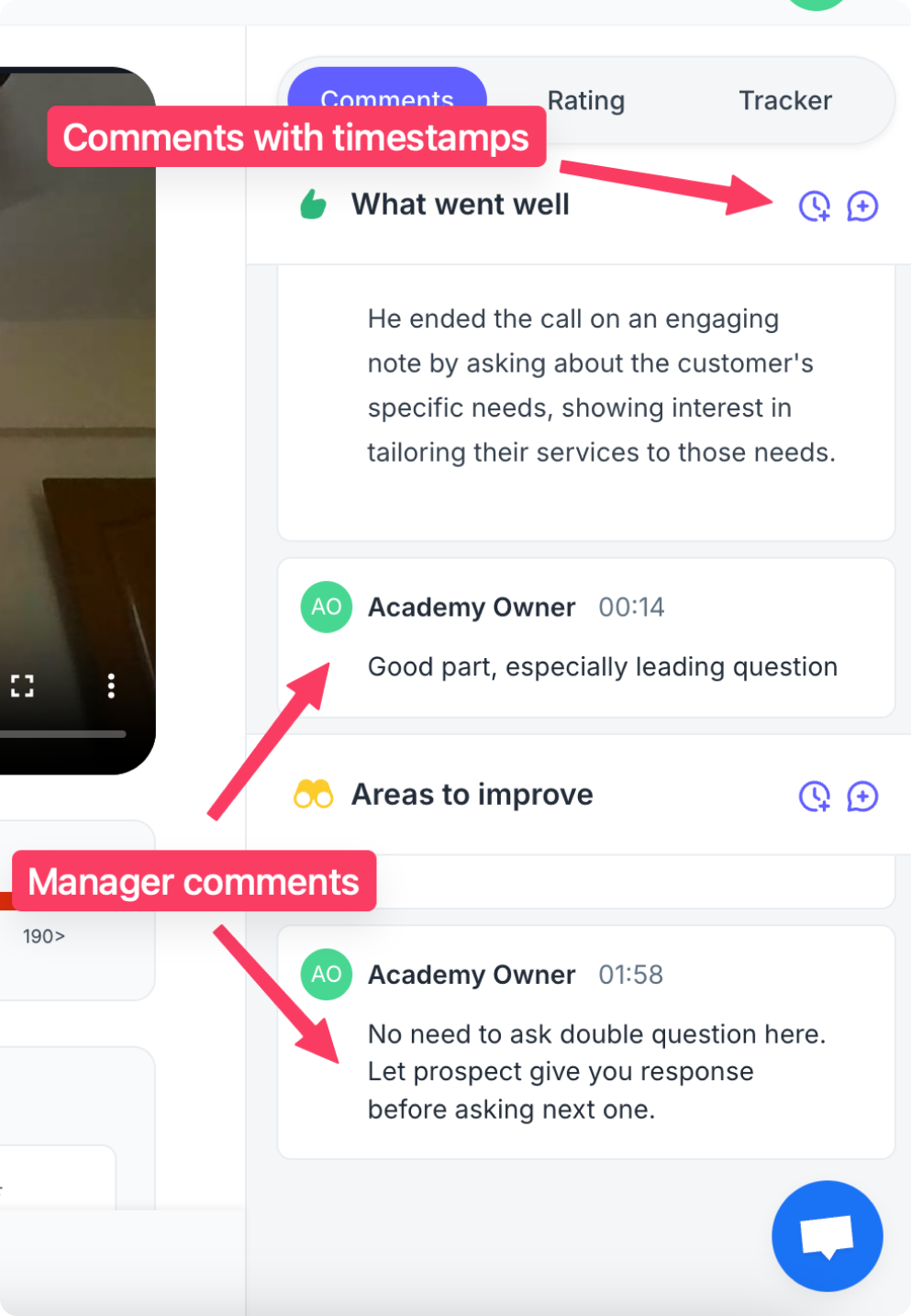
This maps directly onto the 70/30 rule good managers already use. The rep does most of the talking and reaches the insight, while the coach mostly asks and listens. The AI Coach runs that pattern for every rep, on every session, without waiting for a manager's calendar to open up. A team of thirty gets the same reflective coaching a manager could give one or two people a week.
Realistic AI buyers that adapt and push back
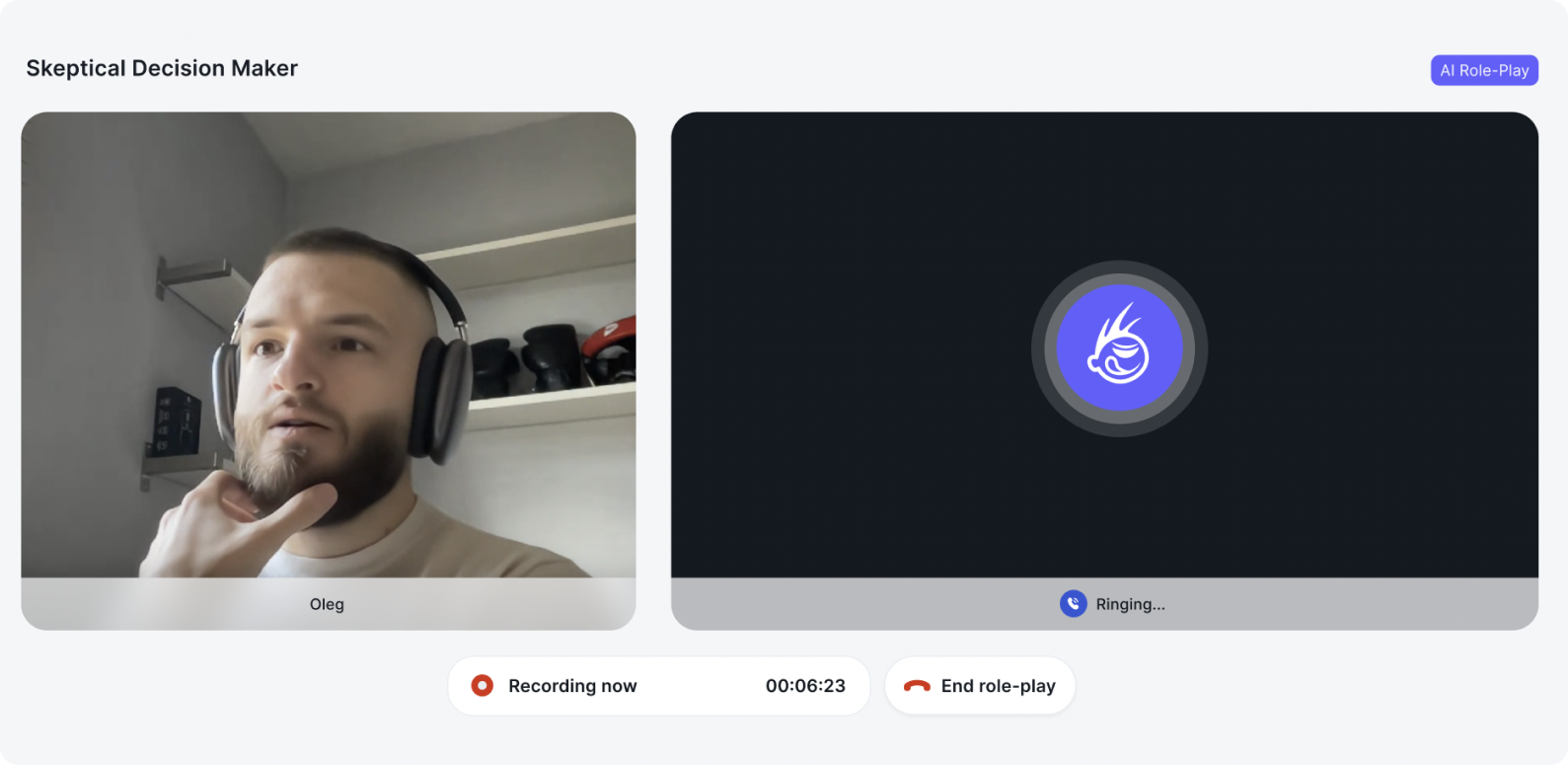
Around the coach sits the practice engine. Reps run live conversations against AI buyers that adapt, object, and push back the way your real prospects do, in screen-share, face-to-face, or phone modes. There are four difficulty levels up to Insane, so a new hire and a senior AE can drill the same scenario at different heat. The realism is what makes the rehearsal transfer to the real call rather than feeling like a script read, and it is why reps stop treating practice as a checkbox and start treating it as reps in the gym.
Scored on your own playbook, not a generic rubric
Every session is graded against your methodology and your scorecard, not a stock template. Reps see where they won the moment, where they lost it, and the exact next step to fix. Because the rubric is yours, a manager trusts the score enough to act on it, and a rep gets feedback that matches what leadership will judge them on in a real deal. That fit between practice and the real bar is what stops a coaching program from drifting into busywork.
Live Call Analysis for the calls that already happened
Practice is only half the loop, so PitchMonster also reviews real calls. Upload a recording and it is scored against the same playbook the role-plays use, which surfaces where a rep won, lost, or skipped a step. That gives a manager one consistent standard across simulated and live conversations, instead of one rubric for practice and another for the field. A weak discovery call on Tuesday becomes a targeted role-play on Wednesday, closing the loop instead of just logging the miss.
Build a coaching scenario in about two minutes
A manager builds a scenario from a call recording, product docs, a transcript, or a website URL in about two minutes, with more than 40 customization parameters to match a persona, industry, or deal stage. That speed is what keeps the program alive, since the person who owns training can spin up a fresh drill the same week a new objection starts showing up on calls. You are never waiting on a vendor or a content team to react to what the market is doing right now.
Voice realism across 27 languages
Voice realism is a real edge here: natural pacing, filler words, and context-aware objections, so a phone rehearsal sounds like a phone call rather than a chatbot exchange. PitchMonster supports 27 languages, which matters for teams selling across regions and running one standard everywhere. It is also the only European-based platform among the leaders, so GDPR compliance and EU data residency are built in rather than bolted on, a point that decides the shortlist for a lot of European buyers.
Coaching signals and skill-gap analytics for managers
For managers and RevOps, the platform turns practice into data. You get skill-gap analytics, readiness signals, and adoption reporting in one view, and scores export to HubSpot, Salesforce, Power BI, or an LMS through the API. A manager can see who is ready before a real call and where the whole team is weak, which is how coaching scales past a single person's calendar. It also gives an enablement lead the numbers to show leadership that training moved a metric, not just filled a seat.
Proof: G2 4.9, 100% enterprise renewal, and the Mentor Group result
The trust signals back the pitch. PitchMonster holds a 4.9 out of 5 on G2 and a 100% enterprise renewal rate since spring 2024, across more than 300,000 reps trained. Mentor Group recorded 30% faster ramp, 37% higher performance, a 28% win rate improvement, and twice the opportunities booked after rolling it out. Pricing is quote-only, with onboarding, a dedicated CSM, and support included and no setup fees. See pricing for your team size, book a demo through the sales leaders view, or read how it maps to a sales enablement program.
The verdict: the strongest pick when the goal is reps who are ready before the first real call, and the only tool here that adds Socratic post-session coaching. You can book a demo and run your first role-play on your own material. G2 rates it 4.9 out of 5.
Pre-call practice tools
Practice tools fix the most common gap on a sales team: reps do not get enough realistic repetitions before they face a buyer. They simulate the conversation, score it against your standard, and let a rep repeat the hard moment until it holds up. This is where new hires ramp and where the middle of the team improves. It is also the group behind one of the highest-demand searches this page ranks for, coaching tools that let reps rehearse pitch and objection handling in practice sessions.
Hyperbound

Hyperbound is built for cold-call and outbound practice. It generates AI buyers with set personas and objections so reps rehearse prospecting calls, and it scores real calls too. Outbound teams reach for it when they want a high volume of repetitions on top-of-funnel conversations, and a self-serve setup gets a team practicing quickly. It also gives managers leaderboards and analytics that suit a competitive SDR floor. G2 rates it 4.9 out of 5.
Where it is lighter: it centers on the call itself more than a reflective coaching conversation afterward, and it skews toward larger, outbound-heavy teams with an enablement lead to build scenarios. Full-cycle reps working consultative deals will find the cold-call focus narrower than they need. If you are weighing the two, here is a Hyperbound alternative built around the coaching loop. The verdict: a fast, focused choice for SDR cold-call drilling, and less suited to full-cycle consultative coaching.
Mindtickle

Mindtickle is a broad enablement suite that folds practice into onboarding, certification, readiness scoring, and analytics. Its AI role-plays and video simulations slot into certification workflows, so reps clear a bar before they reach real prospects, and its readiness index gives managers a competency snapshot across the team. That breadth suits large organizations rolling out training across regions with a formal certification program. G2 rates it 4.7 out of 5.
Teams that find the suite too heavy for a practice gap can weigh the Mindtickle alternatives side by side.
Where it is lighter: the suite can feel heavy to set up, and its practice depth is why many teams add a focused role-play layer on top rather than relying on it alone. A mid-market team that only needs reps to rehearse will pay for a lot of surface it never opens. If practice depth is the real goal, compare a Mindtickle alternative built for it. The verdict: a strong readiness platform for enterprise, and more than most mid-market teams need if practice is the only gap.
Live, in-call coaching tools
Live tools help during the conversation, not after it. They transcribe in real time, flag objections, and surface a cue while the rep can still use it. This is the group to look at when newer reps freeze mid-call and a debrief a week later comes too late. The trade-off is that a prompt on screen only helps a rep who can read and act on it without losing the thread of the call.
Salesloft

Salesloft weaves coaching into the daily sales workflow rather than running it as a separate event. Its Rhythm engine reads deal signals and recommends the next best action, and the platform transcribes calls to flag where performance can improve. Because it lives in the same place reps manage deals, coaching lands without an extra tool to open, which fits teams that treat coaching as part of the workflow. Managers get scorecards and call analytics that tie feedback back to the deals in the pipeline, so a review points at a specific opportunity rather than a vague habit. G2 rates it 4.5 out of 5.
Where it is lighter: the focus is live deal guidance, not pre-call rehearsal, so teams that need reps to practice before they dial will pair it with a role-play tool. A rep who has never worked a given objection out loud will still stumble the first time, prompt or no prompt. The verdict: a good fit when coaching should ride along with pipeline work, and not a practice engine on its own.
Revenue.io

Revenue.io is built for phone-heavy teams that run high call volumes on Salesforce. It pairs a Salesforce-native dialer with real-time prompts that help a rep handle an objection or a technical question in the moment. Its standout is a manager whisper mode that lets a leader listen to a live call and coach the rep without the prospect hearing, which can save a deal as it happens. A guided-selling layer suggests next steps between calls, so the coaching does not stop when the rep hangs up. G2 lists it as a Leader in conversation intelligence.
Where it is lighter: it centers on live monitoring and intervention more than deep post-call review, so analysis-led teams may want a conversation-intelligence tool alongside it. It is also tuned for phone-first motions, so a video-heavy team gets less out of the dialer that anchors the platform. The verdict: a phone-first choice for high-volume Salesforce teams, and overkill if your reps mostly sell over video.
Post-call analysis tools
Analysis tools record and grade real calls, then show a manager where the deal turned. They scale review far past the handful of calls a manager can listen to by hand, and they coach against evidence instead of memory. The catch is timing: every insight lands after the call, so this group works best feeding a practice loop, not replacing one. It is also how a manager who cannot sit in on every call still coaches the whole team.
Gong

Gong is the standard for conversation intelligence. It records, transcribes, and analyzes live calls, tracks hundreds of signals per conversation, and surfaces the moments that matter so managers coach against real evidence. It also ties call data to deal and pipeline health inside the CRM, flagging at-risk deals from signals like low stakeholder engagement. G2 rates it 4.7 out of 5.
Where it is lighter: Gong shows what already happened and is not built for reps to rehearse beforehand, which is why many teams pair it with a practice tool. New users sometimes find the depth of the interface a lot to take in at first, and smaller teams can struggle to use everything they pay for. The verdict: the safe post-call analysis choice for data-driven teams, paired with practice to turn insight into changed behavior.
Chorus by ZoomInfo

Chorus records and analyzes sales calls, highlights key moments, and feeds coaching and forecasting. Its pull is the ZoomInfo connection: call insight sits next to the prospect data and CRM signals a team already works from, with momentum tracking and highlight reels of top-rep calls that double as training material. G2 rates it 4.5 out of 5.
Where it is lighter: like other analysis tools it reviews conversations after they happen rather than letting reps practice first, and its edge depends on you living inside ZoomInfo. A team that does not run the ZoomInfo stack loses the connection that makes it stand out. The verdict: the natural pick if you already run ZoomInfo, and less compelling as a standalone buy.
Clari Copilot

Clari Copilot records, transcribes, and analyzes calls, then rolls the insight up into the wider Clari revenue platform so coaching sits next to forecast and deal data. It adds a real-time layer that most analysis tools skip: battlecards surface during a live call, and CRM fields auto-update from the transcript to cut post-call admin. G2 rates it 4.5 out of 5.
Where it is lighter: it is built for revenue teams that want conversation data feeding pipeline management, so a team whose only gap is rep practice will find more than it needs here. The coaching is retrospective, so it tells a rep what to fix without giving them a safe place to drill it. The verdict: a solid choice when you want call intelligence tied to deal and forecast visibility, and paired with a practice tool when skill-building is the real job.
Highspot

Highspot combines coaching, content management, and training in one platform, which suits large teams that want rep readiness and content usage in the same view. Its Nexus engine delivers role-specific recommendations, and it tracks which sales materials reps use and how those materials move deals, so coaching connects to the content that closes. G2 rates it 4.7 out of 5.
Where it is lighter: its role-play and simulation features are part of a broader suite rather than the core, so teams that want deep, adaptive practice usually pair it with a dedicated tool. The value depends on your team using the content library day to day, which is its own adoption challenge. The verdict: strong when coaching and content need to live together, and not the deepest practice engine.
Cirrus Insight

Cirrus Insight is a Salesforce productivity tool first and a coaching tool second. It syncs meetings, tasks, and emails into the CRM, tracks buyer engagement, and includes basic conversation analytics that record and organize calls for review. For Salesforce-heavy teams that want light coaching insight bundled with admin automation, it covers the basics, and it saves reps the manual data entry that eats into selling time. G2 rates it 4.2 out of 5.
Where it is lighter: its coaching depth trails platforms built for it, with no real practice or simulation layer, so teams that need genuine skill-building will pair it with a dedicated tool. It is a productivity add-on that happens to record calls, not a coaching program you would build a training plan around. The verdict: fine as a low-cost add-on for Salesforce admin plus light insight, and not a coaching program on its own.
How to choose the right tool for your team
Start with the bottleneck, not the feature list. If reps need more repetitions before live calls, you want pre-call practice. If managers cannot listen to enough calls, you want post-call analysis. If newer reps freeze mid-call, you want live guidance. Most teams have exactly one of these as the real constraint, and naming it cuts a long list to three.
Team size shifts the answer. A team of 10 to 50 reps usually wants a focused practice tool with fast onboarding and a named owner from the vendor, so PitchMonster or Hyperbound fit without the weight of a full suite. You want something a manager can stand up in days, not a platform that needs a quarter of configuration and a consultant to run. Mid-market teams that want to lift rep productivity without hiring consultants lean the same way, then add analysis as they grow past the point where a manager can review calls by hand.
For new-hire and junior-rep ramp, pair a call-analysis tool that spots the recurring gap with a role-play tool that drills it. A junior rep needs to fail safely and repeat the hard moment, which is exactly what pre-call practice gives them before they touch real pipeline. Large enterprises running certification across regions get more from a suite like Mindtickle or Highspot, often with a dedicated practice layer on top for the depth those suites do not reach.
Sales coaching tools for managers: how to coach at scale
Managers rarely lose because they lack insight. They lose because they cannot be in every call. The way to coach at scale is to let software do the listening and the repetition, so your time goes to the judgment calls only a human makes.
Use a post-call analysis tool to surface coaching moments across the whole team without triggering each review by hand. Then close the gap with a practice tool that assigns the exact drill a rep needs and scores it on your playbook. Readiness scoring in a suite like Mindtickle or Highspot tells you who is ready before a real call, and skill-gap analytics in a practice tool like PitchMonster tell you where the whole team is weak. That combination is what turns one manager's calendar into coverage for thirty reps, and it is why the manager-facing searches for coaching tools keep pointing back to a mix of analysis and practice rather than a single product.
The feature matrix below shows which job each tool does, so a manager can see the overlap at a glance.
Full comparison10 rows · 6 columns
Tool | Pre-call practice | Live in-call guidance | Post-call analysis | Scores on your playbook | Socratic AI Coach |
|---|---|---|---|---|---|
PitchMonster | Yes | No | Yes | Yes | Yes |
Hyperbound | Yes | No | Yes | Yes | No |
Mindtickle | Yes | No | Yes | Partial | No |
Salesloft | No | Yes | Yes | Partial | No |
Revenue.io | No | Yes | Yes | Partial | No |
Gong | No | Partial | Yes | Partial | No |
Chorus by ZoomInfo | No | No | Yes | Partial | No |
Clari Copilot | No | Yes | Yes | Partial | No |
Highspot | Partial | No | Yes | Partial | No |
Cirrus Insight | No | No | Partial | No | No |
Then pressure-test the shortlist on adoption. Does it score reps against your playbook or a generic rubric? Does it connect to your CRM and call stack so coaching lives where reps work? Is it simple enough that reps keep using it after the novelty fades, and does the vendor help with onboarding? A tool nobody opens returns nothing, no matter how it demos.
Run a real trial before you commit. Build a scenario on your own use case, put a few reps through it, and judge the output rather than the demo. Set a baseline for ramp time and win rate first, so you can prove the return after a quarter instead of arguing about it. For the practice-and-coaching angle, you can book a demo and run your first role-play on your own material. If your gap is broader training rather than pure coaching, our roundup of the top sales training tools covers that side.
FAQ
What are sales coaching tools?
Sales coaching tools are software that help reps improve how they sell without a manager listening to every call. They analyze rep performance, surface skill gaps, and speed up development. They fall into three groups by timing: pre-call practice tools that simulate buyers for role-play, live tools that prompt reps during a call, and post-call analysis tools that review recorded conversations and show where reps won or lost.
What is the best sales coaching software?
There is no single best tool, because the three types solve different problems. For pre-call practice and skill-building, PitchMonster and Hyperbound lead, and PitchMonster is the only one with a Socratic AI Coach after every session. For live guidance during calls, Revenue.io and Salesloft help. For post-call review, Gong and Chorus by ZoomInfo are the standard. Pick the type that matches where your reps lose deals.
What tools help sales managers coach reps at scale?
Managers who cannot listen to every call use post-call analysis tools like Gong and Chorus to find coaching moments across the whole team, then close the gap with a practice tool like PitchMonster so reps drill the exact moment they fumbled. Enablement suites like Mindtickle and Highspot add readiness scoring, so a manager can see who is ready before a real call.
What is the 70/30 rule in sales coaching?
The 70/30 rule says the rep being coached should do about 70% of the talking and the manager about 30%. The manager's job is to ask questions and listen, not lecture, so the rep reaches the insight on their own. It is the same idea behind PitchMonster's AI Coach, which asks reflective questions after a session rather than handing over the answer.
What is the difference between call analysis and role-play tools?
Call-analysis tools like Gong and Chorus review real recorded calls after they happen and flag coaching moments. Role-play tools like PitchMonster and Hyperbound simulate buyers so reps practice before a live call. The strongest setups pair both: analysis shows what went wrong, and practice builds the muscle memory to fix it next time.
How much do sales coaching tools cost?
Most vendors price per seat and quote on request, so published numbers are rare. PitchMonster is quote-only, with onboarding, a dedicated CSM, and support included and no setup fees. Enablement suites and conversation-intelligence platforms usually sit in enterprise contract territory, while a few CRM add-ons publish per-user plans. Confirm current pricing with each vendor for your seat count.
Do sales coaching tools improve rep performance?
They help when reps use them often and the feedback ties to your playbook. The mechanism is repetition: reps rehearse the moments they fumble far more than a manager could coach live. One PitchMonster customer, Mentor Group, recorded 30% faster ramp and a 28% win rate improvement after rollout, alongside 37% higher performance and twice the opportunities booked.
What is the best sales coaching tool for a team of 10 to 50 reps?
A team of 10 to 50 reps usually wants a focused practice tool with fast onboarding and a named contact from the vendor, not a heavy enterprise suite. PitchMonster and Hyperbound fit that size well, since a manager can build scenarios and get reps drilling in days. Add a post-call analysis tool later, once you need to review deals at volume.
Which sales coaching tools work for training junior reps?
Junior reps ramp fastest when they can fail safely and repeat the hard moment. A role-play tool like PitchMonster lets a new hire rehearse discovery and objection handling against an AI buyer before touching real pipeline, scored on your playbook. Pair it with a call-analysis tool so a manager can spot the recurring gap and assign the exact drill that fixes it.
Can AI coaching replace a sales manager?
No, and it is not meant to. AI coaching tools handle the volume a manager cannot: repetition, scoring every rep on the same rubric, and reflective feedback after every session at any hour. That frees the manager for the judgment calls software cannot make, like deal strategy, career development, and the hard conversations. The strongest teams treat AI coaching as extra coaching capacity for the manager, not a substitute for one.