A mock discovery call is a rehearsed discovery conversation, run against a colleague or an AI buyer instead of a live prospect. It follows the same structure and questions as a real call, but nothing is at stake if the rep stumbles. Managers use it to catch gaps before a prospect does, and reps use it to build the habit before it counts.
Most advice on this topic stops at the individual rep. Rehearse before a big call, or ask a manager to play the buyer once. Almost none of it, including most guides ranking for this exact phrase, covers how a manager turns that single exercise into a program. That program needs a schedule, a rubric, and a way to prove it works.
What a mock discovery call is
A mock discovery call rehearses the diagnostic part of a sales conversation before a rep runs it on a real account. The setup is a buyer persona, a set of questions, and a goal the rep has to reach, such as naming a cost the buyer can put a number on. Nothing about the format changes because the buyer isn't real. What changes is that the rep can fail, get a specific correction, and run it again the same day.
A mock sales call is the broader term, covering any stage of the cycle rehearsed the same way, from a cold open to a renewal conversation. A mock discovery call is the narrower, most common version of it. Discovery is where a rep first has to ask a stranger a pointed question and stay comfortable in the silence that follows.
The difference from a real discovery call sits in the stakes and the feedback loop, not the content. A real call ends when the prospect hangs up, whatever the rep learned about their own habits. A mock call can be paused, replayed, and repeated with the difficulty turned up. That repetition is the only way most reps improve at the specific moment where discovery calls go wrong, the second question asked after a vague first answer.
Why peer role-play plateaus
Every sales team already runs some version of a mock discovery call. A manager plays the buyer, or two reps trade roles before a big account meeting. It works, for a while.
The ceiling is structural, not a training problem. A colleague playing the buyer wants the rep to succeed. The moment a rep gives a weak answer, the colleague drops the guard and hands over what the rep needed to hear. PitchMonster's guide to discovery call questions covers this specific failure in depth. Reps stop pressing for detail once the first answer sounds plausible, and a peer role-play cannot fix that. The peer is incapable of staying convincingly vague on purpose.
That single technique, drilling the second question, is worth the read on its own. What it does not cover is what happens once a team has 12 reps who all need that repetition on a schedule, scored the same way. A manager has other things to do than sit in every session. That gap is where a program has to start.
How to run a mock discovery call
A single mock discovery call is worth little on its own. Run one the same way every time and it becomes a diagnostic instead of a one-off exercise. Four parts repeat every time, in this order.
- Pick the scenario. Choose one real account shape: a skeptical economic buyer, a champion who won't loop in procurement, or a buyer who answers every question with "it depends." Base it on a call the team has already had, not a generic persona.
- Set the difficulty. Decide how much the buyer will volunteer unprompted. An easy buyer answers directly. A hard buyer gives a vague first answer and waits to see if the rep presses.
- Score the attempt. Judge the call against a fixed rubric, not a gut feeling, so two reps running the same scenario get compared on the same criteria.
- Debrief before the next attempt. Record the session so the rep can rewatch the exact moment they accepted a vague answer, then ask what they noticed before telling them what they missed. A rep who names their own gap keeps it; a rep who is only told the gap forgets it inside a week.
Run that loop with the same scenario twice before moving on. Budget 10 to 15 minutes per attempt, since a mock call only has to cover the part being drilled, not the full 30 minutes a real discovery call runs. The first attempt tells a manager what the rep does by default. The second attempt, after one debrief, tells them whether the rep can change behavior mid-cycle. That is closer to what a real deal demands than a single clean take.
Building a discovery scenario library
A team that builds one scenario per rep before a big meeting is doing improvisation, not practice. A library is what turns mock discovery calls into a system. It is a small set of named scenarios, each mapped to a real buyer shape the team meets often, reused across the whole roster.
Start with the discovery call script the team already runs on real calls. The questions and their order rarely need to change, so the scenario should test whether a rep can hold to that order under a buyer who resists it. A useful starting library covers 4 or 5 shapes:
- A buyer with no clear pain
- A buyer who deflects budget questions
- A technical buyer who wants a demo before diagnosis
- A champion with no authority to decide
- A buyer who is polite but gives nothing specific
Name each one after the account shape it stands in for, not a generic label like "hard mode." A manager can then assign the right scenario to the right rep without guessing.
Building each one from scratch is the slow part, and it's where most programs stall before they start. PitchMonster builds a scenario from a real call recording, a transcript, a product doc, or a URL in about 2 minutes. A manager can turn last week's toughest real call directly into next week's practice scenario instead of writing a persona from memory.
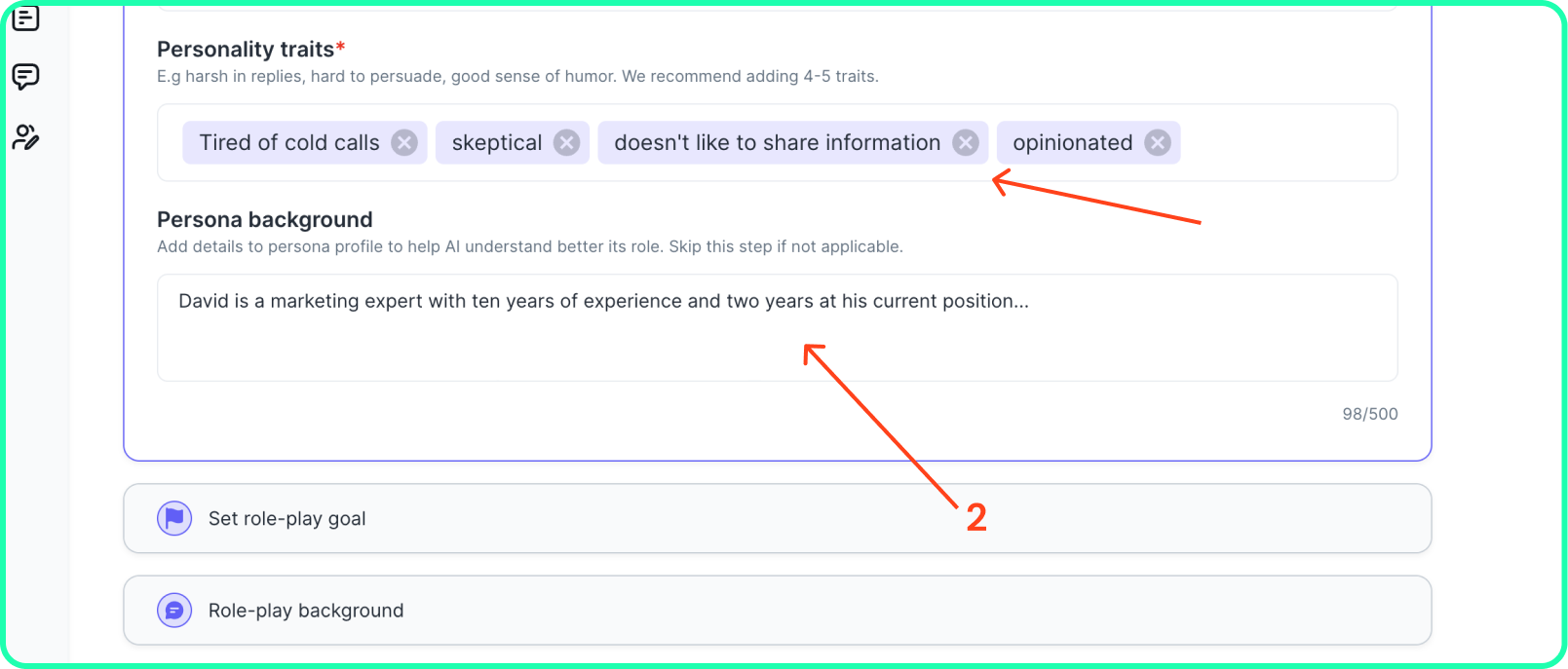
Set the persona's traits specifically. "Skeptical" is not a trait a rep can rehearse against; "tired of vendor calls and answers in one sentence unless pressed twice" is. The more concrete the persona, the more the mock call resembles the real account it is standing in for. A rep notices the difference between a scripted response and one that works faster this way.
Scoring what good looks like
A mock discovery call without a rubric produces an opinion, not a score. "That felt better" is not something a manager can track across 12 reps and 8 weeks, and it is not something a rep can improve against on purpose.
A workable discovery call checklist scores behaviors, not vibes. Five criteria cover most of what separates a strong discovery call from a weak one.
Criterion | What "pass" looks like |
|---|---|
Framing | States what the call will cover and asks permission to change it |
Follow-up question | Presses a vague first answer at least once for something specific |
Cost quantification | Gets a number or a named consequence, not just a description of the problem |
Talk ratio | Buyer talks more than half the call |
Next step | Ends with a named person and a date, not "I'll follow up" |
Score each criterion pass or fail rather than on a 1-to-5 scale for the first few weeks. A finer scale invites debate about whether something was a 3 or a 4. A pass or fail forces a manager to say exactly what would have made it a pass, which is the part a rep can act on directly.
Track the score sheet across attempts, not just the latest one. A rep who fails cost quantification for 3 straight sessions and then passes it on the fourth has learned something a single snapshot score would hide entirely.
Running this as a program, not a one-off
A single great mock discovery call proves a rep can do it once. A program proves the whole team can do it reliably, which is the harder and more useful thing to build.
Start with cadence. Weekly beats monthly for a new hire, and monthly beats quarterly for almost anyone. A rep who runs one mock discovery call every week for the first 8 weeks of ramp gets roughly 8 repetitions before their first few real ones. A rep on a quarterly cadence gets one, which functions as a compliance checkbox rather than practice.
Layer difficulty on top of cadence instead of running every session at the same level. A 4-stage ramp works for most teams.
Weeks | Buyer difficulty | What changes |
|---|---|---|
1-2 | Cooperative, answers directly | Rep learns the question order without resistance |
3-4 | Vague on the first answer, presses once | Rep practices the follow-up question |
5-6 | Deflects budget and brings in a second stakeholder mid-call | Rep practices multi-threading live |
7-8 | Short answers, actively skeptical of the vendor | Rep practices staying calm under real friction |
New hires run the full ramp during onboarding. Tenured reps drop back into it whenever a real account shape changes, such as moving upmarket into accounts with a longer buying committee. PitchMonster's guide to sales role-play scenarios covers the same program mechanics for every call type, not just discovery.
Proving it to leadership is the part most programs skip, and it is also the easiest part to fix once the rubric from the last section exists. Report 3 numbers monthly: completion rate against the assigned cadence, the pass rate on the hardest difficulty tier, and time to first real discovery call that clears the same rubric. Those numbers connect practice directly to a real-call outcome instead of stopping at "reps did the exercise."
A program built this way earns real ramp results, not just completion numbers. Mentor Group cut ramp time by 50% on average and halved coaching time per rep running this kind of structured practice, with message-delivery accuracy up 27%. SThree onboarded new reps 53% faster with a similarly staged approach.
Where AI buyers change the practice, and where they don't
An AI buyer changes one specific thing. It can stay unhelpfully vague for as long as the drill requires, without getting bored or breaking character to be nice. It also won't run out of time before the next meeting. That single trait is what makes the difficulty ramp in the last section possible to run at scale, across every rep, every week, without burning a manager's calendar.
It does not change what "good" looks like on a real call. The rubric still has to come from a manager who has listened to real discovery calls and knows which behaviors correlate with a deal moving forward. An AI buyer scored against the wrong criteria produces reps who are excellent at satisfying a scorecard nobody should be optimizing for.
It also does not replace the moments a manager wants to see in person. That includes how a rep handles being interrupted mid-sentence by an impatient decision maker, or reads a room over screen-share when body language matters more than words. AI role-play and screen-share practice run different mechanics for a reason. A program that only ever runs one of them is missing half the format most B2B discovery calls happen in.
The honest framing is capacity, not quality. A manager can run 2 or 3 live mock calls a week before running out of hours. Any AI sales role-play tool built for this removes that ceiling entirely. That is the only reason a weekly cadence across a full team of 12 or 20 reps is realistic at all.
What PitchMonster does differently
Most of what this guide describes, a cadence, a difficulty ramp, a rubric, works with any tool that can hold an AI buyer conversation. PitchMonster's specific contribution is what happens in the minutes right after the mock call ends, which is also the moment most practice programs waste.
The AI Coach debriefs every session by asking the rep what they noticed before it shows a score. A rep who is told "you accepted a vague answer at minute 4" tends to forget it by Thursday. A rep who is asked what happened right after the buyer said it just takes too long, and has to find the gap themselves, tends to keep it. The correction came from their own answer, not a grade screen. It runs 24/7, so a rep who practices at 9pm gets the debrief at 9pm, not at the manager's next 1:1.
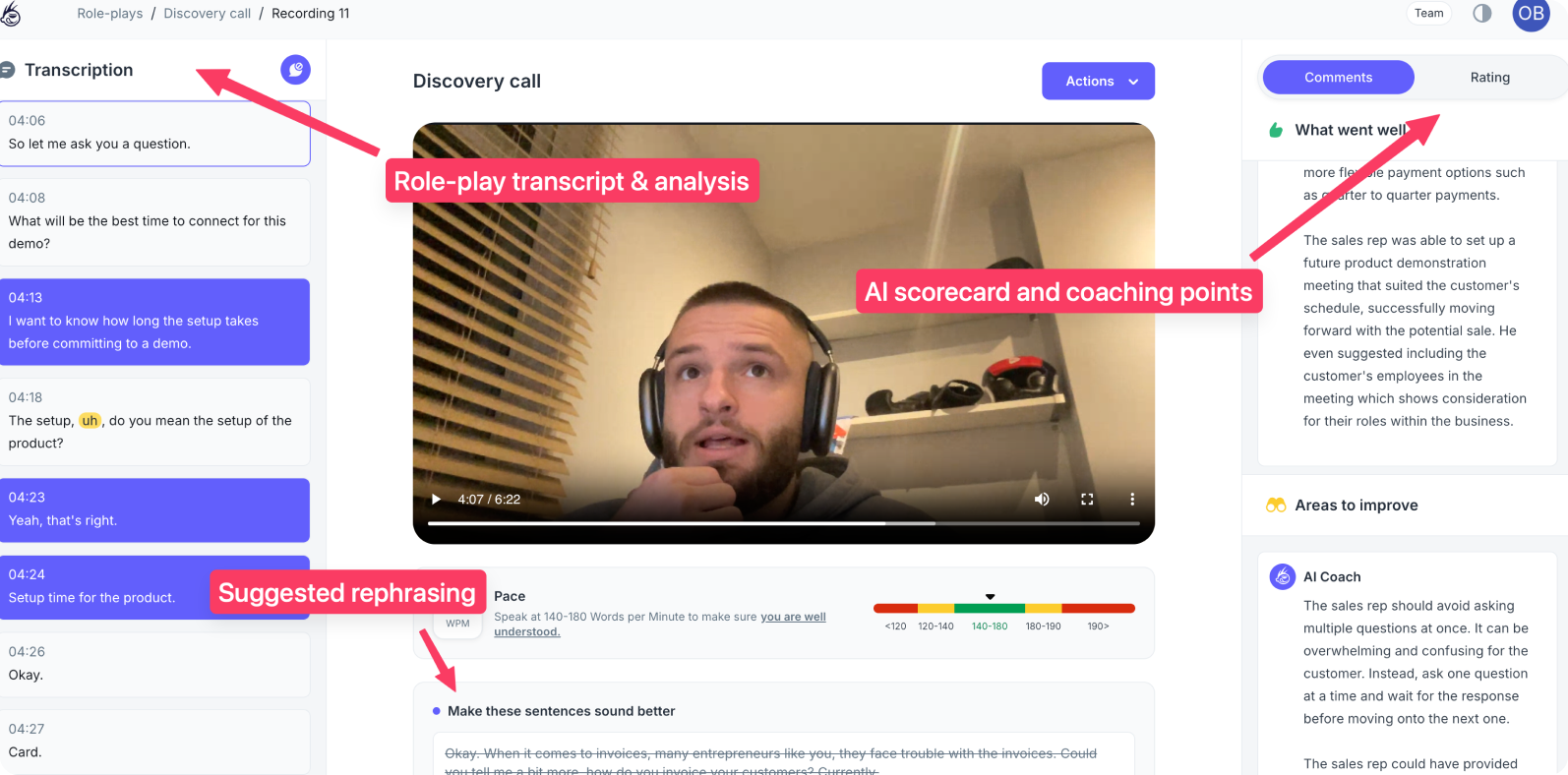
Live Call Analysis runs the same rubric against a rep's real recorded calls, not just the mock ones. A manager can see whether a behavior a rep finally nailed in practice showed up on Tuesday's real discovery call, instead of assuming a mock-call improvement transferred on its own. PRN reps improved 22.37% on real calls running that same practice-to-real loop.
"I think I really like the AI coach... That's definitely going to save us a lot of time." - Wendy Mateo De Perkins, One Park Financial
PitchMonster is EU-based with EU data residency under GDPR, the only European platform among the top 5 in this category. That matters directly for a sales enablement program built on recorded real calls. It holds a 4.9 rating on G2, has kept a 100% enterprise renewal rate since spring 2024, and has trained more than 300,000 reps.
"There's no better substitute for live fire with real clients." - Craig Gordon, Prevail IWS
If your team's mock discovery calls are still a manager reading from a script, book a demo. We will build the first scenario from one of your own recorded calls.
FAQ
What is a mock discovery call?
A mock discovery call is a rehearsed version of a real discovery conversation, run against a colleague or an AI buyer instead of a live prospect. It uses the same questions and structure as a real call, but the rep can pause, get corrected, and run it again the same day. Teams use it to build specific behaviors, not just general confidence, before a rep runs the real thing.
How is a mock discovery call different from open-ended discovery call roleplay?
A mock discovery call usually targets one specific behavior, such as pressing a vague first answer for a number, with a scenario built to force that moment. What people search for as "discovery call roleplay" is usually the fuller, less structured version, with no single behavior isolated. Both have a place, but a team that only runs the open-ended version rarely gets enough repetition on the one moment that decides whether discovery produced anything.
How often should a team run mock discovery call practice?
Weekly beats monthly for a new hire, and monthly beats quarterly for almost anyone. A rep on a weekly cadence for the first 8 weeks of ramp gets roughly 8 repetitions before their first few real discovery calls. A rep on a quarterly cadence gets one, which functions as a compliance exercise rather than practice that changes behavior.
What should a discovery call practice scorecard include?
Score behaviors, not impressions. Include framing at the open and a follow-up question that presses a vague answer. Add a quantified cost instead of a vague description. Add a talk ratio favoring the buyer and a next step with a named person and a date. Score each one pass or fail for the first few weeks, since a fail says exactly what would have made it a pass.
Can AI buyers replace manager-led discovery call practice entirely?
No, and they are not built to. An AI buyer removes the capacity ceiling on repetition, since a manager can only run 2 or 3 live mock calls a week before running out of hours. It does not replace a manager's judgment about which behaviors matter. It also does not replace in-person moments, like reading a room over screen-share, that a text or voice scenario cannot fully recreate.
How long should a mock discovery call take?
Budget 10 to 15 minutes per attempt rather than the full 30 minutes a real discovery call runs. A mock session only needs to cover the specific behavior being drilled. Running the same scenario twice inside that window, with a short debrief between attempts, teaches more than one long, unfocused rehearsal of a full call.
The short version
Run mock discovery calls on a repeatable structure, not as one-off drills: pick a scenario, set the difficulty, score it against a rubric, and debrief before the next attempt. Then turn that structure into a program with a weekly cadence, an 8-week difficulty ramp, and 3 numbers a manager can report to leadership. The mock call is the easy part. Building the program around it is the part almost no team does.