Sales coaching for managers is the practice of running structured, recurring 1:1 conversations with each rep. Each conversation follows a defined framework and draws on specific feedback from real calls. Every session works on one skill. The manager changes what the rep does on the next call, instead of only reviewing pipeline numbers.
This article gives you a cadence you can keep. It gives you a named framework for the conversation itself, and feedback reps use instead of ignore. You also get two ungated templates to start with today. It also covers what good coaching sounds like, and why coaching programs quietly die.
Last, it covers the metrics that show whether coaching for sales managers is working. This piece assumes you already know what sales coaching is, and how it differs from training. For that grounding, see our sales coaching guide and our breakdown of sales coaching vs sales training.
The sections below walk through each piece: the cadence, the framework, the feedback habit, two ready templates, and the metrics that prove it is working.
The coaching cadence that holds: a 1:1 rhythm managers can keep
Sales coaching for managers lives or dies on cadence. A manager who tries to coach in one long monthly session rarely keeps it up through the quarter. A shorter, weekly one-to-one sales coaching session holds up better than a longer, rarer one, because the rep still remembers the call in question.
Aim for a 25 to 30-minute one-on-one every week, per rep. For a manager coaching 6 to 8 reps, that's roughly 2.5 to 4 hours a week. It's a real budget, worth protecting on the calendar the same way you protect a pipeline review.
Split each session three ways. Review one recent call or role-play together, then run the coaching conversation using a framework. Agree on one action the rep will try before the next session. A 1:1 that is all review and no coaching is a status update wearing a coaching label. Kept for a full quarter, this rhythm is what turns feedback into a habit instead of a one-time save.
GROW applied to sales: a framework for the conversation itself
A weekly cadence gives coaching a slot on the calendar. The GROW model gives the conversation inside that slot its own shape, so it doesn't turn into a status update or a lecture. Sir John Whitmore popularized GROW in his book Coaching for Performance, and it maps onto a sales conversation with almost no translation.
GROW step | What it does in a coaching session | Ask the rep |
|---|---|---|
Goal | Sets what this session works on, not the quarter's quota | "What do you want to get better at from this call?" or "If this session works, what changes next time?" |
Reality | Gets the rep describing what happened, in their own words | "What did the buyer do right after you asked that question?" or "Where did the conversation start to slip?" |
Options | Opens up more than one way to handle the same moment | "What else could you have said there?" or "With 10 more seconds before responding, what would you try?" |
Will | Locks in one specific commitment for the next call | "What will you do differently on your next 3 calls?" or "What's the one thing you won't skip next time?" |
Naming and numbering the four steps this way keeps a manager from skipping straight to advice. Reality and Options do the real work in a coaching conversation; skipping them is what turns coaching into telling.
How to give feedback reps use
Feedback only changes behavior if a rep can act on it right away. A rating on its own, "your discovery needs work," gives a rep nothing to do differently tomorrow. Specific feedback names the exact moment and offers a better line in its place.
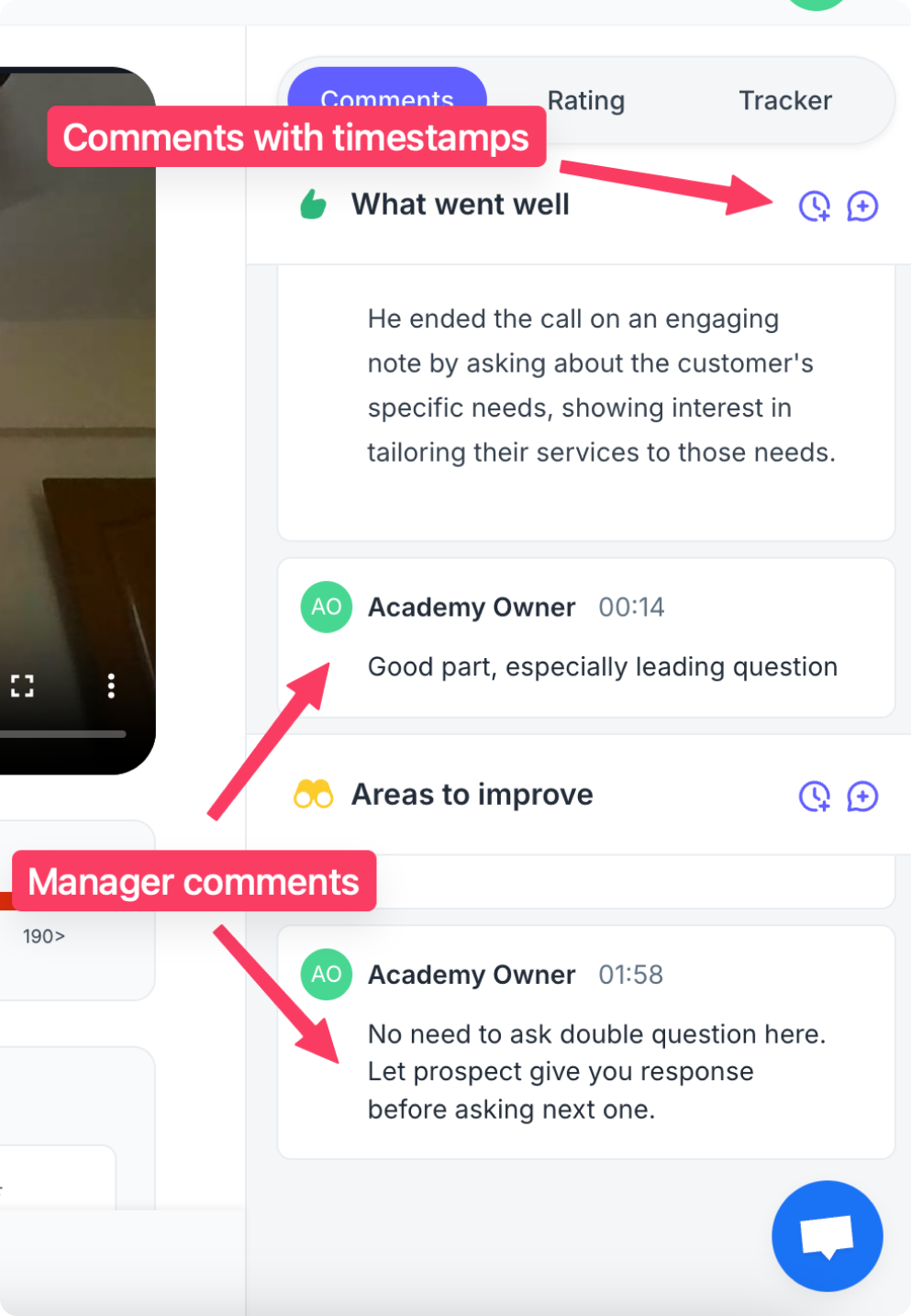
The screen above shows what that looks like in practice. A manager's timestamped comments sit next to the exact moment in the call, sorted into what went well and what to improve. That structure, a specific moment plus a specific fix, is what makes feedback usable instead of just gradeable.
Structure every feedback conversation the same way. Name the specific moment and the impact it had on the buyer. Then give one alternative line the rep can say next time. Skip the sandwich of vague praise around vague criticism; it wastes time and buries the one thing that matters.
Role-play is the fastest way to test a fix before it reaches a real buyer. Once you've named the better line, have the rep run it again, against a buyer who reacts the way a real prospect would. That rehearsal, not just hearing the correction, is what makes the new behavior stick.
Sales coaching templates: a 1:1 template and a call-coaching template
A template gives a manager a starting structure instead of a blank page. The two below cover the two most common coaching moments: the recurring 1:1, and a specific call review. Both are ungated, so copy them straight into your own coaching doc.
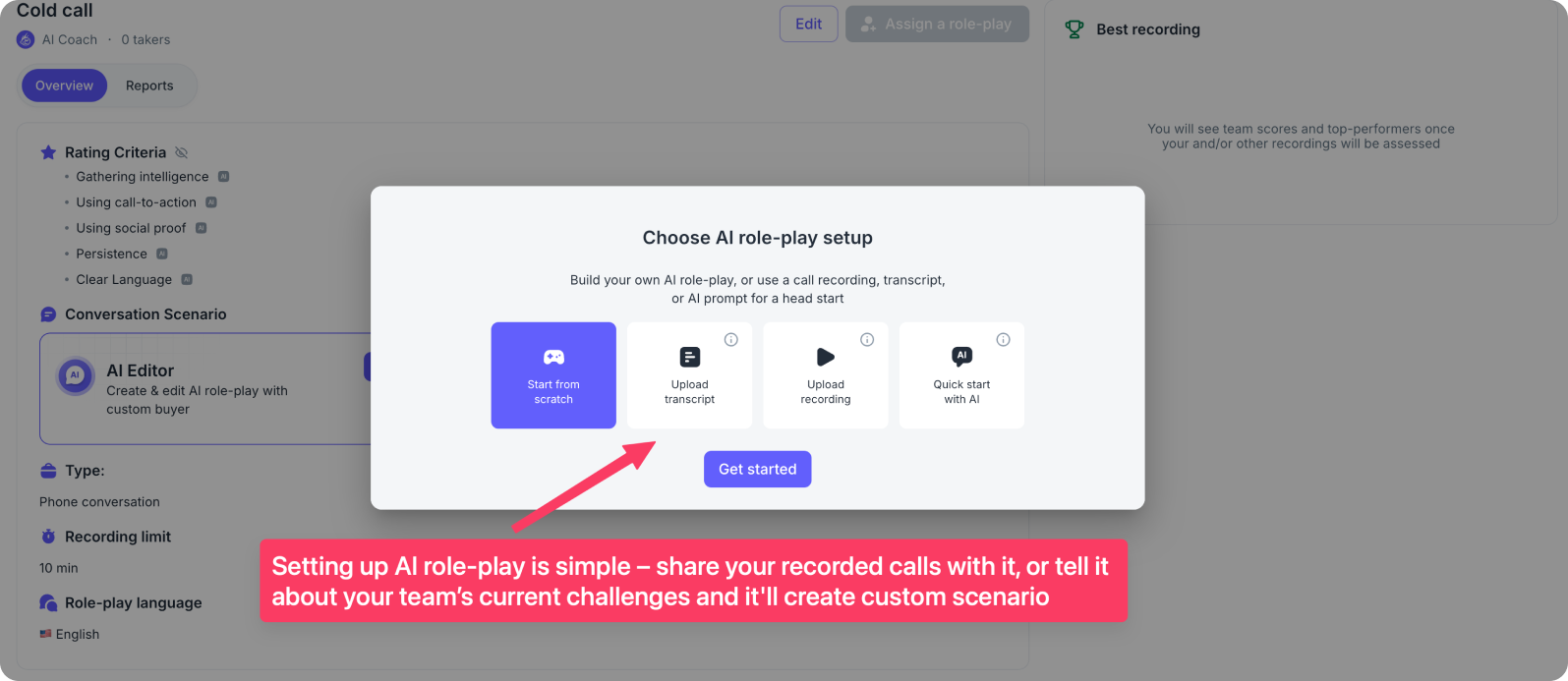
Inside a role-play tool, the same idea shows up as rating criteria set once, up front. The screen above is a cold-call scenario mid-setup, with its criteria held as a reusable list. Every rep who runs it is judged against the same bar. The paper version below does the same job for a manager working from a recording.
Use the 1:1 template as the running agenda for every weekly session.
Segment | What to cover | Time |
|---|---|---|
Quick check-in | Pipeline blockers, wins since last session | 5 min |
Call or role-play review | One recent call, reviewed together | 10 min |
GROW conversation | Goal, Reality, Options, Will for the one skill in focus | 10 min |
Commitment | One action the rep will try before next session | 5 min |
Use the sales call coaching template on a specific recorded call, live or role-played. If you need a sales coaching form template for the rep's file, this table is it: one row per stage, one verdict per row.
Stage | Question to ask | What good looks like |
|---|---|---|
Opening | Did the rep set a clear agenda in the first minute? | Buyer knows what the call covers before it starts |
Discovery | Did the rep ask before they pitched? | Two or more open questions before any product is named |
Objection handling | Did the rep acknowledge the concern before responding? | Objection restated in the rep's own words |
Close | Did the rep ask for a specific next step? | A dated, calendared action, not "I'll follow up" |
These two templates cover the recurring rhythm and the specific-call review. The complete set adds structured coaching frameworks for identifying skill gaps and running 1:1s. It also includes ready-to-use templates for discovery, demo, and objection handling coaching sessions, plus scorecards and call review checklists. Get it from our free sales coaching guide.
What good coaching sounds like: examples by rep level
A framework and a template only prove useful once you can hear the difference in a real conversation. The exchanges below show sales coaching examples at three rep levels: a new hire, a mid-tenure rep, and a rep who pushes back. Each one uses GROW, but the manager spends the time differently.
With a new hire in their first month, the manager keeps Reality short and moves quickly to Options, since a new rep has little to reflect on yet.
Manager: "Walk me through what you were thinking right before the buyer went quiet."
Rep: "I think I was talking about features instead of asking what they needed."
Manager: "Good catch. What's one question you could ask instead, next time it gets quiet?"
With a mid-tenure rep, six months in, the manager spends more time in Reality, since the rep already has instincts worth examining.
Manager: "You paused for almost 4 seconds after that objection. What was going through your head?"
Rep: "Honestly, I didn't have a good answer ready."
Manager: "That's useful to know. Let's build one now, so it's ready next time."
A defensive rep changes the job, not the framework. When a rep pushes back with "the buyer was just difficult," resist the urge to argue the point. Ask a Reality question instead. Try: "What did you try before that moment?" A defensive rep is usually protecting their own read of the call. A specific question about what happened, not a verdict on what they got wrong, is what brings them back into the conversation.
Why sales coaching programs quietly die
Coaching programs rarely fail because a manager stops caring. They fail because the habit quietly erodes, one skipped session at a time, until nobody notices it stopped.
A common pattern: a manager team starts out reviewing real calls together, then leans more and more on an automated score instead of listening. The score is faster to check, so it wins by default. Within a few months, nobody listens to calls at all, and the coaching habit that depended on that listening dies with it. The score was never the problem; it just made it easy to stop doing the harder, more valuable part.
Coaching for sales leaders matters as much as coaching for reps. A manager promoted for selling well is rarely shown how to run a coaching conversation, only told that they now own one. Give managers the same structured practice you give reps, including a way to check whether their own sessions land. A program that trains reps but assumes managers will figure out coaching on their own is built on an untested assumption.
What coaching can and can't fix, by rep tenure
Coaching doesn't affect every rep the same way, and pretending otherwise sets a manager up for a frustrating quarter. New hires typically see the biggest and fastest gains from structured coaching. Most of their skills are still forming, so a specific correction lands quickly.
Seasoned reps see smaller gains, but real ones. A rep with 2 or 3 years of experience already has habits. Coaching them looks more like sharpening one specific skill than delivering an overall lift.
Low performers are the hardest case, and coaching alone often doesn't change much. Sometimes the gap is skill, and coaching closes it. Sometimes it's fit or motivation, and no amount of structured feedback fixes that. A manager who tracks whether a low performer is responding to coaching, rather than assuming more sessions will eventually work, spots that difference faster.
How to know it's working: the metrics that matter
Revenue is a lagging indicator of coaching. By the time it moves, months of coaching decisions already happened. A sales manager coaching assessment needs leading indicators too, ones that show whether coaching is changing behavior before the quarter closes.
Three leading indicators do that work, and each one answers a question an average score cannot.
Leading indicator | What it tells you | What it protects you from |
|---|---|---|
Share of reps above a pass threshold on a shared scorecard | How much of the team has reached a defined bar | A team average that one strong rep inflates |
Score trend across attempts for the same rep | Whether a specific skill is improving session over session | Counting attendance as progress |
Scorecard breakdown by conversation stage | Which stage is weak across the whole team: discovery, objection handling or close | Coaching time spent on a hunch instead of the weak stage |
Track these three alongside whatever lagging revenue metric you already report. The leading indicators tell you whether coaching a sales team is working now; the lagging one tells you whether it worked, several weeks late.
Scaling coaching without burning your best manager's week
A manager coaching 8 reps at 30 minutes a week already spends 4 hours on 1:1s. That's before call review and their own pipeline. Coaching a sales team well and protecting a manager's week are usually in tension. AI role-play with a built-in AI Coach takes the first pass of feedback off the manager's plate, so the 1:1 starts from a diagnosis instead of a replay.
After every practice session, PitchMonster's AI Coach steps in before the score is shown. It's Socratic: it asks the rep reflective questions instead of handing over a verdict, so the rep diagnoses the miss before seeing the number. It runs 24/7. It also stays available as its own tab on the review screen, so a rep can reopen the same session later.
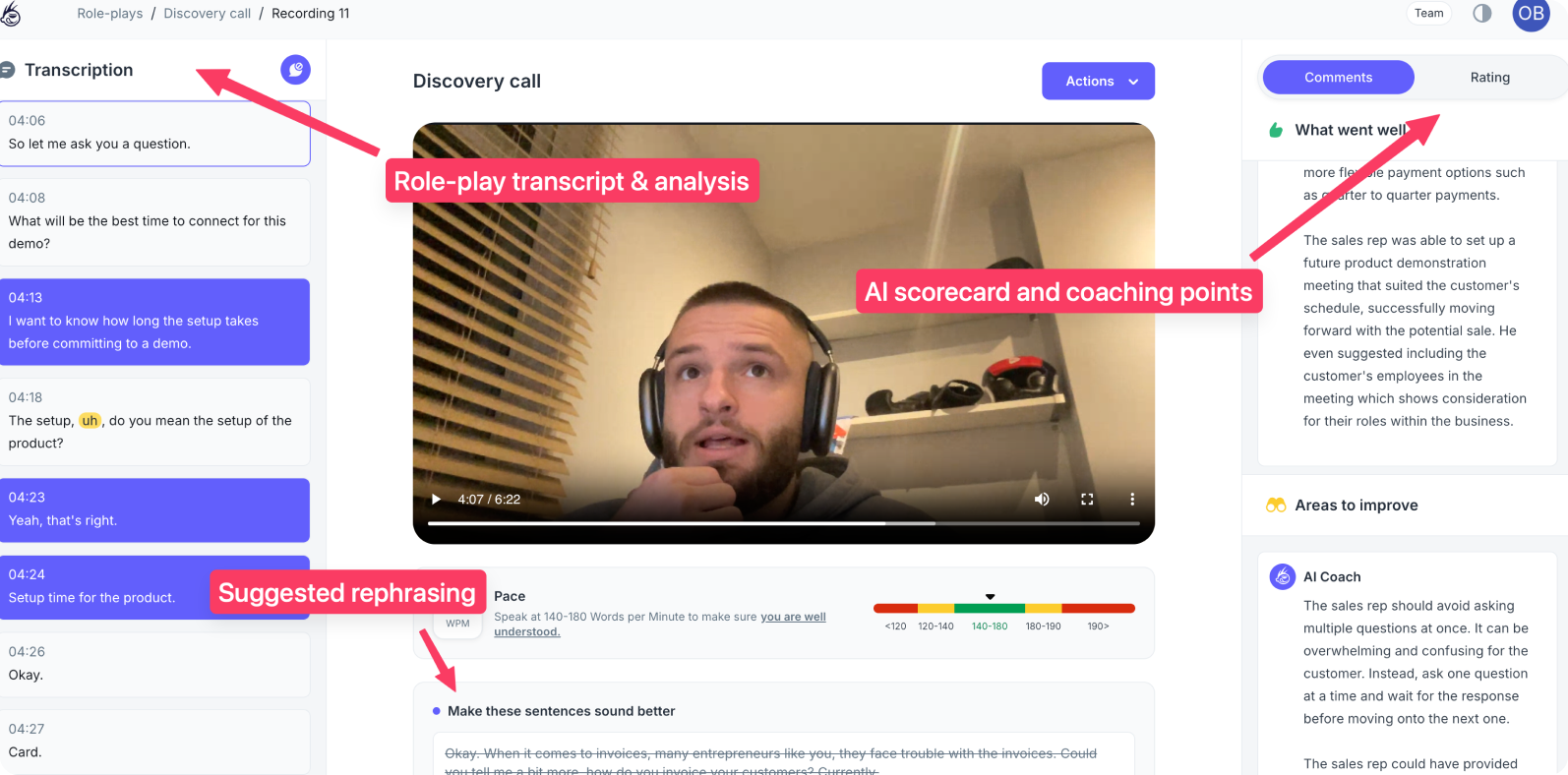
The analysis screen above shows the mechanism. The AI Coach panel sits next to a filler-word highlight and a pace meter. A rep sees exactly where the conversation slipped, not just a final number. A failed scorecard criterion carries written coaching plus a worked example of a stronger line. That's the same structure recommended in the feedback section above, generated automatically instead of typed by a manager every time.
Scoring runs against your own methodology, not a generic rubric. Scorecard templates for Challenger, SPICED, and MEDDIC / MEDDPICC ship ready to use, or a manager builds a custom one from scratch. Every recorded session and its score sit in one place. Per-rep trends let a manager review progress between 1:1s, instead of sitting in on every call live.
SThree, a staffing and recruitment firm, saw 2x less coaching time per rep and 53% faster onboarding after rolling this out. Read the SThree case study for the full breakdown.
"I think I really like the AI coach... That's definitely going to save us a lot of time." - Wendy Mateo De Perkins, One Park Financial
This is where sales coaching and mentoring split. The AI Coach handles the repeatable first pass, and the manager's time goes to mentoring the judgment calls no scorecard covers. That split is what next level sales coaching looks like in practice: less manager time on basics, more on the moments that decide a deal.
This is built for mid-market and enterprise revenue, enablement and learning teams running coaching across whole teams, not a single desk. See the full mechanism on the AI sales coaching software page, and how it fits a manager's week on the sales coaching software for sales managers page. Then book a demo to see the AI Coach run against your own scorecard.
Frequently asked questions
What is sales coaching for managers?
Sales coaching for managers is the practice of running structured, recurring conversations with each rep. The goal is improving one specific skill, not just reviewing pipeline numbers. It pairs a set cadence, usually weekly, with a framework like GROW and specific feedback on real calls. Done consistently, it changes what a rep does on the next call, not just what they know.
What is the GROW model in sales coaching?
The GROW model in sales coaching is a four-step structure for the conversation itself: Goal, Reality, Options, and Will. Sir John Whitmore popularized it in his book Coaching for Performance. Applied to sales, a manager sets what the rep is working on and gets them to describe what happened. Then the manager opens up alternative approaches and locks in one specific commitment for the next call.
How often should a sales manager coach each rep?
A sales manager should coach each rep on a weekly cadence, in sessions of roughly 25 to 30 minutes. Monthly or quarterly sessions are too infrequent for a rep to remember the specific call being discussed. The habit also erodes fast once it slips. A shorter, weekly rhythm, protected on the calendar, holds up far better than a longer, rarer one.
What is the 30-60-90 rule in sales?
The 30-60-90 rule in sales is a structured plan for a new hire's first 90 days. It splits into three 30-day phases: learning the product and process, applying it on supervised calls, then operating independently against a quota. Coaching cadence should shift with each phase, from frequent, detailed feedback early on to a lighter, more independent check-in by day 90.
How much does a sales coach cost?
Sales coach costs vary widely, so there is no single answer. External coaches usually price by engagement, and PitchMonster prices by quote rather than publishing a rate card. Scope moves with team size and the depth of support included. Ask any vendor for a quote scoped to your team, rather than comparing a headline number, and check what onboarding and support the quote covers.
Is there a sales manager coaching guide I can download?
Yes, PitchMonster publishes a free sales coaching guide for sales managers. It covers structured coaching frameworks to identify skill gaps and run effective 1:1s. It adds ready-to-use templates for discovery, demo, and objection handling coaching sessions, plus scorecards and call review checklists. It is the complete version of the two templates in this article. Get it on the sales coaching guide page after a short form.
What does sales manager coaching training cover?
Sales manager coaching training typically covers a repeatable framework for the conversation itself and structured feedback delivery. It also covers how to read a scorecard instead of a gut reaction, and how to handle a defensive or resistant rep. The strongest training pairs that with practice, not just theory. A manager who has only heard the framework described rarely runs it well under a real, tense conversation.