Last updated: 9 November 2026
The best pharma sales training programs for teams are AI role-play tools, field-force learning platforms and enablement suites. This guide compares 11 of them on approved messaging, HCP scenarios, feedback, human review, EU AI Act transparency and pricing. Certification routes for individuals sit in their own section.
Shortlist
Tool | Best for | Why it made the top 3 |
|---|---|---|
PitchMonster | HCP practice on your own approved material | An AI Coach that asks before it tells, scorecards built on your own material, and manager comments on each recording |
Quantified | Scoring against MLR-cleared claims | Built for life sciences and regulated commercial teams, with scoring against MLR-cleared claims and on-label language |
Hyperbound | Practice plus real-call scoring | Practice and real-call evaluation against the same criteria, and multi-party buying-committee role-plays |
Why listen to us?
I am Oleg Bolotnov, founder of PitchMonster. My team builds AI role-play software for customer-facing teams: reps practice against an AI buyer and get coached by an AI Coach. PitchMonster holds 4.9 out of 5 on G2 (checked October 2026).
Our public case studies include PRN Health Services, Mentor Group, SThree and JustSchool. We have no pharma case study, so this guide makes no pharma results claim.
We rank ourselves first, so every competitor fact below comes from public sources checked in October 2026.
The 11 best pharma sales training tools compared
G2 scores are as shown on G2 listings in October 2026, and "Not confirmed" means we could not confirm a score. Published prices come only from each vendor's own pricing page, checked October 2026. Where a vendor lists none, the cell says "Not published". PitchMonster sells by quote. Certification routes appear in their own section because they serve individuals.
Tool | Best for | Pharma fit | Published price | G2 score |
|---|---|---|---|---|
PitchMonster | HCP practice on your own approved material, with an AI Coach | General platform; your team supplies the approved material | By quote | 4.9 |
Quantified | Scoring against MLR-cleared claims | Built for life sciences and regulated industries | Not published | Not confirmed |
Hyperbound | Practice plus real-call scoring | Pharma use-case page; one of several industries | Free plan; paid plans not published | 4.9 |
Second Nature | General sales and customer-team role-play | No pharma page on its site | Not published | 4.6 |
Retorio | Behavior coaching with HCP personas | Pharmaceutical page; one vertical | Not published | 4.8 |
Muchbetter AI | Voice practice for field teams | Life sciences page; 1 of 4 sectors | Not published | Not confirmed |
ACTO | Training and certification for field teams | Life sciences only | Not published | Not confirmed |
SmartWinnr | Role-play plus learning for regulated industries | Pharma page for medical reps | Not published | 4.9 |
Qstream | Knowledge reinforcement | Pharma & Medtech page | Not published | 4.5 |
Allego | Launches and broad enablement | Life sciences page inside a multi-industry suite | Not published | 4.6 |
Mindtickle | Sales readiness and content | Pharma page | Not published | 4.7 |
How we evaluated
We judged the 11 best pharma sales training programs on 5 buyer questions: approved messaging, scenarios, feedback and review, AI disclosure and EU data, and readiness views. Each vendor gets a 1 to 5 score for how clearly its own public pages document the question. Pricing is compared separately in the pricing table.
The 5 questions, in order:
- Can practice be judged against your approved messaging?
- Can you build clinician, pharmacist, payer or committee scenarios, and how fast does new product material become one?
- Does feedback give a rep something specific, and can a person review AI scores before a decision relies on them?
- How does the tool support AI disclosure and EU AI Act transparency obligations, and is EU data residency available?
- Can managers and L&D see who is ready?
We read each vendor's own site on 25 October 2026. We read PitchMonster's public pages, including its published case studies, on 26 October and 9 November 2026. We did not buy or run every platform, so ask vendors to show each capability in a live workflow. The scale is 5 for a named feature with specifics, 4 for one covering part of the question and 3 for a general description. A 2 is a hint, and a 1 means nothing found on the pages we read. A 1 can mean the item sits on a page we did not read, such as a trust page.
We scored PitchMonster the same way, from pitchmonster.io pages only, so a feature that appears only in our product documentation does not count. Scores are not added up, and the list order reflects fit for HCP practice on your own approved material, not a score sum.
Scores for questions 1 to 3, as documented on 25 and 26 October 2026 (PitchMonster re-read on 9 November 2026).
Tool | 1. Approved messaging | 2. Scenarios | 3. Feedback and review |
|---|---|---|---|
PitchMonster | 5 | 5 | 4 |
Quantified | 5 | 5 | 3 |
Hyperbound | 4 | 5 | 4 |
Second Nature | 3 | 4 | 3 |
Retorio | 5 | 4 | 4 |
Muchbetter AI | 4 | 3 | 3 |
ACTO | 3 | 2 | 5 |
SmartWinnr | 4 | 4 | 4 |
Qstream | 2 | 3 | 3 |
Allego | 3 | 3 | 3 |
Mindtickle | 4 | 4 | 3 |
Scores for questions 4 and 5, as documented on 25 and 26 October 2026 (PitchMonster re-read on 9 November 2026).
Tool | 4. AI disclosure and EU data | 5. Readiness view |
|---|---|---|
PitchMonster | 4 | 5 |
Quantified | 3 | 4 |
Hyperbound | 2 | 3 |
Second Nature | 1 | 4 |
Retorio | 5 | 4 |
Muchbetter AI | 3 | 3 |
ACTO | 1 | 4 |
SmartWinnr | 1 | 4 |
Qstream | 1 | 4 |
Allego | 1 | 4 |
Mindtickle | 3 | 4 |
Sources: vendor sites (25 October 2026), pitchmonster.io including its case studies (26 October and 9 November 2026).
Types of pharma sales training tools
The best pharmaceutical sales coaching tools fall into 5 types: AI role-play for spoken HCP practice, field-force learning platforms, microlearning for recall, enablement suites and certification routes for individuals. Each type solves a different job, so the right pick depends on whether reps need conversation practice, recall, launch coordination or a credential.
- Role-play for HCP conversations includes PitchMonster and Quantified. PitchMonster builds practice from your own approved material, with an AI Coach that asks before it tells. Quantified is built for life sciences, with scoring against MLR-cleared claims.
- Cross-industry role-play and coaching covers Hyperbound (with real-call scoring), Second Nature, Retorio and Muchbetter AI.
- Field-force learning platforms that pair training, certification tracking and role-play are ACTO and SmartWinnr.
- Microlearning for knowledge reinforcement is Qstream.
- Enablement and readiness suites are Allego and Mindtickle.
- Certification routes for individuals are CNPR, PRC, CSPP and the CMR Institute credentials, which are not team software.
A certification is a credential for one person, and a quiz tool checks recall but not a spoken answer. Most pharma teams combine a learning tool with a practice tool.
1. PitchMonster: AI role-play on your own approved material for HCP conversations
PitchMonster is best for mid-market and enterprise revenue, enablement and learning teams. They get HCP conversation practice built from their own approved material. An AI Coach offers a debrief after every session, before the score is shown. It holds a 4.9 out of 5 rating on G2 (as of October 2026).
What is PitchMonster?
PitchMonster is a general AI role-play and coaching platform for sales and other customer-facing teams. Pharma teams configure it with their own approved material and build personas such as a hospital pharmacist, a time-poor clinician or a formulary committee member. It is not a pharma-only product and does not ship pre-built pharma personas.
PitchMonster's AI Coach: reflection before the score
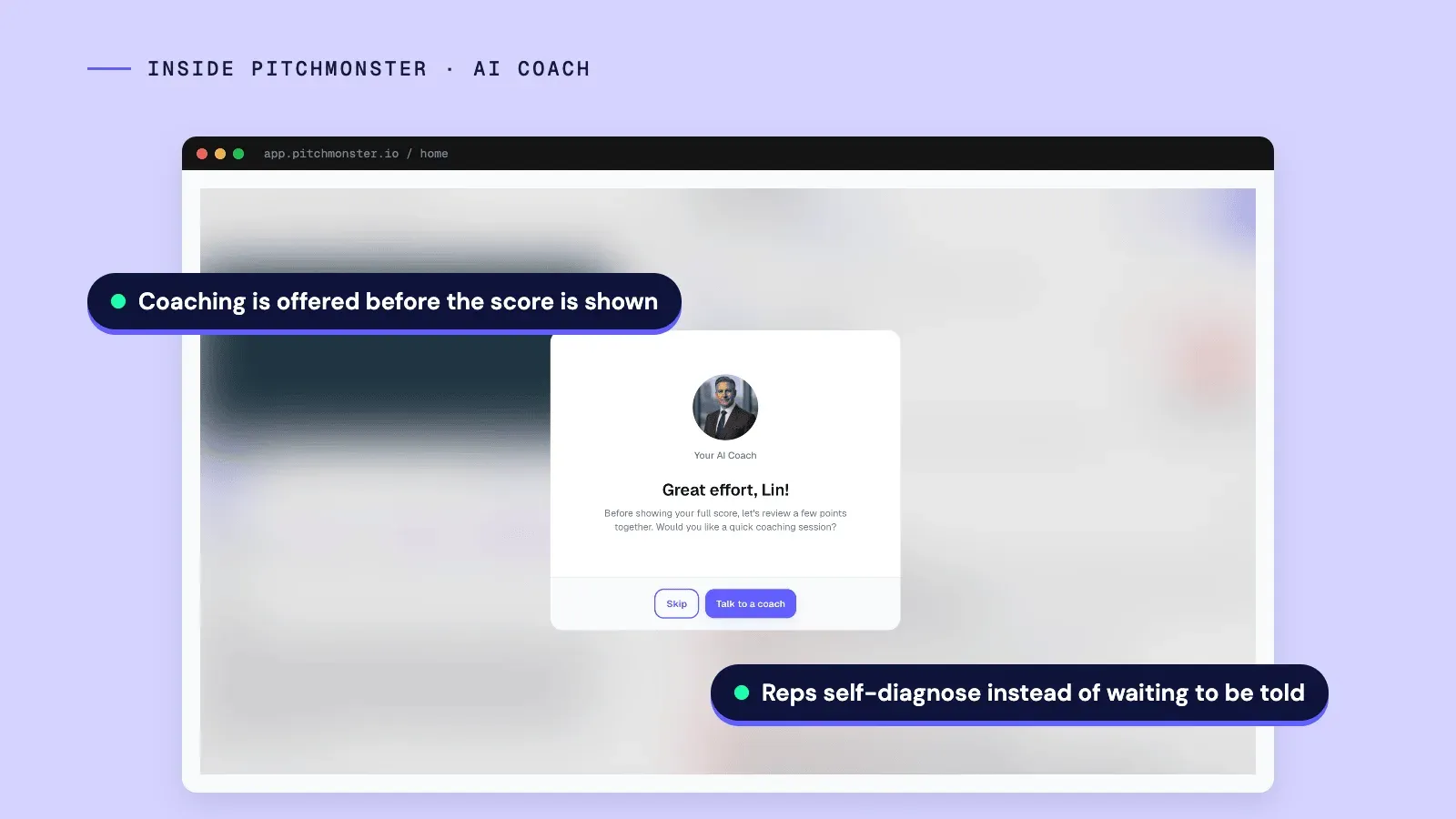
After a session, the AI Coach asks reflective questions before it reveals the score. The rep says what they noticed first, then sees the number. The review then shows scorecard criteria and written coaching with a worked example for each failed criterion. Team comments on that screen come from human managers.
Build a PitchMonster scenario from your approved material

A pharma team works with these building blocks:
- Scenarios built from product or enablement files, a website link, a real call or transcript, Salesforce or Gong, a CSV, or a blank start.
- Replicate, where the AI rebuilds a buyer from a real conversation, including title, context, pains and objections.
- Personas with a static photo or a 3D avatar, a chosen voice and a regional accent.
- 4 difficulty levels for each persona: Easy, Medium, Hard or Insane.
- Context, conversation starters and objections, plus an instruction box where an admin adjusts behavior in plain language.
Solo Practice lets a rep rehearse alone, for example a detail aid walkthrough, before a live conversation.
PitchMonster scorecards scored on your own material

Each role-play has its own knowledge base, so the AI judges answers against the approved material your team uploads. The goal is a written goal or a pass threshold of 60%, 70%, 80%, 90% or a custom value. Reusable scorecard templates include Challenger, SPICED and MEDDIC / MEDDPICC. Live Call Analysis scores uploaded real calls against the same scorecards.
PitchMonster readiness reporting and group-scoped visibility

Admins track practice minutes, scores and readiness by user, including recordings and users with 80%+ scores. A group hierarchy limits who sees whose scores, so users only see results for their own branch. Admins can switch the leaderboard off for GDPR or company policy.
For rollout, PitchMonster supports SAML SSO and assigns each invited user to a group and to role-plays in one table. Webhooks send an event when a recording is completed and feedback is ready, so your team can pass results to its own BI tool or learning platform. That is an event feed you connect yourself.
PitchMonster supports 29 languages and shows AI disclosure notices before recordings and on analysis screens. It is an EU-based company with EU data residency.
PitchMonster pricing
PitchMonster is sold by quote, and trials are sales-led: you request a demo and the team sets you up to try it.
Where PitchMonster falls short
PitchMonster has no pre-built pharma compliance rule set and no automatic off-label detection. It scores against the criteria and material your team supplies, so your approved content and your medical, legal and regulatory reviewers stay in charge. It is not an LMS or a content library. If you need claim scoring built in, start with Quantified below.
Who PitchMonster is best for
Mid-market and enterprise revenue, enablement and learning teams that want HCP practice on their own approved material, with a scorecard they control and manager comments on each recording. See our regulated sales readiness solution for how regulated teams set up scenarios and scorecards.
Our closest examples are non-pharma. At Syngenta, a global agribusiness and a Mentor Group client, internal assessments showed 27% better message-delivery accuracy within 3 weeks. PRN Health Services, a healthcare staffing firm, measured 22.37% higher scores on actual calls over 60 days. The comparison was between recruiters who completed the program and those who had not.
2. Quantified: AI role-play built for life sciences teams

Quantified is best for life sciences teams that want role-play scored against MLR-cleared claims. We could not confirm a G2 score for Quantified on 25 October 2026.
What is Quantified?
Quantified describes itself as an AI sales coaching and role-play platform for life sciences and regulated commercial teams. Its simulations mirror real HCP conversations, with personas for HCPs by specialty, payers and formulary committees, and every session produces an audit-ready record.
Quantified key features
- Sessions scored against your MLR-cleared claims and on-label language, using 9 pre-built rules across claims, safety and conduct.
- Off-label language is flagged, and scoring updates when labels or approved messaging change.
- Modules named on its site: AI role-play, Readiness AI, Field AI, Compliance AI, Self Authoring, and Insights & Reporting.
- Readiness AI covers onboarding, launch and certification prep, and Field AI covers pre-call prep and post-call debriefs.
- Integrations named on its site: Salesforce, Veeva, LMS platforms and approved-content systems.
Quantified pros
- Claim scoring against MLR-cleared messaging is part of the product, not something the team builds.
- Self Authoring builds simulations from approved content.
- Its coverage runs from onboarding and launch readiness to field reinforcement.
Quantified cons
- Its pages do not describe scoring of real recorded calls.
- Its pages state no language count, so confirm coverage for your markets.
- It does not publish a price.
Quantified pricing
No public price; sold by quote. Its pricing page names 2 packages, Base (AI role-play) and Standard (AI Sales Coaching Platform), quoted per organization with no rate card (checked 25 October 2026).
Who Quantified is best for
Life sciences teams that want practice scored against MLR-cleared claims out of the box. See PitchMonster vs Quantified for a side-by-side view.
3. Hyperbound: AI role-play plus real-call scoring across industries

Hyperbound is best for teams that want AI role-play and real-call scoring from one vendor. Hyperbound holds a 4.9 out of 5 rating on G2 (as of October 2026).
What is Hyperbound?
Hyperbound describes enterprise-grade AI sales coaching in 3 products. Practice is AI role-play, Perform gives call insights on real calls, and Kota Activate connects calls, deals and practice to next steps. Its pharma use-case page covers practicing HCP conversations before live calls.
Hyperbound key features
- AI buyer personas for physicians, pharmacists, formulary decision-makers and hospital administrators.
- Multi-party role-plays where several AI buyers with different priorities join one session.
- Scorecards that can reflect your product messaging, approved claims and compliance requirements.
- Real calls and practice sessions can be evaluated against the same criteria.
- Live screen-share role-plays, so a rep can rehearse a demo while the AI sees the screen.
Hyperbound pros
- Practice and real-call evaluation use one set of criteria.
- Multi-party role-plays simulate a full buying committee.
- Its FAQ says a first bot and scorecard take under 10 minutes, and full personas, modules and real-call scoring about 2 weeks.
Hyperbound cons
- Pharma is one use case among several, and pharma does not appear in its homepage industry list.
- Paid plans are priced per user with separate Practice and Perform licenses, and no figures are published.
Hyperbound pricing
No public price for paid plans. Its pricing page lists a Free plan with 45 prebuilt AI role-plays, plus Practice and Perform plans priced per user (checked 25 October 2026).
Who Hyperbound is best for
Teams that want HCP practice and real-call scoring from one vendor. See PitchMonster vs Hyperbound for another view of the two approaches.
4. Second Nature: general AI role-play for sales and customer teams

Second Nature is a general AI role-play and coaching platform with no pharma page on its site. Second Nature shows 4.6 out of 5 on its G2 listing (as of October 2026).
What is Second Nature?
Second Nature describes AI role-play and coaching through a virtual pitch partner that holds conversations with reps, scores them and helps them improve. Its listed industries are insurance, technology, telco, financial services and education, and its site has no pharma or life sciences page.
Second Nature key features
- 1:1, group and chat scenarios with AI personas.
- Scenarios generated from a free-text description or uploaded content.
- Progress, scores, performance trends and knowledge gaps tracked in one place.
- Integration with any LMS via SCORM or LTI, plus CRMs and conference tools.
- A Deal Coach module for AI-driven coaching on live deals.
Second Nature pros
- A team can upload its approved material and have the AI build a scenario from it.
- LMS integration through SCORM or LTI fits teams that already run a learning platform.
- Its site offers free role-plays to try before a demo.
Second Nature cons
- Its site has no pharma or life sciences page, so a pharma team builds HCP scenarios itself.
- It does not publish a price.
Second Nature pricing
No public price; sold by quote. Its site offers a demo request and free role-plays to try, and has no pricing page (checked 25 October 2026).
Who Second Nature is best for
General sales and customer teams that want role-play with LMS integration and will build their own HCP scenarios. See PitchMonster vs Second Nature when weighing general-purpose role-play against a configured pharma scenario.
5. Retorio: behavior coaching with HCP personas

Retorio is best for teams that want behavior and delivery coaching for HCP conversations inside a broader enterprise platform. Retorio holds a 4.8 out of 5 rating on G2 (as of October 2026).
What is Retorio?
Retorio describes an AI coaching platform for enterprise sales, service and leadership teams, with a dedicated pharmaceutical page. Reps practice conversations with virtual clients over video or phone, and the platform gives feedback on how they come across as well as what they say.
Retorio key features
- HCP personas that range from a skeptical specialist to a busy general practitioner.
- Practice on MLR-approved material, so reps rehearse on-label messaging. Retorio says it makes no medical, efficacy or product claims of its own.
- Feedback on verbal content, voice and visual cues, along warmth and competence.
- A coaching generator that builds role-plays from uploaded PDFs, product sheets and FAQs.
- Content generated by AI must be reviewed and approved by a training administrator before it goes live to users.
Retorio pros
- Its site says feedback links to your MLR-approved documents.
- Reps practice with virtual clients over video or phone.
- Its pharma page says analytics dashboards are created automatically.
Retorio cons
- Pharma is one vertical in a broader sales, service and leadership coaching platform.
- Its pages state the language count inconsistently, from 12 to 14, so confirm coverage for your markets.
- It does not publish a price.
Retorio pricing
No public price; sold by quote. Its pricing page says pricing is per user, per year or per month depending on license type, and publishes no figures (checked 25 October 2026).
Who Retorio is best for
Teams that want behavior feedback on how a rep delivers an HCP conversation, not only on what is said. Read PitchMonster vs Retorio for a comparison.
6. Muchbetter AI: voice role-play for field teams

Muchbetter AI is best for field teams that want voice role-play practice from a European vendor. We could not confirm a G2 score for Muchbetter AI on 25 October 2026. The G2 listing could not be read directly, and the score on the vendor's own site is not labelled as G2.
What is Muchbetter AI?
Muchbetter AI describes an AI sales training platform with voice simulations, interactive courses and AI coaching. Its life sciences page focuses on preparing field teams for every interaction with healthcare professionals. Its about page describes a European company with teams in Paris, Madrid and Zurich.
Muchbetter AI key features
- Voice role-plays with AI customers, graded in real time across 5 key sales skills.
- A personal AI coach that spots weak points and delivers targeted drills.
- Skills mapping, certification and a learning journey in the same platform.
- Programs personalized to a company's business context.
- Native integration with CRM, LMS and HR tools.
Muchbetter AI pros
- A single license per user covers managers and reps.
- Course, simulation, coaching and certification sit in one 5-step process.
- Voice practice suits teams that rehearse conversations out loud.
Muchbetter AI cons
- Life sciences is 1 of 4 sectors it serves. Its life sciences page describes approved-messaging and do/don't rules in role-plays but does not name a formal MLR review workflow.
- It does not publish a price.
- Its pages do not describe scoring of real recorded calls.
Muchbetter AI pricing
Not published. Its pricing page shows 2 setups without figures. Premium is for medium teams of 20-200, billed monthly on a sliding scale by number of users. Enterprise is for 200+ users, on annual access plus a simulation pack (checked 25 October 2026).
Who Muchbetter AI is best for
Field teams that want voice role-play, skills mapping and certification in one tool, and that will supply their own approved content.
7. ACTO: field excellence platform for life sciences teams

ACTO is best for life sciences field teams that want training, certification and AI role-play on one platform. We could not confirm a G2 score for ACTO on 25 October 2026.
What is ACTO?
ACTO describes its Intelligent Field Excellence platform for life sciences in 3 parts. Educate covers training and certification, Engage covers AI role-play, coaching, field meetings and messaging, and Augment covers workflow agents. It is built for life sciences field professionals such as sales reps and medical science liaisons.
ACTO key features
- AI-powered training and certification for sales reps and MSLs, including home study, pre-work, live event training and reinforcement.
- Certification through end-of-module assessments, live or asynchronous video verbalizations, or AI-simulated verbalizations assessed by a human or an AI evaluator.
- A digital briefcase holding approved training and marketing materials.
- Adaptive learning journeys and gamification.
- Evaluation records stored for audit readiness. Named uses include product launches, new-hire onboarding, sales meetings and field-team compliance.
ACTO pros
- Training, certification evidence and approved materials sit in one platform.
- Certification can use a human or an AI evaluator on the same verbalization.
- Its Engage module adds AI role-play practice with immediate feedback.
ACTO cons
- It is sold as a multi-module platform, and role-play is one part of the Engage module.
- It does not publish a price.
ACTO pricing
No public price; sold by quote. Its site routes pricing questions to a demo request (checked 25 October 2026).
Who ACTO is best for
Life sciences organizations that want one platform for training, certification and field engagement, and that accept a multi-module rollout.
8. SmartWinnr: AI role-play and learning for regulated industries

SmartWinnr is best for teams that want AI role-play, learning and gamification for regulated industries in one platform. SmartWinnr holds a 4.9 out of 5 rating on G2 (as of October 2026).
What is SmartWinnr?
SmartWinnr describes an AI role-play platform built for regulated industries, with a pharma page for sales teams and medical reps. Its role-plays use AI characters that mirror physicians, pharmacists and hospital decision-makers, and its wider platform adds a targeted LMS, gamification and field coaching.
SmartWinnr key features
- Two-way conversations with feedback on tone, clarity, empathy and accuracy.
- Role-play built around approved safety statements.
- Automated certification tracking and digital records for every rep and session.
- Personalized micro-modules and AI nudges that keep product knowledge sharp between calls.
- Modules for a targeted LMS, sales gamification, field coaching and digital content management.
SmartWinnr pros
- Role-play and certification tracking sit in one tool.
- Learning, gamification and coaching modules sit on the same platform.
- Its pharma page promises practice, fair scoring and audit-ready transcripts.
SmartWinnr cons
- It serves regulated industries broadly, including pharma, medical devices, insurance and banking, so pharma is one page.
- Its pages do not describe scoring of real recorded calls.
- It does not publish a price.
SmartWinnr pricing
No public price; sold by quote. Its pricing address redirects to a demo request (checked 25 October 2026).
Who SmartWinnr is best for
Teams that want role-play and certification tracking in one learning tool and sell into regulated markets.
9. Qstream: microlearning and knowledge reinforcement

Qstream is best for knowledge reinforcement through microlearning, not spoken practice. Qstream holds a 4.5 out of 5 rating on G2 (as of October 2026).
What is Qstream?
Qstream describes an enterprise microlearning platform, with a Pharma & Medtech page for sales reps, MSLs and site monitors. It uses spaced learning and repetition to reinforce knowledge over time, and it scores answers with immediate feedback instead of spoken practice.
Qstream key features
- An AI Author Assistant that builds microlearning programs from a single prompt or from existing content.
- Delivery by email, mobile app and Microsoft Teams, with SMS added on 13 January 2026.
- Leaderboards, scoring and immediate answer feedback.
- Scenario-based testing and performance readiness analytics.
- Manager coaching dashboards.
Qstream pros
- Spaced repetition keeps product knowledge fresh between launches.
- Programs can be built from a prompt or from content you already have.
- Managers get coaching dashboards on readiness.
Qstream cons
- Its pages do not describe spoken practice or AI role-play, so it pairs with a practice tool rather than replacing one.
- It does not publish a price.
Qstream pricing
No public price; sold by quote. The site has no pricing page, and its calls to action are demo requests (checked 25 October 2026).
Who Qstream is best for
Teams whose problem is recall of product and disease-area knowledge. They will add a role-play tool for conversation skill, because Qstream does not describe spoken practice.
10. Allego: enablement suite with a life sciences page

Allego is best for companies that already run a broad enablement suite and want a life sciences program inside it. Allego holds a 4.6 out of 5 rating on G2 (as of October 2026).
What is Allego?
Allego describes a revenue enablement platform with 5 products: Sales Content Management, Modern Learning, AI Role Play & Coaching, Digital Sales Rooms and Conversation Intelligence. Its Life Sciences solution page covers complex launches and keeping reps on-message in every field interaction, with mobile-first learning for field teams.
Allego key features
- AI role-play and coaching with instant feedback, with support for 32 languages and scoring in 59 languages.
- AI-driven scorecards that apply shared rubrics across roles and regions.
- Pre-work, reinforcement and certification around launches.
- One source for approved messaging, clinical resources, launch messaging and compliance guidance.
- Mobile-first learning for field teams.
Allego pros
- Content, learning and role-play sit in one suite.
- Reps get one trusted source for approved messaging and clinical resources.
- Its role-play page states its language coverage.
Allego cons
- Life sciences is one industry page within a multi-industry suite, not a separate product.
- Its pricing page says a typical contract runs 3 years, paid annually.
- It does not publish a price.
Allego pricing
Not published. Its pricing page says it prices per user per month, billed annually upfront, depending on seats and contract length. It adds that AI capabilities and support are included. A typical contract runs 3 years paid annually, with 2-year and 1-year options, and no figures are listed (checked 25 October 2026).
Who Allego is best for
Companies that already run Allego for content and learning and want practice added to the same suite. Read PitchMonster vs Allego when considering a broader suite.
11. Mindtickle: sales readiness suite with a pharma page

Mindtickle is best for companies that already run a sales readiness suite and want a pharma practice and digital sales room offer. Mindtickle holds a 4.7 out of 5 rating on G2 (as of October 2026).
What is Mindtickle?
Mindtickle describes an AI-powered revenue enablement platform covering training, coaching, content, digital sales rooms and analytics, with an AI role-play simulator. Its pharma page describes reps detailing an AI specialist who interrupts and pushes back on data like a real doctor.
Mindtickle key features
- Reps are scored against your approved messaging, per its pharma page, and a whole field force can be certified on a new indication.
- AI-assisted scenario creation, selectable voices and personas, and screen-share role-plays.
- Role-play practice in 25+ languages, with Salesforce integration for skill data.
- A typical AI role-play session runs 2 to 4 minutes, with an average of about 3 minutes, per its role-play FAQ.
- Digital sales rooms that show or hide sections per contact, with consent captured and an audit log.
Mindtickle pros
- Role-play scored on approved messaging sits next to certification.
- Digital sales rooms reach pharmacy, clinical and procurement contacts, not only reps.
- Content and readiness live in one suite.
Mindtickle cons
- Much of its pharma page centers on digital sales rooms rather than conversation coaching.
- It does not publish a price.
Mindtickle pricing
No public price; demo request only. Its AI role-play page says it does not offer a self-serve free version of AI role-play, and points to a free demo (checked October 2026).
Who Mindtickle is best for
Companies that already run Mindtickle for readiness and content. See PitchMonster vs Mindtickle.
Pharma sales training tools pricing compared
Tool | Pricing model | Published price | Free plan or trial | Checked on |
|---|---|---|---|---|
PitchMonster | Quote-based; plan and contract set in the quote | By quote | Trials are sales-led: request a demo | October 2026 |
Quantified | Quoted per organization; 2 packages | Not published | Not stated | October 2026 |
Hyperbound | Per user, with separate Practice and Perform licenses | Not published for paid plans | Free plan: 45 prebuilt AI role-plays | October 2026 |
Second Nature | Quote-based | Not published | Free role-plays to try on its site | October 2026 |
Retorio | Per user, per year or per month by license type | Not published | Not stated | October 2026 |
Muchbetter AI | Premium (20-200 users, monthly, sliding scale) or Enterprise (200+, annual) | Not published | Not stated | October 2026 |
ACTO | Quote-based | Not published | Not stated | October 2026 |
SmartWinnr | Quote-based | Not published | Not stated | October 2026 |
Qstream | Quote-based | Not published | Not stated | October 2026 |
Allego | Per user per month, billed annually | Not published | Not stated | October 2026 |
Mindtickle | Demo request | Not published | No self-serve free version of role-play; free demo offered | October 2026 |
How to choose the right pharma sales training tool
The right choice for pharmaceutical sales rep training depends on what reps must do after they learn the material. Match the tool to the work, then pilot the exact conversation or learning task. Start with the moment that needs work: a new hire's first HCP conversation, a launch message, a knowledge gap or a manager's view of progress.
- If you want HCP practice on your own approved material, with an AI Coach that asks before it tells, start with PitchMonster.
- If you run multi-country teams that need EU data residency and score visibility scoped by group, start with PitchMonster.
- If you want claim scoring built in for life sciences, start with Quantified.
- If you want real-call scoring from the same vendor as practice, plus multi-party buying-committee role-plays, start with Hyperbound.
- If you need training, certification and approved materials in one life sciences platform, start with ACTO.
- If knowledge recall is the problem, start with Qstream and pair it with a practice tool.
- If you want behavior and delivery feedback for HCP personas, look at Retorio.
- If you already run Allego or Mindtickle for content and learning, check their life sciences offers first.
What each vendor's own pages state
What each vendor's own pages describe, what they do not, and the languages they name.
Tool | Described on its own pages | Not described on its pages | Languages stated by the vendor |
|---|---|---|---|
PitchMonster | Scoring against your approved material, AI Coach before the score, scoring of real calls on the same scorecard | Pre-built pharma rule set, automatic off-label detection | 29 |
Quantified | Scoring against MLR-cleared claims and on-label language | Scoring of real recorded calls | Not stated |
Hyperbound | Practice, real-call evaluation, multi-party role-plays | Pharma in its homepage industry list | 25+ |
Second Nature | 1:1, group and chat role-plays; LMS via SCORM or LTI | A pharma or life sciences page | 30+ |
Retorio | MLR-approved material, behavior feedback, admin approval of AI content | Scoring of real recorded calls | 12 to 14, varies by page |
Muchbetter AI | Voice role-plays graded across 5 key sales skills; approved messaging and do/don't rules in role-plays | A named formal MLR review workflow | 25+ |
ACTO | Training, certification, approved-materials briefcase | Role-play as a standalone product | Not stated |
SmartWinnr | AI role-play, certification tracking, micro-modules | Scoring of real recorded calls | Not stated |
Qstream | Spaced learning, AI-built microlearning | Spoken practice or AI role-play | Not stated |
Allego | AI role-play, learning, approved content in one suite | A separate life sciences product | 32 for role-play, 59 for scoring |
Mindtickle | Role-play scored on approved messaging, digital sales rooms | A conversation-coaching focus on its pharma page | 25+ |
Sources: vendor sites and pricing pages (25 October 2026), pitchmonster.io (26 October 2026) and G2 listings (October 2026). Certification issuers and the US Bureau of Labor Statistics were read on 25 October 2026.
Onboarding a new field force
New hires need product knowledge, practice and a clear way to check readiness. Compare a field-force learning platform with role-play software if spoken conversations are part of onboarding. One pairing to consider is a learning platform such as ACTO, SmartWinnr or Qstream with an AI role-play tool such as PitchMonster for spoken practice. Our sales onboarding guide covers the broader ramp process.
Preparing for a product launch
Look for a way to bring approved material into practice and revise scenarios as the launch progresses. A broad suite may fit a team that already uses it for learning and content. A role-play tool may fit when repeated HCP conversation practice is the main task. Allego or Mindtickle suit teams already on those suites, while PitchMonster, Quantified and Hyperbound suit teams whose main need is repeated HCP practice.
Tenured reps and new indications
Experienced reps may need practice on changed messaging or a new stakeholder conversation. Retorio, Muchbetter AI and PitchMonster all let a team build a fresh scenario around the new material. A quiz can reinforce knowledge, while spoken practice shows how a rep explains it.
Multi-country teams
Check language coverage, regional group setup and who can see each team's results. Ask shortlisted vendors to show how a local manager reviews readiness without exposing unrelated teams. Decide who will adapt scenarios when local teams use different approved materials.
L&D and readiness reporting
Decide which readiness measures matter to your managers. PitchMonster reports average scores, recordings and users with 80%+ scores, scorecard breakdowns and improvement over time. Allego and Mindtickle also describe certification workflows. Connect practice to your sales coaching approach.
Run a matched pilot
Once you have a shortlist, run a matched pilot with 6 checks before you sign.
Use the same material and scenario conditions where possible, because a pilot should expose setup work as well as the rep experience. For adjacent needs, see healthcare sales training and medical device sales readiness. For a wider comparison of AI role-play tools, see our AI role-play tool comparison, and for suites see our sales enablement tools comparison.
What is pharmaceutical sales training?
Pharmaceutical sales training is the process of building product and disease-area knowledge, approved messaging and conversation skill with healthcare professionals, payers and formulary committees. It combines recall checks with spoken practice, because a quiz shows whether a rep remembers information but not how the rep handles a question in conversation.
The approved material sets the boundary for that practice. Reps need a way to rehearse within it, while medical, legal and regulatory reviewers keep responsibility for content and claims. The practice tool tests a response against criteria. Reviewers decide which material and claims the team may use.
How do pharma teams run AI practice through a launch cycle?
Pharma teams run AI practice through a launch cycle as a loop of 6 steps. They load approved material, build stakeholder scenarios and set a pass threshold. Then they practice before field release, review scores with people and refresh practice from field objections. Keep the loop tied to the current launch material.
- Load approved product material. Add the approved deck or other enablement documents as the knowledge base for that role-play.
- Build each stakeholder persona. Create scenarios for a clinician, pharmacist, payer or committee member.
- Set a pass threshold. Pick the score a rep must reach, then choose scorecard criteria that reflect your approved messaging. In PitchMonster the threshold can be 60%, 70%, 80%, 90% or a custom value.
- Practice before field release. Assign the role-plays before reps begin those conversations.
- Certify with human oversight. Use scores as evidence, and have a person weigh the context before a readiness decision.
- Keep practice current. When field objections emerge, turn them into new scenarios and score real calls with the same criteria. In PitchMonster, Replicate builds a scenario from a real call and Live Call Analysis scores calls with the same scorecard.
The sales role-play guide offers more on structuring practice.
What can AI practice do in a regulated field, and what can it not do?

AI practice can help a rep rehearse on approved material and repeat a conversation before meeting a stakeholder. It does not replace medical, legal and regulatory review. A score shows how an answer matched a team-supplied scorecard, not whether a claim is approved or promotional content is appropriate.
Human review matters before scores carry consequences. In PitchMonster, team comments come from human managers. The sample above comes from a test workspace, so its numbers show the interface, not results. Make reviewer roles and escalation steps clear before using practice results in a readiness decision.
How does AI disclosure work for pharma practice under the EU AI Act?
Article 50(1) of Regulation (EU) 2024/1689 says providers must design AI systems that talk directly to people so that those people know it is AI. The exception is where that is obvious to a reasonably well-informed person. The transparency duties in Article 50 apply from 2 August 2026 (Article 113).
Other chapters have different dates and the text is being amended, so check the current consolidated version. Whether a notice is legally required in a given role-play is a question for your legal team. PitchMonster shows AI disclosure notices before recordings and on analysis screens to support EU AI Act transparency obligations, but notices alone do not make a customer compliant. PitchMonster is an EU-based company with EU data residency.
Ask every vendor on your shortlist the same question and compare the answers. Read more about AI role-play and GDPR in Europe.
Is certification required to work in pharma sales?
No issuer states that certification is a legal requirement to work in pharma sales. The US Bureau of Labor Statistics calls certification optional for the wider wholesale and manufacturing sales representative occupation. Reps who sell scientific products typically need at least a bachelor's degree. Licensing is a separate matter in some places.
The main certification routes are career credentials for one person, not team software. Each issuer publishes its fees on its own site.
Credential | Issued by | Format | Exam or eligibility | What it covers |
|---|---|---|---|---|
CNPR | NAPSRx | Self-paced; printed manual and practice quizzes | Online exam with a 2-hour limit | Industry overview, FDA and regulation, drug development, distribution and reimbursement, pharmacology, medical terminology, selling skills and sampling rules |
PRC | ACMA | Online, self-paced; 15 modules | 75-question multiple-choice exam; bachelor's degree or 2 years of relevant sales experience | Product types, FDA fundamentals, the drug distribution chain, package inserts, ethics and industry codes |
CSPP | ACMA | Online, self-paced; 18 modules; for experienced reps moving into specialty products | 90-question exam | Insurance, reimbursement and in-depth clinical discussions |
Pharmaceutical Readiness Certificate | CMR Institute | 10 self-paced eLearning courses, sold directly to individuals | Not stated | Readiness for people pursuing a pharma sales career |
AMR and ASM | CMR Institute | Credential programs run through employers | Advanced Medical Representative; Advanced Sales Management | Credentials for sales professionals and managers |
CMR Institute is a nonprofit and says its courses meet licensing and continuing-education rules in Washington DC, the City of Chicago and Oregon. Where licensing applies, it is a legal duty, while certification stays optional. These credentials do not train a team on your approved messaging.
Want HCP conversation practice built from your own approved material?
See PitchMonster run a scenario on your approved deck, with a scorecard your team controls and manager comments on each recording. Book a demo to try it on your own material.
Frequently asked questions
What are the best pharmaceutical sales training tools for teams?
The best pharmaceutical sales training tools for teams depend on the task. AI role-play options include PitchMonster, Quantified, Hyperbound, Second Nature, Retorio and Muchbetter AI. ACTO, SmartWinnr and Qstream focus on field-force learning and reinforcement. Allego and Mindtickle offer broader suites. Compare fit against your approved material and workflow.
Which tools let reps practice HCP conversations with AI?
Tools that describe AI practice for HCP conversations include Quantified, Hyperbound, Retorio, Muchbetter AI, SmartWinnr, ACTO, Allego and Mindtickle. PitchMonster lets teams build their own HCP personas and scenarios from supplied material. Review whether each tool supports the persona, scorecard, human review and reporting your team needs.
Is CNPR certification required to work in pharma sales?
CNPR certification is not described as legally required by its issuer. The US Bureau of Labor Statistics says certification is optional for the wider wholesale and manufacturing sales representative occupation. That guidance covers more than pharma. Some jurisdictions license pharmaceutical representatives, and licensing applies as a legal duty where required.
How do pharma teams keep AI practice on approved messaging?
Pharma teams keep AI practice on approved messaging by supplying the approved material and setting scorecard criteria around it. Some tools describe workflows for approved claims or content. With PitchMonster, the team supplies the knowledge base and scoring criteria, and a medical, legal and regulatory reviewer keeps responsibility for content review.
Does AI role-play replace compliance review?
AI role-play does not replace compliance review. It gives reps practice against material and criteria a team supplies, but it does not approve promotional content or decide which claims are appropriate. Keep human reviewers involved before practice material is assigned and before scores affect certification or readiness decisions.
What should pharmaceutical sales rep training include?
Pharmaceutical sales rep training should cover the product and its disease area, the approved message, and spoken practice with clinicians, pharmacists, payers and committee members. Use knowledge checks for recall and spoken practice for conversation behavior. Set clear review responsibilities so reps practice on approved material and receive human guidance on consequential decisions.
How is pharma sales training different from general sales training?
Pharma sales training differs from general sales training because reps must stay inside approved messaging and know the product and disease area. They speak with healthcare professionals, payers and formulary committees, so promotional content stays under review. For a broader view, see our guide to general sales training programs.
Is there a free AI role-play tool for pharma reps?
Hyperbound lists a free plan with 45 prebuilt AI role-plays, and Second Nature offers free role-plays to try on its site. Neither is a pharma-specific free tool. A regulated team should confirm that practice runs on its own approved material before relying on a free option.
The bottom line
For HCP conversation practice on your own approved material, start with PitchMonster. If you need claim scoring built in for life sciences, look at Quantified, and if you also want real-call scoring, look at Hyperbound. Pair a learning tool such as ACTO or Qstream with a practice tool, and run a matched pilot on one approved deck before you buy. Book a demo to see PitchMonster on your own material.