Allego is a revenue enablement platform founded in 2013. It packages content management, learning, AI role-play, digital sales rooms, and conversation intelligence into one suite. The current release is Allego 9. Pricing is quote-only, charged per user per month and billed annually upfront. A 3-year contract is the published default.
One name check before anything else. Allego N.V., the NASDAQ-listed EV-charging network in the Netherlands, is a different company with no connection to the sales software. It shows up on the same first page of results for the one-word search. The Allego in this review is the enablement platform that revenue teams buy.
Everything asserted here about Allego was read on allego.com in August 2026. Criticisms come from published user reviews, and they are attributed that way throughout. Search demand for allego vs seismic runs ahead of every other Allego comparison, so those head-to-heads get their own sections.
One thing reshaped that shortlist in August 2026. Seismic and Highspot completed their merger on 18 August 2026, which leaves Allego independent while two of the suites it competes with become a single vendor. If you already know you want a practice-first option, the Allego alternative page is the shorter route.
What is Allego?
Allego is enablement software that puts content, training, practice and buyer-facing selling into one platform for revenue teams. Its own homepage headline reads "Allego 9 Brings AI Into the Flow of Work for Sellers, Marketers & Enablement". The company describes its platform as "embedding learning, content, coaching, digital selling, and practical AI into everyday workflows across the customer lifecycle". That wording is Allego's, not a verdict of ours.
The company was founded in 2013, and its origin product was narrow by today's standard. A rep recorded their own video and sent it to a manager for review. That single loop grew into the current suite. It is also why the platform still carries strong asynchronous video habits at its core. The AI product on sale now is a different animal from that first release.
One detail worth correcting before you read anything else. Third-party reviews of Allego still describe the platform as Allego 8. The live site says Allego 9, and the 9 release is where the pre-built role-play scenarios and the MCP API Server appear. If a review you are reading says 8, it predates the current product and its feature list is behind.
For a buyer, the practical framing is simple. Allego competes for the enablement budget that covers content, learning and readiness at once. Compare that against a sales enablement approach that spends the same budget on practice depth. That is the real trade-off in this category.
Allego at a glance
Here is the verified summary in one place. Every row comes from Allego's own pages. The exceptions are headquarters, founding year, trial availability and segment fit, all attributed to published third-party reviews. No Allego rating appears anywhere in this article, because g2.com could not be verified at source.
Factor |  Allego Allego |
|---|---|
Company | Allego, founded 2013 |
Category | Revenue enablement platform |
Current release | Allego 9 |
Headquarters | Not published on allego.com; SalesHive lists Waltham, Massachusetts |
Product areas | Five: Sales Content Management, Modern Learning, AI Role Play & Coaching, Digital Sales Rooms, Conversation Intelligence |
Purchasable bundles | Four SKUs: Modern Learning + Conversation Intelligence; AI Role Play; Content Management; Digital Rooms + Deal Navigator |
AI layer | Marketed as Practical AI and Practical Agentic AI; product brand Allego's Enablement AI, delivered as Sparks |
AI role-play scope | 32 languages, 71 voices and accents, scoring in 59 languages |
Localized UI languages | 12 |
Transcription, translation and AI languages | 99 to 100+ |
Integrations | 120+ integrations and compatibilities |
Industries named | Financial services, life sciences, high tech, manufacturing, insurance, medical devices, technology, professional services |
Pricing | Quote-only, per user per month, billed annually upfront |
Typical contract | 3 years paid annually; 2-year and 1-year options available |
Free trial | None; the evaluation path is a scheduled demo |
Data handling | GDPR, UK DPL and CCPA compliance on globally distributed AWS and Azure infrastructure, with local support teams in Europe |
Best fit | Mid-market and enterprise revenue teams |
Read that table as a shape rather than a scorecard. Allego is broad, sold per seat on a long term, and it treats practice as one paid module inside a bigger platform. The sections below take each row apart so you can see what it means for a rollout.
What Allego does: the five product areas
Allego is organized into five product areas that appear in its global navigation. They are Sales Content Management, Modern Learning, AI Role Play & Coaching, Digital Sales Rooms, and Conversation Intelligence. Those five names are Allego's own wording, read from the site in August 2026.
The commercial map matters more than the marketing map. Allego's pricing page sells four bundles, not five products, and the bundles do not match the navigation one-to-one. Modern Learning and Conversation Intelligence are sold together. AI Role Play is sold on its own. That last point is the single most useful fact in this section for anyone comparing vendors.
Product area (Allego's own nav wording) | The SKU it maps to on the pricing page | What the name covers |
|---|---|---|
Sales Content Management | Content Management | The library where seller-facing content is stored and governed |
Modern Learning | Modern Learning + Conversation Intelligence | Lessons and structured training for reps, with AI Lesson Authoring in the AI feature set |
AI Role Play & Coaching | AI Role Play | Practice against AI video avatars, with feedback and scoring |
Digital Sales Rooms | Digital Rooms + Deal Navigator | A shared space where a seller and a buying group work through a deal |
Conversation Intelligence | Modern Learning + Conversation Intelligence | Recording and analysis of real customer conversations |
Descriptions in that third column stay at the level of what each name covers. Allego keeps its detailed feature documentation behind a demo, so anything more specific would be guesswork. Ask for a screen share of each area you plan to pay for.
Sitting across all five is an AI layer that Allego markets as Practical AI, and in places as Practical Agentic AI. On the product pages it appears as Allego's Enablement AI, delivered as a feature set called Sparks. The named sub-features are AI SmartDocs, AI Deal Alerts, AI Deal Expert Chat, AI Lesson Authoring, and GenAI search. Allego 9 also ships an MCP API Server that connects to Salesforce Einstein and Microsoft Copilot.
That MCP server is the newest item on Allego's site, and it is worth a question in the demo. If your company has already standardized on Copilot or Einstein, a native connection into your enablement content has real value. Ask what data crosses that boundary and who administers it. Ask for the answer in writing.
On connectivity, Allego publishes 120+ integrations and compatibilities. The named ones include Salesforce, Microsoft Dynamics 365, HubSpot, Pipedrive, Zoom, Microsoft Teams, Slack, Box and SharePoint. The list also carries Veeva, Outreach, Salesloft, Okta, Workday, Marketo, Tableau, Power BI, Cornerstone and Seismic. Veeva and Cornerstone tell you who Allego sells to: life sciences teams and companies that already run a corporate LMS.
The industries Allego names are financial services, life sciences, high tech, manufacturing, insurance, medical devices, technology, and professional services. Its trust page describes the platform as built for regulated industries. That is the general claim the site makes. A regulated buyer should treat it as the start of diligence.
Allego AI Role Play and Coaching, examined
Allego AI Role Play is conversational, adaptive, voiced practice against AI video avatars, sold as its own SKU. The product page is titled "Allego AI Role Play and Coaching" and carries the tagline "Practice That Builds Selling Fluency". This is a genuine AI role-play product, and treating it as a repackaged video-review tool would misread what Allego ships today.
Two verbatim lines from Allego's own pages define the scope. The pricing page puts the first one plainly. Reps "practice safely on demand against lifelike AI video avatars, with real-time feedback on talk track, objections & messaging tailored to any selling situation". The coaching page goes further: "Run unscripted simulations. Reps practice conversations that adapt as they respond, with support for 32 languages, 71 voices and accents, and scoring in 59 languages."
Allego 9 adds pre-built AI-Role Play scenarios for the most common sales situations, ready to deploy and customize. For an enablement team with no scenario library and no time to build one, that shortens week one. Ask how many ship, and who keeps them current as your product changes.
One long-tail question comes up often enough to answer directly. People search whether Allego offers video-based sales coaching tools that let managers review and score rep pitches asynchronously. The answer is yes. The company started life as exactly that: record a video, send it to your manager. Coaching is still one of the five named product areas, and role-play sessions carry scoring in 59 languages.
Now the language numbers, because this is where most comparisons go wrong. Allego publishes three separate language figures for three different things, and merging them produces a claim the company never made.
Scope | What Allego publishes | Why it matters to you |
|---|---|---|
Localized product interface | 12 languages | The language a rep sees the app in |
Transcription, translation and AI processing | 99 to 100+ languages | Coverage for processing recorded material |
AI Role Play specifically | 32 languages, 71 voices and accents, scoring in 59 languages | The only figure that describes practice itself |
Use the third row when you compare vendors, and only the third row. PitchMonster runs role-play in 29 languages, including English, German, French, Spanish, Italian, Dutch, Polish, Portuguese and Swedish. Allego's figure of 32 languages is ahead of that. If your rollout needs practice in more than 29 languages, that is a straight point for Allego and you should weigh it.
The 71 voices and accents figure deserves attention too, because accent coverage is what makes a simulation feel like a real buyer. Voice realism is the part of AI role-play that reps notice in the first 30 seconds. Neither of the two published Allego reviews online examines it, so you will have to test it yourself. Run one session in your team's selling language and listen for pacing and interruption, not just vocabulary.
Allego pricing: what the company publishes
Allego pricing is quote-only, with no dollar figure published anywhere on the site. Every pricing call to action reads "Get Pricing". What Allego does publish is the model, and the model tells you plenty.
The company states it plainly: "We price per user per month, billed annually upfront. Price points depend on several factors including number of seats purchased and contract length. Channel and Partner Sales users benefit from a lower list price, and non-revenue roles enjoy substantially reduced pricing." On term, the site says "Our typical contract length is 3 years paid annually... We do also have 2-year and 1-year options available."
Allego also publishes a commercial commitment: "Unlike other vendors, Allego never charges extra for AI capabilities or customer support - both are always included." In a category where AI features often sit behind a premium tier, that removes a common line-item surprise. Get it written into the order form.
What a buyer asks | What Allego publishes |
|---|---|
List price | None published; every pricing CTA reads Get Pricing |
Unit of pricing | Per user per month |
Billing | Annually upfront |
Typical contract length | 3 years paid annually |
Shorter terms | 2-year and 1-year options available |
Bundles you can buy | Modern Learning + Conversation Intelligence; AI Role Play; Content Management; Digital Rooms + Deal Navigator |
Discounted user types | Channel and partner sales users at a lower list price; non-revenue roles substantially reduced |
Charged as an extra | Neither AI capabilities nor customer support, by Allego's own statement |
Free trial or free plan | Not offered; the evaluation path is a scheduled demo |
The friction point in that table is the default term. A 3-year commitment paid annually upfront suits a company that has already decided enablement is a permanent function. Reviewers report that the same default is hard for smaller teams to swallow, especially with no self-serve trial to de-risk it. If you are buying your first enablement platform, ask for the 1-year option and price it.
PitchMonster is quote-only as well, so this is a comparison of two commercial models rather than two numbers. The difference is what the quote includes and how long it locks you in. A PitchMonster quote is sized to your team and covers guided onboarding, a dedicated CSM, and support, with no setup fees. Evaluation starts in a free sandbox plus a guided demo, so you can test scenarios before a contract exists.
Anchor either number against the outcome it has to pay for. In the Mentor Group engagement, PitchMonster's practice-and-coach loop produced a 50% faster average ramp time. It also cut coaching time per rep by 2X and improved message-delivery accuracy by 27%. At PRN, reps improved 22.37% on real calls. Those are the figures to divide by a seat count when you build the business case.
"Our leads are very expensive. Having to do trial and error with live leads is an expensive practice." - Daniel, One Park Financial
You can see how PitchMonster pricing works, or book a demo for a quote sized to your reps.
Where Allego falls short, according to its users
The documented criticisms of Allego cluster around administration rather than the rep experience. These are reviewer and user reports collected in published reviews, not our own testing. They are worth reading as a list of demo questions.
- The admin learning curve is reported as steeper than the end-user experience, so budget real time for whoever owns the platform
- Bulk content upload and organization is described as time-consuming, and content governance gets harder as the library grows
- Internal search across large content libraries is reported as needing improvement
- Video playback lacks resume-from-position, and external videos must restart from the beginning
- Integration depth beyond Salesforce is described as shallow, which matters if your stack is Dynamics-first or HubSpot-first
- There is no free plan and no self-serve trial, and the default 3-year annual-upfront contract creates friction for smaller teams
- Users ask for more flexible customization and reporting, plus more advanced video editing
Look at the pattern behind the individual items. Most of these are the cost of breadth. A platform holds your content library, your lessons, your practice sessions, your deal rooms and your call recordings.
That is more to administer than a tool doing one job. The cost lands on whoever owns enablement, and it never shows up in the seat price.
Put the admin learning curve into a calendar and it stops sounding abstract. One person owns five product areas. That same person is who your reps ping when a lesson will not open.
Ask who trains your admin, how long that training runs, and whether it is included in the quote next to AI and support. Then ask to speak with an admin at a company your size.
The search and governance complaints are the ones that compound. A content library gets bigger every quarter, and a search problem at 500 assets becomes a serious problem at 5,000. Ask the vendor to demo search against a library the size of yours in year two, not the size it is today. Hand them your own worst-case query, the one where several near-identical decks differ by a single slide.
The video-playback gap sounds small until a rep hits it. A session that will not resume from position sends anyone interrupted halfway back to the beginning, and external videos restart too. If reps stop finishing long content, your completion numbers stop meaning much. Ask to pause a video, close the tab, and reopen it during the demo.
The integration and reporting items are the ones to test with your own stack in the room. Allego names Microsoft Dynamics 365 and HubSpot in its integration list, so a connector exists. The reported gap is depth. Ask which fields sync and in which direction. Then name the monthly report you plan to send your VP, and have them build it live.
Who Allego fits
Allego fits mid-market and enterprise revenue teams that want content, learning and practice under one contract. That is a real buying position, and for some companies it is the right one. The fit holds best when several conditions are true at once.
You are a good fit for Allego when your content problem is as urgent as your skills problem. If reps cannot find the right deck and cannot handle the pricing objection, a suite that covers both has an obvious appeal. You get one vendor and one admin relationship instead of two.
The four-SKU structure matters here more than the five-area navigation. Because practice is priced separately, your first quote may not cover the area you assumed.
Price the combination you expect to be running in year three, and get the add-on rate for the SKUs you skip today. That conversation is easier before a 3-year term is signed than after.
You are also a good fit when your stack is Salesforce-centered, since that is where reviewers report the deepest integration. Add Veeva or Cornerstone to that picture and the case gets stronger again. Life sciences teams and companies running a corporate LMS sit inside the intended audience, and Allego names both in its integration list. Test that integration depth with your own object model, and ask which Salesforce objects the platform writes to.
Language coverage is the third fit signal. A team selling in 30-plus languages needs voiced practice in all of them. Allego's 32-language role-play scope covers more languages than PitchMonster's 29. It also publishes 71 voices and accents, and scoring in 59 languages.
Check the interface separately, though. Allego localizes its product UI into 12 languages while role-play runs in 32. A rep can therefore practice in a language the app itself does not display.
For a rollout across the Nordics or Central Europe, that is a real adoption question. Ask for the list of 12 and hold it against your own country list. Allego also publishes local support teams in Europe, so check which countries those teams cover and in which hours.
Independence is the fourth, and it is new as of August 2026. With Seismic and Highspot now merged into one company, Allego remains an independent vendor in content-led enablement. Turn that into a question with a date attached, and ask what ships in the next 12 months.
Where the fit gets weaker is at the other end of the market. Picture a 15-rep team with no enablement hire and no content library problem. Its one urgent gap is skills.
That team is buying a lot of platform to solve a narrow problem. The 3-year default term and the absent trial make it harder to justify. It usually ends up comparing an Allego alternative built around practice instead.
Allego vs Seismic
Allego vs Seismic is now a comparison between an independent enablement platform and a newly consolidated one. Anyone typing allego vs seismic from here on is comparing Allego against one company with two product lines. That changed on 18 August 2026.
Seismic and Highspot signed a definitive agreement to merge on 12 February 2026. The merger completed on 18 August 2026, according to Seismic's and Highspot's own newsrooms. Seismic is the surviving brand. Highspot continues as a product line called Highspot by Seismic.
For a buyer, the first effect is a shorter shortlist. A slide listing Seismic and Highspot as separate finalists now lists one vendor twice. If you started this evaluation in the spring, rebuild the grid before your next internal review.
The second effect is timing. Any completed merger of this size runs an integration period. Roadmap, packaging, support continuity and renewal terms are all fair questions during one. That is not a knock on either product. It is what a careful buyer asks, and the account team should put the answer in writing.
It also leaves Allego independent while its two suite rivals combine. An independent vendor's roadmap answers to its own customers and nobody else's. If your risk register cares about vendor stability through an integration, that row goes to Allego.
On the product side, Seismic's core job is content governance at scale, and its category is content management. It sells to enterprise buyers, and setup commonly runs 6 to 8 weeks. Seismic does not publish pricing, and quotes per company after a demo. Enterprise contracts are reported in the five and six figures a year on annual commitments, with one reported minimum near $30,000 a year.
Factor | Allego |  Seismic Seismic |
|---|---|---|
Category | Revenue enablement platform, five product areas | Content management |
Core job | Content, learning, practice, deal rooms and call analysis under one contract | Content governance at scale |
Segment fit | Mid-market and enterprise | Enterprise |
Ownership status | Independent | Surviving brand of the completed Seismic and Highspot merger, with Highspot by Seismic as a product line |
Pricing | Quote-only, per user per month, billed annually upfront | Quote-only, priced per company after a demo |
Reported deal size | No figure published; seats and term drive the number | Reported at five and six figures a year, with a reported minimum near $30,000 a year |
Contract shape | 3 years paid annually by default, with 2-year and 1-year options | Annual commitments |
Setup time | Not published; ask for a written plan | Commonly 6 to 8 weeks |
AI role-play | AI Role Play sold as its own SKU: unscripted adaptive simulations, 32 languages, 71 voices and accents | Ask which module carries role-play and whether it is included in the quote |
Read every dollar figure in that table as reported, because neither vendor publishes a rate card. What you can compare cleanly is the commercial model. Allego's own default is a 3-year term paid annually upfront with no self-serve trial. Seismic quotes per company on annual commitments, with a 6-to-8-week setup before anyone practices anything.
PitchMonster is quote-only as well, with flexible contract lengths and no setup fees. Guided onboarding runs about 3 to 4 hours and comes with a dedicated CSM. Evaluation starts in a free sandbox plus a guided demo, so nothing is signed before you run a scenario with your own reps. Where PitchMonster fits against the consolidated suite is covered on the Seismic alternative page, with the longer write-up in Seismic alternatives.
Allego vs Highspot
Allego vs Highspot compares an independent platform against a product line inside Seismic. Highspot has been part of Seismic since 18 August 2026, and it now trades as Highspot by Seismic. Search demand for allego vs highspot has not caught up with that yet.
The deal was signed on 12 February 2026 and completed on 18 August 2026, according to both companies' own newsrooms. If Allego, Seismic and Highspot are all on your shortlist, you have two vendors rather than three. Ask one account team for the roadmap of both product lines and see whether the two answers match.
Highspot's core job is content discovery, governance and search, with guided selling on top, and its category is content management. It sells to mid-market and enterprise buyers. Setup commonly runs 2 to 4 weeks, quicker than the 6 to 8 weeks reported for Seismic and Mindtickle.
Pricing is quoted per company after a demo, with no published rates. Third-party sources report roughly $600 to $1,200 per user per year, plus a reported setup fee of $15,000 to $45,000. Treat both ranges as reported figures, and get your own numbers in writing.
Factor | Allego |  Highspot Highspot |
|---|---|---|
Category | Revenue enablement platform, five product areas | Content management |
Core job | Content, learning and practice in one suite | Content discovery, governance and search, plus guided selling |
Segment fit | Mid-market and enterprise | Mid-market to enterprise |
Ownership status | Independent | Part of Seismic since 18 August 2026, running as Highspot by Seismic |
Pricing | Quote-only, per user per month, billed annually upfront | Quote-only after a demo, no published rates |
Reported per-user cost | No figure published | Third-party reported at roughly $600 to $1,200 per user per year |
Reported setup fee | No figure published; onboarding is quoted with the platform | Third-party reported at $15,000 to $45,000 |
Contract shape | 3 years paid annually by default, with 2-year and 1-year options | Quoted per company; ask for the minimum term in writing |
Setup time | Not published; ask for a written plan | Commonly 2 to 4 weeks |
Admin load | Reviewers report a steeper learning curve for admins than for end users | Ask to speak with a customer admin, not an executive champion |
Two rows there matter more than any feature list. A reported setup fee in the tens of thousands changes your first-year total materially. A 3-year annual-upfront default changes the cash profile. Neither shows up in a per-seat comparison, which is why per-seat comparisons mislead buyers in this category.
The practice half of the decision runs on different economics. PitchMonster is quote-only with flexible contract lengths and no setup fees. Guided onboarding runs about 3 to 4 hours with a dedicated CSM, and a free sandbox plus a guided demo comes before any commitment. See the Highspot alternative page, or the wider field in the best sales enablement tools.
Allego vs Mindtickle
Allego vs Mindtickle is a readiness comparison. The question underneath it is where practice lives and what it costs to keep. Mindtickle's core job is enterprise readiness and certification, in the sales readiness category. Allego's practice sits inside a suite built around content.
Because Allego sells AI Role Play as a standalone SKU, you can buy practice without the content library. You can also end up paying for it separately when you assumed learning included it. Read the order form line by line and count only the SKUs you need. That one structural detail drives most of the gap between two quotes.
It also makes the two quotes hard to read side by side. One number may cover a content library you already own, and the other may not. Ask both vendors to price the same rep count on the same term. Ask each of them to list every module inside the figure. A quote you cannot decompose is a quote you cannot negotiate.
Mindtickle is quote-only, with no public free plan and no self-serve trial. Third-party resellers report roughly $100 to $200 per user per year for the readiness platform, and onboarding at $10,000 to $50,000 or more.
Annual contracts are reported at $50,000 and up, reaching high five to six figures once seats and modules are added. Reported deals include a 3% to 7% annual price escalation, and the vendor favors multi-year commitments. Setup commonly runs 6 to 8 weeks.
That escalation clause is the line to check first. A 3% to 7% annual rise compounds across a multi-year term, so model the total at year three. Ask whether the uplift is capped, what triggers it, and what happens to the rate if your headcount falls. A platform bought for a growth year has to survive a flat one.
A reported onboarding fee is the other line worth its own conversation. Ask whether that fee scales with your seat count or stays flat, because a flat fee would land hardest on the smallest team that still needs the whole platform.
Then there is the setup clock: 6 to 8 weeks on Mindtickle, and no published figure from Allego. Either way, practice does not start in week one. Ask what a rep can run in week two, and who builds the first scenario.
Factor | Allego | Mindtickle |
|---|---|---|
Category | Revenue enablement platform, five product areas | Sales readiness |
Core job | Content, learning and practice in one suite | Enterprise readiness and certification |
Segment fit | Mid-market and enterprise | Mid-market to enterprise |
Where practice sits | AI Role Play is a standalone SKU on the pricing page | Ask whether role-play is included or priced separately |
Pricing | Quote-only, per user per month, billed annually upfront | Quote-only; no public free plan and no self-serve trial |
Reported per-user cost | No figure published | Third-party resellers report roughly $100 to $200 per user per year |
Reported onboarding cost | No figure published; onboarding is quoted with the platform | Third-party reported at $10,000 to $50,000 or more |
Reported annual contract | No figure published | Reported at $50,000 and up, reaching high five to six figures with seats and modules |
Price escalation | Not published; ask whether renewal uplift is capped | Reported deals include a 3% to 7% annual escalation |
Contract shape | 3 years paid annually by default, with 2-year and 1-year options | Favors multi-year commitments |
Setup time | Not published; ask for a written plan | Commonly 6 to 8 weeks |
Pre-built scenarios | Allego 9 ships pre-built AI-Role Play scenarios, ready to deploy and customize | Ask how many ship and who maintains them |
The readiness category has a habit of measuring completion rather than capability. A rep who finished nine lessons and scored 100% on a quiz has proved they can pass a quiz. What you want to know is whether they can hold the pricing conversation on Thursday. Score what the rep does in the conversation.
So ask for the artifact that answers it. A manager should open one screen and see which named rep cannot yet handle your hardest objection. If the closest thing on offer is a certification pass rate, you are buying evidence of attendance.
That gap is where a practice-first platform earns its place on the shortlist, and it is where the commercial contrast shows. PitchMonster carries no setup fee, with onboarding of about 3 to 4 hours instead of a 6-to-8-week implementation. Our take on the readiness-suite trade-off sits on the Mindtickle alternative page, and the same argument runs through the Bigtincan alternative comparison.
Allego vs PitchMonster: platform breadth vs practice depth
Allego and PitchMonster overlap on one product area and diverge everywhere else. Allego is a five-area enablement suite where AI Role Play is one SKU among four. PitchMonster is a practice platform with three tools and no content library.
Both products run adaptive, voiced AI role-play with scoring, and both give managers a way to review sessions. Allego covers more ground and reaches more languages in practice. PitchMonster goes deeper on the practice loop itself, and on what happens in the ten minutes after a session ends.
Decision factor | Allego, verified at allego.com |  PitchMonster PitchMonster |
|---|---|---|
Category | Revenue enablement platform, five product areas | AI sales role-play platform, three tools |
AI role-play | Unscripted adaptive simulations against lifelike AI video avatars | Adaptive AI buyers built from your ICP, 4 difficulty levels up to Insane, 40+ customization parameters |
Role-play languages | 32 languages, 71 voices and accents, scoring in 59 languages | 29 languages |
In-session feedback | Real-time feedback on talk track, objections and messaging | Live scoring against your own playbook |
Post-session coaching | Coaching sits inside the AI Role Play & Coaching area | Socratic AI Coach that debriefs every session, available 24/7 |
Scenario creation | Pre-built AI-Role Play scenarios in Allego 9, ready to deploy and customize | Built from a doc, call recording, transcript or URL in about 2 minutes |
Practice formats | Practice against AI video avatars | Face-to-face, phone, and screen-share modes |
Real-call analysis | Conversation Intelligence, bundled with Modern Learning | Live Call Analysis scored on the same playbook as role-play |
Content management | Sales Content Management plus Digital Sales Rooms | Not offered; PitchMonster is practice-first by design |
Integrations | 120+ integrations and compatibilities, including Salesforce, Dynamics 365, HubSpot, Veeva and Seismic | Salesforce, HubSpot and Gong, with API score export and LMS support via SCORM and xAPI |
Data handling | GDPR, UK DPL and CCPA on globally distributed AWS and Azure infrastructure, with local support teams in Europe | EU-based with EU data residency under GDPR |
Commercial model | Per user per month, billed annually upfront, 3-year typical term, AI and support included | Quote-only and sized to your team, with onboarding, a dedicated CSM and support included, no setup fees |
Evaluation path | Scheduled demo, no free plan or self-serve trial | Free sandbox plus a guided demo |
Two rows deserve reading twice. Allego's data handling is GDPR compliance on globally distributed infrastructure across AWS and Azure. That is not the same promise as an EU data-residency guarantee. If your DPO needs data to stay in the EU, that distinction is the whole conversation. PitchMonster is EU-based with EU data residency, and it is the only European platform among the top five in this category.
The other row is post-session coaching. Allego has real coaching and real-time feedback, so nobody should claim otherwise. What no shortlisted competitor offers is a Socratic post-session debrief.
The AI asks the rep what they noticed before showing them a score. Self-diagnosis is what makes a lesson stick, and it is why a rep changes behavior on the next call instead of the next quarter.
What PitchMonster does differently
PitchMonster is built around one outcome: a rep who is ready before the real call. There are three tools. AI Role-play runs the practice, Live Call Analysis scores real recordings on the same playbook, and the AI Coach debriefs every session. No content library and no digital sales rooms.
AI buyers you configure like a real prospect
An AI buyer in PitchMonster is a persona you configure. You set personality traits, write the persona background, and set the goal the rep has to reach. Traits go down to the level of "tired of cold calls", "skeptical", "doesn't like to share information", and "opinionated". That is how a simulation starts sounding like your real pipeline.
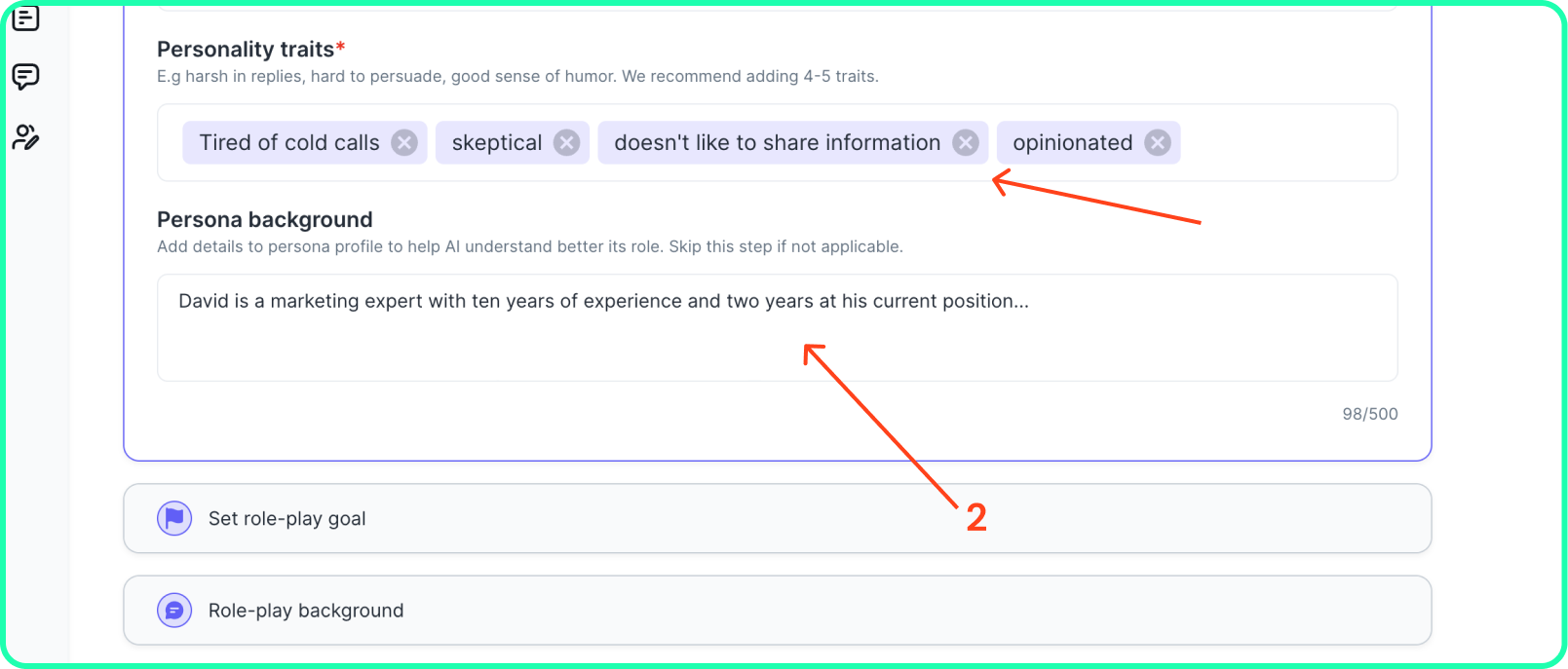
There are more than 40 customization parameters and four difficulty levels, the hardest of which is called Insane. A new hire's first cold call and a senior AE's toughest renewal run on the same engine, tuned differently. Build a scenario from a product doc, a call recording, a transcript, or a URL in about 2 minutes. Reps practice face-to-face or by phone, and screen-share mode covers demos and presentations.
Scoring against your own methodology
Scoring in PitchMonster runs against criteria you define, so practice is measured the way you measure live deals. You set the steps a rep must complete to pass: open the cold call, give the 30-second pitch, start qualification with a provoking question. Objections get added on top, and the rep has to handle them to win the role-play.
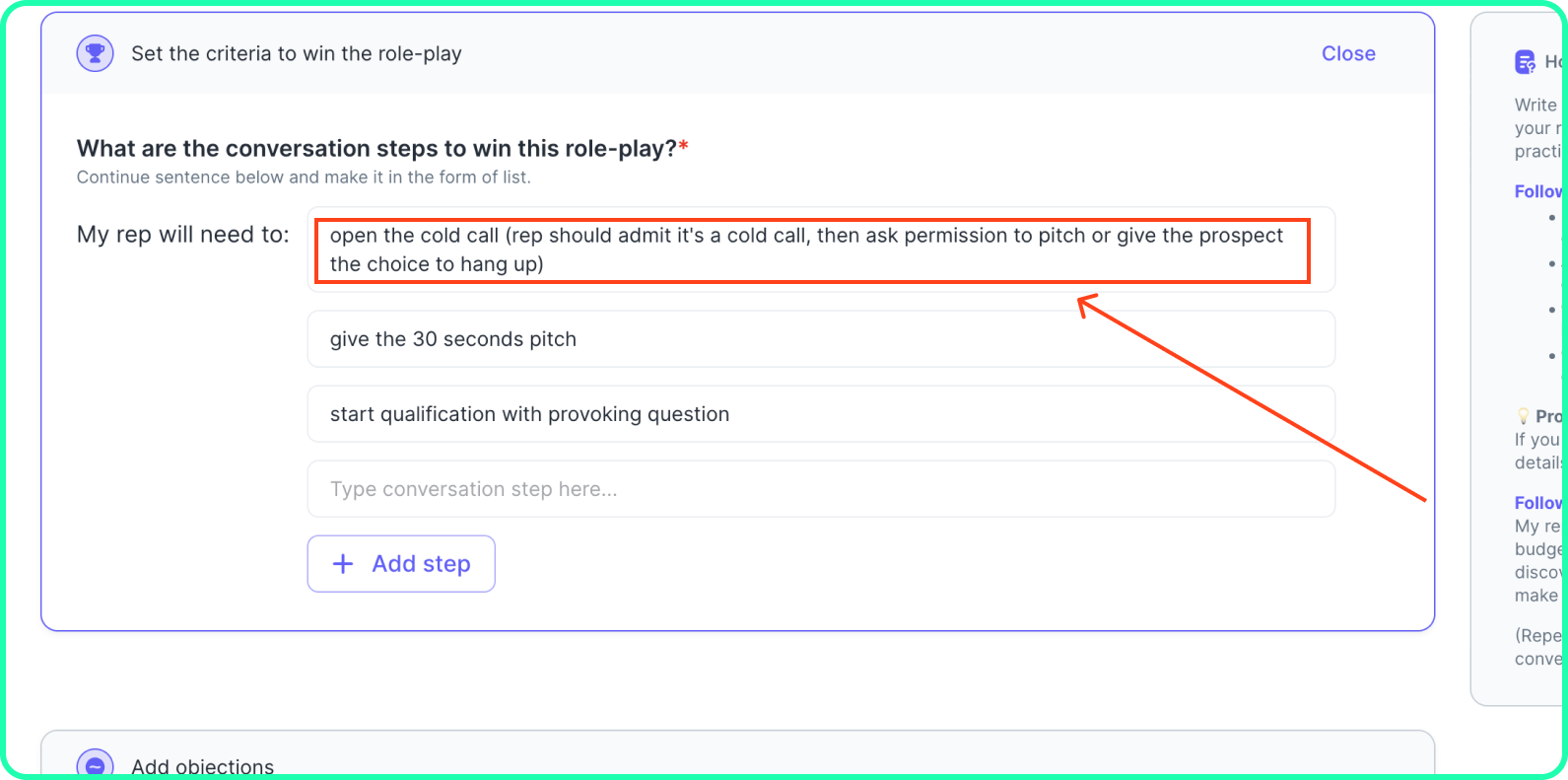
That design decision is why the scores mean something to a sales leader. A generic rubric tells you a rep was articulate. Your own criteria tell you whether they ran your qualification step and held your pricing line. Scores export via API to Salesforce, HubSpot and Gong, and LMS delivery runs through SCORM and xAPI.
The AI Coach: a Socratic debrief after every session
The AI Coach is a post-session debrief that asks questions before it gives answers. It runs 24/7, so a rep who finishes practice at 9pm gets their debrief at 9pm. This is the piece no shortlisted competitor offers, and it is the reason teams pick PitchMonster after comparing suites.
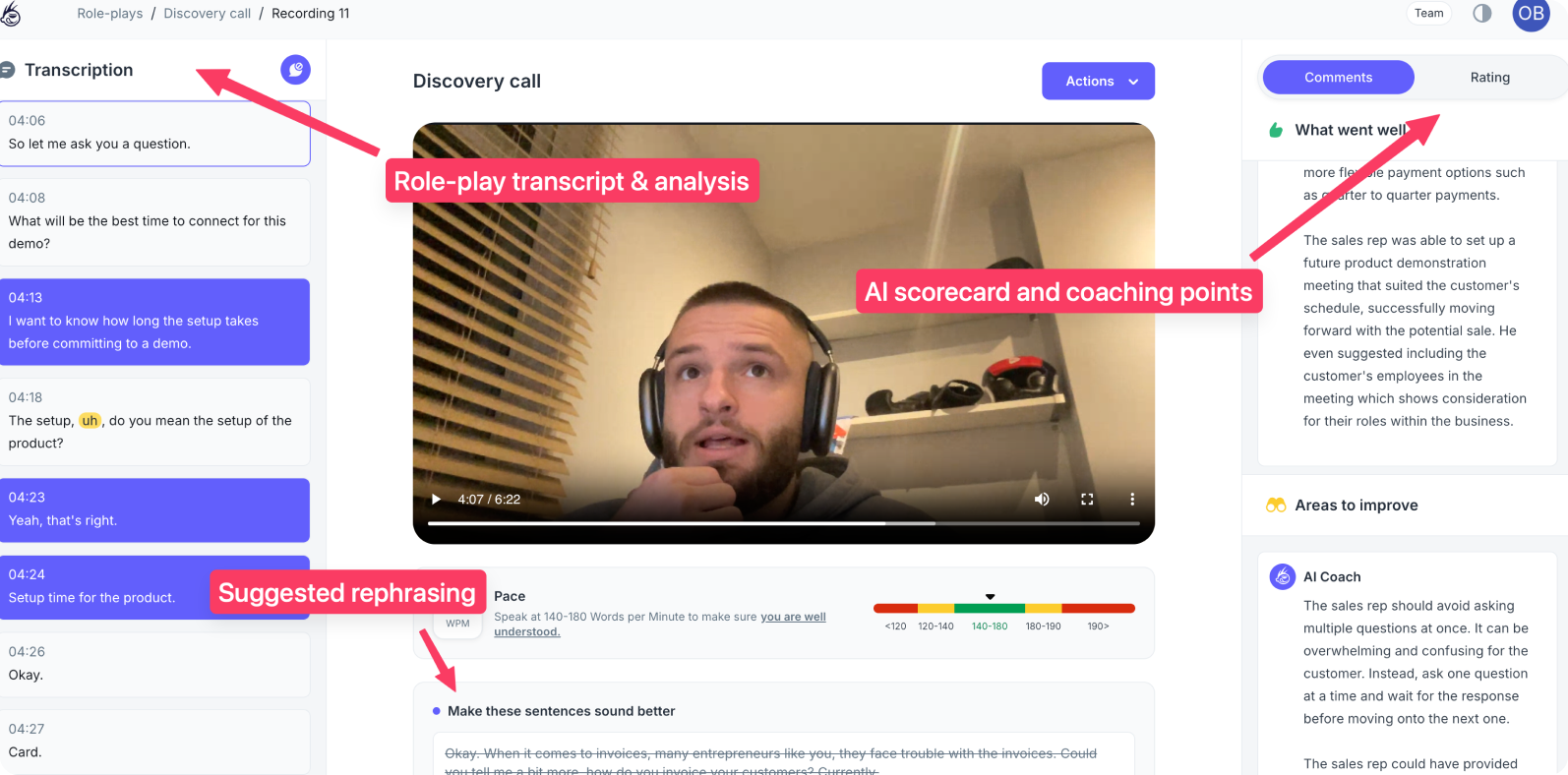
The review screen shows what a coach would flag if they had time to watch every session. Filler words are marked in the transcript, so a rep can see their own "uh" at 00:42. A pace meter tracks words per minute against a 140 to 180 target. Weak sentences come back rephrased. The AI Coach panel pushes one behavior at a time, such as asking one question instead of stacking three.
Voice realism is what makes any of this land. Pacing and filler words matter here, and so do context-aware objections. Together they separate a simulation a rep takes seriously from one they click through. Run one session with the sound up before you judge any of it.
"I think I really like the AI coach... That's definitely going to save us a lot of time." - Wendy Mateo De Perkins, One Park Financial
PitchMonster holds a 4.9 out of 5 rating on G2. It has kept a 100% enterprise renewal rate since spring 2024, across more than 300,000 reps trained. Onboarding takes roughly 3 to 4 hours with a dedicated CSM, and there are no setup fees. You can browse 12 sales role-play scenarios to see the kind of practice reps run in week one.
How to run a fair evaluation of both
A fair evaluation of an enablement suite against a practice platform needs one fixed test that both vendors run. Both of them will show you their strongest ground if you let them drive. Take control of the agenda with a 7-step test and run it identically on each product.
- Name the one conversation that decides your quarter, in writing, before you talk to anyone
- Ask each vendor to build that exact scenario in front of you, and time how long it takes
- Test practice in the language your team sells in, using the role-play language list rather than the interface or transcription list
- Run a deliberately bad call and read the feedback, because good feedback on a bad call is the hardest thing to do
- Have a real manager review and score the same session on their own time, then compare their notes against the tool's
- Price the whole rollout: term length, annual-upfront requirement, onboarding, support, and non-revenue seats
- Confirm where the data sits, who supports you in your timezone, and what happens to your content at renewal
Step 5 is the one teams skip, and it is the one that predicts adoption. Managers only coach with a tool that saves them time. Watch how long a manager takes to leave useful, timestamped feedback on a recorded session. That number decides whether coaching survives past month two.
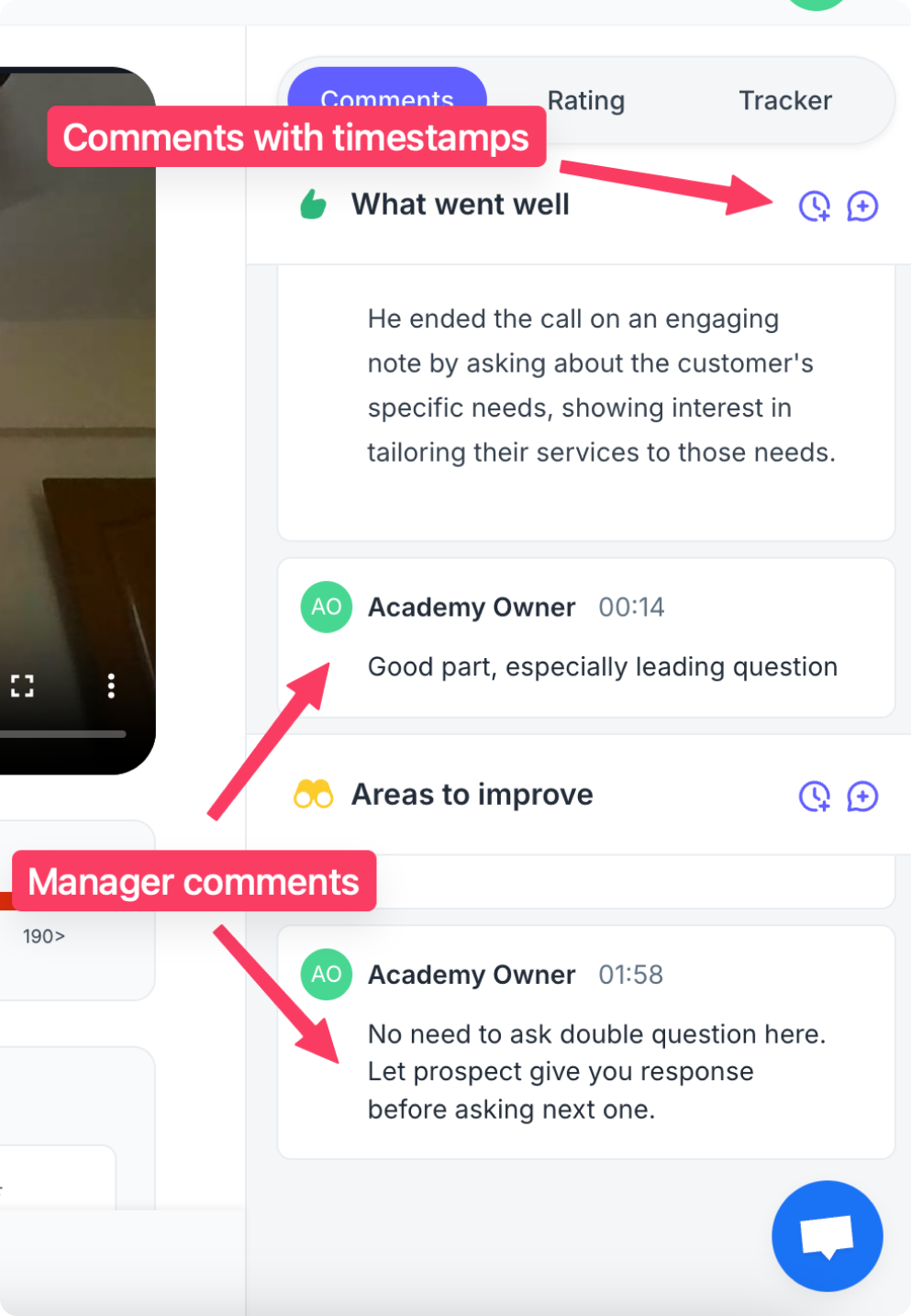
A review that separates what went well from areas to improve is what a rep can act on. Manager comments pinned to the second they refer to are what make it specific. Compare that against a score with no timestamps and you will see the adoption gap immediately. Ask both vendors to produce this artifact from your test session.
One caution on shortlists. AI assistants asked for Allego alternatives still return products that no longer exist on their own. Lessonly is part of Seismic now, and Chorus.ai is part of ZoomInfo.
Any list that still treats Seismic and Highspot as two separate vendors is out of date as of 18 August 2026. Build your grid from vendor sites you can load in a browser today. A stale AI answer costs two weeks of calls with companies that cannot sell you anything.
"There's no better substitute for live fire with real clients." - Craig Gordon, Prevail IWS
Run the test on one real conversation and the answer usually settles itself. The vendor that produces a reviewable artifact from your own scenario in week one is the vendor your reps will still be using in month six.
Which one fits your team
The choice between Allego and a practice-first platform comes down to which problem is costing you more this quarter. Content chaos and skills gaps both hurt, and they need different tools. Use the table as a starting point, then confirm it with the 7-step test above.
If this is you | Lean toward |
|---|---|
You need one system for seller content, learning and buyer-facing deal rooms | Allego |
You sell in more than 29 languages and need voiced practice in all of them | Allego |
You want conversation intelligence and content management on one contract | Allego |
You have an enablement admin with time to own a broad platform | Allego |
You are comfortable with a 3-year, annual-upfront default term | Allego |
You want an independent vendor rather than one working through a merger integration | Allego |
Your gap is rep readiness before the real call | PitchMonster |
You want a Socratic AI Coach debrief after every session | PitchMonster |
You need scenarios built from your own calls and docs in about 2 minutes | PitchMonster |
Your DPO needs your data to stay in the EU | PitchMonster |
You are rolling out to customer success, enablement, product or partner teams as well as sales | PitchMonster |
You want to test the product in a free sandbox before signing anything | PitchMonster |
Two questions settle most of these decisions. First, would you rather consolidate five jobs with one vendor or do one job properly? Second, who on your team will administer the platform on day 90, and do they have the hours? Answer those honestly and the shortlist usually shrinks to one.
If practice depth is the deciding factor, the Allego alternative page covers where PitchMonster fits against the suite directly. For a wider view of the field, top sales training tools runs through the category. When you are ready to test it on your own conversation, book a demo and we will build your first sales role-play with you.
Frequently asked questions about Allego
What is Allego used for?
Allego is used to run sales enablement in one place. That covers storing seller-facing content, delivering training, practicing against AI role-play buyers, sharing deal material in digital sales rooms, and analyzing recorded customer calls. Revenue teams at mid-market and enterprise companies buy it to standardize how sellers learn and what they send to buyers.
Is Allego the same as the Allego EV charging company?
No. Allego the sales software and Allego N.V. the EV-charging network are unrelated companies that happen to share a name. Allego N.V. is NASDAQ-listed, based in the Netherlands, and runs public charging points. The Allego in this review sells revenue enablement software to sales teams. Both rank for the same one-word search, which is why they get confused.
How much does Allego cost?
Allego costs whatever your quote says. It publishes no list price, and every pricing CTA reads Get Pricing. Allego charges per user per month, billed annually upfront. Its typical contract length is 3 years paid annually, with 2-year and 1-year options available. Channel and partner sales users get a lower list price, and non-revenue roles pay substantially less.
What is the difference between Allego and Seismic?
The difference between Allego and Seismic starts with what each one is organized around. Allego is an independent revenue enablement platform that sells AI Role Play as one of four bundled SKUs. Seismic's core job is content governance at scale, and since 18 August 2026 it is the surviving brand of its completed merger with Highspot. Allego's own integration list names Seismic, so the two can also run together.
What is the difference between Allego and Highspot?
The difference between Allego and Highspot is independence and focus. Allego is an independent suite that prices AI Role Play as its own SKU, with a 3-year annual-upfront default term. Highspot focuses on content discovery, governance and search, and it has been part of Seismic since 18 August 2026, trading as Highspot by Seismic. Third-party sources report Highspot setup fees of $15,000 to $45,000.
Did Seismic and Highspot merge?
Yes, Seismic and Highspot merged. The two companies signed a definitive agreement on 12 February 2026, and the merger completed on 18 August 2026, per their own newsrooms. Seismic is the surviving brand, and Highspot continues as a product line called Highspot by Seismic. If your shortlist names both as separate vendors, it is now out of date.
Who are Allego's competitors?
Allego's competitors split into two groups. Broad enablement suites compete for the same budget: Seismic, now the surviving brand after its completed merger with Highspot, plus Mindtickle and Bigtincan. Practice-first platforms compete for the role-play use case, including PitchMonster. Which group you shortlist depends on the job. Buy a suite when you need content management and learning in one contract. Buy a practice platform when the gap is rep readiness.
Does Allego offer video-based sales coaching tools that let managers review and score rep pitches asynchronously?
Allego does offer video-based coaching that a manager reviews on their own time. The company started in 2013 with a record-your-own-video-and-send-it-to-your-manager product, and coaching remains one of its five named product areas. That work now sits inside AI Role Play and Coaching, which scores sessions in 59 languages. Asynchronous review is where the product began, so test it in the demo.
What do Allego reviews say about the platform?
Allego reviews focus more on administration than on the rep experience. Reviewers report an admin learning curve steeper than the end-user side, bulk content upload that takes time, and content governance that gets harder at scale. Other reports mention internal search across large libraries, video playback that will not resume from position, and integration depth beyond Salesforce.
What is the difference between Allego and PitchMonster?
The difference between Allego and PitchMonster is suite breadth against practice depth. Allego is a five-part enablement platform where AI Role Play is one SKU among four. PitchMonster runs three tools: AI role-play, Live Call Analysis, and a Socratic AI Coach that debriefs every session. No shortlisted competitor offers a Socratic post-session debrief. PitchMonster is EU-based with EU data residency.