A cold call script is a written opener and a set of branches that let a rep stop composing sentences and start listening. Below are 7 openers written out word for word, gatekeeper and voicemail lines, responses to the 5 objections that reliably freeze new reps, and blank versions of everything so you can drop in your own market.
One honest caveat first: every guide on this topic tells you not to read the script word for word, then hands you words to read. The gap is not the script. It is that a script only starts working after a rep has said it enough times that it stops sounding like a script, and nothing on a page can do that part.
What makes a cold call script work
Three things, and the third is the one most scripts miss.
A specific, true reason for calling. Not "I help companies like yours", which is what every automated sequence says. A hiring post, a funding round, a leadership change, a product launch. Something you could only know by looking.
One question, asked early. The opener exists to earn a reply, not to deliver a pitch. If your first 20 seconds contain no question mark, you are reading at somebody.
Room to be interrupted. A script written as a paragraph collapses the moment the prospect talks over it, which they will. A script written as sentence, question, branch survives contact.
7 openers, word for word
Use these verbatim while you learn them. Company names are placeholders.
1. The trigger opener. The default. Highest hit rate when the trigger is genuinely recent.
"Hi [Name], it's Sam from PitchMonster. I saw you posted 6 SDR roles this month, so I'm calling about ramp time rather than anything else. Is now a bad moment?"
2. The permission-first opener. For senior titles who resent being handled.
"[Name], this is Sam at PitchMonster, and this is a cold call. Do you want to give me 30 seconds, or shall I try you another time?"
3. The pattern-interrupt opener. Works because it is honest about what is happening.
"Hi [Name], Sam from PitchMonster. You don't know me and I'm interrupting your afternoon. Can I tell you why I picked up the phone, and you can decide if it's worth 2 minutes?"
4. The referred-problem opener. For when you have talked to a peer in the same market.
"[Name], it's Sam from PitchMonster. I've been speaking to a few enablement leads at companies around your size, and the same thing keeps coming up: new reps ramping at wildly different speeds depending on who trains them. Is that familiar, or have you solved it?"
5. The specific-role opener. For when the title tells you the problem.
"Hi [Name], Sam at PitchMonster. You run enablement for a 60-rep team, which usually means you're the bottleneck for every role-play anyone wants to do. Is that roughly your week?"
6. The straight opener. Short, no framing, no throat-clearing. Works better than it should.
"[Name], Sam from PitchMonster. We help sales teams cut ramp time by letting reps practise on an AI buyer instead of on real prospects. Worth 2 minutes?"
7. The follow-up-to-silence opener. For a prospect who ignored 2 emails.
"Hi [Name], it's Sam from PitchMonster. I emailed you twice about rep ramp time and got nothing back, which usually means one of 2 things: it's not a priority, or my emails were bad. Which is it?"
Number 7 works because it gives the prospect an easy, slightly amusing out and most people take the second option.
The gatekeeper
Treat the gatekeeper as a colleague with a job, because they are, and they can tell instantly when a rep is trying to trick them.
"Hi, I'm trying to reach [Name] about their SDR onboarding. I don't have their direct line. Am I better off calling back at a particular time, or is there someone else who handles that?"
What not to do: claim to be returning a call, imply a prior relationship, or say "he's expecting me". Gatekeepers hear all 3 daily, and the cost of being caught is that the account is closed to you rather than just this call.
If asked point blank whether it is a sales call, say yes. The honest answer gets through more often than the evasion does.
Voicemail, 2 versions
Keep it under 20 seconds and never explain the product. The only job is a callback or a warm email open.
Short version:
"[Name], Sam from PitchMonster, 0207 xxx xxxx. Calling about SDR ramp time. I'll send an email with the same subject line so you can find it. Thanks."
With a reason:
"Hi [Name], it's Sam at PitchMonster. I noticed you're hiring 6 SDRs, and I've got a specific idea about getting them productive faster. 0207 xxx xxxx, or reply to the email I'm about to send. Either is fine."
Say the number twice if you say it at all, and slowly. Most reps rush it and the rest of the message is wasted.
The 5 objections reps freeze on
These are the moments where a script earns its keep, because they arrive fast and the instinct is to either argue or apologise.
They say | Do not | Say instead |
|---|---|---|
"I'm not interested." | Argue, or ask why not | "That's fair, you don't know why I'm calling yet. Can I take 20 seconds and then you can tell me to go away?" |
"We already use [competitor]." | Attack the competitor | "Good, then you've already decided this matters. What made you pick them, and what have they not solved?" |
"Send me an email." | Say "sure!" and hang up | "Happy to. So the email is useful, what's the one thing worth putting in it?" |
"Now's not a good time." | Ask when is better and leave it | "No problem. Are you the right person for rep onboarding, so I know whether to call back at all?" |
"How much is it?" | Give a number to seem open | "It depends on team size, so any figure I give you now would be wrong. Can I ask 2 questions and then tell you what it looks like for a team your size?" |
The last one matters more than it looks. Reps under pressure invent a price to keep the conversation friendly, and then spend the rest of the cycle negotiating against a number they made up.
Blank templates to fill in
Copy these and fill in the brackets. Same structures as above, stripped.
Opener skeleton:
"Hi [PROSPECT NAME], it's [YOUR NAME] from [YOUR COMPANY]. I saw [SPECIFIC OBSERVED TRIGGER], so I'm calling about [ONE NARROW PROBLEM]. Is now a bad moment?"
Permission skeleton:
"[PROSPECT NAME], this is [YOUR NAME] at [YOUR COMPANY], and this is a cold call. Do you want to give me [N] seconds, or shall I try another time?"
Peer-problem skeleton:
"[PROSPECT NAME], it's [YOUR NAME] from [YOUR COMPANY]. I've been speaking to [ROLE] at companies around your size and the same thing keeps coming up: [PROBLEM IN THEIR WORDS]. Is that familiar, or have you solved it?"
Gatekeeper skeleton:
"Hi, I'm trying to reach [PROSPECT NAME] about [TOPIC]. I don't have a direct line. Am I better off calling back at a particular time, or is there someone else who handles [TOPIC]?"
Voicemail skeleton:
"[PROSPECT NAME], [YOUR NAME] from [YOUR COMPANY], [PHONE NUMBER]. Calling about [TOPIC]. I'll send an email with the same subject line. Thanks."
Objection skeleton:
Acknowledge in 3 words. Reframe in one sentence. Ask one narrow question. Stop talking.
That last pattern is the whole objection-handling method compressed. Acknowledge, reframe, ask, stop. Reps who learn it stop needing memorised responses for objections they have never heard.
The email that pairs with the voicemail
The voicemail scripts above both promise an email. Send it within 10 minutes, while your name is still in their recent-missed-calls list, and make the subject line the exact phrase you said out loud. That pairing is the point: the voicemail makes the email recognisable and the email makes the voicemail actionable.
Subject: SDR ramp time
"[Name] - I left you a voicemail just now, so this is the short version.
You're hiring 6 SDRs to start in January. Most teams I speak to find the first cohort ramps at wildly different speeds depending on which senior rep trains them, and nobody has the manager hours to fix that.
Worth 15 minutes to compare notes? If not, tell me and I'll stop.
Sam"
Four things that email does deliberately. It references the call, so it is not cold twice. It names the trigger, so it is clearly not automated. It states the problem in one sentence rather than describing a product. And it gives an explicit opt-out, which raises reply rates because it costs the reader nothing to answer honestly.
What it avoids: a calendar link in the first message, a paragraph about your company, and any variant of "just following up".
Cadence, and when to stop
A script only works inside a sequence, and most teams either give up after 2 attempts or never stop at all. Both waste the list.
Touch | Day | Action |
|---|---|---|
1 | 1 | Call. Voicemail if no answer, then the paired email within 10 minutes |
2 | 3 | Call at a different time of day. No voicemail |
3 | 5 | Email only. Reference the same problem, add one specific detail you have since found |
4 | 9 | Call. Voicemail using the follow-up-to-silence opener |
5 | 14 | The closing email below, then stop |
Vary the time of day rather than the day of the week. Reaching the same person at 8:40am three times tells you they are not at their desk at 8:40am, not that they are unreachable.
The last touch should give them an easy exit, because a clean no is worth more than an open loop:
"[Name] - I've tried you a few times about SDR ramp and not landed, so I'll assume the timing is wrong and stop. If it becomes a priority later, reply to this and I'll pick it up. No hard feelings either way."
That message gets more replies than any of the preceding four, which tells you something about how the other four were written.
After touch 5, put the record back in the pool with a date rather than deleting it. Hiring posts, funding rounds and leadership changes are all repeatable triggers, and a prospect who was wrong in August is frequently right in February.
Industry variants
The structure above holds everywhere. The trigger and the problem language do not, and a generic opener is what gets you grouped with the automated outreach. Five versions, changed only where the market forces it.
B2B software and SaaS. Hiring is the cleanest public trigger, because headcount plans are posted and they imply a ramp problem.
"Hi [Name], Sam from PitchMonster. I saw you're hiring 6 SDRs to start in January, so I'm calling about how long they take to get productive. Is now a bad moment?"
IT and managed services. Renewal cycles and compliance deadlines drive these conversations more than growth does.
"[Name], Sam at PitchMonster. Most IT services teams I speak to are carrying a renewal conversation they keep postponing because nobody wants to run it. Is that familiar, or have you got that covered?"
Staffing and recruiting. The whole business is conversations, so call quality is the metric that moves revenue, and they already measure it.
"Hi [Name], Sam from PitchMonster. Your recruiters live on the phone, which means small differences in how a screening call opens turn into real placement numbers. How are you coaching that at the moment?"
Financial services and insurance. Compliance is the frame. Lead with it, because they cannot buy anything that ignores it.
"[Name], this is Sam at PitchMonster. I work with regulated teams where every rep has to say certain things on every call, and coaching that at scale is the hard part. Is that on your list this year, or is it handled?"
Contact centres and BPO. Volume, attrition and ramp are the language. Speak in cost per seat and weeks to competency.
"Hi [Name], Sam from PitchMonster. With the attrition rates most contact centres are running, the ramp curve for a new agent is basically a permanent cost line. How long is yours at the moment?"
Two rules cut across all five. Never claim a trigger you did not verify, because "I saw you're hiring" collapses the moment they ask where. And use the buyer's own metric name rather than yours: a contact centre says time to competency, a SaaS team says ramp, and using the wrong one marks you as an outsider on the first sentence.
Three harder objections
The 5 above cover most calls. These 3 come up less often and derail newer reps more, because none of them has an obvious comeback.
"How did you get my number?" Answer it straight and move. Any evasion here reads as something to hide.
"Fair question. Your details are on your company site and I put the list together myself, so it's me rather than an automated system. Do you want the 30 seconds, or shall I leave you alone?"
"We tried something like this and it didn't work." This is the most valuable objection on the list, because it means budget existed once. Do not defend the category.
"That's useful to know, and honestly more useful than if you'd never tried. What specifically didn't work, so I can tell you whether we'd hit the same wall?"
"Just send me some information." Distinguish the polite exit from a real request. One question does it.
"Happy to. Are you asking because it's genuinely worth a look later, or because now isn't the moment? Either's fine, I'd just rather not send you something you'll never open."
Reps hear the last one as a small win and log it as a follow-up. It usually is not, and asking the question directly costs nothing while saving the pipeline hygiene.
What to measure
Most teams track dials and meetings booked, which are the first and last numbers in a chain of four. The middle two are where a script gets diagnosed.
Metric | What it tells you | Where the script is at fault |
|---|---|---|
Connect rate | Whether your list and calling windows are right | Nothing. This is data and timing, not delivery |
Survival past 15 seconds | Whether your opener earns a conversation | If this is low, the opener is the problem. Nothing later matters |
Objection-to-conversation rate | Whether reps recover after the first brush-off | If this is low, they know the lines but freeze on delivery |
Meetings booked | The outcome | Too far downstream to diagnose anything on its own |
Survival past 15 seconds is the number worth adding if you track nothing else new. It isolates the opener from everything else in the call, and it is the only metric that tells you whether the words or the rep needs work. A team with a good connect rate and poor 15-second survival has a script problem. A team with good survival and poor objection recovery has a practice problem, and no amount of rewriting the opener will fix it.
Set a baseline before you change any wording, or you will not be able to tell whether the new script worked or the list improved.
Why scripts stop working
A script has a lifecycle, and both ends of it are a problem.
Early on the rep is reading, and it is audible. The wording is fine but the delivery has no listening in it, because all their attention is on the next line. Prospects respond to that tone rather than the words.
Later the opposite happens. The rep has said it 400 times and it has flattened into a recording. The trigger line stops being specific because they stopped looking things up. This is the stage where teams conclude that cold calling is dead, when what actually died is the relevance.
The middle of that curve, where the rep knows the words well enough to stop thinking about them and is still paying attention, is where cold calling works. Getting there takes repetitions, and the expensive way to get repetitions is on real prospects.
One thing to keep in view: the cold call is not the sale. Its only job is to earn the discovery call, which is where the actual diagnosis happens. Reps who try to qualify properly on the cold call end up running a compressed version of SPIN into a prospect who has not agreed to be interviewed yet, and it lands badly.
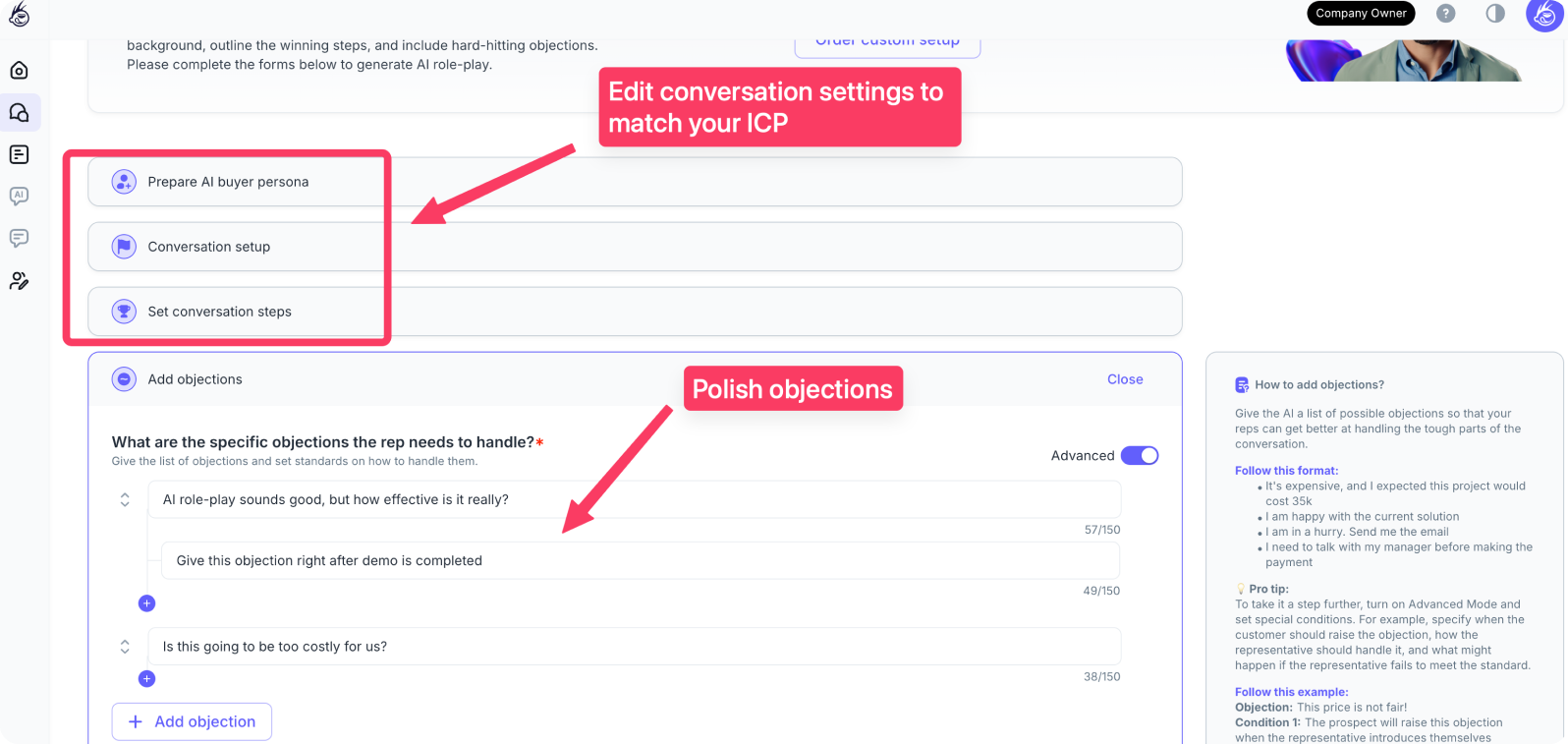
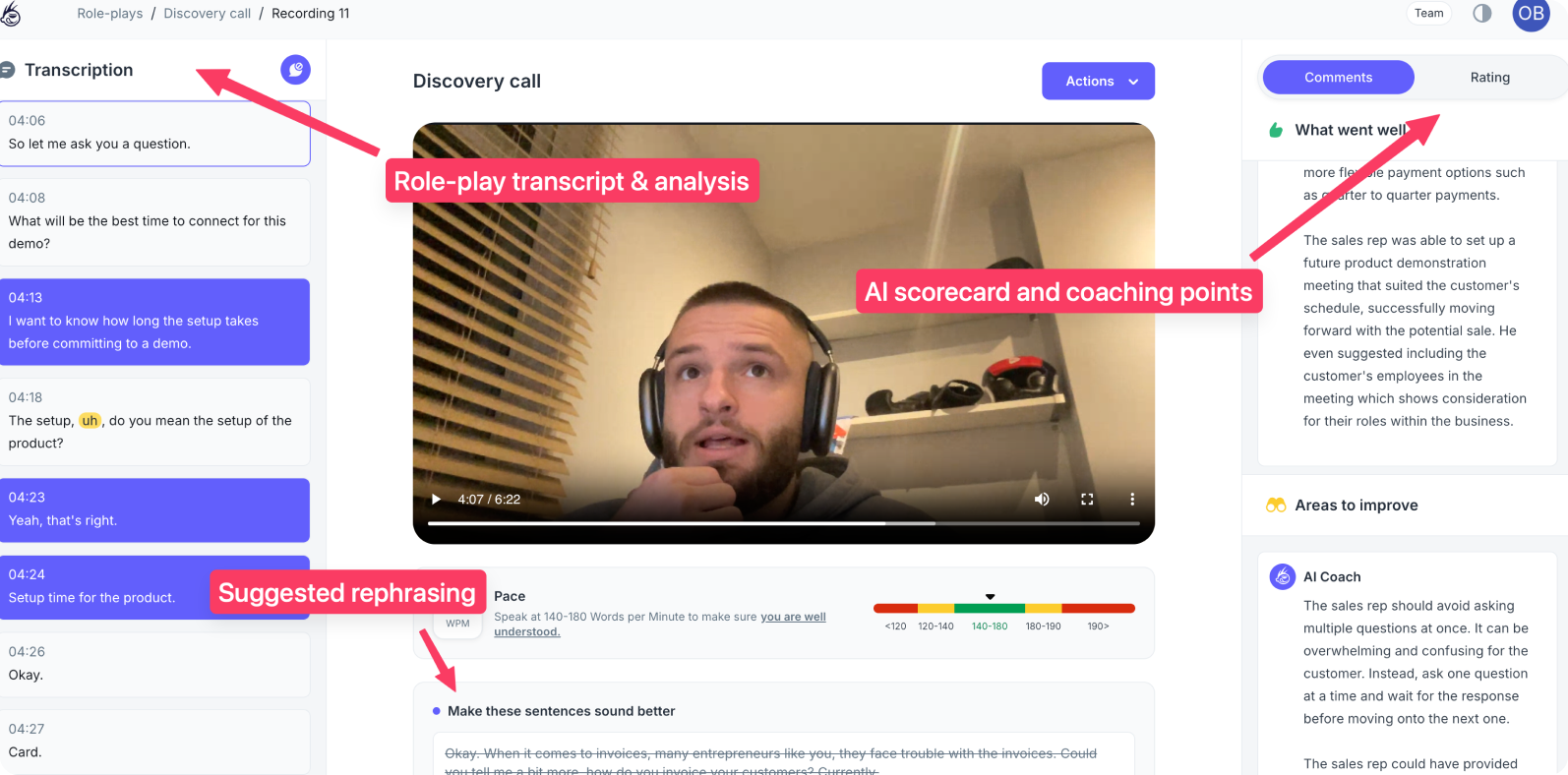
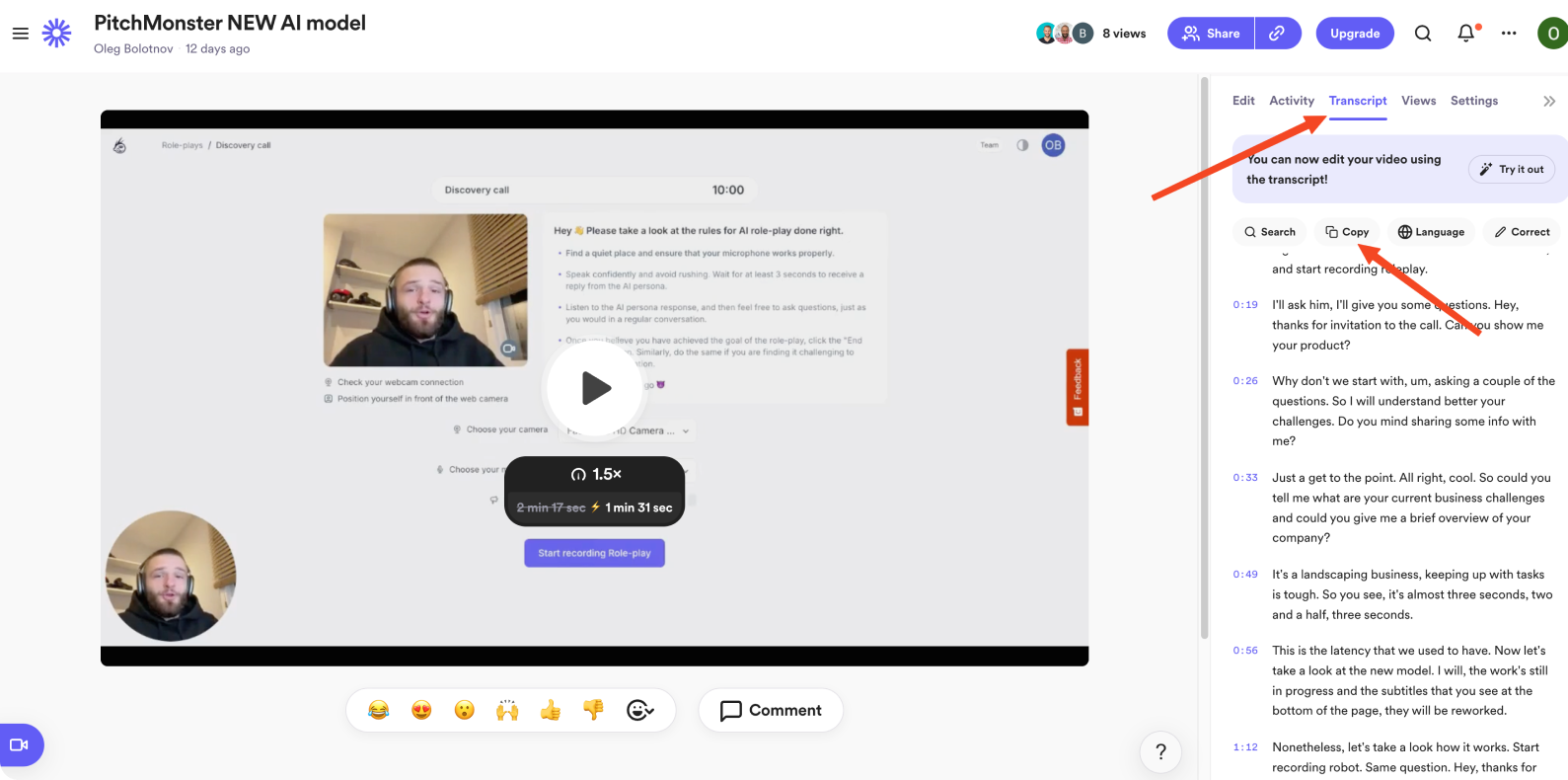
That is the argument for practising against a simulated buyer. A colleague cannot deliver "I'm not interested" flatly 20 times in a row, and will not stay hostile when a rep flounders. In PitchMonster an enablement lead can build an AI buyer from a real recorded cold call, so the brush-offs sound like your market, then have every new rep work through the same 5 objections until the acknowledge-reframe-ask-stop pattern is automatic. Sessions are scored against your own criteria and the AI Coach debriefs by asking the rep what they noticed, which is what converts a repetition into a habit.
The measured version: PRN Health Services recorded 22% higher call quality scores and 14% more interviews scheduled after their team practised this way, and Mentor Group cut ramp time by 50% on average while halving coaching time per rep.
If you want your next SDR cohort making their first 30 mistakes on nobody, book a demo and we will build the scenario from one of your own recorded calls.
FAQ
What is a good cold call script?
A good cold call script gives a rep a structure and a first sentence, then gets out of the way. It names who you are, states a specific reason for calling that references something true about the prospect's company, and asks one question. Scripts that read as a monologue fail because the prospect can hear that the rep is not listening for an answer.
How do you start a cold call?
Say your name, your company, and a direct reason for calling within the first 10 seconds, then ask permission to continue. "This is Sam from PitchMonster. I saw you're hiring 6 SDRs this quarter, so I'm calling about ramp time. Is now a bad moment?" Asking whether it is a bad moment outperforms asking how someone is, because it is answerable and honest.
Should you read a cold call script word for word?
Read it word for word until you no longer need to, then stop. New reps who improvise sound lost, and reps who read a script after their 50th call sound like a recording. The point of a written script is to move the wording out of working memory so attention can go to what the prospect is actually saying.
How long should a cold call script be?
The opener should be 2 or 3 sentences, roughly 15 seconds spoken. Beyond that a script becomes a call guide rather than a script: branches for the 4 or 5 likely responses, plus objection lines. If your opener takes more than 20 seconds to deliver, the prospect has already decided.
What is the best cold call opener?
There is no single best opener, but the highest-performing shape is: name, company, a specific observed trigger, then a permission question. The trigger is what separates it from spam, and it has to be true and recent, such as a hiring post, a funding round, a product launch, or a change of leadership.
How do you handle "I'm not interested" on a cold call?
Treat it as a reflex rather than a decision, because at 5 seconds in it cannot be an informed one. Acknowledge it, then ask one narrow question: "That's fair, you don't know why I'm calling yet. Can I take 20 seconds and you can tell me to go away?" Most reps either hang up or argue. The response that works is neither.
Do cold calls still work in 2026?
Cold calling still works where the buyer is reachable by phone and the reason for calling is specific. What has stopped working is volume without relevance, because buyers now field enough automated outreach to pattern-match a generic opener in about 3 seconds. The differentiator is a real trigger and a rep who can hold an unscripted 60 seconds.
How do you practise cold calls without wasting real leads?
Practise against a simulated buyer instead of a colleague. A peer role-play breaks down because your teammate wants the exercise to go well and cannot stay hostile convincingly. AI role-play holds character, delivers the same brush-off 20 times, and lets a rep make their first 30 mistakes on nobody. Save real dials for after the script sounds like speech.
The short version
Take the 7 openers, pick one, and say it out loud 20 times before you dial. Then learn the acknowledge-reframe-ask-stop pattern for objections, which replaces memorising a response for every brush-off.
The script is the easy part. The reason cold calling feels hard is that nobody gives reps a safe place to sound bad 30 times first.