SPIN selling is a questioning method for complex B2B sales, built on 4 types of question asked in a deliberate order: Situation, Problem, Implication, and Need-payoff. Neil Rackham published it in 1988 after research covering roughly 35,000 sales calls, and the headline finding was narrower than most summaries admit: top performers in large deals did not simply ask more questions, they asked more Implication questions.
This guide covers the 4 types with real examples, the sequencing mistake that makes SPIN sound robotic, a worked discovery thread, how SPIN stacks with MEDDPICC and BANT, and why the framework is easy to memorize and hard to actually run.
What is SPIN selling?
SPIN selling is a method for structuring the questions in a sales conversation so the buyer, not the rep, articulates why the problem is worth solving.
It came out of research at Huthwaite, where Rackham's team observed sales calls rather than surveying salespeople about their own performance. That distinction matters. The behaviours that separated top performers were not the ones sellers reported using, and the pattern the data surfaced was about question type and order rather than charisma or closing technique.
What SPIN is not: a sales process, a qualification checklist, or a script. It governs one conversation. It says nothing about whether the deal is forecastable, who signs the contract, or what the procurement path looks like. That is what a qualification framework is for, and the 2 fit together rather than competing.
The 4 question types
Each type does a different job, and each has a distinct failure mode.
Type | What it does | Example | What reps get wrong |
|---|---|---|---|
Situation | Establishes how the buyer operates today | "How do you onboard new sales hires at the moment?" | Asking things the company website already answers, which spends the buyer's patience on homework the rep skipped |
Problem | Surfaces a difficulty the buyer will admit to | "Where does that process break down?" | Stopping here, then pitching. A named problem is not yet a funded problem |
Implication | Exposes what the problem costs in money, time, or risk | "What does a rep taking 2 extra months to ramp cost you in pipeline?" | Skipping it, because it feels like pressing on a sore spot |
Need-payoff | Gets the buyer to state the value of fixing it | "If ramp came down by a month, what would that change for your number?" | Answering it themselves. The rep says the benefit, so the buyer never has to believe it |
The asymmetry is the point. Situation and Problem questions feel comfortable and produce information. Implication and Need-payoff questions feel uncomfortable and produce urgency. Reps default to the comfortable half and then wonder why a well-qualified deal has no deadline.
The sequencing reps get wrong
The most common failure is collapsing Implication into Problem and treating them as one step.
It sounds like this. The rep asks where onboarding breaks down. The buyer says ramp takes too long. The rep, hearing a problem, moves straight to the demo. Nothing false has happened, and the call will feel like it went well, but the buyer has never said out loud what slow ramp costs them. Without that, the deal has no internal advocate, because nobody can carry "ramp takes too long" into a budget conversation.
The second failure is treating SPIN as 4 blocks to work through in order rather than a sequence you run per thread. A real discovery call has 2 or 3 problem threads in it. Each one needs its own implication, or you end up with a broad survey of everything mildly wrong and nothing urgent enough to fund.
The third is running Situation questions at length. In 1988 a rep had no way to know how a company operated without asking. Now most of it is on the website, in a job posting, or in the buyer's own LinkedIn activity. Ask 2 situation questions, not 8, and spend the recovered time on implication.
A worked discovery call
One thread, run properly. The buyer is a Head of Enablement at a 60-rep B2B software company.
Situation: "How are new reps getting up to speed today, from day 1 to first closed deal?"
Buyer: "Two weeks of product training, then they shadow a senior rep for a month, then they're live."
Problem: "Where does that tend to break down?"
Buyer: "Honestly, the shadowing. It depends entirely on which senior rep they get, and those people have their own numbers to hit."
Implication: "So a new hire's ramp depends on who they were assigned to. What does the gap look like between your fastest and slowest ramping rep from last year's cohort?"
Buyer: "Big. Some are producing at 3 months, some are still not there at 7."
Implication, again: "On a 60-rep team with that spread, how much of your annual pipeline number is sitting in reps who ramped late?"
Buyer: "I have never calculated it. It would be significant."
Need-payoff: "If you could get the slow half of a cohort producing at the pace of the fast half, what would that be worth to you this year?"
Buyer: "That is the whole argument for my budget request, really."
Note what the rep did not do. No feature was mentioned. No claim was made about the product. The second implication question did the heavy lifting, and the buyer ended up building the business case themselves. That last line is the one a champion repeats internally when the rep is not in the room.
SPIN vs MEDDPICC vs BANT
These get compared as if you pick one. They operate at different altitudes.
Framework | What it governs | Answers | Used by |
|---|---|---|---|
SPIN | One conversation | "What do I ask next?" | The rep, live on the call |
BANT | Initial fit | "Is this worth a meeting?" | SDRs, early qualification |
MEDDPICC | The whole deal | "Is this real and forecastable?" | Reps and managers in pipeline review |
A common working pattern: an SDR uses BANT for a first read, the rep runs SPIN on the discovery call, and the evidence those questions produce populates the MEDDPICC scorecard that the manager reviews. SPIN generates the raw material; MEDDPICC audits whether you actually got it.
Worth naming the contrast too. The Challenger Sale runs the opposite move: rather than questioning until the buyer states their own problem, the rep brings a reframe the buyer had not considered. The 2 combine well in sequence, using SPIN to understand the situation and a Challenger reframe once you have earned the standing to offer one.
If your reps have a MEDDPICC scorecard full of blanks, the cause is usually upstream. They are not failing at qualification, they are failing to ask the implication question that would have produced the evidence.
Why SPIN is hard to learn
SPIN takes about 10 minutes to understand and a long time to run well, and the reason is worth being precise about.
The framework asks a rep to do 3 uncomfortable things while thinking on their feet. Stay in questions when the buyer has just handed them an opening to pitch. Press a second time on a cost the buyer has admitted but not quantified. Then stay quiet after a need-payoff question, which is exactly when the silence feels longest.
None of those are knowledge. A rep who can recite all 4 types can still fill the silence, still pitch on the first problem, still soften an implication question into something so gentle it produces nothing. Reading about SPIN does not install the reflex, and neither does a workshop where the practice partner is a colleague who wants the exercise to go well.
That is also why SPIN training so often shows up as improved theory and unchanged calls. The gap is repetitions, under mild pressure, with a buyer who does not cooperate.
How to drill it
The teams that get SPIN to stick isolate one question type at a time rather than practising whole calls.
Start with Implication, because it is the type the research tied to success and the one reps avoid. Give a rep a buyer who admits a problem and then resists quantifying it, and have them press twice without turning it into an interrogation. Ten reps of that beats an hour of general role-play.
Then drill the silence after a need-payoff question. It sounds trivial and it is the single most common place a good sequence gets thrown away.
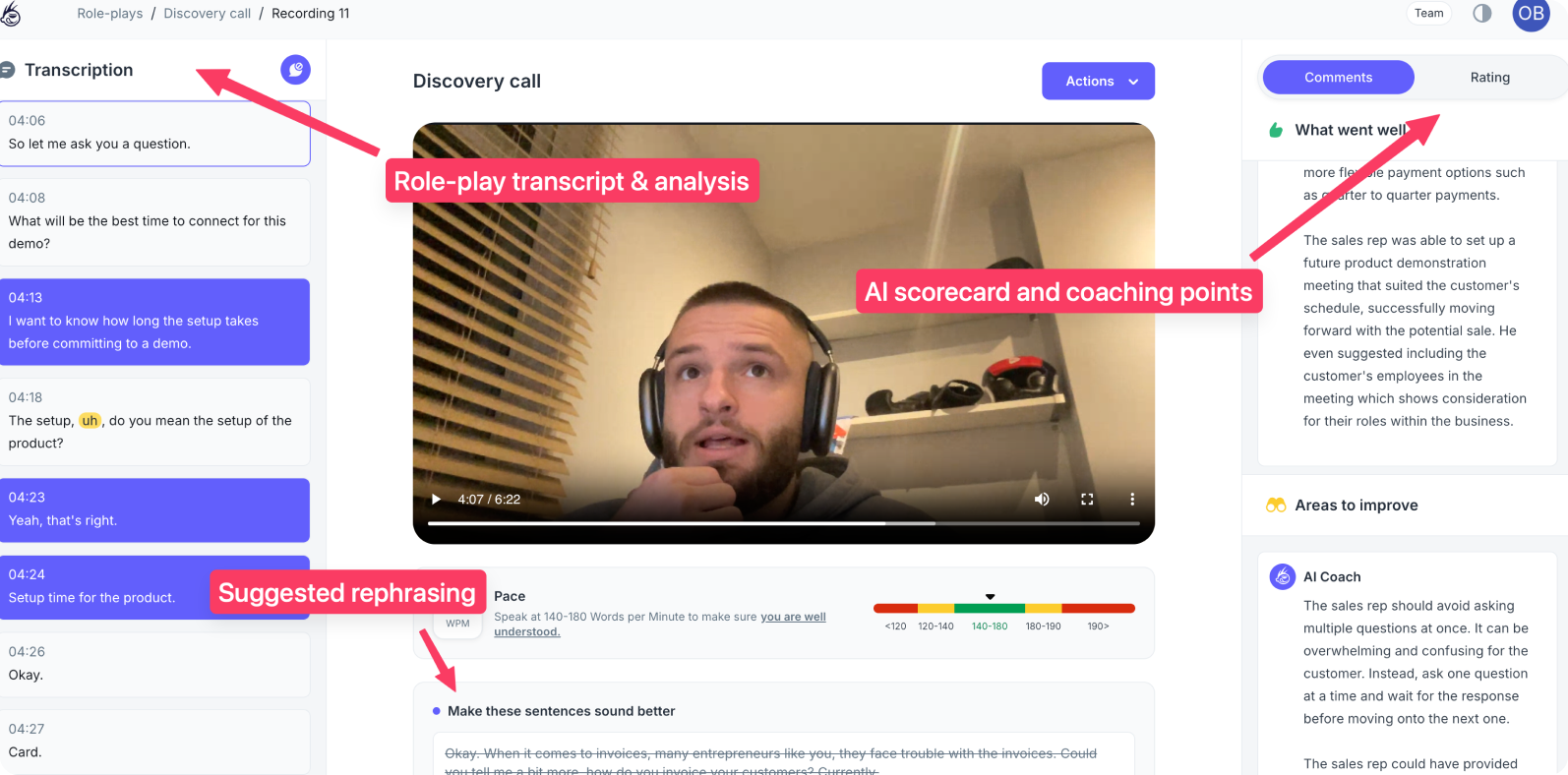
This is where AI role-play does something a colleague cannot. In PitchMonster an enablement lead can build an AI buyer from a real recorded discovery call, set it to deflect implication questions the way a real prospect does, and have every rep run the same thread until the second press stops feeling rude. The session is scored against your own criteria, and the AI Coach debriefs afterwards by asking the rep what they noticed rather than handing over a grade. A peer role-play cannot stay in character when a rep flounders; an AI buyer can.
The measurable version of this is ramp. Mentor Group cut ramp time by 50% on average and halved coaching time per rep by moving practice off their managers' calendars, and SThree onboarded 53% faster the same way. A methodology rollout is an onboarding problem in different clothing.
If you are rolling SPIN out, teach the 4 types once, then spend the remaining time on implication repetitions. Book a demo and we will build the scenario from one of your own discovery calls.
FAQ
What is SPIN selling?
SPIN selling is a questioning method for complex B2B sales built on 4 question types asked in sequence: Situation, Problem, Implication, and Need-payoff. Neil Rackham published it in 1988 after research covering roughly 35,000 sales calls. The core finding was that top performers in large deals ask more questions than average performers, and specifically more Implication questions.
What does SPIN stand for?
SPIN stands for Situation, Problem, Implication, Need-payoff. Situation questions gather context about how the buyer works today. Problem questions surface a difficulty. Implication questions expose what that difficulty costs. Need-payoff questions get the buyer to describe the value of fixing it, in their own words rather than yours.
What are good SPIN selling question examples?
A working sequence on one thread looks like this: "How do you onboard new reps today?" (Situation), "Where does that break down?" (Problem), "What does a rep taking 2 extra months to ramp cost you in pipeline?" (Implication), "If ramp came down by a month, what would that change for your number?" (Need-payoff). The table in this guide gives examples for each of the 4 types.
Is SPIN selling still relevant?
The mechanics hold up because they are about questioning, not about a sales stage or a channel. What has changed is buyer patience. Situation questions that a rep could ask in 1988 are now answerable from a company website, so asking them wastes the buyer's goodwill. Do the research first and spend your call time on Implication.
What is the difference between SPIN selling and MEDDPICC?
SPIN is a questioning method for one conversation; MEDDPICC is a qualification checklist for a whole deal. SPIN tells a rep what to ask next while they are talking to a buyer. MEDDPICC tells a manager whether the deal is real and forecastable. They stack rather than compete: reps run SPIN on the call and the evidence it produces fills in the MEDDPICC scorecard.
What is an implication question in SPIN selling?
An implication question asks what a problem costs, in the buyer's own numbers, time, or risk. "How much revenue do you think slipped last quarter because of that?" is an implication question. It is the type Rackham's research tied most strongly to success in large deals, and the type reps skip most, because it feels like pressing on a sore spot.
What is a need-payoff question in SPIN selling?
A need-payoff question invites the buyer to state the value of solving the problem themselves. "If your reps could handle that objection cleanly, what would it do for your close rate?" is a need-payoff question. It works because a buyer who says the benefit out loud is far harder to talk out of it later than a buyer who heard you say it.
Does SPIN selling work for cold calls?
Partly. A cold call rarely has room for the full sequence, so use a compressed version: one problem question that earns the right to keep talking, then a single implication. Save the full SPIN sequence for the discovery call you are trying to book. Trying to run all 4 types on a 90-second cold call is what makes reps sound like they are reading a worksheet.
The short version
SPIN is 4 question types, and 2 of them do the work. Situation and Problem gather information. Implication and Need-payoff create urgency, and those are the 2 reps skip because they are the 2 that feel intrusive.
Teach the framework once. Then spend the budget on implication repetitions, because that is the letter the original research pointed at and the one your reps are quietly avoiding.