An LMS for sales training is a learning management system that a company uses to store and deliver courses, quizzes and certifications aimed specifically at a sales team. Also called a sales training LMS, it handles onboarding content, product knowledge and compliance modules, and it reports who finished what and when.
Most guides to picking an LMS for sales training come from a company selling one. That is not a cynical complaint. It is a fact you can check yourself. Open any of the big listicles ranking learning platforms, and the site publishing it is usually a vendor with its own product sitting at the top of the list. A reader trying to compare Docebo against Mindtickle rarely gets an honest account of where either platform runs out.
This review sits on the other side of that pattern, and it is worth stating plainly upfront. PitchMonster is an AI role-play and coaching tool, not an LMS. It is not ranked anywhere among the 8 platforms compared below, and it gets its own section near the end so you can weigh this review accordingly. The 8 platforms in the main comparison are the ones built to store and deliver sales training content, then report on it. They are scored on what they document about themselves.
That disclosure matters more in this category than most. An LMS purchase runs for years, and a wrong pick is expensive to unwind once a sales organization's certification history lives inside it.
The full comparison below walks through all 8 platforms one by one, then where PitchMonster fits beside whichever one you pick.
What is an LMS for sales training?
An LMS for sales training is a learning management system configured to deliver, track and certify the courses a sales organization runs. Those courses span product knowledge, compliance and new-hire onboarding modules.
Under the hood, a sales learning management system stores structured content: video lessons, quizzes, document libraries and certification paths, organized into courses a rep gets assigned. It delivers that content on a schedule, often gated so a rep cannot skip ahead of a prerequisite module. And it reports on it: completion rates, quiz scores, certificate expiry dates and, in the stronger platforms, a skills or competency score tied to a specific course.
Some buyers phrase the same search as an LMS for sales enablement. The underlying question and the underlying product category are the same, and the 8 platforms below answer it in different ways. Mindtickle and Seismic Learning build sales training as a named, dedicated capability. Docebo, Litmos, 360Learning, iSpring LMS, TalentLMS and Absorb LMS all treat it as one training category inside a general corporate LMS. That LMS is built for onboarding, compliance and customer education across every department, with sales as one line among them.
That split matters before you shortlist anything. A platform built around sales training as its identity documents far more sales-specific detail than one that lists sales as a single line among 6 other buyer personas. The comparison table below scores that exact difference.
What an LMS does well for sales teams, and what it cannot do
A good LMS earns its budget line. It gives a sales organization one place to publish product updates, pricing changes and compliance training. It also gives one report that tells a manager who opened the module and who did not. For a team of 200 reps spread across 3 regions, that alone is worth paying for, and none of what follows is an argument against buying one.

Here is where an LMS genuinely earns its keep:
- A searchable content library reps can return to before a call, instead of hunting through old email threads for the current pricing deck.
- A certification record that satisfies an audit, with a clear expiry date and a reenrollment trigger before it lapses.
- One system that tracks who finished onboarding and who is overdue, rather than a manager guessing from memory.
- A way to push a policy update to every rep at once, with a completion report a compliance team can point to later.
Where it runs out is the honest half of this argument. An LMS delivers a video and grades a quiz, but it does not put a rep into a live conversation with a buyer who pushes back mid-sentence. It has no mechanism for objection pressure, because there is no counterpart on the other side who interrupts, stalls or pushes back while the rep is still talking.
It cannot score delivery, tone, pacing or how a rep recovers from an interruption, because none of that shows up in a quiz answer. And it gives no same-day debrief on a specific conversation a rep just had. The content it delivers was written weeks or months in advance, disconnected from anything the rep said today.
That gap is not a flaw in the category. An LMS was built to store and deliver content at scale, and the platforms below do that job well. Live conversation practice is a different job, closer to a flight simulator than a course catalogue, and it needs a different kind of tool sitting beside it.
LMS vs sales enablement platform vs practice tool
The category boundaries confuse buyers because 3 different products get pitched with the same word: coaching. An LMS vs sales enablement platform comparison usually misses a third category entirely, the practice tool that runs the rehearsal itself. Here is what each one is built to do.
Category | What it is built to do | What it reports | Where it runs out |
|---|---|---|---|
LMS | Store, deliver and track courses, quizzes and certifications on a schedule | Completion rates, quiz scores, certificate status and expiry dates | Live conversation practice; it cannot simulate a buyer who objects in real time |
Sales enablement platform | Manage content, playbooks and asynchronous coaching workflows, often including self-recorded video review | Content usage, coaching completion, sometimes recorded-call scores | Adaptive, branching practice under real objection pressure; most "coaching" here is a human, or a fixed rubric, reviewing a recording after the fact |
Practice and role-play tool | Run a live simulated conversation against an AI buyer that objects, pushes back and adapts to the rep | Scores against a chosen scorecard or methodology, skill-gap breakdowns by conversation stage, improvement trend over time | A course catalogue, a certification archive or compliance record-keeping; it is not a system of record for training history |
None of this is a knock on any one category. The confusion comes from vendors borrowing each other's language in the same sales deck. An LMS vs sales enablement platform decision gets pitched as a single choice, when it usually is not one. In practice, plenty of sales organizations end up running some combination of all 3. Each one answers a question the others were never built to answer.
A sales training software vs LMS question comes up constantly in that same conversation, and it deserves its own answer rather than a quick aside here. Our sibling review, Best Sales Training Software & Platforms for 2026, covers that exact split across a wider set of practice tools, conversation intelligence platforms and learning suites. This guide stays focused on the LMS side of the comparison.
How to choose an LMS for sales training: 7 questions to ask
Ask these 7 questions before you sit through a single demo. They come straight from what separates the 8 platforms below.
Is sales training a real product, or just a label?
Check whether sales training gets its own page, its own feature list and its own pricing logic. Or does it appear only as one bullet among 6 other buyer personas? Mindtickle and Seismic Learning build sales training as a dedicated, named product.
Docebo, Litmos, 360Learning, iSpring LMS, TalentLMS and Absorb LMS all list sales as one of several training categories inside a general-purpose LMS. How much sales-specific detail sits under that label varies widely. Docebo documents a named AI role-play product; TalentLMS and Absorb LMS document none at all. Neither approach is wrong, but it changes how much sales-specific depth you should expect to find without asking directly.
What kind of practice is on offer?
Ask the vendor to show you the practice mechanic instead of describing it. A live AI conversation that adapts to what the rep says is a different product from a self-recorded video a rep submits for scoring. That is itself different again from a fixed branching scenario, built once and rehearsed the same way every time.
Docebo's role-play product and Seismic's Role-play Agent both name AI personas that respond to the rep in the moment. Litmos scores a self-recorded video. iSpring LMS's role-play is a pre-scripted decision tree authored in advance.
What is published about price?
Most platforms in this category are quote-only, and that is a legitimate business choice for an enterprise sale, not automatically a warning sign. But 3 of the 8 platforms here publish real, checkable numbers today: TalentLMS, 360Learning's entry tier and iSpring LMS. If a vendor's own site has no pricing page at all, treat that as a data point about how long the sales cycle will run. Plan the evaluation timeline around it.
What are the minimum seats and minimum term?
Docebo states a starting point of 250-plus combined learners and a minimum 1-year contract that typically runs 3 to 5 years. TalentLMS scales from a 5-user free tier through named monthly tiers with no long-term lock-in stated. 360Learning's Team plan has no minimum user count and can be cancelled anytime. Get the actual minimum and the actual term written into the proposal before you assume either number.
Which CRM does the vendor name?
Salesforce is the CRM that shows up across most of this comparison. Docebo, Litmos, iSpring LMS and Mindtickle each document a Salesforce connector on their own site, while Absorb names Salesforce only inside a generic list of 40-plus connected systems. 360Learning names only HR systems, such as Workday, SAP and BambooHR, not a CRM at all. HubSpot integration is not documented on any of the 8 platforms' own pages checked for this review. Confirm that specific connector exists in writing if HubSpot is your system of record.
Does it export results anywhere you can use them?
An LMS that only shows completion inside its own dashboard forces a manager to log into a fourth system to see training data next to pipeline data. Ask specifically whether scores and completion status export to a CRM, a BI tool or another platform. The mechanism should be an API, a webhook or a scheduled file, so nobody has to remember to run a manual CSV download every week.
Is SCORM, xAPI or AICC support in writing?
Of the 8 platforms reviewed here, only Litmos names SCORM, xAPI and AICC support directly on its own pricing page. The other 7 do not document it on the pages we checked, which is not the same thing as not supporting it. Compliance and content-portability requirements are exactly the kind of detail that gets asserted verbally on a sales call and then quietly dropped from the contract. Get it in writing before you sign.
How we evaluated each platform
Every platform in this comparison was scored against 5 criteria, read directly from each vendor's own site rather than a sales conversation. First, whether sales training is a dedicated, named product or one label inside a general LMS. Second, what kind of practice mechanic is documented: live AI conversation, self-recorded video, a fixed branching scenario, or nothing at all.
Third, how much of the pricing model is published rather than hidden behind a demo request. Fourth, which CRM integrations are named directly on a vendor's own "integrations" page. Fifth, the shape of the contract: minimum seats, minimum term, and how quickly a team can start.

Here is the disclosure that matters most: every capability, tier and pricing claim in this guide was read on each vendor's own pages on 26 September 2026. Where a fact could only be sourced elsewhere, such as a G2 rating or an ownership change, the entry says so. G2 scores appear as the bare rating with no review count and no link to the review page. Pricing is quoted only where a vendor publishes it directly; everywhere else, the entry states plainly that pricing is quote-only rather than guessing at a figure. PitchMonster sells a practice tool and is not part of the ranking below.
One more thing worth stating plainly: this list is ordered by how much sales-specific capability each platform documents on its own site, not by overall product quality. A platform ranked lower here may be a genuinely stronger general-purpose LMS. It simply documents less that is specific to training a sales team, and that is the axis this review is scoring.
The 8 best LMS platforms for sales training, compared
Here is the comparison before the detail. Scores for sales-specific capability, practice and role-play, and pricing transparency are a documentation read against the criteria above, each on a 1-to-5 scale. G2 ratings are the bare score as published on G2, checked 26 September 2026. Pricing fit describes the team segment each platform serves, because several of these vendors sell by quote rather than a public rate.
Full comparison8 rows · 7 columns
Platform | Best for | Sales-specific capability (1-5) | Practice and role-play (1-5) | Pricing transparency (1-5) | G2 rating | Pricing fit |
|---|---|---|---|---|---|---|
Mindtickle | A revenue-enablement suite built around sales training and readiness | 5 | 4 | 1 | 4.7 | Enterprise, by quote only, no published starting figure |
Seismic Learning | The sales-training and coaching module inside a broader enablement cloud | 4 | 4 | 1 | 4.6 | Enterprise, by quote only, third-party estimates vary widely |
Docebo | An enterprise LMS with a named AI role-play product built in | 3 | 4 | 2 | 4.3 | Mid-market to enterprise, quote-only, 250+ learner minimum, 1-year minimum term |
Litmos | An LMS that documents SCORM, xAPI and AICC support directly on its pricing page | 2 | 2 | 2 | 4.3 | Mid-market to enterprise, quote-only across all 3 tiers |
360Learning | Collaborative course-building with asynchronous, video-based sales coaching | 2 | 1 | 4 | 4.6 | Small teams self-serve from $8 per user per month, scaling to enterprise quote |
iSpring LMS | Published per-seat pricing with a pre-scripted, author-built role-play tool | 1 | 2 | 5 | 4.6 | Mid-market, published per-seat annual pricing from 100 seats |
TalentLMS | A self-serve, generic LMS with fully transparent published pricing | 1 | 1 | 5 | 4.6 | SMB self-serve, free tier through named paid tiers to enterprise quote |
Absorb LMS | An enterprise LMS naming sales training as one category among several | 1 | 1 | 1 | 4.6 | Enterprise, fully quote-only, no published starting point at all |
Read the table as a starting point for a shortlist, not a final verdict. A platform that scores low on sales-specific capability can still be the right buy. That happens when your actual gap is a general course catalogue for the whole company, and sales training is only one line item inside it.
1. Mindtickle: revenue enablement built around sales training and readiness

Mindtickle positions itself as a revenue enablement platform built for customer-facing teams, and it markets "ElevateOS" as an agentic operating system for revenue enablement. It holds a 4.7 out of 5 rating on G2.
Key features
Sales training and readiness is Mindtickle's core, dedicated use case. Its AI role-play simulator lets reps practice a pitch and get immediate AI feedback. An always-on coaching feature layers instant feedback from AI and sales managers on calls, pitches and ride-alongs. A readiness index ties enablement programs to skill improvement and ROI tracking, and conversation intelligence sits alongside it as a distinct platform capability. Salesforce integration is explicitly documented, including a listing on the Salesforce AppExchange, and Microsoft Dynamics CRM is named as part of a broader connection into Microsoft's own product line.
Pros
Sales training is the product's actual identity here rather than an add-on, so the site documents sales-specific capability in detail. A named AI role-play simulator, always-on coaching and a readiness metric are all documented inside one platform.
Cons
Mindtickle publishes no pricing page at all; the URL returns a 404. Every call to action on the homepage reads "Book a demo" or "Request a demo," with no self-serve figure anywhere. HubSpot integration is not documented on the integrations page checked for this review, and SCORM or xAPI support is not named there either.
Pricing fit
Enterprise revenue teams, sold entirely by quote. There is no published starting figure of any kind. That is more opaque than most of the other platforms in this comparison, several of which at least name a tier or a starting learner count.
Best for a revenue organization that wants sales training built as the product's core identity rather than a bolted-on module. See our Mindtickle pricing review and our Mindtickle alternative page for a closer look at where it fits and where it does not.
2. Seismic Learning: the sales-training module inside Seismic's enablement cloud

Seismic Learning is the sales-training and coaching module inside the Seismic Enablement Cloud, built from Seismic's 2021 acquisition of the standalone product Lessonly. Seismic completed its merger with Highspot in August 2026, with the Seismic name surviving. It holds a 4.6 out of 5 rating on G2.
Key features
Seismic markets "AI-powered role-plays" that let a sales leader build interactive training courses and simulate real-life scenarios, plus video recording so reps can review their own delivery afterward. A dedicated "Role-play Agent" sits inside Seismic's "Aura" AI agent suite, letting reps practice realistic scenarios with AI personas, get instant feedback and track progress through LiveInsights. Seismic also documents AI-driven coaching programs that highlight knowledge gaps to prioritize, alongside AI-driven skills assessment.
Pros
Sales training is a genuinely dedicated use case here, built for sales leaders, heads of enablement and RevOps leaders specifically. It is not a general LMS with sales named as one of several personas. The Role-play Agent and the coaching-program language both describe live practice as a documented capability rather than a label.
Cons
CRM integration and SCORM or xAPI support were not confirmed on the pages reached for this review. A third-party review site mentions SCORM support for Seismic, but that claim is not confirmed on Seismic's own documentation, so verify it directly before relying on it. Pricing is opaque even by quote-only standards: Seismic does not publish so much as a starting figure anywhere on its own domain.
Pricing fit
Enterprise sales organizations, sold entirely by quote. Seismic publishes no starting figure anywhere on its own domain, and G2's own pricing page describes access as negotiated rather than self-serve. Third-party sites do circulate per-user and annual estimates, but none of them is vendor-confirmed, so this review does not repeat numbers Seismic has never published.
Best for a sales-enablement team already invested in the broader Seismic Enablement Cloud that wants training and coaching in the same suite. See our Seismic alternatives guide for a closer look at where it fits and where it does not.
3. Docebo: an enterprise LMS with a dedicated AI role-play product

Docebo calls itself an AI Workforce Readiness Platform, an enterprise LMS combining course delivery, skills tracking and AI agents across industries from manufacturing to healthcare. It holds a 4.3 out of 5 rating on G2.
Key features
Sales enablement is one of several named use cases here, alongside onboarding, compliance, partner enablement and customer education. Docebo backs it with a named role-play product supporting voice and chat modes, with video avatars listed as an upcoming addition. The sales-training page describes practice for objection handling, cold calling and discovery with dynamic AI avatars. Reps get real-time AI feedback on clarity, confidence, tone and assertiveness, plus a detailed scorecard covering clarity, confidence, energy and non-verbal cues. A native Salesforce integration has its own dedicated product page, and content can be served directly inside Salesforce itself.
Pros
Docebo backs its sales-training claim with an actual named product rather than a generic feature bullet. That scorecard detail is more specific than most entries in this list document. In January 2026, Docebo acquired 365Talents, an AI skills-intelligence platform.
Cons
Pricing is entirely quote-only, billed on one of 3 active-user models the buyer selects rather than a flat per-seat rate. The minimum contract runs 1 year, though the vendor's own page says it typically runs 3 to 5 years, with a stated starting point of 250-plus combined learners. That rules Docebo out for a small sales team wanting to try AI role-play without a multi-year enterprise commitment. A formal certification program is not documented on the sales-training page; it tracks completion and quota-attainment instead.
Pricing fit
Mid-market to enterprise, on a multi-year quote. No dollar figure is published anywhere on Docebo's own site; only the active-user billing model and the 250-plus-learner starting point are stated directly.
Best for an enterprise-wide LMS buyer who wants a named sales role-play SKU inside a much larger platform, and who has the budget and timeline for a multi-year contract.
4. Litmos: an LMS that documents SCORM, xAPI and AICC support directly

Litmos is a general learning-acceleration platform built to serve employees, customers and partners in one system, not a dedicated sales-training product. It holds a 4.3 out of 5 rating on G2.
Key features
Litmos is the only platform in this comparison that names SCORM, xAPI and AICC import support directly on its own pricing page. Native SCORM authoring through the Litmos Content Authoring Tool is included in its base Foundation tier. A Salesforce AppExchange integration is listed under its integrations.
The top "Platinum AI" tier adds "Role-play scenarios with automated scoring & feedback," an AI video-assessment feature where reps record themselves and get scored. It also adds skill-gap analysis and AI-personalized development paths. Litmos has changed hands 3 times since 2011 and is privately held today.
Pros
The explicit SCORM, xAPI and AICC documentation is a real differentiator for a buyer with a compliance or content-portability requirement. None of the other 7 platforms in this comparison states that support as clearly in writing on the pages we checked.
Cons
Pricing is 100% quote-only, with 3 tiers named, Foundation, Platinum and Platinum AI, but zero published figures anywhere, no stated minimum seats and no free trial mentioned. The one AI role-play capability that exists is locked behind the top Platinum AI tier, and it is a scored self-recorded video exercise, not a live, adaptive AI conversation.
Pricing fit
Mid-market to enterprise, quote-only across all 3 tiers, with every pricing page ending in a "Request Pricing" form rather than a number.
Best for a compliance-heavy buyer who needs SCORM, xAPI and AICC support stated in writing before signing. This fits a buyer who can accept a self-recorded video exercise rather than a live conversation as the practice mechanic.
5. 360Learning: collaborative course-building with video-based sales coaching

360Learning positions itself as an AI-driven LMS built to drive frontline performance, where subject-matter experts co-author content for compliance, onboarding, frontline and customer training. It holds a 4.6 out of 5 rating on G2.
Key features
Sales enablement is one of several use cases here. The site describes it as training a sales team to win with "1:1 video coaching at scale." That is asynchronous video review. An "AI Companion" feature provides real-time mentoring and personalized content generally, and an "AI Content Builder" lets subject-matter experts build interactive content. The platform names roughly 80 HCM and HRIS integrations, including Workday, SAP, BambooHR, Slack and Oracle, though these are HR systems rather than CRM connectors.
Pros
The Team tier is genuinely self-serve at $8 per user per month for up to 100 users. It is billed monthly with no annual commitment, cancellation available anytime, and backed by a 30-day free trial.
Cons
No AI role-play, no certification program and no Salesforce or HubSpot integration are documented on the pages checked for this review. A buyer specifically looking for practice-call simulation, PitchMonster's category, will not find that capability here; the sales-enablement claim tops out at asynchronous video coaching.
Pricing fit
Self-serve for small teams starting at $8 per user per month with no minimum user count, scaling to custom quote-only Business and Enterprise tiers for larger, annual-contract deployments.
Best for a team that wants subject-matter experts to co-author course content collaboratively, with sales as one training track among several rather than the platform's central focus.
6. iSpring LMS: published per-seat pricing with a pre-scripted role-play tool

iSpring LMS is a general corporate LMS built for onboarding, compliance and employee development broadly, with sales appearing only as one of several pre-built course categories. It holds a 4.6 out of 5 rating on G2 for the iSpring LMS product specifically, a separate score from its companion authoring tool, iSpring Suite.
Key features
Role-play simulation is a real, documented feature here: iSpring's own help documentation has a page describing how simulation views are tracked and reported. It is a static, author-built branching scenario created inside the iSpring Suite authoring tool. Salesforce is listed as a native integration alongside BambooHR, Microsoft Azure, Udemy, Go1 and LinkedIn Learning, and an intelligent reenrollment system monitors certificate validity for compliance tracking.
Pros
Pricing is fully published and calculated per active user, meaning someone who logs in at least once a month, which is more transparent than most of this list. At 500 seats on annual billing, the per-user rate drops to €3.78 per month, a real, checkable number rather than a quote-only placeholder.
Cons
The role-play feature is pre-scripted and authored in advance, like a branching decision tree. Reps rehearse the same fixed path rather than reacting to a variable AI conversation partner. SCORM, xAPI or AICC support was not explicitly documented on the iSpring LMS pages checked for this review. iSpring's companion authoring tool is built around SCORM output, but that is a separate product.
Pricing fit
Mid-market, with published per-seat annual pricing starting at €6.61 per user per month at 100 seats and dropping as seat count rises. Teams under 100 seats are directed to an Enterprise quote instead. iSpring markets a 30-day free trial with no card required on its homepage, though the pricing page itself states no trial terms.
Best for a mid-market buyer who wants transparent, published per-seat pricing and can accept a fixed, pre-built role-play scenario rather than a live AI conversation.
7. TalentLMS: a self-serve, generic LMS with transparent published pricing

TalentLMS is a general-purpose, self-serve learning platform built for small and growing businesses to train employees, onboard partners and educate customers. It holds a 4.6 out of 5 rating on G2.
Key features
There is no sales-specific product line, page or messaging anywhere on the TalentLMS site; it is a content-delivery and course-management platform with zero sales-training-specific tooling. Pricing is fully published and self-serve, across 5 named tiers. A Free tier covers up to 5 users and 10 courses.
A Core tier costs $119 per month for 1 to 40 users, and a Grow tier costs $229 per month for 1 to 70 users. A Pro tier costs $449 per month plus $6 per additional user, scaling to 500 users. An Enterprise tier starts at 1,000 users, with a flexible option available from 500 users, quoted through a request form.
Pros
Published, self-serve pricing with a real free tier makes TalentLMS a platform that can be tried without committing budget. A 20% discount applies to every listed monthly price when billed annually, and a "Flex" add-on allows unlimited user registration billed on a monthly-active-user model.
Cons
No AI role-play, no sales coaching workflow, no certification program and no named CRM integration, Salesforce or HubSpot, appear anywhere on the homepage or pricing page. The site lists only a generic "Integrations" feature without naming platforms. A sales-training buyer here is assembling a program from generic course and quiz tooling.
Pricing fit
SMB self-serve, from a free tier through named paid tiers up to a 1,000-user Enterprise minimum, with no long-term contract required at the lower tiers.
Best for a small or growing business that wants transparent, self-serve pricing and does not need sales-specific coaching or practice tooling.
8. Absorb LMS: an enterprise LMS naming sales training as one category

Absorb describes itself as an AI-powered LMS built for internal and external training across onboarding, compliance, customer education and partner enablement. It holds a 4.6 out of 5 rating on G2.
Key features
"Sales & product teams" is named as one buyer persona and "Sales & product training" as one solution category, with no further detail beyond the label. Absorb's AI features, branded "Absorb Aura" agents, are framed around course creation, admin tasks and learner support generally, not sales conversation practice. CRM integration is documented only generically, connecting to "ADP, Workday, Salesforce, and 40+ more systems," with Salesforce named but HubSpot absent.
Pros
For a buyer already running other systems on ADP or Workday, the breadth of named integrations, 40-plus systems, cuts the connector work. Absorb's own site now resolves on the absorbai.com domain, though on-page branding still reads "Absorb LMS" throughout, suggesting an in-progress domain migration rather than a confirmed rebrand.
Cons
No AI role-play, no sales-call coaching workflow and no rep certification program are documented anywhere on Absorb's site. "Sales & product training" appears only as a label with no supporting feature detail. Pricing is fully quote-only, gathered through a lead-generation form asking learner-count brackets from 1-50 up to 25,000-plus, with no tier names and no dollar figures. That is more opaque than Docebo, which at least states a starting learner count.
Pricing fit
Enterprise, fully quote-only, with no published starting point of any kind. A buyer gets a learner-count bracket at best before entering a sales conversation.
Best for an enterprise-wide training buyer who wants one platform across many departments and is comfortable naming sales training as just one line item inside it.
Where an LMS stops: the practice layer reps still need
Three of the highest-intent searches landing on our own blog ask versions of the same question. One asks whether training completion can be tracked directly inside the CRM rather than a separate LMS, and whether any platform combines both. Another, typed as a full sentence by someone identifying as a director of sales enablement at a mid-to-large enterprise, asks what a sales training LMS costs. A third asks for learning management systems that include virtual coaching for sales training.
The honest answer sits underneath all 3 questions. An LMS was never built to run a live conversation, and stacking a video quiz on top of a course catalogue does not change that fact. A director of learning and development at a franchise metal retailer made a related point on a recorded demo call.
Their LMS already carried e-learning on product knowledge, safety and the basics of the company's sales technique. What it could not carry was the one-on-one part: shadowing, role-playing and walking a new hire through the steps. That depended on whichever franchise owner had the time and the skill that week.
This is exactly the gap a practice tool fills, and it is why the 2 categories keep getting confused in buying guides written by one side of the market. Our guide to 12 sales role-play scenarios walks through the specific conversations most sales teams need reps to rehearse before they ever touch a real deal.
The rest of this guide covers exactly that gap: what an AI role-play and coaching layer does, and how it connects back to whatever LMS you already run.
PitchMonster: the AI role-play and coaching layer beside your LMS
PitchMonster is an AI role-play and coaching platform, not an LMS. It puts reps into live, adaptive conversations with an AI buyer that objects and pushes back, with the difficulty set to one of 4 levels before the session starts. It then scores the session against a chosen methodology. It is not one of the 8 platforms ranked above. This section exists so you can weigh it as a separate layer next to whatever LMS your team already runs.
The AI Coach debriefs before the score appears
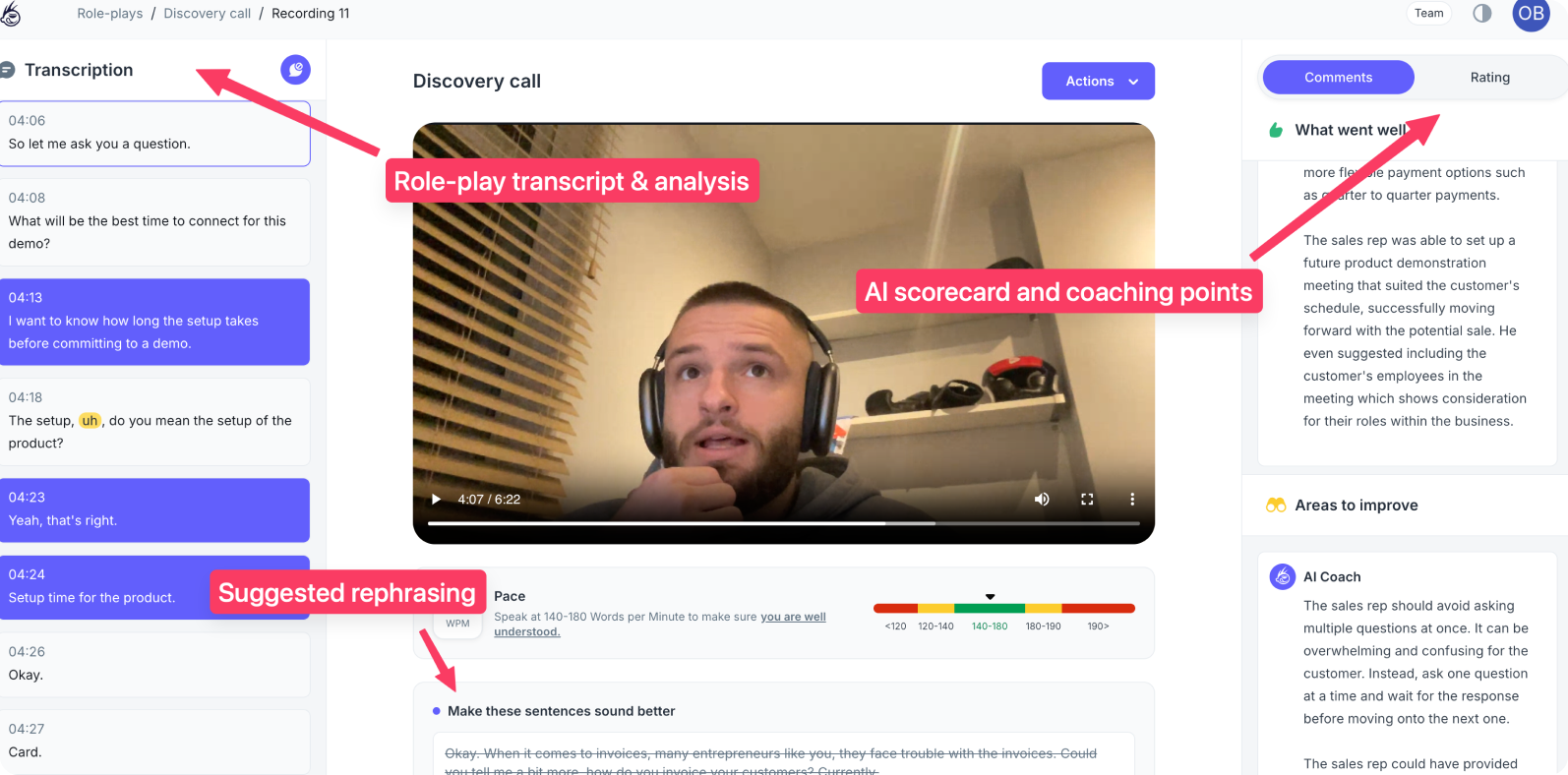
After a role-play session ends, PitchMonster's AI Coach intercepts before the score is revealed. A modal reads roughly: great effort, before showing your full score, let's review a few points together, would you like a quick coaching session. The rep is free to skip it or accept.
The rep reflects and self-diagnoses first, and only then sees the number. The AI Coach opens with reflective questions before it gives its own read, and it stays available 24/7 as a persistent tab on the review screen. Nothing else in this comparison, LMS or enablement suite, describes that specific ordering: reflection before the score.
Role-plays built from your own deals
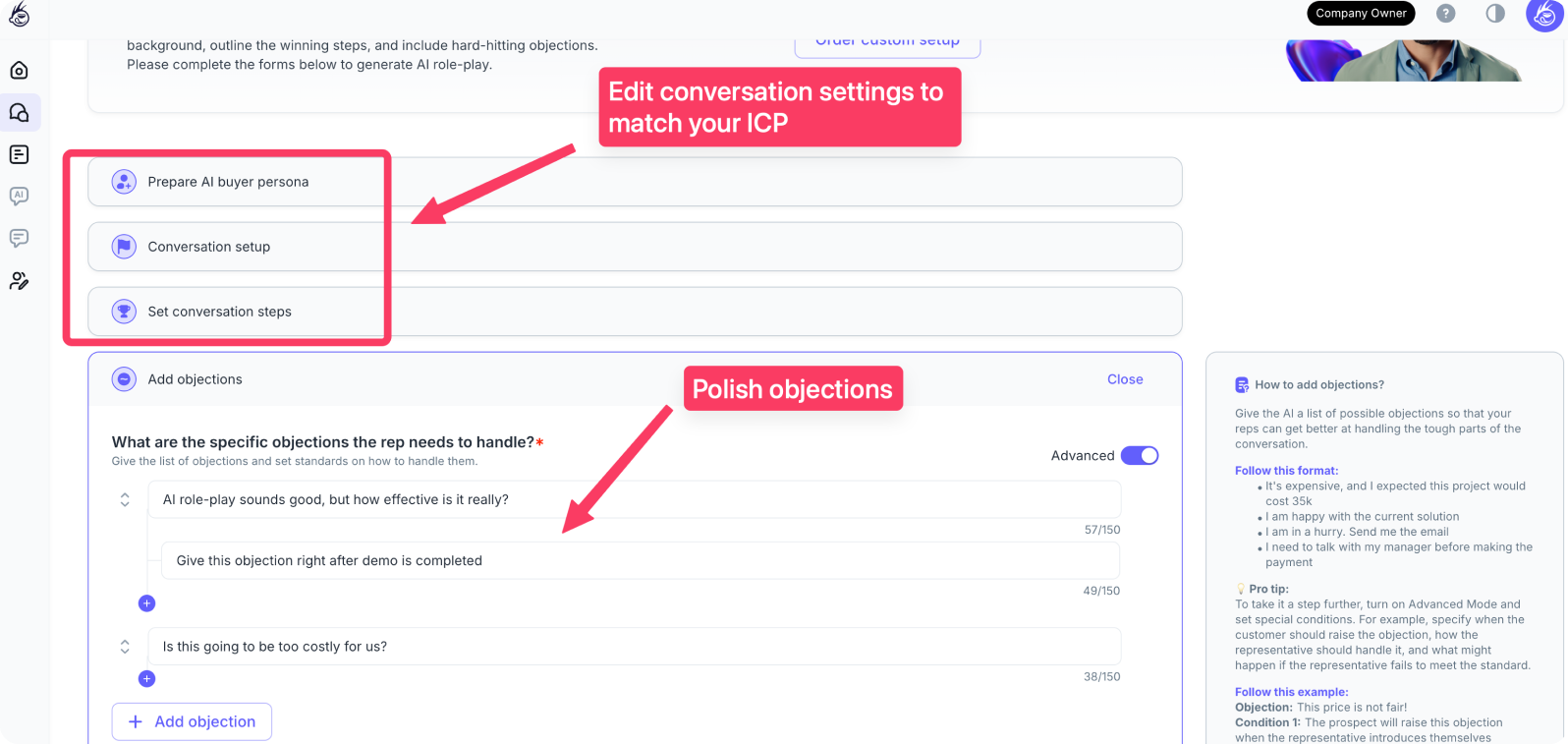
A scenario gets built from 5 sources: a website link, uploaded product or enablement documents, a real call recording or transcript. It can also be built from a filled CSV template or a direct Salesforce or Gong connector. PitchMonster's Replicate feature rebuilds a persona from that call recording or transcript, and the connector pulls the buyer and scenario straight from a real call or opportunity. Each persona carries a difficulty setting across 4 levels: Easy, Medium, Hard and Insane.
Objections, conversation starters and context all attach to the scenario itself. A scorecard groups the criteria a rep gets judged on. It gets built against named methodologies, including MEDDIC, MEDDPICC, SPICED and Challenger, or a custom template a team builds on its own.
What managers get back
On the session review screen, every scorecard group carries its own star rating out of 5, expanded into the individual criteria a rep met or missed. The per-role-play performance view then bands those same groups Low, Mid or High. A manager can see exactly which part of a conversation is weak, rather than one blended score. A per-role-play performance view tracks recordings with an 80%-plus score and users with an 80%-plus score, each as a count and a percentage of the total.
An improvement-over-time chart plots progress against a pass-threshold line. At the workspace level, the same view rolls up across the whole team. It shows total recordings, total practice minutes, average score and the 80%-plus rate, per rep, in one table. Our guide to sales coaching for managers covers how to turn this kind of skill-gap data into an actual coaching conversation instead of a report nobody opens.
Proof it moves the numbers
Immersive ramped new hires 40% faster than previous cohorts, cutting onboarding from 10 weeks down to 6. At Syngenta, within 3 weeks of starting practice, 90% of participants reported increased confidence and internal assessments showed a 27% improvement in message delivery accuracy. Both sets of numbers come from PitchMonster's published Mentor Group customer story, not an internal estimate.
Where it falls short
PitchMonster is not an LMS, and it will not hold your compliance records or your general course catalogue. It was never built to be a system of record for training history the way the 8 platforms above are. There is no native SCORM, xAPI or LTI package.
Building a scenario by hand takes real minutes, even with the source-material tiles doing most of the work. And it is sold by quote, with onboarding, a dedicated customer success manager and support included (see pricing for how that works). It is not a self-serve product you spin up on a credit card.
Best for mid-market and enterprise revenue, enablement and learning teams that already have, or are building, an LMS and need the live-practice layer it cannot provide on its own. See our AI sales role-play training overview and our sales enablement solutions page for the fuller picture. Or book a demo to see the AI Coach on your own scenario.
How PitchMonster connects to your existing LMS

The honest answer starts with what PitchMonster does not do. It has no native SCORM, xAPI or LTI package, so it will not show up inside your LMS as a plug-in course the way a compliance module does.
What it does instead is move data out to wherever your LMS, CRM or BI tool needs it. Webhooks, delivered through Svix, fire the moment a role-play recording is complete and feedback is ready, pointed at a destination URL you configure yourself. A REST API and an SFTP export carry scores and completion data out to an LMS, a BI tool or a CRM. That replaces a manual CSV someone has to remember to run. SAML SSO handles enterprise login, and the same Salesforce and Gong connectors used to build scenarios can also pull the context those platforms already hold.
An enablement lead at a large media company asked PitchMonster's founder this exact question directly on a demo call. They wanted to know whether the platform supports LTI or xAPI for their in-house LMS. The answer, given on that call rather than in published documentation, was direct: "Not LTI. That's basically either API or SFTP connection or the export of the data."
That is still the accurate answer today. If your LMS purchase depends on a native LTI or xAPI package, PitchMonster is not that product. If it depends on getting practice scores into whatever system you already run, the mechanism above is how it happens.
Best picks by team type
Team shape | What to look at first | Why |
|---|---|---|
Under 40 reps, no LMS yet | A self-serve, published-pricing platform such as TalentLMS or 360Learning's Team tier | Neither requires a multi-year contract or a 250-plus learner minimum, and both let a small team try the product before committing budget |
40 to 150 reps, LMS already in place | A dedicated sales-training layer such as Mindtickle or Seismic Learning, evaluated alongside a separate practice tool | At this size, sales training usually needs to be a named product, not a generic label, and the existing LMS stays in place for company-wide content |
150-plus reps in a regulated industry | Litmos, specifically for its documented SCORM, xAPI and AICC support, verified in writing against your actual compliance requirement | Compliance and content-portability requirements need confirmation on paper before a large, regulated rollout |
Reps pass every course and still lose calls | A live AI role-play and coaching layer such as PitchMonster, run beside whatever LMS is already in place | Completion and quiz scores measure content consumption. They say nothing about a real call under objection pressure |
If most of your reps work remote across time zones, read our guide to sales learning platforms for remote teams. It covers a wider mix of async and live-coaching options built for exactly that setup.
Common mistakes teams make buying an LMS for sales
Buying a general LMS and assuming sales training comes with it
Sales training appearing as a named category on a homepage is not the same as it being a built-out, dedicated capability. 6 of the 8 platforms here treat sales as one use case inside a general LMS. 2 of those 6 document no sales-specific feature detail beyond the label at all: TalentLMS and Absorb LMS. 360Learning stops at asynchronous video coaching. Ask to see the sales-training content itself before you assume the gap is covered; a marketing page that names the category proves nothing on its own.
Treating a quiz score as proof a rep can sell
A completed course and a passed quiz tell you a rep consumed content and can recall it under low pressure. Neither tells you whether that rep can handle a real objection, adjust a pitch mid-conversation or recover from an interruption. Teams that stop measuring at completion rate often discover the gap only after a rep loses a real deal to it.
Skipping the SCORM and xAPI question until after signing
Only Litmos states SCORM, xAPI and AICC support directly on its own pricing page among the 8 platforms reviewed here. The other 7 may support some or all of it without documenting it publicly. Not documented and not supported are different findings, and the difference matters most on a regulated or multi-system rollout. Get the answer in writing before the contract is signed.
Assuming quote-only pricing means the vendor is hiding something
5 of the 8 platforms in this comparison publish no pricing figure anywhere on their own site. That is a normal pattern for an enterprise sales motion. The mistake is assuming the silence means the same thing across vendors. Docebo at least states a starting learner count and contract length, while Mindtickle and Absorb LMS state neither. Ask each vendor the same specific questions rather than reading the silence as a signal on its own.
Picking the platform with the best demo instead of the one that fits your team size
A polished demo answers whether a platform can do the thing, not whether it fits a 40-person team versus a 400-person one. Docebo's stated minimum of 250-plus learners and a 1-year-plus contract rules it out for a small team regardless of how good the demo looked. Match a platform's actual minimum seats and contract length to your team size before the demo.
Mistake | What it costs | The question to ask instead |
|---|---|---|
Buying a general LMS and assuming sales training comes with it | A team assumes sales-specific depth that was never built, then finds only a label | Can you show me the sales-training content itself, beyond the page that names it? |
Treating a quiz score as proof a rep can sell | Reps who pass every course still lose real deals to an objection no quiz ever tested | Does this measure how a rep handles a live objection, beyond content recall? |
Skipping the SCORM and xAPI question until after signing | A regulated or multi-system rollout stalls when a claimed capability was never documented in writing | Is SCORM, xAPI or AICC support stated in writing, beyond being described on a call? |
Assuming quote-only pricing means the vendor is hiding something | A buyer rules out a platform over normal enterprise silence instead of asking directly | What is the actual starting learner count and contract length, even without a dollar figure? |
Picking the platform with the best demo instead of the one that fits team size | A team signs a multi-year, high-minimum contract that never matched its actual headcount | What are the actual minimum seats and minimum term, before the demo? |
Frequently asked questions
Which LMS is best for sales training?
Which LMS is best for sales training depends on whether you need a dedicated sales product or a general course catalogue. Mindtickle and Seismic Learning build sales training as their core, named use case. Docebo, Litmos, 360Learning, iSpring LMS, TalentLMS and Absorb LMS all treat it as one category inside a broader corporate LMS, with sales-specific depth varying widely between them.
Do sales teams need an LMS if they already have a sales enablement platform?
Sales teams need an LMS if they already have a sales enablement platform when compliance records, certifications or a company-wide course catalogue are the actual gap. Most enablement platforms are built for content and coaching workflows, not formal training records. Many mid-size and larger sales organizations run both, because each answers a question the other was never built to answer.
Which AI coaching tools work with an existing learning management system?
AI coaching tools that work with an existing learning management system typically connect through an API, a webhook or a scheduled data export rather than a native plug-in. PitchMonster, for example, delivers webhooks through Svix when a role-play recording is complete. A REST API and SFTP export carry scores and completion data, rather than a SCORM or xAPI package built into the LMS itself.
Can a platform connect learning management with sales software?
A platform can connect learning management with sales software through named CRM integrations, most commonly Salesforce, which is documented across most of the 8 platforms in this comparison. Direct HubSpot integration is not documented on any of their own pages checked for this review, so confirm that specific connector in writing if HubSpot is your CRM.
What does a sales training LMS cost at a mid-to-large enterprise?
What a sales training LMS costs at a mid-to-large enterprise is rarely published; 5 of the 8 platforms here are entirely quote-only. Where figures exist, they range from TalentLMS's self-serve $119 to $449-plus per month up through Docebo's multi-year enterprise contracts sized around a 250-plus learner minimum. Get a quote sized to your actual seat count rather than budgeting from a generic figure.
Can we track sales training completion directly inside the CRM instead of a separate LMS?
Tracking sales training completion directly inside the CRM instead of a separate LMS is possible through an export. It is not a native feature of any of the 8 platforms reviewed here. Scores and completion data move into a CRM through an API, a webhook or a scheduled file export. That is the same mechanism a separate practice tool such as PitchMonster uses to reach a CRM, BI tool or LMS.
Is AI role-play something an LMS includes, or is it a separate tool?
Whether AI role-play is an LMS feature or a separate tool depends on the platform. Docebo, Mindtickle and Seismic Learning each document a named AI role-play feature. iSpring LMS and Litmos offer a more limited version: a pre-scripted scenario or a scored recording. None of the 8 platforms documents a coaching step that runs before the score is shown, on the pages checked for this review. That step is the part a practice tool adds beside the LMS.
What is the best LMS for pharmaceutical sales rep training compliance?
This review did not check pharmaceutical-specific compliance claims on any of the 8 platforms, and none surfaced on the pages we did check. A regulated-industry buyer needs that conversation directly with the vendor, not an assumption from a compliance claim. Litmos is the one platform that states SCORM, xAPI and AICC support in writing, the closest starting point for a compliance-heavy evaluation. Ask about audit trails, certificate expiry rules and validated-training records before assuming any general-purpose LMS covers pharmaceutical compliance.
The bottom line
An LMS for sales training earns its place in the stack. It stores your content, delivers it on a schedule and reports who finished what, and none of the 8 platforms compared here fail at that basic job. Where they differ is how much sales-specific depth sits underneath the label. Pricing transparency differs too, and so does whether SCORM, xAPI or AICC support is stated in writing rather than assumed.
Start from what you can name in one sentence: a compliance gap, a content-catalogue gap, or a gap where reps pass every course and still lose real calls. The first 2 point you toward the platforms compared above. The third points toward a live practice layer running beside whatever LMS you keep, which is the gap PitchMonster was built to close.
If that third gap is the one costing you deals, our sales leaders resources page is a reasonable next stop before you shortlist anything.