Mindtickle pricing is quote-only and not published on its site. Third-party resellers report list rates near $100 to $200 per user per year for the readiness platform, plus one-time onboarding of $10,000 to $50,000 or more. Annual contracts commonly run $50,000 to $150,000 for small teams and climb past $400,000 at enterprise scale. This review breaks down the tiers, the real ranges, and who Mindtickle fits.
If you are pricing Mindtickle against a tighter, practice-first tool, jump to the Mindtickle vs PitchMonster comparison or the wider list of Mindtickle alternatives. Every figure below is a reported third-party range from mid-2026, not an official Mindtickle rate card. The only accurate number for your team is the one on a quote.
PitchMonster publishes its rates, so you can put real numbers next to the estimates below: see PitchMonster pricing.
How much does Mindtickle cost?
Mindtickle costs what you negotiate, because there is no public price list and no self-serve signup. Reseller and review-site data put the readiness platform near $100 to $200 per user per year at list, with the total contract shaped by seat count, packages, and term. Once onboarding and support are added, small teams commonly land in the tens of thousands a year and large ones well into six figures.
The table below pulls the most reliable third-party figures into one planning range. Read it as a starting estimate, not a guaranteed price.
Cost component | Reported range | Source basis |
|---|---|---|
List price per user, per year (readiness platform) | $100 to $200 | Reseller list data (Vendr) |
Call AI add-on, per user, per year | $50 to $100 | Reseller list data (Vendr) |
Typical annual contract, 10 to 50 users | $50,000 to $150,000 | Reseller deal data (Vendr) |
Median annual contract (all sizes) | ~$44,000 | Reseller deal data (Vendr) |
Reported average annual spend | ~$92,000 | Third-party pricing index (JustCall) |
One-time onboarding / implementation | $10,000 to $50,000+ | Reseller deal data (Vendr) |
Premium support | 10% to 20% of contract value | Reseller deal data (Vendr) |
Module add-ons (Digital Sales Rooms, Revenue Intelligence) | +20% to 40% of base | Reseller deal data (Vendr) |
Free plan / self-serve trial | None | Mindtickle subscription terms |
Two things stand out. First, the license is only part of the bill, since onboarding and premium support can add five figures before a single rep logs in. Second, the spread is wide because Mindtickle scales from a few hundred seats to tens of thousands, and volume discounts at the top end pull the per-user rate down hard. Treat the license, onboarding, and support as one number when you compare it to a lighter tool.
What is Mindtickle?
Mindtickle is a sales readiness and revenue enablement platform that bundles training, content management, conversation intelligence, and AI role-play into one system. It is built for larger revenue organizations that want foundational learning, coaching, and analytics under a single roof, tied back to CRM data. Founded in 2011, it became a unicorn after a 2021 SoftBank-led round and now serves teams from startups to the Fortune 500.
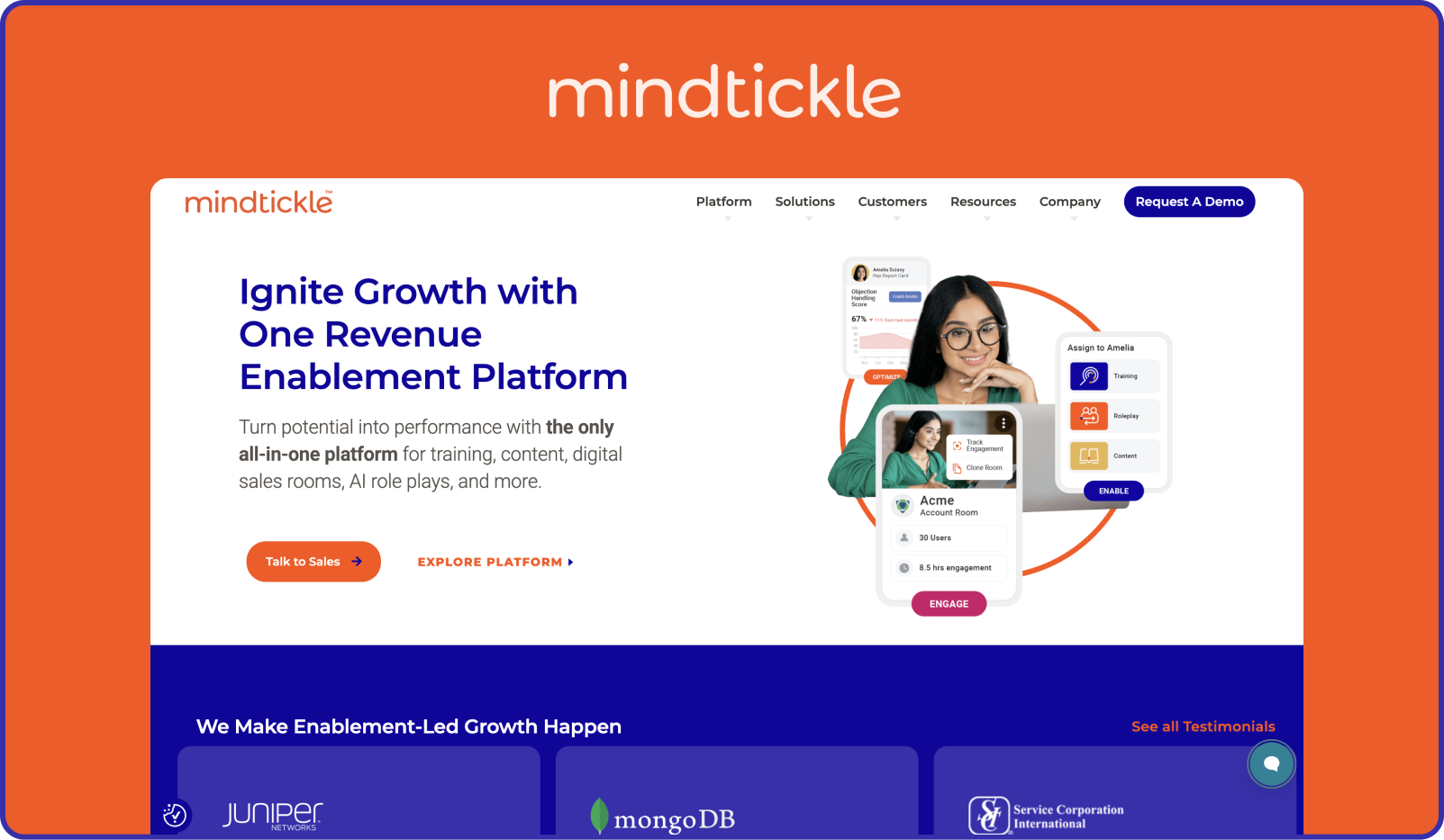
The platform is best understood as a suite rather than a single tool. Its readiness modules run onboarding, learning paths, and certifications. Its Call AI records and analyzes live calls. Its content management and Digital Sales Rooms handle buyer-facing material, and its AI Role Play lets reps rehearse pitches with automated feedback. That breadth is the reason it prices at enterprise levels, and the reason smaller teams often find it more suite than they need.
Because it competes with content-led suites like Highspot and Seismic and with focused practice tools, the pricing question is really a fit question. The rest of this review answers both: what Mindtickle actually costs, and which teams get their money's worth.
Mindtickle pricing tiers, broken down
Mindtickle packages its platform into editions that build on each other, then layers on modules like Call AI and Digital Sales Rooms. The company does not attach public prices to these packages, so the table below shows what each one adds and the segment it fits, using reported package structure rather than invented per-tier dollar figures.
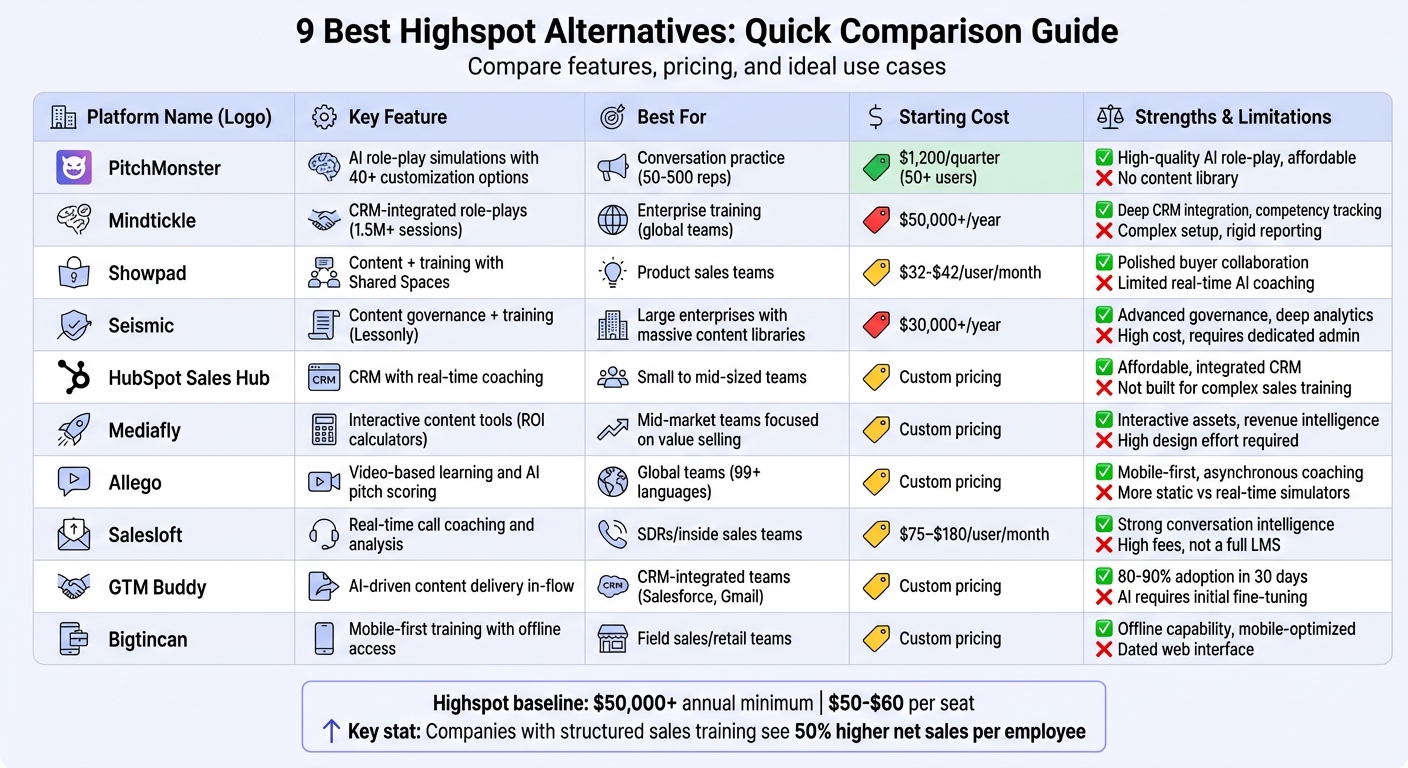
Package | What it adds | Pricing fit |
|---|---|---|
LMS | Adaptive and gamified learning, certifications, program templates | Teams standardizing foundational training |
Readiness | Everything in LMS plus virtual role-plays, AI feedback, data-driven coaching | Teams building a formal readiness program |
Enable | Everything in Readiness plus content management, Digital Sales Rooms, buyer engagement tracking | Mid-market teams running content-heavy deals |
Transform | Everything in Enable plus call recording and analysis, field activity insights, advanced analytics | Large orgs consolidating multiple tools |
The practical takeaway is that the base package is the anchor everyone pays for, and the bigger numbers come from moving up the stack and adding seats. A 30-rep team on the LMS or Readiness package sits in a very different place than a 2,000-seat enterprise running Transform with full conversation intelligence. Match the package to the job you actually need done, then price only that.
Mindtickle pricing by team size
Because Mindtickle is quote-only, the most useful way to plan a budget is by segment. Per-user rates fall as seat count rises, so the same platform lands very differently for an SMB than for an enterprise. The reported annual bands below come from reseller deal data and reflect the license plus typical modules, before onboarding.
Gong runs the same quote-only playbook, and our Gong pricing breakdown shows the licenses, platform fee, and add-ons that make up a first-year bill.
Segment | Team size | Reported annual contract | What to expect |
|---|---|---|---|
SMB | Under 50 reps | $50,000 to $150,000 | Little room to discount per seat; onboarding fee stings most here |
Mid-market | 50 to 200 reps | $150,000 to $400,000 | Volume discounts begin; add-on modules drive the spread |
Enterprise | 200+ reps | $400,000 to $1,000,000+ | Deepest discounts per seat, but full-suite deployments and support fees push the total up |
For an SMB, the math is the hard part. A sub-50-seat team pays close to full list, absorbs the same five-figure onboarding a larger buyer does, and rarely uses the whole suite. That is why a focused practice tool so often wins for smaller teams. At the enterprise end, the per-seat rate drops sharply, which is where Mindtickle's consolidation story starts to pay off. The middle is where module choices decide whether you land near $150,000 or near $400,000.
What drives your Mindtickle quote
Because pricing is negotiated, a handful of variables decide where your number lands. Knowing them helps you read a quote and push back on it.
Seat count is the biggest lever. Per-user rates fall sharply with volume, and reported discounts deepen once a deployment passes several hundred users. A small team pays near full list; a large one does not, which is why the same platform can feel expensive or reasonable depending on scale.
Contract length matters almost as much. Mindtickle favors multi-year commitments, and shorter terms carry higher per-user rates. Reported deals also include a 3% to 7% annual price escalation, so a three-year contract locks in a rising cost you should model up front.
Module mix is the third driver. The base package sets the floor, but Call AI, Digital Sales Rooms, and revenue intelligence each add to the per-user cost, with add-on modules reported to raise the base by 20% to 40%. The more of the suite you light up, the higher the quote.
Timing plays a smaller role. Buyers who negotiate near the end of a quarter and commit to longer terms tend to secure better rates, the same pattern you see across enterprise software. Bring a real seat count and a shortlist of alternatives, and the quote usually improves.
What is included in Mindtickle
For an enterprise budget, Mindtickle delivers a genuinely broad platform. Understanding what is in the box helps you judge whether you would otherwise buy several of these tools separately, which is the case where the price makes the most sense.
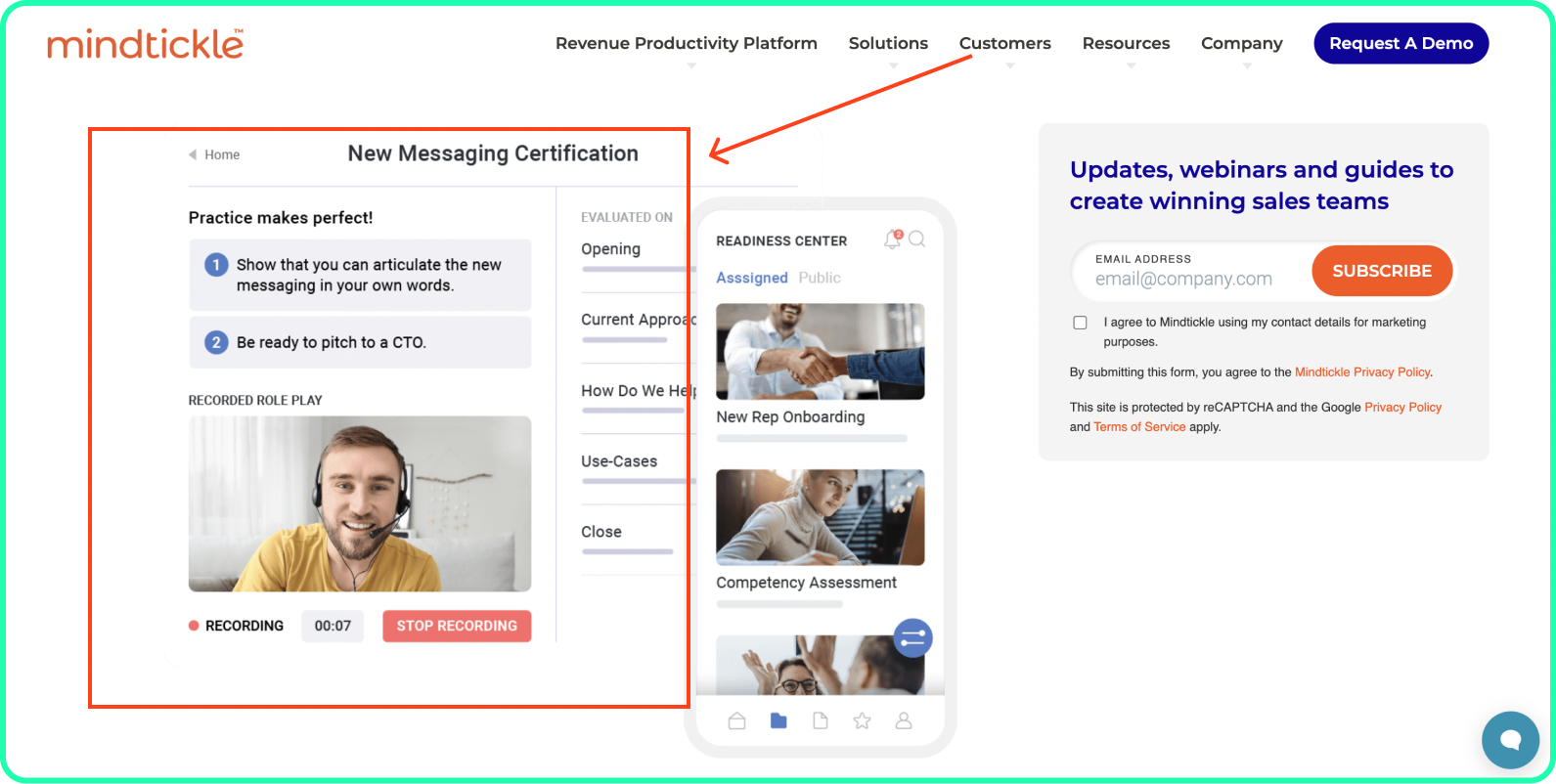
The core modules cover the full readiness-to-revenue loop:
- Sales Training and Readiness Index for onboarding, learning paths, certifications, and a benchmark score for rep readiness.
- AI Role Play for pitch practice with automated feedback on talk tracks and pacing.
- Coaching that gives managers skill and performance data to run personalized sessions.
- Conversation Intelligence (Call AI) for recording, transcribing, and analyzing live calls.
- Sales Content Management and Digital Sales Rooms for surfacing deal content and building buyer-facing spaces.
- Copilot, an AI assistant that pulls context across the platform for revenue teams.
The strength here is consolidation. A large org replacing an LMS, a content tool, and a call-recording product with one platform can justify the spend and simplify its stack. The catch, which reviewers raise often, is that the breadth needs an owner. Standing up learning paths, content, and scorecards is real administrative work, and teams without a dedicated enablement or L&D function tend to use a fraction of what they pay for.
Mindtickle G2 rating and reviews
Mindtickle holds a 4.5 out of 5 rating on G2 across roughly 2,399 reviews, with additional 4.8 out of 5 scores on Software Advice and Capterra from smaller review sets. By any measure it is a well-reviewed, mature product, so the useful question is what buyers consistently praise and criticize.
Reviewers praise the breadth and the analytics. Teams that want one system of record for readiness, content, and coaching value having it in a single place, and managers like the visibility into how reps engage with training. The AI role-play and coaching data get called out as genuinely useful for larger programs.
The recurring criticisms are just as consistent. Buyers flag the total cost of ownership once mandatory add-ons and support are included, the administrative overhead needed to configure and maintain the platform, and an inconsistent mobile experience. As one common theme puts it, the platform is powerful but can feel like more than a team needs, which is the classic sign of a suite bought for a job a focused tool would do. Weigh those reviews against your own team's appetite for admin before you sign.
Mindtickle pros and cons
Here is the straight read on where Mindtickle is strong and where it strains, based on reported pricing and consistent reviewer feedback.
The pattern is clear. Mindtickle rewards scale and punishes small deployments, so the pros and cons map almost entirely to your team size and how much of the suite you will actually use.
Is Mindtickle worth it?
Mindtickle earns its price when you need one platform to run readiness, content, conversation intelligence, and practice across a large selling org, and when you want training tied back to revenue outcomes. It is hard to justify when your real gap is narrower than that. Below is a straight read on both.
Where Mindtickle is worth it
- You are managing hundreds or thousands of reps and want a single system of record for enablement.
- You need conversation intelligence and content management alongside training, and would otherwise buy them separately.
- You have an enablement or L&D team with time to build content and run the platform.
- You want closed-loop reporting that connects training activity to CRM performance.
- Volume gets you deep enough discounts that the per-user rate becomes reasonable.
Where Mindtickle is hard to justify
- Your team is under 50 reps and the per-user list rate has little room to discount.
- Your main goal is realistic call practice and coaching, not a full content and analytics suite.
- A multi-year contract and a five-figure onboarding fee are more commitment than you want.
- You do not have a dedicated owner to build and maintain the content library.
- You need reps practicing this month, not after a multi-week implementation.
If three or more of the "hard to justify" points describe your team, a focused practice platform usually delivers faster and costs less. That is the trade the next two sections walk through.
PitchMonster: the role-play and coaching alternative
If the reason you are pricing Mindtickle is that reps freeze on objections or ramp too slowly, the job you actually need done is practice and coaching, not a full enablement suite. That is the gap PitchMonster is built for. It is the AI sales role-play platform teams add when the goal is rep readiness rather than a content-and-analytics system, and it is quote-only with no setup fee and onboarding in hours.
PitchMonster does not replace a content library or an LMS. What it does is get reps rehearsing real conversations against AI buyers built from your ICP, scored on your own playbook, with coaching after every session. For many teams that is the part of enablement that actually moves win rates, which is why some run it as a practice layer alongside a broader platform rather than instead of one.
Adaptive AI buyers that push back like your ICP
Reps run cold calls, discovery, and full demos against AI buyers that adapt, object, and push back like your real prospects, then get scored against your playbook. Practice runs in screen-share, face-to-face, or phone modes, so an SDR cold call and a solutions demo each rehearse in the right format. This is live-fire practice without burning real pipeline, which a content suite cannot offer.
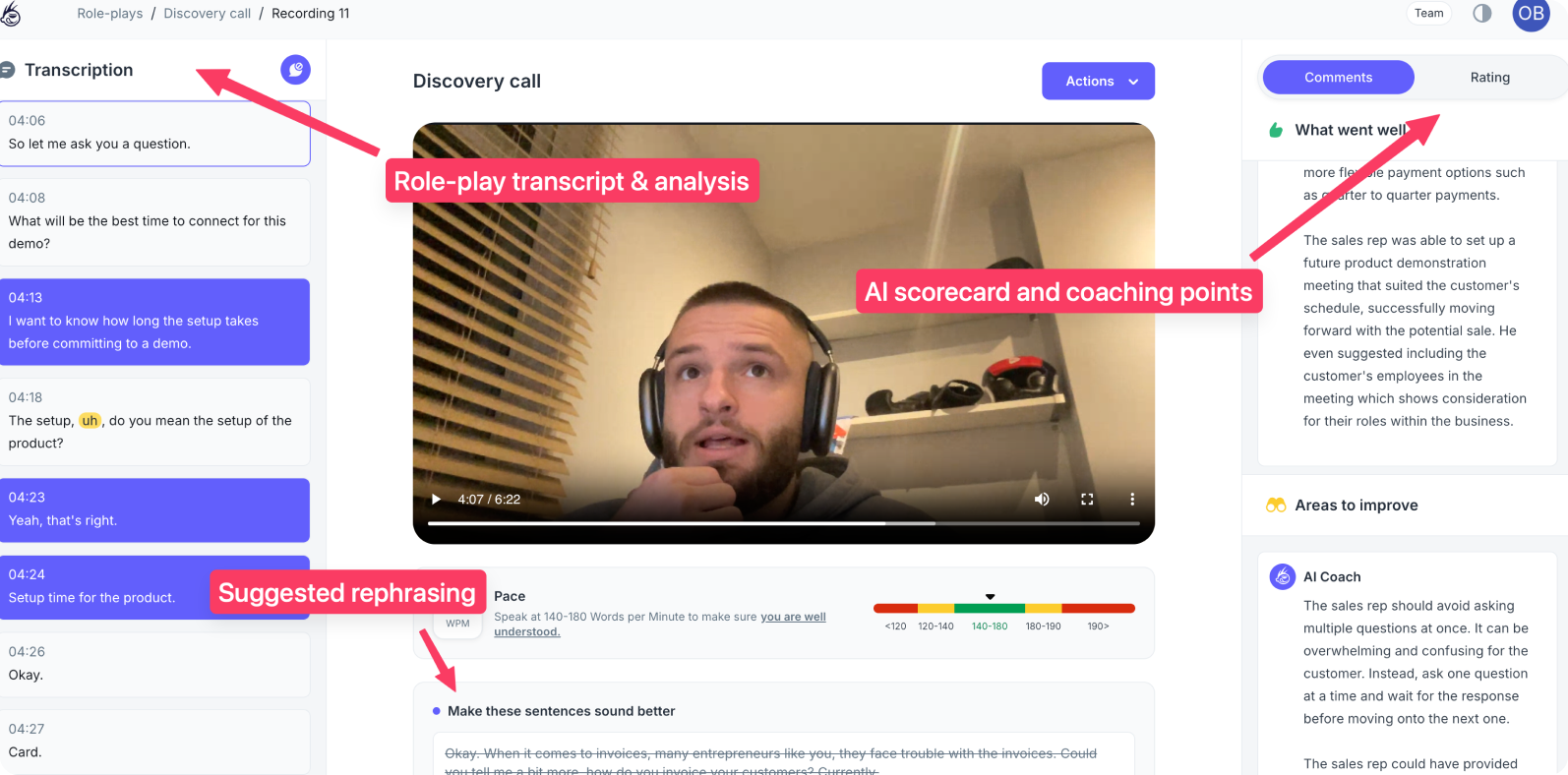
The AI Coach: a Socratic debrief after every session
What sets PitchMonster apart is the AI Coach. After every session, a Socratic AI sales trainer asks reflective questions that guide the rep to their own insight before they ever see a score, and it runs 24/7. Self-diagnosed lessons stick, so the fix holds on the next live call in a way a handed-down score rarely does. As one customer put it, "I think I really like the AI coach. That's definitely going to save us a lot of time" (Wendy Mateo De Perkins, One Park Financial).
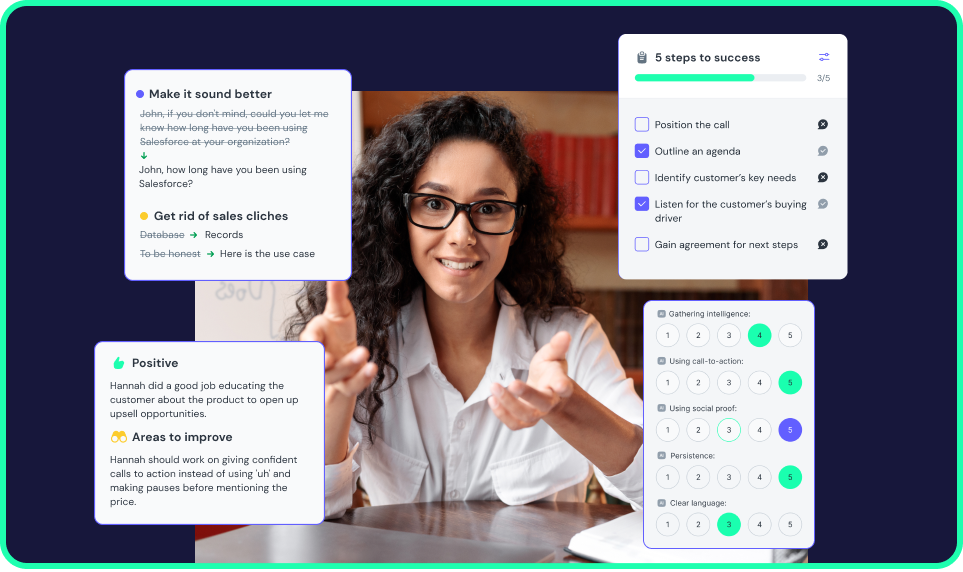
Build a scenario in about two minutes
A manager can build a scenario from product docs, a call recording, a transcript, or a website URL in about two minutes, with 40-plus customization parameters, four difficulty levels including an Insane mode, and support for 27-plus languages. A new competitor, objection, or product launch becomes a fresh role-play the same afternoon, instead of a content project that takes weeks.
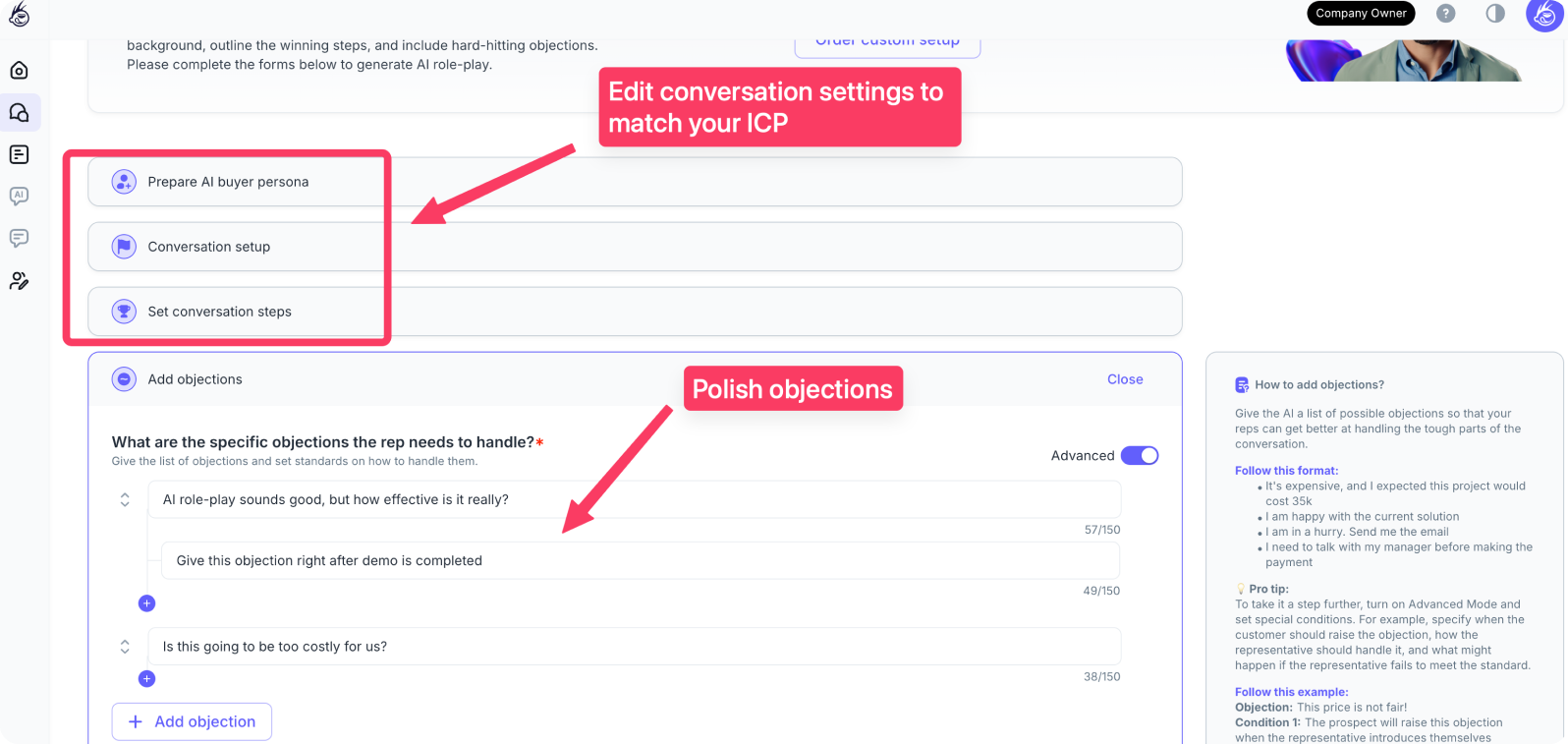
Live call analysis on the same scorecard
Beyond role-play, reps can upload real call recordings and have them scored against the same playbook used in practice. Managers see where reps won, lost, or missed, and can turn a real lost call into a targeted practice scenario. Rehearsal and live performance are measured the same way, so coaching stays consistent from the first practice rep to the closed deal.
Fits your stack, and knows where it stops
PitchMonster integrates with Salesforce, HubSpot, and Gong, and exports rep scores to your CRM, LMS, or Power BI via API. It is also the only European-based platform among the leading practice tools, with EU data residency and GDPR built in. Where it stops is content management, so teams that need both practice and a content hub pair it with a suite rather than replacing one. Pricing is quote-only with onboarding, a dedicated CSM, and support included and no setup fees. See pricing for your team size.
Teams using PitchMonster's practice-and-coaching loop have seen 37% higher performance and 30% faster ramp (Mentor Group case study). It fits teams of 10 to 300 reps who need sellers ready before live calls and want coaching that scales without hiring more trainers.
See it on your own use case. Book a demo and run your first AI role-play, built from your product and your ICP, in about two minutes.
Mindtickle vs PitchMonster
Mindtickle and PitchMonster solve different problems. Mindtickle is a broad enablement suite priced for the enterprise. PitchMonster is an AI sales role-play platform built around practice and coaching, led by its AI Coach. The table compares them on the dimensions buyers ask about most.
Dimension | Mindtickle |  PitchMonster PitchMonster |
|---|---|---|
Pricing model | Quote-based, per user, multi-year | Quote-based, per seat (see pricing) |
Reported cost | ~$50K to $400K+/year plus onboarding | By quote; no setup fees |
Onboarding fee | $10K to $50K+ reported | None; onboarding, CSM, and support included |
Setup time | Several weeks reported | Guided onboarding in hours |
Core focus | Readiness, content, conversation intelligence, training | AI role-play, live call analysis, AI Coach |
Coaching | Manager-led plus analytics | AI Coach: Socratic, post-session, available 24/7 |
Conversation intelligence | Included (Call AI) | Live call analysis scored on your playbook |
Content management / LMS | Included | Not included |
Data residency | Global | EU base, GDPR and EU data residency |
Best fit | Large orgs consolidating tools | Teams of 10 to 300 focused on practice and ramp |
The cost gap is real, and so is the focus gap. A team can run PitchMonster for a year for less than a single Mindtickle onboarding fee, but the sharper point is scope: Mindtickle buys you a whole suite, while PitchMonster buys you the deepest version of the one job most teams are actually failing at. If practice and coaching are the goal, the lighter tool is usually the better buy. If you need content governance and formal certification across thousands of sellers, Mindtickle is the broader system. For a closer head-to-head, see our Mindtickle alternative breakdown. For the full comparison guide, see PitchMonster vs Mindtickle.
Other Mindtickle alternatives
If the Mindtickle quote is more platform and more budget than you need, several tools cover narrower jobs at lower cost. The right pick depends on which part of enablement you are actually trying to fix.
For realistic call practice and coaching, an AI role-play tool like PitchMonster focuses spend on the conversations reps lose deals in, without paying for content management or an LMS. For a broader roundup, see our companion guide to Mindtickle alternatives that help close more deals.
For content governance at enterprise scale, Seismic and Highspot are the closest suites, though both are quote-only and sit in a similar per-user-plus-onboarding band to Mindtickle, so they compete on scope rather than undercut it on price. Get a quote from each, since none of the three publish rates.
For teams that mainly need foundational training, a lighter LMS or onboarding tool often covers the job Mindtickle's readiness modules do, at a fraction of the cost. For a view of what to look for across the category, the sales enablement solution page lays out the buying criteria.
The pattern across alternatives is consistent. You save money by buying the specific capability your team needs now, rather than a full suite you plan to grow into later. Start with your single biggest gap, price that, and add a second tool only if you actually need one.
FAQ
How much does Mindtickle cost?
Mindtickle does not publish list prices. Third-party resellers report list rates near $100 to $200 per user per year for its readiness platform, plus $10,000 to $50,000-plus in onboarding. Annual contracts commonly run $50,000 to $150,000 for small teams and climb past $400,000 at enterprise scale. Your real number comes from a quote.
Does Mindtickle have a free trial or free plan?
No. Mindtickle has no public free plan and no self-serve free trial. Access starts with a sales conversation and a custom quote, and most agreements are annual or multi-year. Buyers who want to see the product first usually request a guided demo or a scoped pilot rather than signing up online.
Why is Mindtickle pricing not public?
Mindtickle uses quote-based enterprise pricing, so the figure on your contract depends on package, seat count, modules, and term length. List rates from resellers and review sites give a useful range, but the only accurate number for your team comes from a Mindtickle quote. Treat published prices as a starting estimate, not a final cost.
Is Mindtickle worth it for a small sales team?
For most teams under 50 reps, Mindtickle is heavier and pricier than the job requires. Its strength is consolidating training, content, and conversation intelligence across hundreds of sellers. A small team that mainly needs reps to practice calls and get coaching usually gets there faster with a focused, lower-cost role-play platform.
Is Mindtickle legit?
Yes. Mindtickle is an established sales readiness and enablement vendor, founded in 2011 and a unicorn since a 2021 SoftBank-led round. It holds a 4.5 out of 5 rating on G2 from roughly 2,399 reviews and serves teams from startups to the Fortune 500. The debate is not whether it is legitimate, but whether its breadth fits your team and budget.
How does Mindtickle pricing compare to Seismic and Highspot?
All three are quote-only enterprise platforms, so a clean comparison needs quotes from each. Mindtickle and Highspot both negotiate around per-user list rates plus onboarding fees, and reported Mindtickle contracts commonly fall in the tens to low hundreds of thousands per year. Seismic sits in a similar enterprise band. Get a quote from each before assuming one is cheaper.