Seismic alternatives fall into three groups: content management platforms like Highspot and Showpad, sales readiness suites like Mindtickle and Allego, and AI sales role-play tools like PitchMonster. The right choice depends on whether your priority is governing content, certifying reps, or getting sellers ready before they reach a live buyer.
Seismic is a capable enablement platform, but it is heavy, priced for the enterprise, and slow to roll out. This guide compares 11 alternatives by price, setup time, and the job each one does best. It names a clear winner for each type of team, and answers the questions buyers actually search: which options are cheaper, which are AI-native, and which one is best when reps just need to practice before the real call.
Weighing PitchMonster specifically? The Seismic alternative page holds that head-to-head in one table.
Why teams leave Seismic
Seismic positions itself as an AI-powered enablement platform for large teams.
Seismic is a legitimate, well-funded enablement leader, so teams rarely leave because the product is bad. They leave because the cost, the rollout, and the fit stop making sense for where the team is now.
Pricing is the first friction point. Seismic does not publish rates and quotes per company after a demo. Enterprise contracts commonly land in five and six figures a year with annual commitments. That is hard to justify for a 30-person team that mainly needs reps to practice, not a full content-governance layer.
PitchMonster takes the opposite approach and publishes its pricing, so you can compare numbers before a single call.
Time to value is the second reason. A full enablement-cloud rollout can take months, and the platform is deep enough that adoption depends on ongoing admin work. Teams that need sellers ready this quarter, not next, feel that drag.
The third reason is new in 2026. In February, Seismic and Highspot announced an intent to merge under the Seismic name. The deal has not closed, but the uncertainty around roadmap, pricing, and support has pushed many buyers to shortlist alternatives before they renew.
There is also a fit gap. Seismic is built around content management. If your real problem is that reps freeze on objections or ramp too slowly, a content library is the wrong tool. That is where sales readiness suites and AI role-play platforms come in, and where most of the alternatives below earn their place.
Is a Seismic alternative right for you?
Switching is not always the answer. Use this quick triage to decide whether to keep Seismic, layer a second tool on top, or replace it outright.
Keep Seismic if your core need is content governance at scale, you have a dedicated enablement admin, and the price fits your budget. For large teams that mainly manage a sprawling content library and buyer-facing Digital Sales Rooms, Seismic still does that job well, and ripping it out rarely pays off.
Add a tool alongside Seismic if content management works but rep readiness does not. Many teams keep Seismic for content and bolt on a practice platform so sellers can rehearse before live calls. This is the most common path for teams whose only gap is coaching and role-play, not storage.
Replace Seismic if the cost outruns the value, the rollout stalled, or you never needed a full enablement cloud in the first place. Smaller and mid-market teams often find a lighter content tool or a focused training platform covers what they actually use at a fraction of the price.
The table below tags each alternative by the job it does best, so you can match the pick to the reason you are looking in the first place.
How we evaluated these alternatives
We did not rank these tools on feature count. We compared them on the four things that actually decide whether a Seismic alternative works for your team.
Price and contract terms, including whether pricing is public, where it starts, and how long you are locked in. A tool you can right-size to a 20-person team is rated differently from one that only makes sense at 500 seats.
Setup and time to value, measured by how long it takes to go live and how much admin work adoption needs. Tools that go live in days are separated from those that need a six-to-eight-week implementation.
Core job, because "Seismic alternative" means different things to different buyers. We tagged each tool by what it is genuinely best at: content management, sales readiness and certification, or AI role-play and practice.
Coaching and feedback depth, since the reason most teams replace Seismic is to get reps better, faster. We looked at whether a tool just stores content or actually changes rep behavior through practice and feedback.
Where a number is not public, we say so and give the segment the tool fits rather than guess. Ratings cited below come from G2 and Gartner Peer Insights, and pricing reflects each vendor's published or commonly reported figures as of mid-2026.
Seismic alternatives compared
The table groups the field by core job and adds a Pricing fit column so you can see which tools suit an SMB budget and which only make sense at enterprise scale. Reported figures are commonly cited ranges, not official vendor quotes.
Full comparison12 rows · 7 columns
Tool | Best for | Core job | Starting price (reported) | Pricing fit | Setup | Rating |
|---|---|---|---|---|---|---|
PitchMonster | AI role-play and rep practice | Sales role-play | Custom, quote-only (see pricing) | SMB to mid-market | 3-4 hrs guided | 4.9 G2 |
Highspot | Content governance and search | Content management | Custom quote | Mid-market to enterprise | Weeks | 4.7 G2 |
Mindtickle | Enterprise readiness and certification | Sales readiness | Custom quote ($30-$50/user/mo reported) | Mid-market to enterprise | 6-8 weeks | 4.7 G2 |
Showpad | Field sales and visual selling | Content management | $32-$42/user/mo (reported) | Mid-market to enterprise | Weeks | 4.6 G2 |
Spekit | Governed content and in-workflow execution | Revenue enablement | Custom quote | Mid-market to enterprise | Varies by rollout | 4.7 G2 |
Allego | Hybrid teams and video coaching | Readiness + video | Custom quote (modular) | Mid-market to enterprise | Weeks | 4.6 G2 |
Hyperbound | High-volume SDR and cold-call reps | Sales role-play | Custom quote | SMB to mid-market | Days to weeks | 4.8 G2 |
Second Nature | Structured enterprise onboarding | Sales role-play | $30-$40/user/mo (reported) | Mid-market to enterprise | Days to weeks | 4.6 G2 |
SmartWinnr | Gamified knowledge reinforcement | Readiness + LMS | Custom quote | Mid-market to enterprise | Weeks | 4.8 G2 |
Quantified | Presentation and delivery coaching | Sales role-play | Custom quote | Mid-market to enterprise | Weeks | 4.8 G2 |
Yoodli | Individual communication coaching | Communication practice | Free to $28/mo | Individual to SMB | Minutes | 4.8 G2 |
Zime | Skill-gap scoring for managers | Sales role-play | Custom quote | SMB to mid-market | Days to weeks | 4.5 G2 |
For tools marked "custom quote," vendors share pricing only after a demo, so the Pricing fit column tells you which team size each one is built for. Where a vendor publishes or commonly reports a per-seat figure, it is in the Starting price column and labeled reported.
The best Seismic alternative by team type

Managers see practice activity, scores and recordings for the whole team in one place.
There is no single best Seismic alternative, because the tools below solve different problems. Match the pick to the job your team actually needs done.
For content management at enterprise scale, Highspot is the most direct Seismic replacement. It covers content governance, buyer-facing Digital Sales Rooms, and analytics, and it is the alternative most often compared head to head with Seismic, though the pending merger means the two product lines may eventually converge.
For sales readiness and certification, Mindtickle is the strongest all-in-one option. It combines content, learning paths, AI role-play, and call analysis, which suits large teams that need a formal, auditable enablement program with role-based paths per seller persona.
For getting reps ready before live calls, PitchMonster is the best fit. It is built for AI sales role-play rather than content storage, ramps in hours instead of weeks, and is the only tool here with an AI Coach that runs a reflective debrief after every session. Teams using it report 37% higher performance and 30% faster ramp (Mentor Group case study).
For high-volume outbound teams, Hyperbound leans into gamified cold-call practice with leaderboards and calling competitions, which fits SDR floors that respond to friendly competition.
For light, fast practice for an individual or a small team, Yoodli starts free and goes live in minutes, though it coaches general communication rather than your specific sales methodology.
12 Seismic alternatives in detail
Here is the full breakdown of each Seismic alternative: what it does best, how it stacks up against PitchMonster, and the team it fits. PitchMonster leads because it is the only tool here built around AI sales role-play and post-session coaching, then the content, readiness, and practice platforms follow.
1. PitchMonster: AI sales role-play and coaching that gets reps ready before the real call
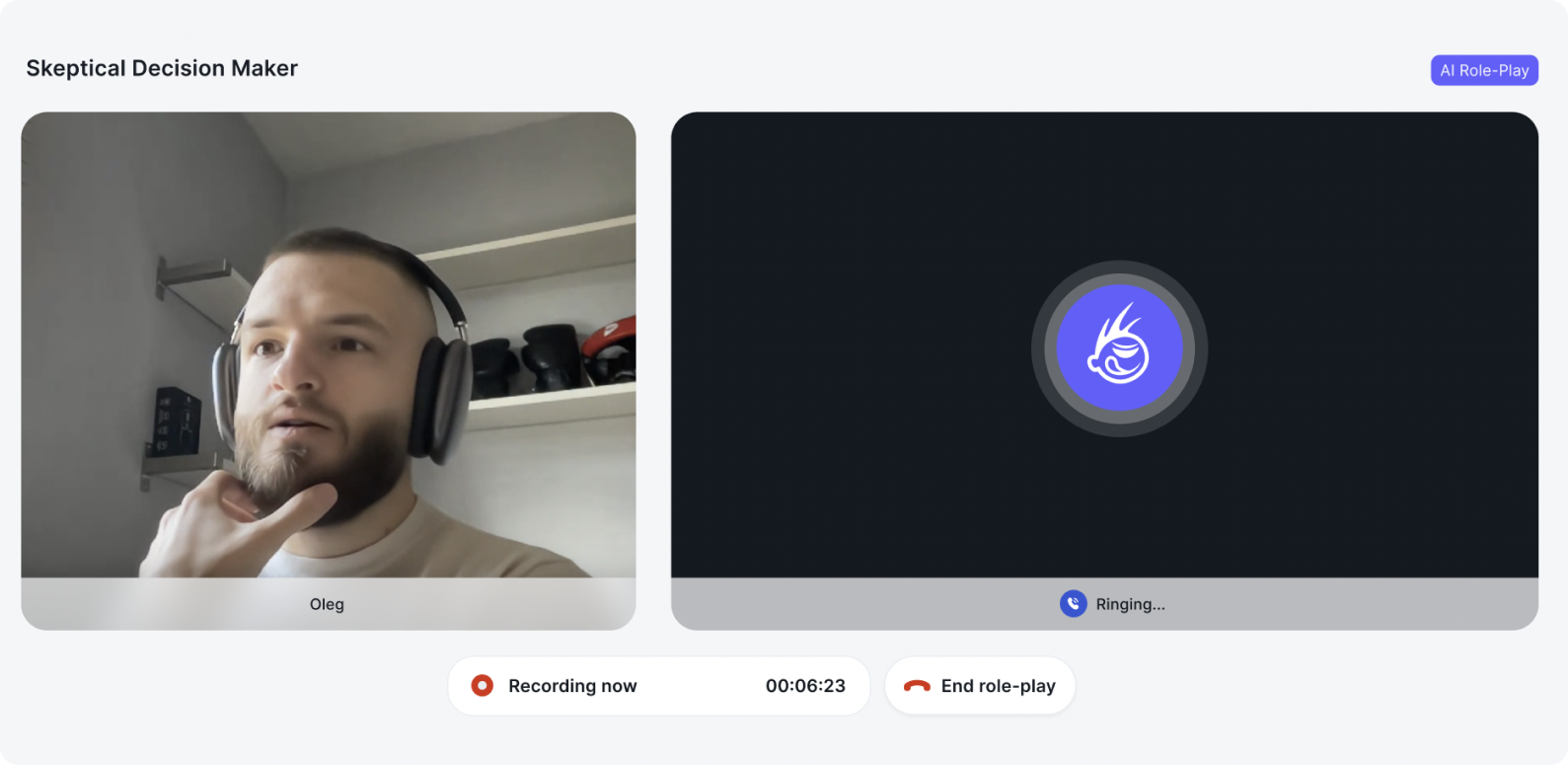
A PitchMonster role-play in progress: the rep on the left, the AI buyer on the right.
PitchMonster is an AI sales role-play platform built for one job the content tools on this list do not touch: getting reps ready before the real call. It is the one Seismic alternative here designed around rehearsal and coaching rather than content storage, which is why teams reach for it when the gap is rep readiness, not a content library. It is quote-only, ramps in hours, and pairs cleanly with a content tool like Seismic rather than replacing one.
Adaptive AI buyers that push back like your ICP
Reps run discovery, objection handling, and full pitches against AI buyers that adapt, push back, and object like your actual ICP, then get scored against your playbook. Practice runs in screen-share, face-to-face, or phone modes, so an SDR cold call and a solutions demo each rehearse in the right format. This is the live-fire practice without live leads that content platforms cannot offer, and it is why practice tools sit in a different category from Seismic.
The AI Coach: a Socratic debrief after every session
What sets PitchMonster apart is the AI Coach. After every session, a Socratic AI sales trainer asks reflective questions that guide the rep to their own insight before they ever see a score, and it runs around the clock. No content-led enablement platform on this list has an equivalent. That coaching loop is where rep behavior actually changes, which is the whole reason most teams replace a content tool like Seismic in the first place.

The AI Coach opens the debrief with a question instead of a score.
"I think I really like the AI coach. That's definitely going to save us a lot of time." - Wendy Mateo De Perkins, One Park Financial
Build a scenario in about two minutes
A manager can build a scenario from product docs, a call recording, a transcript, or a website URL in about two minutes, with more than 40 customization parameters and four difficulty levels including an Insane mode. That removes the usual blocker with enablement suites, where standing up new content is a project. Here a new competitor, objection, or product launch becomes a fresh scenario the same afternoon.
Live call analysis on the same scorecard
Beyond role-play, reps can upload real call recordings and have them scored against the same playbook scorecard used in practice. Managers see where reps won, lost, or missed, and can turn a real lost call into a targeted practice scenario. Practice and real-world performance are measured the same way, so coaching stays consistent from rehearsal to live deal.
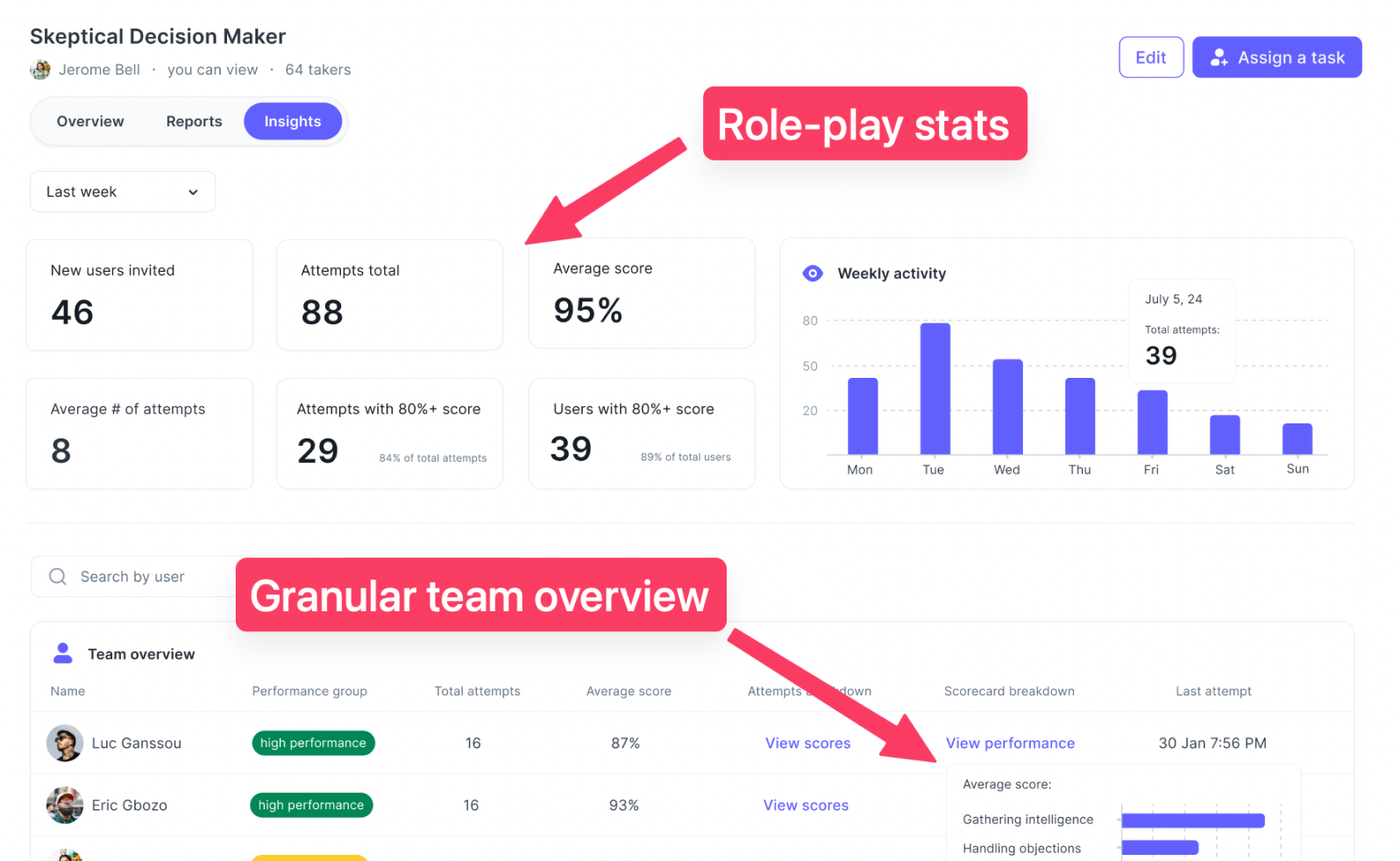
Role-play and live call scores land on one scorecard for the whole team.
Runs in 29-plus languages with CRM and BI exports
The platform runs in more than 29 languages and integrates with Salesforce, HubSpot, and Gong, exporting rep scores to HubSpot, Power BI, or your LMS via API. For a RevOps owner that means one dashboard for skill gaps, readiness, and adoption, and no rip-and-replace of the CRM. It is also the only European-based platform among the top alternatives, with EU data residency and GDPR built in, which matters for teams that cannot ship rep data outside the EU.
Pricing, onboarding, and where it stops
PitchMonster is built for sales teams of roughly 10 to 300 reps, with guided onboarding of three to four hours and no setup fees. Pricing is quote-only and sized to your team; see pricing for a quote by team size. Where PitchMonster stops is content management: it does not store playbooks or govern a content library, so teams that need both practice and a content hub pair it with a tool like Seismic rather than replacing one with the other. That honesty is the point, PitchMonster wins the readiness job and says so, without pretending to be an all-in-one suite. For the full comparison, see our PitchMonster vs Seismic write-up.
Best for: teams of 10 to 300 reps who need sellers ready before live calls and want coaching that scales without hiring more trainers. Trusted by teams at Lenovo, Xactly, and Coupa, and rated 4.9 on G2.
Want to see what AI role-play looks like against your own buyers and objections? Book a demo and we will build your first scenario library with you.
2. Highspot
Highspot is the alternative most often weighed directly against Seismic, and both the SERP and the AI Overview treat it as the strongest content-management competitor. It centralizes sales content, governs versions, and surfaces the right asset through search and recommendations, then tracks how buyers engage through Digital Sales Rooms. For teams that picked Seismic mainly for its content library, this is the closest like-for-like swap.
Where it stands out is content governance and buyer-engagement analytics at scale. Highspot added AI features through its 2022 Nova AI acquisition, and its guidance surfaces recommended content and plays inside the rep workflow. It integrates natively with Salesforce and HubSpot, which answers the common "does it work with my CRM" question directly.
PitchMonster vs Highspot: these tools rarely compete on the same job. Highspot governs content, PitchMonster gets reps ready to sell it. A team that picks Highspot for content and still has a readiness gap is a classic case for adding PitchMonster on top. For a side-by-side on the practice side, see the Highspot alternative comparison.
Best for: mid-market and enterprise teams that need heavyweight content governance and buyer analytics, and can staff a dedicated admin.
3. Mindtickle
Mindtickle sells one platform for training, content and role-play.
Mindtickle is a full sales readiness platform built for large enterprises that want centralized training, content, and coaching in one place. It is consistently named the highest-rated all-in-one Seismic alternative, and it carries more practice depth than the pure content tools. Its role-based homepages tailor the experience for Account Executives, BDRs, and Customer Success Managers.
Its AI role-play module simulates conversations, scores sessions, and evaluates readiness, and its Call AI feature reviews both practice and real calls so managers can see whether coaching is changing live behavior. The platform scores interactions against frameworks like MEDDPICC, and the vendor reports companies using it ramp new hires up to 50% faster through continuous onboarding.
"Mindtickle has been an essential tool for our sales training program. Its microlearning modules allow for quick knowledge absorption, while the role-play feature helps our team practice real-life scenarios." - Cathy D., Specialty Sales Representative, Nestle
PitchMonster vs Mindtickle: Mindtickle is the broader system of record for readiness and certification, while PitchMonster goes deeper on conversation realism and post-session coaching. Many teams run PitchMonster as the practice layer and keep Mindtickle for the formal program. The Mindtickle alternative page breaks down the difference.
Best for: large teams that need rigorous certification, readiness tracking, and an all-in-one enablement system with role-based paths.
4. Showpad
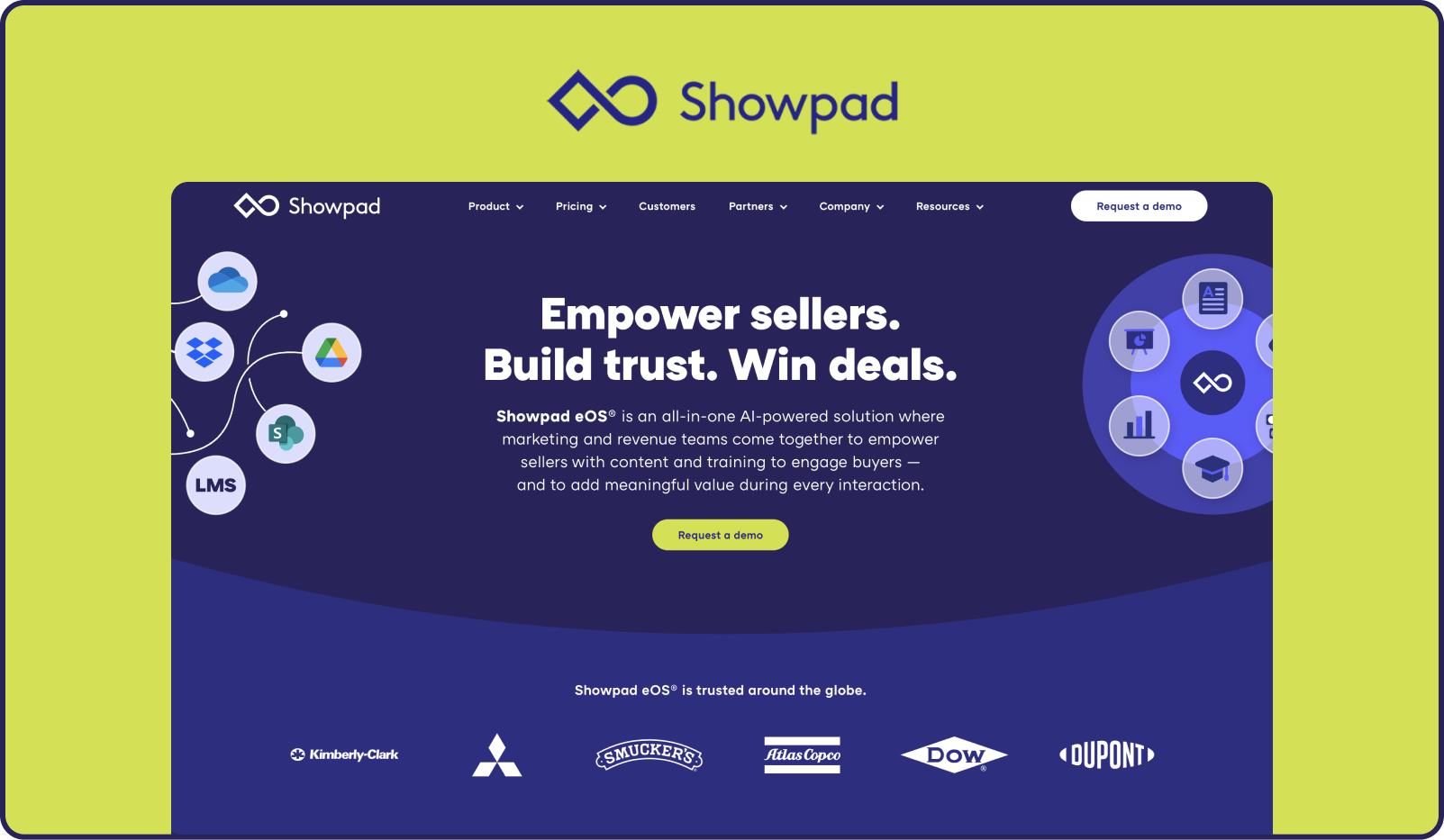
Showpad centers on content and buyer-facing experiences.
Showpad is a content and enablement platform built for field sales and visual selling. It pairs content management with shared buyer spaces and is rated well for ease of deployment and customer support, which is part of why it shows up as a Seismic alternative for teams that found Seismic too heavy. It stands out for companies selling physical products, with interactive content and shared spaces that track buyer engagement.
Reps get an intuitive way to find, present, and share branded content, and the platform tends to score better than Seismic on time to first value. Its "PitchAI" feature lets reps record video pitches and get feedback, though the practice is lighter than tools built for live conversational rehearsal. Showpad's pricing is commonly reported between 32 and 42 dollars per user per month, with custom options for larger deployments.
PitchMonster vs Showpad: Showpad is the stronger pick if interactive, visual content is the core need, especially for physical-product demos. PitchMonster wins when the goal is live conversational practice and coaching depth, because Showpad's feedback is recorded-and-reviewed rather than live.
Best for: marketing-led teams and field sellers who need a content hub with interactive demos and light practice built in.
5. Spekit

Spekit delivers enablement through a Chrome extension, inside the tools reps already work in.
Spekit is an AI-first revenue enablement platform for teams that need governed content management and structured learning but want reps to receive guidance inside their daily workflows instead of relying on a separate portal. Its GTM Knowledge Engine, Learning Paths, Deal Rooms, AI content creation, coaching, and analytics share one governed source of GTM knowledge.
AI Sidekick works alongside reps in Salesforce, Gmail, Outlook, Gong, Slack, LinkedIn, and other browser-based tools. Unified Deal Context combines CRM opportunity data, call intelligence, and email signals so AI Sidekick can surface answers, recommended content, coaching, and next-best actions for the active deal.
PitchMonster vs Spekit: Spekit is the governed content and learning system, delivered inside the tools reps already work in. PitchMonster is the practice layer: AI role-play on phone, video and screen-share, live-call scoring, and an AI Coach that debriefs every session in a Socratic back-and-forth instead of returning a score. Teams replacing Seismic content and learning layer should look at Spekit. Teams replacing Seismic because reps never actually rehearsed should look at PitchMonster. The two sit side by side without overlap.
Best for: mid-market and enterprise B2B revenue teams that want a governed content and learning system connected directly to rep execution and buyer experiences.
6. Allego
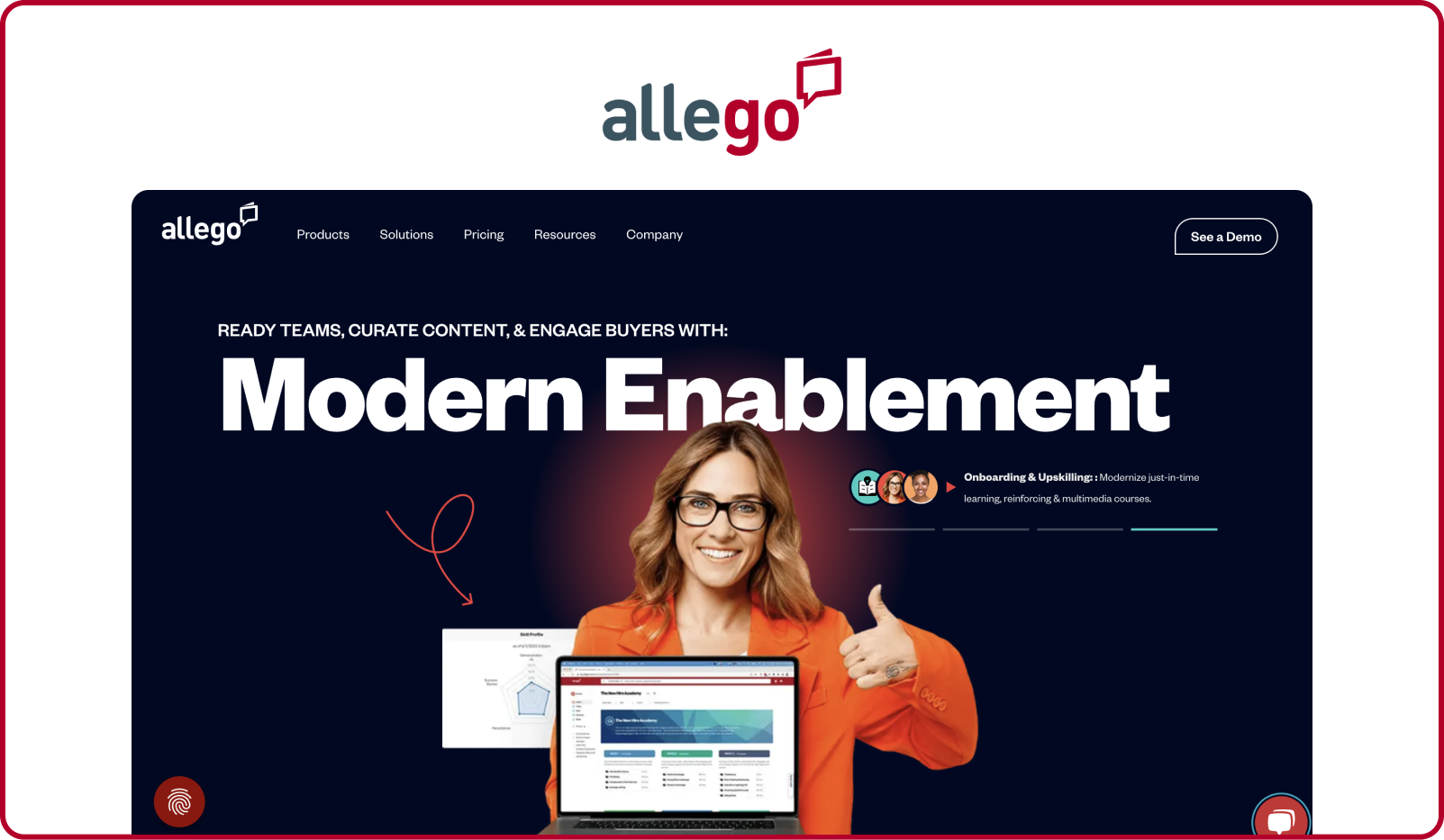
Allego builds around video coaching and asynchronous practice.
Allego focuses on video-based coaching and asynchronous training for hybrid and distributed teams. Reps record practice pitches and get AI-assisted scoring and feedback without a manager present, which suits teams spread across time zones where live sessions are hard to schedule. The AI Overview names it a strong option for hybrid teams that lead with video.
The platform combines video coaching, peer knowledge sharing, content in Digital Sales Rooms, and call transcription across many languages. Its AI evaluates pitch recordings and suggests improvements to clarity and pacing, and reps follow custom learning paths with on-demand training and certifications. It holds a 4.6 out of 5 rating on G2, with users frequently praising the video coaching and support.
PitchMonster vs Allego: both coach reps, but Allego's model is record-then-review video, while PitchMonster is live simulation with an in-session Socratic debrief. Teams that want reps rehearsing dynamic, objection-heavy conversations lean PitchMonster; teams that want a video-first learning library lean Allego.
Best for: global and hybrid teams that want video-first learning and asynchronous coaching.
7. Hyperbound
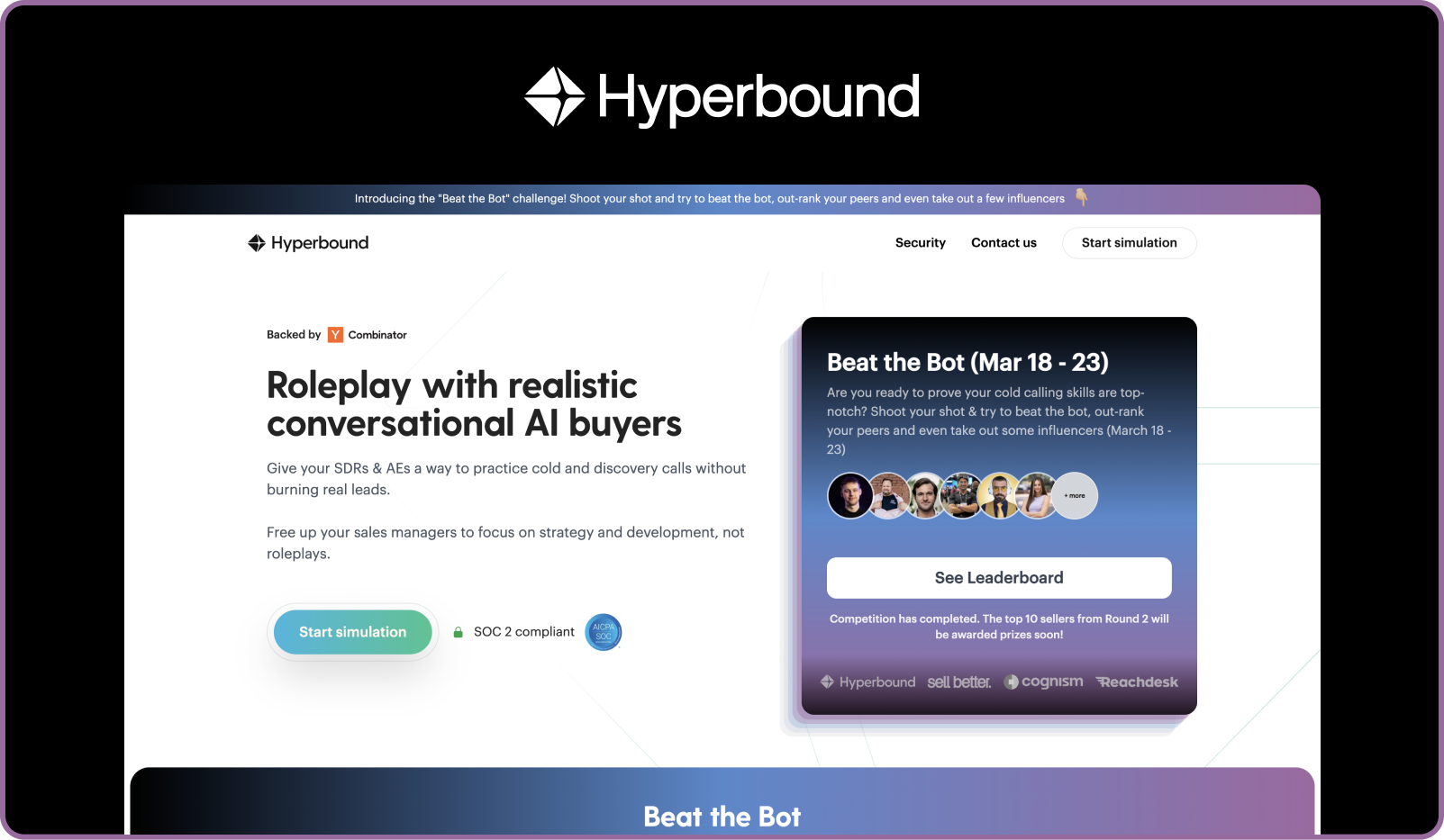
Hyperbound builds around cold call and discovery practice with AI buyers.
Hyperbound turns sales practice into a gamified, competitive experience, built on a large library of B2B sales call data. Its AI bots simulate buyer interactions across cold calls, discovery, demos, and post-sales conversations, with leaderboards, calling competitions, and streaks to drive consistent reps.
Its signature feature is the ability to build buyer bots that mirror specific prospect profiles, so SDRs can drill the exact persona they will face. It integrates with Salesforce, Gong, and Outreach to pull in real calls, and offers built-in learning modules for onboarding and certification.
PitchMonster vs Hyperbound: both are AI role-play tools, but Hyperbound optimizes for competitive, high-volume cold-call reps, while PitchMonster's sweet spot skews smaller, more consultative, and heavier on post-session coaching. The Hyperbound alternative page covers where each one fits.
Best for: high-volume outbound and SDR teams that thrive on competition and cold-call volume.
8. Second Nature
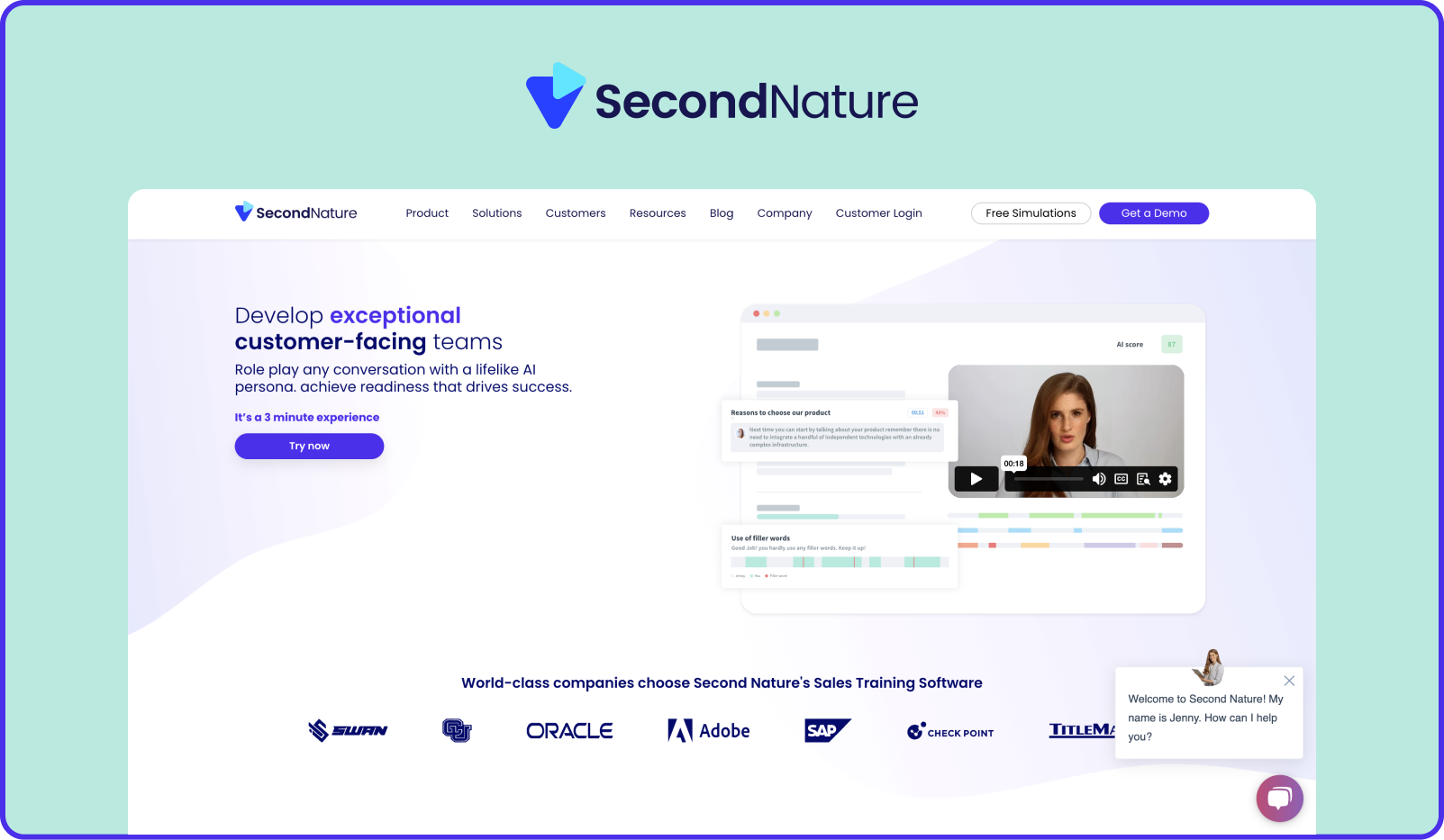
Second Nature runs AI role-play conversations for customer-facing teams.
Second Nature uses voice-driven AI personas to run realistic practice conversations. The AI adapts to a rep's tone, word choice, and delivery in real time, and coaches softer elements like pacing and clarity alongside the words themselves. Teams can map scenarios to methodologies like MEDDIC or Challenger.
It works mainly as a standalone training platform with built-in LMS features, designed for structured enterprise onboarding and certification. Large organizations use it for formal programs, and gamified leaderboards keep practice consistent during ramp.
PitchMonster vs Second Nature: both run AI role-play, but PitchMonster ties practice to real call recordings on one scorecard and adds the Socratic AI Coach debrief, while Second Nature leans on a standalone LMS-style program. See the PitchMonster vs Second Nature comparison for the detail.
Best for: enterprises that want structured, standalone onboarding and certification with voice-driven practice.
9. SmartWinnr
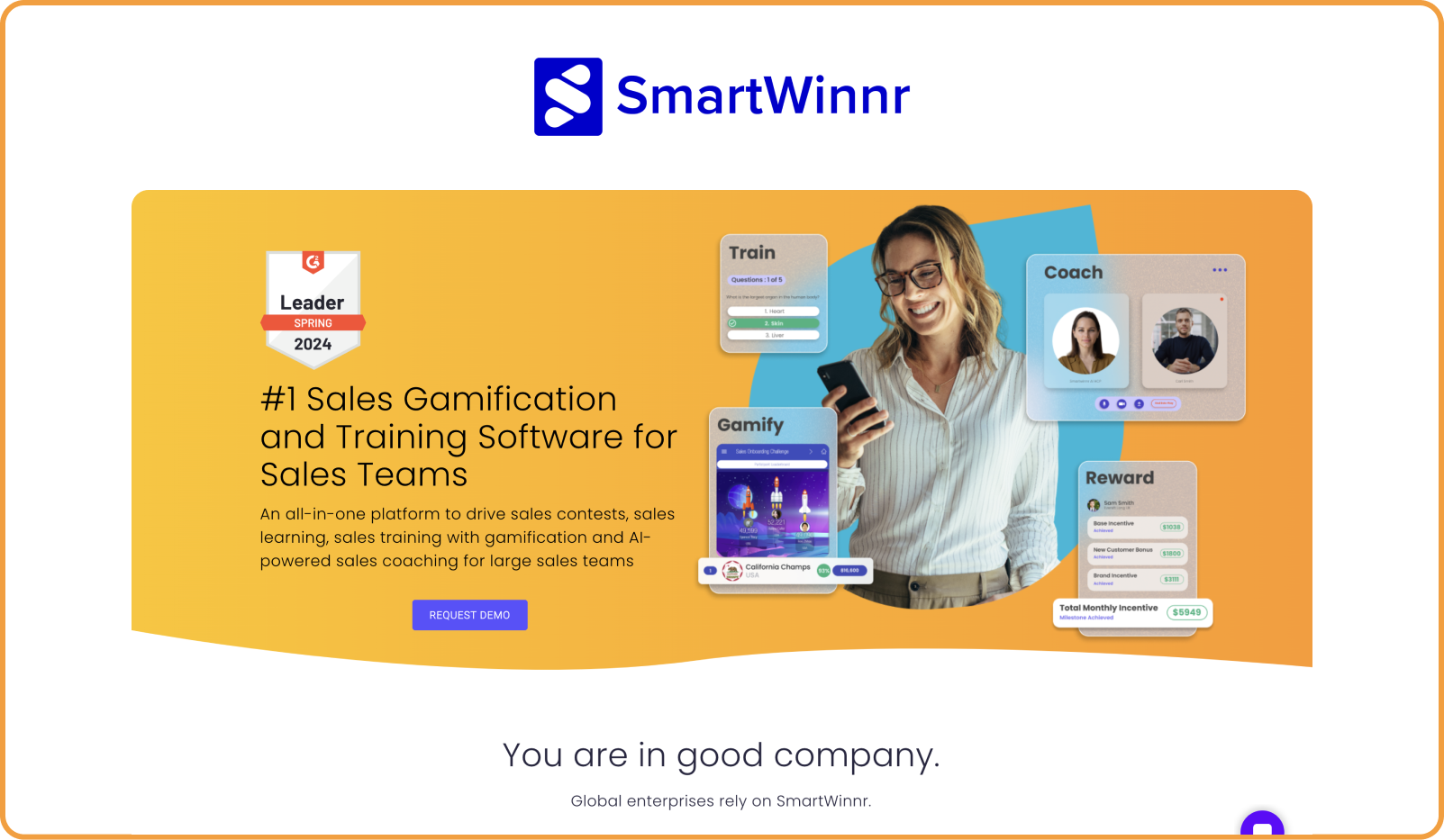
SmartWinnr wraps training in contests, scoring and reinforcement.
SmartWinnr blends AI-driven personalization with micro-learning and quizzes to build and reinforce product and sales knowledge. It supports reps from onboarding through advanced skill development without long training sessions, and ties gamified KPIs to business goals to keep engagement up.
Its strength is knowledge reinforcement and manager visibility. Gamified learning paths adapt to each rep's progress and flag gaps, and real-time analytics help managers target coaching where it is needed. For teams whose problem is retention of product knowledge across a large field force, it fits well.
PitchMonster vs SmartWinnr: SmartWinnr is a knowledge-reinforcement and gamified-LMS tool, while PitchMonster is a live conversational-practice platform with a coaching debrief. Teams that need reps to retain product facts lean SmartWinnr; teams that need reps to handle live objections lean PitchMonster.
Best for: large field teams that need gamified knowledge reinforcement and product-knowledge retention.
10. Quantified
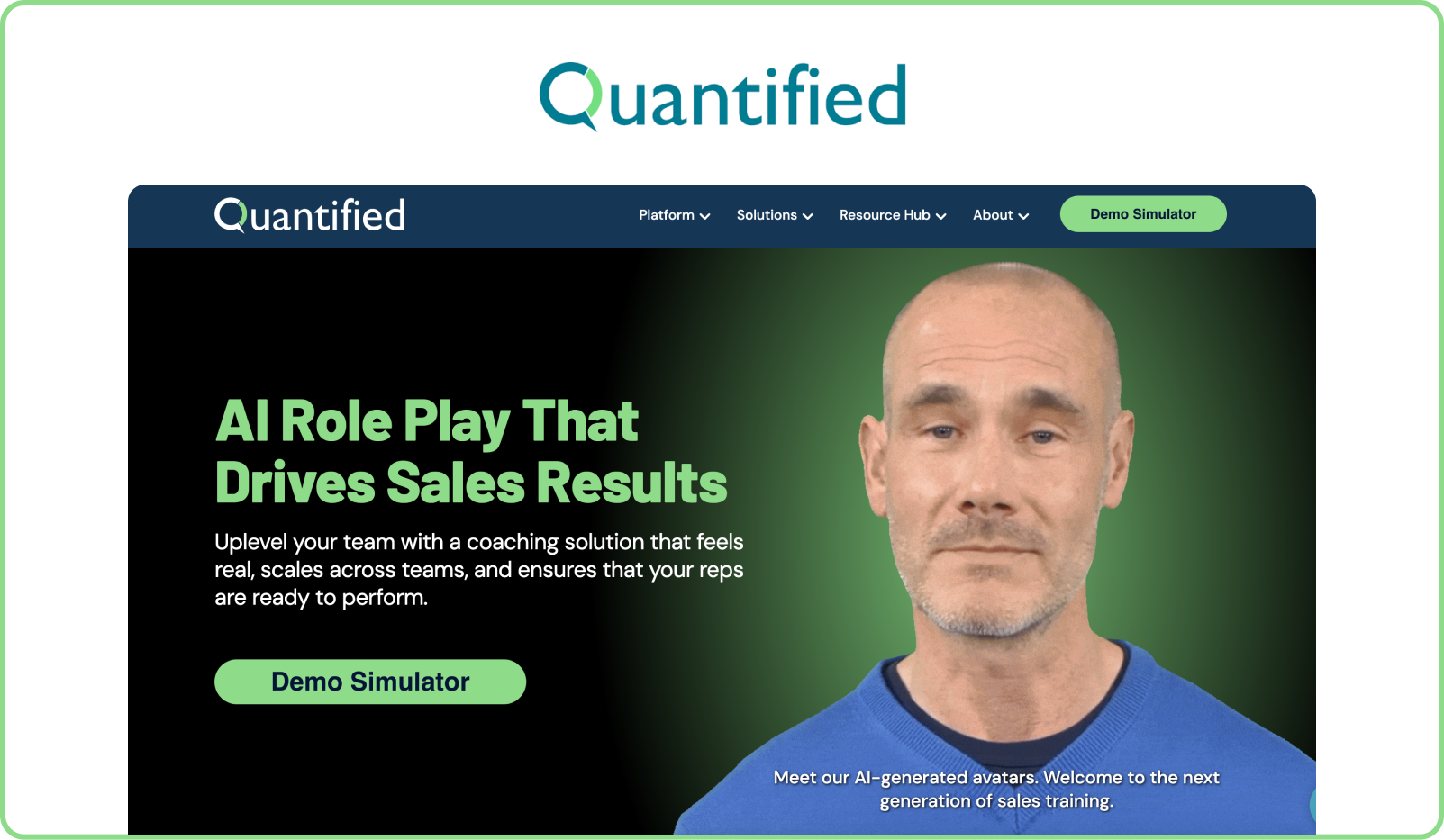
Quantified runs practice against AI-generated avatars.
Quantified is a simulation platform that uses AI avatars to create lifelike practice environments and scores reps across many communication signals, including tone, clarity, and, in video mode, posture and facial expression. It builds scenarios for regulated industries like life sciences, financial services, and medical devices.
Its strength is depth of feedback on delivery and presence. Reps practice everything from cold calls to executive meetings, and the vendor reports that 92% of users say the simulations feel like real calls. It can also act as a live-call companion with real-time prompts, and its automated scoring lets managers cover far more reps than manual coaching allows.
PitchMonster vs Quantified: Quantified goes deepest on delivery signals and avatar realism for regulated industries, while PitchMonster ties practice to your playbook, real call recordings, and a Socratic coaching debrief. Teams in pharma and life sciences often weigh Quantified; teams that want playbook-scored practice lean PitchMonster.
Best for: regulated-industry teams that need deep delivery and presence coaching with AI avatars.
11. Yoodli
Yoodli treats sales practice like training for a sport, with realistic, communication-focused sessions reps can repeat as often as they want without a manager watching. It mimics various customer personas and can be tailored with pitch decks and brand language. Google Cloud used it to train and certify more than 15,000 reps, which shows it can scale.
It earns its place for low-friction, individual coaching. The platform gives instant AI feedback on delivery, runs team dashboards for managers, and starts free, so reps can try AI practice without a procurement cycle. It is SOC 2 Type 2 and GDPR certified.
PitchMonster vs Yoodli: Yoodli is the low-friction, individual communication coach; PitchMonster is the team-wide sales-methodology practice platform with playbook scoring and a coaching debrief. Individuals and tiny teams start with Yoodli; scaling sales orgs move to PitchMonster.
Best for: individuals and small teams that want free, fast communication practice without a procurement cycle.
12. Zime
Zime pairs AI-driven role-play with detailed performance scoring to surface skill gaps across a team. It evaluates discovery, objection handling, and closing, then gives each rep an instant, objective score after a session so managers can see who needs more practice before live calls. It also unifies CRM, call, and customer data to deliver just-in-time playbooks in the flow of work.
Its value is manager efficiency. Dashboards show team readiness, participation, and performance trends, and AI scoring removes subjectivity, so leaders can oversee many reps without sitting in on every session. It holds a 4.5 out of 5 rating on G2 across a small review set, and one reviewer notes it "saves 50% of my time on coaching AEs."
PitchMonster vs Zime: both score AI role-plays, but Zime centers on manager-side skill-gap scoring and living playbooks, while PitchMonster centers on rep-side realistic practice plus a Socratic coaching debrief and live-call analysis on the same scorecard. You can also build custom AI role-plays in PitchMonster for specific industry challenges.
Best for: sales managers who want fast, objective skill-gap scoring and readiness dashboards across a team.
How to choose a Seismic alternative
Start by naming the job, not the brand. "Replace Seismic" is not a requirement. "Govern our content," "certify 200 reps a year," and "get new hires ready in four weeks instead of twelve" are three different problems with three different best tools.
If the job is content management, shortlist Highspot and Showpad and compare them on governance, search, Digital Sales Rooms, and how readily your reps adopt them. These are the closest like-for-like swaps for what Seismic does at the content layer.
If the job is a formal readiness program, look at Mindtickle and Allego, and budget for the enterprise rollout that comes with them. You are buying a system of record for training, so the six-to-eight-week setup is the cost of the depth.
If the job is rep readiness and practice, weigh PitchMonster, Hyperbound, Second Nature, and Quantified, and pay attention to coaching depth. A tool that scores a rep is useful; a tool that also coaches the rep to fix the gap, the way PitchMonster's AI Coach does, is what actually moves win rates. A newer name in this practice category is Kendo AI, a self-serve AI role-play tool; see our PitchMonster vs Kendo AI comparison for the detailed breakdown.
Then pressure-test on price and adoption. Match contract size to your team size, favor tools you can be live on in days or hours over ones that need a quarter to deploy, and remember that the best platform is the one your reps will open every week. To see the practice options side by side, compare the top sales role-play tools, or book a demo and we will build your first role-play library with you.
FAQ
What are the best Seismic alternatives?
The most-cited Seismic alternatives are Highspot and Showpad for content management, Mindtickle and Allego for sales readiness and coaching, and PitchMonster for AI sales role-play and rep practice. The right pick depends on whether your priority is governing content, certifying reps, or getting sellers ready before live calls.
Is Seismic buying Highspot?
In February 2026, Seismic and Highspot announced an intent to merge under the Seismic name. As of mid-2026 the deal has not closed, and both platforms still sell and support customers independently. The pending merger is one reason buyers are re-evaluating their enablement stack and shortlisting alternatives now.
How much does Seismic cost compared to the alternatives?
Seismic does not publish pricing and quotes per company after a demo, with enterprise contracts that typically run into five and six figures a year. Alternatives vary widely: Yoodli starts free, PitchMonster is quote-only and sized to your team, and Mindtickle and Allego sit at the enterprise end with custom quotes.
How long does it take to set up a Seismic alternative?
Setup ranges from days to months. Enterprise readiness platforms like Mindtickle commonly take six to eight weeks with an implementation fee. Lighter content and practice tools go live in days. PitchMonster runs a guided onboarding of three to four hours, and you can build a working role-play scenario in about two minutes.
Do Seismic alternatives integrate with Salesforce and my CRM?
Most do. Highspot, Showpad, Mindtickle, and Allego offer native Salesforce integrations, and several connect to HubSpot and conversation tools like Gong. PitchMonster integrates with Salesforce, HubSpot, and Gong, and exports rep scores to HubSpot, Power BI, or your LMS via API.
Does Seismic compete with a CRM like Salesforce?
Not directly. Seismic is a sales enablement platform for content, coaching, and analytics, and it integrates with Salesforce rather than replacing it. By market share the two barely overlap, since Salesforce owns the CRM category. If you want coaching that lives inside your CRM, look at HubSpot-native tools, while PitchMonster exports rep scores into your CRM via API.
Which Seismic alternative is best for sales training and role-play?
For practice and coaching rather than content storage, look at PitchMonster, Hyperbound, Mindtickle, and Second Nature. PitchMonster is built specifically for AI sales role-play, with an AI Coach that runs a reflective debrief after every session, a feature none of the content-led platforms offer.