Good manufacturing sales training prepares reps for the conversations that decide a quote. These include price pushback, technical questions, incumbent suppliers, stakeholder reviews and silent quotes. Rehearsing these exchanges aloud helps reps respond calmly and move each conversation toward a useful next step.
This guide is for the sales or distributor manager preparing reps for these conversations. It does not cover how to get a job in industrial sales. For a team practice approach, see AI role-play for manufacturing sales teams.
Last updated: November 18, 2026.
The aim is to help reps listen, respond to the buyer in front of them and agree on what happens next.
What the job looks like between the RFQ and the purchase order
Your reps may be engineers moving into sales, inside sales reps stepping into the field, distributor reps carrying many product lines, or experienced sellers learning a technical line. Their conversations happen at a plant, at a distributor branch, in a review with engineering and purchasing, or on video after a quote goes out.
Long cycles, several people who can say no, technical questions mixed with commercial ones, and an established supplier make these conversations demanding. Reps can drop the price as soon as another quote comes up, guess at an engineering answer or criticize the incumbent. They can overlook part of the buying group or send a message that only says "just checking in."
Much industrial sales training covers the product line. Practice should also prepare reps to handle these moments.
The 5 manufacturing sales training conversations to rehearse
Use each example to rehearse the buyer's concern, a useful response and the mistake to avoid. Adapt the buyer's exact question to a real situation your team faces.
1. "A competitor quoted lower"
The situation: A distributor or purchasing manager challenges the quote after comparing it with another supplier. Treat the objection as a question about what the buyer values.
- What the buyer says: "We have another quote that comes in lower than yours. Can you match it?"
- A good reply: "Before we compare the quotes, could we look at what each one includes? I want to make sure we are comparing the same requirements, support and availability. Which part of the other offer matters most to your team?"
The common mistake: Matching the price immediately can give away value before the rep understands the comparison. Running down the other supplier turns attention away from the buyer's needs.
Managers coaching dealer and distributor reps can also use distributor sales training and objection handling training as related resources.
2. The engineer who needs the technical answer first
The situation: A design or process engineer joins before the group discusses price. The rep needs to learn what the application requires and who can answer technical questions.
- What the buyer says: "Before we talk about price, I need to know this will work in our application. What can you tell me?"
- A good reply: "Could you tell me more about the application and what failure you are trying to avoid? I can share what I know, and I will bring our applications engineer in for anything that needs a technical answer. Could we set up a short session with them?"
The common mistake: Guessing to keep the conversation moving can create confusion. Moving to price before the engineer's concern is understood leaves the central question unanswered.
3. "We already have a supplier"
The situation: The buyer is satisfied enough with an incumbent supplier to see little reason to change. The rep can look for a specific need without attacking an existing relationship.
- What the buyer says: "We've worked with our current supplier for years. Why would we change?"
- A good reply: "A supplier who works well for you is valuable. If you could improve one part of the arrangement, what would you change? If there is a fit, we could compare options on one part or discuss a second source for one line."
The common mistake: Criticizing the incumbent can put the buyer on the defensive. Asking for all the business at once makes a possible comparison feel like a risky commitment.
4. The procurement review with several stakeholders
The situation: Purchasing, engineering, quality, operations and a plant or finance manager are all in the review. Each person may need a different answer before the group can agree on a next step.
- What the buyer says: "Thanks for coming in. Each of us has questions, so walk us through why we should approve this."
- A good reply: "Thanks for bringing everyone together. Could I hear from each of you about what you need to see before you can say yes? I will take those questions in order, then we can agree who owns the next step."
The common mistake: Presenting only to the person who arranged the meeting can leave other concerns unresolved. Leaving without agreeing who does what next makes it harder to continue the discussion. Managers can review sales negotiation training for another group conversation to rehearse.
5. The quote that goes silent
The situation: The rep sent a quote and has not heard back. When the buyer responds, the rep needs to learn what is holding up a decision.
- What the buyer says: "Sorry, we haven't had a chance to look at it yet."
- A good reply: "No problem. I had a question about your schedule and the requirement we discussed. What needs to happen on your side before you can make a decision? Could we agree on a date to speak again?"
The common mistake: A "just checking in" message gives the buyer no new reason to talk. Dropping the price to restart the discussion skips the question of what is delaying the decision. The objection handling guide covers another way to prepare for buyer pushback.
Common mistakes new reps make in these conversations
- Matching another supplier's price before finding out what the buyer is comparing.
- Guessing at a technical answer instead of asking what the application needs and involving an applications engineer.
- Criticizing an incumbent supplier or asking the buyer to move all business at once.
- Presenting to one contact while leaving other stakeholders' questions unanswered.
- Sending a "just checking in" message or cutting the price without learning why the quote is waiting.
Coach what the rep is trying to achieve. A rep should understand what the buyer needs and what action could help both sides move forward.
How to run a weekly manufacturing sales training routine
A practical manufacturing sales training routine makes rehearsal a regular part of the team's week. For b2b manufacturing sales training, keep the focus on a real buyer conversation and give reps a chance to hear and review their own responses.
The same routine can support teams selling in person in HVAC, roofing, solar and real estate.
Practice manufacturing sales conversations with AI role-play and an AI Coach
PitchMonster AI role-play gives reps a realistic buyer voice to rehearse these 5 conversations with, as often as they need, before a quote review. The manager builds the scenario in the role-play editor.
In the Persona tab, they set the buyer's name, role, difficulty (Easy, Medium, Hard or Insane), appearance and voice. In the Scenario tab, they add the context and specific objections, such as a lower quote or an established supplier. The Scorecard tab holds the goal and the criteria the session is judged on. A manager can write criteria such as "asked what the other quote includes" or "set a dated next step."
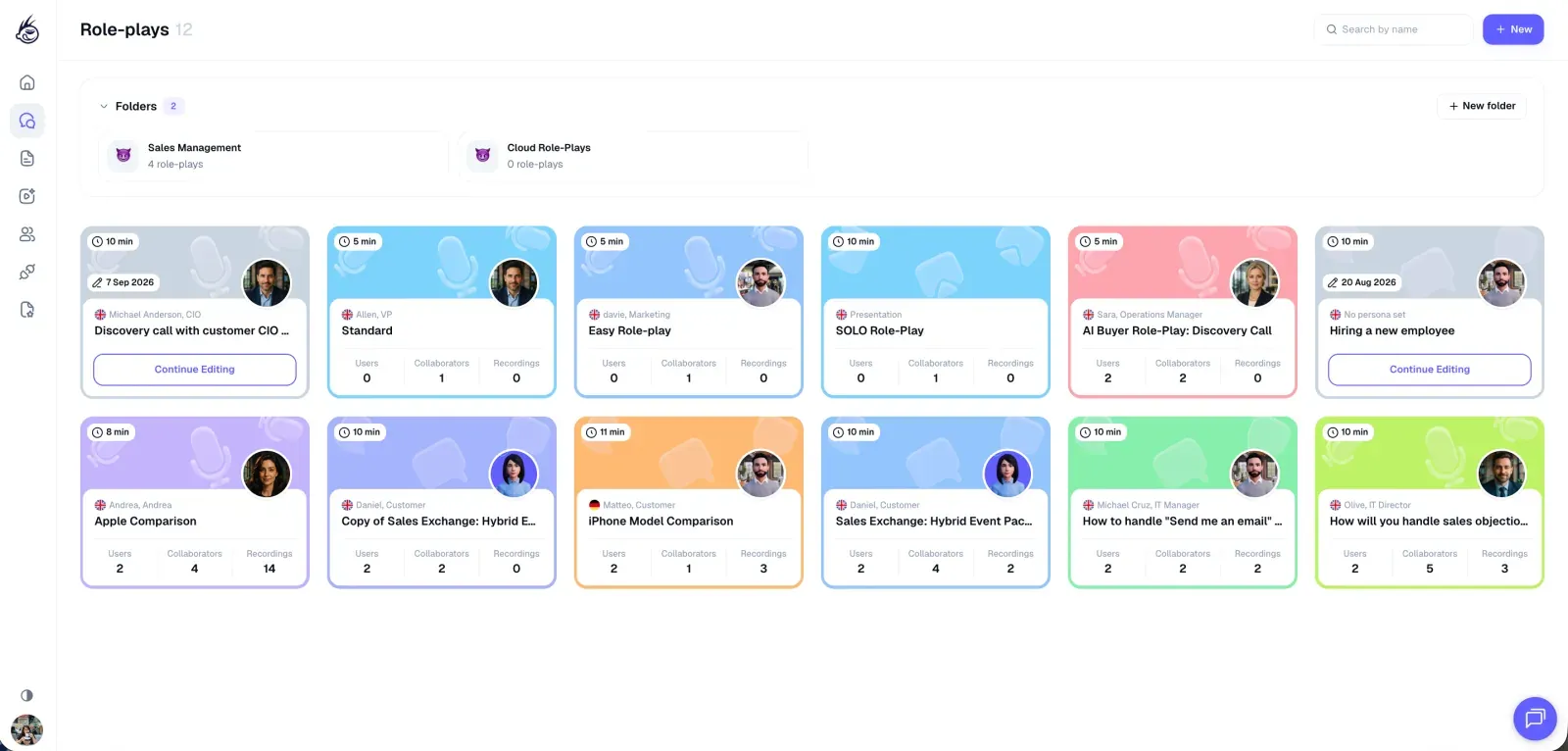
A manager can also build a dealer practice scenario. See an example dealer practice scenario for the kind of setup a manager can create. After a session, the AI Coach asks the rep reflective questions before revealing the score, so the rep can self-diagnose first. The AI Coach is available 24/7. Read the sales role-play guide for more on practice design.

Mentor Group, a UK sales training consultancy, reports that new hires in its client onboarding programs ramp 50% faster on average after adding AI role-play practice.
To see how the team setup works, read about manufacturing sales training for teams.
FAQ
How do you train manufacturing sales reps?
Train manufacturing sales reps by choosing a conversation that affects a quote, modeling a response, and having reps rehearse it aloud. Review a recording and coach a specific change. Then return to the exchange in practice. Product and technical training still matter; conversation rehearsal gives reps a place to apply that knowledge with a buyer.
What should manufacturing sales training cover?
Manufacturing sales training should cover price pushback, technical questions, displacing an incumbent supplier, presenting to a buying group and following up when a quote stalls. Reps also need product knowledge and a clear sense of when to involve a technical colleague. Practice should help them ask useful questions without guessing at answers.
How is industrial sales training different from general sales training?
Industrial sales training often prepares reps for longer buying cycles, technical buyers, several stakeholders and distributor relationships. A rep may need to understand the buyer's application, then bring in an engineer for a question beyond their knowledge. Rehearsal helps teams prepare for those exchanges while product instruction covers the details of the line.
How do you train distributor reps who sell many product lines?
Train distributor reps by rehearsing the conversations that recur across the lines they carry. Build scenarios from their buyers' objections, practice short exchanges and review a recording together. This helps reps work on listening, asking follow-up questions and agreeing on a next step, skills that carry across every product line.