Insurance sales role-play scripts are practice conversations that put an agent through a real quoting call, objection, or renewal conversation before they try it on a live prospect. Each script pairs a specific buyer, an objection, and the compliance language a carrier or state requires. That way a rep rehearses the actual conversation coming up this week, not a generic pitch.
This guide gives you scripts you can hand a rep today across life, Medicare, P&C, and commercial lines. It also covers the objections that come up most and the compliance language that has to sit inside the script, not next to it. Copy any of them straight into your own training doc and adjust the names, products, and state-specific wording to match your book of business.
The scripts below cover all four lines, with the objection and the compliance language built into each one.
What makes an insurance sales role-play script work
A script only works if it does two things at once: it gives the rep something specific to say, and it forces them to say it under real pushback. A generic list of talking points in a shared doc does neither. The rep reads it once, nods, and forgets it by the second call of the day.
The stronger insurance sales scripts below follow the same shape. Each one names a specific buyer, a 62-year-old aging into Medicare, a contractor renewing commercial auto, and states the objection that buyer is likely to raise. Then it gives the rep a response they can say out loud without editing it first. That specificity is what separates a script a rep uses from one that gets filed and forgotten.
Line of business changes what "realistic" means. A life insurance conversation runs on trust and a long time horizon. A P&C renewal is transactional and price-sensitive. Medicare is the most regulated of the four, with disclosure language that has to land inside the pitch, not after it.
One insurance sales script rarely works across all four lines, which is where most generic training material falls short. The opening line still carries as much weight here as it does on a cold call, it just has more riding on it once the buyer says yes.
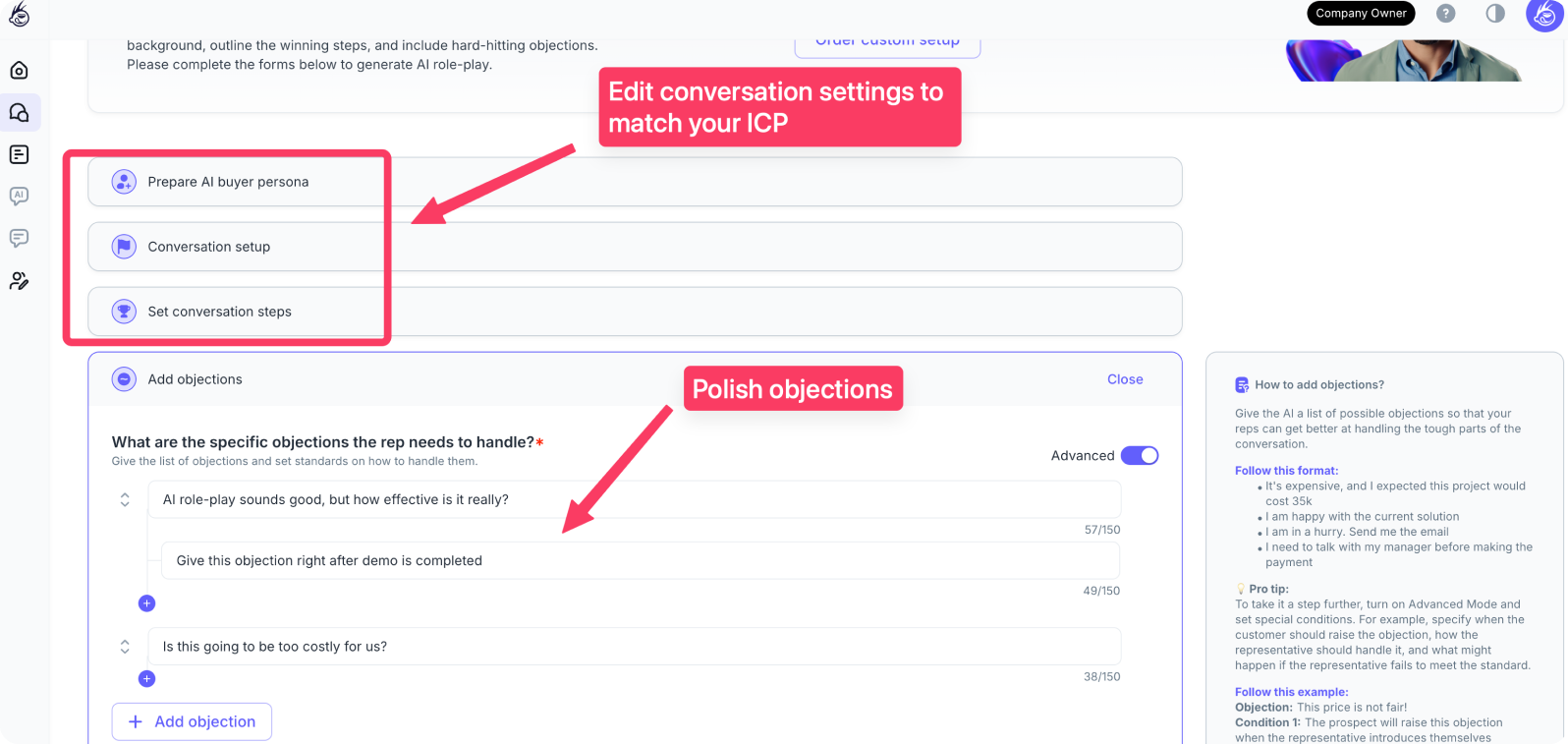
Building a scenario this way means entering the buyer, the objection, and the goal into one setup screen. That is why the scripts below work as starting points rather than fixed answers. You still need to adjust each one to your carrier, your state, and the products your reps sell. For a broader look at structuring practice across a sales team, see our guide to role-play scenarios that sharpen a sales team's skills.
Scripts by line: life, Medicare, P&C, and commercial
The four scripts below are starting points, not a full call flow. Each one gives an opening line, the buyer's likely first objection, and a response that acknowledges it without arguing. It also notes what good sounds like when a rep runs it well.
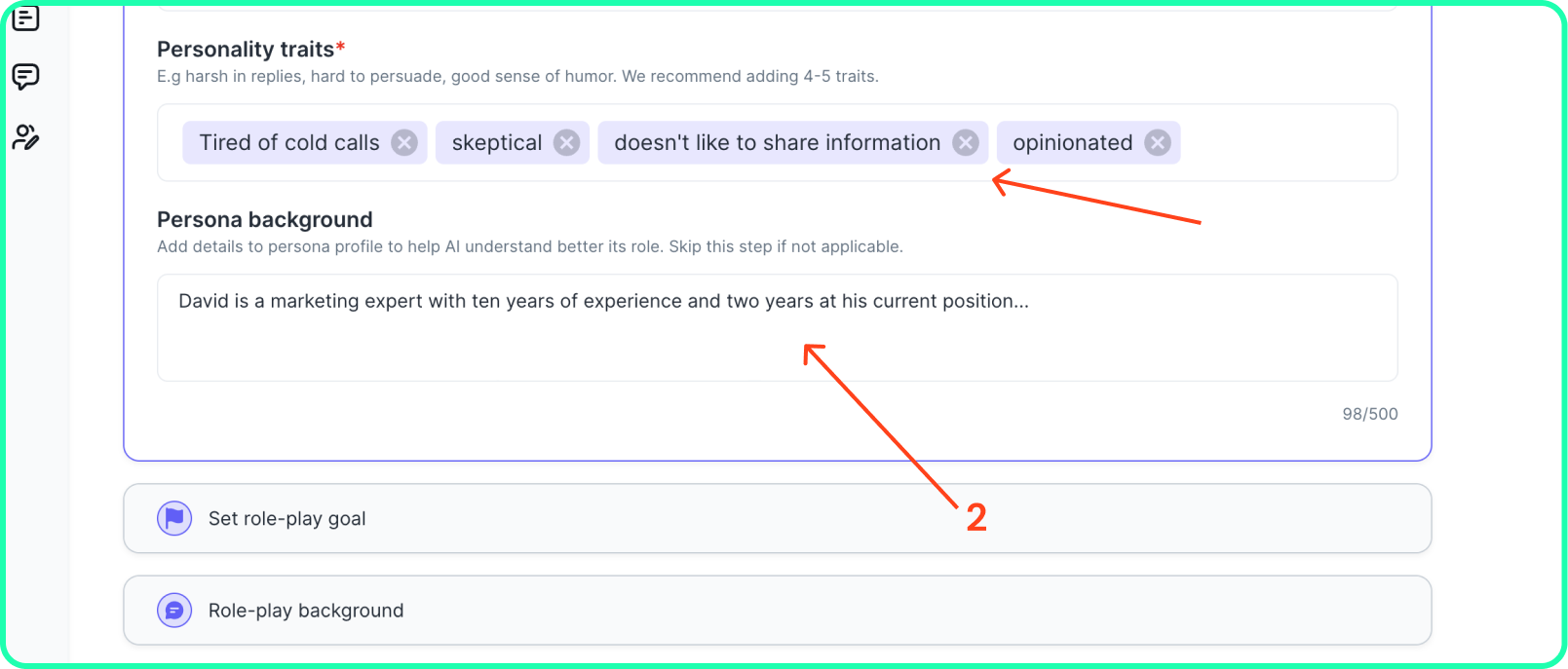
Each buyer below can become its own AI persona, built once and reused for every rep who needs the rep. The opening lines that follow the image work equally well read out loud in a practice session or dropped straight into a written insurance sales script.
Life insurance: a needs-analysis opener
Buyer: a parent in their late 30s with light or outdated coverage.
Rep: "Before I talk about any specific policy, I want to understand what you're actually protecting, your income, your mortgage, your kids' education. Can you walk me through what happens financially in your household if something happened to you tomorrow?"
Buyer objection: "I already have some coverage through work."
Rep response: "That's worth keeping, and a good start. Group coverage through an employer usually ends the day you leave that job, so most people carry it as a supplement, not their whole plan. What happens to that coverage if you changed jobs next year?"
What good sounds like: the rep asks two or three discovery questions before naming a single product. A life insurance sales role-play built this way scores the rep on discovery depth, not on how fast they got to a pitch.
How to practice it: set the AI buyer's persona to a parent with young kids and light savings, script "I have coverage through work" as the first pushback, and score whether the rep asks about real financial exposure before recommending anything.
Medicare: opening with the required disclosure
Buyer: someone about to turn 65 and enroll for the first time.
Rep: "Before we get into any plan details, I need to let you know I don't offer every plan available in your area, only a specific set of plans, and you can always call 1-800-MEDICARE or visit Medicare.gov to see all your options. Is now still a good time, and are you comfortable if I cover costs and benefits, or would you rather I stick to what you called about?"
Buyer objection: "I just want to know what's cheapest."
Rep response: "Price matters, and I hear that a lot. Before I quote anything, I need to check which pharmacies and doctors you use, because the cheapest plan on paper sometimes costs more once your prescriptions and providers are counted. Can we go through those first?"
What good sounds like: the disclosure lands naturally, not read like a warning, and the rep confirms the appointment covers specific plan details before naming a single plan.
How to practice it: score the session on whether the required disclosure appears before any plan-specific detail, the same way an audit would check it.
P&C: the home and auto renewal
Buyer: a homeowner whose premium just went up at renewal.
Rep: "I saw your renewal is coming up and your premium moved up about 8 percent. Before we talk about that number, when did someone last actually review your coverage, not just renew it automatically?"
Buyer objection: "Every year it just gets more expensive. I'm thinking about shopping around."
Rep response: "A lot of people are doing exactly that right now, and it's fair. Before you do, it's worth checking whether shopping gets you a lower price or just a lower limit. Can I show you what's actually driving the increase first?"
What good sounds like: the rep acknowledges the increase without getting defensive, then reframes toward coverage value instead of arguing the number.
How to practice it: give the AI buyer a rate-increase trigger plus the "I'm shopping around" objection, and score whether the rep asks a diagnostic question before defending price.
Commercial: the business-owner conversation
Buyer: a contractor or small-business owner renewing general liability or workers' comp.
Rep: "You've grown the crew since last year, so I want to check your coverage actually matches the business today, not what it looked like when we first wrote this policy. What's changed, headcount, equipment, any new locations?"
Buyer objection: "I don't have time for this, just renew what I had."
Rep response: "I can do that, and I want to flag one thing first. If you're carrying more equipment or more staff than last year's policy assumed, a claim could come back underpaid. That's a 5-minute conversation, not a form to fill out."
What good sounds like: the rep frames the coverage review as a risk to the owner's business, not as an upsell.
How to practice it: set the AI buyer to a time-pressured owner, and score whether the rep gets the coverage-gap point across in 2 exchanges or fewer.
Line | Opening move | Top objection to drill | What good sounds like |
|---|---|---|---|
Life | Needs-analysis discovery, no product named yet | "I have coverage through work" | Two or three discovery questions before a pitch |
Medicare | Required disclosure before plan detail | "I just want the cheapest plan" | Disclosure lands naturally, not read as a warning |
P&C (home/auto) | Acknowledge the renewal increase directly | "I'm shopping around" | Reframes to value before defending price |
Commercial | Confirm what's changed in the business | "Just renew what I had" | Coverage gap framed as owner risk, not upsell |
Every one of these openers assumes the rep has already done the discovery work to know who they're calling. The scripts give the words; the scorecard behind the practice session should confirm the rep earned the right to say them.
The objections every insurance rep needs to practice
Every insurance rep hears the same handful of objections, no matter the line of business. The 4 below cover most of what comes up in a real conversation. Practice each one as its own short rep, not folded into a longer script, so a rep builds the reflex instead of memorizing one long conversation. For a deeper breakdown of how to structure this kind of practice, see our guide to role-play strategies for objection handling.
Premium and price
The instinct is to defend the number. The better move is to acknowledge it, then move the conversation to what the price buys. "You're right, this costs more than the bare minimum. Here's specifically what that difference covers if you ever have to file a claim." Practice this with a buyer persona that interrupts before the rep finishes, since price objections rarely wait for a full answer.
"I need to think about it"
This objection usually hides a more specific concern. A rep who accepts it at face value loses the sale by default. "Totally fair. What's the one thing you'd want to think through, the price, the coverage, or something else? I'd rather help you with that directly." Score the AI buyer session on whether the rep narrows the vague stall into a specific, answerable concern.
"I already have coverage"
This is not a no, it is an invitation to compare. "That's good to hear. When did you last check whether that coverage still matches your situation?" works better than restating the pitch. Practice it against a buyer who is mildly annoyed at being asked, since that is the realistic version of this objection.
Distrust and skepticism
Insurance carries industry-wide distrust that has nothing to do with the individual rep. "I get it, and you're right to be careful. Insurers are heavily regulated to pay valid claims, and I'm happy to walk through exactly how ours handles them, so there are no surprises." Naming the skepticism directly, instead of arguing around it, is what separates a rep who defuses this objection from one who fights it.
Objection | Rep's first move | What to avoid |
|---|---|---|
Premium and price | Acknowledge, then name what the price buys | Defending the number head-on |
"I need to think about it" | Ask which specific thing they're weighing | Accepting the stall and moving on |
"I already have coverage" | Ask when it was last reviewed | Repeating the original pitch |
Distrust and skepticism | Name the skepticism directly | Arguing the industry's reputation |
Once an objection is handled, the call still needs a close. An assumptive close, "I'll get this started, and you'll have the paperwork by Friday," works well right after a rate or bundling conversation. A trial close, "does this sound like it covers what you were worried about?" works earlier, to check whether the objection is resolved before pushing further. Practice both inside the same session as the objection itself. That way a rep learns to move from pushback to close in one motion, not two separate skills.
Cross-sell and renewal conversations
Cross-sell and renewal conversations happen on almost every account, and they get less practice time than new-business pitches. A rep who is smooth on a first sale often freezes on a renewal call. The stakes are different: the client can simply say no and keep what they already have.
Rep (bundling): "While I have you, I noticed you're only carrying auto with us. A lot of clients in your situation save when they bundle home and auto, and it raises your liability protection with an umbrella policy on top. Want me to run the numbers, no obligation?"
Buyer objection: "I don't want to switch my home insurance and deal with the hassle."
Rep response: "Switching feels like a hassle even when the math works, and that's fair. I'm not asking you to switch today, just to see the number, so you have it the next time your renewal comes up somewhere else."
A renewal rate-increase conversation follows the same logic as the P&C script above. It just happens at scale, across a whole book of business, not one call at a time. Run every rate-sensitive segment of your book through a practice scenario before renewal season starts, not during it. That way the reps making those calls have already handled the pushback once.
How to practice it: set the AI buyer persona to an existing client with a single policy who has never been offered a bundle, and score whether the rep raises cross-sell before the client raises price. Building that scenario from a real recorded renewal call, rather than writing one from scratch, keeps the practice close to what reps hear.
Keeping the practice compliant
Insurance sales sits under more rules than most sales conversations, and the practice session should reflect that. 3 sets of rules show up across the scripts above, and a rep needs to say the required language exactly, every time, not just know it exists.
Every call and text falls under telemarketing consent rules. The FCC's Telephone Consumer Protection Act (47 CFR 64.1200) requires prior consent before an autodialed or prerecorded call and requires honoring the National Do Not Call Registry. It applies to insurance sales calls the same as any other telemarketing. The FTC's Telemarketing Sales Rule adds its own material-terms disclosure requirements, though how far it reaches into insurance sales can depend on state law. None of that is optional, it applies to the call your rep is already on.
Medicare conversations carry their own layer on top. CMS's marketing rules for Medicare Advantage and Part D require a third-party marketing organization disclosure before specific plan benefits get discussed. They also require a documented Scope of Appointment before the conversation moves into plan-specific detail. That is why the Medicare script above puts the disclosure before the pitch, not after it.
Life insurance carries the NAIC's Life Insurance Illustrations Model Regulation, adopted with variations by most states. It governs what an illustration can promise and requires the agent and applicant to sign it alongside the application. Replacement rules add a second layer: swapping one policy for another requires its own disclosure, so a client can see what they are giving up.
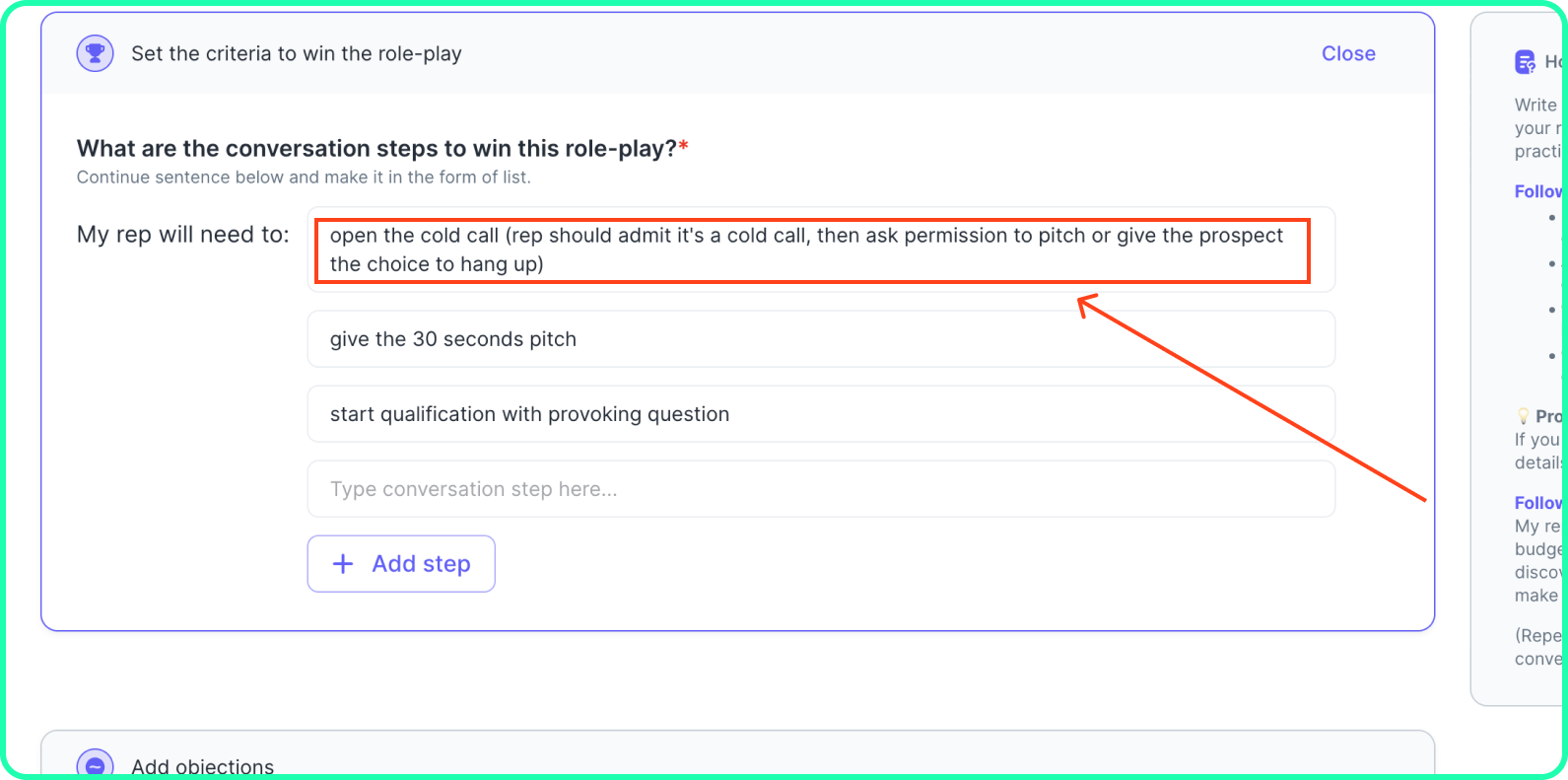
None of this is legal advice, and a compliance team should still own the exact wording. What a practice session can do is score whether the required language showed up in the right place, the same way a real audit would. Build the disclosure into the objection response itself, not as a separate line a rep bolts on afterward, so it survives the moment the conversation gets difficult.
How to run it, not just read it
A script gets a rep ready to say the right words. It does not get them ready for a buyer who pushes back, changes the objection halfway through, or asks something the script never covered. That gap is where most insurance training stops, and it is where PitchMonster starts.
Before a rep sees their score, PitchMonster's AI Coach steps in with a short reflective conversation. It is Socratic, meaning it asks questions instead of handing over a verdict, so the rep diagnoses their own miss before the number confirms it. It runs after every session, 24/7, which matters most exactly when it is least convenient, the night before open enrollment starts.
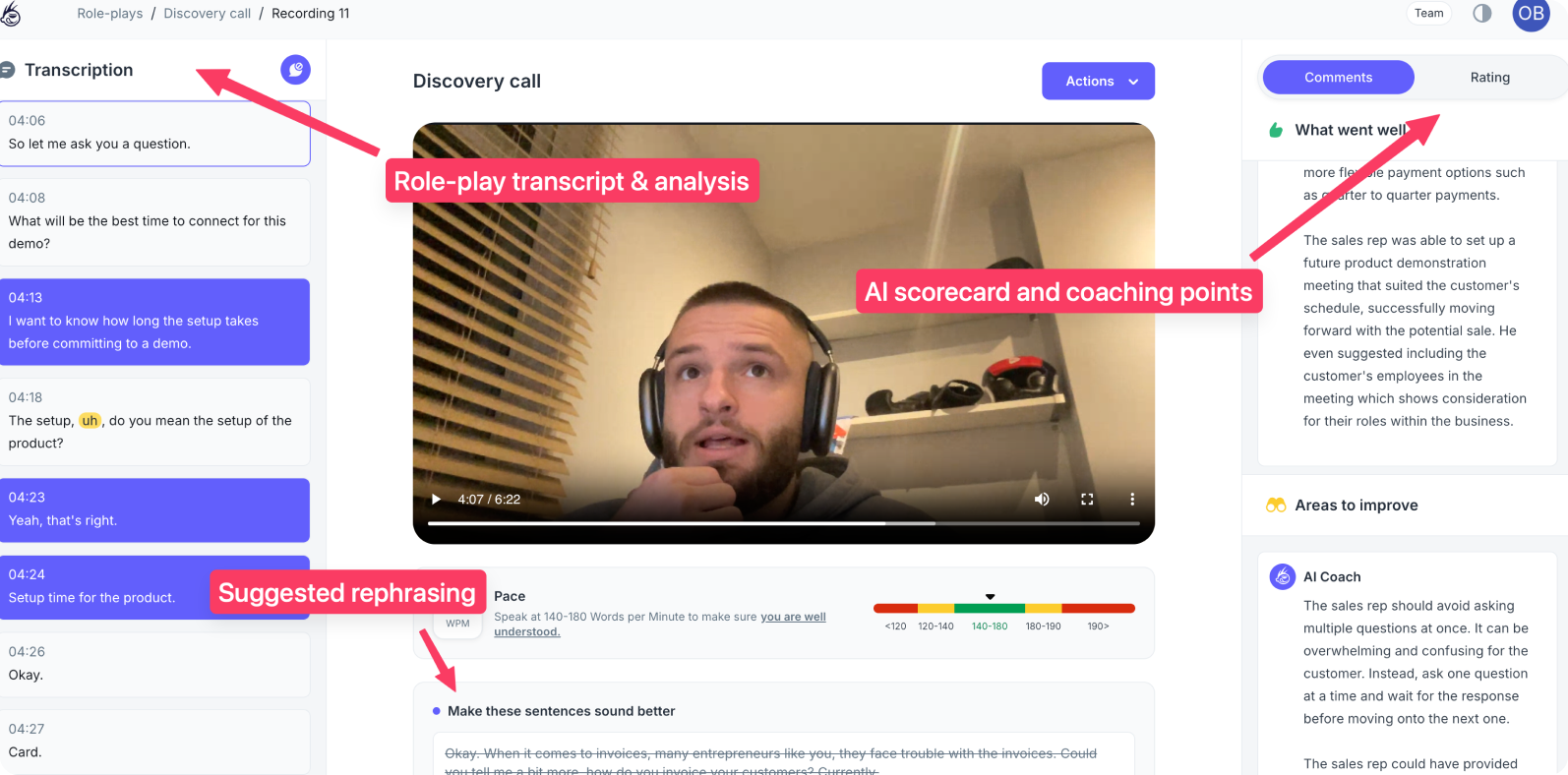
Every session gets scored against a scorecard you build. A failed criterion comes back with a written coaching note plus a worked example of a stronger line, not just a mark. Put the required disclosure into that scorecard as its own criterion, and a rep who skips it fails that line the same way a real audit would catch it.
Scenarios come from what you already have: a real call recording, a product one-pager, or a website URL. Any of those becomes an AI buyer with the persona, the objection, and the goal you set. A manager prepping Medicare open-enrollment training can turn last season's hardest call into this season's practice scenario, instead of writing one from a blank page. See how this applies specifically to insurance sales training built around your own products and disclosures.
Real calls get the same treatment. Live Call Analysis scores recorded calls against the identical scorecard used in practice. A manager can then see whether the compliance language and objection handling that worked in a role-play showed up on a live call.
"Our leads are very expensive. Having to do trial and error with live leads is an expensive practice," said Daniel, a sales leader at One Park Financial, a PitchMonster customer in lending and financial services. That trade-off, testing scripts on real prospects instead of in practice, is exactly what a scored role-play replaces. The same regulated, relationship-driven sales motion shows up across financial services teams running similarly high-stakes conversations.
The pattern holds outside financial services too. At Syngenta, a regulated, message-sensitive go-to-market, teams using the same platform reported 27% better message delivery accuracy and 90% higher reported confidence within 3 weeks. None of PitchMonster's named customers is an insurance carrier today, but the mechanic, adaptive practice scored against a real playbook, applies to any regulated conversation.
PitchMonster is built for enablement and learning teams at mid-market and enterprise carriers and brokerages running this kind of training at scale. It is not a one-agent tool for a single desk. If your team is still handing new agents a script doc and hoping the words survive a real objection, that gap is worth closing. Book a demo and see what a scored, coached practice session looks like against your own compliance language.
Frequently asked questions
What is an insurance sales role-play script?
An insurance sales role-play script is a rehearsed conversation, not just a list of talking points. It pairs a specific buyer objection with the compliance language a rep has to use in the same call. A rep runs it against a practice partner, human or AI, before trying the same conversation on a real prospect.
What are some catchy phrases for selling insurance?
A catchy phrase does not close an insurance sale on its own, and a compliance-heavy conversation punishes anything that sounds like a slogan. What works instead is a specific, honest line tied to the buyer's actual situation, for example asking what happens financially in their household tomorrow instead of reciting a tagline. Practice the question, not the phrase.
What are some good role-playing scenarios for sales?
Good role-playing scenarios pair a specific buyer type with a specific objection: a rate-increase renewal, a "need to think about it" stall, or a cross-sell moment on an existing account. For insurance specifically, add the compliance language the line of business requires, so the scenario practices the whole call, not just the pitch.
What are some good role-playing scripts for customer service?
Insurance-adjacent customer service scripts should practice the conversations reps get most: a client checking a claim's status, a mid-term coverage change, or a complaint about a rate increase. The strongest scripts acknowledge frustration first, then move to a specific next step, the same structure that works in a sales objection.
Can you give me some examples of role-playing scenarios?
Examples include a P&C renewal where the premium jumped and the client is shopping around, and a Medicare call that opens with the required disclosure. Others include a life insurance needs-analysis with a parent carrying outdated coverage, and a commercial policy review after a business added staff or equipment. Each one pairs a buyer, an objection, and a goal.