PitchMonster and Second Nature AI are both sales role-play platforms where reps practice against an AI persona and get scored. Second Nature is strong on structured training at scale and slots into an existing LMS. PitchMonster adds a Socratic AI Coach, higher conversation realism, and a European base. This guide compares both on features, pricing, and fit.
If you are shortlisting the two, the deciding factors are coaching depth, realism, and where your data lives. Both build an AI persona from your content and report on how reps perform. Where they part ways is what happens after the score and how the tool is run day to day.
For the condensed version of this comparison, see the Second Nature alternative page. The walkthrough below covers the detail.
Verdict at a glance
Here is the short answer before the detail:
The verdict. Choose Second Nature if your priority is structured, LMS-resident training and certification at scale, built to live inside an existing LMS through SCORM or LTI. Choose PitchMonster if you want personalized, adaptive practice of your team's real conversations: AI buyers built from your ICP, scored on your own methodology, with a Socratic AI Coach that debriefs every session. It serves sales, CS, enablement, and product teams, not reps alone. Both build an AI persona from your content. The split is structured training versus adaptive, real-conversation practice, which is why teams comparing a Second Nature alternative for coaching and realism tend to land on PitchMonster. See how your reps handle a live objection first: book a demo and we build your first role-play with you.
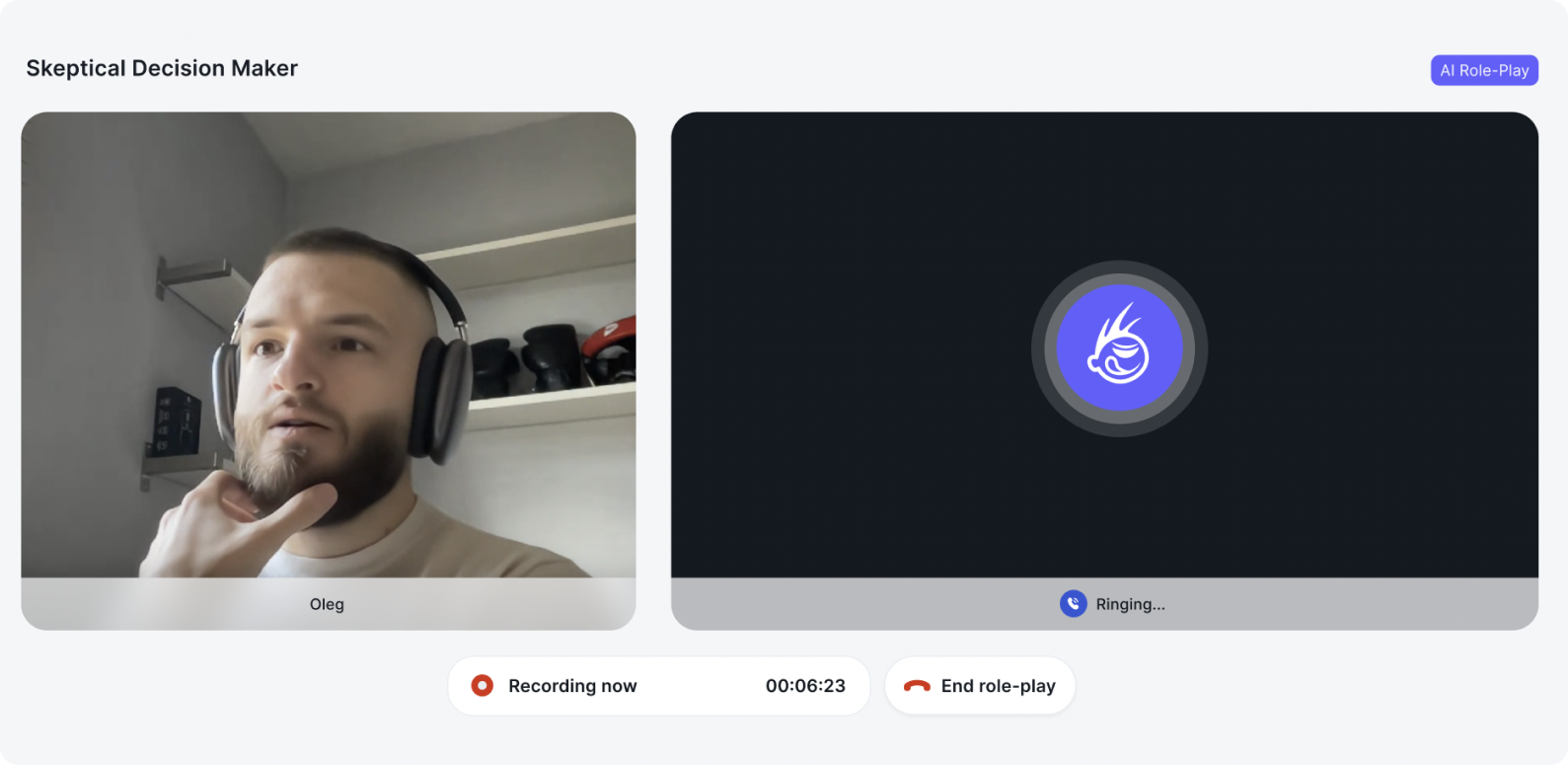
We ran the same cold call in both tools and recorded it. Here is what happened.
PitchMonster vs Second Nature at a glance
The table below sums up how the two compare on what a sales buyer weighs most. Both are quote-based at the team level, so compare them on fit rather than a sticker price.
Factor |  PitchMonster PitchMonster | Second Nature |
|---|---|---|
Best for | Sales, CS, enablement, and product teams practicing real customer conversations | Structured training and certification at scale |
Core job | Sales role-play scored on your methodology | AI role-play training inside your enablement stack |
Signature feature | Socratic AI Coach that debriefs every session | LMS-integrated role-play and Deal Coach |
AI buyer setup | From calls, docs, or a URL in about 2 minutes | From decks, recordings, or freeform text |
Scoring | Your own playbook and scorecard | Structured scoring and progress tracking |
Conversation realism | Natural pacing, fillers, context-aware objections | Persona-based role-play |
LMS integration | Exportable via API | Native SCORM and LTI |
Data residency | European-based, GDPR, EU data residency | Israel-founded, global |
Service model | Dedicated CSM, guided onboarding | Self-serve leaning, enterprise support |
Pricing model | Quote-only, onboarding included | Quote-only, per company |
Proof | 4.9 on G2, 100% enterprise renewal since spring 2024 | LMS-integrated training focus |
Read the table as a fit question rather than a scorecard. Second Nature leans toward structured training that lives in your LMS. PitchMonster leans toward realistic practice with a reflective coach and a guided rollout. The sections below unpack each so you can match it to your team.
What Second Nature is built for
Second Nature is an AI role-play training platform. You describe a scenario in freeform text or upload decks, call recordings, or playbooks, and it builds an AI persona reps can practice against. Managers track progress across a team, which makes it a common pick for structured onboarding and certification programs.
Its strength is fitting into an existing enablement stack. Second Nature integrates with common learning platforms through SCORM and LTI, so role-play becomes another module in the LMS rather than a separate tool. It also offers a Deal Coach that gives reps AI-driven coaching on live deals, and its homepage features a free simulations library for hands-on sampling.
For an enablement team that already runs training through an LMS and wants AI role-play inside it, that integration-first approach is the selling point. Reps get a consistent, trackable practice path, and managers get progress data in the system they already use.
The trade-offs for a sales buyer are realism and coaching. Second Nature is built around structured training, so the practice can feel more scripted than a free-flowing sales call, and its coaching reports scores rather than guiding a rep to their own conclusion. Those are the gaps the comparison below focuses on.
What PitchMonster is built for
PitchMonster is an AI sales role-play platform built for one outcome: reps who are ready before the real call. Reps rehearse cold calls, discovery meetings, and demos against AI buyers that adapt, object, and push back like your actual ICP. Every session is scored against your own playbook, so practice is measured the same way you measure live deals.
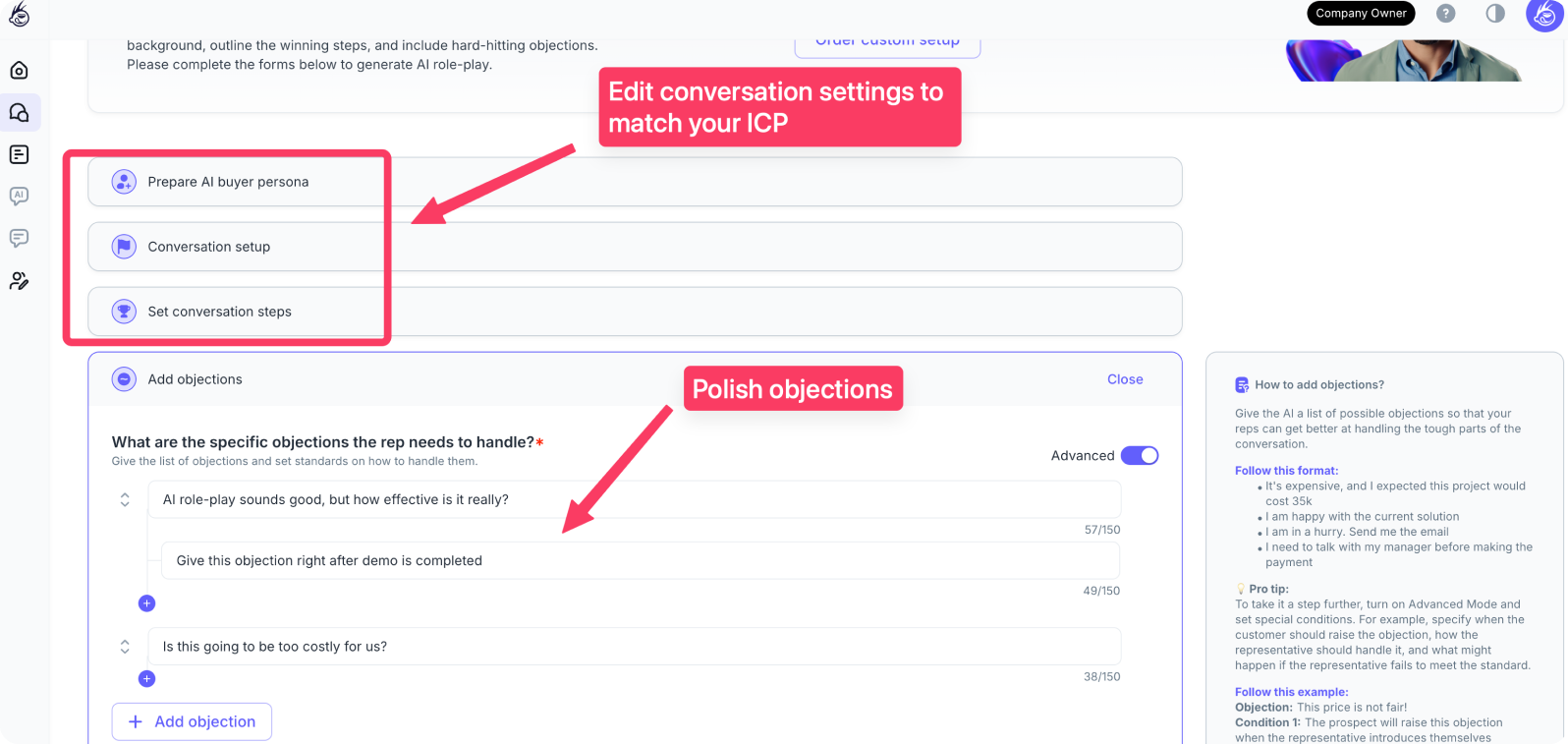
A manager can build a scenario from a call recording, product docs, a transcript, or a website URL in about two minutes. There are four difficulty levels up to Insane, more than 40 customization parameters, and support for 27-plus languages, so a global team practices on scenarios that mirror its real buyers. Reps can practice by phone, face-to-face, or over screen-share, matching how they sell.
What separates PitchMonster is the AI Coach. After each session, a Socratic AI sales trainer asks reflective questions that guide the rep to their own conclusion before they ever see a score. It runs 24/7, so a rep debriefs on their own time, and no competitor on the sales role-play shortlist offers this. Self-diagnosed lessons stick harder than a handed-down score, which is why this step is where rep behavior changes.
PitchMonster is European-based, which brings GDPR compliance and EU data residency, and it runs a high-touch service model with a dedicated CSM and guided onboarding rather than pure self-serve. It holds a 4.9 out of 5 rating on G2 and a 100% enterprise renewal rate since spring 2024, and customers include Lenovo, Adobe, Salesforce, Land Rover, and Coupa.
Feature comparison
Both tools build an AI persona from your content, run role-plays, and score reps. The divide is realism, coaching depth, and how the tool is deployed. The table below lays out the head-to-head.
Capability | PitchMonster | Second Nature |
|---|---|---|
AI role-play | Yes, adapts and objects like your ICP | Yes, persona-based practice |
Post-session coaching | Socratic AI Coach guides self-diagnosis | Scoring and progress tracking, Deal Coach |
Scenario building | From calls, docs, URL in ~2 minutes | From decks, recordings, or freeform text |
Scoring model | Your sales methodology and scorecard | Structured scoring rubrics |
Conversation realism | Natural pacing, fillers, context-aware | Persona-based role-play |
LMS integration | Exportable via API | Native SCORM and LTI |
Difficulty levels | 4, up to Insane | Scenario configuration |
Languages | 27+ | Multiple |
Manager analytics | Skill-gap and readiness dashboards | Progress and certification tracking |
Data residency | EU-based, GDPR, EU residency | Israel-founded, global |
Service model | Dedicated CSM, guided onboarding | Self-serve leaning, enterprise support |
The line that matters most is coaching. Second Nature scores the call. PitchMonster's coach debriefs it - the difference between a grade and a lesson. Second Nature reports how a rep scored and tracks it over time. PitchMonster runs a reflective debrief that makes the rep reason through what they would change, then ties it to the scorecard. For skill that has to hold up on a live call, that reflection step is the difference between a rep who reviews a score and one who changes behavior.
The second line is realism and deployment. Second Nature is built for structured training inside an LMS, which suits certification programs. PitchMonster is built for free-flowing, realistic sales conversations with a guided rollout, which suits teams whose problem is reps freezing on real objections rather than completing modules.
Pricing compared
Neither company publishes standard pricing, so this is a comparison of models, not sticker prices. Both quote per team after a demo, and you will not get a firm number from either without a call.
Second Nature ai pricing is quote-based, sized to your team and the modules you turn on, with no public per-seat rate. Reported figures on third-party review sites vary widely, so treat any single number as unofficial until Second Nature puts it in writing. Either way, a real team rollout is a quoted deal.
PitchMonster is also quote-only, and the model bundles onboarding, a dedicated CSM, and support with no setup fees. Because both end up as custom quotes, compare them on total value and rollout support rather than a headline rate.
Plan | PitchMonster | Second Nature |
|---|---|---|
Entry | Guided demo, then a team-sized quote | Team rollout custom-quoted; free simulations to sample |
Team / Enterprise | Custom quote; onboarding, CSM, support included | Custom quote, per company |
Public per-seat price | Not published (quote-only) | Not published (quote-only) |
What shapes the quote | Team size and seats | Team size and modules |
The practical takeaway is that pricing should not be the tiebreaker, because both are custom-quoted. What differs is what comes bundled and how the tool is run, which is where the fit question below comes in.
What you are pricing is readiness. Teams running PitchMonster's practice-and-coach loop report a 50% faster ramp-up and a 2X reduction in coaching time per rep in the Mentor Group case study.
"Our leads are very expensive. Having to do trial and error with live leads is an expensive practice." - Daniel, One Park Financial
You can book a demo for a quote sized to your reps.
Which one fits your team
Because the two overlap on core role-play and diverge on coaching, realism, and deployment, the choice comes down to what you are optimizing for. Use the table as a starting point, then pressure-test it in a demo with your own scenarios.
If you are... | Lean toward |
|---|---|
Running certification and onboarding inside an existing LMS | Second Nature |
Wanting role-play to slot into SCORM or LTI courses | Second Nature |
Comfortable with a self-serve, structured-training setup | Second Nature |
Wanting a reflective AI Coach, not just a score | PitchMonster |
A sales, CS, enablement, or product team practicing real, free-flowing conversations | PitchMonster |
Required to keep data in the EU under GDPR | PitchMonster |
A team of 10 to 300 that wants guided onboarding | PitchMonster |
Buying with a lean enablement team that needs a hands-on rollout | PitchMonster |
Two questions settle most decisions. First, does training need to live inside your LMS, or stand on its own as realistic practice? If LMS integration is the requirement, Second Nature is built for that. If realistic conversations and coaching are the goal, PitchMonster covers more of the loop. Second, how much rollout help do you need? Second Nature leans self-serve; PitchMonster brings a CSM and guided onboarding.
If your priority is coaching depth, realism, or an EU data base, the next section covers why sales teams pick PitchMonster.
Where PitchMonster pulls ahead
Second Nature is a capable platform built for structured training and certification that lives in an LMS. For most sales teams the deciding factor is what happens after the practice, and whether the tool helps a rep improve rather than just recording that they completed a module. That is where PitchMonster is built to pull ahead.
It starts with the AI Coach. After every role-play, PitchMonster runs a Socratic debrief that asks the rep what they noticed and what they would change before they see a score, so they self-diagnose instead of waiting for a manager. This is the piece no other sales role-play tool has, and reflection is where behavior shifts.
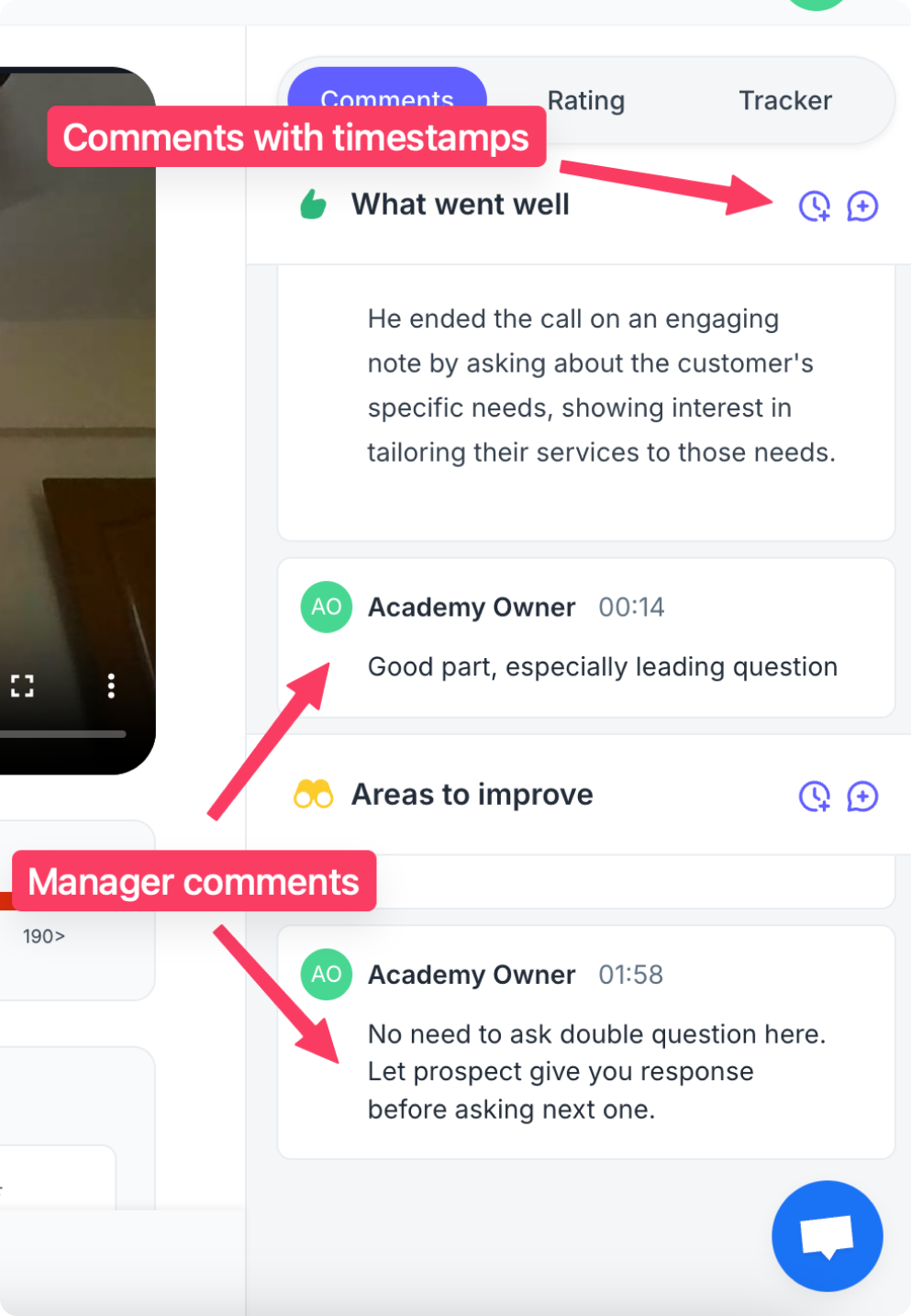
Around the Coach sits realistic practice. AI buyers object and push back like your real ICP with natural pacing and context-aware objections, scenarios come from your own calls and docs, and every rep is scored against the same playbook you use on live deals. Live Call Analysis applies that scorecard to real call recordings, so practice and live performance are measured the same way, and managers get skill-gap dashboards to see who is ready before the call.
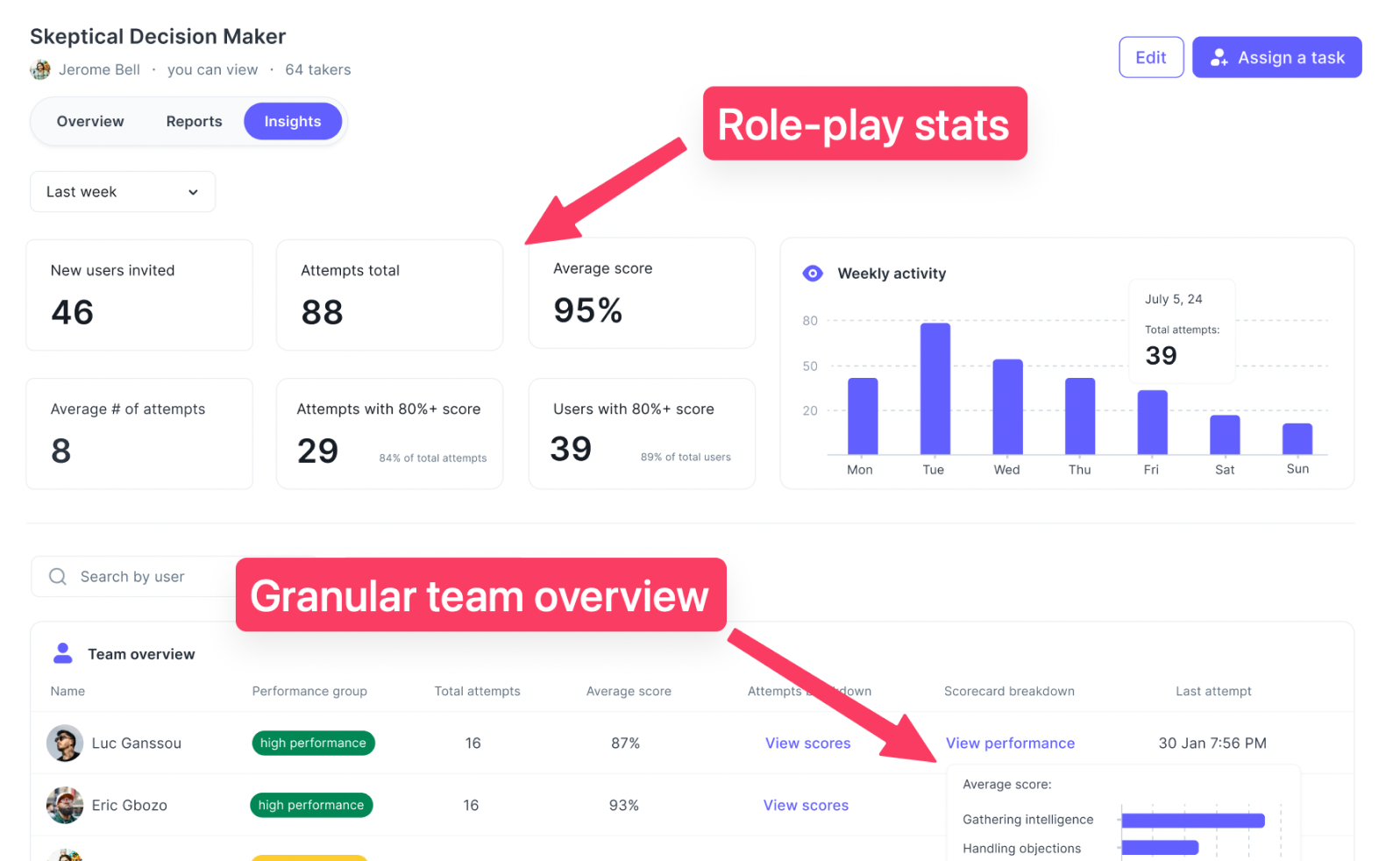
The service model is the other divide. PitchMonster is built for teams of roughly 10 to 300 reps, with guided onboarding and a dedicated CSM, and it is the only European-based option among the leading tools, with GDPR compliance and EU data residency. Teams running the practice-and-coach loop report 50% faster ramp-up and a 2X reduction in coaching time per rep in the Mentor Group case study.
"I think I really like the AI coach. That's definitely going to save us a lot of time." - Wendy Mateo De Perkins, One Park Financial
If you want realistic practice plus a coach that makes it stick, that is the gap to close. Book a demo and we will build your first sales role-play with you, or see pricing sized to your team. You can also browse 12 sales role-play scenarios to see the kind of practice reps run.
FAQ
What is Second Nature AI?
Second Nature is an AI role-play training platform founded in Israel in 2018. Reps practice conversations with an AI persona built from your decks, call recordings, or playbooks, and managers track progress at scale. It integrates with common LMS platforms through SCORM and LTI, plus CRMs and SAML, so training slots into an existing enablement stack.
How much does Second Nature AI cost?
Second Nature does not publish pricing. It quotes per company after a demo, based on team size and modules, so there is no public per-seat rate. Reported ranges on review sites vary widely and should be treated as unofficial. Both Second Nature and PitchMonster are custom-quoted at the team level, so compare them on fit and coaching depth rather than a sticker price.
What is the difference between Second Nature and PitchMonster?
Both run AI sales role-plays and score reps. Second Nature is built for structured, LMS-resident training at scale. PitchMonster is built for personalized, adaptive, realistic practice of your team's real conversations: AI buyers from your ICP, scored on your methodology, with a Socratic AI Coach that debriefs each session. It serves sales, CS, enablement, and product teams, not just reps. PitchMonster suits teams that want coaching depth and conversation realism.
Is Second Nature AI good for sales teams?
Yes, for structured onboarding and certification at scale, especially when you want role-play to live inside an existing LMS. Second Nature does that job well. If your priority is realistic objection practice plus a reflective coaching layer that helps reps self-diagnose, compare it against PitchMonster, which is built specifically for that outcome.
What is the best Second Nature AI alternative?
For teams that want AI role-play plus deeper coaching and EU data residency, PitchMonster is the closest Second Nature alternative. Reps practice cold calls, discovery, and demos against AI buyers built from your ICP, get scored on your playbook, and debrief with a Socratic AI Coach. PitchMonster is European-based with GDPR compliance and holds a 4.9 out of 5 rating on G2.
Who are Second Nature's main competitors?
In AI sales role-play, Second Nature is compared most with PitchMonster and Hyperbound, then a set of newer entrants. For teams whose priority is practice plus a reflective coaching layer and a European data base, PitchMonster is the common head-to-head. For contact-center simulation specifically, buyers also look at frontline-focused platforms.