You ran a good workshop. The room was engaged, the end-of-day scores were strong, and the client's VP called it the best session their team had sat through in years. 6 weeks later that VP asks whether the new messaging is landing on live calls, and the honest answer is that you have no idea.
That gap is the commercial problem in sales training and coaching, and it belongs to your firm rather than to your client. The sales training companies that hold accounts for years are the ones that closed it. The rest sell the same 2-day program to a new logo every quarter and call it a pipeline.
This is written for the delivery side: the owner of a training consultancy, the practice lead at an L&D agency, the independent sales enablement consultant with 6 retained clients. Almost everything published on this topic is written to sell training to a firm like yours. This is about what you put into the engagement after the room empties.
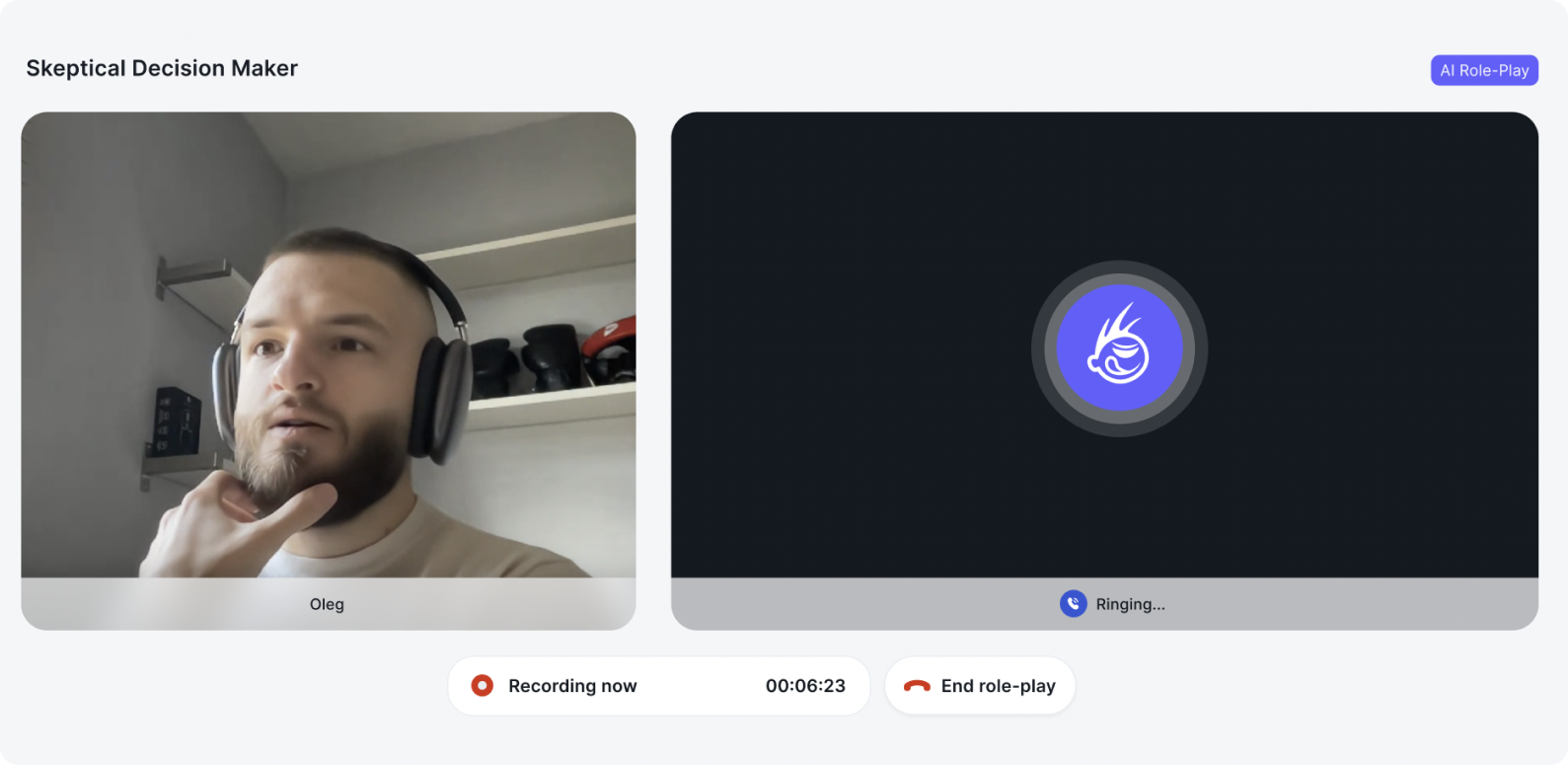
Why does a workshop stop working 3 weeks after you leave the room?
Because you taught a model and the reps needed reps.
A workshop transfers understanding fast. A seller leaves knowing what a good discovery question sounds like and why the demo comes after the diagnosis. What they have not done is say it out loud 20 times with someone pushing back. Understanding decays quietly. Behavior never formed at all.
The standard answer is manager reinforcement, and it fails for a reason everyone in the industry already knows. The frontline manager who was going to run weekly practice has a forecast, an escalation and 9 direct reports. Week 1 happens. Week 4 does not. By week 8 the client has concluded that training does not work, which is a conclusion about you.
There is a second problem that only firms feel. Reinforcement is unbillable unless you sell it. Trainers are your inventory, so every hour nursing a cohort through week 7 is an hour not delivering a new engagement. That conflict is sharper when the client's sellers are billable consultants or technical experts who sell part-time, because they will not trade utilization hours for a practice session.
Read the pages ranking for corporate sales training and you hit the same wall. 6 of the 8 leading results say reinforcement decides whether training works. Not one says what it consists of week by week, who owns it after you invoice, how a firm gets paid for it, or what the client sees at renewal. The category agrees on the diagnosis and will not write the prescription.
It cannot even agree what it sells. One page calls training the event and coaching the layer on top. Another calls a program a 60-day journey that already contains the coaching. A third insists its programs are not single events, then names no module and no duration. A buyer reading 3 of those in a row cannot tell what they are being quoted for. So fix the definition before you sell anything.
What is a practice layer, and how is it different from more training?
Three jobs, and most proposals blur them.
Training transfers the model. One-to-many, time-boxed, delivered by you or your associates. It installs the framework, the language and the proof points.
Coaching corrects the individual. One-to-one, diagnostic, dependent on a skilled human with a calendar. It is expensive and it does not scale past the number of skilled humans you have.
Practice is the repetition in between that neither of those is. A rep runs a scenario against an AI buyer, gets scored on a fixed rubric, gets debriefed, runs it again. Asynchronous, self-serve, identical for rep 1 and rep 500, available at 7am when the rep has 12 free minutes.
Training without practice decays. Coaching without practice burns your senior people on things a rubric would have caught. Practice without training is drilling with no model to drill toward. The layer is what your engagements are missing, and it is the part that survives you leaving.
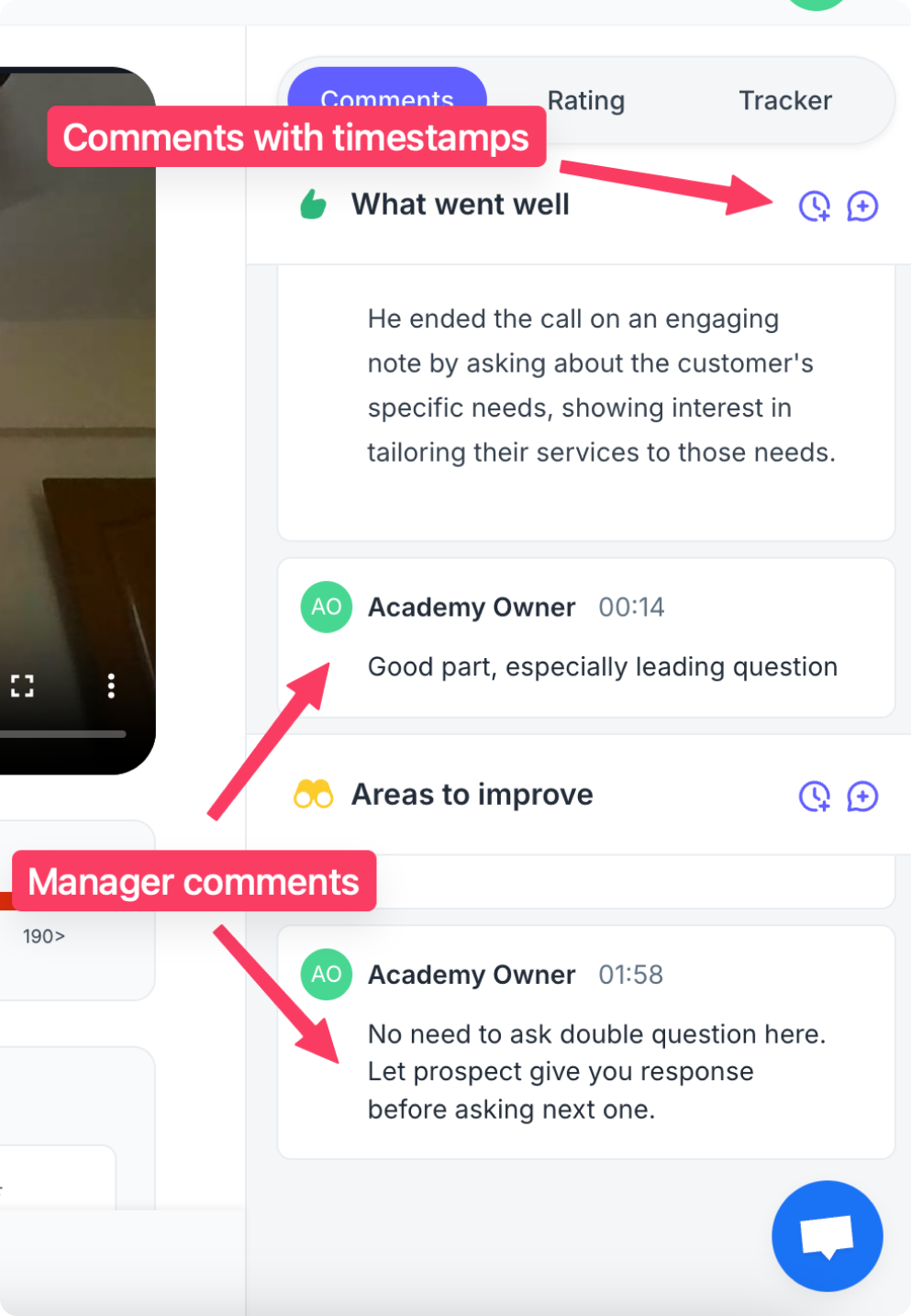
Get one thing right early, because most vendors get it wrong for your buyer. Practice in this category is usually demonstrated as a cold call. For an enterprise software client, a consultancy or a professional services firm, the cold call is not where the deal dies. The deal dies in a 20-minute solution walkthrough. The seller is talking through a deck or a product screen, gets interrupted at minute 4 by a stakeholder who missed the last meeting, and never recovers the thread.
That is why screen-share and presentation mode is where these programs start. The rep shares their real deck or the client's real product, and presents to an AI buyer that interrupts. Scoring covers structure, whether a capability was tied to a stated problem, and what they did after being knocked off script. Nobody ranking for this topic writes about that format. Your clients live in it.
What should a client practice between sessions?
Start from the deal the client runs, not from a scenario library.
Client type | First scenario to build | Practice format | What the scorecard measures |
|---|---|---|---|
Enterprise software | 20-minute solution walkthrough, interrupted at minute 4 by a new stakeholder | Screen-share on the live product | Structure, capability tied to a stated problem, recovery after interruption |
Professional services and consulting | Credentials-to-diagnosis pivot in the first meeting | Presentation mode on the firm's own deck | Minutes on the client's problem versus the firm's history |
Channel and partner sellers | Joint value story told to an end customer | Presentation mode, 2 logos on one slide | Clarity of the joint proposition, who does what after signature |
Technical experts who now sell | Discovery without demoing anything | Voice role-play | Question ratio, talk-time, whether they opened the product unprompted |
Account managers | Renewal and expansion with a skeptical sponsor | Voice role-play | Handling pushback, naming the commercial ask out loud |
Inside sales and SDR teams | Opening call with a buyer who was not expecting it | Voice role-play | Reason for the call in 15 seconds, objection handling, booked next step |
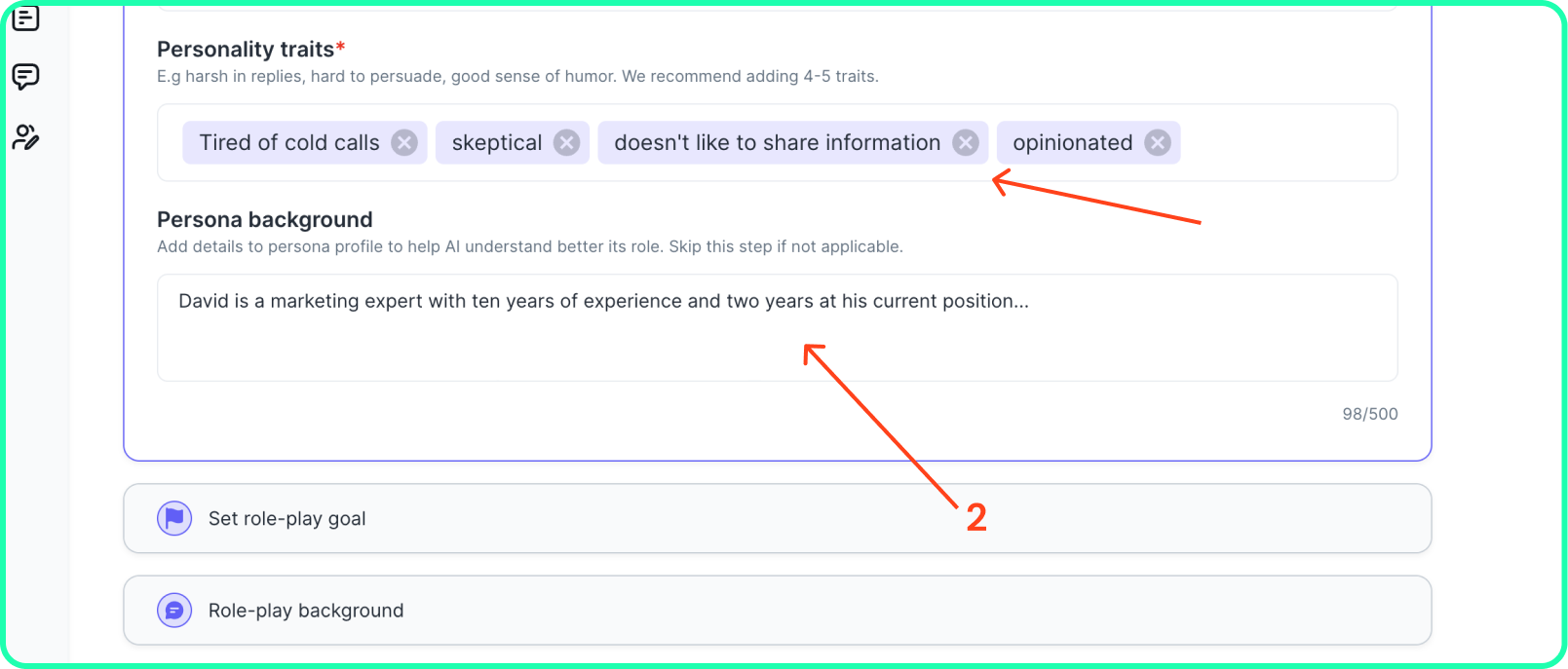
Two rules keep this from becoming a content project. Build 3 to 5 scenarios per cohort, not 30. Build them from the client's own material, because a generic persona gets 2 attempts and then gets ignored.
Scenario map: the 7 fields to fill in per client
Fill this in with the sponsor in a 45-minute call, before you build anything. The bracketed answers come from a professional services rollout.
- The moment the deal is won or lost. [First meeting, minutes 5 to 15, when the partner has to stop presenting the firm and start diagnosing.]
- Who is on the other side. [Operations director, 3 years in role, sold to by 4 firms this year, skeptical of methodology talk.]
- What they say that derails the seller. [We looked at this internally already and it went nowhere.]
- The format the real conversation happens in. [45-minute video call, deck shared on screen.]
- What good looks like, in the client's words. [Names 2 specific operational symptoms back to the buyer before proposing anything.]
- The 4 to 6 things that get scored. [Diagnosis before solution, proof point accuracy, handling the internal-attempt objection, commercial next step.]
- Who signs off. [The sponsor plus 1 respected senior seller, because peer sign-off is what makes the cohort take it seriously.]
How do you add practice to an engagement you have already sold?
You do not redesign the workshop. You give it a spine. Take a standard 3-day corporate sales training program and rebuild it as a 90-day sales coaching program without changing a slide:
- Day -14. Every participant runs 1 scored scenario before they meet you. 15 minutes each. You now own a before number and a real read on the cohort, which makes day 1 sharper.
- Days 1 to 3. The workshop runs as designed. The only addition is a 10-minute practice rep at the end of each day on what was taught that day.
- Weeks 2 to 6. 2 scenarios per week, released on a schedule, each debriefed by an AI Coach that asks the rep what they would change rather than handing them the answer.
- Week 6. Mid-point readout to the sponsor: cohort scores by dimension, the 2 weakest behaviors, what you are changing in response.
- Weeks 7 to 12. Harder scenarios aimed at whatever week 6 says the cohort is worst at. This is what makes the engagement feel bespoke, and the data does the work.
- Week 12. Re-run the day -14 scenario on the same rubric. Report the delta.
The client's workshop now produces evidence. Your 3-day fee is untouched and there is a 90-day line item under it with a renewal date attached.
White-label, co-delivery or client-licensed: which model fits your firm?
4 structures, and they pay very differently. The one you pick decides who the client thinks they bought from.
Full comparison4 rows · 6 columns
Model | Who fronts it | Who administers | Who holds the data | What the client renews | Fits you when |
|---|---|---|---|---|---|
White-label | Your brand, your platform URL | Your team | You, with client access granted | Your program | You have delivery staff and want the platform invisible |
Co-delivery | Both brands, named openly | You build, client admins users | Client tenancy, partner access for you | Both, together | The client is enterprise and wants a direct vendor relationship |
Client-licensed | The vendor, introduced by you | Client's enablement team | Client | The licence, separately from your program | You want recurring pull-through without operational load |
Train-the-trainer | Your methodology, client's trainers | Client | Client | Certification and refreshes, not delivery days | Your IP is the product and delivery days are the constraint |
3 questions decide it. Does your firm want operational responsibility for user administration? Does procurement need a direct contract with the software vendor? And where does the client require recordings and transcripts to live?
That last one settles more deals in Europe than firms expect. If a client's legal team has already said conversation recordings cannot leave the EU, an EU-based platform removes an argument you would otherwise spend 6 weeks losing. PitchMonster is one of the few European-based platforms in the category, which for a UK or EU firm is a procurement advantage rather than a feature.
How Mentor Group embeds practice into Lenovo, Infor and Syngenta programs
Mentor Group is a UK sales performance consultancy. Software is not their business. They sell training, and they put a practice layer inside engagements they already run for clients including Lenovo, Infor and Syngenta.
Across that client work they report 50% faster ramp-up on average and a 2X reduction in coaching time per rep. The second number is the one that moves a firm's economics, because coaching hours are the ceiling on how many cohorts your senior people can carry at once.
One client-level result from the same program: participants recorded a 27% improvement in message-delivery accuracy, testable against their own approved messaging rather than a subjective read on tone.
On what the layer gives the client's managers, Martin Sharpe, Solutions Director at Mentor Group, puts it plainly: "Sales leaders finally get a window into how their teams are selling."
And on the commercial question every firm reading this is holding, Ben Barton, Assistant Marketing Manager at Mentor Group, says: "PitchMonster is probably the easiest product we've ever sold."
The full write-up is in the Mentor Group case study.
What expands after the workshop ends?
The category will not discuss this, so here is the model. No prices, because PitchMonster is quoted per engagement, but the shape is consistent.
Seats accumulate by cohort. Engagement 1 covers one group. The next intake needs the same scenarios, already built. Cohort 2 is margin rather than delivery.
Programs spread to accounts. A layer bought for one business unit gets noticed by another. A single market or team that shows a result is the reference case for the rest of the account.
Onboarding runs whether you are in the building or not. New-hire practice never pauses, and it carries the cleanest number, because ramp time is already on the client's dashboard.
A project fee becomes a recurring line. The workshop ends. The practice layer renews. That single change is what turns lumpy revenue into forecastable revenue, and it is what a buyer of your firm would pay a different multiple for.
Language stops being a hiring problem. A program built once runs in 29 languages, so a Nordic or APAC rollout does not mean finding a trainer per market and hoping they deliver your method faithfully.
One warning. Do not pass the licence through at no margin with nothing attached. Attach the scenario build, the scorecard design and a quarterly readout, and your sales coaching services are something the client cannot buy from the vendor directly. Pass it through bare and you have introduced your client to a supplier who no longer needs you.
How do you evidence client outcomes once you have left the room?
By baselining before session 1. Everything below depends on that one act, and it costs 15 minutes per participant.
When | What you can evidence | The measure | Where it comes from |
|---|---|---|---|
Before session 1 | Starting capability, by rep and by cohort | Baseline scenario score across 4 to 6 dimensions | Scored practice run |
Day 30 | Adoption and early movement | Completion rate, score change on repeated scenarios | Platform dashboard |
Day 60 | Behavior showing up in the work | Score change on the hardest scenario, plus analysis of real call recordings | Practice data and call analysis |
Day 90 | Capability change on the same test | Re-run of the baseline scenario, same rubric | Scored practice run |
Renewal | Business movement the sponsor already tracks | Ramp time, coaching hours per rep, the KPI the sponsor named in week 0 | The client's own reporting |
The verified results below are what the right-hand end of that table looks like when it is done.
Client | Delivered via | Measure | Result |
|---|---|---|---|
Mentor Group client base | Partner-delivered | Ramp-up time | 50% faster on average |
Mentor Group client base | Partner-delivered | Coaching time per rep | 2X reduction |
Mentor Group client base | Partner-delivered | Message-delivery accuracy | 27% improvement |
PRN Health Services | Direct | Scores on actual calls, 60-day window | 22.37% higher |
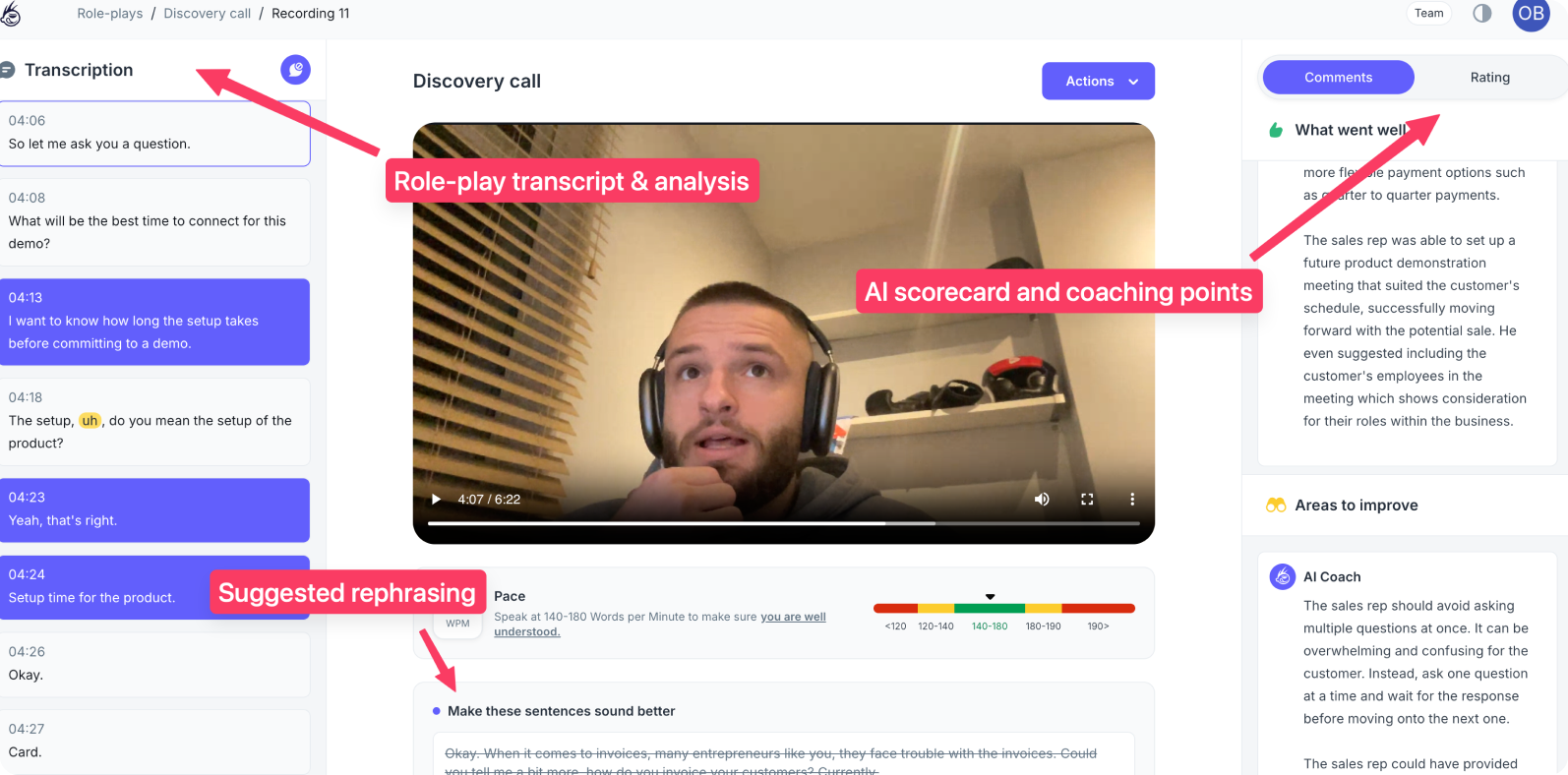
The outcome scorecard: 6 dimensions to score
Use the same 6 before and after. Change the rubric mid-program and the comparison is gone.
- Opening and framing. Was an agenda set and agreed in the first 2 minutes?
- Diagnosis before solution. Minutes spent on the buyer's situation before anything was proposed.
- Message accuracy. The share of approved proof points delivered correctly under interruption. This is the measure Mentor Group clients report, and it is the easiest one for a sponsor to accept because it is testable against their own approved messaging.
- Handling pushback. What happened at the objection the client told you they lose deals on.
- The commercial ask. Was a specific next step named out loud, with a date?
- Recovery. After being knocked off script, did they get back to the point or keep talking?
Scored by the platform, not by you. That matters more than it sounds. A score your firm produced is marketing. A score a platform produced on a fixed rubric is evidence, and the sponsor can audit it.
The renewal conversation, on one slide
Baseline cohort score. Day 90 cohort score. The 2 dimensions that moved most. The 1 that did not, and what you propose doing about it in the next 90 days. The sponsor's own KPI beside it. That slide is why the expansion conversation happens in the meeting instead of 3 months later over email.
What belongs in the SOW?
None of these clauses is controversial once written down, and all of them hurt when they are not.
- Licence term against engagement term. What happens on day 91. If the program ends and the licence runs on, say who pays and who administers.
- Scenario scope. How many scenarios are in the build, and what a change request costs after sign-off.
- Scenario and persona IP. Personas are built from the client's ICP and your method. Say who can reuse them, and whether the client keeps them if they do not renew.
- Scorecard authorship. Whose rubric it is and who may change it. A client editing the rubric mid-program destroys the day 90 comparison.
- Data residency and ownership. Where recordings and transcripts sit, who can export them, what gets deleted at termination.
- User administration. Who adds and removes people. The most common source of quiet friction in month 2.
- Reporting cadence. Put the week 6 and week 12 readouts in the SOW so they are deliverables rather than favors.
- Expansion terms. A pre-agreed rate for cohort 2. Negotiating it fresh after a good result is how firms lose momentum.
- Support path. Who a rep contacts when something breaks, and how fast.
How do you sell the practice layer to a client who already bought the workshop?
Your advantage is that they already trust you. Your risk is sounding like a software reseller. 5 objections and what to say.
"We already have an LMS." You do, and it tracks completion. Completion is attendance with a database behind it. Ask the sponsor to name the last time the LMS told them which rep cannot handle the pricing objection.
"Our managers will handle the reinforcement." Ask what happened in week 7 of the last program. Everyone in the room knows. The practice layer does not remove the manager, it removes the scheduling problem that defeats the manager.
"Reps will not use it." They will not use a generic persona. They will use a scenario built from their own deck, their own product screen and the objection that lost a deal last quarter. That is especially true with a respected senior seller signed off on it.
"Is this you replacing yourself with software?" The opposite, and Mentor Group is the proof. They sell training, added a practice layer, halved coaching time per rep and kept delivering. The platform does repetition and grading. It does not diagnose why a cohort skipped the commercial ask or redesign the module that caused it.
"Legal will not let recordings leave the EU." Then bring an EU-based platform to the meeting and stop having that argument.
To see the delivery side before you take it to a client, the sales trainers and agencies page covers the partner model. Book a demo gets you a walkthrough built on your own material. For the scenario mechanics, start with 12 sales role-play scenarios or the tool comparison.
Frequently asked questions
Who runs the practice after the trainer leaves?
Nobody runs it in the sense of a person in a room. Scenarios release on a schedule you set during the build. The AI buyer plays the other side, the scorecard grades every attempt on the same rubric, and an AI Coach debriefs the rep one-on-one straight after the session. The client's managers get a dashboard rather than a job. Your firm keeps admin rights and reads the data before the sponsor does.
How do billable consultants find time for practice reps?
A scored scenario runs in 10 to 15 minutes and needs no second human, no scheduled slot and no room. That is why asynchronous practice works for subject-matter experts who sell part-time. A consultant on a client site can run a solution walkthrough at 7am, read the debrief and be back on billable work before the first meeting. 2 reps a week is a realistic ask. 2 live role-plays a week is not.
Does a practice platform replace the trainer?
No, and firms that sell it that way lose the account. The platform does repetition, grading and tracking. It does not diagnose why a whole cohort skipped the commercial ask, redesign the module that caused it, or run the conversation with the sponsor about what changes next quarter. Mentor Group added a platform and kept selling training.
What does a pilot with a training partner look like?
One cohort, one program, 90 days, 3 to 5 scenarios. Baseline every participant on a scored scenario before session 1, then run the workshop as designed. Release scenarios across the following weeks, then re-score the baseline scenario at day 90 on the same rubric. The deliverable is a before-and-after readout on one measure, and that readout is what the expansion conversation is built on.
How does this work for a client's team on another continent?
Asynchronous practice does not need your trainers awake. Scenarios run in the rep's timezone and the scorecard applies the same rubric in every market, which is what makes a multi-region rollout comparable. PitchMonster supports 29 languages, so a program built once in English reaches local-language teams without hiring a trainer per market.
How do you prove the outcome at renewal?
Same scenario, same scorecard, scored before session 1 and again at day 90, next to whatever field metric the sponsor already reports. Mentor Group clients have recorded a 27% improvement in message-delivery accuracy using this method. PRN Health Services measured 22.37% higher scores on actual calls across a 60-day window. Baseline first or you have nothing to compare.