Sales pitch training is the structured practice of rehearsing how a rep opens and frames value. It also covers how the rep asks for the next step, all before doing it on a real prospect. It covers both a stand-alone pitch and a product demo, scored against a fixed set of criteria rather than a gut feeling of how the call sounded.
The rest of this guide breaks down both rehearsals and the rubric behind them.
What sales pitch training means
Sales pitch training covers how a rep delivers a pitch, not just what the pitch says. A script and a slide deck describe the message. Training is the repeated practice of saying that message out loud, under a bit of pressure, until it holds up when a buyer pushes back.
A written script tells a rep what to say. It says nothing about pacing, tone, or what to do when a buyer interrupts with a question the script never planned for. A rehearsal closes that gap by forcing the rep to handle the moment live, then correcting it before the next attempt.
Most guides on this topic treat a stand-alone pitch and a product demo as two separate skills, taught from two separate playbooks. They share the same bones underneath: an opening frame and a value story tied to something the buyer cares about. Both lead to a specific next step. Treating pitch delivery and demo delivery as one practice discipline is the more useful way to build training. It's the approach the rest of this guide takes.
Underneath, most pitch and demo problems are a confidence problem. That shows up as a rep who freezes up or rushes the pitch when a buyer pushes back. Others go quiet instead. Confidence usually follows behavior, not the other way around. A rep who has run the same tough moment ten times stops freezing on the eleventh, because the moment is no longer new.
That doesn't mean a pitch and a demo rehearse identically. A demo adds a screen, and a screen changes what the buyer is reacting to in the moment. For the wider picture on structuring role-play across every call type, see PitchMonster's guide to sales role-play.
Why most pitch and demo practice doesn't change real calls
Most reps already rehearse something before a big pitch or demo. They run the slides once in their head, or ask a colleague to listen for five minutes. That kind of practice rarely changes the real call, because nothing about it forces one specific behavior to improve.
A repeatable structure works better: the same scenario, scored against the same rubric, run more than once. PitchMonster's guide to building a sales role-play program covers the cadence and rollout side of that structure, plus its own scoring rubric, from sourcing scenarios to measuring ramp time. This guide stays on a narrower question: what belongs inside a single pitch or demo rehearsal, and how to score it.
Honest feedback matters as much as repetition. A colleague who wants the rep to feel good after a rehearsal tends to soften the correction. That tendency to soften feedback is exactly what PitchMonster's breakdown of AI role-play feedback covers in more depth.
The gap shows up in a specific way. A rep rehearsing alone tends to fix whatever felt awkward, like a stumble on a slide transition. The part that stays unpracticed is usually the objection that comes up almost every time. A fixed rubric catches that gap, since it scores the same criteria every time, not whatever felt uncomfortable in the moment.
How to structure a sales pitch rehearsal
A sales pitch rehearsal has four parts worth practicing on purpose, not just running through in order. Each one maps to a specific moment where a real pitch usually breaks down. Drilling all four in one rehearsal covers most of what a rep needs before the real call.
- Open with the point of the call. State what you want to cover and why it matters to this buyer, so the pitch doesn't sound like a script read from the top.
- Tie the value story to a real pain point. Name the specific cost or consequence the buyer already mentioned, not a generic feature list.
- Weave in an objection mid-pitch. Practice handling pushback without dropping the story, since a real buyer rarely lets a pitch run all the way through uninterrupted.
- Close with a specific ask. End on a named next step and a date, not "let me know what you think."
Difficulty is what makes a rehearsal harder to fake. PitchMonster runs 4 difficulty levels up to Insane, with over 40 parameters for shaping the buyer and the scenario around them. A rep who passes the rubric at the easiest level hasn't proven much yet.
PitchMonster builds each of these moments into a single role-play scenario before the rehearsal starts. A manager sets the buyer's personality and the pain point in play. The same setup controls how hard the objection lands. The rep then runs the pitch against it as many times as the difficulty ramp calls for.
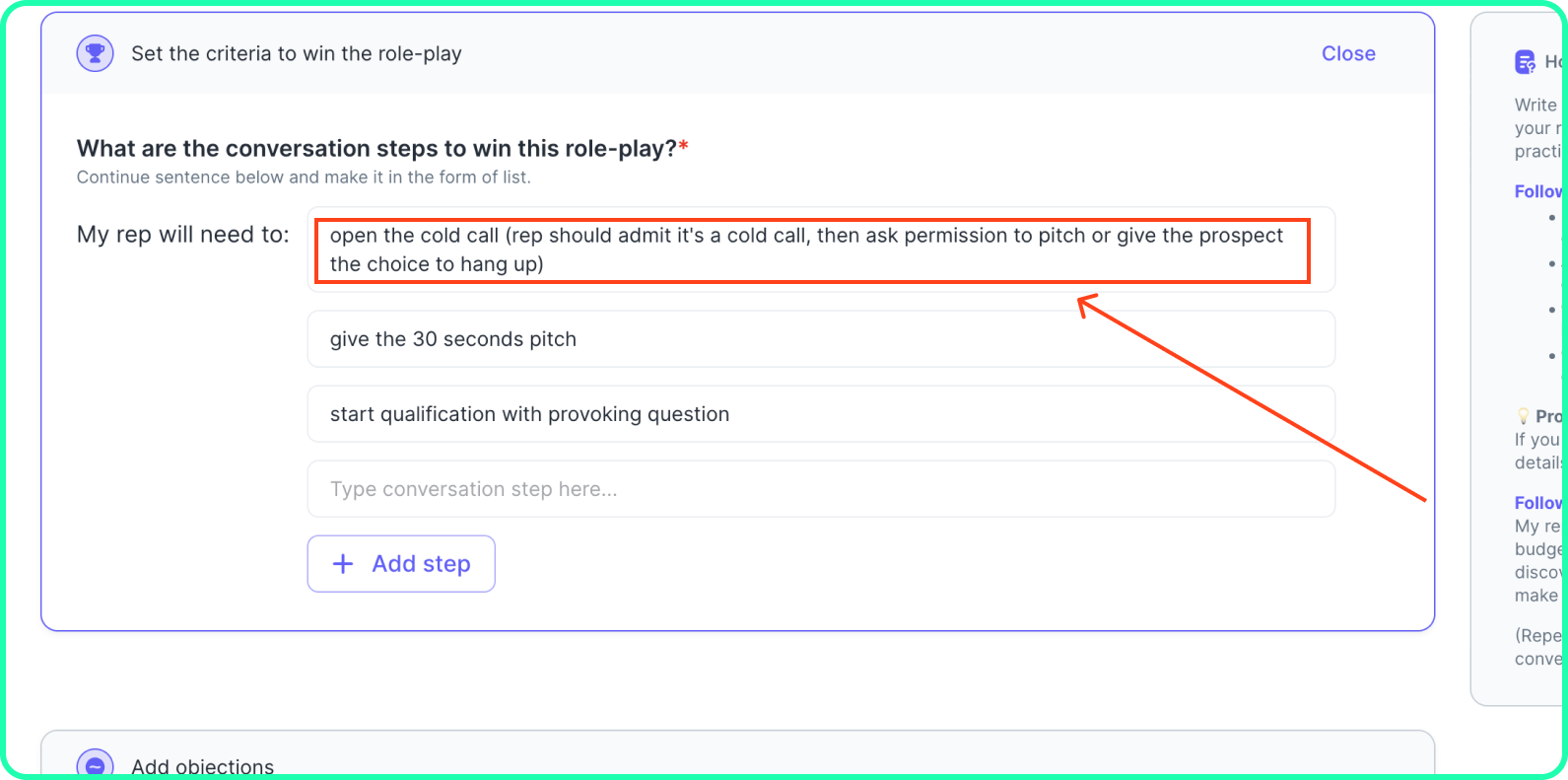
That setup step is what turns a generic pitch rehearsal into practice for one specific account. A rep pitching a skeptical economic buyer needs a different rehearsal than a rep pitching a technical champion. The buyer changes what the rep has to prove, even when the underlying pitch stays the same.
How to structure a product demo rehearsal
Product demo training starts from the same four parts as a pitch rehearsal, with one addition: the screen. Everything changes the moment a rep shares it. A pitch is entirely about what the rep says, and a demo adds a visual the buyer is now judging in real time.
Good sales demo training ties every screen the rep shows back to what discovery surfaced, rather than running the full product top to bottom. A rep who demos features the buyer never asked about is demoing the product, not the account.
A full feature tour fails for a simple reason: the buyer stops tracking what matters well before the tour ends. Picking fewer moments and tying each one to a named pain point keeps the buyer's attention on the parts of the product that decide the deal. It skips the parts that are only easiest to demo.
Four moves are worth drilling on purpose.
- Tie the demo back to discovery before opening a single screen. Skipping this step is the most common reason a demo feels generic.
- Pick 3 to 5 aha moments instead of a full walkthrough. A buyer remembers the 3 or 4 screens that mapped directly to their own problem, not the navigation between them.
- Handle a live objection mid-deck. A buyer who asks a hard question halfway through is testing whether the rep can stay on track, not just whether the feature exists.
- Close with the same specific ask a pitch rehearsal ends on. A named next step and a date, every time.
Practice all four moves in one pass, not as separate drills, since a real demo forces them together.
Where to get scripts and scenarios to practice with
A rehearsal is only as good as the scenario behind it. Writing one from scratch, complete with a believable buyer persona and a realistic objection, is the slow part, and it's where most practice plans stall before they start.
PitchMonster builds a scenario from a real call recording, a transcript, a product doc, or a URL in about 2 minutes. A manager can turn last week's toughest pitch directly into next week's rehearsal instead of writing a persona from memory. The same process works for a demo scenario, built from whatever the last real demo covered.
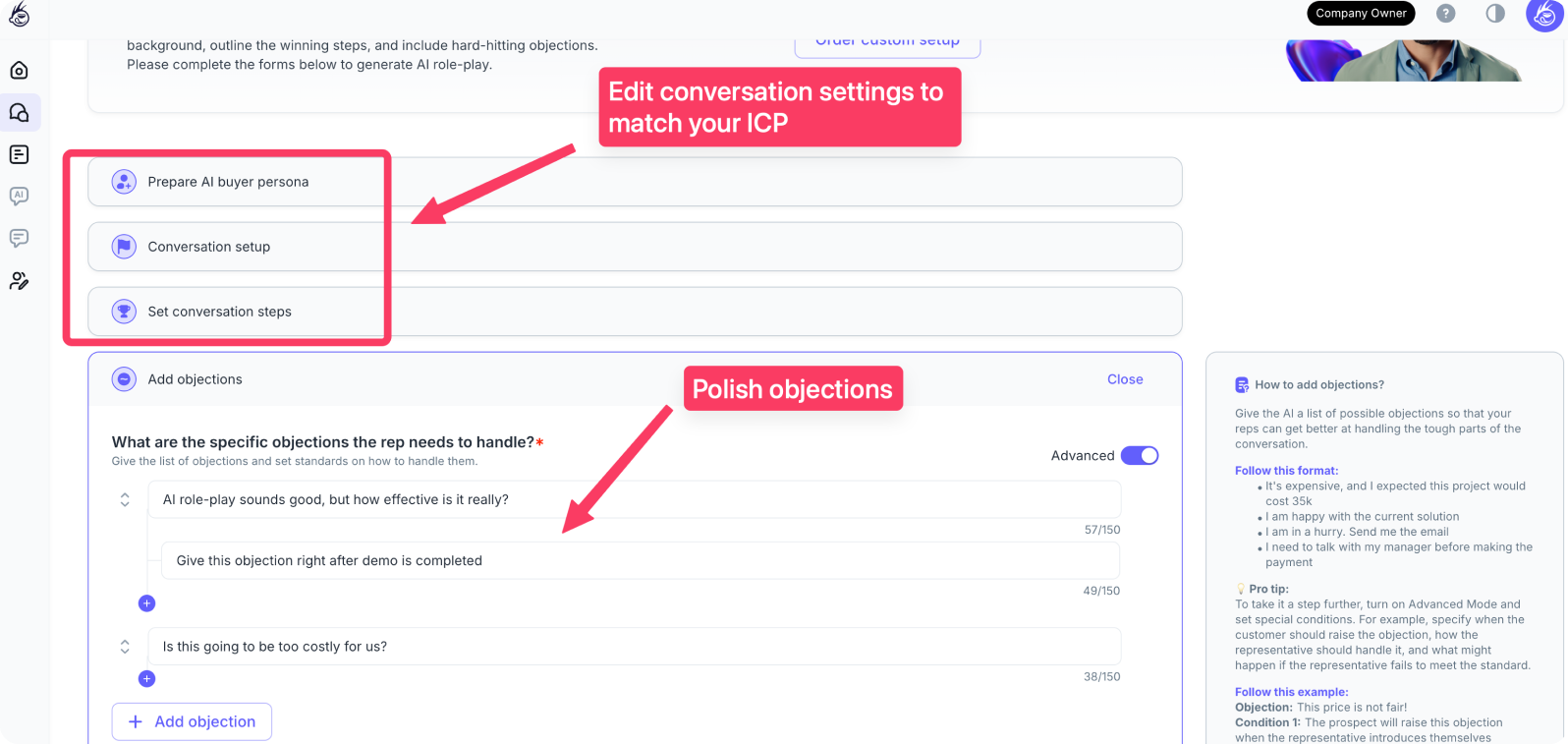
The same builder works in 29 languages. A global team can rehearse in the language the real call will happen in, instead of a script translated after the fact.
If you need a starting library instead of one scenario, PitchMonster's collection of sales pitch examples covers that ground in more depth. PitchMonster's guide to building an AI role-play from scratch walks through writing the buyer persona and the objections yourself. A team rehearsing a different call type first, like a cold open, can start from PitchMonster's cold call practice scenario instead.
Scoring a pitch or demo rehearsal
A rehearsal without a rubric produces an opinion, not a score. "That felt strong" doesn't tell a rep what to repeat, and it doesn't tell a manager whether the whole team is improving or just getting more comfortable in the room.
Five criteria work for both a pitch and a demo, since the two rehearsals share the same underlying moves. Score each one plainly, pass or fail, rather than on a finer scale that invites debate about whether something was a 3 or a 4.
Criterion | What "pass" sounds like |
|---|---|
Opening frame | States the point of the call and what good looks like by the end |
Value tied to pain | Connects the pitch or the demo to a cost or consequence the buyer already named |
Aha moment (demo only) | Shows one capability that maps directly to what discovery surfaced, not a full walkthrough |
Objection recovery | Handles a live pushback without abandoning the story or getting defensive |
Next step | Ends with a named person and a date, not "let me know" |
This rubric works with any practice method, from a peer role-play to an AI buyer, since it scores the rep's behavior and not the tool running the session. Track it across attempts instead of judging a single rehearsal in isolation. The pattern across multiple sessions says more than any one of them on its own. This five-criteria rubric covers one rehearsal; PitchMonster's guide to building a sales role-play program carries the version that spans a full team rollout.
A rep who nails the opening frame and the value story but skips the next-step ask still fails the rehearsal. That's the point of scoring behaviors separately instead of judging one overall impression. A manager can say exactly which one thing to fix next time, instead of a vague note to do better on the close.
Use the same five rows for a debrief immediately after the rehearsal ends. Reading the rubric out loud with the rep, one row at a time, turns the score into a conversation instead of a verdict handed down after the fact.
Where AI buyers help pitch and demo practice, and where they don't
An AI buyer changes one specific thing: capacity. It can run the same pitch or demo scenario as many times as a rep needs, at any hour, without getting tired of hearing the same objection twice.
A manager running live rehearsals in person runs out of hours long before the whole team has had a turn. An AI buyer lifts that ceiling, which is what makes a weekly cadence realistic for every rep rather than a rotating few.
It doesn't decide what good looks like. The rubric in the last section still has to come from a manager who has listened to real pitches and demos. That manager knows which behaviors correlate with a deal moving forward. An AI buyer scored against the wrong criteria produces reps who are good at satisfying a scorecard that never mattered in the first place.
It also doesn't replace every in-person moment. Reading a room when you're physically in it, or handling a buyer who interrupts mid-sentence with real frustration, still benefits from a human watching and coaching live.
Capacity and judgment aren't competing goals. A team that runs weekly AI rehearsals still needs a manager to sit in on a handful of live sessions each quarter. That check confirms the rubric still matches what's winning real deals.
"There's no better substitute for live fire with real clients." - Craig Gordon, Prevail IWS
What PitchMonster does differently
Most of what this guide describes, a repeatable structure and a scoring rubric, works with any tool that can hold an AI buyer conversation. PitchMonster's specific difference sits in what happens right after a rehearsal ends, which is the moment most practice tools reduce to a score.
The AI Coach debriefs every session the Socratic way: it asks the rep what they noticed before it shows a score. A rep told "you rushed the close" tends to forget the note soon after. A rep asked what happened in the last 30 seconds, and left to find the gap themselves, tends to keep the correction longer. It runs 24/7, so a rep who rehearses at 9pm gets the debrief at 9pm, not at the manager's next 1:1.
"I think I really like the AI coach... That's definitely going to save us a lot of time." - Wendy Mateo De Perkins, One Park Financial
The same coach runs on screen-share sessions, not just face-to-face or phone sessions, which matters directly for the demo rehearsal covered earlier. A rep practicing which aha moment to show gets feedback on that choice specifically, not just on tone or pacing.
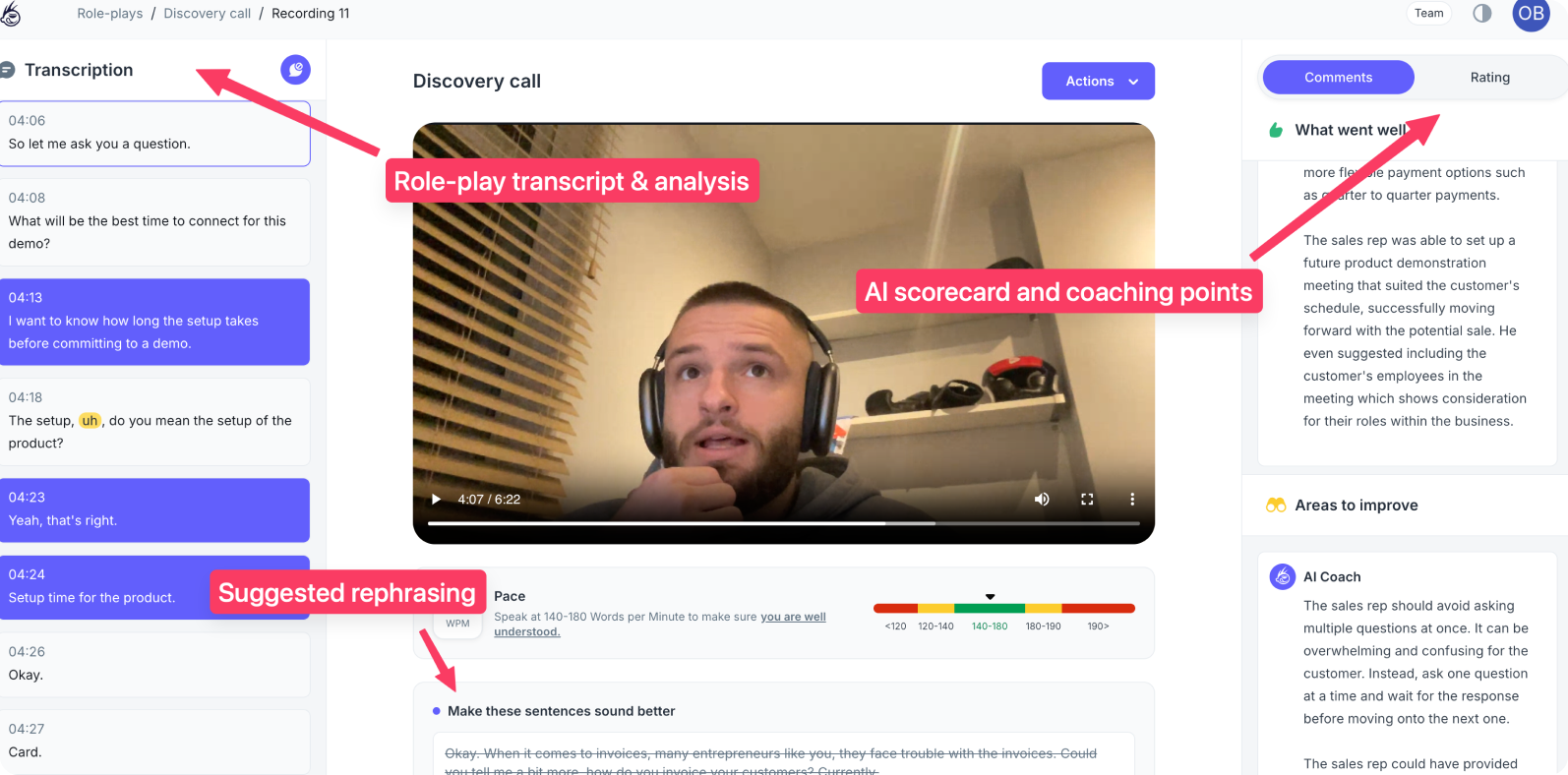
Live Call Analysis runs the same rubric against a rep's real recorded pitches and demos, not just the rehearsed ones. A manager can see whether a behavior the rep finally nailed in practice showed up on Tuesday's real demo, instead of assuming a rehearsal improvement carried over.
Mentor Group cut average ramp time by 50% and halved coaching time per rep running structured practice like this, with message-delivery accuracy up 27%. PRN reps improved 22.37% on real calls after the same practice-to-real loop. SThree onboarded new reps 53% faster running a similarly structured approach.
None of that comes from a single mode either. AI Role-play runs face-to-face, over the phone, and over screen-share, so the same rubric applies whichever format the rehearsal happens to use.
PitchMonster is EU-based with EU data residency under GDPR, the only European platform among the top 5 in this category. That matters for a sales enablement program built on recorded real calls. It holds a 4.9 rating on G2 and has kept a 100% enterprise renewal rate since spring 2024. It has also trained more than 300,000 reps.
If your team's pitch and demo rehearsals are still a slide deck read out loud, book a demo. We'll build the first scenario from one of your own recent calls.
Frequently asked questions about sales pitch and demo training
What is sales pitch training?
Sales pitch training is structured rehearsal of how a rep opens and frames value, then closes a pitch or a demo, scored against a fixed rubric. It covers a stand-alone pitch and a product demo alike, since both rely on the same core moves. That means a clear opening and a value story tied to real pain. It ends with a specific next step.
What's the difference between sales pitch training and product demo training?
A product demo rehearsal adds one thing a pitch rehearsal doesn't: a screen the buyer is watching in real time. Everything else stays the same, including tying the value story to real pain and closing with a specific next step. The demo version also requires picking 3 to 5 aha moments instead of a full walkthrough, since a buyer remembers the few screens that mapped to their own problem.
How often should a team rehearse a pitch or a demo?
Before every high-stakes call at minimum, and on a regular weekly cadence for anyone still ramping. A new rep who rehearses weekly for the first 8 weeks gets roughly 8 repetitions before their first few real pitches and demos. A rep on a quarterly cadence gets one, which works more like a compliance check than practice that changes behavior.
What's the best way to practice sales pitch delivery before a big call?
Run it against the rubric, not just from memory. Score the opening frame, the value story, the objection recovery, and the close ask, pass or fail. Then record the attempt so you can watch the exact moment something went flat. Run the same scenario twice in one sitting, since the second attempt shows whether the correction stuck.
Can AI role-play replace manager-led pitch and demo coaching?
No, and it isn't built to. An AI buyer removes the capacity limit on repetition, since a manager can only run a handful of live rehearsals a week before running out of hours. It doesn't replace a manager's judgment about which behaviors the rubric should reward. It also doesn't replace in-person moments, like reading a room when you're physically in it, that a scripted scenario can't fully recreate.
Is this the same as running a full sales role-play program?
No. This guide covers what belongs inside one pitch or demo rehearsal and how to score it. A full program adds the layer around that: a cadence and a difficulty ramp across a ramp period. It also adds a rollout across the whole team. Both pieces matter, but they solve different problems, and a team can start with the rehearsal content covered here before building the program around it.
How long should a pitch or demo rehearsal take?
Budget 10 to 15 minutes per attempt rather than a full 30-minute call. A rehearsal only needs to cover the specific behavior being drilled, not a complete run from open to close. Running the same scenario twice inside that window, with a short debrief in between, teaches more than one long, unfocused pass.