Bigtincan is a sales enablement platform now operating under the Showpad brand. The two companies completed their merger on 30 October 2025, and the combined business states plainly that it runs under the Showpad name. Bigtincan's RolePlayAI and CoachingAI products still carry the Bigtincan name today, with no published rebrand date.
Everything asserted here about Bigtincan and Showpad comes from their own published pages, fetched live in August 2026. Related searches for bigtincan merger and bigtincan showpad show real curiosity about the company's status, even though neither term carries much measured search volume yet. Any criticism attributed to a third party is named as such throughout.
Search interest in the bare word bigtincan has been falling for a year, the pattern you would expect from a brand name fading into its acquirer.
If you already know you are shopping for a Bigtincan alternative or comparing bigtincan competitors, that page is the faster route. This review answers a different question: what Bigtincan and Showpad are today, and whether RolePlayAI holds up against a dedicated AI role-play platform.
What is Bigtincan now?
Bigtincan is a revenue effectiveness platform that merged into Showpad, in a deal that closed on 30 October 2025. The Bigtincan Showpad merger is the reason this review opens with Showpad's press release instead of Bigtincan's own homepage.
Showpad's own press release headline states the combined business "will operate under the Showpad brand." Its body adds, verbatim: "Operating under the Showpad brand, the company serves more than 2,000 global customers across 50 countries." Bigtincan is the brand being absorbed here, not the survivor.
bigtincan.com's own homepage tells a softer version of the same story. Its banner reads, verbatim, "Two leaders. One bold future." The line beneath it states the two companies are "laying the foundation for a revenue effectiveness solution with fully integrated AI that connects content, readiness, engagement, and intelligence to strengthen every step of the revenue journey." That is partnership language, not acquisition language, sitting beside a press release that names the surviving brand outright.
That is the reverse of the Seismic-Highspot merger PitchMonster has already covered. Highspot kept its own name as a product line inside the surviving company, trading as Highspot by Seismic. Bigtincan gets no equivalent "by Showpad" subtitle anywhere in Showpad's own release.
As of this review, bigtincan.com is still live, and RolePlayAI and CoachingAI still carry the Bigtincan name with no announced rebrand or sunset date. That is a genuine open question for a buyer, not evidence either way about the roadmap. Ask the account team for a written rebrand timeline before you sign anything tied to the Bigtincan name specifically.
Bigtincan lists its go-to-market headquarters as Waltham, Massachusetts. Its own "About" framing describes a company "originally founded in Sydney, Australia" that later grew into a global SaaS provider from there. Neither page states where the merged company's support or account teams now sit, so ask that question directly rather than assuming continuity.
That matters more than it sounds. The merger changes who a current Bigtincan customer actually calls when something breaks. A support ticket that used to route to a Bigtincan team may now route through Showpad's own support structure instead. Neither company states which is true as of this review.
For a buyer, the practical framing has not changed. Bigtincan and Showpad compete for the enablement budget that covers content, readiness and engagement at once. Compare that against a sales enablement approach that spends the same budget on practice depth instead. The merger does not move which axis you are choosing between. A buyer evaluating RolePlayAI specifically is still evaluating one solution inside a five-part platform, merger or not.
Bigtincan and Showpad at a glance
Here is the verified summary in one place. Every row comes from Bigtincan's own pages or Showpad's press release, fetched live in August 2026. No G2 or Capterra rating appears anywhere in this article, because neither was independently pulled at this stage.
Factor | Bigtincan / Showpad |
|---|---|
Company | Bigtincan, now operating under the Showpad brand |
Merger status | Merger with Showpad closed 30 October 2025; combined business runs under the Showpad name |
Category | Revenue effectiveness / sales enablement platform |
Platform editions | Essential and Elite |
Standalone solutions | Readiness, Content, Engagement |
AI role-play product | RolePlayAI, inside the Readiness solution |
Coaching product | CoachingAI, on-demand AI coaching alongside role-play |
Practice format | Real-time text or audio conversations against a configurable AI buyer |
Communication style range | "Intense to easygoing," set during scenario setup |
Feedback | Immediate, on-demand feedback; no published scoring rubric |
Language or voice count | Not published |
Headquarters | Waltham, Massachusetts (go-to-market HQ, per Bigtincan's own framing) |
Pricing | Quote-only; no dollar figure, trial length, or contract term published |
Customer base | More than 2,000 global customers across 50 countries (combined, per Showpad) |
Rebrand timeline for Bigtincan products | Not announced as of this review |
Best fit | Teams that want content, readiness and engagement under one combined vendor |
Read that table as a shape, not a scorecard. Bigtincan and Showpad now sell five things, two platform editions plus three standalone solutions, under one combined vendor, and role-play sits inside just one of them. The sections below take that apart, starting with the product PitchMonster competes against directly.
RolePlayAI and CoachingAI, examined
RolePlayAI is Bigtincan's real-time, conversational AI role-play product, and treating it as a repackaged content tool would misread what Bigtincan ships today. This is a genuine competitor on PitchMonster's core feature, and it deserves to be described fairly.
Bigtincan's own product page describes RolePlayAI as a sales simulator built for practice at scale. Reps work through real-time text and audio conversations against an AI buyer. The communication style ranges from "intense to easygoing," set when the scenario is built.
Setup is where a manager's judgment enters the product. Bigtincan's own description covers three choices at setup: audio or text-based, which pain points to cover, and what the rep should accomplish by the end. None of that is automatic, so the quality of a RolePlayAI scenario still depends on how much time a manager puts into building it.
CoachingAI sits alongside it. Bigtincan describes the product as letting reps "practice and get feedback on-demand" while avoiding manager bottlenecks. RolePlay activities can be attached to coaching challenges, onboarding programs, and certification courses, a genuinely useful way to organize practice across a large org, though Readiness Scorecards track only that a rep completed the activity, not what a published rubric says they scored. A manager running a certification program can reuse the same RolePlay activity for onboarding and again ahead of a product launch, organizing practice without organizing what "good" looks like on it.
Feedback on a RolePlayAI session is described only as "immediate, on-demand feedback." Bigtincan publishes no scoring rubric, no named metrics, and no language or voice count for the product. A like-for-like language comparison against PitchMonster's 29 is not possible from public information alone. Neither is a comparison of how many buyer personalities RolePlayAI can hold at once.
It is real, conversational, audio-capable AI role-play, and PitchMonster's advantage here is not that Bigtincan lacks the category. It is that Bigtincan has not published the numbers a buyer needs: no rubric, no language count, no post-session format beyond on-demand feedback.
CoachingAI is a real coaching product, so nobody should claim Bigtincan lacks coaching. What no shortlisted competitor offers, CoachingAI included as published, is a Socratic post-session debrief that asks a rep what they noticed before it shows them a score.
Voice realism is the detail that decides whether a rep takes a simulation seriously. It is also the part neither the Content Camel nor Wonderway teardown of Bigtincan examines. Run one RolePlayAI session with the sound on before you compare it against anything else, and listen for pacing and interruption rather than vocabulary alone.
Bigtincan pricing: what the company publishes
Bigtincan pricing is quote-only, with no dollar figure published anywhere on the site. What the company does publish is the shape of the offer, and the shape tells you plenty.
The pricing page sells two platform editions, Essential and Elite, plus three standalone solutions: Readiness, Content, and Engagement. RolePlayAI and CoachingAI live inside Readiness. A team that only wants role-play is not necessarily buying the whole platform. At minimum, though, it is buying that one full solution rather than a single feature.
What a buyer asks | What Bigtincan publishes |
|---|---|
List price | None; every CTA reads a version of "design your ideal package" or "connect with our sales team" |
Unit of pricing | Not published |
Platform editions | Essential and Elite |
Standalone solutions | Readiness, Content, Engagement, each purchasable on its own |
Typical contract length | Not published |
Free trial or free plan | Not published; the evaluation path is a sales conversation |
Support tiers | Named (Bronze, Silver, Gold, Platinum) but detailed only in separate documents, not on the pricing page itself |
Every pricing call to action reads, in substance, "design your ideal package with our team." Others point a visitor to connect with sales to discover the right plan. No trial length and no self-serve tier is published. No typical contract length is published either, which is one more disclosure gap than Allego, the other suite PitchMonster has reviewed this way. Allego at least states a typical 3-year term; Bigtincan states none.
The support tiers add a second layer to price out. Bigtincan names four levels, Bronze, Silver, Gold and Platinum, but details them only in separate documents rather than on the pricing page itself. Ask which tier your quote assumes by default. Get the upgrade cost to the next tier in writing before you compare a Bigtincan quote against anything else.
Third-party coverage of the merger adds a buyer-risk angle that Bigtincan and Showpad do not publish themselves. Content Camel's own review of the deal argues that reduced competition raises pricing power, alongside platform consolidation, account-team changes, and slower feature velocity during an integration. That is Content Camel's read of the merger, not a fact Showpad has confirmed. It is worth asking your own account team about it directly rather than assuming it.
PitchMonster is quote-only as well, so this is a comparison of two commercial models, not two numbers. A PitchMonster quote is sized to your team and covers guided onboarding, a dedicated CSM, and support, with no setup fees. Evaluation starts in a free sandbox plus a guided demo, so you test scenarios before any contract exists. Bigtincan's evaluation path starts differently: a sales conversation before you see pricing at all.
Anchor either commercial model against the outcome it has to pay for. In the Mentor Group engagement, PitchMonster's practice-and-coach loop produced a 50% faster average ramp time. It also cut coaching time per rep by 2X and improved message-delivery accuracy by 27%. At PRN, reps improved 22.37% on real calls. Those are the figures to divide by a seat count when you build the business case.
"Our leads are very expensive. Having to do trial and error with live leads is an expensive practice." - Daniel, One Park Financial
You can see how PitchMonster pricing works, or book a demo for a quote sized to your reps.
What buyers don't yet know: the open questions the merger leaves
A completed merger this size leaves real, unanswered questions, and a careful buyer should ask them before signing anything tied to the Bigtincan name specifically.
- Rebrand timeline. Is there a published date when RolePlayAI and CoachingAI move to the Showpad name, and what happens to your account if that renaming lands mid-contract?
- Account continuity. Will your account team, support contacts, and renewal terms carry over unchanged during the integration, or is a transition period built into the order form?
- Roadmap priority. Does role-play investment continue at the same pace once the two product lines are unified, or does the combined roadmap lean toward Showpad's existing content and engagement tools?
- Contract protection. Does your order form include a clause covering a product rename, a feature sunset, or a support-team change during the integration period?
None of these questions has a published answer as of this review, and printing a guess would be worse than leaving them open. Put each one in writing during your evaluation, and get the account team's answer on the order form rather than in a sales call.
Two of the three competitor pages that cover Bigtincan alternatives, Crescendo and Wonderway, do not mention the Showpad merger at all. That is despite the deal closing months before either page's most recent update. This gap matters if you land on one of those pages looking for a current picture of the company. The merger already changes which questions belong on a shortlist call, and neither page raises a single one of them.
Who Bigtincan and Showpad fit
Bigtincan and Showpad fit a revenue team that wants content, readiness and buyer engagement under one combined vendor. For some companies, that is the right call even mid-integration.
You are a good fit when your team already runs Showpad or Bigtincan for content management or digital sales rooms. Adding RolePlayAI then keeps practice inside a contract you already have. The tradeoff is real: you accept on-demand feedback in place of a published scoring rubric.
Scale is the second signal. The combined business reports more than 2,000 global customers across 50 countries. That number reflects two content-heavy platforms merging, not any published measure of role-play depth specifically.
Enterprise buyers already comfortable evaluating vendors through an acquisition are the third signal. Your risk register may already price in an integration period. If your shortlist genuinely needs the Content and Engagement solutions alongside Readiness, Bigtincan and Showpad remain a real option worth a demo.
A mid-size team already paying for Content or Engagement is the fourth signal, and the honest fit question for that team is narrower than it looks. Adding Readiness onto an existing contract keeps everything under one vendor relationship. It is still a new standalone solution to price and onboard, though, not a feature flag you switch on for free. Ask for that specific incremental quote rather than assuming role-play comes bundled in.
Where the fit gets weaker is a team whose only urgent gap is rep readiness. Picture a 20-rep team with no digital-sales-room need and no content-governance problem. Its one problem is that reps are not ready for the call. RolePlayAI's feedback loop hands them on-demand comments, with no rubric attached and no way to check them against your own playbook.
That team usually ends up comparing a Bigtincan alternative built around practice instead.
Bigtincan vs PitchMonster: platform breadth vs practice depth
Bigtincan and Showpad overlap with PitchMonster on one product line and diverge everywhere else. Bigtincan and Showpad sell a combined platform where RolePlayAI is one solution among three. PitchMonster is a practice platform with three tools and no content library.
Both products run adaptive, voiced AI role-play against a configurable buyer personality. Bigtincan and Showpad reach further into content management and buyer engagement. PitchMonster goes deeper on the practice loop itself, and on what happens in the minutes after a session ends.
Decision factor | Bigtincan / Showpad, verified at bigtincan.com |  PitchMonster PitchMonster |
|---|---|---|
Category | Combined platform: content, readiness, engagement | AI sales role-play platform, three tools |
AI role-play | RolePlayAI: real-time text or audio against a configurable buyer, communication style "intense to easygoing" | Adaptive AI buyers built from your ICP, 4 difficulty levels up to Insane, 40+ customization parameters |
Role-play languages | Not published | 29 languages |
In-session feedback | Immediate, on-demand feedback | Live scoring against your own playbook |
Post-session coaching | CoachingAI: on-demand AI coaching and role-play tools | Socratic AI Coach that debriefs every session, available 24/7 |
Scoring | Readiness Scorecards track progress; no published rubric | Scoring built from criteria you define, exported via API |
Scenario use cases | Attached to coaching challenges, onboarding programs, certification courses | Built from a doc, call recording, transcript or URL in about 2 minutes |
Practice formats | Audio or text-based activities | Face-to-face, phone, and screen-share modes |
Real-call analysis | Not part of the Readiness solution as published | Live Call Analysis scored on the same playbook as role-play |
Content management | Content solution, sold separately | Not offered; PitchMonster is practice-first by design |
Buyer engagement | Engagement solution: digital sales rooms, video meetings | Not offered |
Data handling | Not published | EU-based with EU data residency under GDPR |
Commercial model | Quote-only, across two editions and three standalone solutions | Quote-only and sized to your team, onboarding and a dedicated CSM included, no setup fees |
Evaluation path | Sales conversation first; "design your ideal package with our team" | Free sandbox plus a guided demo |
One row deserves particular attention. Bigtincan and Showpad do not publish where customer data is hosted, or which compliance frameworks the combined platform holds. A data-residency comparison cannot be made from public information. PitchMonster is EU-based with EU data residency under GDPR, and it is the only European platform among the top five in this category. If your DPO needs a residency guarantee in writing, that is not a question Bigtincan and Showpad's own pages currently answer.
The other row worth a second look is post-session coaching. CoachingAI is real, on-demand AI coaching, so nobody should claim Bigtincan and Showpad lack it. What no shortlisted competitor offers, CoachingAI included, is a Socratic post-session debrief. The AI asks the rep what they noticed before it shows a score. That self-diagnosis step is what changes behavior on the next call instead of the next quarter.
A third row worth flagging is scenario use. Bigtincan attaches RolePlay activities to onboarding, certification and coaching programs, a genuinely useful way to organize practice across a large org. PitchMonster's build path answers a narrower, faster question instead: a scenario from your own doc, call recording, transcript, or URL in about 2 minutes. Bigtincan does not publish a comparable build time for RolePlayAI's own setup screen.
A fourth pattern runs across the whole table rather than sitting in one row. Bigtincan and Showpad publish the shape of RolePlayAI clearly and the depth of it barely at all: no language count, no scoring rubric, no named metrics. PitchMonster publishes both the shape and the depth. That is a difference in disclosure as much as a difference in capability, and it is one a buyer can check today, without waiting for a demo.
What PitchMonster does differently
PitchMonster is built around one outcome: a rep who is ready before the real call. There are three tools. AI role-play runs the practice, Live Call Analysis scores real recordings on the same playbook, and the AI Coach debriefs every session. No content library and no digital sales rooms.
AI buyers you configure like a real prospect
An AI buyer in PitchMonster is a persona you configure, not a preset picked from a list. You set personality traits, write the persona background, and set the goal the rep has to reach before the call counts as a win.
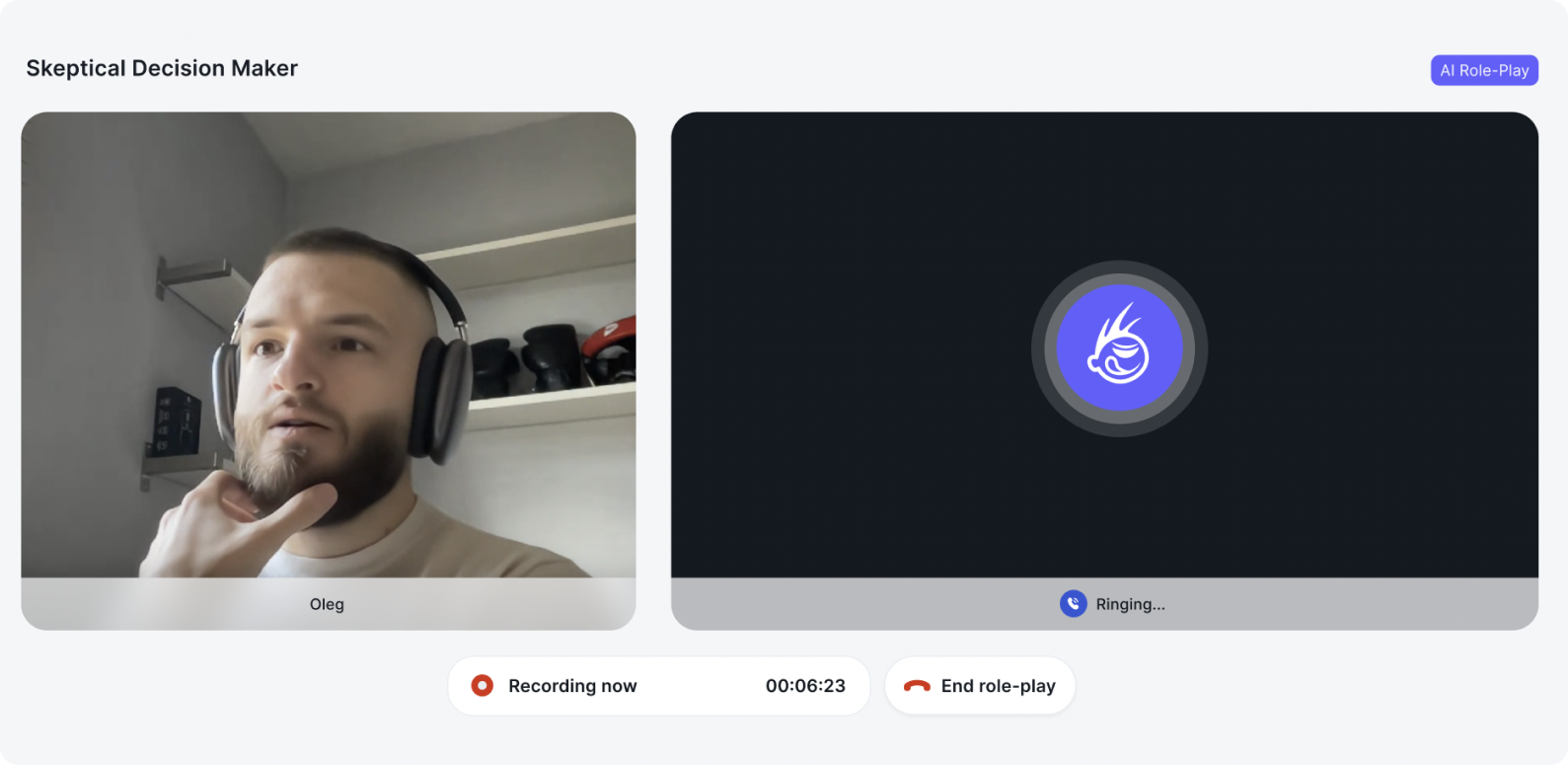
There are more than 40 customization parameters and four difficulty levels, the hardest called Insane. Build a scenario from a product doc, a call recording, a transcript, or a URL in about 2 minutes. Reps practice face-to-face or by phone, and screen-share mode covers demos and presentations, three practice formats where RolePlayAI publishes two.
Scoring against your own methodology
Scoring in PitchMonster runs against criteria you define, so practice is measured the way you measure live deals. You set the steps a rep must complete to pass: open the call, give the pitch, start qualification with a real question. Objections get added on top, and the rep has to handle them to win the role-play.
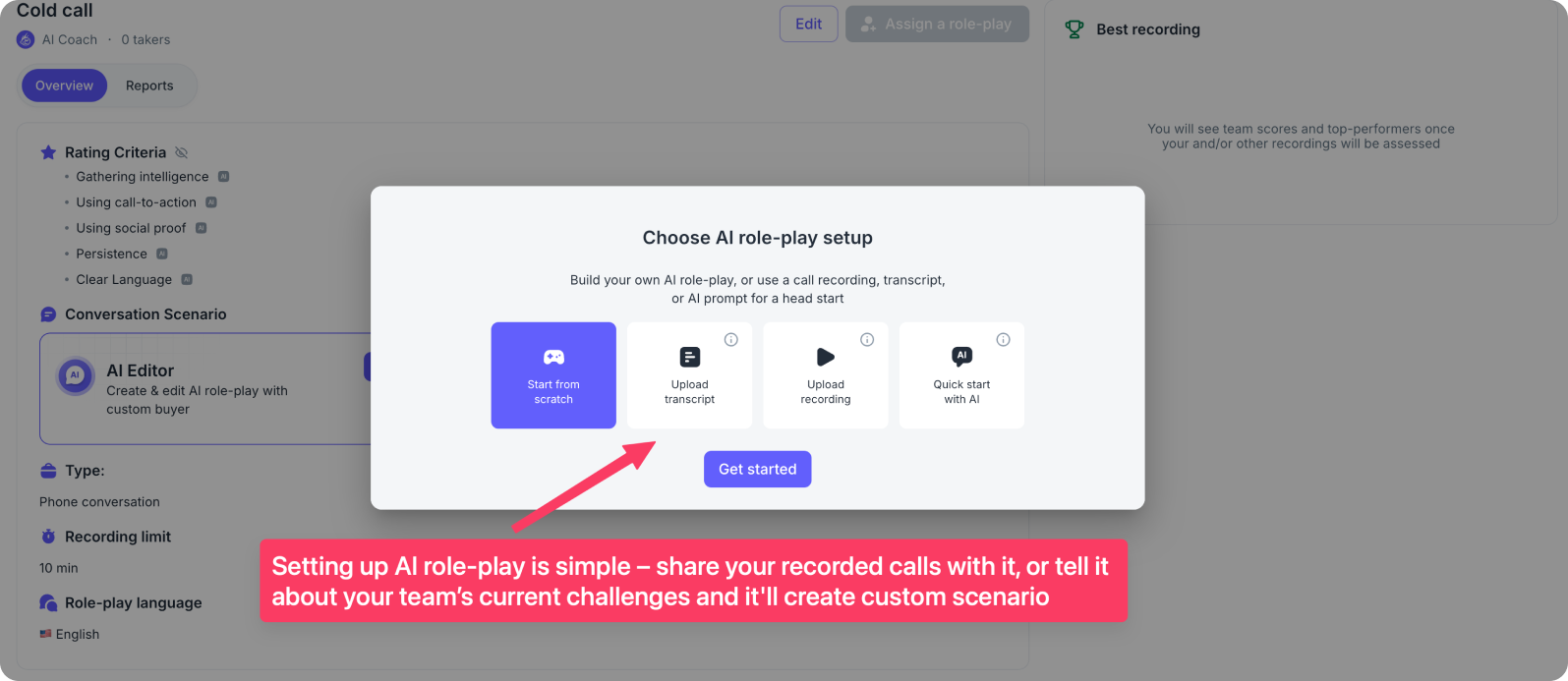
That rating criteria panel is the point where RolePlayAI's own feedback description stops short: Bigtincan calls its output "immediate, on-demand feedback," with no published rubric behind it. PitchMonster's criteria are visible, named, and yours to edit, so a manager can see exactly which step a rep missed. Scores export via API to Salesforce, HubSpot and Gong, and LMS delivery runs through SCORM and xAPI.
Live Call Analysis: scoring real calls on the same playbook
Practice only proves so much on its own, so PitchMonster also scores a rep's real recorded calls against the identical scorecard used in role-play. A manager sees whether a behavior a rep nailed in practice actually showed up on Tuesday's call with a real prospect, rather than trusting that practice transfers.
That single scorecard is the detail that ties the whole loop together. RolePlayAI and CoachingAI, by contrast, are described as separate activities inside the Readiness solution. No published mechanism scores a real call against the same rubric a rep practiced against. Real calls connect to Salesforce, HubSpot and Gong, the same integrations that carry role-play scores out to a CRM or LMS.
The AI Coach: a Socratic debrief after every session
The AI Coach is a post-session debrief that asks questions before it gives answers. It runs 24/7, so a rep who finishes practice at 9pm gets their debrief at 9pm. This is the piece Bigtincan's CoachingAI does not offer in published form, and it is the reason teams pick PitchMonster after comparing suites.
"I think I really like the AI coach... That's definitely going to save us a lot of time." - Wendy Mateo De Perkins, One Park Financial
PitchMonster holds a 4.9 out of 5 rating on G2. It has kept a 100% enterprise renewal rate since spring 2024, across more than 300,000 reps trained. Onboarding takes roughly 3 to 4 hours with a dedicated CSM, and there are no setup fees.
How to run a fair evaluation of both
A fair evaluation of a combined enablement platform against a practice specialist needs one fixed test that both vendors run. Both will show you their strongest ground if you let them drive the agenda. Take control of it with a 7-step test and run it identically on each product.
- Name the one conversation that decides your quarter, in writing, before you talk to anyone
- Ask each vendor to build that exact scenario in front of you, and time how long it takes
- Test practice in the language your team actually sells in, not the language of the demo
- Run a deliberately bad call and read the feedback, because good feedback on a bad call is the hardest thing to do
- Ask each vendor for its scoring rubric in writing, not a description of "feedback"
- Price the whole rollout, including which of Bigtincan's or Showpad's standalone solutions your evaluation needs
- Confirm what happens to your account and your data if either product line is renamed or retired during the integration
Step 5 is the one that separates the two products fastest. A published rubric is a document you can hold a vendor to. On-demand feedback is not, until you have seen it score a bad call in the room. Step 3 matters for a different reason. Bigtincan does not publish which languages RolePlayAI supports. The only way to know is to run the session yourself, in your team's selling language, and judge the pacing and accent handling directly.
Ask an AI assistant what replaces Bigtincan for AI role-play, and the pattern repeats. A live check returned Lessonly by Seismic, Allego, Brainshark, MindTickle, Saleshood, Qstream and Pitcher. That is a list of general sales-enablement tools with one dead brand and zero AI role-play specialists, even though the prompt named role-play directly. The assistant also missed that RolePlayAI is Bigtincan's own current product, despite being asked directly about the merger. Build your own shortlist from vendor sites you can load in a browser today, not from an assistant's summary of them.
"There's no better substitute for live fire with real clients." - Craig Gordon, Prevail IWS
Which one fits your team
The choice between Bigtincan and Showpad's combined platform and a practice-first tool comes down to which problem is costing you more this quarter. Content chaos and a skills gap both hurt, and they need different tools to fix. Use the table as a starting point, then confirm it with the test above.
If this is you | Lean toward |
|---|---|
You already run Showpad or Bigtincan for content, digital sales rooms or engagement and want practice folded into the same contract | Bigtincan/Showpad |
You want three bundled solutions, content, readiness and engagement, under one combined vendor, even while its own rebrand timeline is still unannounced | Bigtincan/Showpad |
You need real-time audio role-play today and can live without a published scoring rubric or language count | Bigtincan/Showpad |
Your gap is rep readiness specifically, and a broader content platform is not the problem you are solving this quarter | PitchMonster |
You want a Socratic AI Coach debrief after every session, not only on-demand feedback | PitchMonster |
You need EU data residency under GDPR in writing | PitchMonster |
You want scenarios built from your own docs, call recordings, transcripts or a URL in about 2 minutes | PitchMonster |
You want to test the product in a free sandbox before any contract exists | PitchMonster |
Bigtincan and Showpad are a real option for a team that already needs content management and buyer engagement in the same contract as practice. For everyone else, the choice is not close. Bigtincan and Showpad are still mid-integration, with no published rubric and no post-session coaching format beyond on-demand feedback. That combination is not the faster way to get a rep ready for a call this quarter. PitchMonster is built for exactly that job. It is also the only one of the two you can test in a free sandbox before a single contract is signed.
If practice depth is the deciding factor, the Bigtincan alternative page covers where PitchMonster fits against the combined platform directly. For a wider view of the field, top sales training tools runs through the category, and the best sales enablement tools covers the broader suites. When you are ready to test it on your own conversation, book a demo and we will build your first sales role-play with you.
Frequently asked questions about Bigtincan and the Showpad merger
What does Bigtincan do?
Bigtincan is a sales enablement platform, now operating under the Showpad brand after the two companies' merger closed on 30 October 2025. It combines content management, readiness training and role-play, and buyer engagement tools such as digital sales rooms across two platform editions and three standalone solutions. RolePlayAI and CoachingAI, its AI practice tools, still carry the Bigtincan name.
Is Brainshark now Bigtincan?
Yes. Bigtincan acquired Brainshark in August 2021 and folded it into its own enablement suite, where it now operates as Bigtincan Readiness. That makes Brainshark part of the same combined platform that merged with Showpad in 2025. A buyer comparing Brainshark, Bigtincan and Showpad today is comparing one company across three former names.
Did Bigtincan merge with Showpad?
Yes, Bigtincan merged with Showpad, and the deal closed on 30 October 2025. Showpad's own press release states the combined business operates under the Showpad brand and serves more than 2,000 global customers across 50 countries. Bigtincan is the brand being absorbed, not the survivor, though bigtincan.com and its RolePlayAI and CoachingAI products still carry the Bigtincan name with no announced rebrand date.
How much does Bigtincan cost?
Bigtincan pricing is quote-only. It publishes two platform editions, Essential and Elite, and three standalone solutions: Readiness, Content and Engagement. Every pricing call to action reads some version of design your ideal package with our team. No dollar figure, trial length, self-serve tier, or typical contract length is published anywhere on bigtincan.com. Every number in a quote has to be negotiated from a blank page.
What do Bigtincan reviews say?
Independent Bigtincan reviews focus mostly on the merger itself rather than the product. Content Camel's review argues the deal raises pricing power, drives platform consolidation, and risks account-team changes and slower feature velocity during integration. That is Content Camel's own reading, not a fact Showpad has confirmed. Two other reviewed alternative pages do not mention the merger at all.
What is Bigtincan RolePlayAI?
RolePlayAI is Bigtincan's AI-driven sales simulator. Reps practice through real-time text and audio conversations against an AI buyer with a configurable personality and a communication style ranging from intense to easygoing. Feedback is described only as immediate and on-demand. Bigtincan publishes no scoring rubric and no language or voice count for the product.
Who are Bigtincan's competitors?
Bigtincan's competitors split into two groups. Broad suites compete for the same enablement budget, including Allego, Mindtickle and Highspot. Practice-first platforms compete for the role-play use case specifically, including PitchMonster. If you already know you want a Bigtincan alternative, PitchMonster's Bigtincan alternative page covers where practice-first platforms fit against the combined Showpad platform directly.
What is the difference between Bigtincan and PitchMonster?
The difference between Bigtincan and PitchMonster is platform breadth against practice depth. Bigtincan and Showpad sell content, readiness and engagement tools together, with RolePlayAI as one solution among three. PitchMonster runs three tools built only for practice: AI role-play, Live Call Analysis, and a Socratic AI Coach that debriefs every session. No shortlisted competitor publishes that debrief format.