Sales training programs are structured courses and practice systems that teach reps how to sell and then drill those skills until they hold up on a live call. The strongest ones pair a selling methodology with active practice on real scenarios and feedback after each rep, measured against revenue outcomes like win rate and ramp time rather than course completion.
This guide compares the 20 best sales training programs for 2026. You will find a side-by-side table, what each one is genuinely best for, how the formats and best-fit teams break down, and a short method for matching a program to the gap your team has. The list mixes instructor-led methodologies, courses, and software platforms, because "sales training programs" covers all three, and most teams end up combining them.
Rolling a program out to an existing team is its own job: sales team upskilling covers the cadence and scoring that make it stick.
Comparison table
Use this table to scan the field, then read the full write-up on any program that fits. Formats and pricing change often, and most providers quote per seat or per team on request, so treat these as a starting point and confirm before you buy. The pricing column shows the best-fit team and the buying model rather than list prices, since almost none are published; G2 ratings are shown where a program is listed on g2.com.
Program | Best for | Format | Best-fit team and pricing |
|---|---|---|---|
PitchMonster | AI role-play practice with post-session coaching | AI practice platform, on demand | 10-300 reps, consultative B2B; by quote; G2 4.9 |
Richardson Sales Performance | Consultative selling for complex B2B deals | Virtual and in-person workshops | Mid-market to enterprise; by quote |
Sandler Training | Trust-based selling and reinforcement over time | In-person, virtual, self-paced | SMB to enterprise; by quote |
Dale Carnegie | Confidence and interpersonal selling skills | In-person, virtual, blended | All sizes, global; by quote |
The Brooks Group (IMPACT Selling) | A repeatable six-step methodology | Modular, 1 to 3 days | Mid-market; by quote |
The Challenger Sale | Reframing a buyer's thinking on complex deals | Workshops plus reinforcement | Mid-market to enterprise; by quote |
RAIN Group | Consultative selling with strong online options | Virtual, on-demand, in-person | SMB to enterprise, global; by quote |
SPIN Selling (Huthwaite International) | Question-based discovery on considered purchases | Workshops plus reinforcement | Mid-market to enterprise; by quote |
Winning by Design | SaaS and recurring-revenue selling | Cohort and on-demand | Startups to enterprise SaaS; by quote |
Korn Ferry (Miller Heiman) | Enterprise selling across large, multi-region orgs | Blended, global delivery | Enterprise; by quote |
ASLAN Training and Development | Reaching unreceptive, guarded buyers | Workshops plus reinforcement | Mid-market to enterprise; by quote |
ValueSelling Associates | A shared framework for value and qualification | Workshops, virtual, reinforcement | Mid-market to enterprise; by quote |
Janek Performance Group | Research-backed skills across the sales cycle | In-person, virtual, on-demand | Mid-market to enterprise; by quote |
JB Sales (John Barrows) | Modern B2B and tech sales fundamentals | On-demand and live training | Individuals to teams; by quote |
Gap Selling (A Sales Growth Company) | Problem-centric discovery and business impact | Workshops, on-demand, reinforcement | SMB to enterprise; by quote |
Gong | Call analysis and coaching on real deals | Conversation-intelligence platform | Mid-market to enterprise; by quote; G2 4.7 |
Mindtickle | All-in-one enablement and readiness at scale | Enablement suite | Enterprise; by quote; G2 4.7 |
Allego | Mobile, video-based learning and coaching | Video-first platform | Mid-market to enterprise; by quote; G2 4.6 |
SmartWinnr | Reinforcement through quizzes and gamification | Microlearning platform | Regulated mid-market to enterprise; by quote |
Yoodli | Communication delivery and confidence | AI communication coach | Individuals to teams; by quote; G2 4.7 |
What is a sales training program?
A sales training program is a structured course or platform that develops the skills reps use to win deals: prospecting, discovery, qualification, handling objections, negotiation, and closing. Some programs deliver a selling methodology through workshops. Others give reps a place to practice that methodology against realistic buyers and get coached. The test of any program is whether a rep does something differently on a live call, and whether that shift shows up in win rate, deal size, or ramp time.
That is what separates a real program from a one-off workshop or a library of videos. A popular framework here is learn, practice, apply, then coach, which keeps skills moving from the classroom into real deals. The 20 programs below approach that loop in different ways, from instructor-led methodology to AI-driven practice, but they share the same goal: get reps ready before the next real conversation.
The word "program" is doing a lot of work in this market. It can mean a multi-week instructor-led course, a licensed methodology your team certifies against, or a software platform reps log into on demand. This guide covers all three, because the best result usually comes from combining a framework with a way to practice it, not from picking one and hoping it sticks.
Why sales training programs matter
Sales training programs matter because selling is a performance skill, not a body of knowledge. A rep can memorize a discovery framework and still stall on a live call when a CFO pushes back on price. The programs that move the number close the gap between what a rep knows and what a rep does under pressure, which is where deals are won or lost.
When the gap is how reps talk rather than what they know, our sales communication skills training roundup narrows the field to the programs built for that.
The cost of skipping structured training shows up first in ramp. New hires take longer to reach quota, and that delay pushes pipeline weeks or months down the road. It shows up again in inconsistency, where one rep handles an objection cleanly and the next freezes on the same one, so forecasting gets shaky and coaching time balloons.
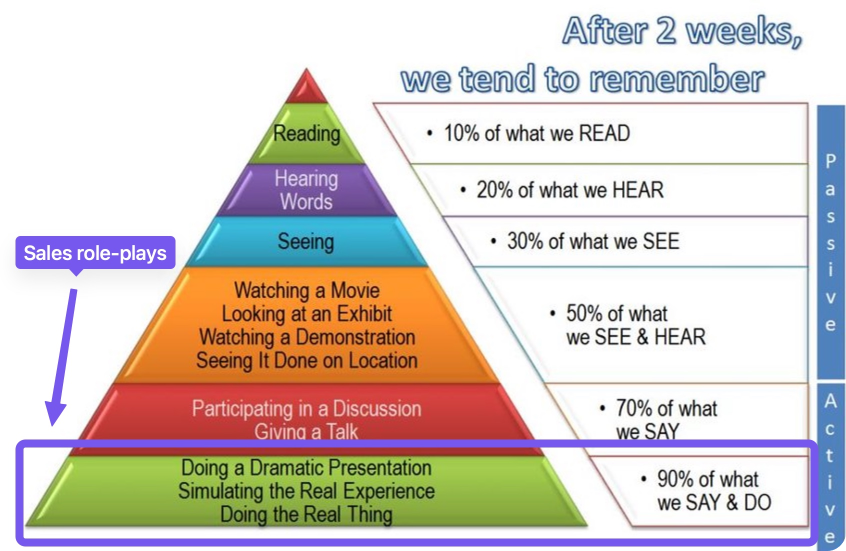
There is also a retention problem baked into most training. Reps forget the bulk of what they hear in a single workshop within a few weeks unless they use it, so passive content fades fast. That is the reason reinforcement and practice matter more than the length of the session, and why the programs on this list that build in repetition tend to hold their gains.
Done well, a program turns into something a budget owner can defend. One PitchMonster customer, Mentor Group, recorded 30% faster ramp, 37% higher performance, and a 28% win rate improvement after rolling out structured practice, alongside 2x more opportunities booked. Numbers like that are the difference between training seen as a cost and training seen as a growth lever.
What separates a program that works
Not every program changes behavior. A few features separate the ones that lift quota attainment from the ones that fade after a week.
Active practice is the first. Reps retain only a fraction of what they watch in a video after a week, so programs that lean on passive content lose ground fast. The ones that work put reps into the conversation, responding to a CFO who pushes back on price or a technical buyer scrutinizing the product, until the response becomes muscle memory.
Fast, specific feedback is the second. When a rep hears what to fix right after a practice rep, they can adjust before the next live call instead of waiting for a manager to find time. The shorter that loop, the faster the result.
Realistic scenarios are the third. Generic scripts do not prepare a rep for the objections, personas, and sales cycles they meet in your market. The closer the practice is to your real pipeline, the more of it transfers to live calls.
Measurable outcomes are the fourth. Strong programs track a leading metric like ramp time and a lagging one like win rate, so the investment is defensible. If a program cannot show you before-and-after numbers on the metrics your leadership already watches, it will be the first line cut in a tight quarter. Keep that bar in mind as you read the 20 programs below.
20 best sales training programs
The list starts with the practice layer, moves through the instructor-led methodologies that dominate this category, and ends with the software platforms that reinforce and measure it. Order is not a ranking of quality, it maps to the job each one does.
1. PitchMonster
Best for: teams that want reps to practice realistic conversations and get coached after every one, not just attend a workshop.
The differentiator is the AI Coach. After each session, a Socratic AI sales trainer asks reflective questions that guide the rep to their own insight before they ever see a score, available 24/7. No other program on this list does that, and it is where behavior changes, because reps self-diagnose and then practice the fix.
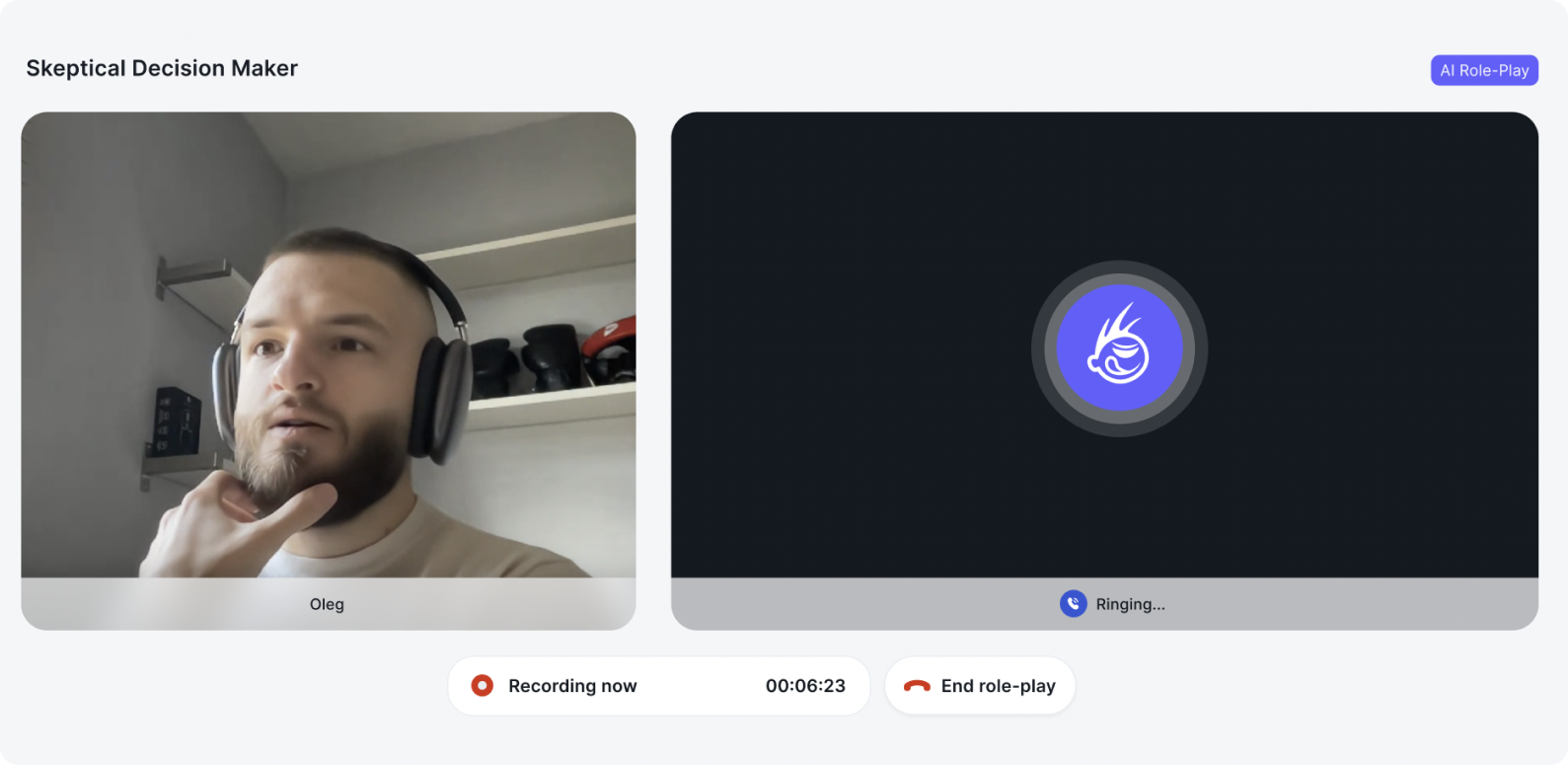
PitchMonster is an AI sales role-play platform. Reps practice cold calls, discovery, and demos against AI buyers that adapt and object like your real ICP, then get scored against your own playbook. A manager can build a scenario from a call recording, product docs, or a website URL in about two minutes, with four difficulty levels and support for 27 languages. It is also the only European-based platform among the leaders, which matters for teams that need GDPR compliance and EU data residency.
Where it fits: sales teams of roughly 10 to 300 reps running consultative B2B motions, with someone who owns training. It is not a methodology, and it does not pretend to be one. It works as the practice layer that turns a methodology into a repeatable skill, alongside or after an instructor-led program. Pricing is quote-only (custom per seat), with onboarding, a dedicated CSM, and support included and no setup fees. See pricing for your team size. As Wendy Mateo De Perkins of One Park Financial put it, "I think I really like the AI coach. That's definitely going to save us a lot of time." PitchMonster holds a 4.9 out of 5 on G2 and has trained more than 300,000 reps, with a 100% enterprise renewal rate since spring 2024.
2. Richardson Sales Performance
Best for: consultative, value-based selling in complex B2B deals.
Richardson is a long-standing methodology provider focused on moving reps away from feature pitching toward conversations that match buyer needs. Workshops use behavioral modeling to show the difference between weak and strong selling, with scenarios like qualification on enterprise deals, presenting value, and managing long sales cycles.
The format leans on live workshops, usually a sequence of virtual or in-person sessions with assignments between them so reps apply the skill on real deals. Reinforcement and self-correction exercises aim to keep the behavior in place after the program ends. Where it is lighter: the depth and pacing suit teams that can commit to a structured, multi-session program rather than ad hoc practice. Pricing is quoted on request and depends on team size and customization, with a best fit at mid-market to enterprise.
3. Sandler Training
Best for: trust-based selling and reinforcement that compounds over time.
Sandler has refined its consultative system over decades, built around active listening, disciplined questioning, and a set of selling principles rather than high-pressure tactics. The emphasis is on lasting behavioral change, not a one-time event, which is why the program is structured for ongoing reinforcement. It sits at #5 on the Google results for this term, a sign of how established the brand is.
Formats span in-person sessions, live virtual workshops, and self-paced courses, with role-play exercises and job aids reps use in their daily work. Specialized tracks cover modern challenges like prospecting and social selling. Where it is lighter: the reinforcement model rewards teams that stay with it, so it fits organizations ready to invest over quarters rather than weeks. Pricing is custom by team size and format, sold through a global network of local trainers, and fits SMB through enterprise.
4. Dale Carnegie
Best for: confidence, credibility, and the interpersonal side of selling.
Rooted in relationship-building, Dale Carnegie's sales training is learning by doing: interactive activities and practice scenarios with immediate trainer feedback, designed to feel close to real customer interactions. It targets the confidence reps need to hold consultative conversations with informed, selective buyers, and it ranks near the top of the search results for this category.
Formats include in-person, virtual, and blended delivery, with session lengths from a couple of hours to a multi-week course. Where it is lighter: it focuses on interpersonal skill rather than a deep B2B deal methodology, so complex sales teams often pair it with a more technical program. Pricing varies by format and location and is quoted on request, with a fit that spans teams of all sizes worldwide.
5. The Brooks Group (IMPACT Selling)
Best for: teams that want one repeatable, six-step methodology across the floor.
The Brooks Group's IMPACT Selling is a structured, six-step method delivered through a mix of classroom, virtual, and micro-learning, with modules on questioning, listening, and presenting. The modular format keeps reps in the field while they train, and a track for handling pricing pressure prepares them for unexpected objections.
Participants get workbooks and coaching reports that pinpoint where to improve, and managers get frameworks to tie the method to daily activity. The structure flexes from one to three days depending on the team. Where it is lighter: it is a strong single methodology, so teams running several motions may want to layer practice on top. Per-participant pricing varies by format and is confirmed on request, with a best fit at mid-market.
6. The Challenger Sale
Best for: teams selling complex or disruptive solutions who need to reframe how a buyer thinks.
The Challenger approach comes from the research behind the book of the same name, which found that the top performers teach buyers something new, tailor the message to the buyer, and take control of the conversation. Training turns that into a method reps can run, with workshops backed by reinforcement so the behavior does not fade.
It suits products where the value depends on changing a buyer's status quo, which is common in enterprise and category-creating sales. Where it is lighter: the model works when your solution genuinely reframes the problem, and it is a weaker fit for simple, transactional selling where a buyer already knows what they want. Pricing is quoted by engagement, with a best fit at mid-market to enterprise.
7. RAIN Group
Best for: consultative selling backed by strong online and on-demand delivery.
RAIN Group teaches a consultative model through its RAIN Selling foundations, and it shows up on the first page of Google for this term with its online training in particular. The programs run virtual, on-demand, and in-person, which makes them workable for both individual learners and full teams that want to stay competitive without leaving the field for days.
The curriculum spans prospecting, opportunity management, and negotiation, with coaching and reinforcement options on top. Where it is lighter: the breadth is a strength and a caution, since a broad curriculum needs a champion to connect it to your specific pipeline. Pricing is quoted on request and fits SMB through enterprise across global teams.
8. SPIN Selling (Huthwaite International)
Best for: question-based discovery on larger, considered purchases.
SPIN Selling is one of the most cited methodologies in B2B, built on Neil Rackham's research into what separates high performers on complex deals. The name maps the question sequence reps learn: Situation, Problem, Implication, and Need-payoff. Huthwaite International runs the official training, with workshops and reinforcement that drill the questioning discipline.
It fits teams whose deals hinge on discovery, where surfacing the real cost of a problem moves a buyer more than a feature pitch. Where it is lighter: SPIN is a discovery framework rather than a full-funnel platform, so it pairs best with practice that lets reps rehearse the questions until they sound natural. Pricing is quoted by program and fits mid-market to enterprise.
9. Winning by Design
Best for: SaaS and recurring-revenue teams that sell on a subscription model.
Winning by Design built its reputation on frameworks for modern B2B and SaaS selling, including a widely used approach to structuring deals and revenue. Delivery runs through cohorts and on-demand content, which fits fast-growing tech teams that hire in waves and need a shared language across the floor.
The material goes deep on the full customer lifecycle, from first touch through expansion, which suits recurring-revenue models where retention matters as much as the first close. Where it is lighter: the frameworks are opinionated and built for subscription businesses, so they are less tailored to one-off transactional selling. Pricing is quoted on request and fits startups through enterprise SaaS.
10. Korn Ferry (Miller Heiman)
Best for: enterprise selling across large, multi-region organizations.
Korn Ferry brings the Miller Heiman methodologies, including long-established approaches to strategic and large-account selling, under a global consulting brand. The programs are built for scale, with content, delivery, and analytics that hold up across hundreds of reps in different regions and languages.
That reach is the draw for enterprises standardizing a sales approach across the org. Where it is lighter: the enterprise scale and price point make it a heavier lift than a small team needs, and rollout takes planning. Pricing is quoted by engagement and fits enterprise buyers.
11. ASLAN Training and Development
Best for: reaching buyers who are guarded, indifferent, or not asking for help.
ASLAN built its reputation on Other-Centered Selling, a model that starts from the buyer's perspective rather than the rep's pitch. It ranks at or near the top of several large program roundups, and it focuses on the mindset shift that gets an unreceptive prospect to open up. Training runs through workshops and reinforcement, with tracks for inside sales, field sales, and leadership.
Where it fits: teams whose reps get stonewalled early in the funnel and need a repeatable way to earn a conversation. Where it is lighter: the model is a selling philosophy more than a tooling platform, so pair it with practice to drill the behavior on real calls. Pricing is quoted on request and fits mid-market to enterprise.
12. ValueSelling Associates
Best for: teams that need a shared framework for qualifying deals and articulating value.
ValueSelling Associates runs the ValueSelling Framework, a widely adopted method for keeping deals focused on business value rather than features. The framework gives reps a common language for qualification, plus a shorthand for diagnosing where a deal really stands. Delivery spans instructor-led workshops, virtual sessions, and reinforcement tools.
Where it fits: teams with inconsistent qualification, where deals slip because reps chase the wrong opportunities. Where it is lighter: like most methodologies, it is a framework you still have to drill, so results depend on reinforcement after the workshop. Pricing is quoted by engagement and fits mid-market to enterprise.
13. Janek Performance Group
Best for: research-backed selling skills across the full sales cycle.
Janek delivers its Critical Selling programs, grounded in ongoing sales research, covering prospecting, discovery, negotiation, and account management. The company publishes a steady stream of studies on what separates top performers, and the training reflects that evidence base. Formats include in-person, virtual, and on-demand, with coaching and reinforcement layers.
Where it fits: teams that want a broad, evidence-based curriculum from a single provider. Where it is lighter: the breadth means you should map the modules to your specific gap rather than buying the whole catalog. Pricing is quoted on request and fits mid-market to enterprise.
14. JB Sales (John Barrows)
Best for: modern B2B and tech sales fundamentals for individual reps and teams.
JB Sales, founded by John Barrows, focuses on the day-to-day mechanics of modern selling: prospecting that gets replies, discovery that uncovers real pain, and closing without pressure. It is popular with SaaS and tech sales teams, and content is available through on-demand training and live sessions. The tone is practical and rep-first, which lands well with newer sellers.
Where it fits: tech and SaaS teams that want current, tactical training reps will use. Where it is lighter: it centers on skills and tactics rather than a single named methodology, so teams wanting a rigid framework may look elsewhere. Pricing is quoted by plan and fits individuals through teams.
15. Gap Selling (A Sales Growth Company)
Best for: problem-centric discovery that anchors the deal in business impact.
Gap Selling, from Keenan and A Sales Growth Company, trains reps to find the gap between a buyer's current state and desired future state, then quantify the cost of staying put. It has a strong following among reps who want discovery to drive the deal rather than a feature demo. Training runs through workshops, on-demand content, and reinforcement.
Where it fits: teams whose reps pitch too early and skip the discovery that justifies urgency. Where it is lighter: the approach demands disciplined discovery, so it rewards teams willing to practice the questioning until it is second nature. Pricing is quoted on request and fits SMB to enterprise.
16. Gong
Best for: analyzing real sales calls and coaching reps on actual deals.

Gong is the standard for conversation intelligence. It records, transcribes, and analyzes live calls and meetings, then surfaces where reps win, lose, or miss so managers can coach against real evidence. It connects to your CRM and turns call data into deal and pipeline signals, which makes it a training input as much as a coaching tool. It holds a 4.7 out of 5 on G2 across more than 6,600 reviews.
What stands out: deep call analysis, deal-level visibility, and a large integration footprint. Where it is lighter: Gong shows what already happened. It is not built for reps to rehearse before the call, which is why many teams pair it with a practice program. Pricing is quoted by seat and fits mid-market to enterprise. For a practice-first approach to the same coaching problem, see how PitchMonster compares for rep readiness.
17. Mindtickle
Best for: all-in-one sales readiness and enablement at scale.

Mindtickle is a broad enablement suite that combines learning modules, onboarding automation, readiness assessments, and analytics in one place. It is built for larger organizations that want foundational training, content, and coaching under a single roof, with reporting that holds up across many reps. It carries a 4.7 out of 5 on G2 from more than 2,200 reviews.
What stands out: breadth and reporting for sizeable teams. Where it is lighter: the suite can be complex to set up and configure, and its practice and coaching depth is why many teams add a focused role-play layer on top rather than relying on it alone. Pricing is quoted for enterprise buyers. If practice and coaching depth is your real goal, compare a Mindtickle alternative built for it.
18. Allego
Best for: mobile, video-based learning and asynchronous coaching.

Allego centers on video. Reps record pitches, get feedback, and access on-demand learning from their phones, which suits distributed and field teams. It includes content management and CRM integrations so training material stays close to the workflow, and managers can leave timestamped comments on recorded calls. Reviewers rate it 4.6 out of 5 on G2, and it has been recognized as a leader in sales enablement.
What stands out: video coaching and a mobile-first library that travels with the rep. Where it is lighter: it leans toward recorded practice and content rather than live, adaptive conversation, and tailoring the content to your process takes setup time. Pricing is quoted by seat and fits mid-market to enterprise.
19. SmartWinnr
Best for: reinforcement through quizzes, gamification, and KPI contests.
SmartWinnr keeps knowledge fresh with short quizzes, AI-assisted coaching, and gamified contests tied to sales KPIs. It is built to drive participation and keep messaging consistent across a team, with personalized learning paths that adjust as reps complete modules. G2 has recognized it as a leader for sales gamification, and it is widely used in regulated industries like pharmaceuticals, insurance, and medical devices.
What stands out: engagement mechanics and reinforcement that fit busy reps, plus strength in compliance-heavy sectors. Where it is lighter: it is a reinforcement layer rather than a deep practice or call-analysis platform, so it complements a core program rather than replacing one. Pricing is quoted on request and fits regulated mid-market to enterprise teams.
20. Yoodli
Best for: communication delivery, clarity, and confidence.

Yoodli is an AI communication coach that zeroes in on how a rep delivers a message: tone, pacing, filler words, and word choice. Teams can build role-play scenarios tied to specific personas and objectives, then get feedback focused on delivery. It holds a 4.7 out of 5 on G2, though from a smaller review pool than the established platforms.
What stands out: fast, specific feedback on the mechanics of speaking well, which helps newer reps sound prepared. Where it is lighter: reviewers note it coaches communication rather than the full sales motion built from your ICP and scored on your methodology, so a well-delivered but strategically weak pitch can still pass. It works best as a complement to a program that scores selling. Pricing is quoted by plan and fits individuals through teams.
How to reinforce a program with practice
Most training fails at the same point: the workshop ends, reps go back to their desks, and the new behavior fades before it reaches a live call. Reinforcement is what fixes that, and it is the part methodology programs leave to you. This is where a practice platform earns its place, and where PitchMonster leads with the AI Coach.
The AI Coach runs after every practice session. Instead of handing a rep a score and a list of fixes, a Socratic AI sales trainer asks reflective questions that walk the rep to their own conclusion first. A rep who talks themselves through why they missed the budget question remembers the fix far longer than a rep who reads it on a scorecard. It runs 24/7, so a rep preparing for a big call at 9pm gets the same coaching quality as one in a Tuesday session. No other program in this guide offers that.
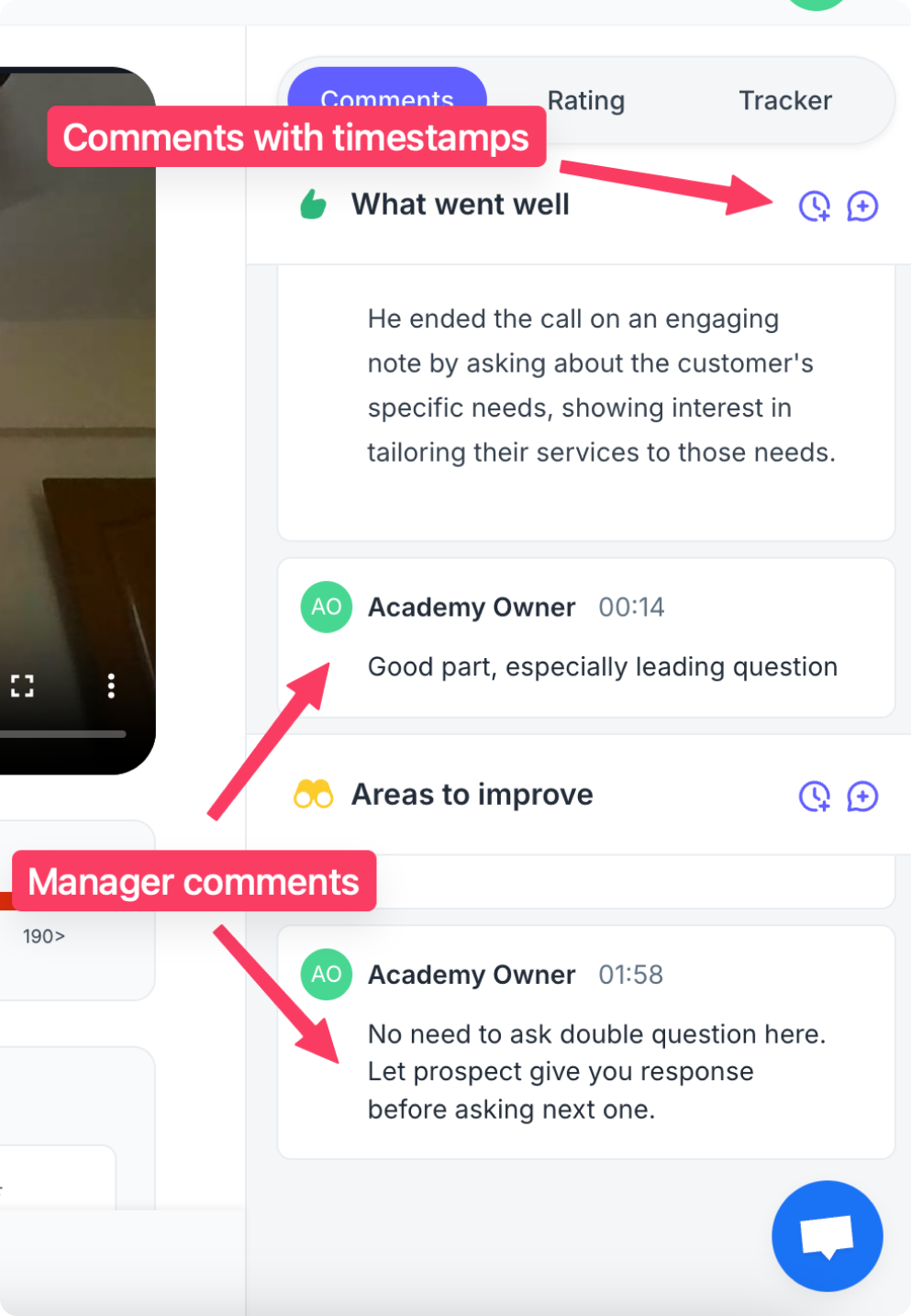
Practice comes before the coaching. Reps run the exact conversation they are about to have: the cold call, the discovery, the pricing pushback, against an AI buyer that adapts and objects like your real ICP. Because you build the scenario from a real call recording, product docs, or a website URL in about two minutes, the practice matches your pipeline instead of a generic script. Four difficulty levels let a manager dial the buyer from friendly to hostile as a rep improves.
Every rep is scored against your own playbook, the same scorecard whether it is a role-play or an uploaded recording of a real call. That gives an enablement lead something methodology workshops rarely produce: a consistent, comparable read on where each rep stands, and a skill-gap view across the team. When leadership asks whether the training is working, the answer is a chart, not an anecdote.
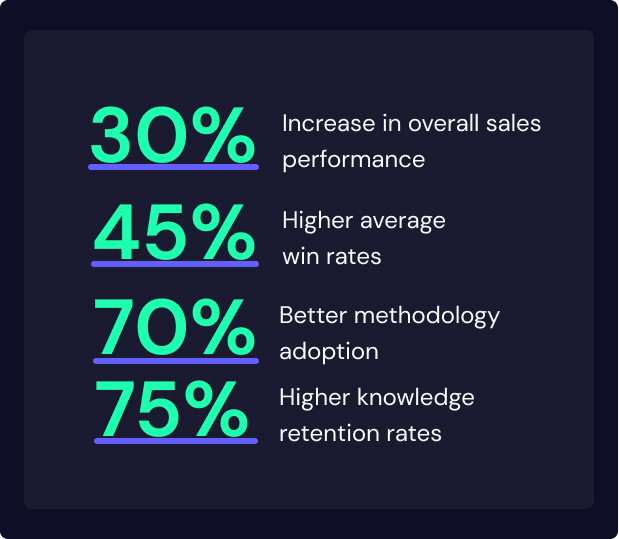
The pattern most teams settle on is simple. Run the methodology for the framework, then run practice to make it stick, with coaching after every attempt. Training sets the baseline. Practice and coaching are what carry it into the deal. You can book a demo and run your first role-play on your own material to see the loop in action.
Sales training for tech and field teams
Not every team has the same training problem, and the right program shifts with the motion. A few common cases come up often enough to call out.
Tech and SaaS teams sell on recurring revenue, where expansion and retention matter as much as the first close. A framework built for subscription selling, like Winning by Design or JB Sales, gives reps a shared model, and a practice platform lets new hires drill product objections and competitive traps before they burn a real opportunity. Fast-growing tech teams hire in waves, so on-demand practice scales better than scheduling live workshops for every cohort.
Field and distributed teams cannot gather in a room. Video-first tools like Allego travel with the rep, and an on-demand practice platform means a rep in a different region or time zone rehearses on the same scenarios and gets scored on the same playbook as everyone else. Consistency across locations is the hard part, and shared scenarios solve it.
Regulated industries such as pharmaceuticals, insurance, and medical devices add a compliance layer. Reinforcement tools like SmartWinnr keep messaging consistent, and building scenarios from your approved materials keeps practice inside the lines. Teams selling in multiple languages have a further need, and PitchMonster's support for 27 languages lets a global floor practice in the language they sell in. For a wider view of the software in this space, see our roundup of the best sales training platforms.
How to choose and prove results
Start with the bottleneck, not the brand. If reps lack a framework for complex deals, a methodology program like Richardson, Sandler, Challenger, or The Brooks Group fits. If they know the framework but freeze on live calls, the gap is practice, and a tool like PitchMonster closes it by letting them rehearse and get coached on demand. If managers cannot coach at scale, call analysis like Gong gives them real evidence. If the issue is confidence and rapport, Dale Carnegie or Yoodli lean that way. Most teams have one of these as the real constraint. Some teams also weigh Kendo AI, a self-serve AI role-play tool, against these picks; see our PitchMonster vs Kendo AI comparison for how the two differ.
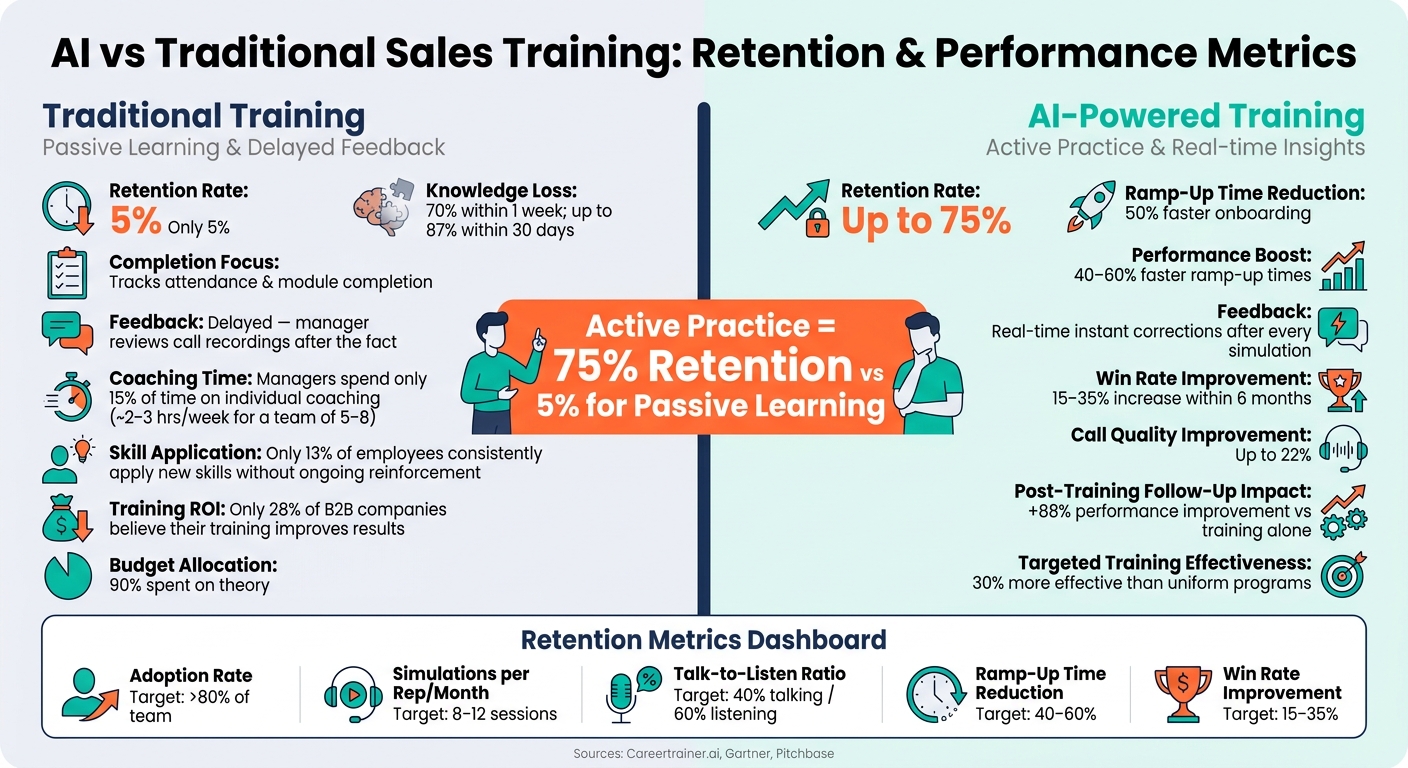
Then pressure-test the shortlist on what decides adoption. Does the program fit how your reps work, or pull them out of the field for days at a time? Is there reinforcement after the session, or does it end when the workshop does? Can you build practice on your own scenarios rather than generic scripts? And does it produce evidence a leader will accept?
That last point is where most training fails to justify itself. Set a baseline for ramp time and win rate before rollout, then measure again after a quarter. Review adoption and results on a regular cadence so you can drop what is not moving the number. The proof a budget owner trusts looks like the Mentor Group result: 30% faster ramp and a 28% win rate improvement, tied to metrics leadership already tracks.
For the practice-and-coaching angle specifically, you can book a demo and run your first role-play on your own material. For a wider view of the programs that change behavior fast, see our comparison of sales performance training programs, and for scenario ideas your team can practice this week, see our sales role-play scenarios.
FAQ
What is the best sales training program?
There is no single best program, only the best fit for your gap. If reps lack a selling framework for complex deals, a methodology like Richardson, Sandler, or Challenger fits. If they know the framework but freeze on live calls, a practice platform such as PitchMonster closes that gap by letting reps rehearse against a realistic AI buyer and get coached after every attempt.
What training does a salesperson need?
A salesperson needs three layers: a selling framework for discovery, objections, and negotiation; regular practice that turns the framework into a repeatable skill; and feedback tied to real deal outcomes. Methodology programs cover the framework. A practice tool covers the reps. Call analysis and coaching cover the feedback loop back into live deals.
Which sales certification is best?
The best certification depends on your motion. Sandler, Richardson, and RAIN Group certify consultative and complex B2B selling. Challenger certifies a teach-and-tailor approach. Salesforce and LinkedIn Learning offer accessible role-based certificates. A certificate proves knowledge, not execution, so pair any of them with practice that scores how a rep performs.
How much do sales training programs cost?
Most providers quote per participant or per team and rarely publish rates, so confirm with each vendor. Instructor-led workshops are usually priced per seat for a fixed program. Software platforms are usually annual per seat. PitchMonster is quote-only (custom per seat), with onboarding, a dedicated CSM, and support included and no setup fees. See pricing for your team size.
What is the 70/30 rule in sales?
The 70/30 rule says the buyer should talk about 70% of the time and the rep about 30%. It is a reminder to run discovery through questions and listening, not a monologue. Good training builds the habit, and practice reinforces it, since reps can hear their own talk-to-listen ratio played back after a role-play.
What is the 3-3-3 rule in sales?
The 3-3-3 rule is a prospecting-prep habit: spend about three minutes finding three relevant facts about a buyer before outreach, so your opening earns the first few seconds of attention. Versions differ by trainer, so treat it as a research-discipline guideline rather than a fixed formula, and drill it until it becomes routine.
What are the top 3 skills for sales?
Most training programs come back to the same three. Discovery and active listening, so you understand the buyer before pitching. Objection handling, so a hard question does not stall the deal. Clear articulation of value, so the buyer sees why it matters to them. Each one improves faster with reps and feedback than with lectures alone.
Is classroom training or AI role-play better for sales reps?
They solve different parts of the problem. Classroom and methodology training give reps a framework for discovery, objections, and negotiation. AI role-play turns that framework into a repeatable skill by letting reps rehearse against a realistic buyer and get scored. Many teams run both: a methodology for the what, and a practice tool to make it stick.
How do I prove a sales training program is working?
Tie it to metrics you already track: ramp time for new hires, win rate, average deal size, and quota attainment. Set a baseline before rollout, then compare after one or two quarters. One PitchMonster customer, Mentor Group, recorded 30% faster ramp and a 28% win rate improvement, which is the kind of before-and-after a budget owner can defend.