The Challenger Sale is a B2B sales methodology from Matthew Dixon and Brent Adamson, published in 2011. Its central claim is that in complex sales the best performers are not the best relationship builders. They are the reps who teach buyers something new about their own business, tailor it to each stakeholder, and take control of the conversation.
This guide covers the 5 seller profiles, the 3 behaviours, what commercial insight actually means as opposed to how the phrase gets used, and the specific way Challenger rollouts go wrong: teams train the assertiveness and skip the insight.
What is the Challenger Sale?
Challenger is a methodology built on a research finding rather than a framework someone designed.
Dixon and Adamson's team profiled sales reps across a large sample of B2B organisations and sorted them into 5 behavioural types. The surprise in the data was that Relationship Builders, the profile most sales cultures were selecting and training for, performed worst on complex deals, while Challengers performed best and the gap widened as deal complexity increased.
The uncomfortable implication is that being easy to deal with is not the same as being useful to deal with. On a complex purchase the buyer does not primarily need a pleasant vendor relationship. They need someone who can tell them something they did not know and hold a position when challenged.
Worth stating plainly: Challenger is a behaviour model, not a qualification checklist or a process. It says nothing about whether your deal is forecastable. That is what MEDDPICC is for, and the 2 sit alongside each other.
The 5 seller profiles
Profile | How they operate | Where it breaks |
|---|---|---|
The Hard Worker | High activity, more calls, more follow-up, coachable | Effort without a point of view; loses to a rep with a better idea |
The Relationship Builder | Generous with time, builds internal advocates, agreeable | Avoids tension, so never displaces the status quo. Weakest on complex deals |
The Lone Wolf | Instinctive, self-directed, often a top performer | Unmanageable and unrepeatable; nothing transfers to the rest of the team |
The Reactive Problem Solver | Reliable, detail-focused, excellent post-sale | Becomes a service function; drifts from selling into account maintenance |
The Challenger | Brings a point of view, comfortable with productive tension | Becomes arrogant when the insight is thin. This is the failure mode to watch |
Two things people misread here. The profiles describe behaviour, not personality, which is the whole reason the model is useful: behaviour can be trained. And the Lone Wolf's presence in the top ranks is why so many organisations think they have a Challenger culture when what they actually have is 2 unusual individuals and no transferable method.
Teach, Tailor, Take Control
The 3 behaviours are interdependent, and the failure mode when you isolate one is specific and predictable.
Teach means bringing an idea that changes how the buyer sees their situation. Not product education. Not a market statistic they could have found themselves. Something that reframes a problem they already have.
Tailor means translating that insight into what each stakeholder is measured on. The same reframe has to land differently for a CFO worried about ramp cost and a frontline manager worried about their week. Skip this and a good insight sounds irrelevant to 3 of the 5 people in the room.
Take Control means guiding the process: proposing next steps, naming who needs to be involved, and being direct about price and timelines rather than waiting to be led.
The dependency is worth stating in the negative, because it is how you diagnose a struggling rollout. Teach without tailoring and you are irrelevant. Tailor without teaching and you sound like every other vendor. Take control without either and you are simply annoying.
That last combination is the most common outcome of Challenger training, and the next section is about why.
What commercial insight actually is
The term does more damage than any other part of the methodology, because it gets used to mean "our content".
A working test. An insight qualifies if it does 3 things: it tells the buyer something about their own business they did not know, it is credible enough to survive a follow-up question, and it leads naturally to something you are genuinely better at than the alternatives.
That third condition is what most attempts miss. An insight that could appear in a competitor's deck unchanged is a thought-leadership asset, not commercial insight, because it teaches the buyer to want a category rather than to want you.
An example in our own market. The weak version is "sales training is broken and reps forget most of what they learn", which every vendor says and which leads nowhere in particular. The stronger version: teams measure training with completion and certification, and both measure recall, so a rep can be fully certified and still unable to ask a finance director who signs the contract. The reframe is that the metric is wrong, not that the training is. That leads specifically to practice rather than to content, and it survives the follow-up question.
Note the shape. It names the thing the buyer currently does, explains why it produces a misleading result, and points at a different mechanism. That is the structure to build yours on.
The commercial teaching sequence
The part most summaries leave out, including the first version of this guide. Challenger does not just say "teach" and leave you to work out how. The book sets out a 6-step choreography for delivering an insight, and the order is the whole point: the solution comes last, after the buyer has already accepted that their current thinking is wrong.
Step | What happens | What it sounds like |
|---|---|---|
1. The Warmer | Show you understand their world before you challenge it | "Talking to enablement leads at your size, the pattern we keep hearing is..." |
2. The Reframe | Introduce the surprising idea that recasts the problem | "The interesting thing is that the teams with the worst ramp are usually the ones with the most training content" |
3. Rational Drowning | Quantify the cost of the reframe until it feels urgent | "On a 60-rep team, a 3-month ramp spread across a cohort is a full quarter of one rep's number" |
4. Emotional Impact | Make it their story, not a market statistic | "Does that sound like your last cohort, or is yours tighter than that?" |
5. A New Way | Describe what has to change, vendor-agnostic | "Which means the fix is repetitions before the call, not more content after it" |
6. Your Solution | Only now, show how you deliver that specific thing | "That's the part we built" |
Two things about that sequence. Step 5 is deliberately vendor-neutral, and reps skip it because it feels like leaving the door open for a competitor. It is the step that makes the insight credible, because a buyer who only hears "and therefore buy us" discounts everything before it.
And step 4 is the one that turns a presentation into a conversation. Without it you have delivered a webinar at someone.
The common failure is compressing 2 through 6 into a single breath, which reads as a pitch with a statistic bolted on the front. Each step needs the buyer to react before you move.
How to build a commercial insight
Insight is the scarce input, and most teams try to source it from marketing in a single workshop. A more reliable process, in 4 steps:
Find what the buyer currently believes. Not their problem, their belief about the problem. In our market the belief is that reps who complete training are ready to sell. That belief is what you are going to contradict, so state it plainly first.
Find where that belief produces a bad outcome. Certification measures recall. Selling requires delivery under pressure. So a fully certified rep can still be unable to ask a finance director who signs the contract, and the certificate reports success either way.
Quantify the gap in the buyer's own units. Ramp weeks, win rate, manager hours. Not "engagement" or "confidence", which nobody budgets against.
Check it fails the competitor test. Would this insight sell a rival's product just as well? If yes, it is category marketing and you need to keep going. Ours passes because the conclusion is specifically "repetitions against a resistant buyer", which content libraries and LMS platforms cannot deliver.
Then pressure-test it on 5 real calls before you roll it out. An insight that survives contact with 5 sceptical buyers is worth more than one signed off by a committee.
Mobilizers, not champions
The follow-up research, published as The Challenger Customer in 2015, changed the target. It found that the stakeholder most willing to talk to you is often the least able to drive a purchase internally, which is why reps come back from good meetings with nothing.
The distinction it draws is between talkers and mobilizers. Talkers are receptive, generous with their time, and give you information. Mobilizers build internal consensus, which is what actually moves an enterprise deal. Three profiles do the mobilizing: the Go-Getter who wants to improve things, the Teacher who is good at persuading peers, and the Sceptic who pushes back hard but implements carefully once convinced.
The practical implication is uncomfortable. The Sceptic who challenges every claim on the first call is a better bet than the enthusiastic contact who agrees with everything, and reps systematically prefer the second one because the meetings feel better.
This is also where Challenger and MEDDPICC meet. MEDDPICC asks who your champion is and what they have done for you. A talker fails that test, and it is the specific reason a deal with a warm, helpful contact stalls with nobody arguing for you in the room.
How teams get it wrong
Three failures, in the order of how often they happen.
They train Take Control and skip Teach. It is the easiest of the 3 to teach and the easiest to observe, so it dominates the workshop. The result is reps who are more assertive without being more useful, which reads as pressure. Buyers experience this as a worse version of the previous approach, and the methodology gets blamed.
They centralise the insight and stop there. Marketing builds a strong reframe and puts it in a deck. Reps deliver it, get one follow-up question they cannot answer, and revert. An insight a rep cannot defend unscripted is worse than no insight, because the buyer now trusts them less.
They confuse tension with conflict. Productive tension is telling a buyer their measurement is misleading. Conflict is telling them they are wrong about their business. The line between the 2 is almost entirely tone, and tone is the part that never gets rehearsed.
Challenger vs SPIN vs MEDDPICC
These get set against each other in comparison posts. They operate on different things.
Challenger | |||
|---|---|---|---|
What it is | A behaviour model | A questioning method | A qualification checklist |
Core move | Bring a reframe the buyer lacks | Ask until the buyer states the problem | Test whether the deal is real |
Direction | Rep to buyer | Buyer to rep | Rep to manager |
Best for | Displacing a comfortable status quo | Uncovering a problem the buyer half-knows | Forecasting and deal review |
The productive combination in a real cycle: run SPIN questions to understand the situation properly, offer a Challenger reframe once you have earned the standing to give one, then record what you learned against MEDDPICC to see whether the deal holds up.
Sequencing matters. A reframe delivered before you understand the buyer's situation is a guess, and buyers can tell. Challenger works best in the second half of a discovery conversation, not the first 5 minutes.
How to drill it
Practise the reframe in isolation, and practise holding it.
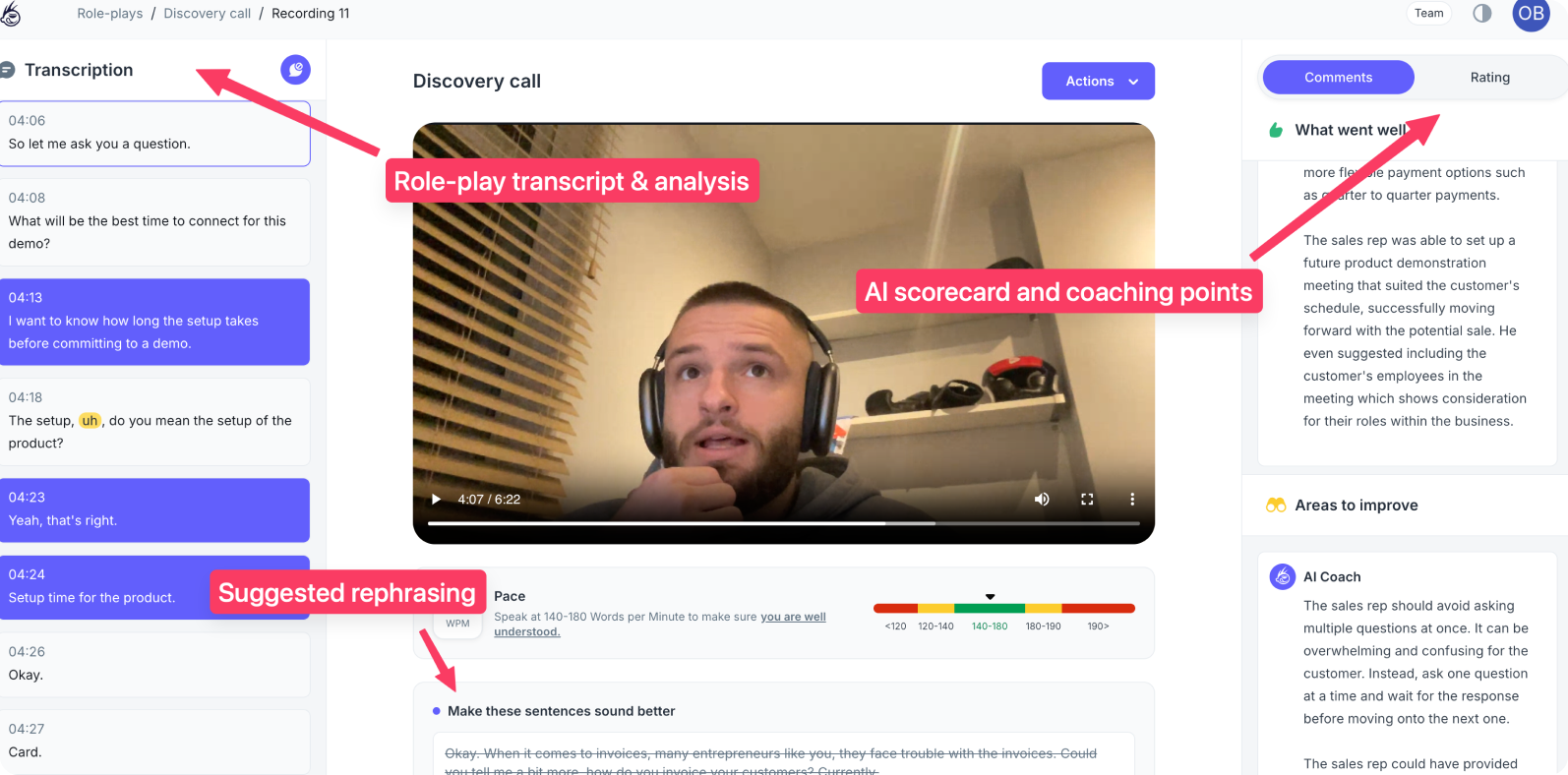
The drill: give a rep a buyer who states a confident assumption that happens to be wrong, such as "our certification programme covers this, everyone passes it". The rep has to challenge that once, respectfully, and then not retreat when the buyer pushes back. The push-back is the point of the exercise. Almost every rep can deliver a reframe into a receptive silence; far fewer can hold it when a senior person says "I think you're overstating that".
This is the drill that fails hardest as a peer role-play. A colleague playing a sceptical VP will concede after the first good sentence, because they want their teammate to succeed and staying unconvinced feels unkind. The rep gets a repetition that teaches them the reframe always works, which is the opposite of what they need.
An AI buyer does not have that instinct. In PitchMonster you can build one from a real recorded call so the objections sound like your market, set it to defend the assumption for as long as the rep keeps pushing, and score against your own criteria. The AI Coach then debriefs by asking what the rep noticed rather than issuing a grade, which is what makes a repetition stick.
Then measure it on ramp. Mentor Group cut ramp time by 50% on average and halved coaching time per rep; SThree onboarded 53% faster. If you are rolling Challenger out at a sales kickoff, the reframe drill is the thing to schedule for the 90 days after, not the 2 days during.
Write the insight first, then rehearse defending it. Book a demo and we will build the sceptical-buyer scenario from one of your own calls.
FAQ
What is the Challenger Sale?
The Challenger Sale is a B2B sales methodology from Matthew Dixon and Brent Adamson, published in 2011. Its argument is that the best performers in complex sales do not just build relationships, they teach buyers something new about their own business, tailor that insight to each stakeholder, and take control of the buying conversation.
What does teach, tailor, take control mean?
Teach means giving the buyer a genuinely new perspective on their business, not a product pitch. Tailor means adapting that insight to what each stakeholder is measured on. Take control means guiding the process and making clear recommendations, including on price and next steps, rather than waiting to be told what happens next.
What are the 5 Challenger seller profiles?
The Hard Worker, the Relationship Builder, the Lone Wolf, the Reactive Problem Solver, and the Challenger. The book's central finding was that Challengers outperformed the other 4 profiles in complex sales, and that Relationship Builders, long assumed to be the ideal, performed worst on those deals.
What is commercial insight?
Commercial insight is a specific, credible idea that changes how a buyer understands a problem they already have, and that leads naturally to something you are uniquely good at. If the insight would work just as well in a competitor's deck, it is content marketing rather than commercial insight.
Is the Challenger Sale still relevant?
The behaviours hold up in deals with several stakeholders and a real status quo to displace. What has aged is the assumption that buyers lack information. Buyers now arrive with plenty of it, so the value of teaching has moved from supplying facts to reframing what those facts mean for them specifically.
What is the difference between Challenger and SPIN selling?
SPIN is a questioning method: it tells a rep what to ask so the buyer articulates their own problem. Challenger is closer to the opposite move, where the rep brings a point of view the buyer had not considered. They combine well in practice, using SPIN questions to establish the situation and a Challenger reframe once you understand it well enough to have earned one.
Why do Challenger rollouts fail?
Two reasons. Teams train the take-control behaviour without the insight, which produces reps who are assertive with nothing to say. And they underestimate that a reframe has to be delivered, not just known: saying "I think you are measuring the wrong thing" to a senior buyer requires a tone reps have never rehearsed.
What are the 6 steps of Challenger commercial teaching?
The sequence is Warmer, Reframe, Rational Drowning, Emotional Impact, A New Way, and Your Solution. The order carries the method: your solution comes last, after the buyer has accepted that their current thinking produces a bad outcome. Reps who compress the middle steps end up delivering a pitch with a statistic attached to the front.
What is a mobilizer in Challenger selling?
A mobilizer is a stakeholder who can build internal consensus, as opposed to a talker who is receptive and informative but cannot move a purchase. The Challenger Customer identifies 3 mobilizer profiles: the Go-Getter, the Teacher, and the Sceptic. Reps tend to prefer talkers because those meetings feel better, which is why warm deals stall.
How do you practise Challenger selling?
Practise the reframe itself, in isolation. Give a rep a buyer who states a confident but flawed assumption, and have them challenge it once, respectfully, without retreating when the buyer pushes back. That last part is the whole skill, and it needs a practice partner willing to stay unconvinced, which colleagues rarely are.
The short version
Challenger is 3 behaviours and only one of them is hard to fake. Take Control is easy to train and produces nothing on its own. Teach requires an insight you can defend under questioning, which most teams never build.
Write the insight first. Then rehearse holding it when a senior buyer tells you that you are overstating it, because that moment is where the methodology either works or collapses.