Solution selling is a sales methodology that starts from a buyer's pain, not from a product feature, and works forward to a configuration of your offering that fixes it. The rep's job is not to describe capabilities. It is to trace what one person's daily frustration costs someone above them, then build the case in the words of the person who signs.
This guide covers the pain chain, how it maps onto a real buying committee, and the exact difference between solution selling and consultative selling. The 2 get blurred constantly, and the difference is precise. It also covers where solution selling runs into trouble and how it stacks against Challenger and MEDDPICC. And it covers the one skill no workshop installs: turning a user's daily annoyance into a sentence an economic buyer will believe.
A note on the name: Solution Selling® is a registered trademark of Richardson Sales Performance (formerly Sales Performance International). This guide explains the methodology generally. It is not affiliated with, endorsed by, or a certification from the trademark holder, and if you want official training you should go to them directly.
What is solution selling?
Solution selling starts from a buyer's named pain, not a product feature, and works forward from there. The rep's first job is not to describe capabilities. It is to find a problem specific enough to be worth fixing, then trace what that problem costs the person who signs.
Michael Bosworth formalized the approach in his book, published in the 1990s, after watching top performers do something average reps did not. They diagnosed a specific pain before they proposed anything, and they tracked how that pain compounded as it moved up a reporting line. Rackham's SPIN research and Bosworth's solution selling came out of a similar era, from different directions. One is about the questions to ask. The other is about what to do with the answer once you have it.
The qualification mechanic Richardson Sales Performance trains today is PPVVC: Pain, Power, Vision, Value, Consensus. One note if you learned this in the Sales Performance International era: the last C was commonly taught then as Control, the rep's ability to steer the buying process. Richardson's current material renders it as Consensus, and that is the version this guide uses. Pain is the problem, named specifically enough to be worth fixing. Power is the person who can fund the fix. Vision is what the buyer pictures once it is solved. Value is what that picture is worth in their own numbers. Consensus is whether the people around the buyer will let the deal close.
What solution selling is not: a way to sell in general. It assumes a pain already exists and is willing to be found. If nobody in the account is unhappy yet, solution selling has nothing to attach to, and a different opening move is needed.
The pain chain
The pain chain is Bosworth's real contribution, and it is the concept most guides on this topic skip entirely. It says a problem changes shape as it climbs a reporting line. What a frontline employee describes as an annoyance, their manager describes as a missed number, and their manager's boss describes as a risk nobody can explain.
A rep who only interviews the user gets the annoyance. A rep who follows the chain gets the sentence that raises budget.
Level | What they feel | What it costs someone above them | What they would never say to a VP |
|---|---|---|---|
User (ops manager, rep, analyst) | A daily task takes longer than it should | Their manager loses hours reworking the output | "This is annoying" |
Manager (director, team lead) | A recurring miss against a weekly or monthly target | Their VP explains a variance nobody can trace to one cause | "My team is a bit behind" |
VP / department head | A pattern across teams that shows up in the quarterly number | The CFO or CEO sees a miss with no single owner to hold accountable | "We have a process problem" |
Economic buyer (CFO, COO, CRO) | Nothing directly. They inherit the aggregate | A board question they cannot answer with a specific cause | Says nothing. Approves, or does not, based on whether someone gave them a cause |
Read the right-hand column again. Nobody in that chain is going to hand a rep the sentence that unlocks budget. The user will not say it, because it sounds like complaining. The economic buyer cannot say it, because they never felt the original pain and only see its aggregate. The rep's job is to build the sentence that connects row 1 to row 4, in row 4's language, using row 4's number.
That is the pain chain doing real work, and it is also where most solution-selling training stops. Reps learn to draw the chain on a whiteboard. Almost none of them learn to say the last row's sentence out loud, to the actual person in that seat, while that person is unconvinced. That gap is the subject of the next 2 sections.
Mapping the pain chain to a buying committee
The pain chain explains the cost. The buying committee is who has to agree the cost is real enough to fund. A solution-selling deal with more than one stakeholder needs both, and most reps only build the first.
4 seats show up on nearly every enterprise pain chain, and the fourth is the one nobody prepares for.
Stakeholder | Where they sit on the pain chain | What has to be true for them to say yes | The translation gap |
|---|---|---|---|
User | Feels the original pain daily | The fix removes the daily friction | None. This stakeholder is easy; they already agree |
Technical evaluator | Sees the pain as a system or process defect | The fix works inside the existing stack, cleanly | Needs proof it will not break something else, not proof the pain is real |
Champion / mobilizer | Sits between the user and the money, and wants the fix to happen | Someone above them accepts the business case | Has to carry the sentence internally when the rep is not in the room |
Economic buyer | Sits above the pain, inherits only its aggregate | The cost of the pain, in their number, beats the cost of the fix | Never felt the original pain, and does not automatically trust a rep's account of it |
The champion row deserves its own note, because it is the same role our Challenger guide calls a mobilizer rather than a champion. An enthusiastic user who cannot move budget is not the same as someone who can carry the sentence upward. Solution selling and Challenger agree on this point even though they disagree on almost everything else.
The honest differentiator sits in the last row. Reps can map all 4 seats correctly on a whiteboard in a workshop. Then an actual CFO asks why this is their problem, live, and the same rep freezes. That single moment is the part a pain-chain diagram cannot rehearse for them.
A worked conversation
One thread, run properly. The pain chain here started with a customer success team's ops manager describing slow ticket handoffs to their director, who reported a support SLA that kept slipping. The rep is now in the room with the VP of Finance, who approves the budget and has never opened a support ticket.
VP Finance: "I've seen the proposal. Help me understand why this is a Finance problem and not an Ops problem."
Rep: "Fair question. Your renewal rate dropped 3 points this year. Do you know what's driving that?"
VP Finance: "Churn is always messy. A few reasons, probably."
Rep: "One of them is measurable. In your own renewal data, accounts that had a support ticket miss the SLA window churned at more than twice the rate of accounts that didn't. Your Ops director has 14% of tickets missing that window right now."
VP Finance: "That's an Ops metric. I still don't see why I'm signing the check."
Rep: "Because at your renewal volume, closing that gap by half is worth more in retained revenue this year than the cost of the fix, and Ops has already told us where the handoff breaks. The number in front of you is the Finance version of their problem."
VP Finance: "Send me the retained-revenue math and I'll take it to the board line."
Notice what the rep did not do. No feature got described. The rep translated a support-ops complaint into a renewal-revenue sentence, in the VP's own metric, then stopped talking before the VP finished being convinced. That translation, delivered live while a senior stakeholder is skeptical, is the actual skill. Everything upstream of it, the pain chain, the stakeholder map, is preparation for that one moment.
Solution selling vs consultative selling
These 2 get treated as synonyms constantly, and the confusion costs both methodologies their usefulness. The difference is precise, not a matter of tone. Our consultative selling guide covers that posture on its own terms; this section covers where it parts company with solution selling.
Solution selling starts after a pain is already named and works forward to a configured fit from your own catalog. Consultative selling starts upstream, before a pain is named, and stays open to the honest answer that your product is not it.
Solution selling | Consultative selling | |
|---|---|---|
Starting point | A pain the buyer already has, or can be led to name quickly | A business goal, with the pain not yet identified |
Rep's role | Diagnose the pain, connect it up the chain, configure the fix | Advise on the goal, even past the point where your product stops being the answer |
Bounded by | Your own product catalog | Nothing. The honest output can be "not us, not yet" |
Timeframe | One deal cycle | Often longer than one deal; the relationship outlasts a single sale |
Where they overlap: both put the buyer's actual situation ahead of a feature pitch, and both resist the instinct to open with a demo. Where they do not: solution selling is honestly bounded by what you sell, and a rep running it is allowed to stop once the fit is configured. Consultative selling carries no such boundary, which is what makes it slower and, done well, more trusted.
Most enterprise reps run a blend without naming it. Consultative selling in the meetings before a pain surfaces, solution selling once one is named. This guide stays with the pain chain once it already exists.
Where solution selling breaks down
Two failure modes, and only one gets discussed honestly in most training.
The first is the practice gap from the last 2 sections. A rep can recite the pain chain and name all 4 buying-committee seats. They can still freeze on the sentence that connects them, live, in front of the one stakeholder who was not in the room for the original complaint.
The second is the Challenger critique, and it deserves to be stated fairly rather than ignored the way most solution-selling guides ignore it. In their Harvard Business Review article "The End of Solution Sales," Dixon, Adamson and Toman argued that solution selling assumes a buyer needs help diagnosing their own problem. Increasingly, buyers have already done that diagnosis themselves, using their own data and a procurement process built for exactly this. A rep who walks in and hands back a diagnosis the buyer already reached adds nothing, and can read as behind rather than helpful.
Both critiques point at the same fix. The pain chain and the buying-committee map are necessary, but not sufficient on their own. What still differentiates a rep is adding something the buyer's own procurement process did not already produce. Usually that is the translation into the economic buyer's language, done live, which a self-diagnosis cannot do for itself.
Solution selling vs Challenger vs MEDDPICC
These get compared as competing philosophies. In practice they answer different questions, and a mature rep runs elements of all 3 on the same deal. If your team sells subscriptions, SPICED is worth reading alongside this. Its Pain and Impact stages do the same work as the first 2 rungs of the pain chain, sequenced as a live call script.
Solution selling | |||
|---|---|---|---|
What it is | A pain-to-fit diagnostic method | A behavior model | A qualification checklist |
Core move | Trace a named pain up the chain to whoever funds it | Bring a reframe the buyer had not considered | Test whether the deal is real |
Direction | Buyer's pain to rep's fit | Rep to buyer | Rep to manager |
Best for | A buyer who already knows something hurts | A buyer who does not yet know they have a problem | Forecasting and deal review |
PPVVC and MEDDPICC overlap almost letter for letter. That is worth naming: it shows MEDDPICC auditing whether the solution-selling work held up, rather than competing with it.
PPVVC | Maps to MEDDPICC | What changes |
|---|---|---|
Pain | Identify Pain | Same test: named specifically enough to fund |
Power | Economic Buyer | Same seat, same question: who signs |
Vision + Value | Metrics + Decision Criteria | PPVVC bundles these; MEDDPICC scores them separately |
Consensus | Champion | PPVVC asks if the group agrees; MEDDPICC asks who argues for you when you are not there |
MEDDPICC adds 2 things PPVVC does not track at all: Decision Process and Paper Process, the actual approval sequence and the legal and security review. A solution-selling deal can pass every PPVVC check and still stall for a quarter in procurement, which is exactly the gap MEDDPICC was built to close.
Challenger sits at a different angle from both. Solution selling and MEDDPICC assume the pain is find-able; Challenger assumes the buyer does not know they have one yet, and the rep has to supply the reframe. Reach for a Challenger reframe when an account looks comfortable with its status quo and nothing is named yet. Our Challenger guide, though, puts that reframe in the second half of a discovery conversation rather than the first 5 minutes. That is because a reframe offered before you understand the account reads as a guess. Switch to solution selling's pain chain once something is named.
How to drill it
Isolate the one behavior: translating a named pain into an economic buyer's cost sentence, live, while that buyer pushes back or looks unconvinced. Everything else in this guide is preparation for that moment, and it is the part a whiteboard cannot teach.
The drill: give a rep a buyer who never felt the original pain and is primed to ask why this is their problem. Have the rep deliver the translation in 1 or 2 sentences, in the buyer's own metric, then stop talking. Score it against the same PPVVC or MEDDPICC criteria your team already uses, so the drill reinforces the framework instead of running alongside it.
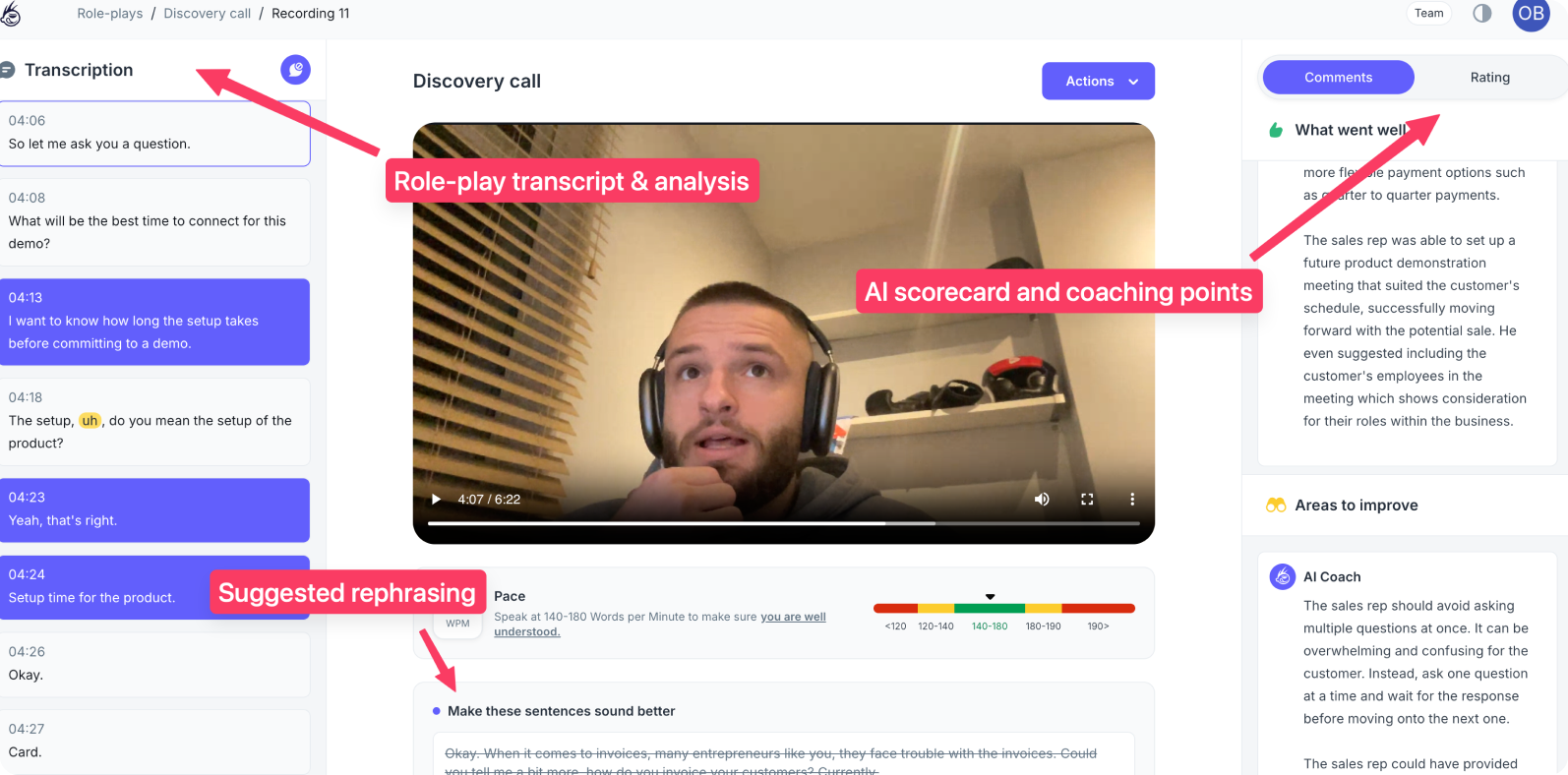
This is the drill that fails hardest as a peer exercise. A colleague playing a skeptical VP concedes after the first reasonable sentence, because staying unconvinced feels unkind to a teammate. The rep leaves the room believing the translation always lands, which is the opposite of what a real economic buyer will do.
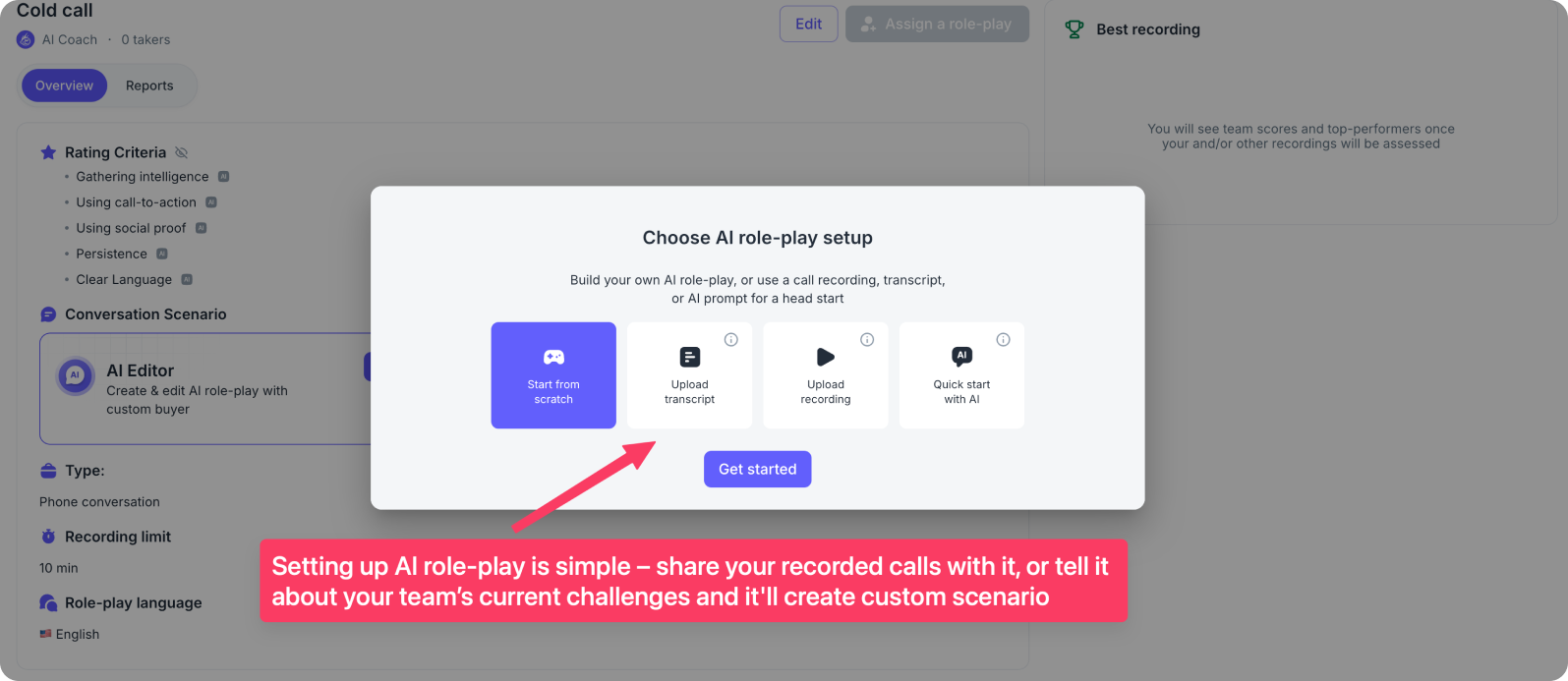
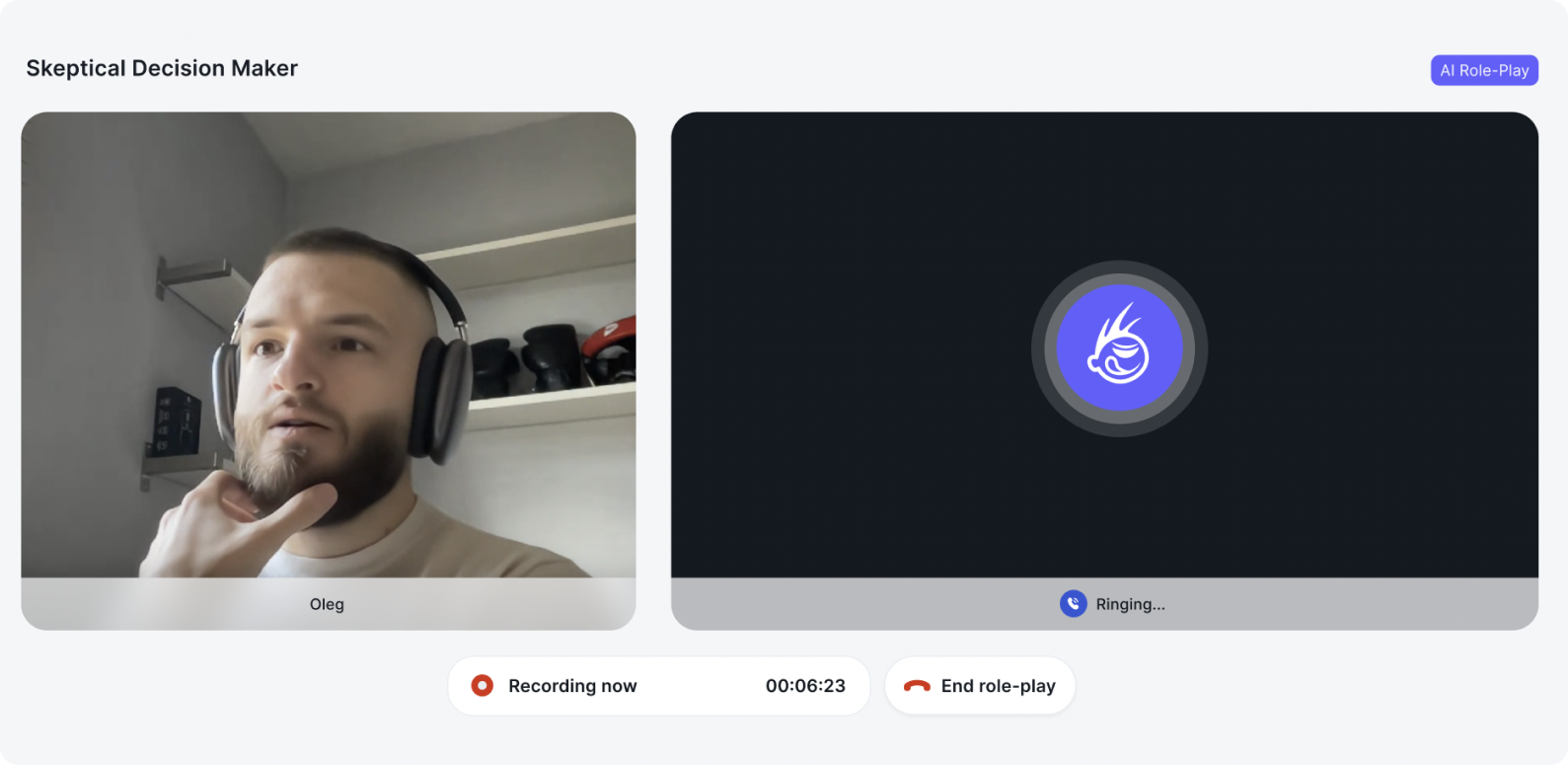
In PitchMonster, an enablement lead builds the AI buyer from a real recorded call, so the objections sound like your market. It gets set to resist the vague version of the sentence and ask "so what" until the rep gets specific. Then it scores the session against the team's own MEDDPICC or PPVVC criteria. The AI Coach debriefs afterward by asking the rep what they noticed rather than issuing a grade, which is what makes a repetition stick instead of just happening.
The measured version of practicing this way: PRN Health Services recorded 22.37% higher call quality on real calls and 14% more interviews scheduled. Mentor Group cut ramp time by 50% on average while halving coaching time per rep. Reps get good at this the way they get good at anything else on a call: repetitions, against someone who does not help them.
If you are rolling solution selling out this quarter, teach the pain chain once, then spend the remaining time on repetitions of the economic-buyer sentence. Book a demo and we will build the scenario from one of your own deals.
FAQ
What is solution selling?
Solution selling is a sales methodology that starts from a buyer's named pain, not from a product's features. It works forward to a configuration of the product that fixes that pain. Michael Bosworth formalized the approach in the 1990s, and Richardson Sales Performance still teaches its qualification mechanic as PPVVC: Pain, Power, Vision, Value, Consensus.
What is an example of solution selling?
An ops manager says onboarding takes too long. A rep traces that up the chain. The manager's director reports a wider ramp gap across the team, and the VP overseeing the group is carrying a quarter of lost pipeline because of it. The rep builds the business case in the VP's own pipeline number, rather than pitching a feature to the ops manager who first raised it.
What is the pain chain in solution selling?
The pain chain is Michael Bosworth's concept that a single problem changes shape as it moves up a reporting line. A user's daily annoyance becomes a manager's missed number, which becomes a VP's pattern across teams, which becomes an economic buyer's unexplained variance. Solution selling works by tracing that chain and building the case in the language of whoever sits at the top of it.
What is the difference between solution selling and consultative selling?
Solution selling starts once a pain is already named and works forward to a fit from your own product catalog. Consultative selling starts upstream, before a pain is named, and stays open to the honest answer that your product is not the fix. Both put the buyer's situation ahead of a pitch. Solution selling is bounded by what you sell, and consultative selling is not.
What is the difference between solution selling and MEDDPICC?
Solution selling is a diagnostic method for finding a pain and following it to whoever can fund fixing it. MEDDPICC is a qualification checklist that tests whether a deal is real once that work is done. PPVVC, solution selling's own qualification mechanic, maps closely onto MEDDPICC's letters. But MEDDPICC adds Decision Process and Paper Process, the approval sequence and the legal review that solution selling does not track.
What are the 4 types of selling?
The 4 commonly named types are transactional selling, solution selling, consultative selling, and insight or provocative selling. Transactional selling competes mainly on price and convenience. Solution selling matches a named pain to a product fit. Consultative selling advises on a goal before a pain is even named. Insight selling, the basis of Challenger, brings the buyer a reframe they had not considered.
Is solution selling still relevant?
The pain chain and the buying-committee mapping hold up in any deal with more than one stakeholder. What has aged is the assumption that buyers need a rep to diagnose their problem for them. Harvard Business Review's "The End of Solution Sales" argued buyers increasingly do that diagnosis themselves, which is why translating the pain into an economic buyer's language now matters more than finding it.
What are the steps in the solution selling process?
Most solution-selling rollouts run 5 steps: find a pain the user will admit to, then trace it up the pain chain to see what it costs someone above them. Map the buying committee against that chain, build the case in the economic buyer's own metric, and confirm consensus across the stakeholders who have to agree before signature. The last 2 steps are where most reps lose the deal.
The short version
Solution selling is one mechanic. Find a pain, trace what it costs someone who did not feel it, and say that cost out loud to whoever can fund the fix. The pain chain and the buying-committee map are the easy half. The sentence that lands with a skeptical economic buyer, live, is the half no workshop installs.
Teach the mechanic once. Then put the practice budget on the translation. It is the step every ranking guide on this topic leaves out. It is also the one a rep can go a whole year without saying out loud to anyone senior enough to test it.