Consultative selling is an approach to B2B sales where the rep diagnoses a buyer's problem before proposing anything, using questions instead of a pitch to get there. The idea traces to Mack Hanan's 1970 book Consultative Selling, and it still describes the posture that separates a trusted advisor from a rep working through a script.
This guide covers what the term requires beyond a mission-statement phrase, how it differs from transactional and product-led selling, and a worked call that shows the discipline in practice. It also covers the specific way the posture collapses the moment a deal gets time-pressured or a senior buyer pushes back.
What is consultative selling?
Consultative selling is a sales approach where the rep acts like a consultant: understand the problem in detail before recommending anything, rather than leading with a product.
Mack Hanan coined the term in his 1970 book Consultative Selling: The Hanan Formula for High-Margin Sales at High Levels. It was aimed at reps selling into other companies rather than to individual consumers. His argument was direct. A rep who diagnoses a client's business problem the way a consultant would gets treated like one, and paid like one. The result is bigger deals and less price resistance than a rep who opens with a pitch.
The mechanics have not changed much since. What has changed is how much information buyers already have before the call starts, which shifts where the real diagnostic work happens. It is no longer about surfacing facts. It is about staying in the questions past the first thing the buyer is willing to say out loud.
That distinction, staying past the first admission, is the entire discipline underneath the term. Most treatments of consultative selling never get more specific than "understand the customer's needs."
Worth placing on the map before going further. Consultative selling says nothing about whether a prospect is worth a first meeting or whether a deal will close. An SDR might use BANT to decide the first, and a manager might use MEDDPICC to test the second. Consultative selling is what happens between those 2 checkpoints, on the call itself.
It is also not the same thing as solution selling, which is the closest neighbouring term and the one it gets confused with most. Solution selling starts once a pain is already named and works forward to a fit from your own product catalog. Consultative selling starts upstream of that, before a pain is named, and stays open to the answer that your product is not it. Our solution selling guide works that distinction through in full.
Diagnosis before prescription
Diagnosis before prescription sounds like common sense until you watch how often reps skip it.
A named problem is not a diagnosed one. A buyer who says "onboarding takes too long" has admitted to a symptom, not handed over a business case. Diagnosis means staying in the conversation long enough to find out what that symptom costs and who else feels it. It also means finding out whether fixing it is worth the buyer's political capital to champion internally.
Here is the sequence that separates a real diagnosis from a comfortable one.
Stage | What it sounds like | Where reps stop too early |
|---|---|---|
Symptom admitted | "Ramp takes about 4 months right now." | Treating this as the whole diagnosis and moving to the demo |
Cost quantified | "What does a rep taking an extra month cost you in pipeline?" | Accepting a vague answer like "a lot" instead of a number |
Ownership named | "Whose target does that miss land on?" | Never asking, so nobody internally has to answer for the gap |
Priority tested | "Where does this sit against the other things competing for budget this quarter?" | Assuming urgency instead of checking it |
Each row the rep skips is a row the buyer never has to think through out loud. That leaves the rep as the only one who believes the deal is urgent. A prescription written on 2 rows of that table instead of 4 is a guess with a product attached.
The failure is not laziness. It is that stopping at "symptom admitted" feels like progress, and pressing further feels like friction. Diagnosis requires tolerating that friction on purpose.
Consultative vs transactional vs product-led selling
These get used almost interchangeably, and the differences matter for how a call goes.
Consultative | Transactional | Product-led | |
|---|---|---|---|
What drives the conversation | The buyer's problem, as diagnosed | The buyer's stated request | The product's feature set |
Who talks more | The buyer | Whoever is negotiating price | The rep |
What the rep leads with | A question | A quote | A demo |
What proves the fit | The buyer's own answers | The buyer's willingness to sign | The feature-to-need match on a slide |
Failure mode | Diagnosis with no buyer-side owner to champion it | Racing to price before value is established | The buyer sees a feature list instead of a fix |
A transactional call can close fast and still leave money on the table, because nobody established what the fix was worth. A product-led call can look thorough and still fail. The rep never confirmed the feature they demoed maps to the buyer's real problem instead of an assumed one.
Consultative selling is slower up front by design. The bet is that a diagnosed problem sells itself once it is properly quantified. A rep who skips the diagnosis is negotiating from a weaker position without knowing it.
The question discipline it demands
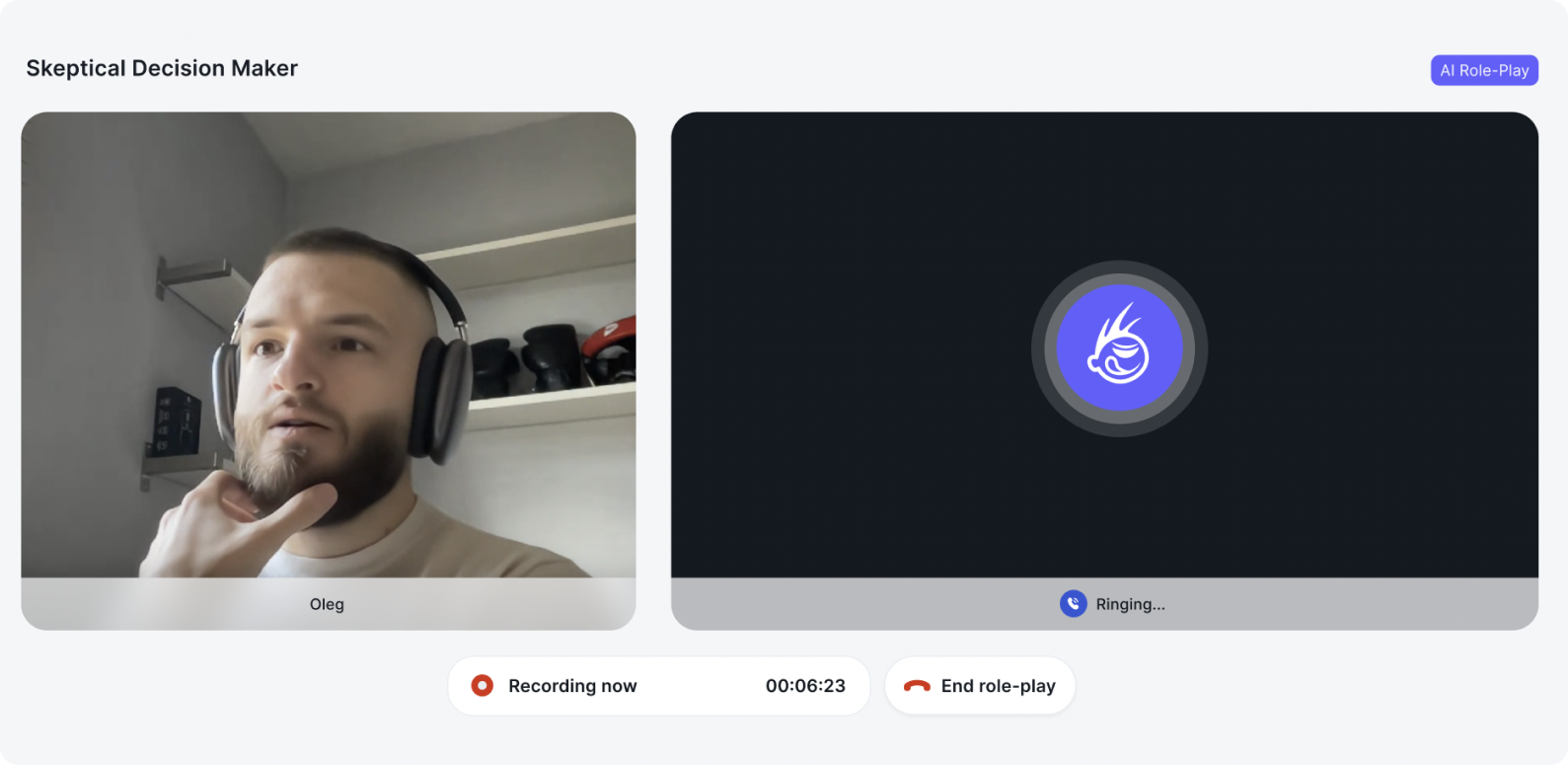
Consultative selling is a posture, and a posture only shows up in how a rep questions a buyer. Here is one thread, run properly, with a Head of Sales Operations at a 40-rep company.
Rep: "Walk me through how a deal moves from qualified opportunity to closed-won today."
Buyer: "Reps run discovery, then it goes to a proposal, then legal and procurement, then signature."
Rep: "Where does that stall most often?"
Buyer: "Legal, honestly. Contracts sit there for weeks sometimes."
Rep: "What happens to a deal while it's sitting? Does the buyer's urgency hold, or does it decay?"
Buyer: "It decays. We've lost deals that were basically agreed because the buyer's internal priorities moved on."
Rep: "Do you track how many of those you've actually lost that way, or is it more of a felt sense?"
Buyer: "We don't track it formally. I'd guess it's a meaningful chunk of what shows up as 'no decision' in the CRM."
Rep: "If you could see that number clearly, would it change how your team prioritizes the legal handoff?"
Buyer: "It would change how I make the case to leadership for headcount on the legal side. Right now it's a hunch, not a business case."
Notice the shape. The rep did not stop at "legal is slow," which is where most calls would have pivoted to a pitch about faster contracting. The rep kept asking until the buyer admitted the gap was uncounted, which is the actual finding: the problem was never quantified internally, so nobody could act on it. That is the diagnosis a prescription should be built on, and the buyer arrived at it, not the rep.
Why it collapses under pressure
This is the part almost no treatment of consultative selling addresses, and it is where most rollouts fail.
Consultative selling reads simple. Ask before you tell. In a calm, cooperative call, most reps can do a passable version of it. The posture breaks down under 3 specific conditions, and every rep who has run more than a handful of real deals has watched it happen.
Pressure trigger | What breaks first | What it looks like on the call |
|---|---|---|
A compressed timeline | Diagnosis gets cut short | The rep jumps to the recommendation to "save the buyer's time" |
A skeptical or senior buyer | Question discipline | The rep over-explains the product instead of asking the next question |
Silence after a diagnostic question | The posture entirely | The rep fills the gap with a pitch rather than waiting for the answer |
Each of these is a moment where staying in questions feels like the wrong move, and reverting to a pitch feels like taking control back. That instinct is exactly backwards. The rep who fills the silence has just told the buyer the diagnosis was theater. The rep who over-explains under a skeptical buyer has swapped a question they could have asked for a claim they now have to defend.
None of this is a knowledge gap. A rep can recite "diagnose before you prescribe" perfectly and still pitch the moment a VP leans back and says "I've heard this before". Reading about the posture does not install the reflex to hold it when it costs something to hold. A workshop where the practice partner is a cooperative colleague never tests the reflex at all.
Consultative selling vs SPIN vs Challenger
These 3 get compared as if a team should pick one. They sit at different altitudes, and the confusion is mostly about which one is the umbrella.
Consultative selling | |||
|---|---|---|---|
What it is | A posture: diagnose before you prescribe | A questioning method, 4 types in order | A behavior model |
Core move | Withhold the recommendation until the problem is proven | Ask until the buyer states the problem | Bring a reframe the buyer had not considered |
Direction | Buyer leads, rep follows with questions | Buyer to rep | Rep to buyer |
Best for | Any complex sale where trust has to be earned before a recommendation | Uncovering a problem the buyer half-knows | Displacing a comfortable status quo |
Consultative selling is the posture; SPIN is one disciplined way to run it, question type by question type, on a single call. A rep asking Situation, Problem, Implication and Need-payoff questions in order is practicing consultative selling with a specific vocabulary attached to each step.
Challenger is closer to the opposite instinct, and that is fine, because it belongs later in the same conversation. A reframe delivered before the rep has diagnosed anything is a guess dressed up as insight. A reframe delivered after real diagnosis, once the rep has earned the standing to say "here's what I think you're missing," lands as expertise instead.
The 3 are not competitors. Consultative selling sets the posture and SPIN gives that posture a question-by-question script. Challenger tells the rep what to do once the diagnosis has bought them the right to say something the buyer did not expect.
How to drill it
The teams that get consultative selling to stick do not rehearse whole calls. They isolate the reflex that breaks first: staying in questions past the point where pitching would feel easier.
Start with a buyer who admits a problem quickly and then resists quantifying it, the way the Head of Sales Operations did above. Have the rep press twice, past "I don't track that formally," without turning the call into an interrogation. That single repetition, done 10 times against a buyer who does not cooperate, does more than an hour of general role-play.
Then add the pressure conditions on purpose. Run the same scenario with a hard 8-minute clock, and again with a buyer who opens skeptical: "We've talked to 3 vendors already, what's different here?" Watch which reflex breaks first. It tells you exactly what to drill next, and it is rarely the same answer for every rep on a team.
This is where practicing against a person runs out of road. A colleague playing a resistant buyer concedes early, because the exercise is meant to go well for both people in the room. A rep who is only ever diagnosed by a cooperative partner never feels what it costs to hold the posture against a real one.
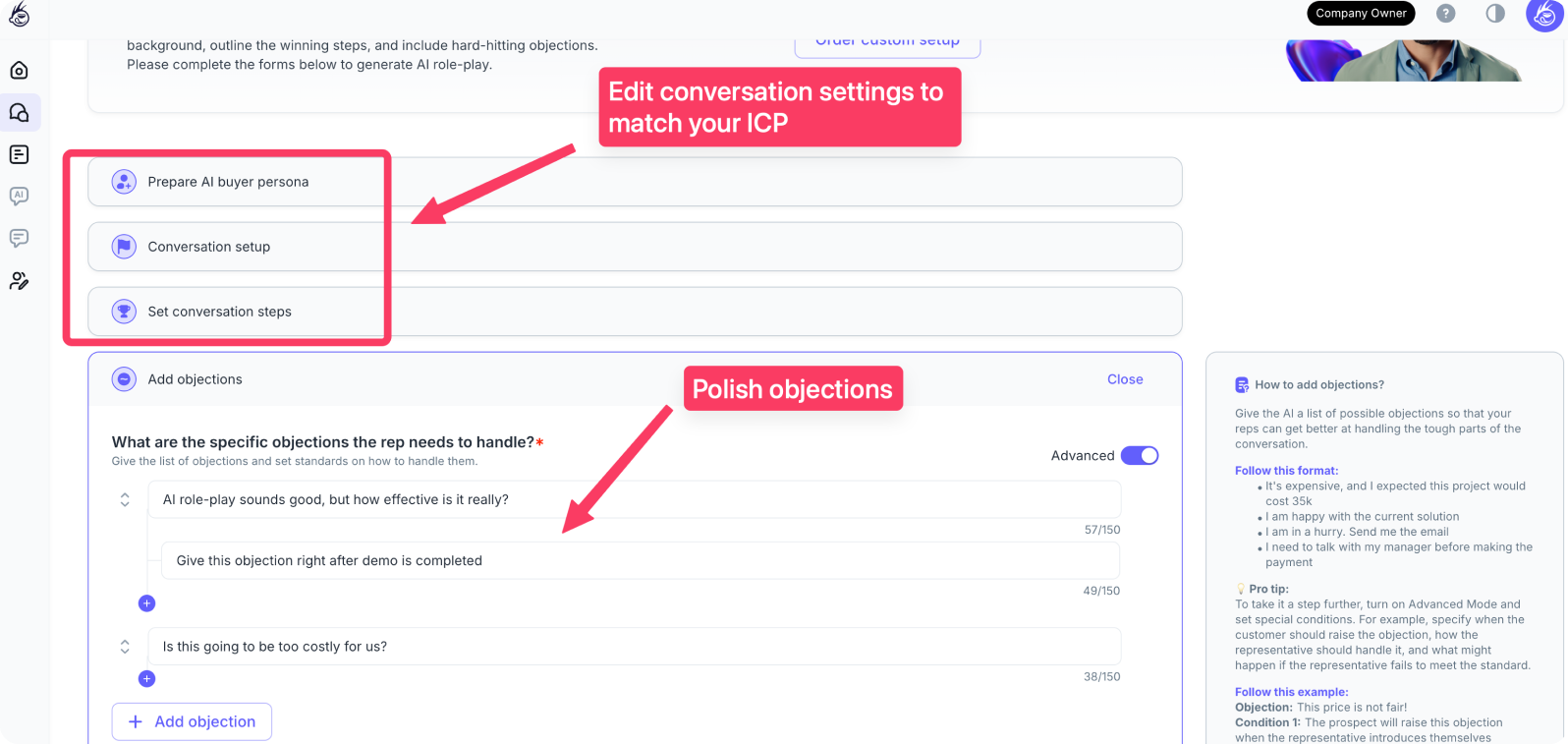
In PitchMonster, an enablement lead can build an AI buyer from a real recorded call. Set it to resist quantifying a problem the way an actual prospect does, and run every rep through the same scenario under a real clock. The session is scored against your own criteria. The AI Coach debriefs afterward by asking the rep what they noticed, rather than handing over a grade. A human practice partner cannot stay resistant on command for the twelfth rep in a row. An AI buyer can.
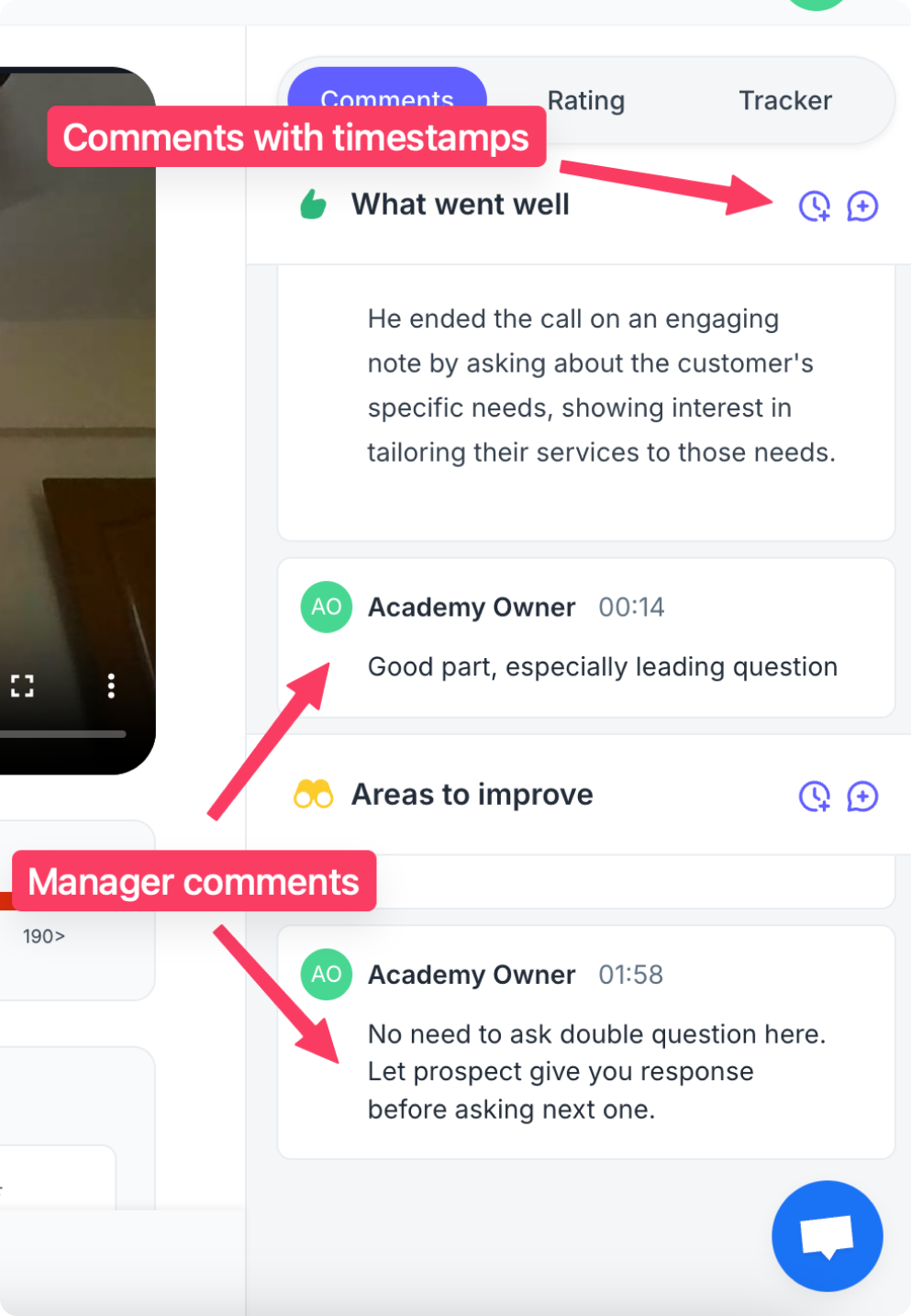
The measurable version of this is ramp time. Mentor Group cut ramp time by 50% on average and halved coaching time per rep, moving repetitions off their managers' calendars. SThree onboarded 53% faster the same way. Both numbers moved because the repetitions moved, not because the training deck changed.
If you are teaching consultative selling as a posture, not a slogan, spend most of the practice budget on the 2 or 3 moments where reps revert to pitching. Our role-play scenario guide covers other setups worth drilling alongside this one. Book a demo and we will build the resistant-buyer scenario from one of your own recorded calls.
FAQ
What is consultative selling?
Consultative selling is an approach where the rep diagnoses a buyer's problem before proposing anything, using questions rather than a pitch to get there. The term comes from Mack Hanan's 1970 book Consultative Selling. Its core idea is that a recommendation only earns trust once the problem behind it is proven, not assumed.
What are the 8 steps of consultative selling?
Sources vary on an exact 8-step list. The common shape is research, opening, needs discovery, diagnosis, solution alignment, presentation, objection handling, and close with an ongoing relationship in mind. The number of steps matters less than the order: diagnosis has to happen before solution alignment, not after.
What are examples of consultative selling?
A rep who asks where a process breaks down before naming a product is selling consultatively. So is a rep who asks a buyer to quantify what a problem costs before proposing a fix. So is a rep who walks away from a deal because the diagnosis did not support the product. The worked example in this guide shows what that sounds like on a real call.
What is the difference between consultative selling and solution selling?
Solution selling starts once a pain is already named and works forward to a fit from your own product catalog. Consultative selling starts upstream, before a pain is named, and stays open to the answer that your product is not the fix. The 2 overlap heavily in practice. The dividing line is that solution selling is bounded by what you sell and consultative selling is not. Our solution selling guide works the difference through with a full example.
Is consultative selling the same as SPIN selling?
No. Consultative selling is a posture: diagnose before you prescribe. SPIN selling is a questioning method with 4 specific question types in order. SPIN is one practical way to run the consultative posture on a live call, but consultative selling does not require SPIN specifically. A rep can diagnose well without ever naming the framework.
How is consultative selling different from the Challenger Sale?
Consultative selling waits for the buyer to reveal the problem before the rep says anything prescriptive. The Challenger Sale does close to the opposite: the rep brings a reframe the buyer had not considered. They are not opposed methods, they are sequenced ones, with a Challenger reframe landing only after enough consultative diagnosis has earned the standing to offer one.
Who created consultative selling?
Mack Hanan is credited with the term, in his 1970 book Consultative Selling, aimed at B2B sales reps. The book argued that a rep who acts like a business consultant, diagnosing a client's problem before recommending anything, wins more trust and bigger deals. That beats a rep who leads with a product pitch.
Does consultative selling work under time pressure or on a compressed sales cycle?
It works, but it is the first thing reps drop when time is short. Diagnosis takes longer than a pitch, so a compressed cycle or an impatient buyer tempts a rep to skip straight to the recommendation. The fix is not abandoning the posture, it is drilling the diagnostic questions until they take less time to ask.
The short version
Consultative selling is one idea: diagnose before you prescribe. It sounds obvious and it is exactly what reps abandon the moment a call gets hard, because staying in questions costs more than it looks like it should.
Teach the posture once. Then spend the practice budget on the 3 moments it breaks: a compressed timeline, a skeptical buyer, and the silence after a hard question. Those are the moments a real deal tests it.