Quick answer
If you are looking for a retorio alternative, the deciding question is not which vendor is better. It is whether you are buying measurement or buying reps. Retorio scores recorded sales conversations against a behavioural model built on verbal and non-verbal signals. PitchMonster runs live, adaptive conversation practice against scorecards you write yourself, with a Socratic AI Coach after each session. Both companies are European and host in the EU.
Everything stated below about Retorio comes from pages on retorio.com read on 25 August 2026, or from one independent publication. Where Retorio publishes no answer, this article says so instead of guessing.
What Retorio does
Retorio was founded in 2018 out of the Technical University of Munich, and its about page credits research collaboration with MIT and the University of Tokyo. The company is headquartered in Munich with offices listed in New York, Calgary, Barcelona and Istanbul, and names Porsche Ventures and Storm Ventures among its backers.
The current homepage H1 is "The pioneer in AI coaching". The hero line underneath reads as follows.
"AI sales coaching for the enterprise. Better conversations, more revenue."
The product description is specific. Retorio's own wording puts it this way.
"scores sales conversations against Warmth and Competence, the validated model of how buyers judge trust and capability."
The named modules on the product page are a session generator, a persona generator, AI role-play, guided AI feedback, analytics and a content hub. A session runs as a simulated video or phone call with an AI persona. After the call, the platform analyses verbal and non-verbal behaviour and returns feedback against Retorio's dimensions. Managers get engagement rates, session completion, cohort comparison and behavioural metrics. Integrations named on that page are CRM, LMS, performance management software and a REST API.
That is the coaching half.
There is a second half to Retorio's history that matters for anyone evaluating it, and Retorio's current site does not lead with it. Retorio also built AI video interview assessment for recruiters. MIT Technology Review's July 2021 investigation into AI interview tools reported that Retorio's software evaluated candidates using Big Five personality traits. The piece cited a February 2021 Bavarian Public Broadcasting investigation. That investigation found the algorithm assessed candidates differently when they changed video backgrounds or wore glasses. Retorio co-founder Christoph Hohenberger responded in that piece: "We are an assisting tool, and it's being used in practice also together with human people on the other side. It's not an automatic filter."
Two things follow from that, and both are fair to say. First, the assessment lineage is real and it is why Retorio's engine is good at inferring things from video. Second, the company has moved on. The pages live today market sales, service and leadership coaching, and the EU AI Act page is explicit about what the platform does not do.
"Retorio does not recognize emotions, feelings, or psychological states" and "does not conduct any biometric analysis."
The 2021 finding is 5 years old and predates the debiasing work Retorio now documents. Bring it to a reference call as a question, not as a verdict.
What PitchMonster does
PitchMonster is live conversation practice. A rep opens a scenario and talks to an AI buyer in real time. The buyer pushes back the way a real one does: interrupting, changing its mind, raising the objection the rep just walked into. Three practice modes cover cold calls, discovery and demo, and screen-share or presentation delivery for the deals that are won on a shared screen rather than a phone call.
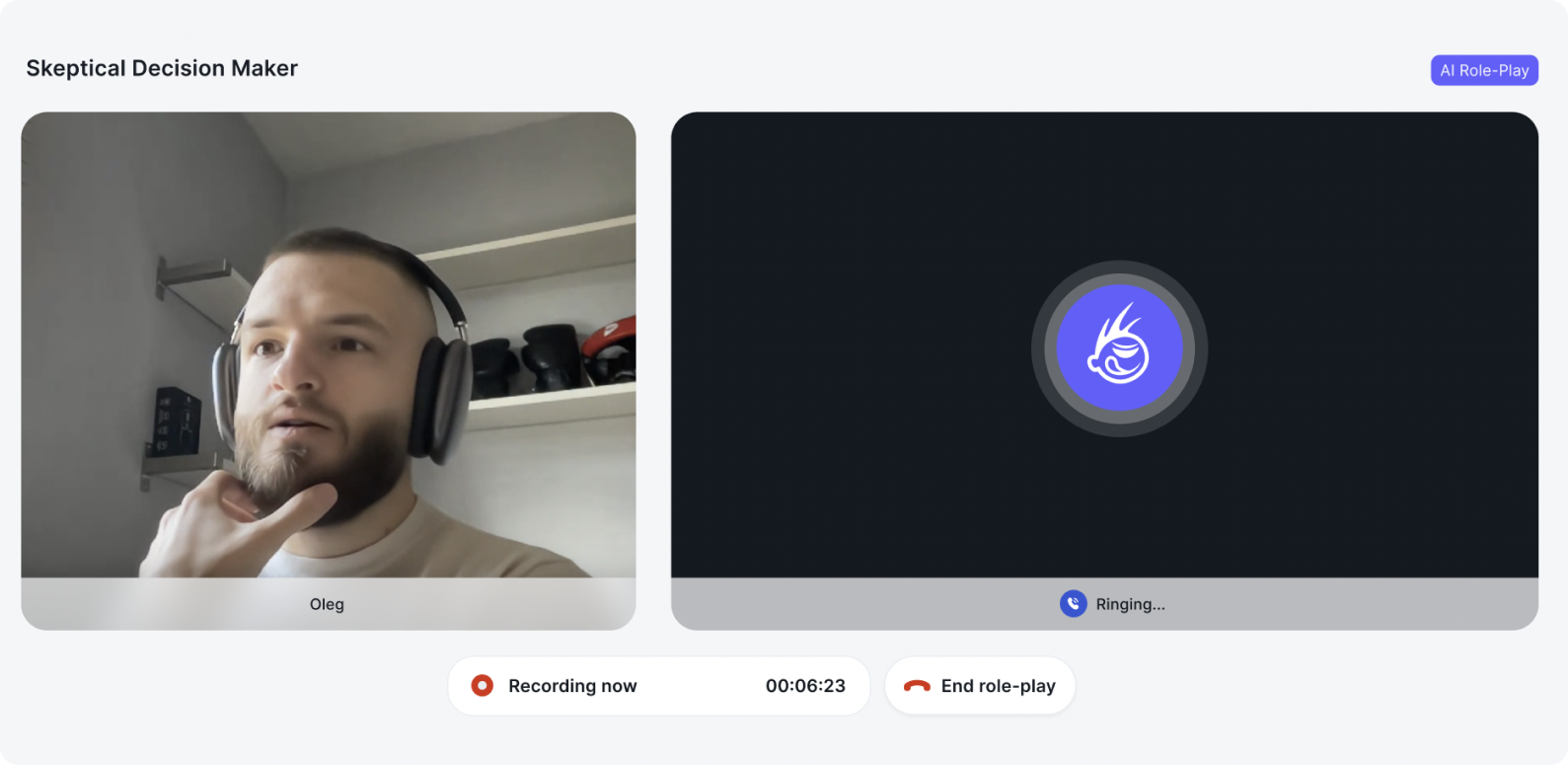
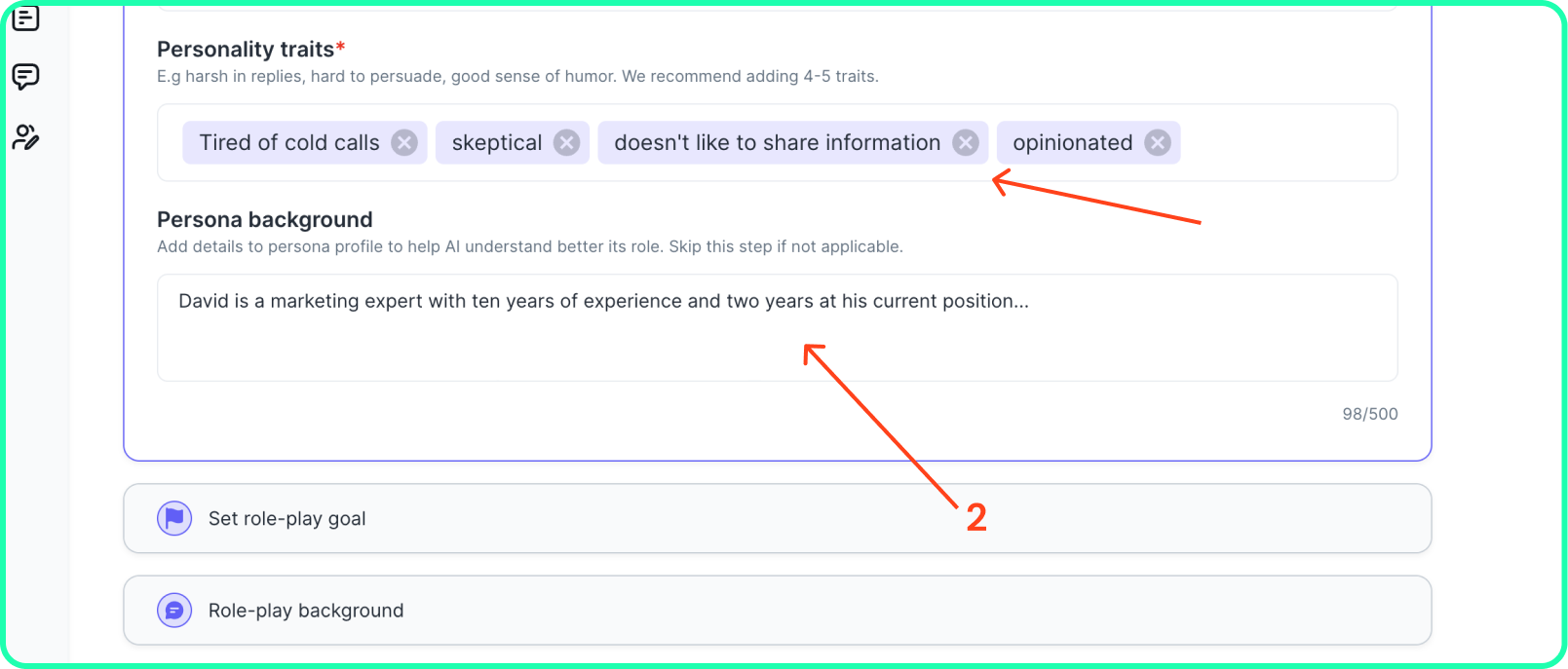
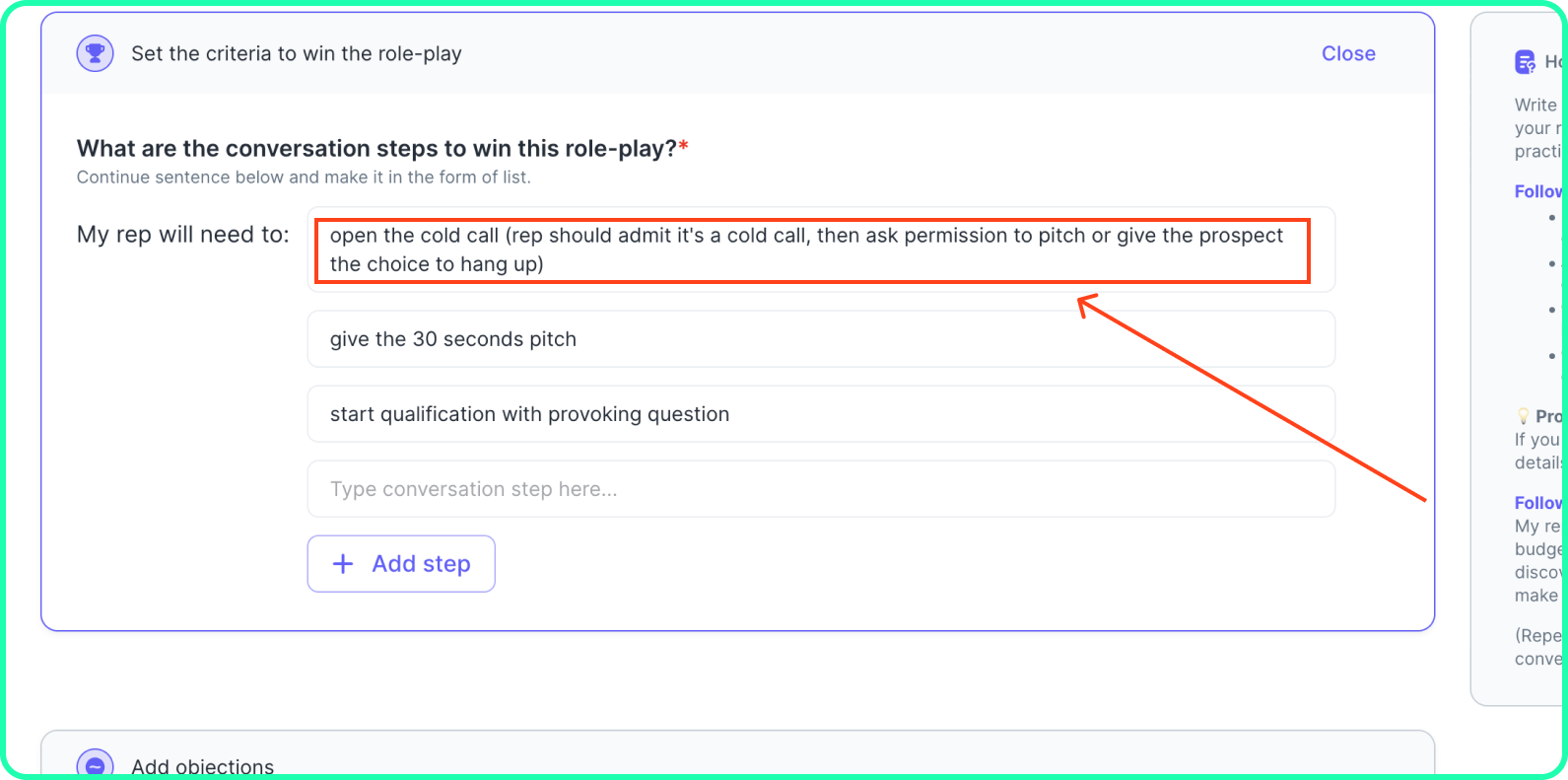
Scenario setup is where the platform earns its keep. You define the buyer persona, the company context, the traits (sceptical, distracted, opinionated), and then write the win criteria: the specific things a rep has to do to pass. That is the custom scorecard. It is not a fixed taxonomy that you fit your methodology into. If your team runs MEDDPICC, the scorecard is MEDDPICC. If it runs a 4-step discovery framework your enablement lead wrote last quarter, the scorecard is that.
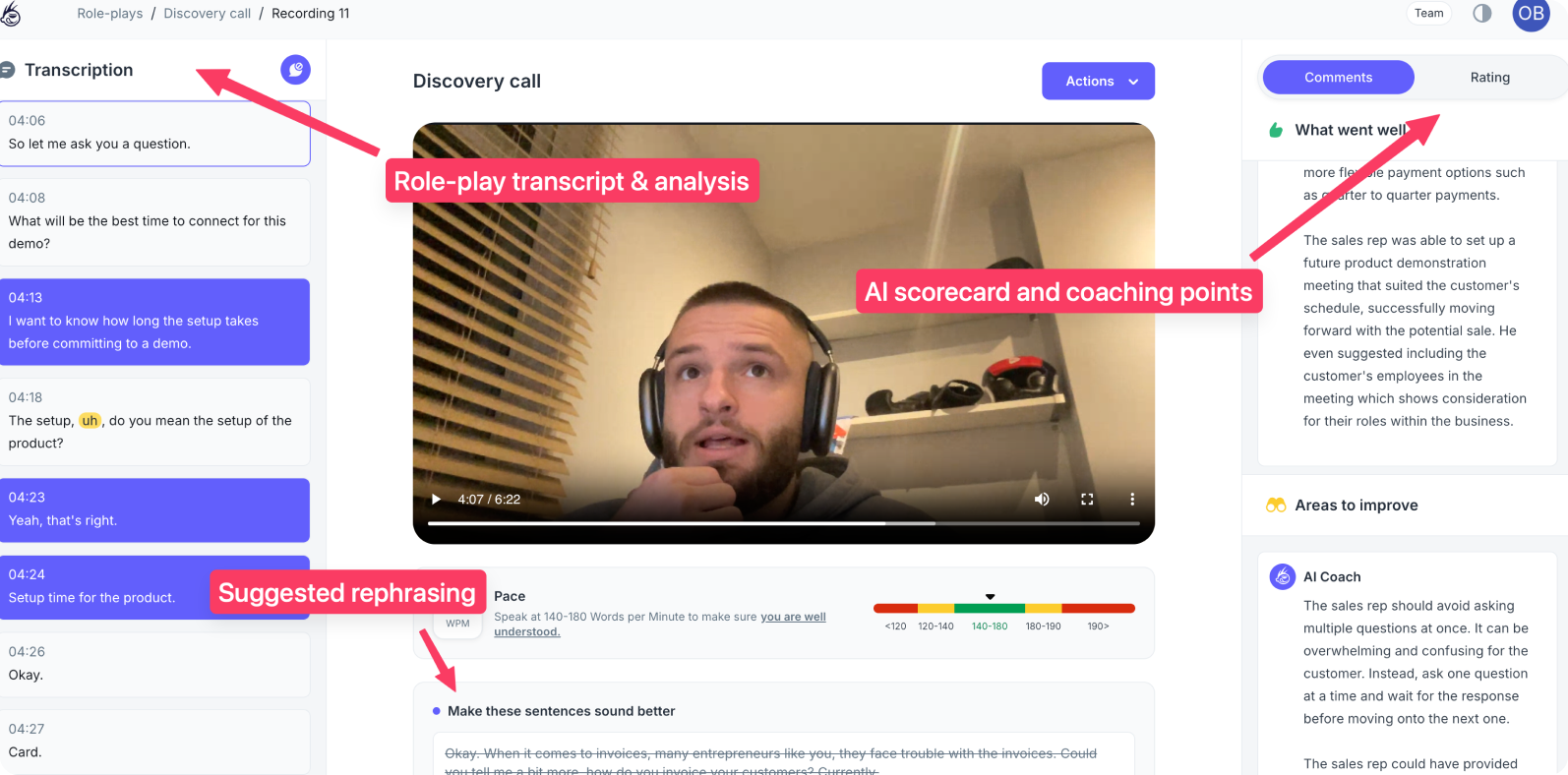
After the session, the AI Coach takes over. It is Socratic rather than prescriptive: it asks the rep what they were trying to do at the moment the deal wobbled, then works through the alternative. It runs 24/7, it is personalised to the rep's own transcript, and it is the piece managers do not have time to do 40 times a week. PitchMonster also analyses real recorded calls, so the same scorecard covers practice and the live pipeline. Full detail sits on the AI sales role-play training and AI sales coaching software pages.
Assessment or practice: which problem are you solving?
This is the reframe that makes the choice easy, and it is the reason a straight "retorio vs" feature war misleads people.
Assessment answers "how good is this rep, on a consistent scale, across the whole org." Practice answers "can this rep get through the SVP-of-Finance pricing objection without conceding 15%." They are different jobs. Assessment produces a comparable number. Practice produces reps.
Both platforms do some of both. The difference is which one is the centre of gravity, and therefore which one the product is designed around.
Table A: what each platform is
Retorio |  PitchMonster PitchMonster | |
|---|---|---|
Origin | TUM spin-out, founded 2018, Munich | European, purpose-built for sales practice |
Core method | Multimodal behavioural scoring of video and voice | Live adaptive conversation with an AI buyer |
Primary job | Measure behaviour consistently at scale | Build reps through repetition against your criteria |
Scoring basis | Retorio's own dimensions under a Warmth and Competence model | Custom scorecards you write per scenario |
Session formats | Simulated video or phone call | Cold call, discovery/demo, screen-share and presentation |
Post-session coaching | Guided AI feedback against the dimensions | Socratic AI Coach, personalised, 24/7 |
Who typically buys it | Enterprise L&D and behavioural coaching programmes | Enablement, sales leadership, RevOps |
Published languages | 12 named on the homepage | 29 |
How the two platforms compare feature by feature
Table B: assessment vs practice capability grid
Capability | Retorio | PitchMonster |
|---|---|---|
Live two-way voice role-play | Yes, simulated video or phone calls | Yes, across 3 practice modes |
Adaptive objections that change with what the rep says | Not described on the product page | Yes, the buyer reacts and shifts position |
Custom scorecards written by you | Not described; scoring runs on Retorio's dimensions | Yes, win criteria defined per scenario |
Post-session AI coaching | Guided AI feedback | AI Coach, Socratic, 24/7, personalised |
Non-verbal and video scoring | Yes, a core capability | No, PitchMonster scores the conversation |
Screen-share / presentation practice | Not described on the product page | Yes |
Real call analysis on the same scorecard | Not described on the product page | Yes |
Manager analytics and cohort comparison | Yes | Yes |
Persona generation | Yes, persona generator | Yes, deep scenario setup |
CRM / LMS integration | Yes, listed as add-ons | Yes |
Hiring and candidate assessment | Historic product line; not marketed on the current sales pages | No, and never will be |
Four rows in that grid decide most deals.
Adaptive objections come first. Retorio's product page describes simulated calls with AI personas and analysis afterwards. It does not describe a buyer whose position moves in response to what the rep says. That distinction separates a scripted drill from a conversation, and it is the reason a rep's third attempt at the same scenario is harder than their first.
Custom scorecards come second. Retorio scores against its own dimensions, which are well constructed, but they are Retorio's. Say your enablement team has spent 2 years building a discovery framework and certifying against it. You either translate that framework into Retorio's language or you accept a second, parallel scale. PitchMonster inverts that: the scorecard is your framework, which is what makes sales rep certification defensible internally.
Non-verbal scoring is the clearest place where Retorio does something PitchMonster does not. If your programme's thesis is that presence, gesture and vocal delivery drive outcomes, Retorio measures those and we do not. Be honest about whether that thesis holds for your motion. For phone-led inside sales it usually does not. For pharma detailing or an in-person automotive handover it might.
Screen-share practice is the fourth. For consultancies, agencies and any team that pitches on a deck, the deal is won while a screen is shared. Practising that delivery is a different exercise from practising a cold call, which is why sales trainers and agencies tend to start there.
How each one scores a conversation
Retorio publishes its taxonomy openly, which is more than most vendors in this category do. The dimensions listed on the homepage are:
- Applied Knowledge
- Active Listening (Attention & Focus and Verbal Mirroring)
- Empathy (including Empathetic Response Generation)
- Confidence (hedging language, filler words, presence)
- Persona-Oriented Communication (lexical sophistication, syntactic complexity, conceptual abstraction, information density)
Those roll up to the Warmth and Competence model.
That is a serious, research-grounded rubric. It is also fixed. Two reps in different segments get scored on the same axes, which is exactly what you want if the point is comparability. It is exactly what you do not want if the point is "did this rep run our qualification framework."
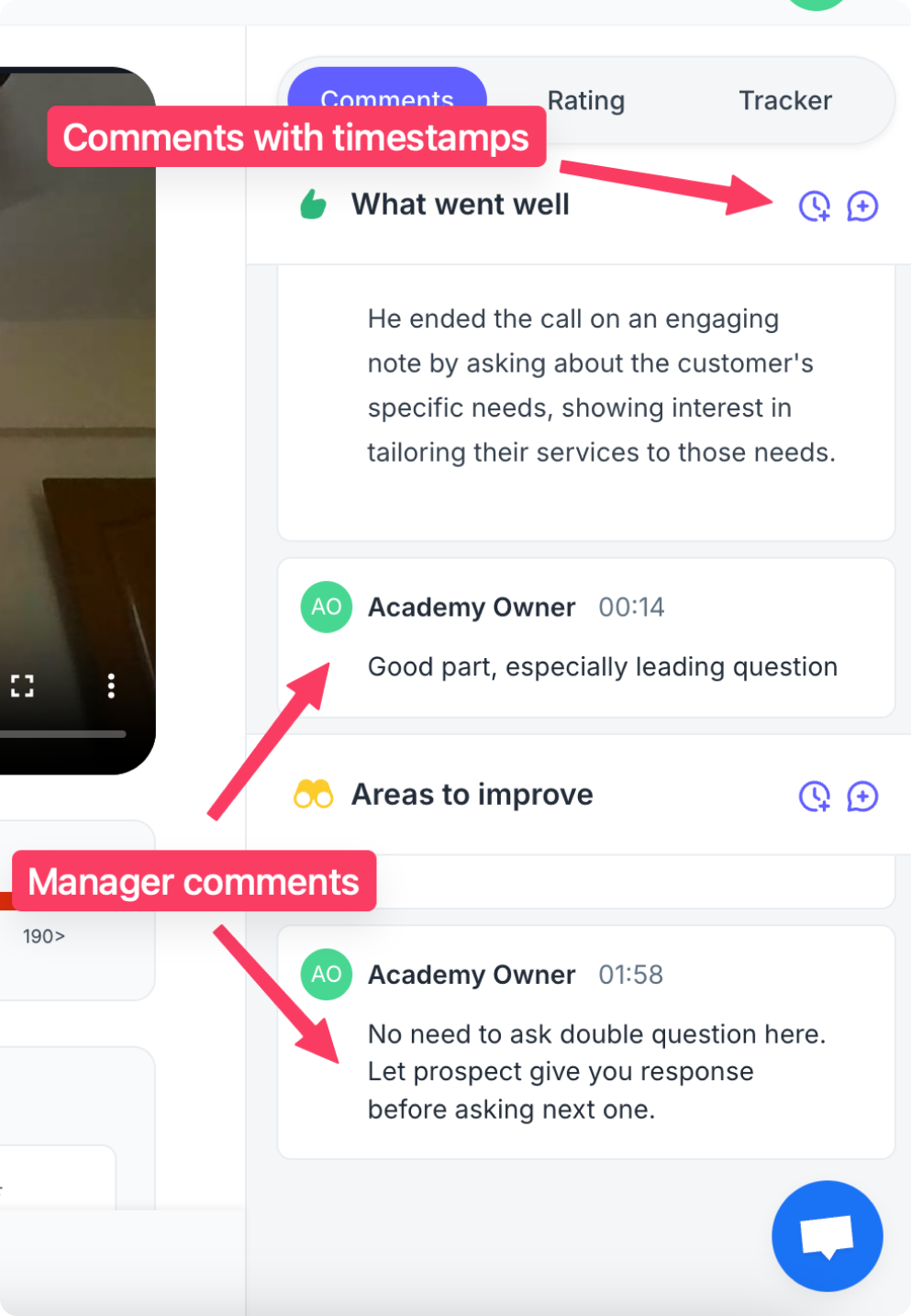
PitchMonster scores what you tell it to score. A scenario carries its win criteria as a list of conversation steps. The review afterwards shows a timestamped transcript, pace, and the AI Coach's read on the specific moments where the rep helped or hurt themselves.
Ask both vendors to show you a real scored session on your own scenario during the trial, not a demo recording. Scoring output is the product. Nobody in this category shows enough of it.
What European buyers should ask about data and the EU AI Act
This is the section where "ai sales coaching europe" stops being a phrase and starts being a procurement problem. The good news for European buyers is that both vendors here are European and both publish an EU posture, which is not true of most of the category.
Retorio's ethical data page states several things about how it handles client data.
- It hosts client data exclusively on ISO-certified servers within the European Union.
- Data is anonymised and encrypted.
- Person-related data is optional, and the platform can run with full anonymisation via token login.
- Penetration tests are performed quarterly.
- Its data protection officer is external.
- Subprocessor data is automatically deleted after sessions.
The homepage adds that Google Cloud Platform is the primary host, with Microsoft Azure used for the OpenAI integration, both in EU data centres. Retorio also states it does not train its models on client data.
On the EU AI Act page, Retorio addresses emotion inference directly.
"The underlying AI does not recognize emotions, and does not try to do so. The AI only checks facial expressions, such as a smile."
The page lists what it observes and excludes.
- Observed: smiling, seriousness, friendliness toward the simulated customer, hand, arm and head movement, voice characteristics.
- Excluded: skin colour, gender, age, dialect, background, hair colour.
It states the platform performs no biometric analysis and is not designed to identify an individual. The ethical data page adds that models were debiased and tested on global datasets including UCLA's FairFace.
Take that at face value. It is a more detailed public answer than almost any competitor publishes. The remaining work is yours. The EU AI Act's restrictions on emotion inference in the workplace turn on how a system is used, not only on how a vendor describes it. A works council will want the answer in writing rather than on a marketing page.
Table C: European buyer posture
Question | Retorio | PitchMonster |
|---|---|---|
Hosting region | EU only, stated on the ethical data page (GCP primary, Azure for the OpenAI integration) | EU, European company |
Certifications published | ISO 27001, GDPR compliance stated | Request the current security documentation during evaluation |
Trains models on your data | Stated as no | No |
Video and facial signals processed | Yes, facial expression and movement are scored inputs | No video scoring, so no facial data to process |
Emotion inference exposure | Retorio states it does not recognise emotions or psychological states | Not applicable, the conversation is what is scored |
Anonymisation option | Person-related data optional, token login supported | Discuss during evaluation |
Penetration testing cadence | Quarterly, per the AI Act page | Ask for current cadence in writing |
Support timezone | Munich HQ, European hours | European hours |
One structural point decides some deals on its own. A platform that scores facial expression has to process facial data. A platform that scores the conversation does not. That is not a compliance verdict on Retorio, whose published position is clear. It is a smaller surface area to explain to a German or French works council. And if you have ever sat through that meeting, you know what the difference is worth.
The 5 questions to put to any vendor scoring video, including us.
- Which signals are inferred, named individually, not as "multimodal analysis"?
- Is inference of emotional or psychological state switchable off, and is that documented contractually?
- Where do the models run, and which subprocessors touch the recording?
- What is retained, for how long, and who can delete it?
- What documentation exists for a works council or a DPIA, and can I see it before signature?
What languages and regions does each cover?
Retorio's homepage states the platform "currently supports" 12 languages: English, German, French, Spanish, Portuguese, Italian, Dutch, Bulgarian, Greek, Russian, Korean and Turkish. Additional languages and auto-translation appear in the pricing FAQ as paid add-ons rather than as included capability. That is worth confirming in writing if you are rolling out across markets.
PitchMonster runs in 29 languages, included. For a European enablement team, the practical test is not the headline count but whether the languages your actual sellers work in are covered without a change order. Nordics, CEE and the Baltics are where most platforms in this category thin out.
Nobody else on this search result page answers the language question with a list. Ask both vendors for one.
What does Retorio cost, and what should you budget?
Retorio does not publish figures. There is no pricing page at retorio.com/pricing; the URL returns 404. What exists is a homepage FAQ answer on how Retorio is priced, and it is unusually detailed about structure while containing zero numbers.
What that FAQ does state, verbatim in substance:
- A subscription model with annual base fees and tiered licensing.
- Packages covering an entry-level option for SMBs, a contact-centre-specific option and enterprise tiers for multi-market deployments.
- Licences whose per-user cost decreases across nine pricing tiers as volume grows.
- "Licenses can be passed on from user to user once the active period expires."
- Add-ons for additional accounts, languages, auto-translation, SSO and CRM/LMS integrations.
- "Enterprise contracts run for 36 months with annual payment in advance and a 60-day cancellation notice period."
Read that last clause twice. A 36-month term with the year paid in advance and a 60-day notice window is a real commitment. It is the single most consequential fact published about Retorio's commercial model. It may be entirely reasonable for a 5,000-seat enterprise rollout. It is a different conversation for a 60-rep team that wants to see whether practice sticks.
PitchMonster pricing is quote-based and we do not publish per-seat figures. That is a deliberate choice, not a coyness tactic: what a team pays depends on seats, languages and whether call analysis is in scope. A headline number that ignores those is a number you have to renegotiate. The pricing page explains the model and a demo gets you a written quote.
Table D: commercial shape
Retorio | PitchMonster | |
|---|---|---|
Published figures | None on the site as of 25 August 2026 | None, quote-based |
Unit of charge | Licences, tiered across 9 tiers by volume | Discussed per rollout |
Licence reuse | Transferable between users after the active period expires | Discuss in evaluation |
Named add-ons | Extra accounts, languages, auto-translation, SSO, CRM/LMS integrations | Discussed per rollout |
Minimum term stated publicly | 36 months for enterprise contracts | No published minimum |
Payment timing stated publicly | Annual, in advance | Discussed per rollout |
Cancellation notice stated publicly | 60 days | Discussed per rollout |
Whatever you shortlist, get 4 things in writing before signature:
- The tier table with the breakpoints named.
- Which of your languages are included versus billed as add-ons.
- The exact minimum term.
- What happens to unused licences at renewal.
That list is worth more to your finance business partner than any published list price.
What results has each platform published?
"Retorio reviews" is an evidence query. People typing it want to know whether the outcomes are real. Here is the honest state of the record on both sides.
Retorio publishes result cards on its homepage and attaches customer names to several of them, including Nürnberger Versicherung, Vodafone VOIS and Daimler Truck. That is more attribution than most vendors in this category manage. What the cards do not carry is a date, a sample size, a measurement window or a statement of what was measured against what. A turnover reduction and a euro saving are strong claims. Without a baseline and a period, they are vendor claims rather than evidence, and they should be treated that way in an evaluation. Retorio's own best AI coaching platform post repeats several performance percentages with the same gap, and names no competitor while answering the FAQ "How does Retorio compare to other AI coaching platforms?" with Retorio features only.
Our own record, with the measurement basis stated:
- PRN Health Services (US healthcare staffing): 22.37% higher scores on actual calls over a 60-day measurement window, plus a 14% increase in interviews conducted and a 9% increase in talk time. The champion was Mandy Nycz, then Director of Learning & Development. The scores are from real calls, not simulated sessions. Read the case.
- Mentor Group (UK sales performance consultancy, clients including Lenovo, Infor and Syngenta): 50% average faster ramp-up and a 2X reduction in coaching time per rep. Read the case.
- Immersive Labs, delivered through Mentor Group: onboarding cut from 10 weeks to 6, a 40% reduction, across 5 regions.
- Syngenta, also through Mentor Group: 27% improvement in message delivery accuracy and 90% of participants reporting increased confidence, within 3 weeks.
- SThree (FTSE STEM staffing, around 2,700 people across 11 countries): 2x less coaching time per rep. Champion: Stefano Bianchini, Senior Curriculum Lead. Read the case.
- JustSchool (phone-led sales): +8.3% new-hire conversion from lead to payment, around 8% uplift for experienced sellers, and 5+ hours per week saved per sales leader. Champion: Vlad Belozercev. Read the case.
Do not take either set on trust. Ask both vendors for a reference call with a customer in your industry and at your headcount. Then ask that customer one question: what did you measure before, and what did you measure after? The vendors who can answer it quickly are the ones whose numbers survive contact with your CFO. More of ours sit on the customer cases page.
Who Retorio is genuinely better for
There are teams that should buy Retorio, and pretending otherwise would waste your time.
Pick Retorio if your programme's core thesis is behavioural: you believe presence, delivery and non-verbal signal drive your outcomes, and you want those measured rather than discussed. Retorio is one of very few platforms that scores them at all, and it does so against a published, research-grounded model rather than an opaque black box.
Pick Retorio if you need one comparable scale across a very large, multi-market organisation. A fixed taxonomy is a feature when the goal is comparability across 5,000 people in 12 countries. Retorio's enterprise reporting is built for exactly that shape of rollout.
Pick Retorio if your customer conversations are face to face. Pharma detailing, automotive retail, in-branch insurance and field service are all motions where how someone shows up in the room is not a soft factor. Retorio names those industries directly.
Pick Retorio if you are already committed to a behavioural rubric and want a vendor whose model is the rubric. You do not want a platform you have to configure into one.
Who PitchMonster is better for
Pick PitchMonster if the problem is reps who need reps. Volume of live, adaptive practice against a buyer who fights back is the thing that changes call performance, and it is what the platform is built to produce.
Pick it if you have your own methodology and want the scorecard to be that methodology, not a translation of it. Enablement teams running MEDDPICC, Challenger, SPIN or something they wrote in-house get scored on their own language from day one.
Pick it if coaching capacity is the bottleneck. Managers cannot review 40 sessions a week. The AI Coach does the post-session conversation for every rep, every time, at whatever hour they practise. That is the mechanism behind the coaching-time reductions at Mentor Group and SThree.
Pick it if you are ramping people fast, or if you sell on a shared screen. Sales onboarding, team upskilling and staffing agency sales training are the three motions where the ramp numbers above came from.
And pick it if the European question matters. PitchMonster is the only European-based platform in the category's top 5. That shows up as GDPR posture, an EU timezone for support, and buyer personas that understand a German procurement cycle.
How should you run the evaluation?
Two worked examples, both real shapes of deal.
Example 1: 40 reps, 3 countries, objection handling
An enablement lead needs the team through a new pricing objection before the quarter turns. On PitchMonster, they build one scenario. The buyer is a sceptical CFO and the context is a renewal at a 12% uplift. The win criteria are the 5 things a rep must do before conceding anything. They publish it in English, German and French. Reps practise on their own time; the buyer pushes differently each run.
The AI Coach debriefs each attempt. On Monday the lead opens the dashboard and sees which of the 5 criteria the team misses most. The lead then coaches that one thing in the team meeting instead of guessing. Time from decision to first rep session: hours.
On Retorio, the same lead uses the session generator and persona generator to create the simulation. Reps run video or phone sessions. The platform returns behavioural feedback against Retorio's dimensions plus cohort analytics. The feedback tells them whether reps came across as warm and competent while handling it. What it will not tell them, unless they map it themselves, is whether reps hit their own 5 criteria. Confirm the languages are in the licence rather than an add-on before committing.
Example 2: 200 field reps, behavioural programme, in-person motion
A pharma or automotive L&D team already runs a behavioural competency framework and needs a consistent, comparable score across markets for people who sell face to face. Presence and delivery are in scope because the conversations happen in a room. This is Retorio's deal, and we would tell you so on the call. The fixed taxonomy is the point, and the multimodal scoring measures what the programme is about. The EU hosting posture and 36-month enterprise shape fit an organisation planning at that horizon. Ask about the tier breakpoints and the works-council documentation early, because those are the two things that slow this deal down.
The evaluation checklist
Run this against every vendor on your shortlist, including us.
- Show me a scored session on my scenario, not a demo recording.
- Can I write the scorecard, or do I score against your model?
- Does the AI buyer change position based on what the rep says? Show me two runs of the same scenario.
- Which of my languages are included, and which are add-ons?
- What is the minimum term, the payment timing and the cancellation notice?
- Give me the tier table with breakpoints, in writing.
- Which signals do you infer, named individually?
- Where does the data live, which subprocessors touch it, what is retained, and for how long?
- What documentation do you provide for a works council or DPIA?
- Give me a reference customer in my industry who can state what they measured before and after.
If you want a broader shortlist first, our comparison of the top tools for sales role-plays covers the rest of the field. The role-play scenario library gives you scenarios to test any of them with.
Frequently asked questions
Is Retorio a sales tool or a recruiting tool?
Today it is marketed as a sales, service and leadership coaching platform, and that is what its product pages describe. Historically it also sold AI video interview assessment to recruiters, which MIT Technology Review reported on in 2021. If you land on retorio.com from a talent acquisition search and from an enablement search, you are looking at the same behavioural engine pointed at two different jobs.
Does Retorio publish prices?
No. There is no pricing page and the homepage FAQ on pricing contains no figures. It does publish the commercial structure: nine pricing tiers, add-ons for languages, auto-translation, SSO and integrations, 36-month enterprise contracts, annual payment in advance and 60 days' cancellation notice. Ask for the tier table in writing.
Is Retorio's video and non-verbal scoring optional?
Retorio's product is built around multimodal analysis, and its AI Act page states the platform checks facial expressions such as a smile while not recognising emotions or psychological states. Whether the video component can be switched off for a given deployment is a question for their team, and it is one to ask before a works council does.
Where is data hosted for each platform?
Retorio states it hosts and processes exclusively in the EU, on Google Cloud Platform with Microsoft Azure used for the OpenAI integration. It also states that it does not train models on client data. PitchMonster is a European company hosting in the EU. Get the current sub-processor list from both.
What is the minimum contract?
Retorio publishes 36 months for enterprise contracts with annual payment in advance. PitchMonster does not publish a minimum term; terms are set per quote.
What are the alternatives besides these two?
The category's top 5 includes Hyperbound, Second Nature, FullyRamped and Yoodli alongside PitchMonster, with Retorio sitting slightly apart because of its behavioural-measurement origin. If you are building a shortlist rather than choosing between two, start with the role-play platform overview and the tools comparison.
Which one should a European team pick?
If you are measuring behaviour across a large face-to-face organisation, look hard at Retorio. If you are trying to get reps talking, against your own scorecard, in your own languages, with coaching after every session, that is PitchMonster. Book a demo and run your own scenario in the trial. The scorecard question usually settles it within 20 minutes.