The Sandler sales methodology is a seven-step consultative selling framework developed by David H. Sandler in the 1960s. The seller qualifies pain, budget, and the decision process before presenting anything, and either side can walk away early. It flips the traditional pitch: the buyer sells you on why they need to change, not the other way around.
David H. Sandler developed the seven-step system in the 1960s, and it is taught today by Sandler Systems, LLC, which holds the Sandler marks and runs the certification programs. This guide covers the seven steps in order, the behavior a manager can hear on a call, and a seven-row scorecard. It also covers three drills that build the reflex, and how Sandler compares to MEDDPICC, BANT, SPIN, and the Challenger Sale.
A note before you read further: this article explains a publicly documented sales methodology. PitchMonster is not affiliated with, endorsed by, certified by, or licensed by Sandler Systems, LLC, and nothing here should be read as Sandler training or certification. If you want the official program, go directly to the trademark holder.
What is the Sandler sales methodology?
Most sales training assumes the seller has to convince the buyer. Sandler starts from a different premise: the buyer has to convince the seller that the deal is worth pursuing, before the seller shows a single feature.
David H. Sandler developed the system while running his own sales training practice in the 1960s, and it broke from a decade of pitch-first selling. Instead of building rapport, presenting a solution, and closing hard, a rep working the Sandler system moves through pain, budget, and decision authority up front. The rep also keeps the right to walk away from a deal that does not qualify, the same right the buyer has.
That inversion is the whole idea. A traditional pitch puts the seller in the position of chasing the buyer's approval. Sandler puts the buyer in the position of justifying why they need to change anything at all. That produces a shorter list of deals and a far more honest one.
Why the steps run in sequence
The seven steps are not a menu. Sandler describes them as a series of sealed compartments, so a gap left open in step two does not just sit there, it leaks into every step that follows.
Skip the up-front contract and a rep has no standing to end the call when the buyer stalls. Skip the pain conversation and the budget conversation has nothing to anchor to, because nobody has said out loud what the problem is costing. Skip the decision step and the rep ends up presenting to someone who was never going to sign. Each step depends on the one before it holding.
That is also why a rep who has memorized all seven names can still fail badly on a call. Reciting the steps in order is not the same as closing each compartment before opening the next one. The tell is usually the same: a rep already talking about the product while pain and budget are still vague.
The 7 steps of the Sandler selling system
Below is the sequence in the order Sandler runs it, worded in our own language rather than lifted from any training manual. Read the table first for the shape. Then each step gets its own breakdown: what the rep is doing, the behavior a manager can hear on a recording, and the tell that the step got skipped.
# | Step | One-line definition | Observable behavior | The tell when it is missing |
|---|---|---|---|---|
1 | Bonding and Rapport | The rep earns a real, adult-to-adult conversation before anything else happens | Rep matches the buyer's pace and tone instead of running a script | Buyer stays clipped and formal three minutes in, answering in fragments |
2 | Up-Front Contract | Both sides agree on the agenda, the time, and what happens at the end, including that either can say no | Rep states the agenda out loud and asks the buyer to agree to it, no included | Call just starts, there is no agreed ending, and it drifts |
3 | Pain | The rep uncovers what the problem costs, past the first tidy answer | Rep asks a second and third question after the buyer's first answer instead of moving on | Rep accepts the first surface complaint and starts talking about the product |
4 | Budget | The rep confirms money exists or can be found, without asking for a number the buyer will guess defensively | Rep asks what the problem currently costs, not what has been allocated | Rep asks "what's your budget" and takes a vague answer as a yes |
5 | Decision | The rep maps who signs, who can block, and the real approval sequence | Rep asks the buyer to name every person and step between today and a signature | Rep assumes the person on the call can sign, and finds out otherwise later |
6 | Fulfillment | The rep presents the solution only after pain, budget, and decision are confirmed, tied back to what the buyer said | Rep references the buyer's own words from earlier steps while presenting | Demo starts in the first ten minutes, before pain or budget came up |
7 | Post-Sell | The rep surfaces buyer's remorse in the room, before it can grow in private | Rep asks the buyer directly what might make them change their mind later, right after the yes | Rep says thank you and hangs up, and the deal unravels in a follow-up email |
Every step above earns a scored behavior later in this guide, not just a definition. That is the part most explanations of Sandler skip.
1. Bonding and Rapport
This step is not small talk. It is establishing that the conversation is between two adults who can each say no, which changes how honestly the buyer answers everything that follows.
A rep doing this well drops the opening script and responds to what the buyer says, including a tangent. The buyer relaxes into full sentences instead of one-word answers. When this step is skipped or rushed, the whole call runs at arm's length. The buyer gives the rep the version of the truth meant for a salesperson rather than the real one.
2. Up-Front Contract
The rep and buyer agree, out loud, on the agenda, the time box, and what a good ending looks like, including an honest no. A full breakdown of what this sounds like, with weak and strong examples, follows in the next major section.
The behavior a manager listens for is simple: did the rep name an ending before the call started, one that includes "we agree this is not a fit"? Reps who skip this step are the ones who cannot end a stalled call cleanly, because they never earned the standing to.
3. Pain
Pain is not the buyer's first complaint. It is the third or fourth question deep, past the answer that costs the buyer nothing to give. A rep who stops at "onboarding is slow" has a comment, not pain.
The observable behavior is persistence without interrogation: a second question that builds on the first answer rather than restarting the topic. A full three-layer breakdown of how to get there is in the pain funnel section below.
4. Budget
Budget is not a number the buyer volunteers on request. It is evidence that the cost of the problem is large enough to fund fixing it.
One original exchange shows the shape of it:
Rep: What does the current process cost you, in hours or in deals that stalled?
Buyer: Honestly, we've never put a number on it.
Rep: If you had to guess, is it closer to one lost deal a quarter, or one a month?
Buyer: Closer to one a month, if I'm honest.
Rep: That's worth funding then. Who would that budget come from?
Nobody asked "what's your budget." The rep surfaced a range from the cost of the problem instead, which is the behavior that separates this step from the version most reps default to.
5. Decision
Decision is the step where a rep finds out whether the person on the call can sign, and if not, who can. Five questions build the map without sounding like an interrogation:
- "Walk me through every step between today and a signature."
- "Who has to sign off, and has anyone already said no to something like this?"
- "Is there a date this needs to be solved by, or could it slip to next year?"
- "Who could stop this even if everyone else says yes?"
- "If nothing changes, what happens to the plan you had for this?"
The tell that this step got skipped shows up late: a verbal yes from a contact who was never the signer. A new stakeholder then appears in week six with a fresh set of objections.
6. Fulfillment
Fulfillment is the presentation, and it comes sixth on purpose. A rep who has genuinely closed the first five compartments does not pitch generically here, they reference the buyer's own numbers and words from the pain and budget conversations.
The behavior a manager listens for is specific: does the rep say something like "you mentioned this was costing you a lost deal a month, here's how that changes"? That is different from running the same demo script for every buyer. A demo that could have been given without the earlier steps is a sign fulfillment happened too early.
7. Post-Sell
Post-sell is the step most guides leave out entirely, and it is the one that prevents a signed deal from quietly falling apart. The rep asks, directly, what might cause the buyer to have second thoughts.
Rep: Now that we've agreed, what could come up in the next two weeks that might make you second-guess this?
That question does something a thank-you email cannot: it surfaces buyer's remorse while the rep is still in the room to address it. Otherwise, the rep finds out three weeks later that legal raised a concern nobody addressed.
The Sandler pain funnel, in three layers
Sandler's own writing describes pain as something to be layered, moving from a surface answer down to what the problem costs the person on the call. The three-layer version below is our own language, written to illustrate the concept for a mid-market SaaS deal. It is not Sandler's published question sequence, and it should not be treated as one.
The first layer almost always comes free. The second requires a follow-up the buyer has not thought through yet. The third is where most reps stop asking, because it starts to feel personal rather than operational, which is exactly why it is the layer that produces urgency.
Layer | What you're listening for | Example question |
|---|---|---|
Surface complaint | The first, safe answer that costs the buyer nothing to give | "What's not working well with how you onboard reps today?" |
Business impact | A number, even a rough one, attached to the complaint | "What does that slowdown cost you in ramp time?" |
Personal consequence | What the delay costs the person on the call, not just the business | "What happens to your plan for this year if that doesn't improve?" |
A working thread through all three layers, on the same topic: "Where does the current process slow you down?" leads to "How many deals do you think stalled because a rep wasn't ready?" That question leads to a third: "Who notices when a rep ramps slow, and what do they say to you?" Three questions, each one a layer deeper, and no script was read.
What a strong up-front contract sounds like
The up-front contract fails most often for a specific reason: reps state the time box and skip everything else, so the "contract" part never actually happens.
Six paired lines show the gap between a scheduling question and an actual agreement.
Weak | Strong |
|---|---|
"Does 30 minutes work?" | "Let's take 30 minutes. I'll ask about where things stand today, you can ask me anything about how we work, and at the end we'll both know whether this is worth a next step. Does that work?" |
"I just want to learn more about your team." | "I'm here to find out whether this is worth your time. If the answer is no, I'd rather we both know inside 30 minutes than after three meetings." |
"Feel free to stop me if you have questions." | "You should feel free to say no at any point, including right now if this already sounds like the wrong fit." |
"So what happens next?" | "At the end of this call, there are two outcomes: we agree there's enough here to keep going, or we agree there isn't. Either one is a good use of 30 minutes." |
"This should only take a few minutes." | "Let's agree on 30 minutes on the clock. If we need more time, we'll both say so out loud rather than letting it run long." |
"I'll follow up after this." | "If we decide this is worth continuing, what should happen next, and who else needs to be part of that conversation?" |
The pattern across all six: the strong version names the agenda and states the rep's actual goal. It also gives the buyer explicit permission to say no, and describes both possible endings before the call has started. None of it is a trick. It is just stated instead of assumed.
Sandler compared to MEDDPICC, BANT, SPIN, and Challenger
These frameworks get compared as if a team should pick one. They mostly answer different questions and stack rather than compete.
Framework | What it qualifies | Best-fit motion | Where it breaks | Guide |
|---|---|---|---|---|
Sandler | Pain, budget, decision authority, and the right to walk away, before a pitch happens | Consultative sales with a skeptical or previously burned buyer | Long enterprise cycles with many stakeholders, where one framework does not cover the paper process | this guide |
MEDDPICC | An 8-part evidence checklist for a complex deal, including procurement and competition | Enterprise deals with several stakeholders and a security review | Short transactional sales, where 8 categories is overhead | |
BANT | Budget, authority, need, and timeline, fast | Inbound triage, SDR qualification | Committee purchases with no single signer | |
SPIN | The questions inside one conversation, not the whole deal | Discovery calls where the buyer has not named the cost of the problem | Says nothing about who signs or when, so it needs a qualification layer around it | |
Challenger | Nothing directly, it is a behavior model for displacing a comfortable status quo | Complex sales where the buyer already has an incumbent or a "do nothing" default | A rep with a thin insight sounds pushy rather than credible |
The comparison people search for most is Sandler sales methodology vs MEDDIC. They are not rivals. Sandler governs how the rep behaves in the conversation itself, while MEDDIC, or its extended MEDDPICC form, scores whether the resulting deal has enough evidence to forecast. A rep can run a textbook Sandler call and still leave a MEDDPICC scorecard full of blanks if nobody wrote down what they learned. The two work best paired, Sandler for the conversation and MEDDPICC for the paper trail it produces.
Why Sandler rollouts fade after the workshop
The failure mode is worth stating plainly: a rep can learn the names of all seven steps in a workshop. The rep can still return to pitching under quota pressure when the behaviors are not reinforced.
The mechanism is straightforward. A workshop teaches recall, not behavior, and nobody is scoring whether the up-front contract got set on a live call. Managers cannot listen to every conversation their team has. So the gap between "the rep can name all seven steps" and "the rep opened the last ten calls with a real contract" stays invisible. It surfaces only once a deal stalls for reasons nobody can explain from the CRM.
This is a practice gap, not a knowledge gap. Asking a buyer to name every step between today and a signature is a skill with a physical component: tone, timing, and staying quiet after the question lands. A workshop installs the words. It does not install the reflex, and neither does a certificate.
How to score a Sandler conversation
A scorecard turns "the call felt good" into something a manager can coach against.
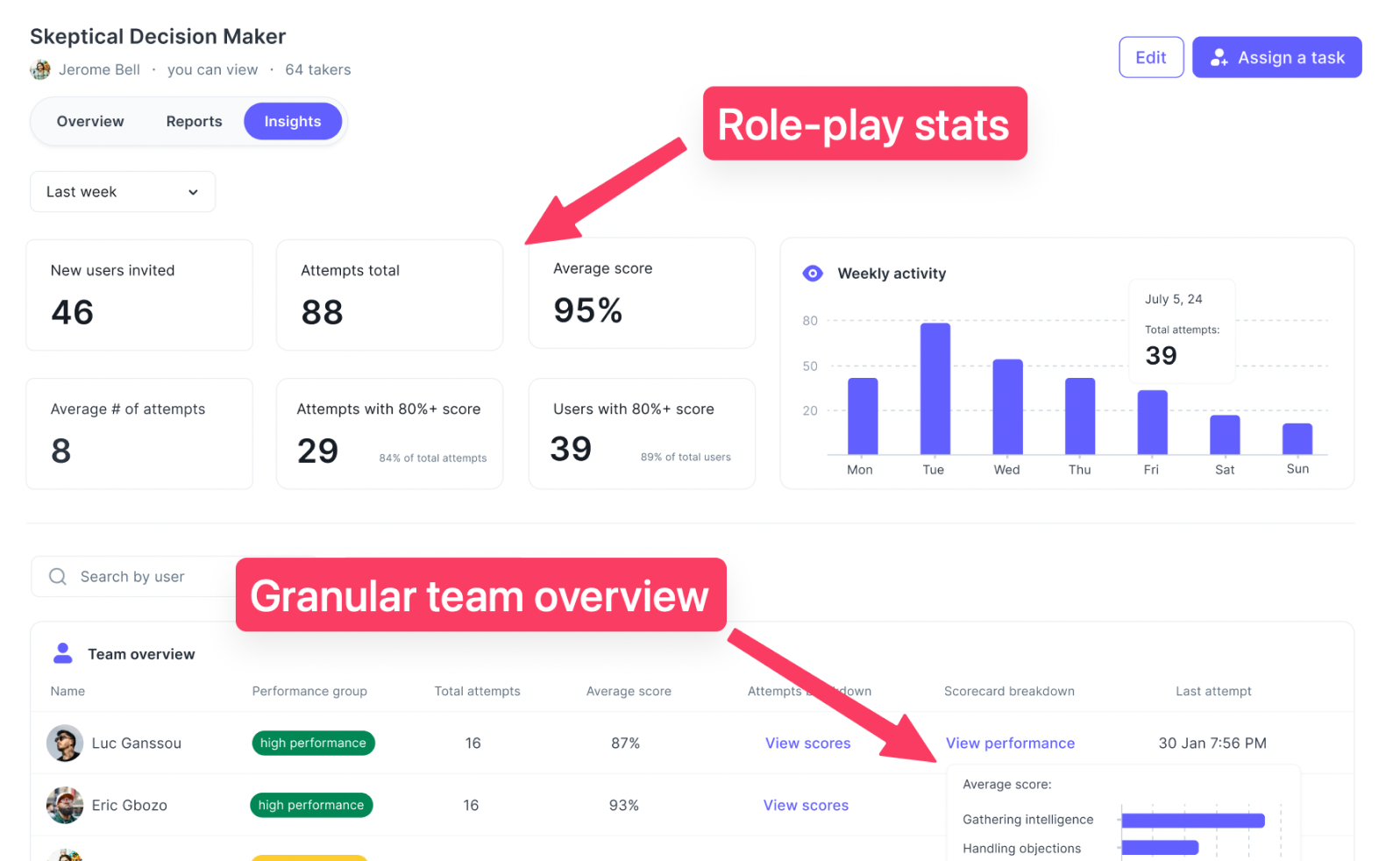
Score each of the seven steps 0, 1, or 2, based on evidence from the call rather than the rep's own impression of how it went.
Full comparison7 rows · 6 columns
Step | Observable behavior | 0 = absent | 1 = attempted | 2 = clean | What the manager coaches next |
|---|---|---|---|---|---|
Bonding and Rapport | Rep matches the buyer's tone and pace | Script read verbatim, buyer stays clipped | Some adjustment, buyer warms up partway | Buyer talks in full sentences within 3 minutes | Practice dropping the opening script entirely |
Up-Front Contract | Agenda and ending stated and agreed | No agenda stated | Agenda stated, no agreed ending | Both stated, buyer explicitly agrees | Drill the "two outcomes" phrasing until it's automatic |
Pain | Rep asks past the first answer | Accepts the first complaint | One follow-up question | Reaches the third layer of pain | Drill the surface-complaint scenario below |
Budget | Rep surfaces cost without asking for a figure | Asks "what's your budget" directly | Asks about cost, accepts a vague answer | Gets a real range from the problem's cost | Rehearse the budget exchange word for word |
Decision | Rep maps signer, blocker, and process | Assumes the contact can sign | Asks who signs, stops there | Maps the full sequence and any blocker | Drill the five decision-map questions |
Fulfillment | Presentation ties back to earlier steps | Generic pitch, no reference to the call | Some reference to buyer's words | Presentation built entirely from what the buyer said | Record the next demo and check for this |
Post-Sell | Rep checks for second thoughts after a yes | Call ends at "thanks, talk soon" | Asks a generic follow-up question | Names a specific risk and asks about it directly | Drill the post-sell line below |
A call passes at 10 out of 14. Below that bar, the manager picks the single lowest-scoring step and drills it before the next call, rather than trying to fix all seven at once.
What to check across the next five recorded calls, before assuming the workshop worked:
What to listen for | How to check it | Red flag |
|---|---|---|
Up-front contract stated | Does the call open with an explicit agenda and an ending both sides agreed to? | Call starts with small talk that drifts straight into a pitch |
Pain past the first answer | Did the rep ask a second question after the buyer's first complaint? | Rep pivots to product within the first two minutes of hearing a problem |
Budget without the budget question | Did the rep ask about current cost rather than "what's your budget"? | Rep asks for a figure and accepts silence as a no |
Decision map named | Did the rep name who signs and what happens if nothing changes? | Rep assumes the person on the call is the signer |
Post-sell handled | Did the rep ask what might cause second thoughts, right after a yes? | Call ends at "great, talk soon" with no check for buyer's remorse |
Three drills to build the reflex
Reading the seven steps takes twenty minutes. Building the reflex to run them under pressure takes repetitions against a buyer who does not cooperate. The three drills below rehearse the behaviors the Sandler methodology describes, run as Sandler-style practice on our own platform, never as Sandler training or certification.
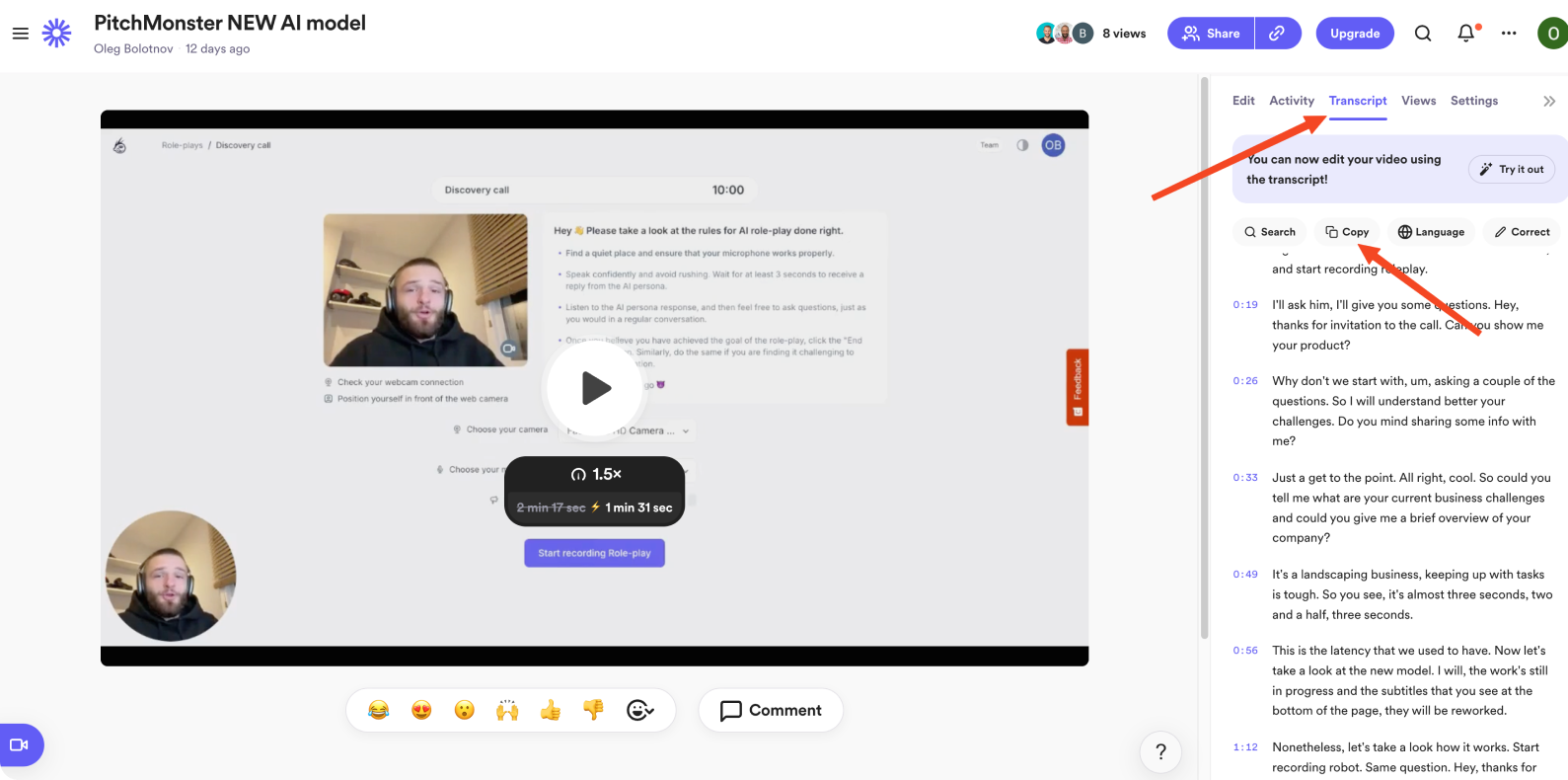
Drill 1: The contract that gets broken. Setup: the AI buyer agrees to the up-front contract at the start of the call. Then, around the five-minute mark, the buyer tries to end it early with a plausible excuse. Rep goal: re-establish the contract without conceding the meeting, using the ending both sides agreed to at the start. AI buyer instruction: accept the opening contract, then interrupt with a reason to leave once pain is half-surfaced. Time box: 10 minutes. Scoring cue: did the rep reference the original agreement rather than simply asking for more time? Debrief prompt: what did you say when the buyer tried to leave, and what was the alternative you did not say?
Drill 2: The surface complaint. Setup: the AI buyer offers a tidy, shallow problem and resists going deeper when pressed. Rep goal: reach the third layer of the pain funnel, personal consequence, without interrogating. AI buyer instruction: deflect the first two follow-up questions and only open up on a third, more specific one. Time box: 8 minutes. Scoring cue: did the rep ask at least three distinct questions before accepting the buyer's answer as final? Debrief prompt: which question got past the surface answer, and what made it different from the ones before it?
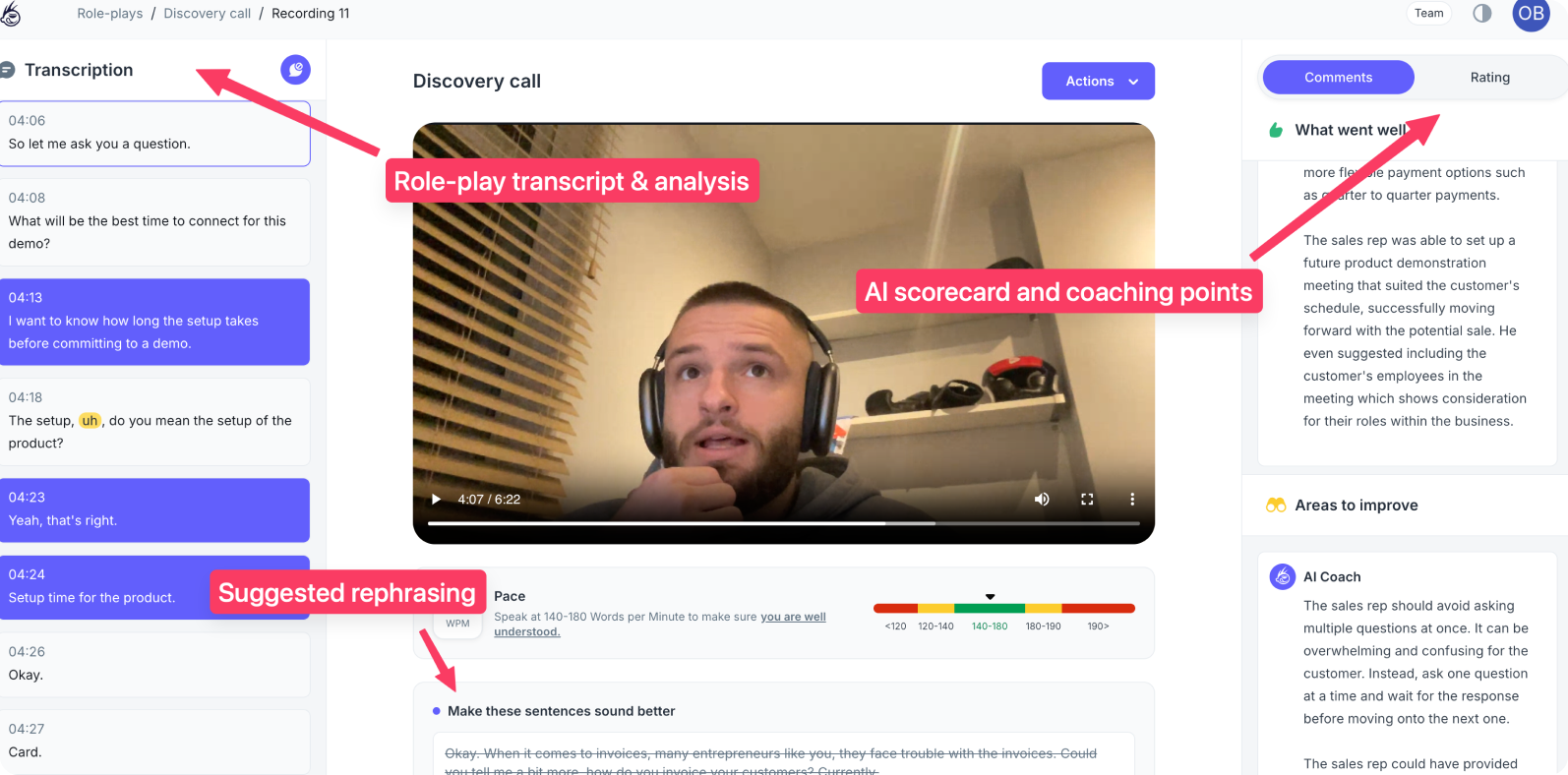
Drill 3: The premature demo ask. Setup: the AI buyer demands a demo at minute four, before pain, budget, or decision have been covered. Rep goal: hold fulfillment until the earlier steps are qualified, without sounding evasive. AI buyer instruction: push twice for the demo, testing whether the rep holds the sequence or gives in. Time box: 10 minutes. Scoring cue: did the rep name a reason for the sequence out loud, rather than just stalling? Debrief prompt: what did you say instead of showing the demo, and did it sound like a stall or a reason?
Run each drill until the scoring cue passes twice in a row before moving to whole-call practice. A rep who can only pass a drill once got lucky, not competent.
Practicing Sandler steps with AI role-play
The gap between knowing the seven steps and running them under pressure is a repetitions problem, and it is where PitchMonster's AI Coach fits. After every practice session, the AI Coach asks the rep Socratic, reflective questions rather than handing over a grade. So a rep who broke the up-front contract has to say out loud what they would do differently, which is what changes the next call.
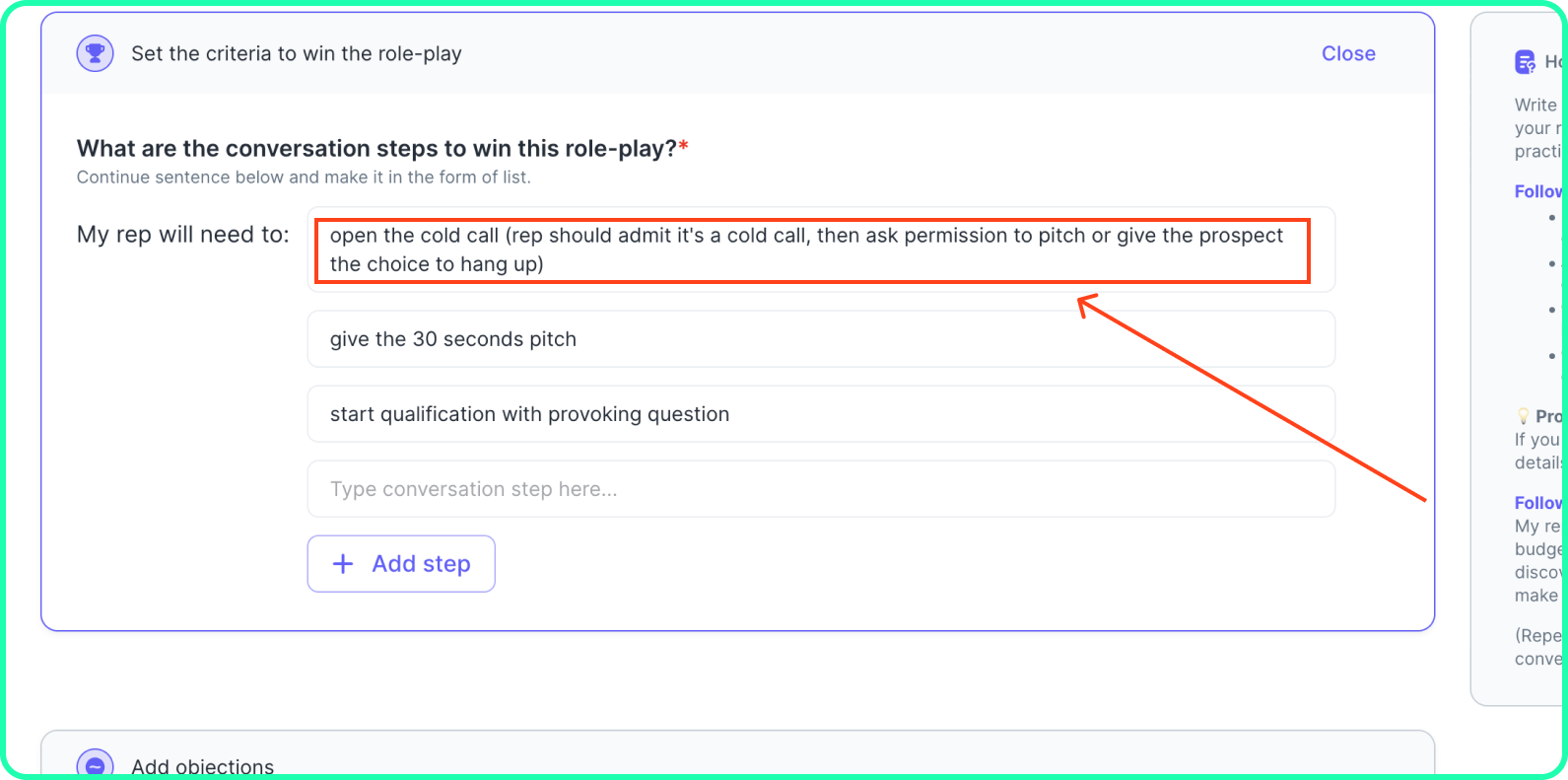
An enablement lead can build an AI buyer from a real recorded call. Every rep on the team can then run the same drill against a buyer who deflects the way an actual prospect does. It's scored against the seven-row rubric above rather than a generic checklist. The role-play exercises guide covers the single up-front contract drill as one entry among many practice formats. This guide goes far deeper on that one drill and the six that surround it. For a wider set of formats to rotate through once the Sandler drills are running, see the role-play scenario library.
The proof point that matters here is ramp, not recall. Mentor Group cut ramp time by 50% on average and halved coaching time per rep. Immersive is an example inside that same engagement. New hires there ramped 40% faster, cutting onboarding from 10 weeks to 6. Both gains came from moving repetitions off managers' calendars and onto a platform reps can practice on before a real call. A methodology rollout is an onboarding problem wearing a different name.
If you are running Sandler this quarter, teach the seven steps once. Then spend the rest of the budget on repetitions of the three moments reps break. Those are re-contracting, pushing past the surface complaint, and holding off the premature demo ask. Book a demo and we will build the contract-drill scenario from one of your own calls.
Common mistakes teams make with Sandler
A handful of failures show up across most rollouts, in roughly this order of frequency.
Running budget before pain leaves the number with nothing to anchor to, so a buyer names a low figure defensively or dodges the question outright.
Treating the up-front contract as a formality read off a script, rather than an actual agreement the buyer says yes to out loud. That leaves the rep with no standing to invoke it later when the call stalls.
Skipping post-sell because the deal already feels done, then losing it three weeks later to a concern nobody addressed while the rep was still in the room.
Asking "what's your budget" directly and accepting a vague or evasive answer as if it settled the question.
Teaching all seven steps in a single workshop and never revisiting a single one, so the words fade back into whatever the rep was doing before.
Every one of these is a sequencing or a scoring failure, not a knowledge gap. The fix in each case is the same: pick the specific step that broke and drill it in isolation, rather than re-running the whole workshop.
Can you use Sandler without buying Sandler training?
Yes, with real limits worth being precise about. The seven-step sequence and the general logic of qualifying before pitching are publicly documented ideas, and explaining them in your own language, as this guide does, is not restricted.
What is protected is the Sandler name itself, the stylized marks Sandler Systems, LLC holds, and their specific training materials, worksheets, and diagrams. Also protected is any claim that your team is Sandler-certified without having gone through their program. Reproducing their materials or implying an affiliation that does not exist crosses from explaining the methodology into using the trademark holder's property.
What a team can do lawfully in-house: build your own version of the seven steps in your own words, and create your own scorecard like the one above. It can also run its own drills. Describe the result as a Sandler-style qualification process rather than Sandler training. What requires the trademark holder: an actual certification, use of their copyrighted materials, or any language that implies your team is affiliated with, endorsed by, or licensed by them.
If your team wants the credential, go to Sandler Systems, LLC directly. This guide is not a substitute for that program and does not try to be. What it gives you is a way to build and score the behaviors described publicly, in your own words, before or alongside any formal training you decide to pursue.
FAQ
What are the 7 steps of Sandler?
The seven steps of the Sandler selling system are Bonding and Rapport, Up-Front Contract, Pain, Budget, Decision, Fulfillment, and Post-Sell. Each step has to close before the next one opens. A rep who skips the up-front contract has no standing to end the call, and a rep who skips pain has no anchor for the budget conversation that follows.
What are the top 5 sales methodologies?
The five B2B sales methodologies teams compare most often are Sandler, MEDDPICC, BANT, SPIN, and the Challenger Sale. They are not interchangeable. Sandler and Challenger shape how a rep behaves in the room, BANT and MEDDPICC qualify whether a deal is real, and SPIN structures the questions inside one conversation. Most teams combine two or three rather than picking a single one.
What is the Sandler selling System?
The Sandler selling system is a seven-step consultative sales methodology developed by David H. Sandler in the 1960s. It has the seller qualify pain, budget, and decision authority before presenting anything. It also gives both sides the right to end the conversation early if the fit is not there. The goal is a shorter list of real deals, not a longer list of pitches.
How effective is Sandler sales training?
Sandler sales training teaches a clear seven-step framework, but recalling the steps is not the same as changing call behavior. A rep can name every step and still pitch under quota pressure if nobody scores whether the up-front contract, pain, budget, and decision process surfaced. Formal training needs a repeated practice and coaching layer after it, not instead of it.
Is the Sandler sales methodology still relevant?
The Sandler sales methodology is still relevant because the underlying problem, sellers pitching before they have earned the right to, has not gone away. What has aged is the idea that reciting the seven steps changes behavior on its own. Teams that drill it against a resistant buyer, rather than treat it as a script to memorize, are the ones where it still works.
Sandler vs MEDDIC: which should we use?
Sandler and MEDDIC answer different questions, so the honest answer is often both. Sandler shapes how a rep runs the conversation and earns the right to qualify a buyer at all. MEDDIC, or its extended form MEDDPICC, scores whether the resulting deal is real enough to forecast. Use Sandler's discipline to run the call, then record what you learned against a MEDDIC scorecard.
Do you need Sandler certification to use the methodology?
No, you do not need Sandler certification to use the qualifying logic described publicly. You do need it, though, if you want an official credential or the right to say your team is Sandler-certified. A team can build its own version of the seven steps, its own scorecard, and its own drills without a license. What you cannot do is call any of that official Sandler training.
How do you practice the Sandler method?
You practice the Sandler method by drilling one step at a time against a buyer who resists, not by rehearsing whole calls. The three places reps break most often are re-contracting when a buyer tries to leave early, pushing past a surface complaint, and holding off a premature demo ask. Isolate each one, score it, and repeat until it stops feeling rude to ask.
The short version
Sandler is seven sealed compartments, and most teams only ever learn their names. The up-front contract, the third layer of pain, and the post-sell check are the three that quietly go missing under quota pressure, because nobody is scoring whether they happened.
Teach the framework once. Then spend the budget on repetitions of the three moments this guide named. Score them against the rubric until they feel like a normal conversation, not an interrogation.